
A condo with fewer facilities can be the better home if it leaves room in the budget for the activities your household actually uses. A larger facility offering can justify a higher commitment when it replaces journeys and spending you would otherwise make. Compare those two propositions with real unit costs, rather than assume that more facilities always mean better value or higher fees.
Start with a normal week, not the facility count
List what the household would use in an ordinary week: swimming, exercise, a children’s play area, space for gatherings or somewhere an older parent can sit comfortably. Put likely days and times beside each activity. A pool you expect to use after work needs a different assessment from one used on weekday mornings.
At the selected development, ask about opening hours, booking arrangements, guest rules, charges and any planned closures. Inspect the route from the actual unit to the facility. A long walk, stairs or an exposed section can change whether it is useful for the person who needs it.
This does not require a verdict that a compact estate is quieter or that a larger estate is crowded. Observe the relevant places at suitable times, subject to access permission, and distinguish what you saw from what you were told.
Compare the full recurring cost
BCA’s condo-owner guidance explains that owners contribute to shared-property upkeep and that contributions support daily maintenance and future repairs or upgrades. A facility is not free merely because it sits inside the estate.
Obtain the selected unit’s current contributions and the supporting accounts and planned works. The number of pools or gyms alone does not establish the charge. Our MCST and maintenance-fee guide covers the fund and contribution checks in more detail.
| Monthly item | More on-site facilities | Fewer on-site facilities |
|---|---|---|
| Assumed unit contributions | S$600 | S$380 |
| Activities paid for elsewhere | S$40 | S$160 |
| Total | S$640 | S$540 |
| Annual total at the same monthly amounts | S$7,680 | S$6,480 |
On these assumptions, the difference is S$100 a month or S$1,200 a year. It becomes S$6,000 over five years only if those amounts remain unchanged. This is arithmetic, not a forecast: contributions, activity charges, household use and repair needs can change.
The table excludes purchase-price differences, financing, taxes, special contributions and work inside the unit. Keep those in separate rows rather than pretend that the lower recurring total identifies the cheaper purchase overall.
Older versus newer is a separate comparison
A development’s age and its facility range are different facts. An older estate may have extensive facilities; a newer building may offer a smaller selection. Compare the actual condition and planned expenditure instead of using age as a substitute for evidence.
For a completed home, inspect what exists and ask about maintenance records and works. For a home still under construction, assess the agreed project documents and the expected occupation date. A render is not an inspection of completed facilities. Use the new-launch versus resale guide for the different timing and evidence available.
Add essential works before deciding which estate is cheaper
The recurring-cost table answers only one part of the choice. A lower monthly total can be outweighed by work inside the unit or a contribution for shared works. Obtain the actual unit contributions, accounts and planned expenditure for both estates instead of assigning a repair bill merely because one is older.
Illustrative five-year comparison: keep the table’s assumed S$640 monthly total for the broader facility offering and S$540 for the smaller offering. Over 60 months those become S$38,400 and S$32,400. Now assume essential internal works of S$8,000 for the first unit and S$20,000 for the second. The combined subtotals become S$46,400 and S$52,400.
On these inputs, the home with the lower recurring total costs S$6,000 more across these selected items. The S$12,000 difference in essential works outweighs its S$6,000 recurring saving. These are hypothetical costs, with no purchase-price difference, tax, financing, special contribution or resale outcome included.
Change the works assumptions and the result can reverse. That is why a generic claim that a smaller or older estate is always cheaper is unhelpful. Keep confirmed quotations distinct from allowances and keep an unconfirmed shared-works bill out of the base case, with a separate sensitivity calculation for the amount the household could absorb.
Test the offering when one favourite facility is unavailable
Ask which activity makes the broader offering valuable to you. If it is the pool, compare the household routine during a closure: the alternative venue, journey and actual extra spending you would accept. This is a resilience check rather than a prediction that a particular estate will close its pool.
A landlord should not assume that the same facilities justify a rental premium for every tenant. An owner-occupier can reasonably value convenience without claiming it will produce a return on sale. Keep the personal benefit visible and the financial assumptions separate.
Before choosing, compare the unit, essential works, recurring expense and the activities the household will realistically replace. If the supposed saving depends on cancelling an outside membership you intend to retain, remove that saving. If the monthly cost leaves no reserve for known works, reconsider the overall commitment rather than judge the clubhouse in isolation.
Give the unit as much attention as the clubhouse
A useful gym cannot make an unsuitable bedroom work. Compare usable living space, storage, privacy, ventilation and the route from lift or car park to the front door. Consider visitors, deliveries and the needs of anyone who may find steps difficult.
For an investor, do not insert an assumed rent premium because a facility looks attractive. Ask for relevant rental evidence and keep rent, vacancy and expenses separate. The rental comparison shows why higher headline rents do not guarantee higher collected income.
Before paying more for the broader offering, identify the activities it would replace and the journeys it would remove. If the household would still maintain the same outside memberships, those savings do not exist. If the on-site option materially improves an older parent’s or child’s daily routine, record that benefit alongside the cost rather than force it into a resale-return prediction.
Shortlist the home with the better combination of unit, routine and sustainable expense. Request the current unit charges, relevant rules and planned works before finalising the comparison, then put the purchase and moving costs into the cash and CPF calendar.
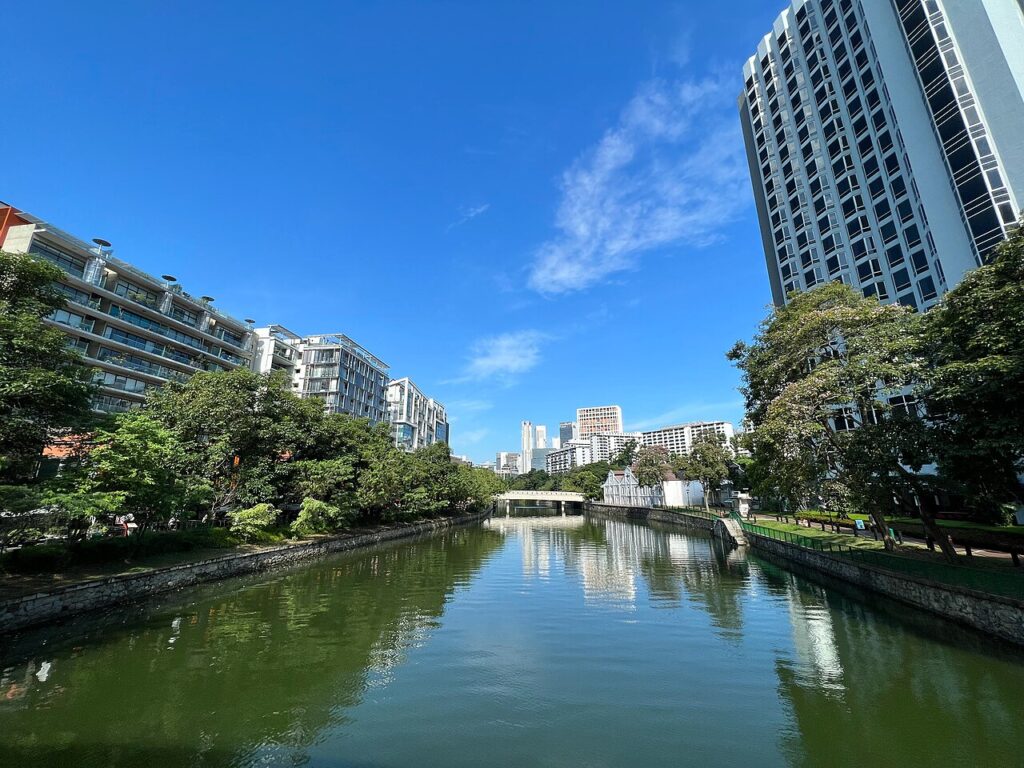
Singapore River at Robertson Quay, photographed 14 August 2022. Photo: Wzhkevin, Wikimedia Commons. CC BY-SA 4.0. Resized for web. Neighbourhood context, not a valuation. Source: https://commons.wikimedia.org/wiki/File:Singapore_River_at_Robertson_Quay_-_2022-08-14.jpg. Licence: https://creativecommons.org/licenses/by-sa/4.0/.
Need a brochure, price list or professional introduction?
Contact Lin Xuan at 82222556 or Ade at 81888871 or Benn at 83218774 for the full project brochure, latest available price list, a viewing, or introductions to bankers who can help you compare home-loan rates and packages to find the best available option for your needs. If you need legal advice on a property purchase, sale or tenancy, we can also put you in touch with property lawyers.
WhatsApp Lin Xuan | WhatsApp Ade. Let us know the project or property question you would like help with. Prices and availability are subject to developer confirmation, while loan terms and approval are determined by the bank.
Lin Xuan: ONG LIN XUAN, CEA registration R069812H. Ade: CHUA MUAY MUAY (ADE CHUA), CEA registration R014252F. ERA REALTY NETWORK PTE LTD, estate agent licence L3002382K.
Benn: TAN JUN FENG, BENNEDICT (BENNEDICT TAN), CEA registration R058941E. PROPNEX REALTY PTE. LTD., estate agent licence L3008022J.