Quick Answer: How Does Property Agent Commission Work in Singapore?
- The Council for Estate Agencies (CEA) regulates all licensed estate agents and registered salespersons in Singapore under the Estate Agents Act, but CEA does not set or cap commission rates.
- Commission is not fixed by law. It is a common misconception; rates are freely negotiable between a client and their agent, and no statute prescribes a mandatory percentage.
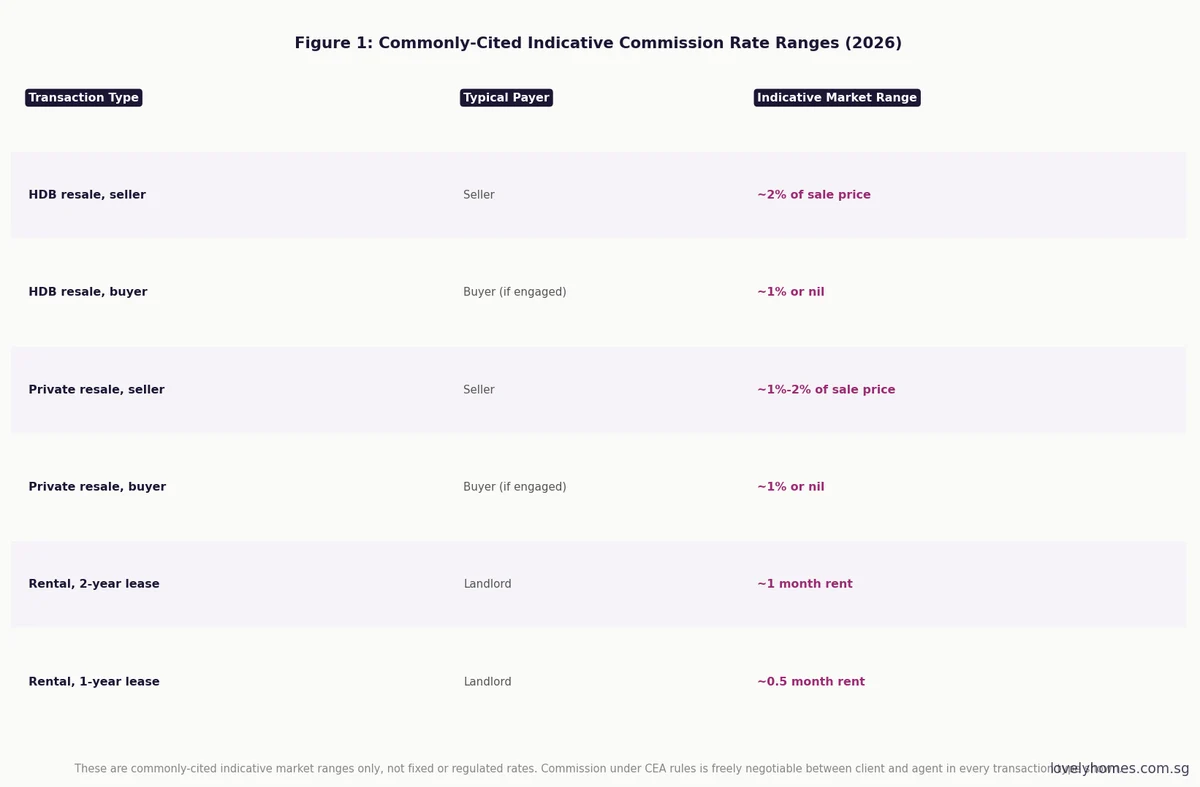
- Commonly-cited indicative market ranges: ~2% for an HDB resale seller, ~1%-2% for a private resale seller, and around one month’s rent for a landlord on a typical 2-year tenancy.
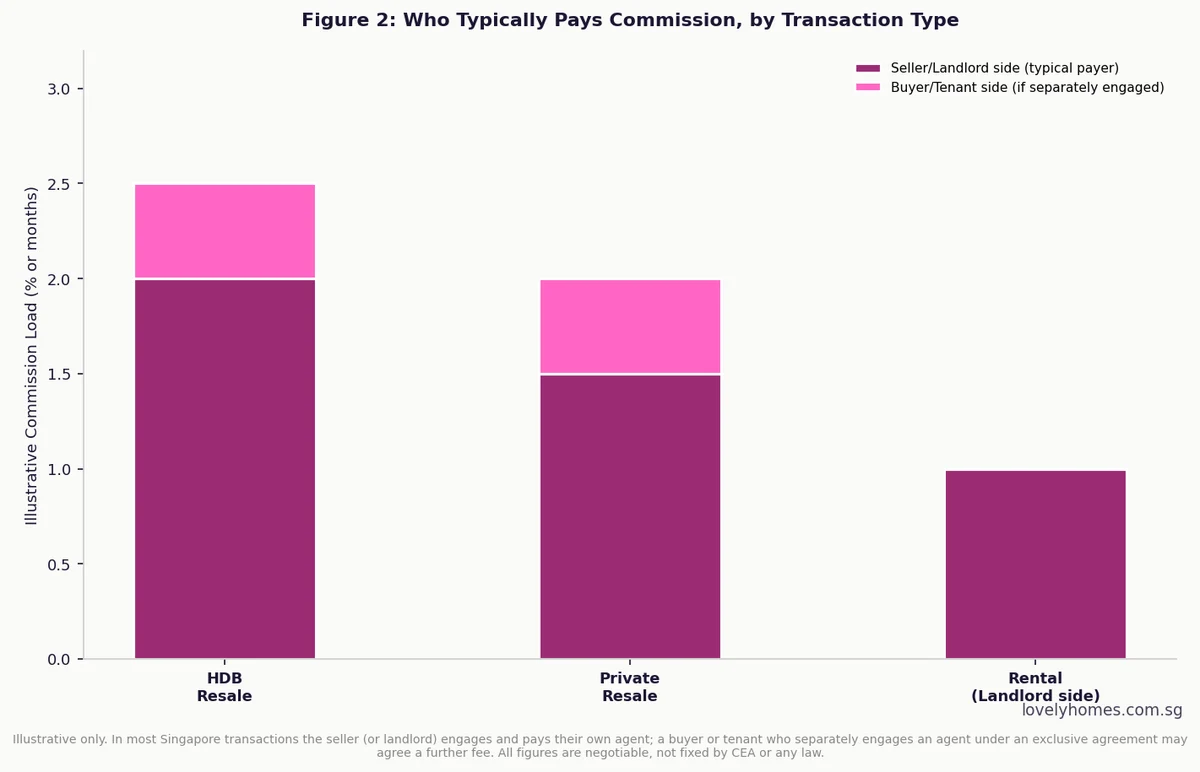
- In most transactions the seller or landlord engages and pays their own agent; a buyer or tenant who separately and exclusively engages an agent may agree a further, separately negotiated fee.
- Dual representation, one agent or agency acting for both parties, is permitted only with informed written consent from both sides under CEA’s Estate Agency Agreement rules, given the inherent conflict of interest.
- A written Estate Agency Agreement (EAA), in CEA’s prescribed form, is mandatory before an agent can act, and can be exclusive or non-exclusive, each with different terms on duration and termination.
- GST at 9% applies on top of commission charged by a GST-registered agency, current as at 2026; always confirm the agency’s GST-registered status before agreeing a fee.
- Always verify an agent’s licence and disciplinary record on CEA’s public Real Estate Salesperson (RES) register before engaging them; practising without a valid licence is an offence under the Estate Agents Act.
Few numbers in a Singapore property transaction generate as much confusion, and as much folklore, as estate agent commission. Sellers and landlords are routinely told “the rate” as though it were a tariff set by the Government, when in fact no such tariff exists. This guide sets out exactly how commission actually works under Singapore law: who regulates agents, why rates are negotiable rather than fixed, the ranges most commonly cited in the market today, who typically pays in each type of transaction, how dual representation and the mandatory Estate Agency Agreement work, how GST applies, and how to check that the person you are dealing with is actually a licensed, registered agent before you sign anything.
What CEA Is and How It Regulates Estate Agents
The Council for Estate Agencies (CEA) is the statutory board responsible for regulating the real estate agency industry in Singapore under the Estate Agents Act. CEA licenses estate agencies, registers individual salespersons as Real Estate Salespersons (RES), sets mandatory entry qualifications and continuing professional development requirements, prescribes the standard forms agents must use, and investigates complaints and disciplinary matters. What CEA does not do is fix, cap, or otherwise prescribe how much an agent may charge; its role is conduct and competency regulation, not price-setting. This distinction is the source of most of the confusion consumers have about commission, and it is worth stating plainly at the outset of this guide.
Commission Is Not Fixed by Law: A Common Misconception
It is a widely held but mistaken belief that Singapore has an official, legally mandated commission rate, commonly repeated as “2% for sellers” or similar. No such rate is prescribed anywhere in the Estate Agents Act, its subsidiary legislation, or any CEA practice circular. What exists instead are commonly-cited market-rate ranges, figures that reflect what agents and clients typically agree to in practice, shaped by convention, competition and the complexity of a given transaction, but never binding on any individual deal. Every commission figure is, in principle and in practice, a matter of negotiation between the client and the agent, to be agreed and recorded in the Estate Agency Agreement before the agent starts work.
Commonly-Cited Indicative Market-Rate Ranges
Based on general market practice, commission for an HDB resale seller is commonly cited in the region of 2% of the sale price, while a buyer who separately and exclusively engages their own agent might agree roughly 1%, though many HDB buyers do not pay any commission at all where the seller’s agent facilitates both sides. For private resale property (condominiums and landed homes), seller-side commission is commonly cited in the region of 1%-2%, with buyer-side commission, where separately engaged, similarly around 1%. For rental transactions, the landlord conventionally pays roughly one month’s rent in commission for a standard two-year lease, or around half a month’s rent for a one-year lease, while tenants typically pay no commission unless they have separately engaged their own agent under an exclusive arrangement. These figures are indicative, general market ranges only, not fixed or regulated rates, and are not attributable to any particular firm.
Who Typically Pays Commission in Each Transaction Type
As a general rule, the party who engages an agent is the party who pays that agent, which in most Singapore transactions means the seller in a sale, or the landlord in a rental, since it is conventionally their agent who markets the property, arranges viewings and manages the transaction through to completion. A buyer or tenant is free to engage their own agent under a separate, exclusive buyer’s or tenant’s agency agreement, in which case that agent’s fee is a matter for negotiation between the buyer or tenant and their own agent, and is entirely independent of whatever the seller or landlord has agreed with their own agent.
Dual Representation and Conflicts of Interest Under CEA Rules
Dual representation, where the same estate agency, or in some cases the same individual salesperson, acts for both the seller and the buyer (or both landlord and tenant) in one transaction, is permitted under CEA’s rules but only under strict conditions. Because representing both sides of a negotiation creates an obvious potential conflict of interest, CEA’s Estate Agency Agreement (EAA) framework requires that both parties give informed written consent to the dual representation arrangement before it proceeds, with the agent obliged to disclose the arrangement clearly rather than allow it to emerge only after the fact. Clients who are uncomfortable with dual representation are entitled to decline it and insist on independent representation for their side of the transaction.
The Mandatory Estate Agency Agreement: Exclusive vs Non-Exclusive
Before an estate agent can act for a client in most residential transactions, CEA requires a written Estate Agency Agreement (EAA) in one of CEA’s prescribed standard forms, setting out the commission, the scope of the agent’s authority, and the duration of the engagement. An exclusive EAA appoints a single agency for a fixed period, typically several months, during which the client agrees not to engage another agent for the same property, in exchange for which the agent typically commits greater marketing effort; a non-exclusive EAA allows the client to engage multiple agents simultaneously, with commission payable only to whichever agent successfully introduces the buyer or tenant. Both forms carry prescribed cooling-off and termination terms, including a short cooling-off period after signing during which the agreement may be cancelled, and defined circumstances under which either party may terminate early; clients should read these terms carefully before signing rather than treating the EAA as a formality.
GST on Commission
Where the estate agency is GST-registered, Goods and Services Tax (GST) is chargeable on top of the agreed commission, at Singapore’s prevailing rate of 9%, confirmed correct as at 2026 following the last scheduled increase. A client agreeing a headline commission figure should always clarify whether that figure is quoted before or after GST, since the difference is material on a large transaction, and should check the agency’s GST registration status if unsure, as not every smaller agency is necessarily GST-registered.
How to Verify an Agent’s Registration and Disciplinary Record
Before engaging anyone as an estate agent, it is straightforward, and strongly advisable, to verify their status on CEA’s public Real Estate Salesperson (RES) register, a free online lookup that confirms whether a named individual is currently a registered salesperson, which agency they are attached to, and whether any disciplinary action has been recorded against them. The same public register allows a check on whether an agency itself holds a valid CEA licence. This single check, taking only a minute or two, is one of the most effective ways for a consumer to protect themselves before signing an Estate Agency Agreement or paying any commission.
Red Flags of Unlicensed Practice and Penalties
Acting as an estate agent, or estate agency, in Singapore without the relevant CEA licence or registration is an offence under the Estate Agents Act, carrying financial penalties on conviction. Red flags that a person may be practising unlicensed include an inability or reluctance to provide their RES registration number, refusal to issue a proper written Estate Agency Agreement before starting work, requests for payment in cash with no formal receipt or invoice, and marketing activity conducted under a personal name or informal group rather than a CEA-licensed agency. Consumers who suspect unlicensed practice, or who have a dispute with a licensed agent, may lodge a complaint directly with CEA.
When Commission Is Negotiable: Practical Tips
Because commission is never fixed by law, clients are entitled to negotiate, and several factors reasonably affect where within a market range a final figure lands: the complexity and likely marketing effort required for a property, whether the arrangement is exclusive or non-exclusive, current market conditions and how quickly comparable properties are transacting, and whether the client is also engaging the same agency for a related transaction, such as a simultaneous purchase after a sale. Clients should raise commission explicitly at the first meeting, request the figure in writing on the Estate Agency Agreement before any marketing begins, and feel free to discuss it with more than one agency before committing.
Summary: Commission Facts at a Glance
| Question | Short Answer |
|---|---|
| Does CEA set commission rates? | No. CEA regulates conduct and licensing, not pricing; commission is negotiable. |
| Indicative HDB resale seller commission? | Commonly cited around 2% of sale price, market range only. |
| Who usually pays in a rental transaction? | The landlord, commonly around one month’s rent for a 2-year lease. |
| Is dual representation allowed? | Yes, but only with informed written consent from both parties. |
| What is the current GST rate on commission? | 9%, confirmed current as at 2026, where the agency is GST-registered. |
| How do I check an agent is licensed? | Search their name on CEA’s public Real Estate Salesperson (RES) register. |
Worked Example: HDB Resale Seller, S$650,000 Sale Price
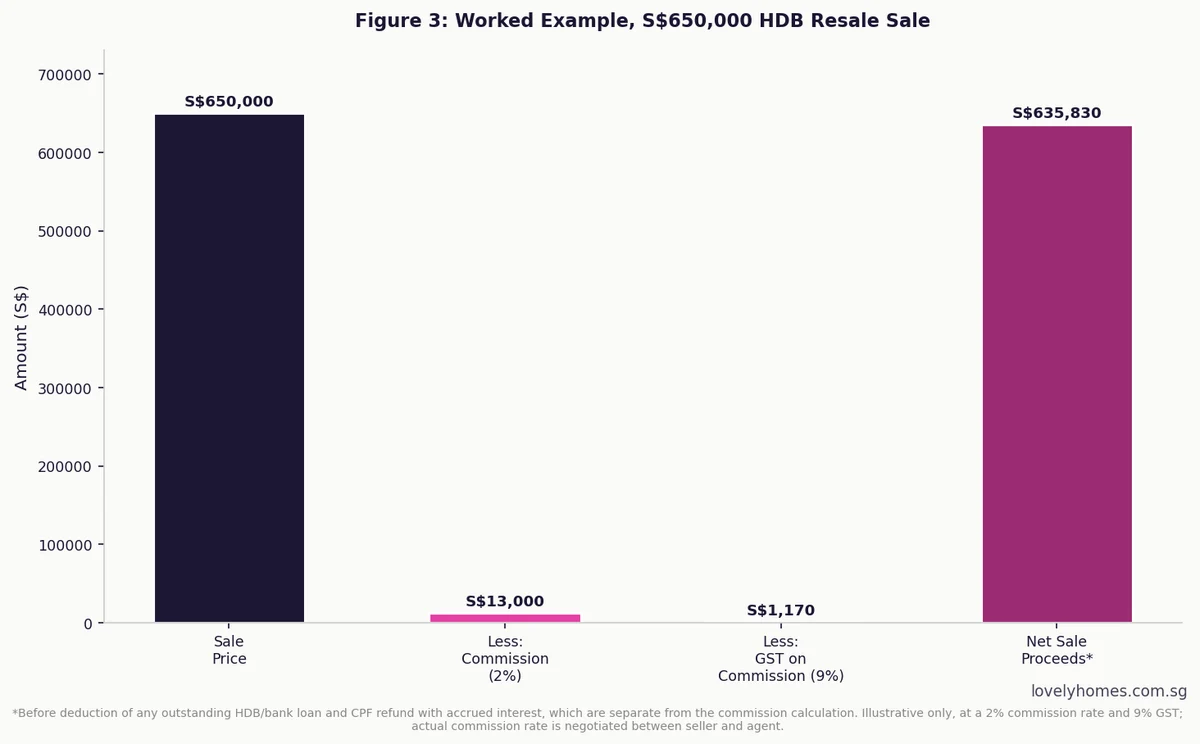
The scenario: An HDB flat is sold on the resale market for S$650,000. The seller has agreed a commission of 2% with their agent, payable to a GST-registered agency.
The commission: 2% of S$650,000 is S$13,000.
GST on the commission: At the prevailing 9% GST rate, GST on the S$13,000 commission is S$1,170.
Total payable to the agency: S$13,000 plus S$1,170 GST comes to S$14,170.
Net sale proceeds before loan and CPF deductions: S$650,000 less S$14,170 leaves S$635,830. This figure is before any further deduction of an outstanding HDB or bank loan and any CPF principal and accrued interest refund, both of which are entirely separate from, and unrelated to, the commission calculation, and would typically reduce the seller’s final cash-in-hand considerably further.
This example uses a commonly-cited 2% market rate purely for illustration; the seller’s actual commission is whatever was negotiated and recorded in their Estate Agency Agreement, and could reasonably be higher or lower depending on the specific arrangement.
Why This Matters for Buyers, Sellers and Landlords
Understanding that commission is negotiable, not fixed, changes the entire dynamic of engaging an agent: clients who assume a rate is compulsory rarely think to discuss it, while clients who understand the market-range framework are better placed to have a fair, informed conversation with their chosen agency from the outset. Equally important is understanding what CEA actually protects: licensing and conduct standards, the mandatory EAA, dual representation consent, and a public complaints and disciplinary process, rather than price protection. For a seller in particular, the worked example above shows that commission and GST are a modest, predictable slice of proceeds compared with the outstanding loan and CPF refund that typically follow, so budgeting for the full picture, not commission in isolation, matters more for financial planning.
Frequently Asked Questions
Is there a legally fixed commission rate in Singapore?
No. Commission is freely negotiable between a client and their agent. CEA regulates agent licensing and conduct, not pricing.
Can I negotiate a lower commission with my agent?
Yes. Since commission is not fixed by law, clients can and do negotiate the rate, particularly for straightforward or high-value transactions, before signing the Estate Agency Agreement.
Does the buyer ever pay commission in an HDB resale purchase?
Only if the buyer separately and exclusively engages their own agent, in which case that fee is negotiated independently of what the seller pays their agent.
What is dual representation and is it allowed?
Dual representation is when one agency or salesperson acts for both parties in a transaction. It is allowed under CEA rules only with informed written consent from both sides.
How do I check if my agent is properly licensed?
Search their name or registration number on CEA’s public Real Estate Salesperson (RES) register, which also shows their agency and any disciplinary record.
Is GST always charged on commission?
Only where the agency is GST-registered. Where it is, GST at the prevailing 9% rate applies on top of the agreed commission.
What happens if someone acts as an agent without a CEA licence?
Practising as an estate agent or agency without the required CEA licence or registration is an offence under the Estate Agents Act and can attract financial penalties.
Related Articles on LovelyHomes
- Singapore Property Conveyancing Process Guide 2026: Legal Fees, Timeline and Due Diligence
- Property and Rental Scams in Singapore 2026: How to Spot Fake Listings and Protect Your Deposit
- Forced Sale of Jointly-Owned Property in Singapore 2026: What Happens When a Co-Owner Won’t Agree to Sell
- MCST Guide Singapore 2026: Management Corporation, Maintenance Fees, Sinking Fund and By-Laws Explained
- Singapore Property Valuation and Cash-Over-Valuation (COV) Guide 2026: How Bank and HDB Valuation Really Works
- HDB BTO vs Resale Singapore 2026: Price, Wait Time, Grants and Which Is Right for You
Supporting graphics
Original article illustrations are available below.