Sengkang Singapore Neighbourhood Guide 2026: HDB, MRT & Schools

Sengkang Singapore Neighbourhood Guide 2026: HDB, MRT & Schools

Quick Answer — Sengkang Neighbourhood Guide 2026

  • Location: District 19, North-East Region of Singapore, bounded by Punggol, Hougang, and Seletar.
  • HDB resale prices: 4-room flats median ~S$565,000; 5-room ~S$685,000 (Q1–Q2 2026).
  • MRT access: North East Line (NEL) Sengkang station (NE16) plus an integrated Light Rail Transit (LRT) system with three loops serving the entire town.
  • Private condo PSF: approximately S$1,200–S$1,400 for recent transactions in 2026.
  • Schools: Nan Chiau Primary, Nan Chiau High, Springdale Primary, CHIJ St Joseph’s Convent, Sengkang Primary.
  • Healthcare: Sengkang General Hospital (opened 2018), a major 1,000-bed acute hospital.
  • Lifestyle: Compass One mall, Rivervale Mall, Seletar Mall; Punggol Waterway Park and nature trails accessible from Sengkang.
  • Investment note: Competitive yields from rental demand driven by proximity to Punggol Digital District and Seletar Aerospace Hub.

What Is Sengkang? An Overview of Singapore’s North-East New Town

Sengkang is one of Singapore’s planned new towns located in the north-east of the island, developed by the Housing and Development Board (HDB) from the late 1990s onwards. Occupying the eastern part of the planning region that also includes Punggol, Sengkang was built on land that was formerly part of the Sengkang fishing village and kampong settlements. Today it is home to roughly 260,000 residents and is one of the most populous HDB towns in Singapore.

The town is administered under Sengkang GRC (Group Representation Constituency) and is served by one of Singapore’s most comprehensive integrated public transport systems — a combination of the Mass Rapid Transit North East Line (NEL) and the Sengkang Light Rail Transit (SLRT), which loops through the town’s residential precincts and feeds directly into the Sengkang MRT interchange station.

For property buyers, Sengkang offers an attractive combination: lower entry prices compared to mature estates such as Bishan, Toa Payoh, or Queenstown; good transport connectivity; and a young, family-friendly community with well-regarded schools and complete town amenities.

Sengkang HDB resale median prices by flat type 2026 — neighbourhood guide
Figure 1: Sengkang HDB Resale Median Prices by Flat Type (Q1–Q2 2026). Source: HDB Resale Portal.

HDB Resale Prices in Sengkang 2026

Sengkang is classified as a non-mature estate by HDB, which historically meant lower resale prices compared to mature towns like Bishan or Queenstown. However, as the town has matured over the past two decades, resale prices have risen steadily. Based on HDB Resale Portal data for Q1–Q2 2026, indicative median transaction prices are:

Flat Type Median Resale Price (Q1–Q2 2026) Indicative Range
3-Room ~S$375,000 S$320,000 – S$440,000
4-Room ~S$565,000 S$490,000 – S$650,000
5-Room ~S$685,000 S$600,000 – S$780,000
Executive ~S$780,000 S$710,000 – S$860,000

Values vary significantly based on floor level, remaining lease, proximity to MRT, and specific sub-precinct (e.g., Rivervale versus Sengkang West). Flats with longer remaining leases (60+ years) and higher floors command premiums. The highest transacted prices in Sengkang have exceeded S$900,000 for well-positioned 5-room and Executive flats — a figure that would have seemed extraordinary when the town was first developed.

HDB BTO launches in Sengkang typically carry a new flat price at a significant discount to resale — typically 20–30% below market — courtesy of the HDB’s cost-based pricing model. Prospective buyers who qualify for BTO may find Sengkang a compelling entry point into homeownership.

Private Property in Sengkang — Condos and PSF

Private residential development in Sengkang is concentrated in Rivervale and the surrounding areas. The town’s private condo market is driven largely by upgraders from nearby HDB flats and investors seeking exposure to the northeastern corridor. Key projects include:

  • Riverfront Residences (2019, 1,472 units) — one of the largest en bloc redevelopments in Singapore’s northeast, consistently among the most transacted condos in D19.
  • High Park Residences (2019, 1,390 units) — an integrated development with a childcare centre; popular with families.
  • A Treasure Trove (2016, 882 units) — a mid-size project near Punggol Park, often compared to Sengkang alternatives by buyers weighing the two towns.
  • Sengkang Grand Residences (2023, 680 units) — an integrated mixed-use development directly above Buangkok MRT station on the NEL; commands a premium for its transport convenience.
  • iNz Residence and Parc Botannia — additional mid-scale developments with competitive PSF for the northeast market.
Sengkang private condo PSF compared with neighbouring districts D19 2026
Figure 2: Private Condo Average PSF — Sengkang vs Neighbouring Districts in D19 (2026). Source: URA REALIS.

Average PSF for private condos in Sengkang in 2026 is approximately S$1,200–S$1,400, compared to S$2,650+ in the Core Central Region (CCR). This discount to CCR reflects the northeast’s non-prime classification and longer commute times to the CBD, but the gap has been narrowing as Punggol Digital District development progresses and as MRT connectivity improves across the island. Rental yields for Sengkang condos typically range from 3.5%–4.5% gross, driven by demand from Seletar Aerospace Park workers, Punggol Digital District companies, and families priced out of more central locations.

Transport Connectivity — NEL and Sengkang LRT

Sengkang’s transport system is one of its most distinctive features. The town is served by two overlapping rail networks:

North East Line (NEL): Sengkang MRT station (NE16) connects directly to Serangoon (NE12/CC13) in approximately eight minutes and to Dhoby Ghaut (NE6) in the city centre in roughly 25 minutes. The NEL also connects to Harbourfront and Chinatown. Travel time to Raffles Place via a single interchange at Dhoby Ghaut is approximately 35 minutes.

Sengkang LRT (SLRT): The automated light rail system operates in two loops — East Loop and West Loop — radiating from Sengkang MRT station. The SLRT covers all major sub-precincts including Rivervale, Compassvale, Anchorvale, Cheng Lim, and Farmway. This gives Sengkang residents walkable LRT access from virtually every corner of the town without needing a feeder bus, making it notably pedestrian-friendly by Singapore standards.

Bus services connect Sengkang to Tampines, Hougang, Ang Mo Kio, and various expressways (KPE, TPE). Motorists have quick access to the Kallang–Paya Lebar Expressway (KPE) and Tampines Expressway (TPE).

Schools in Sengkang 2026

Education infrastructure is a key drawcard for family buyers. Sengkang is home to a number of well-regarded schools across primary and secondary levels:

School Level Notable Feature
Nan Chiau Primary Primary Top-tier SAP school; regularly among the most sought-after schools in D19
Springdale Primary Primary Established school in the heart of Sengkang residential precincts
CHIJ St Joseph’s Convent Primary Catholic mission school; popular among families seeking faith-based education
Sengkang Primary Primary Neighbourhood school with strong co-curricular programme
Anchor Green Primary Primary Located near Rivervale; well-regarded for pastoral care
Nan Chiau High Secondary Affiliated to Nan Chiau Primary; SAP stream; consistent academic results
Compassvale Secondary Secondary Long-established neighbourhood school in Sengkang

Under the Ministry of Education’s (MOE) Primary 1 Registration exercise, proximity to school is a key determining factor. Buyers targeting specific schools, particularly Nan Chiau Primary, often pay a premium for flats and condos within the 1–2km school registration phase radius.

Healthcare and Amenities

The opening of Sengkang General Hospital (SKH) in 2018 was a landmark for the northeast. SKH is a 1,000-bed acute hospital under the SingHealth cluster and the first new acute hospital to be built in Singapore in 23 years. It serves the growing northeast population and reduces the need for residents to travel to distant hospitals like Tan Tock Seng or Singapore General. SKH is located at Sengkang West Road and is accessible via feeder bus from Sengkang MRT.

Commercial amenities are centred around Compass One (Sengkang MRT), a major suburban mall with approximately 200 retail and F&B outlets. Rivervale Mall and Rivervale Plaza serve the eastern precinct, while Seletar Mall (near Fernvale LRT) is a newer lifestyle mall at the northern end of Sengkang. The town also benefits from proximity to Seletar Aerospace Park and Punggol Digital District, with additional retail and dining options developing in those areas.

Sengkang neighbourhood at a glance — key property and lifestyle facts 2026
Figure 3: Sengkang at a Glance — Key Property and Lifestyle Facts (2026). Sources: HDB, URA, MOE.

Worked Example — Buying a 4-Room Resale Flat in Sengkang

Scenario: First-Timer Couple Buying a 4-Room Resale HDB in Sengkang (2026)

Purchase price: S$565,000 (median 4-room resale)

Buyer profile: Singapore Citizen couple, combined income S$8,000/month, first-time buyers, using HDB loan.

Item Amount
Purchase Price S$565,000
Buyer’s Stamp Duty (BSD) — 1% × S$180K + 2% × S$180K + 3% × (S$565K – S$360K) S$11,550
CPF Housing Grant (EHG, max income ceiling S$9,000/mth) — up to S$80,000 –S$80,000 (if eligible)
HDB Loan (90% LTV) → loan on S$485,000 (after grant) S$436,500
Balance Downpayment (10% after grant; payable fully via CPF OA — no mandatory cash for HDB loan) S$48,500 (CPF OA)
Monthly HDB Loan Repayment @ 2.6% p.a., 25-year tenure ~S$1,975/month

Note: BSD is payable on the purchase price. EHG eligibility depends on combined income not exceeding S$9,000/month; amount depends on income band. Consult HDB’s online calculators at hdb.gov.sg for current grant amounts. The above figures are illustrative only.

Why Sengkang Matters for Singapore Property Buyers in 2026

Sengkang occupies a unique position in Singapore’s property market as a non-mature estate that is rapidly maturing. The town has outperformed initial expectations — when BTO launches in Sengkang first opened in the late 1990s and early 2000s, buyers paid prices that in retrospect were deeply discounted relative to today’s resale values. Owners of early-generation flats in Sengkang have seen capital appreciation of 100–150% over 20 years, though future gains will naturally be more modest as the market normalises.

The northeast corridor is undergoing a structural upgrade in economic fundamentals: the Punggol Digital District, expected to reach full development by the early 2030s, is designed to house Singapore’s digital and cybersecurity industries, bringing well-paid PME jobs to the region. The Seletar Aerospace Park to the north already employs thousands of aerospace professionals, many of whom rent or own in Sengkang due to its relative proximity. Both catalysts support rental demand for private condos and larger HDB flats in the area.

For first-timer buyers, Sengkang’s competitive entry prices relative to central and mature estates, combined with strong school choices and full town amenities, make it one of the better-value residential locations in Singapore in 2026. The town does not offer the cachet of Queenstown or the convenience of Toa Payoh, but for buyers prioritising value and community infrastructure over prestige address, Sengkang is a compelling choice.

What Might Come Next for Sengkang Property

Several trends are worth monitoring for buyers and investors tracking Sengkang’s property outlook. First, continued BTO launches in Sengkang North — land pockets at the northern fringe of the town — will add housing supply and could place modest downward pressure on resale prices in those precincts. Second, HDB’s classification of Sengkang as a Standard BTO town (not a Prime or Plus zone under the revised BTO classification framework introduced in 2024) means resale restrictions remain relatively relaxed, which keeps liquidity in the market. Third, the Punggol Digital District employment catchment effect will likely strengthen over the next 5–8 years, pulling rental yields upward as more companies set up operations there. This is speculative at present, and buyers should form their own judgement based on updated development progress. The MRT network in the northeast is largely complete, but planned enhancements to bus rapid transit and cycling infrastructure under the Land Transport Authority’s (LTA) masterplan could further improve liveability.

FAQ — Sengkang Neighbourhood Guide 2026

Is Sengkang a good place to buy property in 2026?
Sengkang offers good value for buyers who prioritise space, a full range of town amenities, and family-friendly infrastructure over a prestige address. HDB resale prices are lower than in mature estates, and private condo PSF is well below the Core Central Region. The northern flank of Sengkang is still developing, which creates both opportunity and uncertainty. Buyers should assess their specific needs — commute tolerance, school catchment priorities, and investment horizon — before committing. As with any property decision, consult a licensed real estate salesperson and conduct thorough due diligence.
How long does it take to commute from Sengkang to the CBD?
By MRT, Sengkang to Raffles Place takes approximately 35–40 minutes via the North East Line (Sengkang NE16) with a single interchange at Dhoby Ghaut. Sengkang to Serangoon takes about 8 minutes, and Sengkang to Harbourfront takes roughly 45 minutes. For drivers, the KPE connects the northeast to the city, with morning peak journeys typically taking 25–35 minutes to Marina Bay. The LRT makes first-mile connectivity within Sengkang particularly convenient for residents not living immediately adjacent to the NEL.
Which HDB precincts in Sengkang command the highest prices?
Within Sengkang, sub-precincts that consistently command premium resale prices include Rivervale (near Rivervale LRT and Rivervale Mall), Compassvale (near Buangkok MRT), and Sengkang Central (near Sengkang MRT and Compass One). Proximity to the NEL MRT stations — Sengkang (NE16), Buangkok (NE15), and Hougang (NE14) — is the strongest price driver within the town. Floor level and remaining lease are also key variables: high-floor flats with 70+ years remaining can trade at 15–25% premiums over average.
What are the top schools near Sengkang and how do I get a school place?
The most sought-after primary school in Sengkang is Nan Chiau Primary, a Special Assistance Plan (SAP) school with a bilingual Chinese-English curriculum. Springdale Primary, CHIJ St Joseph’s Convent, Sengkang Primary, and Anchor Green Primary are also popular. Under the MOE Primary 1 Registration framework, children of Singapore Citizens with a home address within 1km of a school receive registration priority in Phase 2C. Parents targeting specific schools should verify current school phase registration distances on the MOE website before purchasing property, as catchment boundaries are reviewed periodically.
Can foreigners buy property in Sengkang?
Foreigners (non-Singapore Citizens and non-Permanent Residents) cannot purchase HDB flats in Sengkang — HDB flats are restricted to Singapore Citizens and Permanent Residents under prescribed eligibility conditions. Foreigners may purchase private condominiums in Sengkang (such as Riverfront Residences or High Park Residences) subject to the applicable Additional Buyer’s Stamp Duty (ABSD), which is currently 60% for foreigners on the purchase of any residential property in Singapore. For more details on ABSD rates by buyer profile, see our ABSD Singapore Complete Guide 2026.
What is Sengkang’s outlook for rental demand?
Rental demand in Sengkang is supported by workers in Seletar Aerospace Park, Punggol Digital District (growing), and north-east industrial precincts. Gross rental yields for private condos in Sengkang are typically 3.5–4.5% in 2026, which is competitive with many mature estate alternatives. HDB subletting is permitted after the minimum occupation period (5 years for standard HDB, 10 years for PLH flats) with HDB approval. Rental demand is sensitive to overall economic conditions and the pace of Punggol Digital District build-out, both of which buyers should monitor.
How does Sengkang compare to Punggol for property buyers?
Sengkang and Punggol are adjacent and often compared. Punggol is younger, has more waterfront HDB blocks and the Punggol Digital District anchor, but has fewer completed amenities in some precincts. Sengkang has a more established town centre (Compass One), a larger HDB resale market with more price history, and the Sengkang General Hospital. Private condo PSF in Punggol (around S$1,350) is slightly higher than Sengkang on average, reflecting the waterfront premium and Digital District halo effect. Buyers who want more established infrastructure tend to prefer Sengkang; those prioritising growth potential and waterfront living tend to lean towards Punggol.

Disclaimer: This article is for general information purposes only and does not constitute financial, legal, or property advice. Property prices, HDB policies, stamp duty rates, and grant amounts are subject to change. Data cited reflects publicly available information as at July 2026. Verify all figures with official sources including HDB (hdb.gov.sg), Urban Redevelopment Authority (ura.gov.sg), Inland Revenue Authority of Singapore (iras.gov.sg), and CPF Board (cpf.gov.sg). Always engage a licensed real estate salesperson registered with the Council for Estate Agencies (CEA) and consult a financial adviser before making property decisions.
Tampines Singapore Neighbourhood Guide 2026: HDB, Schools & Living

Tampines Singapore Neighbourhood Guide 2026: HDB, Schools & Living

Tampines is Singapore’s largest and most self-contained town in the East — a place where a full life can be lived entirely within the neighbourhood, from world-class shopping and hawker food to schools, parks and an integrated sports hub. For property buyers and renters in 2026, District 18 offers an attractive combination of HDB affordability, accessible private condo prices and Changi Airport proximity that no other regional centre can match.

Quick Answer: Tampines Property 2026 at a Glance

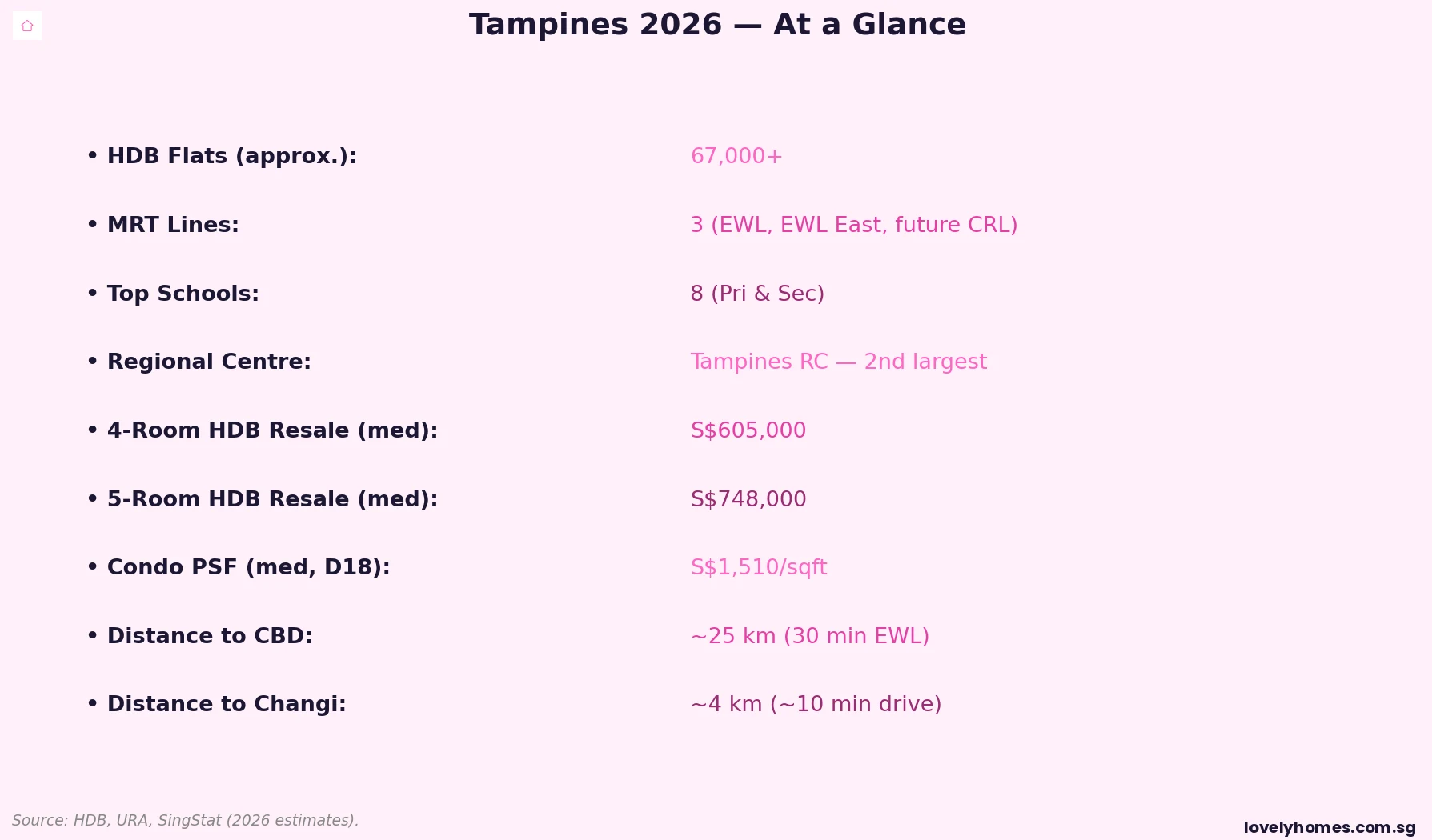
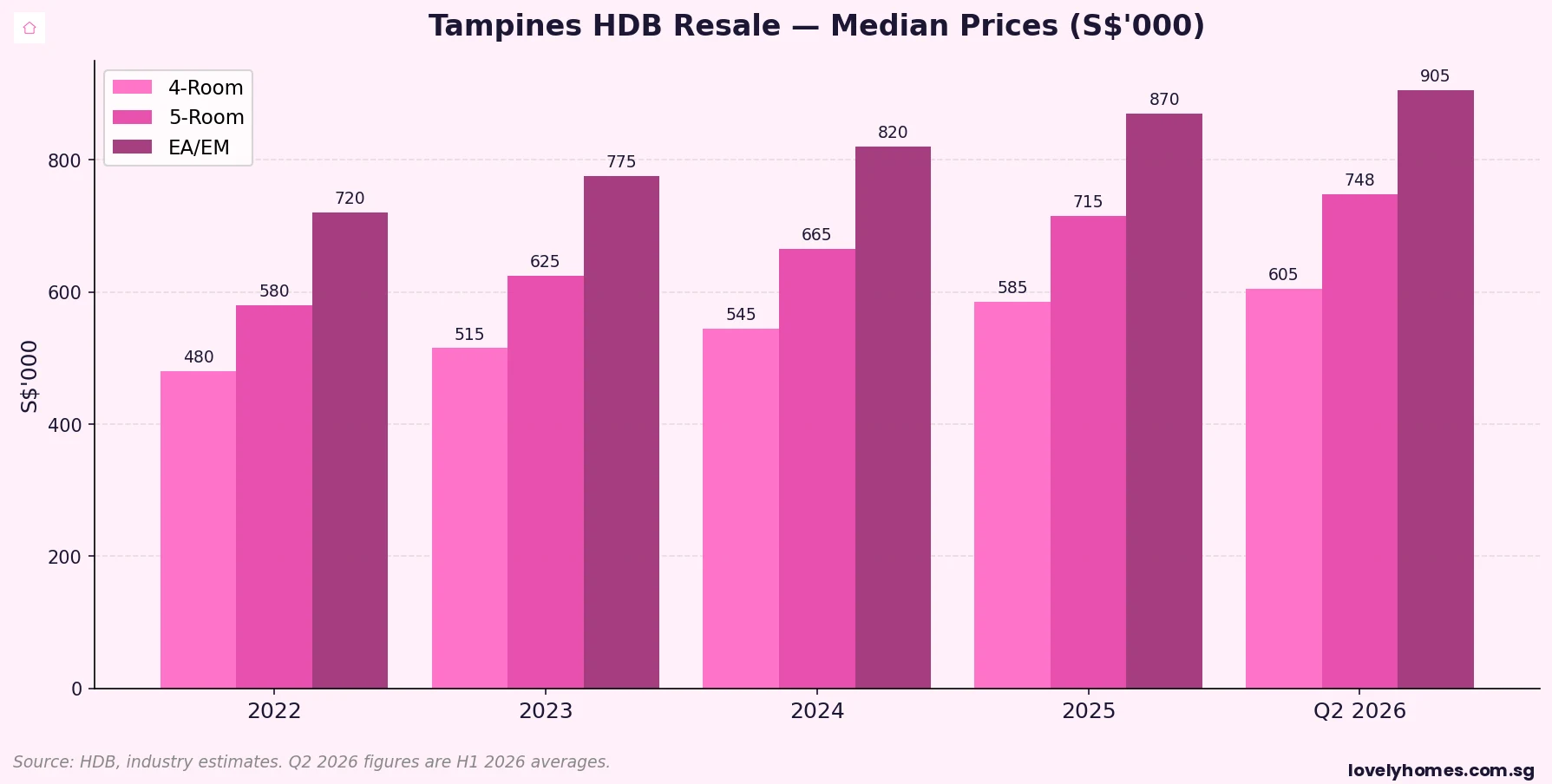
  • HDB Resale (4-room median): S$605,000 (H1 2026); 5-room: S$748,000; EA/EM: S$905,000
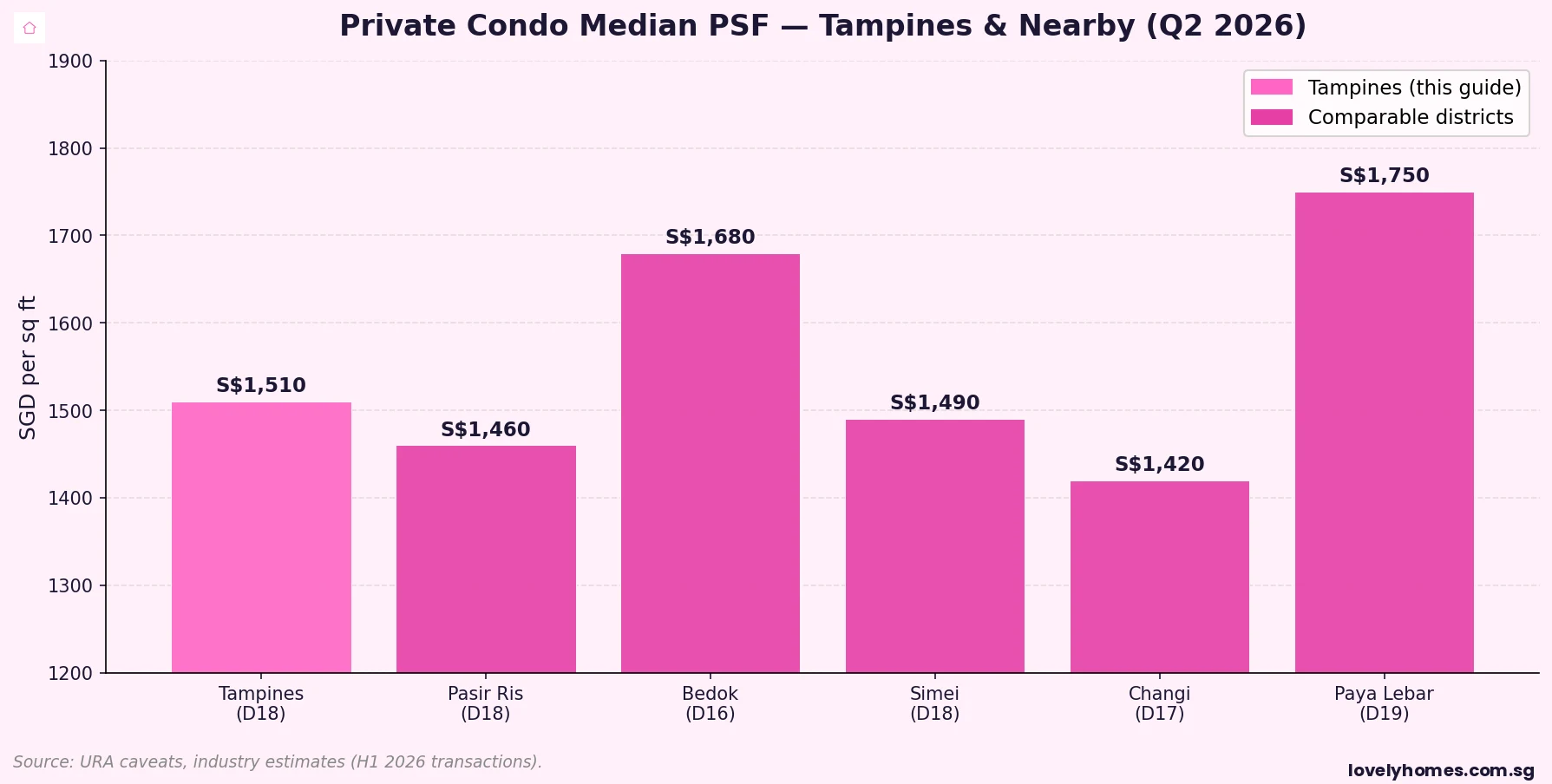
  • Private Condo PSF: S$1,400–S$1,650 (District 18, H1 2026 median)
  • MRT: East-West Line (Tampines, Tampines West, Tampines East); Cross Island Line (CRL) interchange at Tampines by 2029
  • Top Schools: Temasek Primary, Junyuan Primary (SAP), Changkat Primary, St Hilda’s Primary and St Hilda’s Secondary within the estate
  • Regional Centre: Tampines Regional Centre is Singapore’s second-largest commercial hub outside the CBD
  • Distance: ~25 km from CBD (30 minutes on EWL); ~4 km to Changi Airport (10 minutes by road)
  • URA Master Plan: Tampines North extension, new housing parcels, and CRL station upgrade in progress

What Is Tampines and Why Does It Matter?

Administered by the Tampines Town Council under the Tampines GRC, the estate covers 20.4 km² in the eastern planning area. The Housing and Development Board (HDB) designated Tampines a Regional Centre in the 1991 Concept Plan, making it one of only four such designations alongside Jurong East, Woodlands and Seletar. That status brought concentrated investment — Tampines Mall, Century Square, Tampines One, Tampines Hub and the White Sand shopping centre together form a retail belt that draws catchment from Pasir Ris, Simei and Bedok Reservoir.

For property buyers, the regional centre designation matters because it creates sustained employment demand, which in turn supports rental yields and long-term capital values. URA’s Draft Master Plan 2025 doubles down on Tampines with Tampines North — a new housing precinct for roughly 21,000 HDB units at Tampines Avenue 9/10 — and the CRL Phase 2 Tampines interchange station expected to open by 2030.

Tampines HDB Resale Market 2026

Tampines is one of Singapore’s top three HDB resale markets by volume. In H1 2026, HDB resale transactions in the town tracked broadly flat relative to H2 2025, reflecting island-wide cooling after the strong 2023–2024 run-up.

Tampines HDB resale median prices by flat type 2022 to 2026
Figure 1: Tampines HDB Resale — Median Prices by Flat Type (S$’000), 2022–Q2 2026. Source: HDB, industry estimates.

Key Flat Types and Indicative Ranges

Flat Type Typical Range (H1 2026) Median PSF (est.)
3-Room S$350,000 – S$440,000 ~S$520–S$580/sqft
4-Room S$540,000 – S$680,000 ~S$570–S$650/sqft
5-Room S$680,000 – S$820,000 ~S$560–S$650/sqft
EA / EM S$820,000 – S$990,000 ~S$530–S$620/sqft

Buyers should note that blocks in Tampines Court (privatised HUDC), Tampines Central and Tampines Street 82 near the MRT consistently command a premium of 8–15% above the town average due to their proximity to the MRT interchange and Tampines Hub.

Private Condo and EC Market in District 18

District 18 sits squarely in the Outside Central Region (OCR), making it subject to the more restrictive loan-to-value (LTV) ratio of 75% for first-time buyers using bank loans, and eligible for CPF Housing Grants for HDB upgraders. Private condo prices here are broadly accessible for HDB upgraders with household incomes above S$10,000 per month.

Private condo PSF comparison Tampines District 18 vs nearby districts Q2 2026
Figure 2: Private Condo Median PSF — Tampines (D18) vs Comparable Districts, H1 2026. Source: URA caveats, industry estimates.

Notable Private Developments in Tampines

Development Units Completed Median PSF (2025/26)
Watercove 80 2016 ~S$1,300
The Alps Residences 626 2019 ~S$1,390
Treasure at Tampines 2,203 2023 ~S$1,510
Tenet EC (Tampines St 62) 618 2026 ~S$1,320 (EC)

Executive Condominiums (ECs) in Tampines remain popular as they qualify for CPF Housing Grants during the initial HDB eligibility period and typically sell at a 10–20% discount to comparable private condos, making them the most cost-effective route for eligible buyers.

Schools and Education in Tampines

Tampines has one of the most concentrated clusters of primary schools in Singapore — a critical factor for families facing Primary 1 registration. Under the Ministry of Education’s (MOE) Phase 2C proximity rules, living within 1 km of a school in a higher-priority cluster significantly improves balloting odds.

Notable schools within or adjacent to Tampines include: Temasek Primary School (established 1959, known for Gifted Education Programme feeder status), Junyuan Primary School (one of Singapore’s Special Assistance Plan SAP schools offering Chinese as first language), St Hilda’s Primary School (Anglican mission school, consistently popular), Changkat Primary School, Poi Ching School, Tampines Primary School, Temasek Secondary School, St Hilda’s Secondary School, and Tampines Junior College. Temasek Polytechnic, Singapore University of Social Sciences (SUSS) and United World College of South East Asia (UWCSEA, Dover) are also accessible from Tampines.

Transport and Connectivity

Tampines is one of the best-connected regional towns in Singapore’s east. Three MRT stations on the East-West Line (EWL) serve the town: Tampines (EW2), Tampines West (EW1) and Tampines East (EW3). The Tampines station is also an interchange with the Downtown Line (DT32), providing a one-transfer link to Marina Bay, Botanic Gardens and Buona Vista.

The Cross Island Line (CRL), Singapore’s newest MRT line under construction, will add a Phase 2 station at Tampines North and a major interchange at the existing Tampines MRT station, expected to complete by 2030–2031. This will provide direct connectivity to Bright Hill, Ang Mo Kio, Defu and Pasir Ris, dramatically expanding Tampines’ transport reach without a CBD transfer.

By road, Tampines is served by the Tampines Expressway (TPE), Pan-Island Expressway (PIE) and East Coast Parkway (ECP), giving swift access to the CBD (30–35 minutes off-peak) and Changi Airport (10 minutes).

Tampines Neighbourhood Overview

Tampines Singapore neighbourhood overview key statistics 2026
Figure 3: Tampines 2026 — At a Glance. Source: HDB, URA, SingStat.

Worked Example: Buying a 5-Room HDB Flat in Tampines

Consider a first-timer Singapore Citizen couple earning a combined gross monthly income of S$12,000, looking to buy a 5-room HDB resale flat in Tampines at S$748,000 (median price, H1 2026).

Item Amount
Purchase Price S$748,000
CPF Housing Grant (Family Grant — first-timer SC couple, income ≤S$14k) S$50,000
Eligible HDB Loan (80% LTV after grant) S$558,400
Cash / CPF downpayment (20%) S$139,600
BSD (Buyer’s Stamp Duty @ 1–4% tiered) S$17,040
Legal fees + valuation ~S$3,500
Total Cash Outlay (est.) S$160,140
Monthly mortgage (HDB, 2.6% p.a., 25 yr) ~S$2,540
MSR limit (30% of S$12k gross) S$3,600 — serviceable

Note: ABSD does not apply to first-timer Singapore Citizens buying their first residential property. Couples must ensure they have not previously owned a residential property. BSD is payable on the purchase price (first S$180k at 1%, next S$180k at 2%, next S$640k at 3%, remainder at 4%). Administered by IRAS.

Why Tampines Matters for Property Buyers in 2026

Three structural factors make Tampines stand out compared to other OCR towns: (1) Changi Airport proximity — the planned Terminal 5 expansion and Changi City Point redevelopment will add tens of thousands of airport-sector jobs over the next decade, creating sustained rental demand; (2) CRL upgrade — a second MRT line adds a premium that the market has not yet fully priced in for non-MRT-facing units; and (3) Tampines North — new BTO supply keeps prices honest but also brings fresh amenities and a younger demographic to the north of the town.

For investors, gross rental yields in Tampines HDB have held at 3.5–4.5% in H1 2026, above the Singapore-wide HDB average of ~3.0%, partly because proximity to the airport and Temasek Polytechnic supports a pool of international students and aviation workers willing to pay market-rate rents.

What Might Come Next for Tampines Property (H2 2026 and Beyond)

This section contains forward-looking commentary based on publicly announced plans and market trends. It is not a price forecast or financial advice.

The CRL Phase 2 approval is likely to be the single biggest price catalyst for the Tampines North corridor. Historically, MRT proximity adds a 10–20% premium to HDB resale values over a 3–5-year horizon from announcement to completion (based on Northeast Line and Circle Line precedents). If this pattern holds, Tampines North BTO flats — priced in the S$500,000–S$620,000 range on launch — could see resale premiums of S$50,000–S$100,000 by 2031–2033 at MOP. This is, of course, speculative and contingent on broader market conditions, employment growth and interest rate trends that the Government of Singapore (GOS) and MAS cannot control.

Frequently Asked Questions About Tampines Property

Is Tampines a good area to buy property in Singapore?

Tampines is widely regarded as one of Singapore’s most complete towns for family living. For owner-occupiers, the combination of good schools, abundant amenities, competitive HDB prices and improving MRT connectivity (CRL coming) makes it a strong long-term choice. For investors, proximity to Changi Airport and Temasek Polytechnic supports a stable rental pool. However, OCR condos in Tampines face moderate new-supply pressure from upcoming GLS sites and Tampines North BTO releases, which may limit short-term capital appreciation for private properties.

What are typical HDB resale prices in Tampines in 2026?

As of H1 2026, indicative medians are: 4-room ~S$605,000; 5-room ~S$748,000; Executive Apartment/Maisonette ~S$905,000. Blocks near MRT stations (Tampines, Tampines West, Tampines East) typically command 8–15% above the town median. Always check current HDB resale portal listings and obtain a formal valuation before committing.

Which Tampines school is the best for Primary 1 registration?

The “best” school depends on your priorities. Temasek Primary, St Hilda’s Primary and Junyuan Primary are the most sought-after based on historical demand and Phase 2B/2C oversubscription. Living within 1 km of your preferred school is the single most reliable strategy to improve balloting priority. MOE releases updated P1 registration data each year; consult the official MOE Primary 1 Registration page for the latest enrollment figures.

Is Tampines served by the Circle Line?

No. Tampines is served by the East-West Line (EWL) and the Downtown Line (DTL) at Tampines station. However, the Cross Island Line (CRL) Phase 2 will introduce a Tampines North station and an interchange at the existing Tampines EWL/DTL station, expected around 2030. This will provide direct connections westward to Ang Mo Kio and Bright Hill without a city-centre transfer.

What is ABSD for a second property purchase in Tampines?

ABSD is imposed by IRAS on a buyer’s stamp-duty basis: Singapore Citizens buying a second residential property pay ABSD at 20%, and a third or subsequent at 30%. Permanent Residents buying a first residential property in Singapore pay ABSD at 5%, a second at 30%. Foreigners pay ABSD at 60% on any residential property. ABSD applies regardless of whether the property is HDB or private — the applicable rate depends on the buyer’s citizenship status and existing property count, not the property type. Always verify current rates at iras.gov.sg before transacting.

Can foreigners buy property in Tampines?

Foreigners may not purchase new or resale HDB flats. Foreigners may purchase private condominiums and ECs that have reached their 5-year privatisation period, subject to ABSD at 60% (effective 27 April 2023, as administered by IRAS). Certain Approved Purchasers (nationals of countries with free-trade agreements with Singapore) may be eligible for reduced ABSD rates — consult a Singapore-licensed property professional or lawyer for advice specific to your citizenship.

What is Tampines North?

Tampines North is URA’s designated extension precinct to the north of the existing Tampines town, bounded by Tampines Expressway (TPE) to the east and Tampines Avenue 10 to the south. The area will eventually house approximately 21,000 HDB units across multiple BTO exercises, supported by a new neighbourhood centre, parks, community facilities and the CRL Phase 2 Tampines North station. Development is expected to proceed in phases through the late 2020s and into the 2030s.

Related Articles

Disclaimer

This article is for general informational purposes only and does not constitute financial, investment, legal or tax advice. Property market figures, HDB resale prices and private condo PSF are indicative estimates based on industry data and publicly available transaction records as at July 2026; they may differ materially from the final transacted price of any specific unit. Readers should conduct independent due diligence and consult licensed professionals — including a Singapore-registered property agent, a lawyer admitted to the Singapore Bar, and a financial adviser holding a Capital Markets Services Licence — before making any property purchase or investment decision. Official sources include the HDB Resale Portal (hdb.gov.sg), URA REALIS (ura.gov.sg), IRAS (iras.gov.sg), CPF Board (cpf.gov.sg), MAS (mas.gov.sg) and SingStat (singstat.gov.sg).

Tags: Tampines, District 18, neighbourhood guide, HDB resale, condo PSF, Singapore property 2026, Tampines Hub, East region, EWL MRT, Changi Airport

×Click anywhere to close

Translate »