Quick Answer: How to Use This Glossary
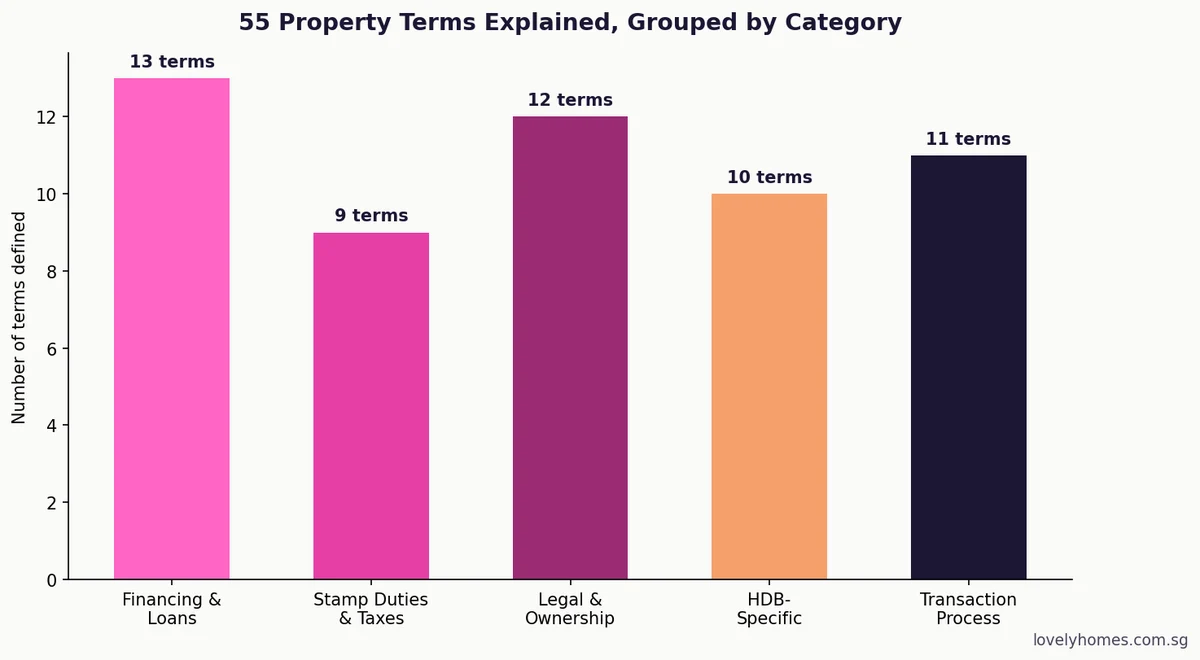
- This glossary explains 55 of the most-used Singapore property terms, grouped into five categories: financing and loans, stamp duties and taxes, legal and ownership, HDB-specific rules, and the transaction process.
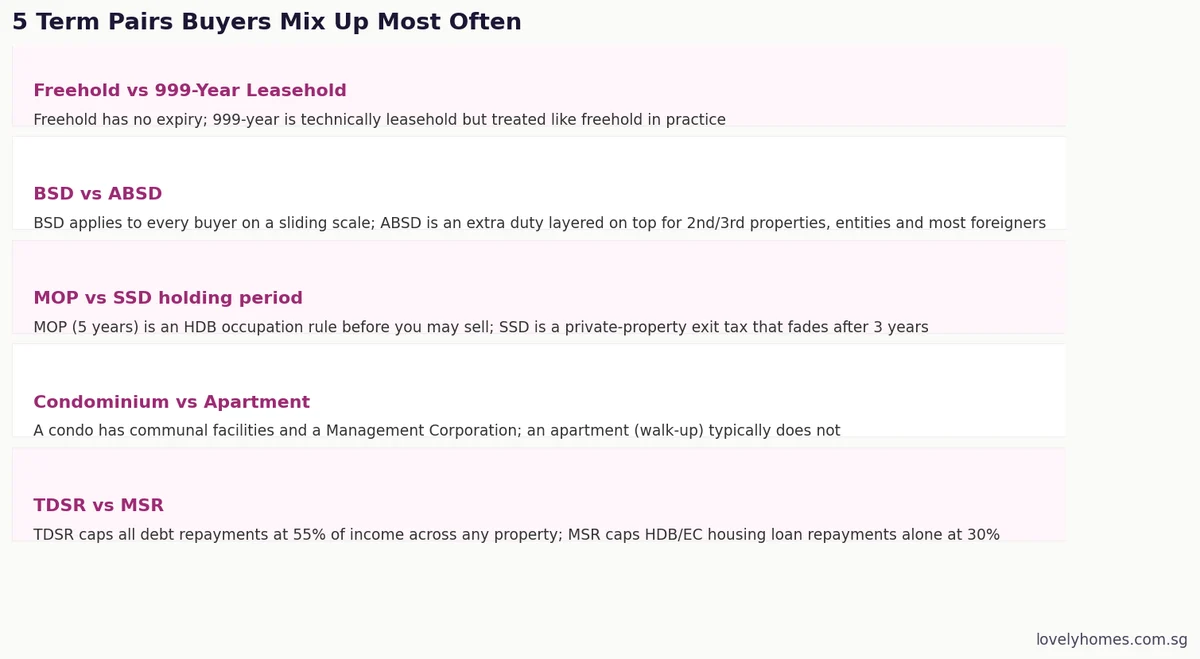
- BSD (Buyer’s Stamp Duty) applies to every property buyer on a sliding scale; ABSD (Additional Buyer’s Stamp Duty) is a separate, much larger duty layered on top for second and subsequent properties, most entities and most foreign buyers.
- TDSR caps total monthly debt repayments, across all loans, at 55% of gross monthly income; MSR caps HDB and EC housing-loan repayments alone at 30% of gross monthly income.
- MOP (Minimum Occupation Period) is a 5-year HDB rule before an owner may sell on the open market; it has no equivalent for private property, which instead has a separate Seller’s Stamp Duty (SSD) holding-period regime.
- Freehold tenure has no expiry date; a 999-year leasehold is technically a lease but is treated, in practice and in financing, almost identically to freehold given its extremely long remaining term.
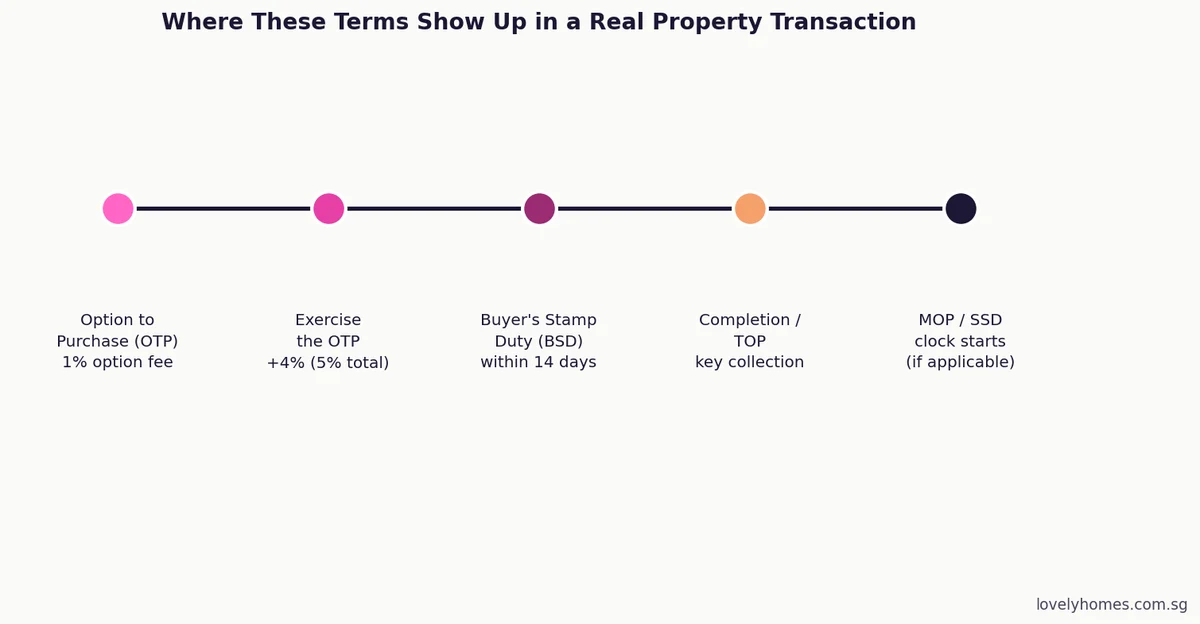
- The typical transaction path runs Option to Purchase (1% option fee) → exercise the option (a further 4%, 5% total) → pay Buyer’s Stamp Duty within 14 days → completion, with CPF and mortgage steps running in parallel.
- Terms are cross-referenced to LovelyHomes’ full guides wherever a topic deserves more than a one-paragraph definition, so this page works as a starting point, not a replacement, for the detailed guides.
Singapore property transactions come with their own dense vocabulary, much of it borrowed from statutes, CPF rules and bank underwriting criteria that most buyers only encounter once every several years. Getting a term wrong, confusing BSD with ABSD, or MOP with SSD, is one of the most common ways first-time buyers misjudge their true cost of ownership or their eligibility for a scheme. This glossary collects the terms LovelyHomes readers ask about most often, defines each one in plain English, and links through to the full guide wherever the topic is complex enough to deserve one.
Financing & Loans
LTV (Loan-to-Value): the maximum proportion of a property’s price or valuation, whichever is lower, that a bank will lend, currently up to 75% for a first housing loan at standard tenure, stepping down for second and subsequent loans or longer tenures. TDSR (Total Debt Servicing Ratio): caps all monthly debt obligations, home loan plus car loan, credit cards and other borrowings, at 55% of gross monthly income. MSR (Mortgage Servicing Ratio): a stricter 30% of gross monthly income cap that applies specifically to the housing loan on an HDB flat or Executive Condominium. IWAA (Income-Weighted Average Age): used when several borrowers share a loan, blending each borrower’s age, weighted by their income share, to determine the maximum loan tenure. SORA (Singapore Overnight Rate Average): the benchmark rate most Singapore floating-rate mortgages are now pegged to, having replaced the old SIBOR/SOR benchmarks. Equity Term Loan: a loan secured against a property’s paid-up value rather than its purchase price, sometimes used to unlock equity from a fully or partially paid property.
Stamp Duties & Taxes
BSD (Buyer’s Stamp Duty): a tiered duty payable by every buyer, calculated on the higher of the purchase price or market value. ABSD (Additional Buyer’s Stamp Duty): an additional duty on top of BSD for second and subsequent properties bought by citizens and PRs, and for most purchases by entities and foreigners, with rates that can reach 60%. SSD (Seller’s Stamp Duty): a duty payable if a private property is sold within a defined holding period after purchase, designed to discourage short-term flipping. Annual Value (AV): the estimated annual rent a property could fetch if let out, used by IRAS as the base for calculating property tax, not the actual rent collected. Property Tax: an annual tax on property ownership, calculated by applying a progressive rate schedule to the Annual Value, with owner-occupied homes taxed more lightly than non-owner-occupied ones.
Legal & Ownership
Freehold: ownership with no expiry date. Leasehold: ownership for a fixed term, typically 99 or 999 years in Singapore, after which title reverts to the state (for 99-year state land leases) unless renewed. Joint Tenancy: a form of co-ownership where all owners hold an undivided equal share and a deceased owner’s share passes automatically to the surviving owner(s), bypassing a will. Tenancy-in-Common: a form of co-ownership where each owner holds a specific, possibly unequal, share that can be willed or sold independently. MCST (Management Corporation Strata Title): the body corporate that manages common property and collects maintenance fees in a condominium or strata development. OTP (Option to Purchase): a legal document giving the buyer the exclusive right, for a defined period, to proceed with a purchase after paying an option fee.
HDB-Specific Terms
MOP (Minimum Occupation Period): the 5-year period an HDB flat owner must physically occupy the flat before selling it on the open market or renting out the whole unit. EIP (Ethnic Integration Policy): quotas that cap the proportion of each ethnic group’s ownership in an HDB block and neighbourhood, applied at the point of resale purchase. SPR Quota: a separate cap on the proportion of flats in a block or neighbourhood that may be owned by Singapore Permanent Resident households. BTO (Build-To-Order): HDB’s main new-flat sales scheme, where flats are built only after a launch receives sufficient applications. SBF (Sale of Balance Flats): a scheme selling completed or nearly-completed flats that were not taken up in earlier BTO exercises. Resale Levy: a charge payable by second-time HDB buyers who previously enjoyed a housing subsidy, designed to keep the subsidy system fair between first- and second-timers.
The Transaction Process, Step by Step
OTP (Option to Purchase): issued by the seller after receiving an option fee, typically 1% of the price for private property, giving the buyer an exclusive window, usually 2 to 3 weeks, to decide. Exercise the Option: the buyer’s formal acceptance, made by signing and returning the OTP together with a further payment, typically 4%, bringing the total deposit to the conventional 5%. Completion: the date on which the balance purchase price is paid and legal title transfers, for a resale property, or the date a Certificate of Statutory Completion (CSC) is issued, for a new development. TOP (Temporary Occupation Permit): issued once a new development is safe to occupy, though some external works may still be ongoing. Conveyancing: the legal process of transferring property title, typically handled by a conveyancing lawyer on both the buyer’s and seller’s sides.
Summary: 10 Terms Every Buyer Should Know First
| Term | One-Line Definition |
|---|---|
| BSD | Tiered duty every buyer pays, based on price or value. |
| ABSD | Extra duty for 2nd/3rd properties, entities, most foreigners. |
| LTV | Maximum % of price/value a bank will lend. |
| TDSR | 55% of income cap across all debt. |
| MSR | 30% of income cap for HDB/EC housing loans only. |
| MOP | 5-year HDB occupation rule before open-market resale. |
| SSD | Exit tax if a private property is sold within the holding period. |
| OTP | Legal option giving a buyer exclusive right to proceed. |
| MCST | Body corporate managing a condo’s common property. |
| TOP | Permit confirming a new development is safe to occupy. |
Worked Example: All These Terms in One Purchase
The scenario: a Singaporean couple exercising an OTP on a S$1.5 million private resale condo as their first property.
The illustrative maths: they pay a 1% option fee (S$15,000) to receive the OTP, then a further 4% (S$60,000) to exercise it, bringing their deposit to the conventional 5% (S$75,000). Within 14 days of exercising, they pay BSD of roughly S$44,600 under the current tiered schedule. Because this is their first property, no ABSD applies. Their bank approves a loan at 75% LTV (S$1,125,000), having checked that their combined monthly repayment keeps TDSR at or below 55% of their gross income. At completion, the balance 95% (S$1,425,000) less the loan amount is paid, title transfers, and they collect the keys.
Figures are illustrative, based on the current BSD schedule and standard first-property LTV limits; always confirm exact duties and loan eligibility for a specific transaction with IRAS, your bank and your conveyancing lawyer.
Why This Matters for Buyers and Sellers
Misreading a single term can be an expensive mistake in Singapore property: confusing MOP with SSD can lead an HDB owner to attempt a sale before they are legally entitled to, and confusing BSD with the much larger ABSD can leave a second-property buyer badly under-budgeted at the point of exercising an option. Agents and lawyers use this vocabulary fluently and can move quickly through a conversation that assumes familiarity with it; a buyer or seller who understands the core 20 to 30 terms in this glossary is far better placed to ask the right follow-up questions, spot an error in a quotation, and negotiate from a position of genuine understanding rather than simply trusting whoever is speaking most confidently in the room.
Frequently Asked Questions
What is the difference between BSD and ABSD?
BSD is a tiered duty every buyer pays on a property purchase. ABSD is a separate, much larger additional duty that applies on top of BSD for second and subsequent properties bought by citizens and PRs, and for most purchases by entities and foreign buyers.
What is the difference between TDSR and MSR?
TDSR caps total monthly debt repayments, across all loans and credit facilities, at 55% of gross monthly income for any property type. MSR is a stricter, narrower cap of 30% of gross monthly income that applies specifically to the housing loan repayment for an HDB flat or Executive Condominium.
Is a 999-year leasehold the same as freehold?
Not technically. Freehold has no expiry date at all, while a 999-year lease is still, in law, a lease. In practice, given the extremely long remaining term, banks, valuers and buyers generally treat 999-year leasehold almost identically to freehold.
What happens when I exercise an Option to Purchase?
Exercising the OTP is the buyer’s formal acceptance, made by signing and returning the option together with a further payment, typically bringing the total deposit to the conventional 5% of the purchase price, and it legally commits both parties to complete the sale.
What is Annual Value and how is it different from rent?
Annual Value is IRAS’s own estimate of the yearly rent a property could reasonably fetch, used purely as the base for calculating property tax. It is not the same as the actual rent a landlord charges or collects.
Does MOP apply to private condominiums?
No. MOP is an HDB-specific rule. Private property has no equivalent occupation requirement, though it has its own Seller’s Stamp Duty holding-period regime that discourages short-term resale.
What is the difference between Joint Tenancy and Tenancy-in-Common?
Under Joint Tenancy, all owners hold an equal, undivided share and a deceased owner’s share passes automatically to the surviving owners. Under Tenancy-in-Common, each owner holds a specific, potentially unequal, share that can be willed or sold independently of the other owners.
Related Articles on LovelyHomes
- ABSD Singapore 2026: Complete Guide to Additional Buyer’s Stamp Duty
- Buyer’s Stamp Duty (BSD) Singapore 2026: Complete Guide to Rates, Calculation and Exemptions
- TDSR & MSR Guide Singapore 2026
- Singapore HDB Minimum Occupation Period (MOP) 2026: Complete Guide
- Singapore Freehold vs Leasehold Guide 2026
- Singapore Property Ownership Types 2026: Tenure, Title & Buyer Restrictions
Supporting graphics
Original article illustrations are available below.