URA Closes Chitty Road & Veerasamy Road Conservation GLS Tender 2026
Click anywhere to close
The Urban Redevelopment Authority (URA) closed bids today, 28 July 2026, for one of Singapore’s most unusual Government Land Sales (GLS) tenders: a cluster of 18 conserved two-storey pre-war terrace houses at Chitty Road and Veerasamy Road in the Little India Historic District. The site was launched for public tender on 5 March 2026, giving developers almost five months to assess the restoration scope and submit bids.
The properties were built in 1927 as municipal quarters for government employees — a heritage of civic purpose embedded in the heart of a district that Singapore has invested decades in preserving. The successful tenderer will be required to sensitively restore all 18 buildings and adapt them for either residential or long-stay serviced apartment use under URA’s conservation guidelines. An award announcement is expected in the coming weeks.
Quick Summary — Chitty Road & Veerasamy Road GLS Tender
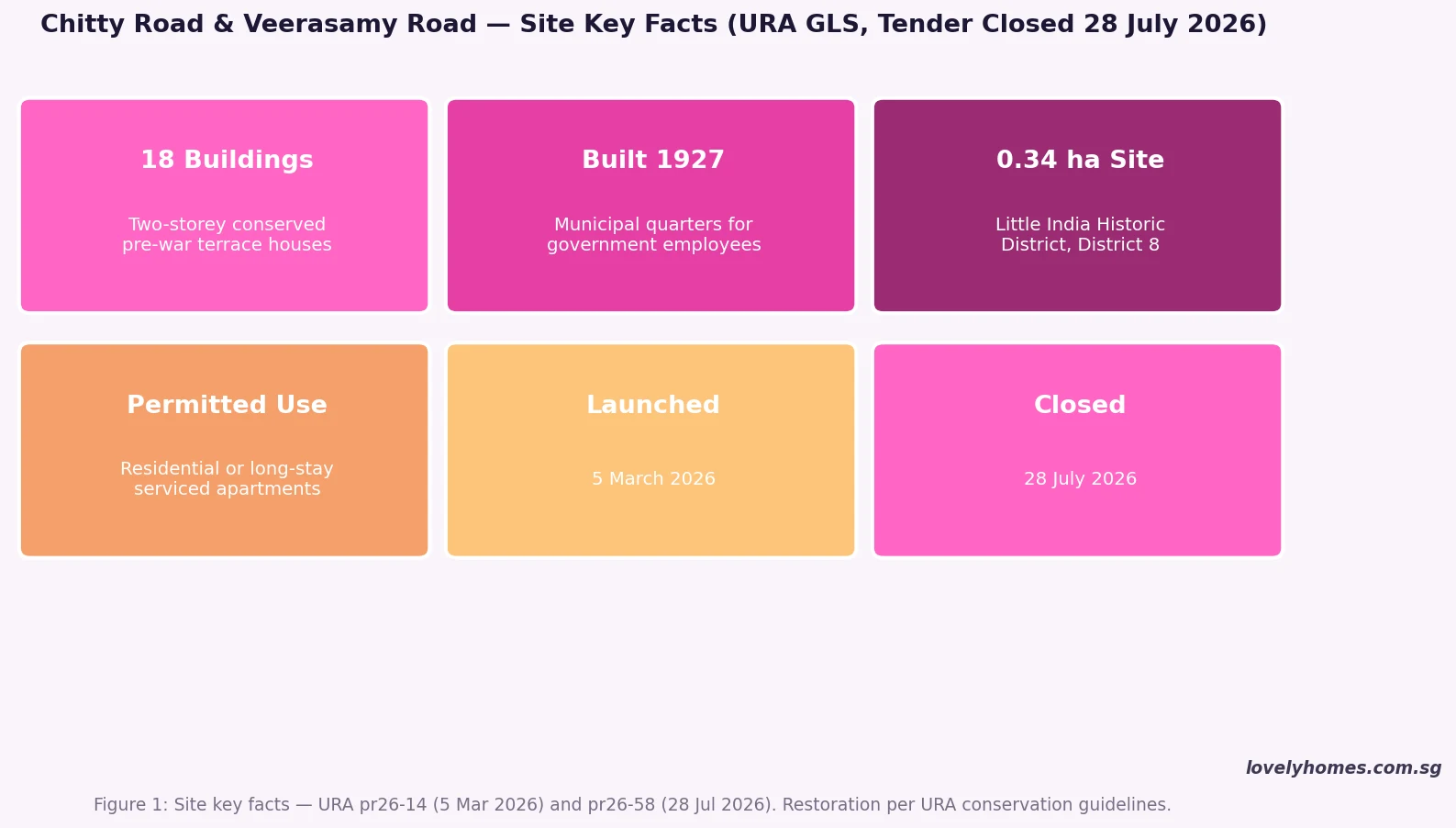
- 18 two-storey conserved buildings constructed in 1927; originally government employee quarters in the Little India Historic District.
- Site area: 0.34 hectares in District 8 (Little India / Farrer Park MRT).
- Permitted use: Residential or long-stay serviced apartments, subject to URA conservation guidelines.
- Tender launched: 5 March 2026; tender closed: 28 July 2026.
- Bids received as at close of tender; details in URA Annex A (pr26-58). Award expected to be announced in August/September 2026.
- This is a conservation GLS sale — not a standard redevelopment site. The buildings must be retained and restored; they cannot be demolished and rebuilt.
- Structural investigation reports have been prepared and made available to tenderers to assess restoration and strengthening works required.
- The site sits within the Little India Conservation Area, one of four historic districts (alongside Chinatown, Kampong Glam, and Boat Quay) gazetted under Singapore’s Urban Conservation Programme.
What Makes This Tender Unusual
Standard GLS residential tenders ask developers to bid for a cleared site where they can design and build a new development from scratch. This tender is fundamentally different. The 18 buildings are conserved structures — gazetted by the URA and protected from demolition. The developer who wins must work within the existing building envelopes, adapting 1927 two-storey terrace construction for modern residential living or serviced apartment use.
This imposes unique constraints. Structural investigations have been carried out and the reports made available to tenderers, who must factor restoration and strengthening costs into their bids. These costs can be substantial — heritage conservation work typically runs at a significant premium over standard construction, reflecting specialist tradespeople, careful material matching, and the time required to comply with URA’s conservation guidelines on facades, rooflines, windows, and internal structural elements.
The Little India Historic District: Heritage and Property Value
The Little India Historic District is one of Singapore’s four protected historic conservation areas. It encompasses the streets around Serangoon Road — Dunlop Street, Campbell Lane, Clive Street, Buffalo Road, and the Chitty Road / Veerasamy Road cluster — as a living cultural precinct rather than a museum. URA’s conservation philosophy for Little India is to maintain the area as a mixed-use residential, commercial, and cultural district where heritage architecture frames contemporary activity.
For property owners and investors, conservation districts carry a distinct set of supply constraints and price dynamics. New residential supply in Little India is severely limited by the conservation controls that prevent demolition and significant new development. The Chitty Road/Veerasamy Road cluster, once restored, will represent one of the few instances of new private residential supply entering the Little India Historic District in recent years.
| Feature | Chitty Road/Veerasamy Road Site |
|---|---|
| District | D8 (Farrer Park / Little India) |
| Number of buildings | 18 two-storey conserved terrace houses |
| Year built | 1927 |
| Site area | 0.34 hectares (approx. 3,400 sq m) |
| Original use | Municipal quarters (government employees) |
| Proposed use | Residential or long-stay serviced apartments |
| MRT access | Farrer Park MRT (NE Line), ~5 min walk |
| Conservation status | Gazetted conserved buildings, Little India Historic District |
| Tender launched | 5 March 2026 |
| Tender closed | 28 July 2026 |
What Happens Next: Award and Implications
URA’s press release (pr26-58, 28 July 2026) confirms that bids have been received and that this is not an announcement of tender award. Bids will now be evaluated and a decision announced at a later date — typically within four to eight weeks of tender close for GLS sites.
The award price will be a benchmark for conservation property values in Singapore’s historic districts. Unlike standard GLS land prices (expressed as price per square foot per plot ratio, or PSF PPR), conservation tender prices are harder to compare because the developer’s value is locked into the existing building footprints rather than a variable GFA. The implied per-unit price — after restoration, fit-out, and marketing costs — will give the market a signal about what well-restored conserved shophouses and terrace houses in Singapore’s historic districts are worth as residential or serviced apartment assets.
Comparable conserved property transactions in Little India and Kampong Glam have ranged from S$3.5 million to S$7 million per unit for restored shophouses used as residences or boutique hotels, depending on floor area, lease type, and frontage. The Chitty Road units, being terrace houses (typically shallower plots than shophouses), will likely command values at the lower end of this range — but the cluster format and central location near Farrer Park MRT may support premium pricing.
What This Means for Buyers and Investors
For buyers interested in heritage property, the completion of the Chitty Road/Veerasamy Road restoration — likely three to five years from award — will offer a rare opportunity to own a conserved pre-war residence in a protected historic district. Heritage homes in Singapore’s conservation areas have demonstrated strong capital resilience over time: their supply is permanently capped by conservation controls, and their aesthetic distinctiveness attracts buyers and tenants willing to pay for character that new-build developments cannot replicate.
The serviced apartment option is also significant. Singapore’s long-stay serviced apartment sector has tightened considerably since URA revised minimum stay requirements in 2023. A conservation-grade long-stay serviced apartment cluster in Little India — steps from the heritage shophouses of Serangoon Road and connected directly to the North-East Line — would be positioned at the premium end of the market for corporate relocations and diplomatic tenants.
Frequently Asked Questions
Can the winning developer demolish and rebuild the Chitty Road and Veerasamy Road terrace houses?
No. These buildings are conserved structures gazetted under Singapore’s Urban Conservation Programme, administered by the URA. Gazetted conserved buildings cannot be demolished. The successful tenderer must retain the external character of the buildings — facades, rooflines, windows, and other defining architectural elements — while adapting the interiors for the approved residential or serviced apartment use. The URA’s conservation guidelines set out in detail what can and cannot be altered. Any proposed adaptation must be submitted to URA for approval as part of a Development Application (DA) before works commence.
What is the difference between a conservation GLS tender and a standard residential GLS?
A standard residential GLS tender involves a cleared or clearable site where the developer has freedom (within GLS parameters) to design a new building to the maximum approved GFA, density, and height. A conservation GLS tender involves existing buildings that must be retained and restored. The developer’s value creation comes from the quality of restoration, the permitted use, and the location — not from maximising a new development. Conservation tenders typically attract a smaller, more specialised field of bidders because the required expertise in heritage restoration is narrower than standard residential development.
When will the award be announced?
URA’s press release pr26-58 states that the award decision will be made after the bids have been evaluated, and will be publicised at a later date. Based on URA’s typical practice for GLS tenders, award announcements generally occur four to eight weeks after tender close. Given the tender closed on 28 July 2026, an award announcement is most likely in August or September 2026. LovelyHomes will report on the award when URA makes the announcement. Monitor our Property News section for the update.
Who typically buys conserved property in Singapore’s historic districts?
The buyer profile for conserved shophouses and terrace houses in Singapore’s historic districts includes high-net-worth individuals (both Singaporean and foreign, noting that foreigners can buy conserved shophouses subject to the Residential Property Act), family offices, hospitality operators (for boutique hotels or serviced residences), and corporate entities. The limited supply, heritage prestige, and land scarcity in conservation zones make these assets a store of value. Unlike standard residential condos, conserved properties are not subject to Additional Buyer’s Stamp Duty (ABSD) if they are classified as commercial use (e.g., commercial shophouses) — but residential-only conserved properties are subject to standard residential stamp duty rules, including ABSD based on the buyer’s profile and existing property count.
How does Singapore’s conservation programme compare to those of other cities?
Singapore’s Urban Conservation Programme, launched in 1989 under Lee Kuan Yew’s government and administered by the URA, is widely regarded as one of the most systematic conservation frameworks in Southeast Asia. It has gazetted over 7,000 conserved buildings across four historic districts (Chinatown, Little India, Kampong Glam, Boat Quay) and numerous individual conservation areas. Unlike Hong Kong, where many pre-war buildings have been lost to redevelopment pressure, Singapore’s framework enforces conservation as a condition of all development and redevelopment in designated areas. Comparable programmes in Penang (George Town UNESCO World Heritage Site), Malacca, and Bangkok have adopted varying degrees of enforcement, but Singapore’s combination of statutory backing and active government sale of conserved properties for private adaptive reuse is a distinctive model.