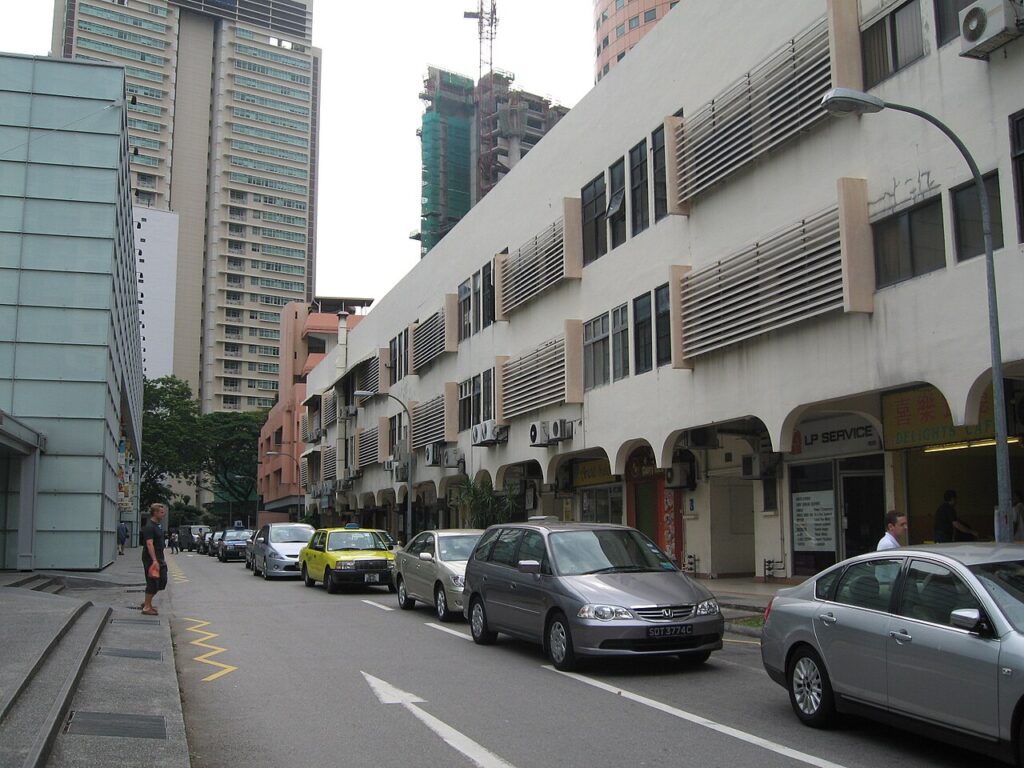
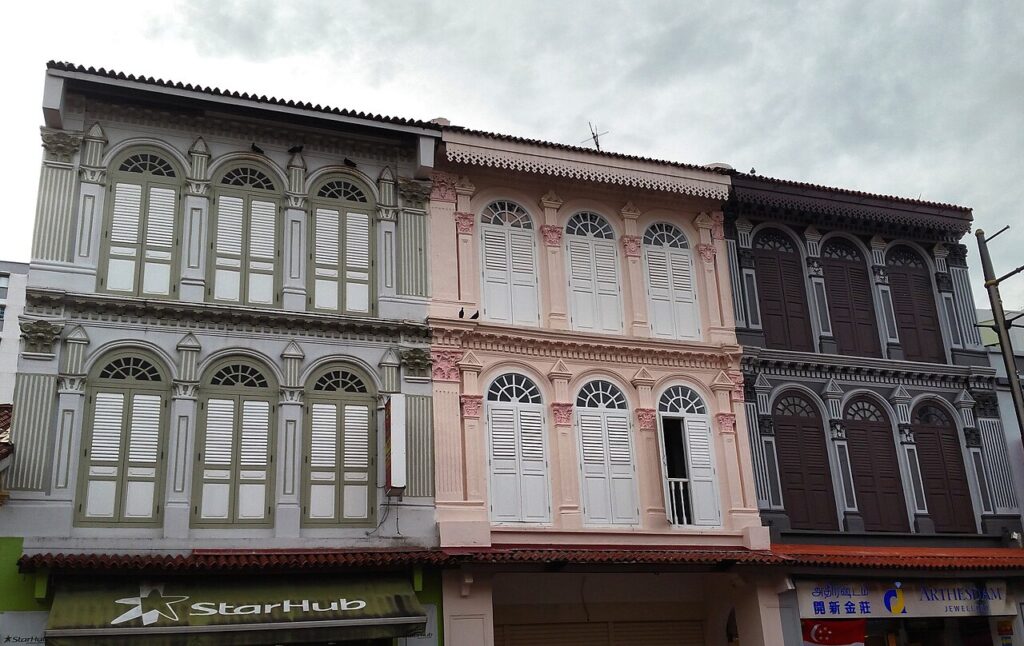
The Urban Redevelopment Authority (URA) closed bids today, 28 July 2026, for one of Singapore’s most unusual Government Land Sales (GLS) tenders: a cluster of 18 conserved two-storey pre-war terrace houses at Chitty Road and Veerasamy Road in the Little India Historic District. The site was launched for public tender on 5 March 2026, giving developers almost five months to assess the restoration scope and submit bids.
The properties were built in 1927 as municipal quarters for government employees — a heritage of civic purpose embedded in the heart of a district that Singapore has invested decades in preserving. The successful tenderer will be required to sensitively restore all 18 buildings and adapt them for either residential or long-stay serviced apartment use under URA’s conservation guidelines. An award announcement is expected in the coming weeks.
18 two-storey conserved buildings constructed in 1927; originally government employee quarters in the Little India Historic District.
Site area: 0.34 hectares in District 8 (Little India / Farrer Park MRT).
Permitted use: Residential or long-stay serviced apartments, subject to URA conservation guidelines.
Tender launched: 5 March 2026; tender closed: 28 July 2026.
Bids received as at close of tender; details in URA Annex A (pr26-58). Award expected to be announced in August/September 2026.
This is a conservation GLS sale — not a standard redevelopment site. The buildings must be retained and restored; they cannot be demolished and rebuilt.
Structural investigation reports have been prepared and made available to tenderers to assess restoration and strengthening works required.
The site sits within the Little India Conservation Area, one of four historic districts (alongside Chinatown, Kampong Glam, and Boat Quay) gazetted under Singapore’s Urban Conservation Programme.
What Makes This Tender Unusual
Standard GLS residential tenders ask developers to bid for a cleared site where they can design and build a new development from scratch. This tender is fundamentally different. The 18 buildings are conserved structures — gazetted by the URA and protected from demolition. The developer who wins must work within the existing building envelopes, adapting 1927 two-storey terrace construction for modern residential living or serviced apartment use.
This imposes unique constraints. Structural investigations have been carried out and the reports made available to tenderers, who must factor restoration and strengthening costs into their bids. These costs can be substantial — heritage conservation work typically runs at a significant premium over standard construction, reflecting specialist tradespeople, careful material matching, and the time required to comply with URA’s conservation guidelines on facades, rooflines, windows, and internal structural elements.
Figure 1: Key site facts for the Chitty Road and Veerasamy Road conservation GLS tender (URA pr26-14 and pr26-58, 2026). The site comprises 18 pre-war terrace houses built in 1927 on a 0.34-hectare site in the Little India Historic District.
The Little India Historic District: Heritage and Property Value
The Little India Historic District is one of Singapore’s four protected historic conservation areas. It encompasses the streets around Serangoon Road — Dunlop Street, Campbell Lane, Clive Street, Buffalo Road, and the Chitty Road / Veerasamy Road cluster — as a living cultural precinct rather than a museum. URA’s conservation philosophy for Little India is to maintain the area as a mixed-use residential, commercial, and cultural district where heritage architecture frames contemporary activity.
For property owners and investors, conservation districts carry a distinct set of supply constraints and price dynamics. New residential supply in Little India is severely limited by the conservation controls that prevent demolition and significant new development. The Chitty Road/Veerasamy Road cluster, once restored, will represent one of the few instances of new private residential supply entering the Little India Historic District in recent years.
Feature
Chitty Road/Veerasamy Road Site
District
D8 (Farrer Park / Little India)
Number of buildings
18 two-storey conserved terrace houses
Year built
1927
Site area
0.34 hectares (approx. 3,400 sq m)
Original use
Municipal quarters (government employees)
Proposed use
Residential or long-stay serviced apartments
MRT access
Farrer Park MRT (NE Line), ~5 min walk
Conservation status
Gazetted conserved buildings, Little India Historic District
Tender launched
5 March 2026
Tender closed
28 July 2026
What Happens Next: Award and Implications
URA’s press release (pr26-58, 28 July 2026) confirms that bids have been received and that this is not an announcement of tender award. Bids will now be evaluated and a decision announced at a later date — typically within four to eight weeks of tender close for GLS sites.
The award price will be a benchmark for conservation property values in Singapore’s historic districts. Unlike standard GLS land prices (expressed as price per square foot per plot ratio, or PSF PPR), conservation tender prices are harder to compare because the developer’s value is locked into the existing building footprints rather than a variable GFA. The implied per-unit price — after restoration, fit-out, and marketing costs — will give the market a signal about what well-restored conserved shophouses and terrace houses in Singapore’s historic districts are worth as residential or serviced apartment assets.
Comparable conserved property transactions in Little India and Kampong Glam have ranged from S$3.5 million to S$7 million per unit for restored shophouses used as residences or boutique hotels, depending on floor area, lease type, and frontage. The Chitty Road units, being terrace houses (typically shallower plots than shophouses), will likely command values at the lower end of this range — but the cluster format and central location near Farrer Park MRT may support premium pricing.
What This Means for Buyers and Investors
For buyers interested in heritage property, the completion of the Chitty Road/Veerasamy Road restoration — likely three to five years from award — will offer a rare opportunity to own a conserved pre-war residence in a protected historic district. Heritage homes in Singapore’s conservation areas have demonstrated strong capital resilience over time: their supply is permanently capped by conservation controls, and their aesthetic distinctiveness attracts buyers and tenants willing to pay for character that new-build developments cannot replicate.
The serviced apartment option is also significant. Singapore’s long-stay serviced apartment sector has tightened considerably since URA revised minimum stay requirements in 2023. A conservation-grade long-stay serviced apartment cluster in Little India — steps from the heritage shophouses of Serangoon Road and connected directly to the North-East Line — would be positioned at the premium end of the market for corporate relocations and diplomatic tenants.
Frequently Asked Questions
Can the winning developer demolish and rebuild the Chitty Road and Veerasamy Road terrace houses?
No. These buildings are conserved structures gazetted under Singapore’s Urban Conservation Programme, administered by the URA. Gazetted conserved buildings cannot be demolished. The successful tenderer must retain the external character of the buildings — facades, rooflines, windows, and other defining architectural elements — while adapting the interiors for the approved residential or serviced apartment use. The URA’s conservation guidelines set out in detail what can and cannot be altered. Any proposed adaptation must be submitted to URA for approval as part of a Development Application (DA) before works commence.
What is the difference between a conservation GLS tender and a standard residential GLS?
A standard residential GLS tender involves a cleared or clearable site where the developer has freedom (within GLS parameters) to design a new building to the maximum approved GFA, density, and height. A conservation GLS tender involves existing buildings that must be retained and restored. The developer’s value creation comes from the quality of restoration, the permitted use, and the location — not from maximising a new development. Conservation tenders typically attract a smaller, more specialised field of bidders because the required expertise in heritage restoration is narrower than standard residential development.
When will the award be announced?
URA’s press release pr26-58 states that the award decision will be made after the bids have been evaluated, and will be publicised at a later date. Based on URA’s typical practice for GLS tenders, award announcements generally occur four to eight weeks after tender close. Given the tender closed on 28 July 2026, an award announcement is most likely in August or September 2026. LovelyHomes will report on the award when URA makes the announcement. Monitor our Property News section for the update.
Who typically buys conserved property in Singapore’s historic districts?
The buyer profile for conserved shophouses and terrace houses in Singapore’s historic districts includes high-net-worth individuals (both Singaporean and foreign, noting that foreigners can buy conserved shophouses subject to the Residential Property Act), family offices, hospitality operators (for boutique hotels or serviced residences), and corporate entities. The limited supply, heritage prestige, and land scarcity in conservation zones make these assets a store of value. Unlike standard residential condos, conserved properties are not subject to Additional Buyer’s Stamp Duty (ABSD) if they are classified as commercial use (e.g., commercial shophouses) — but residential-only conserved properties are subject to standard residential stamp duty rules, including ABSD based on the buyer’s profile and existing property count.
How does Singapore’s conservation programme compare to those of other cities?
Singapore’s Urban Conservation Programme, launched in 1989 under Lee Kuan Yew’s government and administered by the URA, is widely regarded as one of the most systematic conservation frameworks in Southeast Asia. It has gazetted over 7,000 conserved buildings across four historic districts (Chinatown, Little India, Kampong Glam, Boat Quay) and numerous individual conservation areas. Unlike Hong Kong, where many pre-war buildings have been lost to redevelopment pressure, Singapore’s framework enforces conservation as a condition of all development and redevelopment in designated areas. Comparable programmes in Penang (George Town UNESCO World Heritage Site), Malacca, and Bangkok have adopted varying degrees of enforcement, but Singapore’s combination of statutory backing and active government sale of conserved properties for private adaptive reuse is a distinctive model.
Disclaimer: This article is based on URA press releases pr26-14 (5 March 2026) and pr26-58 (28 July 2026). Bid amounts, award decision, and restoration timeline have not been announced by URA at the time of publication. Property valuations and comparable transaction prices cited are market estimates only. This article does not constitute investment or financial advice. LovelyHomes recommends consulting the URA website (ura.gov.sg) and licensed property professionals for authoritative information on conservation guidelines and property purchase decisions.
A collective sale — more commonly known in Singapore as an en bloc sale — is the simultaneous sale of all strata units in a development to a single purchaser, typically a property developer. The legal framework is contained in the Land Titles (Strata) Act (LTSA), Chapter 158, administered by the Strata Titles Board (STB) and, on appeal, the High Court. En bloc sales are a uniquely Singapore mechanism: they enable ageing private residential developments to be redeveloped into higher-density modern projects under master plan intensification guidelines, recycling urban land that would otherwise be impossible to redevelop without unanimous owner consent.
This guide explains the entire en bloc process from start to finish — how the 80%/90% consent threshold works, how reserve prices are set and negotiated, what owners actually receive, what the stamp duty implications are, and how to evaluate whether an en bloc offer is fair. It also examines recent 2024–2026 collective sales in Singapore, including the landmark Bayshore Park award in July 2026.
Key Takeaways — Singapore En Bloc (Collective Sale) Guide 2026
An en bloc sale requires 80% consent by share value AND strata area (for developments ≥ 10 years old). Newer developments (under 10 years) require 90% consent on both measures.
The Collective Sale Agreement (CSA) sets the reserve price — the minimum total sale price below which the CSC cannot proceed. The reserve price is a negotiating floor, not the final sale price.
Owners receive proceeds based on the apportionment method in the CSA: share value, strata area, or a hybrid formula. Exact payouts depend on the development’s total share value schedule (SLA).
Proceeds from an en bloc sale are not taxable as income for individuals. However, IRAS may assess the gain as a trading receipt if the owner has a pattern of property transactions indicative of a trading intent.
After a successful collective sale, owners must vacate within the period stipulated in the Sale and Purchase Agreement (typically 6–9 months post-completion). CPF OA funds used for the purchase are refunded with accrued interest.
The Strata Titles Board (STB) must approve all collective sales where there are objecting owners. Even with 100% consent, the STB order is required if there are no objections — except where the High Court waives the requirement.
En bloc premiums in Singapore have historically ranged from 10–35% above individual resale market values, with premiums higher for developments on sites with strong redevelopment potential (GFA uplift, DC waiver, strategic location).
The typical timeline from CSC formation to owner payout is 2–4 years, including tender, STB application, and legal completion.
The Legal Foundation: LTSA Section 84
The en bloc framework is rooted in Section 84 of the Land Titles (Strata) Act. The legislation was enacted in 1999 and significantly amended in 2007 and 2010 following waves of collective sale activity. The key provisions are:
Section 84A governs collective sales of strata developments where the development is at least 10 years old from the date of issue of the latest Temporary Occupation Permit (TOP). It requires a minimum of 80% consent by share value and 80% by strata area, as recorded in the Subsidiary Strata Certificates of Title (SSCTs). Section 84A(1A) sets the higher 90% threshold for developments less than 10 years from their latest TOP.
The Collective Sale Committee (CSC) — the elected body of owners that drives the process — must follow prescribed procedural rules set out in the LTSA Schedule, including notice requirements, cooling-off periods, and rules on how to treat mortgagee interests and subsidiary proprietors who are in arrears. Non-compliance with procedure is a ground on which the STB may refuse to approve the sale.
Figure 1: The eight key stages of a Singapore en bloc (collective sale) process under LTSA s.84. The Strata Titles Board (STB) application typically runs concurrently with High Court proceedings when there are objectors. Total timeline: 2–4 years from CSC formation to payout.
The Consent Process: Reaching 80% (or 90%)
The most time-consuming phase of any collective sale is gathering the required consent. The Collective Sale Committee must first form under the rules of the management corporation (MCST), typically through an extraordinary general meeting (EGM). Once formed, the CSC appoints a property consultant (to advise on reserve price and marketing), a legal firm to draft the CSA, and a valuer to establish the independent valuation.
Owners then have the opportunity to sign the CSA. Each signature binds the owner to sell at or above the reserve price. Consent is measured in two ways simultaneously: by share value (each unit’s share in the development’s common property, as set by the SLA in the strata title) and by strata area (the floor area of each unit’s lot as recorded in the SSCT). Both thresholds must be met. This dual-threshold rule prevents large-unit owners from being able to block a sale that small-unit owners overwhelmingly support, and vice versa.
The consent period can extend for up to 12 months from the date the first signature is obtained. If 80% (or 90%) is not reached within 12 months, the CSA lapses and the process must restart from the beginning — including a new EGM resolution and new CSC formation. This is a meaningful risk for CSCs and often leads to significant negotiation between hold-out owners and the CSC.
Setting the Reserve Price
The reserve price is the floor price for the tender. It must be supported by an independent valuation from a licensed valuer. The reserve price is not publicly disclosed during the tender process — developers submit sealed bids and the CSC accepts or rejects them. If bids are insufficient (all below reserve), the CSC can either accept the highest bid (if owners consent to amend the reserve price) or decline all bids and re-tender.
The reserve price calculation incorporates several elements: the current market value of the development on an individual-unit basis, the development charge (DC) payable by the developer to the Singapore Land Authority (SLA) for any GFA uplift beyond current approved use, the cost of demolition and construction, financing costs over the redevelopment period, and the developer’s profit margin (typically 15–25% of gross development value). The collective sale price is, in effect, a property developer’s residual land valuation: how much can be paid for the site after accounting for all development costs and a commercially acceptable profit?
Factor
Impact on Reserve Price
Direction
GFA uplift from rezoning/intensification
Increases max GFA → increases land value
↑ Higher
Development Charge (DC) payable
Developer cost → reduces land bid
↓ Lower
Construction cost (per sqm GFA)
High construction costs → reduces land bid
↓ Lower
Location / MRT proximity
Higher demand for completed units → higher land value
↑ Higher
Current individual-unit resale prices
Sets owners’ opportunity cost floor
↑ Higher
Number of units / share value split
Affects per-unit payout distribution
Neutral
Lease remaining (99-yr vs freehold)
Freehold commands DC waiver in some scenarios
↑ FH Higher
Figure 2: En bloc sale prices versus estimated individual-unit market values for selected Singapore collective sales, 2022–2026. Bayshore Park (D16) was awarded to Gemini Residential at S$2.128 billion in July 2026 (URA pr26-55), representing one of Singapore’s largest residential collective sales. Premiums of 22–35% above individual resale values are typical for sites with strong GFA uplift.
What Owners Receive: Apportionment of Proceeds
The total collective sale price is distributed among all owners according to the apportionment method agreed in the CSA. The LTSA allows three main methods:
Share Value Method: Proceeds are distributed in proportion to each unit’s share value as registered in the strata title. Share values are assigned by the SLA at the time of strata subdivision and are immutable (they cannot be changed without unanimous owner consent and SLA approval). This method benefits owners of units with higher share values — typically larger units.
Strata Area Method: Proceeds are distributed in proportion to each unit’s strata area (floor area as per the SSCT). This method is more straightforward and often preferred where unit sizes vary significantly but share values do not fully reflect size differences.
Hybrid Method: A weighted combination of share value and strata area, with the weighting specified in the CSA. This is increasingly common for mixed-unit developments (e.g., those with both small and large units, or with commercial units).
After the collective sale price is distributed to each unit, each owner must settle their outstanding mortgage (if any) from the proceeds, refund their CPF OA (with accrued interest at 2.5% p.a.) for the principal and accrued interest drawn from CPF, and pay legal and conveyancing costs. The net cash remaining after these deductions is the owner’s free cash from the en bloc.
Figure 3: Illustrative payout per unit type for a 200-unit development with 15,000 total shares and a S$600 million collective sale price. Actual payouts depend on the CSA’s apportionment method. Owners must deduct outstanding mortgages and CPF refunds (with accrued interest) from gross proceeds.
Dissenting Owners: Objections and STB Process
Owners who did not sign the CSA — or who signed but subsequently wish to object — can file an objection with the Strata Titles Board within 21 days of the date of the STB application. The grounds for objection under LTSA s.84A(9) are limited:
An owner may object that the transaction is not in good faith, taking into account the sale price relative to the valuation, the method of distribution, and the relationship (if any) between the developer and any sale committee member. An owner may also object on the basis that the sale will result in financial loss — that their net proceeds after repaying their outstanding mortgage, legal costs, and CPF refund (with accrued interest) will be less than the amount they originally paid for the unit. Importantly, “financial loss” is assessed on the individual transaction, not on opportunity cost or market value appreciation foregone.
The STB holds a mediation session to attempt settlement. If mediation fails and the objection is maintained, the STB conducts an inquiry. It can approve the sale despite objections if it finds no bad faith and no financial loss to the objecting owners. The STB’s decision can be appealed to the High Court on points of law.
Worked Example: The Lim Family — Bishan 3-Bed Condo En Bloc, S$600M Sale
Scenario: Mr and Mrs Lim own a 3-bedroom unit (1,100 sq ft, 80 share values out of 15,000 total development shares) in a 200-unit Bishan condominium. The CSC has successfully gathered 83% consent and launched a public tender. Gemini Residential submits the highest bid of S$600,000,000, which exceeds the reserve price of S$580,000,000. The STB approves the sale. No objections were filed.
Deductions from gross payout:
Outstanding bank mortgage (remaining): S$420,000
CPF OA refund (principal drawn: S$280,000 + accrued interest at 2.5% p.a. × 14 years ≈ S$98,000): S$378,000
Legal / conveyancing costs (purchaser’s law firm): S$8,500 Total deductions: S$806,500
Net cash in hand: S$3,200,000 − S$806,500 = S$2,393,500
Original purchase price (14 years ago): S$980,000
Net capital gain (before tax): S$3,200,000 − S$980,000 = S$2,220,000
IRAS individual income tax on capital gain: S$0 (Singapore does not tax capital gains for individuals, unless IRAS determines the gains arise from trading in property)
Stamp duty on purchase of next property:
Once vacated, the Lims intend to buy a 4-room HDB resale in Bishan (S$680,000). At that point they will not own any property (the en bloc condo is sold), so BSD only applies: BSD on S$680,000 = S$18,600. ABSD = 0% if this is their first property repurchase after the sale. If they purchase before completion of the en bloc (i.e., before the sale and purchase agreement with the developer is completed), they would own two properties and incur ABSD.
Tax and CPF Implications of En Bloc Proceeds
The IRAS does not impose capital gains tax on en bloc proceeds received by individual owners who are not in the business of property trading. Singapore has no capital gains tax regime for individuals. However, IRAS can and does assess gains as trading income in cases where an individual has a pattern of buying and selling properties in a short time frame suggestive of a trading operation rather than long-term investment. For most owner-occupiers who have held their unit for 5+ years, this risk is minimal.
The CPF Board requires all CPF monies drawn for the property — including the principal drawn from OA and the accrued interest that would have been earned had the money remained in the OA — to be refunded to the member’s CPF account upon sale. The accrued interest is computed at 2.5% p.a. compounded. This refund goes back into the OA and can be reused for a subsequent property purchase. The refund does not reduce the member’s cash payout — it simply restructures the gain between cash and CPF.
What This Means for You
En bloc activity in Singapore is cyclical, closely tracking the private residential property market cycle and developer land bank appetite. High periods of en bloc activity — 2006–2007, 2017–2018, and to a lesser extent 2024–2026 — occur when developer confidence is high, GLS supply is perceived as insufficient, and individual market values have appreciated strongly enough that collective sale premiums are meaningful but the reserve price remains financeable.
For owners in ageing condominiums (particularly those 20+ years old in well-located districts), the en bloc potential is a latent option value embedded in their property. A 30-year-old condo in Districts 9, 10, or 11 with a plot ratio uplift opportunity is likely to attract developer interest. Owners should periodically check whether their development’s gross plot ratio under the URA Masterplan allows significantly more GFA than is currently built — a development built at 1.6× plot ratio on a site zoned for 2.8× plot ratio has strong en bloc potential.
Regional comparisons are instructive: Hong Kong’s compulsory sale mechanism (under the Land (Compulsory Sale for Redevelopment) Ordinance) requires only 80% consent for buildings over 50 years old — broadly comparable to Singapore’s framework. Japan’s urban renewal legislation differs significantly, requiring higher judicial involvement. Singapore’s LTSA framework is widely regarded as a balanced model: it enables urban renewal without giving developers veto power over unwilling majorities, while protecting minority owners through good-faith and financial-loss grounds.
What Might Come Next for Singapore En Bloc Sales
The en bloc market in 2026 is active but selective. The Bayshore Park award (S$2.128 billion, URA pr26-55, July 2026) confirmed that large, well-located sites with strong GFA uplift potential can still attract aggressive developer bids even in a period of elevated construction costs. Industry analysts expect continued en bloc activity in Districts 14, 15, and 21 — areas where ageing condominiums sit on sites with significant Masterplan intensification headroom.
Policy watch: the Ministry of National Development (MND) has previously considered whether the consent threshold should be raised to 85% to better protect minority owners, a proposal last tabled publicly in 2019. Any legislative amendment would require Parliamentary debate. Buyers and owners in older developments should also monitor the URA’s periodic Masterplan reviews — the next full Masterplan review is expected in 2028 — as plot ratio changes directly affect en bloc residual land values.
Frequently Asked Questions
What is the difference between a collective sale and an en bloc sale?
They are the same thing. “En bloc” is the French phrase meaning “in one go” or “as a whole”, and it became the colloquial Singapore term for a collective sale of all strata units in a development to a single buyer. The formal legal terminology in the LTSA uses “collective sale” and the body that processes them is the “Collective Sale Committee” (CSC). In everyday usage, Singapore property owners, lawyers, and media use “en bloc” interchangeably with “collective sale”. Both terms refer to the same statutory process under LTSA s.84.
Can I be forced to sell my unit if I did not sign the CSA?
Yes, subject to the STB approval process. If the required 80% (or 90%) consent threshold is met by other owners, the STB can order the minority to sell. The STB will only approve the sale if it finds the transaction was conducted in good faith (the sale price is not significantly below independent valuation) and no objecting owner will suffer a net financial loss (their gross payout exceeds their original purchase price less costs). If you did not sign and you believe either condition is not met, you can file an objection with the STB within 21 days of the STB application. The STB hearing provides a formal channel for your concerns. However, if the STB finds no grounds for your objection, the sale proceeds and you must sell on the same terms as consenting owners.
When is the 90% consent threshold required instead of 80%?
The 90% consent threshold applies when the development is less than 10 years old, measured from the date of issue of the latest Temporary Occupation Permit (TOP) or Certificate of Statutory Completion (CSC) for the development. The logic is that newer buildings have owners who are more likely to still be living in their units as primary residences, and a higher threshold protects their right to remain. Once a development crosses the 10-year mark from the latest TOP, the 80% threshold applies. The age is calculated from the TOP (not from purchase date or completion of individual units).
Do I have to pay ABSD when I buy a replacement property after the en bloc?
This is one of the most practically important questions for en bloc owners. ABSD is assessed at the time of the new purchase based on how many residential properties you own at that moment. If the en bloc sale has completed (i.e., legal title has transferred to the developer) before you sign the Option to Purchase (OTP) for your replacement property, you own zero properties at the time of the new purchase and pay 0% ABSD (for an SC buying their first replacement property). If, however, you buy the replacement property before the en bloc completes, you own two properties simultaneously and your new purchase attracts 20% ABSD for an SC second property. Timing the purchase carefully — waiting for legal completion of the en bloc — can save a substantial sum.
How is the development charge (DC) calculated and who pays it?
The Development Charge is a tax payable to the Singapore Land Authority (SLA) by the developer when they seek planning permission that involves an increase in the development potential (GFA) of a site. DC is calculated based on the land use zoning, the GFA uplift, and the DC rates published by the SLA and updated quarterly. For a residential-to-residential redevelopment with a GFA increase, the developer pays DC to the SLA before obtaining planning permission. The DC is a developer cost — it reduces the residual land value that the developer can offer in a collective sale tender. Owners do not pay DC directly; however, a high DC liability reduces the maximum price developers can bid, which is why the CSC’s property consultant carefully models DC in setting the reserve price.
What happens to my mortgage when the en bloc completes?
Your outstanding mortgage must be fully repaid from the collective sale proceeds at legal completion. The bank (mortgagee) has a legal interest in your unit and will require full redemption of the loan before releasing the strata title to the developer. The mechanics work as follows: at legal completion, the developer pays the purchase price into a stakeholder account held by the lawyers. The lawyers first redeem your mortgage in full (principal + interest + early repayment penalties, if any). The remainder is then remitted to you — first to refund your CPF account, then as cash. If your outstanding mortgage exceeds your share of the en bloc proceeds, the shortfall must be met in cash. This situation — a negative net proceed — is one of the grounds on which an owner can file an objection with the STB.
Can foreigners participate in an en bloc sale — either as an owner being sold out or as a developer buying?
Yes on both counts, with conditions. Foreign individuals and foreign companies can own units in a Singapore strata residential development (subject to the Residential Property Act and ABSD rules), and if their development undergoes a collective sale, they participate as any other owner. As a developer, a foreign entity can bid for a residential collective sale site in Singapore. However, foreign entities are subject to additional government approval requirements under the Residential Property Act to acquire residential land (as opposed to completed strata units). In practice, most large en bloc purchases are made by listed property developers (Singapore-listed or foreign), who obtain the requisite approvals as part of the tender process.
Disclaimer: This article is for general informational purposes only and does not constitute legal, financial, or tax advice. En bloc laws, STB procedures, ABSD rates, and CPF rules are subject to legislative amendment. Worked examples are illustrative only; actual payouts, tax treatment, and stamp duty depend on individual circumstances. Readers should consult the Land Titles (Strata) Act (Cap. 158), the Strata Titles Board (stb.gov.sg), and the Inland Revenue Authority of Singapore (iras.gov.sg) for authoritative information. LovelyHomes strongly recommends engaging a qualified property lawyer, licensed valuer, and financial adviser before making any property decision related to a collective sale.
The Urban Redevelopment Authority (URA) awarded the Bayshore Drive GLS site to Gemini Residential Pte. Ltd. and Gemini Trustee Pte. Ltd. (as trustee-manager of Gemini Mall Trust) on 20 July 2026.
Winning bid: S$2,128,000,000 — equivalent to S$14,243.83 per sqm of gross floor area (GFA).
Site area: 57,460.6 sqm; maximum permissible GFA: 149,398 sqm; tenure: 99 years.
Allowable development: commercial and residential — a mixed-use site in the emerging Bayshore precinct of District 16 (East Coast).
The land cost implies a break-even selling price of approximately S$2,400–S$2,700 PSF for private residential units on the site, depending on construction cost and margin assumptions.
This is the highest ever GLS price for an East Coast / Bayshore site, reflecting strong developer confidence in the Long Island project and upcoming TEL proximity.
The Deal at a Glance
On 20 July 2026, URA announced that it had awarded the tender for the Bayshore Drive Government Land Sales site — launched for tender on 30 March 2026 and closed on 15 July 2026 — to Gemini Residential Pte. Ltd. and Gemini Trustee Pte. Ltd., acting as trustee-manager of Gemini Mall Trust. The winning bid of S$2.128 billion equates to a land rate of S$14,243.83 per sqm of permissible GFA, a figure that market observers describe as aggressive but defensible given the site’s strategic position.
The Bayshore Drive site spans 57,460.6 sqm of land with a maximum GFA of 149,398 sqm — permitting a sizeable mixed commercial and residential development. The site is offered on a 99-year leasehold basis, consistent with all GLS residential land in Singapore.
Detail
Data
Location
Bayshore Drive, District 16 (East Coast), Singapore
Figure 1: The S$14,243.83 PSM GFA Bayshore Drive award significantly exceeds comparable East Coast GLS transactions from 2021 and a 2012 benchmark estimate, reflecting the precinct’s enhanced infrastructure outlook. Source: URA pr26-55; LovelyHomes research.
Why S$14,243 PSM GFA Is Significant
To contextualise the land rate: residential GLS sites in the East Coast / Marine Parade corridor have historically traded at S$5,000–S$9,500 PSM GFA. The Bayshore Drive award at S$14,243 PSM represents a substantial step up, driven by several factors converging in the Bayshore precinct in 2026.
First, the Thomson-East Coast Line (TEL) brings new MRT connectivity to the East Coast, with Bayshore MRT station (TEL Stage 4, opened 2024) significantly reducing travel times to the CBD. TEL access materially enhances the Bayshore precinct’s residential appeal compared to the historically bus-dependent East Coast corridor.
Second, the Long Island reclamation project — preparatory works for which commenced from end-2026 per URA’s pr26-50 (30 June 2026) — promises to extend the East Coast’s waterfront significantly over the coming decades, with a projected 570-hectare Phase 1 reclamation west of Bedok Jetty creating new coastal land that could underpin property values in the area for generations.
Third, the site’s mixed commercial and residential allowance enables Gemini to build a retail or F&B podium beneath the residential towers, enhancing lifestyle amenity and supporting higher average selling prices for the residential component.
Implied Break-Even and Launch Price Estimates
Using standard developer margin assumptions and Singapore construction cost benchmarks for 2026:
Land cost: S$14,243 PSM GFA → at an assumed plot ratio of 2.6 and residential-commercial GFA split, the residential land cost component translates to approximately S$1,050–S$1,100 PSF of saleable residential area.
Construction cost: S$550–S$650 PSF (mid-to-high spec, mixed-use).
Developer margin: 15–20%.
Implied break-even (residential units): approximately S$2,350–S$2,600 PSF.
Expected launch selling price: S$2,500–S$2,800 PSF, depending on unit mix, floor levels, and market conditions at launch (expected 2027–2028).
At S$2,600 PSF for a 700 sqft 2-bedroom unit, the ticket price would be approximately S$1.82 million. This positions Bayshore Drive as a premium East Coast launch — above the current OCR average but reflecting the TEL uplift and Long Island location premium.
What This Means for D16 Property Buyers and Owners
For existing D16 (Bedok, East Coast, Bayshore) property owners, the strong GLS award price is generally supportive of values in the surrounding area. Developers do not bid aggressively for land unless they believe they can achieve selling prices that justify the land cost — and Gemini’s willingness to commit S$2.128 billion signals confidence in the Bayshore sub-market. Comparable new launches in the area — including upcoming projects near Bedok MRT and along the East Coast Parkway — may find their pricing benchmarks elevated by this award.
For buyers considering D16 resale purchases in 2026, the Bayshore Drive award provides a useful data point: if the new launch from this site prices at S$2,500–S$2,800 PSF, comparably-located resale condominiums trading at S$1,700–S$2,000 PSF represent a meaningful relative discount that may narrow over time as the new launch sets a higher market reference.
What Might Come Next — Project Pipeline and Market Implications
Forward-looking commentary; not confirmed plans.
Gemini is likely to take 12–18 months to finalise architectural plans, obtain the necessary development approvals from URA, and prepare for a new launch sale. Industry expectations place the first preview sales in 2027, with TOP (Temporary Occupation Permit) around 2030–2031. The mixed-use format means Gemini Mall Trust’s commercial component will likely include a neighbourhood retail centre, potentially anchored by a supermarket and F&B cluster catering to the Bayshore residential population — comparable to the model at developments like Pasir Ris 8 or Tengah Plantation.
Watch for URA’s Q2 2026 full data release on 24 July 2026, which will provide updated D16 transaction volumes and median PSF data for the East Coast submarket, helping buyers benchmark current market conditions before this project launches.
Frequently Asked Questions
Who is Gemini Residential Pte. Ltd.?
Gemini Residential Pte. Ltd. and Gemini Trustee Pte. Ltd. (as trustee-manager of Gemini Mall Trust) are the winning bidding entities for the Bayshore Drive GLS site. As at the award date, further details about the developer behind the Gemini entities — whether a major listed developer or a private consortium — had not been publicly confirmed by URA. Buyers should monitor URA’s project approval records and the developer’s public communications in due course for more information on the project concept and timeline.
What will be built on the Bayshore Drive site?
The site has been tendered and awarded for “commercial and residential” development under URA’s GLS framework. This means the completed project will include both a residential component (private condominiums) and a commercial component (retail, F&B, or office). The exact mix — number of residential units, commercial GFA, design concept, and project name — will be determined by Gemini following URA approval of a development application, which typically takes 6–12 months. A marketing launch is not expected before 2027 at the earliest.
Does this affect my existing D16 condo’s value?
High GLS land bids are generally supportive of surrounding property values, as they signal developer confidence in the area’s future price trajectory. However, the direct impact on your individual unit’s value depends on its specific location, age, facing, and floor level relative to the new development. Owners in Bayshore Road, Eastwood, and Upper East Coast Road estates are likely to see the most direct uplift in market sentiment. Owners in Bedok North, Tanah Merah, or other D16 sub-zones further from Bayshore MRT may see a more indirect effect.
When will the URA Q2 2026 full data be released?
URA’s full real estate statistics for 2nd Quarter 2026 are scheduled for release on 24 July 2026, per the flash estimate press release (pr26-51). The full data will include detailed transaction volume, median PSF, and price index figures by market segment and district — providing the most comprehensive picture of Singapore’s property market performance in April–June 2026. LovelyHomes will publish an analysis of the full data upon release.
Is Bayshore a good area to invest in Singapore?
Bayshore (broadly the stretch from Marine Parade to Bedok along the East Coast) has become increasingly attractive as an investment location following the opening of Bayshore MRT on the Thomson-East Coast Line in 2024. The Long Island reclamation project (preparatory works from end-2026) adds a long-term waterfront development catalyst. Strong fundamentals include proximity to East Coast Park, established schools (Temasek Primary, Victoria Junior College), and a diverse residential community. However, buyers should note that new launch prices in 2027–2028, anchored by the Gemini project, may set a higher reference that reduces relative yield on resale purchases made at current prices. As always, individual unit factors — facing, floor, lease remaining — drive actual returns.
Disclaimer: This article is based on URA’s public press release pr26-55 (20 July 2026). Break-even and launch price estimates are illustrative projections based on industry assumptions and are not official developer or URA figures. Property values and market conditions are subject to change. Always verify information with URA (ura.gov.sg) and seek advice from a licensed property agent and financial adviser before making investment decisions. LovelyHomes does not represent any developer or agent in connection with the Bayshore Drive GLS site.
Quick Answer — JLD White Site at Town Hall Link: Key Facts
What: URA launched a White site at Town Hall Link, Jurong Lake District (JLD) for public tender on 3 July 2026 under the 2H2026 Confirmed List GLS Programme.
Scale: Total potential GFA of 186,139 sqm — the largest mixed-use GLS in western Singapore.
Residential component: Up to 1,200 private residential units, making this a significant addition to JLD’s housing supply pipeline.
Office anchor: At least 40,000 sqm of office space required, reinforcing JLD’s decentralisation role.
MRT connectivity: Connected to Jurong East MRT interchange and the upcoming Cross Island Line station (CR19), planned to open in 2032.
Tender close: 17 November 2026. Developers must submit bids by 12 noon.
What it means for buyers: Signals sustained government confidence in JLD; completed residential units from this site are unlikely before 2031–2032, but the GLS award will influence land values in D22 and adjacent D5.
What Is the JLD White Site at Town Hall Link?
On 3 July 2026, the Urban Redevelopment Authority (URA) formally launched the tender for a White site at Town Hall Link in Jurong Lake District (JLD) as part of the Government Land Sales (GLS) 2H2026 Confirmed List. The launch marks a significant milestone in Singapore’s longest-running urban transformation project — the conversion of JLD from a light-industrial backwater into what planners describe as “the largest mixed-use business node outside Singapore’s city centre.”
A White site is one of the most flexible land-use designations in Singapore’s GLS framework. Unlike a purely residential or commercial parcel, a White site allows developers to determine the precise mix of uses within broad parameters set by URA. In this case, the parameters are: a mandatory minimum of 40,000 sqm of office space, up to 1,200 private residential units, and 44,000 sqm of complementary uses — retail, serviced apartments, hotel, sports, recreational and community spaces, medical clinics, and attractions. The remaining GFA (~42,000 sqm) can be allocated flexibly across those permitted uses, giving the eventual developer considerable creative latitude.
Figure 1: URA Town Hall Link White Site — GFA breakdown across the four major use categories. Office component is mandatory minimum; residential is capped at 1,200 units. Source: URA pr26-53, 3 July 2026.
Why Town Hall Link Matters: Location Within JLD
The site sits at a pivotal node within JLD. To the west, it adjoins the Jurong Town Hall — a gazetted national monument, Singapore’s first air-conditioned building, and the only surviving structure from Jurong’s industrial founding era. To the north lies a future park. To the east, the site connects via multi-level pedestrian linkages to Jurong East MRT interchange station (served by North-South Line, East-West Line, and the opening Jurong Region Line), and to the heart of the new JLD precinct where the Cross Island Line’s CR19 station will open in 2032.
In practical terms, a buyer of a residential unit in this future development would have walk-through-shelter access to one of Singapore’s best-connected MRT interchanges and, by 2032, to a seventh line that will run across the island to Changi. That dual-line plus cross-island connectivity is a significant draw that few Singapore addresses can match.
The Jurong East MRT interchange itself is already one of Singapore’s busiest, serving commuters, students (Nanyang Technological University, Republic Polytechnic via JRL), and the growing Jurong Gateway commercial cluster. Adding CR19 effectively makes this node a triple-line interchange by the early 2030s.
Scale and Context in JLD’s Development Arc
JLD’s transformation has been years in the making. The 90-hectare Jurong Lake Gardens — one of Singapore’s largest urban parks — was revitalised and opened in phases from 2019 to 2023. The Jurong Region Line (JRL), which will serve the International Business Park area from the JE6 station, is planned for partial opening from 2028. The New Science Centre is set to anchor the eastern edge of JLD. The Jurong Gateway Hub — an integrated development combining a bus interchange, offices, shops, library, community club, and sports facilities — will further densify the precinct.
The Town Hall Link White Site is the residential and mixed-use centrepiece that pulls these infrastructure investments together into a coherent live-work-play destination. With 186,139 sqm of total GFA, this is a development of Paya Lebar Quarter-level ambition, but in a suburban context with full government infrastructure backing.
Figure 2: JLD key milestones from 2020 to 2033. The Town Hall Link White Site (2026 GLS launch) sits between the opening of Jurong Lake Gardens and the planned opening of the Cross Island Line, both of which will affect unit values in the completed development. Sources: URA, LTA.
What the 1,200-Unit Residential Cap Means for Supply and Pricing
The cap of 1,200 private residential units is meaningful in two directions. First, it limits the amount of new private housing supply this site adds to the western Singapore market — 1,200 units is roughly one medium-sized launch, so there is no risk of oversupply shock to D22’s existing stock. Second, given the prime-adjacent location and MRT super-connectivity, those 1,200 units are likely to be priced at a premium to the surrounding District 22 market, which currently sees resale condos in the S$1,350–S$1,600 psf range (based on URA REALIS data for 2025–2026).
Assuming the winning developer breaks ground in 2027–2028 (after an estimated 12–18 months from tender award to planning approvals and site preparation), the earliest TOP would be 2031–2033. That places these units in the market coinciding with or just after the Cross Island Line opens at CR19, potentially driving a price uplift at completion.
Jurong East interchange (NS/EW/JRL) + CR19 Cross Island Line (2032)
Adjacent heritage
Jurong Town Hall (national monument)
Tender close
17 November 2026, 12 noon
Administering authority
Urban Redevelopment Authority (URA)
Worked Example: Estimating What a Unit Here Might Cost
This is illustrative — no units are yet for sale — but it gives buyers a realistic planning benchmark. Assume the site is awarded at a land price of approximately S$1,500–S$1,800 psf ppr (per square foot per plot ratio). That is within the range implied by recent JLD-adjacent GLS bids and by the Bayshore Drive GLS award (S$14,244 psm GFA / ~S$1,323 psf ppr) for a D16 site in July 2026, adjusted upward for JLD’s superior transport connectivity.
At a land cost of S$1,650 psf ppr and a developer margin plus construction cost of roughly S$700–S$800 psf, the break-even launch price would be in the range of S$2,350–S$2,450 psf. A 2-bedroom unit of 65 sqm (700 sqft) would therefore carry a launch price of approximately S$1.65M–S$1.72M. A 3-bedroom unit of 90 sqm (970 sqft) would be approximately S$2.28M–S$2.37M.
These are rough estimates only. Actual pricing will depend on the bid price achieved, unit mix, and market conditions at launch (likely 2028–2029). Buyers comparing this to existing D22 resale condos at S$1,400–S$1,600 psf should factor in the premium for brand-new units, the CR19 connectivity uplift, and the integrated-development premium typical of projects with retail and commercial podiums.
What This Means for D22 Property Buyers and Investors
The GLS launch carries several signals worth watching. First, the government’s decision to include a mandatory 40,000 sqm office component reinforces its long-term commitment to JLD as a genuine employment hub — not merely a residential satellite. A functioning office cluster reduces the risk that JLD becomes a commuter-dormitory precinct with weak daytime vibrancy, which is the key risk factor that has historically depressed prices in outer-region new towns.
Second, the White site designation means the developer has flexibility to respond to market conditions. If the residential market softens by the time planning is finalised, the developer can shift GFA toward serviced apartments or hotel to preserve returns. That flexibility is a buffer against project-level distress, which benefits buyers in adjacent resale stock too.
Third, buyers already holding units in D22 — Jurong West, Clementi, Buona Vista corridor — should note that the CRL’s CR19 station in JLD will materially shorten travel times to the eastern half of Singapore. The eventual connectivity premium will likely flow through to the entire D22 and adjacent D5 resale market over the 2028–2033 period, not only to the new White site development.
What Might Come Next
The tender closes on 17 November 2026. URA will typically announce the award within one to three months of tender close, placing a likely award announcement in Q1 2027. Industry observers expect between two and five bids — the mandatory office component narrows the field to larger developers with commercial track records, ruling out most boutique residential-only players. Names frequently mentioned in JLD speculation include the integrated REIT-developer groups with retail and commercial asset management capabilities.
Beyond this site, the JLD Master Plan still contemplates additional parcels being released over the 2030s. The Town Hall Link White Site is the first major residential-integrated GLS in JLD, but is unlikely to be the last. Buyers and investors with a five-to-ten-year horizon should view this launch as the opening chapter of a sustained supply programme — not a one-off event.
What is a White site in Singapore’s GLS programme?
A White site is a Government Land Sales parcel where URA specifies broad use parameters rather than a single fixed use category. Developers can determine the precise mix of office, residential, retail, hotel, and other uses within the permitted envelope. This flexibility allows developers to optimise the project for market conditions at the time of planning, and is typically reserved for large, complex mixed-use sites where rigid zoning would constrain design quality or commercial viability.
When will the residential units from this site be available to buy?
No units will be available until the site is awarded (likely Q1 2027), planning permissions are secured, and the developer launches sales — a process that typically takes 18–24 months from award. The earliest launch would therefore be around 2028–2029, with completion (TOP) likely in 2031–2034 depending on construction pace. Buyers interested in JLD residential exposure in the near term should focus on existing resale condos in D22 such as J Gateway, Westwood Residences, or Lake Grande.
How does the 1,200-unit cap affect existing D22 property owners?
The cap limits near-term supply pressure. 1,200 units is a single medium-sized launch — comparable to one large project rather than a wave of supply. Given that D22 absorbs several hundred resale transactions per quarter, this addition to the pipeline is unlikely to cause oversupply. The more relevant effect is long-term: as JLD matures and the CRL opens in 2032, rising demand from employment growth and connectivity improvements is expected to support resale prices in the surrounding area.
Is the Jurong Town Hall adjacent to the White site?
Yes. The Jurong Town Hall — gazetted as a national monument by the National Heritage Board — sits adjacent to the Town Hall Link White site. Conservation requirements mean the monument cannot be redeveloped. The developer of the White site will need to integrate the project design sensitively with the heritage building. This is likely to result in a lower-density or open-plaza approach on the heritage-facing elevations, which could be a positive lifestyle feature for residents facing the monument and future park.
What is the Cross Island Line (CRL) and when does it open near this site?
The Cross Island Line (CRL) is Singapore’s eighth MRT line, designed to run across the island from Changi in the east to Jurong in the west. The CR19 station, planned for the heart of the new JLD precinct, is scheduled to open in 2032 alongside the western extension of the line. For residents of the Town Hall Link development, CR19 will provide direct connections east to the CBD, Paya Lebar, Ang Mo Kio, and eventually Changi Airport — all without a transfer. This is the single most significant connectivity improvement expected to lift JLD property values over the 2028–2035 period.
Will the complementary uses include a shopping mall?
URA’s parameters include retail as a permitted complementary use, but do not mandate a shopping mall of any specific size. Developers typically include a commercial podium in mixed-use integrated developments of this scale — analogous to what was delivered at Paya Lebar Quarter or Northshore Plaza. The 44,000 sqm complementary GFA envelope is large enough for a substantial retail and F&B offering. Given that Jurong East’s IMM and Westgate malls already serve D22, a new retail component here is most likely to be positioned as a lifestyle-and-F&B complement rather than a standalone destination mall.
Disclaimer: This article is for general informational purposes only and does not constitute financial, investment, or legal advice. Property prices, GFA parameters, and infrastructure timelines are subject to change. All GLS, planning, and regulatory matters are administered by the Urban Redevelopment Authority (URA) — refer to ura.gov.sg for authoritative information. Readers should seek advice from a licensed property professional or financial adviser before making any property purchase or investment decision.
Price trend: HDB Resale Price Index (RPI) declined in Q2 2026 — the second consecutive quarter of softening after a multi-year bull run
Record million-dollar flats: 491 million-dollar HDB resale transactions in Q2 2026 — an all-time quarterly high, up from 467 in Q1 2026
The paradox: Overall prices easing, yet the premium end of the market is more active than ever — a tale of two HDB markets
Private vs HDB divergence: URA data shows private residential prices rose +0.5% in Q2 2026, while HDB resale drifted lower — the widest divergence in recent years
Context: The price softening is modest — HDB resale remains significantly above pre-pandemic levels. This is a correction, not a collapse
What buyers should know: Affordability is improving for mass-market HDB buyers; premium location and high-floor units continue to command strong premiums
Source: HDB press release dated 24 July 2026; URA Q2 2026 flash estimates
HDB Resale Prices Ease Again — But the Premium Segment Tells a Different Story
Singapore’s Housing & Development Board released its Q2 2026 resale statistics on 24 July 2026, delivering a nuanced picture that will require careful reading. On the surface, the headline is straightforward: the HDB Resale Price Index (RPI) fell for the second consecutive quarter, extending a mild correction that began in Q1 2026. For most buyers who have been watching resale prices run continuously higher since 2020, this represents the clearest signal yet that the pandemic-era HDB bull run has entered a consolidation phase.
But the data contains a striking counterpoint. Within the same quarter that saw overall resale prices ease, 491 million-dollar HDB flats changed hands — the highest quarterly figure ever recorded by HDB. Singapore’s premium HDB segment, far from cooling, is operating at peak intensity. Understanding this apparent contradiction is the key to reading the Q2 2026 data correctly.
This report draws on HDB’s 24 July 2026 press release, URA’s Q2 2026 private residential flash estimates, and town-level resale data to give buyers and sellers a clear-eyed picture of where the HDB resale market stands at the midpoint of 2026.
Figure 1: Singapore Million-Dollar HDB Flat Sales by Quarter (Q2 2024 – Q2 2026). Q2 2026 hit a record 491 transactions. Source: HDB, 24 July 2026.
The Overall Price Picture: A Modest and Orderly Correction
The HDB Resale Price Index has now posted two consecutive quarterly declines. This is the first such back-to-back softening since the 2018–2019 period, when a combination of ABSD hikes (in July 2018) and rising interest rates cooled both private and public housing markets simultaneously. The current correction has different drivers: mortgage rates have stabilised (the 3-month compounded SORA rate has eased from its 2024 peak of approximately 3.7% to around 2.9% as at June 2026), and HDB has steadily increased BTO supply, reducing urgency among first-time buyers who previously faced years-long queues.
The price softening is characterised as modest by historical standards. Resale flats across the board remain significantly above their pre-pandemic (Q4 2019) levels — the pandemic-era run-up added an estimated 30–40% to HDB resale prices between 2020 and 2023, and a two-quarter decline has unwound only a fraction of those gains. Buyers who purchased resale flats in 2020–2021 are still sitting on substantial paper gains in most towns.
HDB Resale Trend
Q1 2026
Q2 2026
Direction
HDB Resale Price Index (RPI)
Declined
Declined
↓ 2nd consecutive quarter
Million-Dollar Flat Transactions
467
491 (record)
↑ All-time quarterly high
Private Residential PPI (URA)
+0.3%
+0.5%
↑ Outperforming HDB
Market character
Selective softening
Mass-market easing + premium surge
Diverging
Source: HDB press release 24 July 2026; URA Q2 2026 flash estimates. RPI directional change only — specific index values at hdb.gov.sg.
The Million-Dollar Flat Phenomenon: 491 in a Single Quarter
The 491 million-dollar resale transactions in Q2 2026 represent a market segment that is effectively decoupled from the overall HDB resale trend. To put this in context: in the entirety of 2019 (before the pandemic acceleration), fewer than 500 million-dollar HDB flats transacted across the whole year. By Q2 2026, that is now a single-quarter figure.
The million-dollar flat segment is concentrated in a handful of locations: mature estates close to the city or with distinctive cachet. Bishan, Queenstown, Buona Vista, Toa Payoh, Clementi, and Ang Mo Kio consistently produce the bulk of these transactions. The common factors are remaining lease (typically 60+ years, some freehold-equivalent 99-year blocks built in the late 1990s now hitting 25–30 years remaining), floor level (high-floor units with city or greenery views), and proximity to primary schools with strong alumni ballot priority.
Figure 2: HDB Resale vs Private Residential Price Performance (Q4 2024 – Q2 2026, Rebased). The two markets are diverging for the first time since 2019. Source: HDB, URA. Note: Index values are illustrative trend indicators; refer to official HDB/URA releases for precise figures.
The HDB–Private Divergence: What It Signals
For the first time since 2019, Singapore’s HDB resale market and the private residential market are moving in opposite directions. URA’s Q2 2026 flash estimate showed private residential prices up +0.5% for the quarter (led by a +1.8% rise in the Core Central Region and +2.5% in the Landed segment), while HDB resale drifted lower. This divergence has meaningful implications for housing upgraders and property investors alike.
For HDB-to-private upgraders, the divergence is a double-edged sword: their HDB resale proceeds may be slightly lower than at the market’s Q3 2023 peak, while the private property they are purchasing has held its value or risen. The net affordability of the upgrade journey has therefore widened in favour of staying in HDB rather than upgrading — at least in the short term. This dynamic may itself be depressing resale volume as potential upgraders postpone the move.
For HDB resale buyers, the correction is an incremental improvement in affordability. A 4-room flat in Jurong West that might have commanded S$480,000 at the 2023 market peak may now transact at S$455,000–S$465,000 in comparable precincts, subject to block, floor, and condition. For buyers who were priced out during the 2020–2023 run-up, this is the most accommodating entry point in three years.
📊 Worked Example: Buying a 4-Room Resale HDB in 2026
Scenario: Singapore Citizen couple (first-time buyers) purchasing a 4-room HDB resale in Sengkang at S$540,000 (consistent with Q2 2026 median pricing for the area).
Item
Amount (S$)
Purchase price
540,000
Buyer’s Stamp Duty (BSD) — 1% on first S$180K + 2% on next S$180K + 3% on balance
10,800
ABSD — Singapore Citizens, first residential property
Nil
HDB conveyancing & legal fees (estimate)
1,600
Minimum down payment at 5% (HDB loan) or 25% (bank loan)
27,000 or 135,000
Enhanced Housing Grant (EHG) — if household income ≤ S$9,000/month
Up to (80,000)
CPF Family Grant — first-timer couple buying 4-room or larger resale
Up to (50,000)
Estimated monthly HDB loan repayment at 2.6% p.a. over 25 years on S$513,000 loan
approx. 2,326/month
BSD: 1% × S$180K = S$1,800 + 2% × S$180K = S$3,600 + 3% × S$180K = S$5,400; total S$10,800. Grant amounts are illustrative — verify eligibility at homes.hdb.gov.sg. Figures do not constitute financial advice.
Why This Matters: Reading the Signal Correctly
Two-quarter HDB price declines are historically brief episodes in Singapore. Policy guardrails — including the BTO supply pipeline (which increases supply but also validates long-term demand by requiring buyers to commit years in advance), the loan-to-value framework under MAS Notice 645, and the Total Debt Servicing Ratio cap — tend to prevent both runaway inflation and disorderly corrections in the public housing segment.
The million-dollar flat figure of 491 is important precisely because it shows that premium demand is structurally intact even as the mass market softens. Singapore’s affluent households continue to see mature-estate HDB flats — particularly those in education-premium catchment zones — as a combination of lifestyle asset and inflation hedge. Until either school registration rules change materially or a large volume of new premium-location HDB supply enters the market (neither of which is imminent), the premium segment is unlikely to correct sharply.
For the mass market, the correction is a healthy unwinding of excesses built during a period of constrained supply and ultra-low rates. Buyers who waited now have a modestly more favourable entry point; sellers who need to transact should price competitively and be prepared for longer marketing periods than in 2021–2023.
What Might Come Next (Speculative Outlook)
The following is editorial analysis and not investment advice. Several factors will shape the HDB resale market through the second half of 2026:
BTO MOP completions: A cohort of flats from 2021 launches (when BTO applications surged) will complete their 5-year Minimum Occupation Period from 2026. This adds fresh resale supply, particularly in newer towns like Tengah, Punggol, and Bidadari — which could modestly increase inventory and extend the softening in those submarkets.
Interest rate trajectory: SORA has eased in 2025–2026, reducing the cost of HDB loans (capped at 0.1% above CPF Ordinary Account rate, currently 2.6% p.a.) and bank variable-rate mortgages. Further easing would improve affordability and could reverse the price trend in H2 2026.
Cooling measure review: The government has signalled willingness to adjust property market measures when warranted. If HDB resale prices continue declining, a targeted reduction in ABSD or HDB loan restrictions is not outside the realm of policy possibility, though the government typically moves slowly and cautiously.
Are HDB resale prices expected to keep falling in 2026?
Two consecutive quarterly declines do not constitute a trend on their own, and most market observers expect the Q2 2026 softening to be modest and temporary rather than the start of a sustained downturn. Singapore’s HDB resale market is supported by structural demand (permanent population growth, household formation, upgrader activity) and policy guardrails. The more likely scenario for H2 2026 is price stabilisation rather than further decline, though this depends heavily on interest rate movements and supply dynamics. Buyers and sellers should plan based on their own financial circumstances rather than trying to time the market.
What is driving record million-dollar HDB sales if overall prices are falling?
The million-dollar HDB segment is effectively a separate micro-market defined by location, lease, floor level, and school catchment rather than by general HDB supply-demand dynamics. These flats transact at prices that reflect their proximity to elite primary schools, remaining lease above 70 years, and their status as high-floor, city-view units in mature estates — attributes that are structurally scarce and for which affluent buyers pay a structural premium. The mass-market softening does not materially affect buyers who specifically want a CHIJ-, Ai Tong-, or Nanyang-catchment HDB flat with 80+ years remaining — there are simply very few of them, and multiple buyers typically compete for each one.
Should I buy or wait if HDB resale prices are falling?
This is a personal financial decision that depends on your household income, CPF savings, grant eligibility, and housing timeline. If you plan to live in the flat for 5–10 years, short-term price movements matter less than whether you can comfortably service the loan. If you are trying to time the market, note that two quarters of softening does not necessarily mean prices will fall further — previous HDB correction episodes (2014–2018) lasted longer but also offered only modest discount opportunities before prices rebounded. Consult a licensed financial adviser before committing.
Where do million-dollar HDB flat transactions typically occur?
The majority of million-dollar HDB resale transactions are concentrated in mature estates with central locations and strong school catchments. Consistently high-volume estates include Queenstown (near Henry Park Primary, Queensway Secondary), Bishan (near Ai Tong School), Toa Payoh (near CHIJ Primary), Ang Mo Kio (near Ai Tong and Anderson Primary), Clementi (near Nan Hua Primary), and Buona Vista. High-floor units in blocks with long remaining leases, unobstructed views, and MRT proximity within these estates typically clear S$1 million. Serangoon, Tampines, and Bedok have also seen increasing million-dollar transactions as buyers move slightly further from the city for comparable space.
How does the HDB Resale Price Index (RPI) differ from individual flat prices?
The HDB Resale Price Index is a composite index computed by HDB that tracks the overall price level of HDB resale transactions across all flat types and towns. It is analogous to URA’s Property Price Index for the private sector. A decline in the RPI means the weighted average transaction price across all HDB resale flats has fallen — but individual flat prices can and do diverge significantly from the index. A mature-estate 5-room flat with an exceptional view may transact well above its Q4 2025 level even as the national RPI falls. Buyers should use town-level transaction data from HDB’s resale flat prices portal at hdb.gov.sg for relevant pricing guidance rather than relying on the headline index alone.
What CPF housing grants are available for HDB resale buyers in 2026?
First-timer Singapore Citizens buying an HDB resale flat in 2026 may be eligible for the Enhanced Housing Grant (EHG, up to S$80,000 based on income), the CPF Family Grant (up to S$50,000 for 4-room or larger flats), and the Proximity Housing Grant (up to S$30,000 if buying near parents or married child). Single Singapore Citizens buying a 2-room or larger resale flat may qualify for the Single Person EHG (up to S$40,000) and the Singles Grant (up to S$25,000 for 4-room and larger). All grants are subject to income ceilings, property value caps, and other eligibility criteria — check your specific entitlement via the HDB Flat Portal at homes.hdb.gov.sg before house-hunting.
Disclaimer: This article is for general informational purposes only and does not constitute financial, legal or property investment advice. Price trend data is sourced from HDB’s press release of 24 July 2026 and URA’s Q2 2026 flash estimates. The illustrative price index chart (Figure 2) is a directional representation for editorial purposes; exact HDB Resale Price Index values are available at hdb.gov.sg. Million-dollar transaction figures (491 units in Q2 2026) are sourced from HDB’s official data. All other figures, estimates and projections are illustrative. Readers should verify all data at hdb.gov.sg, ura.gov.sg, iras.gov.sg, and cpf.gov.sg before making any property decision. Consult a licensed property agent, mortgage broker and/or qualified financial adviser for advice specific to your circumstances.
The Urban Redevelopment Authority (URA) released its full Q2 2026 private residential statistics on 24 July 2026 (press release pr26-57), completing the picture that the flash estimate of 1 July 2026 (pr26-51) had begun to sketch. The full data confirms a modestly slowing market: overall prices rose 0.5% for the quarter, H1 2026 cumulative gains are 1.4%, and a striking regional divergence has emerged — with the Core Central Region (CCR) accelerating even as the Rest of Central Region (RCR) corrected by 1.2%.
Quick Answer: Singapore Property Market Q2 2026
Overall private residential price index: +0.5% in Q2 2026 (vs +0.9% in Q1 2026); H1 2026 cumulative: +1.4%
Landed: +2.5% (sharp rebound from -0.4% in Q1)
Non-landed overall: -0.1% (reversal from +1.3% in Q1)
CCR non-landed: +1.8% | RCR: -1.2% | OCR: -0.1%
Developer sales: 2,141 units (excl. ECs) — highest in five quarters
Resale: 3,813 transactions — 62.0% of all sales, up from 59.6% in Q1
Pipeline unsold (with planning approval): 15,810 units — near-5-year low
GLS supply: 4,745 units on H2 2026 Confirmed List; full-year 9,320 units — >50% above 10-year annual average
Private Residential Prices: Overall and By Segment
The headline 0.5% price gain for Q2 2026 represents a deceleration from Q1’s 0.9% and brings the cumulative H1 2026 increase to 1.4% — modestly below the 1.8% recorded in H1 2025. The Government’s statement accompanying the release notes that the macroeconomic outlook “remains highly uncertain” and advises households to “exercise prudence when purchasing property and taking out mortgage loans.”
Figure 1: Singapore Private Residential Price Index Changes — Q1 vs Q2 2026 by Segment. Source: URA pr26-57, 24 July 2026.
Landed vs Non-Landed: A Tale of Two Markets
The landed segment swung sharply to +2.5% in Q2 2026 after a -0.4% decline in Q1. This reversal was driven by a pick-up in Good Class Bungalow (GCB) and semi-detached transactions as domestic high-net-worth buyers — many of whom had paused in Q4 2025 and Q1 2026 — returned to the market. Landed supply in Singapore is constitutionally constrained: foreigners may not purchase landed homes without Singapore Land Authority (SLA) approval, and only certain long-term residents qualify. This structural scarcity underpins landed prices over the medium to long term.
Non-landed properties, by contrast, edged down 0.1% — a modest reversal from Q1’s 1.3% gain. This masks a significant regional split: the CCR gained 1.8% (its strongest quarter in 18 months) while the RCR fell 1.2% (likely reflecting large-unit resale softness at the city fringe) and the OCR was nearly flat at -0.1%.
Why Is the CCR Outperforming?
The CCR’s return to outperformance in Q2 2026 likely reflects several converging factors. First, the ABSD shock of April 2023 (foreigners’ rate raised to 60%) had suppressed CCR demand for several quarters; two years on, some wealthy buyers have adjusted and are re-entering. Second, Singapore’s continued status as a global wealth hub — reflected in new family office registrations and ultra-high-net-worth relocations — has sustained demand for trophy units in Orchard, Nassim and Marina Bay. Third, the CCR pipeline is tighter relative to its buyer pool than it was three years ago.
Developer Sales, Launches and Resale Market
Figure 2: Developer New Sales, Launches and Resale Transactions — Private Residential (excl. ECs), Q2 2025 to Q2 2026. Source: URA pr26-57. Prior quarters are estimates.
Developer Market
Developers launched 1,783 uncompleted private residential units (excluding Executive Condominiums) in Q2 2026, slightly below Q1’s 1,844. Developer sales of 2,141 units exceeded launches for the first time since Q4 2024, implying that unsold inventory from previously launched projects was absorbed. The launch-to-sale ratio of 1.20 (sales exceeding launches) is healthy and suggests no near-term overhang problem at the new-launch segment.
For ECs, the quarter was notably quiet: zero EC units were launched (vs 1,320 in Q1 2026, which had included a large EC project), and 175 EC units were sold from prior launches.
Resale Market
The resale segment was Q2 2026’s standout story. At 3,813 transactions (excluding ECs), resales hit a level not seen since Q2 2022. Resales now account for 62.0% of all private residential sales — up from 59.6% in Q1 — confirming a structural shift towards secondary-market activity as HDB upgraders and move-up buyers transact on existing stock rather than waiting for new launches. Sub-sales (a proxy for speculative flipping) rose modestly to 194 transactions (3.2% of total), unchanged as a proportion — suggesting no alarming speculative uptick.
Supply Pipeline and Completions
Figure 3: Unsold Pipeline Supply (with Planning Approval) and Vacancy Rates by Region — Q2 2026. Source: URA pr26-57, Annex E-1.
Pipeline: Unsold Inventory Trending Down
As at end-Q2 2026, there were 42,472 units in the supply pipeline with planning approval (including ECs), of which 15,810 remained unsold. This is near the lowest level in five years, consistent with the steady absorption that developer sales data shows. An additional 18,153 unsold units — including 4,745 on the H2 2026 Confirmed List — have not yet received planning approval, meaning the market will need to absorb significant future supply.
Looking further out, about 60,600 private residential units (including ECs) are expected to complete in the coming years: approximately 25,900 by 2028 and 34,700 from 2029 onwards. This completions pipeline is substantial and is one reason the Government has signalled that it is maintaining — not cutting — GLS supply: the full-year 2026 Confirmed List of 9,320 units is more than 50% above the 10-year annual average.
Vacancy: Rising Slightly, Still Manageable
The overall vacancy rate for completed private residential units (excluding ECs) rose to 6.4% in Q2 2026, from 6.2% in Q1. By region: CCR 8.3% (up from 8.2%), RCR 6.1% (down from 6.3%), OCR 5.6% (up from 5.2%). The CCR’s persistently high vacancy reflects a structural feature of that market: prime units sit vacant between tenancies or are held as pied-à-terre by owners who travel frequently. An 8.3% CCR vacancy does not signal distress so long as rental yields and capital values are supported, but it does cap near-term rental upside.
Rental Market (Q2 2026)
Rentals of private residential properties rose 0.7% overall in Q2 2026 (vs +0.3% in Q1). Landed rentals surged 2.7% (vs +0.1% in Q1), likely driven by a tight landed-rental supply and demand from expat families seeking landed homes in prime districts. Non-landed rentals rose 0.4% overall. By region: CCR +1.2%; RCR unchanged (0.0%); OCR -0.3%.
The OCR rental decline (-0.3%) may partly reflect elevated new supply in suburban areas as completions outpaced absorption. For investors holding OCR condos, rental yields remain the highest of the three regions but gross yields face mild downward pressure if the completions pipeline delivers on schedule.
Commercial Property: Office and Retail (Q2 2026)
While the LovelyHomes editorial focus is primarily residential, the URA Q2 2026 release covers all property sectors.
Office: Prices +0.4% (vs +0.2% in Q1); rentals +0.8% (vs -0.2% in Q1 — a meaningful reversal). The island-wide office vacancy rose to 11.0% (from 10.8%), as completions outpaced net take-up. Pipeline: 848,000 sqm GFA.
Retail: Prices +0.8% (vs +2.2% in Q1); rentals +0.6% (vs -0.6% in Q1 — also a reversal). Retail vacancy rose to 6.5% (from 6.3%), with net occupied space declining for the second consecutive quarter. Pipeline: 604,000 sqm GFA.
Q2 2026 Key Statistics: Summary Table
Metric
Q1 2026
Q2 2026
Change
Overall PPI (private residential)
+0.9%
+0.5%
Slower
Landed prices
-0.4%
+2.5%
Sharp rebound
Non-landed overall
+1.3%
-0.1%
Reversed
Non-landed CCR
+0.6%
+1.8%
Accelerated
Non-landed RCR
+0.8%
-1.2%
Reversed sharply
Non-landed OCR
+2.2%
-0.1%
Stalled
Rental index (overall)
+0.3%
+0.7%
Strengthened
Developer launches (excl. ECs)
1,844
1,783
-61 units
Developer sales (excl. ECs)
2,013
2,141
+128 units
Resale transactions (excl. ECs)
3,225
3,813
+588 (18%)
Vacancy rate (overall, excl. ECs)
6.2%
6.4%
+0.2pp
Unsold pipeline (w/ planning approval)
~15,900
15,810
Declining
Source: URA pr26-57, 24 July 2026. Q1 2026 unsold pipeline is an estimate.
Worked Example: How Q2 2026 Data Affects a Purchase Decision
Consider a Singapore Citizen (SC) couple deciding in July 2026 between purchasing a resale condo unit in the CCR versus an OCR project. They have S$800,000 in combined savings and CPF Ordinary Account (OA) and earn S$18,000 per month combined.
Consideration
CCR Option (D10 condo)
OCR Option (D18 condo)
Unit: 800 sqft, 2BR+study
S$3,200,000 (S$4,000 psf)
S$1,280,000 (S$1,600 psf)
BSD (IRAS, 2026)
S$112,600
S$32,400
ABSD (1st property SC)
Nil
Nil
25% downpayment
S$800,000
S$320,000
75% bank loan
S$2,400,000
S$960,000
Monthly mortgage (3.5% p.a., 25 yr)
~S$11,980
~S$4,790
TDSR limit (55% of S$18k)
S$9,900 — OVER TDSR
S$9,900 — serviceable
Downpayment available?
S$800k available = just covered
S$320k needed, S$800k available
Q2 2026 price direction
CCR +1.8% — momentum positive
OCR -0.1% — sideways
Estimated gross rental yield
2.8–3.2%
3.5–4.2%
In this example, the CCR option fails the TDSR test: the monthly mortgage of S$11,980 exceeds the TDSR ceiling of S$9,900 (55% of S$18,000). The couple would need to either reduce the loan amount (larger downpayment) or choose a smaller unit. The OCR option is comfortably within TDSR. This exercise illustrates why the Q2 2026 CCR outperformance does not benefit all buyer segments equally — the CCR’s price point is simply inaccessible for median-income Singaporean households without significant liquid capital beyond CPF.
What This Means for Buyers, Sellers and Investors
For HDB upgraders eyeing OCR condos, the near-flat Q2 2026 OCR price movement is relatively benign — the dramatic outperformance of 2023 and early 2024 has unwound, and entry prices are more predictable. However, the strong resale market means good-value units are being absorbed quickly.
For investors watching the CCR, the +1.8% Q2 price gain is a meaningful reversal of trend, but the 8.3% vacancy and upcoming pipeline completions in districts 9 and 10 mean that rental yield compression remains a risk in the near term.
For sellers, the 3,813 resale transactions in Q2 suggest genuine market depth — the highest quarterly resale volume in four years. Well-priced units in good locations are transacting; overpriced listings are sitting.
What Might Come Next: H2 2026 Outlook
The following is forward-looking commentary based on current data trends. It is not a forecast or financial advice.
The Government’s explicit guidance to maintain a “high and steady supply” of private housing through GLS — with the 9,320-unit full-year 2026 Confirmed List — signals that price stability (rather than appreciation) is the policy goal. With H1 2026 cumulative gains of 1.4% already below H1 2025’s 1.8%, the full-year 2026 outcome is likely to settle in the 2–3% range for the overall index — assuming no major global macro shock. The landed sector, with structural scarcity and resilient wealth-based demand, may outperform. RCR could see continued choppiness as city-fringe supply normalises post-peak-launch years. OCR is the most policy-sensitive segment and will be watched closely for signals of demand-supply imbalance in Tampines North and Tengah.
Frequently Asked Questions About Singapore Property Market Q2 2026
Did private property prices rise or fall in Q2 2026?
Overall, private residential property prices in Singapore rose by 0.5% in Q2 2026, according to URA’s full statistics released on 24 July 2026 (pr26-57). This was slower than the 0.9% gain in Q1 2026, bringing the cumulative H1 2026 increase to 1.4%. Within this overall figure, landed prices rose a strong 2.5%, while non-landed prices edged down 0.1%. The CCR (Core Central Region) was the standout gainer at +1.8% for non-landed properties.
How does Q2 2026 compare to the same quarter last year?
URA’s full data release does not directly provide a year-on-year comparison for the price index, but based on the cumulative change data: H1 2026 private residential prices are up 1.4% versus H1 2025’s 1.8%. This suggests that the pace of price gains is moderating on a year-on-year basis. The resale market shows more resilience: 3,813 resale transactions in Q2 2026 compare favourably to lower quarterly volumes in 2025.
Why are developer sales higher than launches in Q2 2026?
Developer sales of 2,141 units exceeded launches of 1,783 units in Q2 2026 because buyers were purchasing from previously launched but unsold projects — specifically from launches in Q4 2025 and Q1 2026 that had not fully sold out at initial launch weekend. This “overhang absorption” is a normal market dynamic and is generally positive: it means developer inventory is being cleared without needing to discount prices aggressively.
What is the current vacancy rate for private residential properties?
As at end-Q2 2026, the overall vacancy rate for completed private residential units (excluding ECs) is 6.4%, up from 6.2% in Q1 2026. By region: CCR is 8.3%, RCR is 6.1%, and OCR is 5.6%. The CCR’s higher vacancy reflects its greater dependence on expatriate tenants and the structural tendency for prime units to sit between tenancies longer than mass-market units.
How much new supply is coming to the Singapore private housing market?
URA’s Q2 2026 data shows about 60,600 private residential units (including ECs) in the completions pipeline over the coming years: roughly 25,900 by 2028 and 34,700 from 2029 onwards. For new launches specifically, the H2 2026 GLS Confirmed List adds 4,745 units, bringing the full-year 2026 total to 9,320 units — over 50% above the 10-year annual average. This is a deliberate policy choice by the Government to maintain market stability through supply rather than additional demand-side measures.
Does the URA Q2 2026 data suggest a property crash is coming?
No. The URA data shows a gradually moderating market — not one in distress. Key indicators that would precede a significant correction (sharp ABSD increase, mass foreclosures, severe unemployment, major credit tightening) are not present in the Q2 2026 data. The Government’s stated policy is to maintain a “steady supply” and “stable” market, not to cool prices aggressively. However, the combination of high global uncertainty, elevated vacancy in CCR, and a large upcoming completions pipeline does mean that capital gains from private property should not be assumed. For official guidance, always consult MAS, URA and IRAS.
This article is based on URA press release pr26-57 released 24 July 2026 and is for general informational purposes only. It does not constitute financial, investment, legal or property advice. All price indices, transaction volumes, vacancy rates and rental figures are sourced from URA and are subject to revision. Prior-quarter estimates are indicative and sourced from industry data. Readers should not make property purchase or investment decisions based solely on this article. Consult a Singapore-registered property salesperson (CEA), lawyer and financial adviser before transacting. Official data: ura.gov.sg, eservice.ura.gov.sg/reis, iras.gov.sg, mas.gov.sg.