Quick Answer: Executive Condominiums in Singapore 2026
- ECs are hybrid housing , built by private developers on HDB land and priced ~15–25% below comparable private condos at launch.
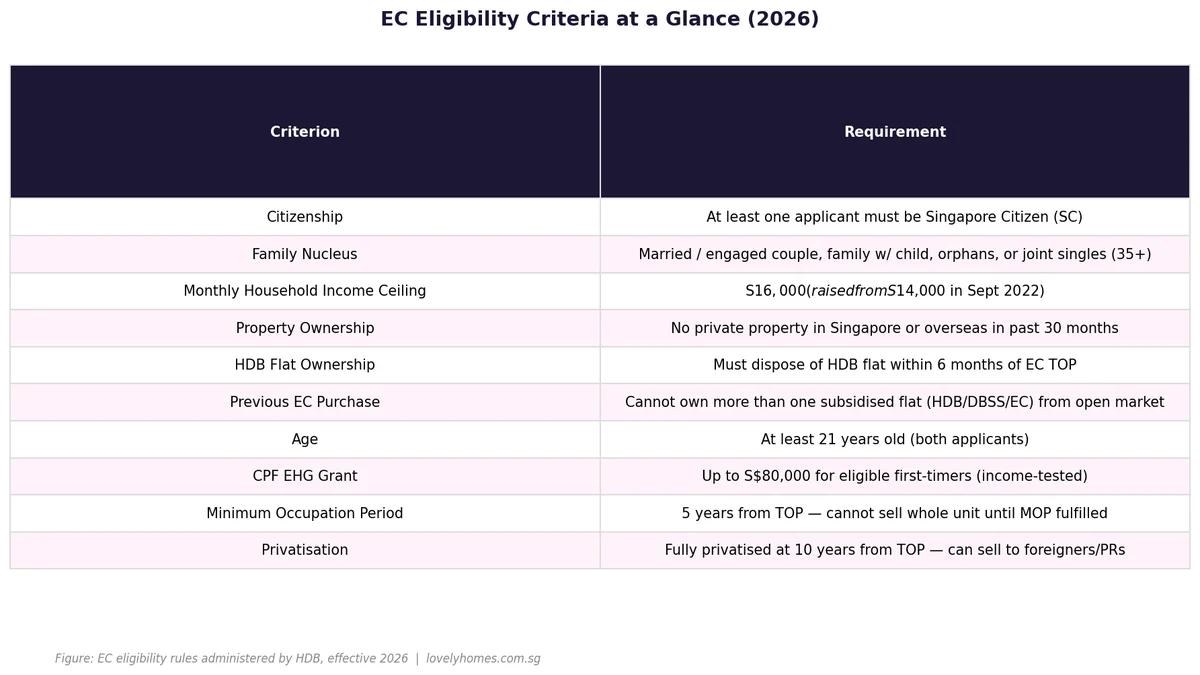
- At least one applicant must be a Singapore Citizen (SC); monthly household income ceiling is S$16,000 (raised from S$14,000 in September 2022).
- Eligible first-timer buyers may receive up to S$80,000 in CPF Enhanced Housing Grant (EHG), subject to income testing.
- Only bank financing is available for ECs , no HDB loan. Loan-to-Value (LTV) is up to 75%; TDSR of 55% applies.
- Minimum Occupation Period (MOP): 5 years from the date of Temporary Occupation Permit (TOP). You cannot sell or rent out the entire unit during this period.
- After 5 years (post-MOP): resale to Singapore Citizens and Permanent Residents only.
- After 10 years from TOP: the EC is fully privatised and can be sold to foreigners. Foreign buyers pay ABSD (currently 60%).
- No Additional Buyer’s Stamp Duty (ABSD) for SC buying their first EC. ABSD applies for second and subsequent properties.
What Is an Executive Condominium?
An Executive Condominium (EC) is a unique housing type found only in Singapore. Introduced in 1995, ECs were designed to meet the aspirations of the “sandwiched class” , households that earned too much to qualify for standard HDB Build-To-Order (BTO) flats but found private condominiums financially out of reach.
ECs are constructed by private developers on land sold by the Housing and Development Board (HDB), under a framework that imposes a set of public-housing rules at the point of sale. Over time, however, these restrictions are progressively lifted, allowing the EC to transition into a fully private condominium. This two-stage life cycle , public at birth, private at maturity , is what makes ECs both accessible and potentially lucrative.
The Urban Redevelopment Authority (URA) and HDB jointly administer the EC framework. HDB selects and tenders EC sites as part of the Government Land Sales (GLS) programme; private developers then design, build, and sell the units directly to eligible buyers.
EC Eligibility: Who Can Buy?
EC eligibility rules are more restrictive than those for private condominiums but more relaxed than those for new HDB BTO flats. All criteria must be met at the point of application.
The key qualifying conditions are as follows. First, at least one applicant must be a Singapore Citizen. This means SC–SC couples and SC–SPR (Singapore Permanent Resident) couples both qualify; however, SPR–SPR couples and foreigners cannot apply for a new EC launch directly. Second, applicants must form an eligible family nucleus , married or engaged couples, families with children, orphaned siblings applying jointly, and under the Joint Singles Scheme, two or more SC singles aged 35 or above may apply together.
Third, the monthly household income ceiling is S$16,000, a limit set by HDB. This threshold was raised from S$14,000 in September 2022 to accommodate wage growth and broaden access to the EC scheme. Households earning above S$16,000 are ineligible and must look to the private condo market. Fourth, neither applicant may own private residential property in Singapore or overseas, nor have disposed of such property within the 30 months preceding the EC application. Fifth, if either applicant currently owns an HDB flat, it must be sold or transferred within six months of the EC receiving its TOP.
EC Pricing: The Launch Discount and What It Means
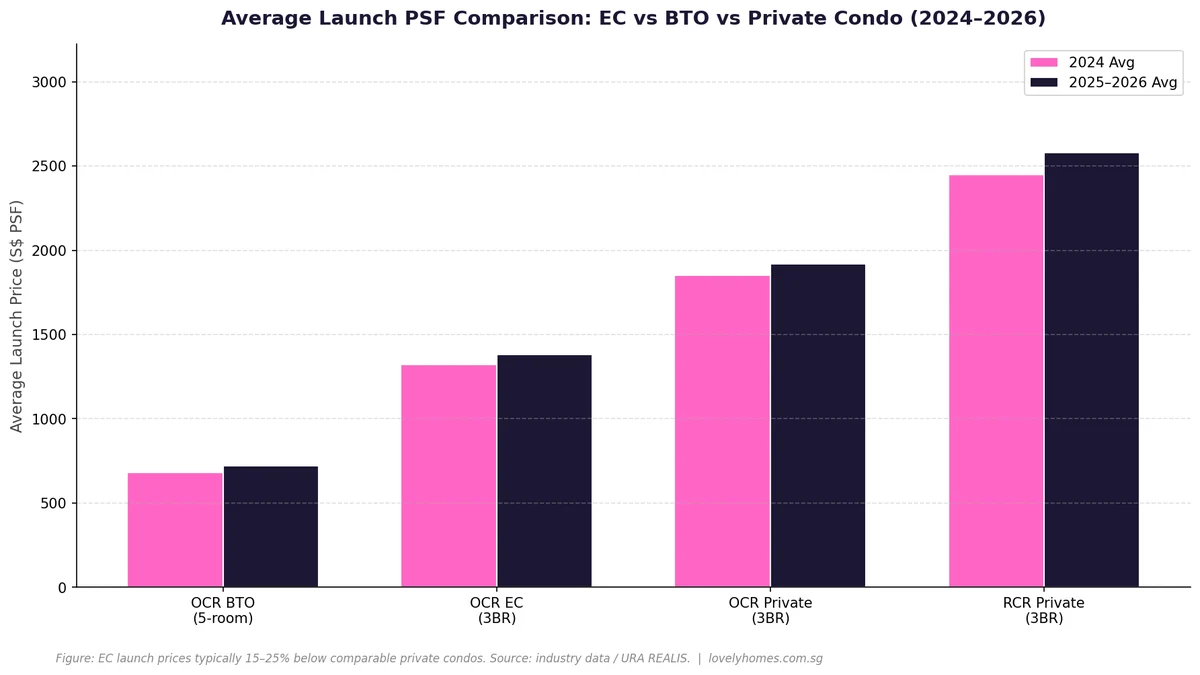
At launch, new EC units are typically priced 15–25 per cent below comparable private condominiums in the same area. This launch discount reflects the public-housing rules that apply for the first ten years , primarily the MOP restriction and the limitation on resale to foreigners. Buyers are, in effect, compensated for accepting these constraints.
The practical implication is significant. An EC buyer who meets the eligibility criteria can acquire a condominium-quality home in a well-connected location at a meaningfully lower cost than the private market. Once the MOP is fulfilled and, ultimately, once the EC reaches full privatisation, the gap with private condo prices tends to narrow , often substantially , providing the owner with capital appreciation driven partly by the removal of restrictions.
Industry data for 2025–2026 shows new EC launches in the Outside Central Region (OCR) pricing in the S$1,300–S$1,450 PSF range , well below OCR private condo launches at S$1,850–S$2,100 PSF. The BTO new flat price (on a per-square-foot equivalent basis) is lower still, but BTO flats are leasehold 99-year properties without the full condominium facilities that an EC offers.
CPF Housing Grants for EC Buyers
First-timer families purchasing a new EC may apply for the Enhanced CPF Housing Grant (EHG). The EHG is administered by HDB and credited directly into the buyers’ CPF Ordinary Accounts, where it is applied towards the purchase price or outstanding loan. The grant amount is income-tested: households with an average gross monthly income at or below S$1,500 qualify for the maximum S$80,000 grant; the amount tapers as income rises, reaching S$5,000 for households earning up to S$9,000 per month. Households earning above S$9,000 are not eligible for the EHG.
The EHG must be applied for through the HDB e-Service portal after an Option to Purchase (OTP) is granted. Buyers should factor grant eligibility into their financial planning early, as the grant can meaningfully reduce the initial outlay or the quantum of the bank loan required.
EC Ownership Timeline: From Ballot to Privatisation
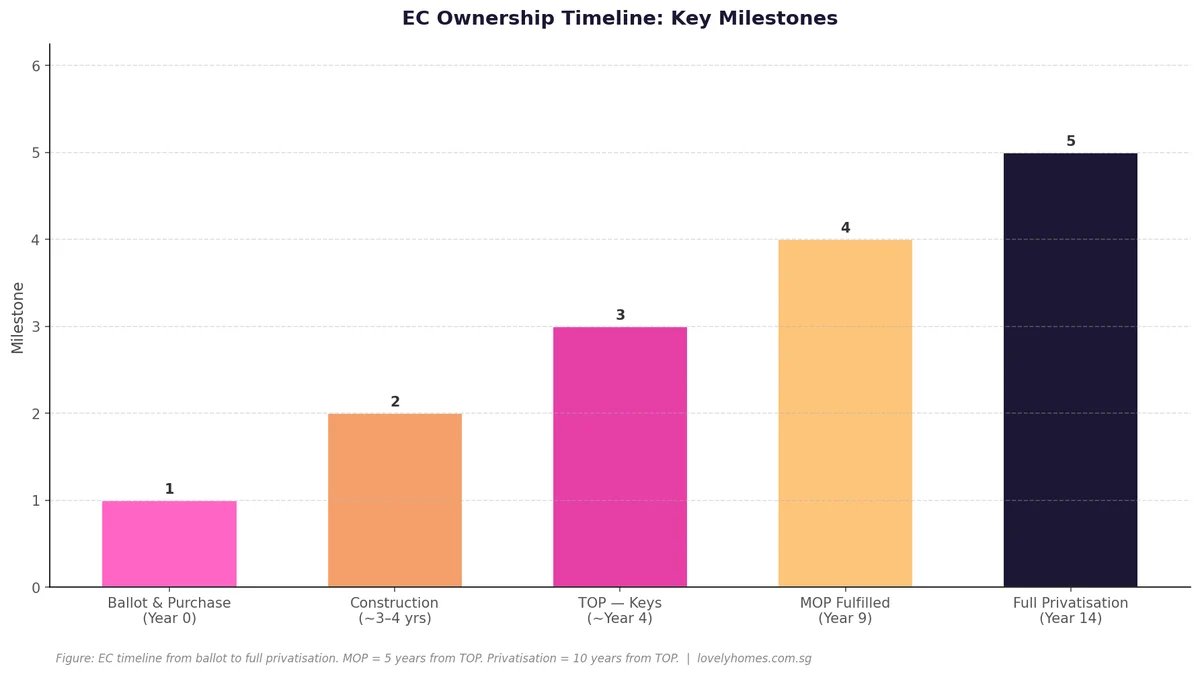
Understanding the EC timeline is critical to making an informed purchase decision. The lifecycle unfolds in broadly five stages. At the time of ballot and purchase (Year 0), the buyer signs an OTP, secures a bank loan, and pays the requisite stamp duty. Construction typically takes three to four years from the date of purchase; during this period no occupation is permitted and progress payments are made as construction milestones are reached.
The TOP is issued when the building is certified fit for occupation , typically four to five years after the sales launch. The five-year MOP runs from this date. During the MOP, the entire unit cannot be sold on the open market, and it cannot be rented out as a whole. Owners may, however, rent out individual rooms (subject to HDB conditions). After the MOP is fulfilled (approximately nine years from the sales launch), the owner can sell the unit on the open market, but only to Singapore Citizens and Permanent Residents. Finally, ten years after the TOP, the EC achieves full privatisation: it is legally indistinguishable from a private condominium, and foreigners may purchase it subject to ABSD and other prevailing rules.
Financing an EC: What Buyers Need to Know
Unlike HDB BTO flats, ECs are ineligible for HDB concessionary loans. All EC financing must be arranged through a commercial bank or a licensed financial institution. The applicable rules are the same as those for private property purchases: the LTV ratio is capped at 75% of the purchase price or the property’s valuation, whichever is lower; buyers must have at least 5% of the purchase price in cash (the remaining 20% can come from CPF Ordinary Account savings); and the Total Debt Servicing Ratio (TDSR) of 55% applies to ensure the buyer’s total monthly debt obligations do not exceed 55% of gross monthly income. The Mortgage Servicing Ratio (MSR), which caps monthly repayments to 30% of gross income for HDB flats, does not apply to EC purchases.
Summary: EC vs BTO vs Private Condo at a Glance
| Feature | HDB BTO Flat | Executive Condo (EC) | Private Condo |
|---|---|---|---|
| Developer | HDB | Private (on HDB land) | Private |
| Citizenship requirement | At least 1 SC | At least 1 SC | None |
| Income ceiling | S$14,000 (varies) | S$16,000 | None |
| CPF Housing Grant | Up to S$120,000 | EHG up to S$80,000 | None |
| HDB loan available? | Yes | No | No |
| LTV (bank loan) | 75% | 75% | 75% |
| MOP | 5 years | 5 years from TOP | None |
| Resale after MOP (before 10 yrs) | SC & SPR | SC & SPR | SC, SPR, Foreigner |
| Resale after 10 years | SC & SPR | SC, SPR & Foreigner | SC, SPR & Foreigner |
| Condo facilities | No | Yes (pool, gym, etc.) | Yes |
| ABSD on purchase (1st property, SC) | Nil | Nil | Nil |
| Typical launch discount vs private | Very large (subsidised) | 15–25% | Benchmark |
Worked Example: Buying a 3-Bedroom EC in 2026
Case Study , Mr & Mrs Raj: First-Time EC Buyers
Profile: Mr Raj (SC, 34) and Mrs Raj (SC, 32), married, no prior property ownership. Combined gross monthly income: S$12,500. Purchasing a 3BR EC unit in Tengah at S$1,320,000.
Buyer’s Stamp Duty (BSD): administered by IRAS on all property purchases.
- First S$180,000 @ 1% = S$1,800
- Next S$180,000 @ 2% = S$3,600
- Next S$640,000 @ 3% = S$19,200
- Next S$320,000 @ 4% = S$12,800
- Total BSD = S$37,400
ABSD: Nil , both applicants are SC and this is their first residential property.
CPF EHG Grant: Monthly household income S$12,500 exceeds the S$9,000 income ceiling , not eligible for EHG. (A household earning S$7,000/mth would receive S$40,000; one earning S$5,000 would receive S$60,000.)
Bank Loan: 75% LTV = S$990,000. Assumed rate: 3.40% per annum / 30 years. Monthly repayment ≈ S$4,387.
TDSR Check: S$4,387 ÷ S$12,500 = 35.1% , well within the 55% TDSR limit. PASS.
Cash down payment (5% minimum): S$66,000. Remaining 20% (S$264,000) may be funded from CPF Ordinary Account.
Total upfront outlay: BSD S$37,400 + cash down S$66,000 + legal fees ~S$3,000 = ≈ S$106,400 in cash (plus CPF S$264,000).
Why ECs Make Sense for the Sandwiched Class
The EC scheme directly addresses the affordability gap that exists between HDB public housing and private condominiums in Singapore. For households earning between S$9,000 and S$16,000 per month , comfortably above the threshold for most HDB grants but priced out of new private launches , the EC offers condominium-quality living at a meaningful discount.
The investment case is buttressed by the privatisation mechanism. Historically, ECs that reached full privatisation have traded at prices approaching or matching comparable private condominiums in the same district. The combination of a lower entry price, CPF grant eligibility for lower-income first-timers, and the embedded optionality of privatisation has made ECs among the most consistently resilient residential investment vehicles in the Singapore market over a 10–15-year horizon.
For peer-country context: Singapore’s EC framework has no direct equivalent in Hong Kong, Australia, or Malaysia. It is a deliberately engineered policy tool , the joint creation of HDB and the Ministry of National Development , designed to keep home ownership attainable without crowding out the private market. That institutional backing provides a degree of policy continuity that pure private-market investments cannot replicate.
What Might Come Next for the EC Scheme
The income ceiling of S$16,000, last revised in September 2022, may be reviewed again if household income growth continues. HDB has historically adjusted EC eligibility parameters every three to five years in response to prevailing wage levels and housing affordability conditions. Any upward revision would expand the eligible buyer pool and support demand at new EC launches.
There is ongoing speculation in industry circles about whether the MOP duration , unchanged at five years since the scheme’s inception , could be revisited, particularly given policymakers’ stated goal of discouraging short-term property speculation. A longer MOP would reduce the EC’s liquidity relative to private condos; conversely, no change is also possible if policymakers are satisfied that the current framework balances access and speculation risk adequately. These are speculative scenarios; buyers should plan around the current five-year MOP as the operative rule.
Frequently Asked Questions
Can a Singapore Permanent Resident (SPR) buy a new EC?
An SPR cannot purchase a new EC on their own or with another SPR as the sole applicants. However, an SPR can co-purchase a new EC together with a Singapore Citizen spouse under the Public Scheme or the Fiancé/Fiancée Scheme. The SC must be the principal applicant. The income ceiling and other eligibility criteria apply equally to the SC–SPR couple.
Can I rent out my EC unit during the MOP?
You cannot rent out the entire EC unit during the five-year MOP from the TOP date. However, you are permitted to rent out individual rooms within the unit, subject to compliance with HDB’s prevailing subletting regulations. Once the MOP is satisfied, you may rent out the entire unit without restriction, though you must still inform HDB of any tenancy arrangement.
What happens to the EC rules if I divorce during the MOP?
A divorce during the MOP does not automatically waive the MOP restrictions. In general, if a court order transfers the EC to one party, the MOP continues to run from the original TOP date. HDB will assess each case individually; in certain circumstances, an early disposal may be approved by HDB if both parties no longer have alternative housing. Legal and financial advice should be sought immediately in such situations, as the BSD and ABSD implications of any subsequent purchase also need to be considered.
Can I use CPF to pay for my EC?
Yes. CPF Ordinary Account (OA) savings can be used to fund the initial down payment (above the mandatory 5% cash portion), the Buyer’s Stamp Duty, legal conveyancing fees, and the monthly mortgage instalments. If an EHG grant is awarded, it is credited to your CPF OA and can also be applied towards the purchase. CPF usage for an EC is subject to the CPF property withdrawal limit, which ties the usable CPF amount to the property’s valuation and remaining lease at the time of purchase.
Do I need to sell my HDB flat before applying for an EC?
Not necessarily before applying , but you are required to dispose of your existing HDB flat within six months of the EC receiving its TOP. This means you can hold both your HDB flat and the under-construction EC simultaneously during the building phase. However, you cannot retain the HDB flat once you have taken possession of the EC unit. Failure to comply with this condition can result in financial penalties imposed by HDB.
Are there any ABSD exemptions for EC purchases?
Singapore Citizens purchasing their first EC are not liable for ABSD. SC couples buying jointly where both are first-time buyers similarly pay no ABSD. An SC–SPR couple buying a first EC is also not liable for ABSD on that purchase. However, if either buyer already owns a residential property (HDB flat, condo, or EC) at the time of purchase, ABSD is payable at the prevailing rate for their buyer profile. ABSD must be paid within 14 days of signing the Sales & Purchase Agreement, and remission applications (where applicable) are handled by IRAS.
What is the difference between a new EC launch and a resale EC?
A new EC launch is sold directly by the developer under the full HDB framework , eligibility criteria, income ceiling, and grant availability apply. A resale EC is one that has already passed its MOP (5+ years from TOP) and is sold on the open market. Resale ECs that are between 5 and 10 years old can be purchased by SC and SPR buyers without the income ceiling applying , but grants are generally not available. Resale ECs that are more than 10 years old (post-privatisation) can be purchased by anyone, including foreigners, and are treated as private property for all intents and purposes, including ABSD.
Related Articles
- ABSD Singapore 2026: Complete Guide to Additional Buyer’s Stamp Duty
- HDB Community Care Apartments Guide 2026
- Singapore Property Market Outlook 2027
- Singapore Property Stamp Duty Calculator Guide 2026
- Singapore HDB Lease Buyback Scheme Guide 2026
- Singapore Property Cooling Measures Timeline 2009–2026
- Singapore Property Financing Options Guide 2026
Disclaimer: This article is intended for general informational purposes only and does not constitute financial, legal, or property advice. EC eligibility rules, grant amounts, income ceilings, and stamp duty rates are subject to change by HDB, IRAS, and the Ministry of National Development. Readers should verify all information directly with HDB (hdb.gov.sg), IRAS (iras.gov.sg), and CPF Board (cpf.gov.sg) and consult a licensed property agent or legal professional before making any purchase decision. All dollar figures quoted are in Singapore Dollars (SGD) unless stated otherwise. Worked examples are illustrative and do not constitute a commitment or guarantee of any particular outcome.
Supporting graphics
Original article illustrations are available below.
- Figure 1: EC eligibility criteria administered by HDB, effective 2026. Source: HDB.gov.sg.
- Figure 2: Average launch prices (S$ PSF) across HDB BTO, EC, and private condo segments, Outside Central Region. Source: industry data / URA REALIS.
- Figure 3: Key milestones in EC ownership from ballot to full privatisation. MOP = Minimum Occupation Period. Source: HDB/URA framework.