Quick Answer: What Are Development Charge and Differential Premium?
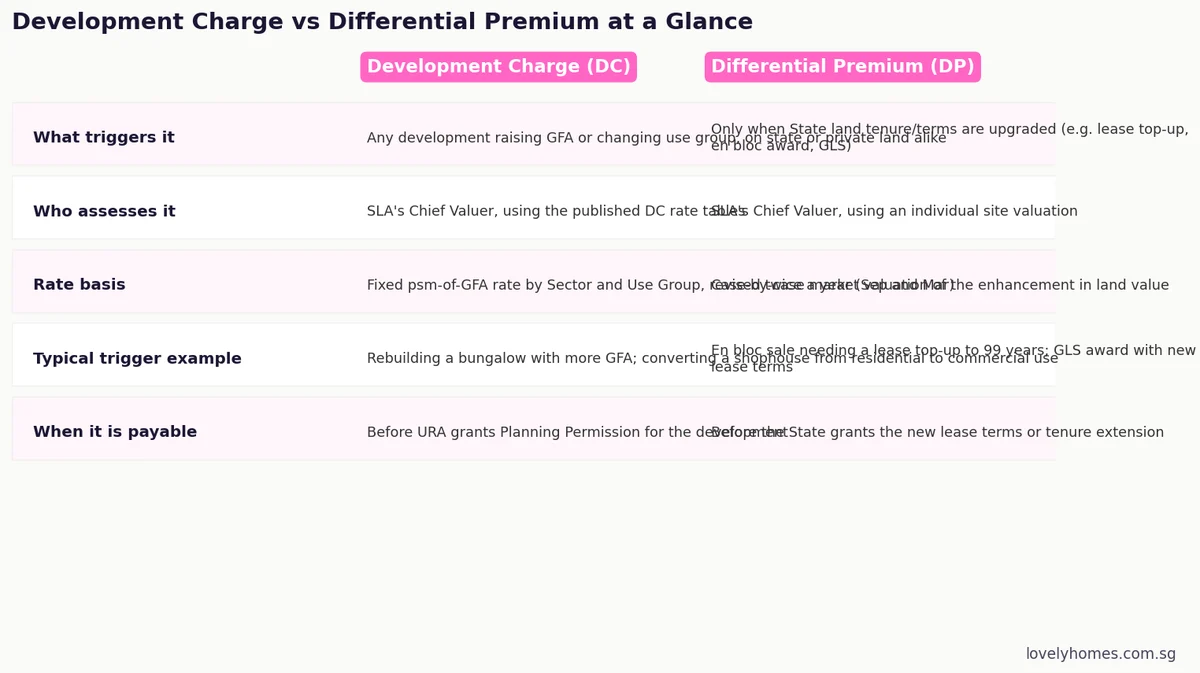
- Development Charge (DC) is a levy payable to the State when a proposed development increases a site’s gross floor area (GFA) or changes its use group, whether the land is state or privately held.
- Differential Premium (DP) is a related but distinct levy payable when the State agrees to upgrade the lease terms or tenure of a specific site, such as a lease top-up granted as part of an en bloc sale or a Government Land Sales (GLS) award.
- Both are assessed by the Singapore Land Authority’s (SLA) Chief Valuer, but DC uses published rate tables while DP uses an individual site valuation.
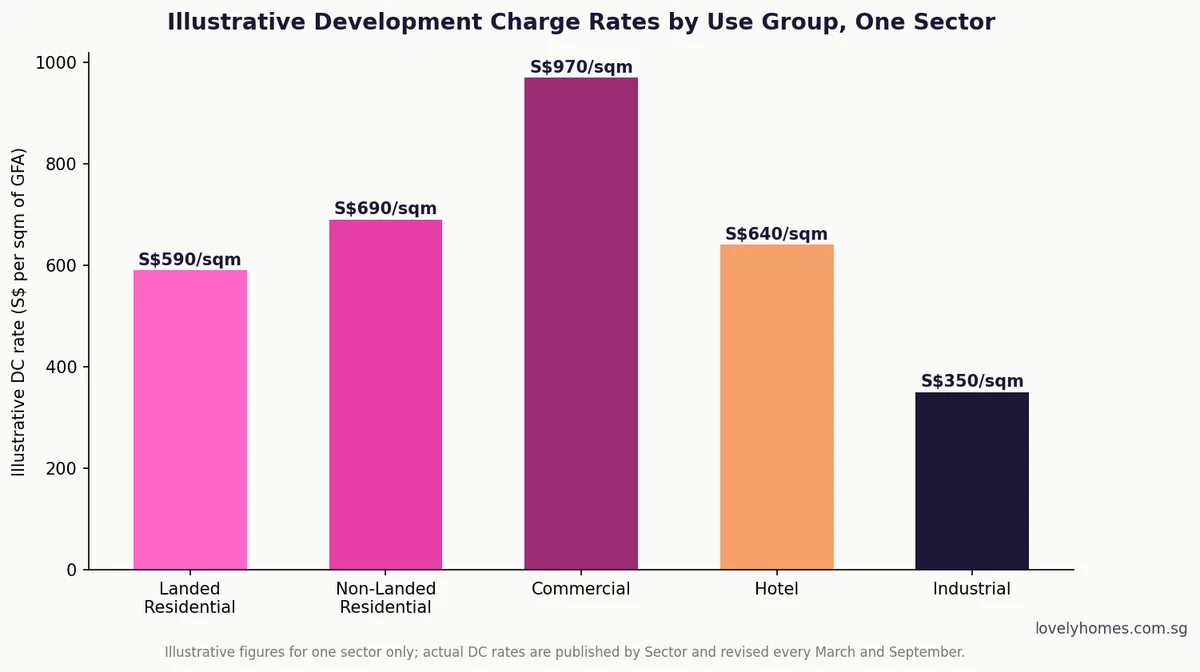
- DC rates are revised twice a year, typically effective 1 September and 1 March, based on a review of market land values across 118 geographic sectors and use groups.
- A homeowner rebuilding a bungalow with more GFA than before, or a shophouse owner converting from residential to commercial use, may trigger DC; an en bloc sale committee negotiating a 99-year lease top-up will typically face DP.
- DC or DP is payable before the relevant approval is granted, DC before URA’s Planning Permission, DP before the State grants the new lease terms.
- Both charges apply on top of, and are separate from, Buyer’s Stamp Duty, Additional Buyer’s Stamp Duty and Seller’s Stamp Duty, none of which are affected by DC or DP.
- Owners planning a rebuild, an A&A with a GFA increase, or a change of use should always request a written DC estimate from an appointed architect or directly check the current DC rate tables before committing to a scope of works.
Every property owner eventually runs into one of Singapore’s quieter but more expensive regulatory levies: the charge the State collects when a piece of land is allowed to be worth more than it was before. Whether that happens because a homeowner rebuilds a bungalow with a larger footprint, a shophouse changes from residential to commercial use, or a collective sale committee negotiates a fresh 99-year lease, the mechanism is broadly the same. Development Charge (DC) and Differential Premium (DP) are the two levies that capture this uplift in land value for the State, and they are frequently confused with each other and with stamp duty. This guide sets out exactly how each is calculated, when each applies, and what a typical bill looks like.
Development Charge: The Levy on Uplift From Redevelopment
Development Charge is administered under the Planning Act and applies whenever a proposed development would increase a site’s gross floor area, change its use group (for example, from residential to commercial), or increase the intensity of an existing use beyond what the site was last approved for. It applies regardless of whether the land is state land or held under a private title, which is why an ordinary landed homeowner rebuilding their own freehold bungalow can still be liable for DC if the new house has a larger GFA than the old one. DC is calculated using rate tables published jointly by SLA and URA, broken down by 118 geographic sectors and a set of standard use groups (landed residential, non-landed residential, commercial, hotel, industrial and others). The rate for a given sector and use group is multiplied by the increase in GFA (or, for a use change, by the difference in value between the old and new use groups) to arrive at the DC payable. Because these rates are revised every March and September to track market land values, the DC bill for the same project can differ depending on exactly when the Planning Permission application is submitted.
Differential Premium: The Levy on Lease and Tenure Upgrades
Differential Premium serves a related purpose but is triggered differently. Where DC is about physically building more, DP is about the State agreeing to grant better lease terms on land it retains an interest in, most commonly a top-up of a decaying leasehold tenure back to a fresh 99-year term. This is the levy most associated with en bloc sales: when a collective sale committee negotiates with the State to top up the remaining lease on an ageing development before selling to a developer, DP is payable on the uplift in land value that a longer lease represents. Unlike DC, DP is not read off a published table; SLA’s Chief Valuer assesses it on a case-by-case basis, reflecting the specific site’s characteristics, its remaining lease term, and current market land values. DP also arises in some Government Land Sales contexts and in restoration or amalgamation of State land parcels, where the successful tenderer’s bid already reflects an assumed lease term, and any subsequent variation triggers a DP recalculation.
When a Homeowner Actually Pays Development Charge
For most homeowners, DC only becomes relevant when they plan a rebuild or a substantial addition that increases GFA beyond what the existing house was approved for. A straightforward like-for-like rebuild that does not increase GFA, or a minor Addition & Alteration (A&A) that keeps the total floor area within the previously approved envelope, typically does not attract DC. Where DC does apply, it is calculated on the net increase in GFA only, not on the whole new structure. A shophouse owner converting from purely residential use to a commercial or mixed-use function is a common trigger for a use-group change, since commercial DC rates are usually higher per square metre than residential rates for the same sector. Anyone planning a rebuild or use change should ask their appointed architect to check the current DC rate table for their specific sector and use group, and to model the DC payable, before finalising a design or a purchase decision on a site earmarked for redevelopment.
How DC and DP Interact With Stamp Duties and Other Charges
Because DC and DP sit outside the stamp-duty framework entirely, they are easy to mistake for, or accidentally double-count against, Buyer’s Stamp Duty (BSD), Additional Buyer’s Stamp Duty (ABSD) and Seller’s Stamp Duty (SSD). Stamp duties are calculated on the purchase price or market value of a property transaction and are administered by IRAS; DC and DP are calculated on the uplift in development potential or lease value of a specific site and are administered by SLA. A single transaction can trigger both: a buyer acquiring a landed site with the intention to rebuild will pay BSD (and ABSD, if applicable) on the purchase itself, and separately may face DC later when Planning Permission is sought for the larger new house. Property tax, which is levied annually based on a property’s Annual Value, is a third, entirely separate charge that continues regardless of any DC or DP paid. Owners and their advisers should model all of these charges independently rather than assuming a DC estimate already accounts for stamp duty, or vice versa, since conflating the two is one of the more common budgeting errors seen in rebuild and collective sale planning.
Summary: DC and DP Facts at a Glance
| Question | Short Answer |
|---|---|
| Who assesses DC and DP? | SLA’s Chief Valuer, using published rate tables for DC and individual valuation for DP. |
| How often are DC rates revised? | Twice a year, typically 1 September and 1 March. |
| Does DC apply on private freehold land? | Yes, DC applies to GFA increases or use changes regardless of tenure. |
| What commonly triggers DP? | En bloc lease top-ups and certain Government Land Sales or amalgamation cases. |
| Is DC the same as Buyer’s Stamp Duty? | No. DC/DP are development levies; BSD/ABSD/SSD are transaction-based stamp duties. |
| When is DC payable? | Before URA grants Planning Permission for the development. |
Worked Example: Rebuilding a Bungalow With a Larger GFA
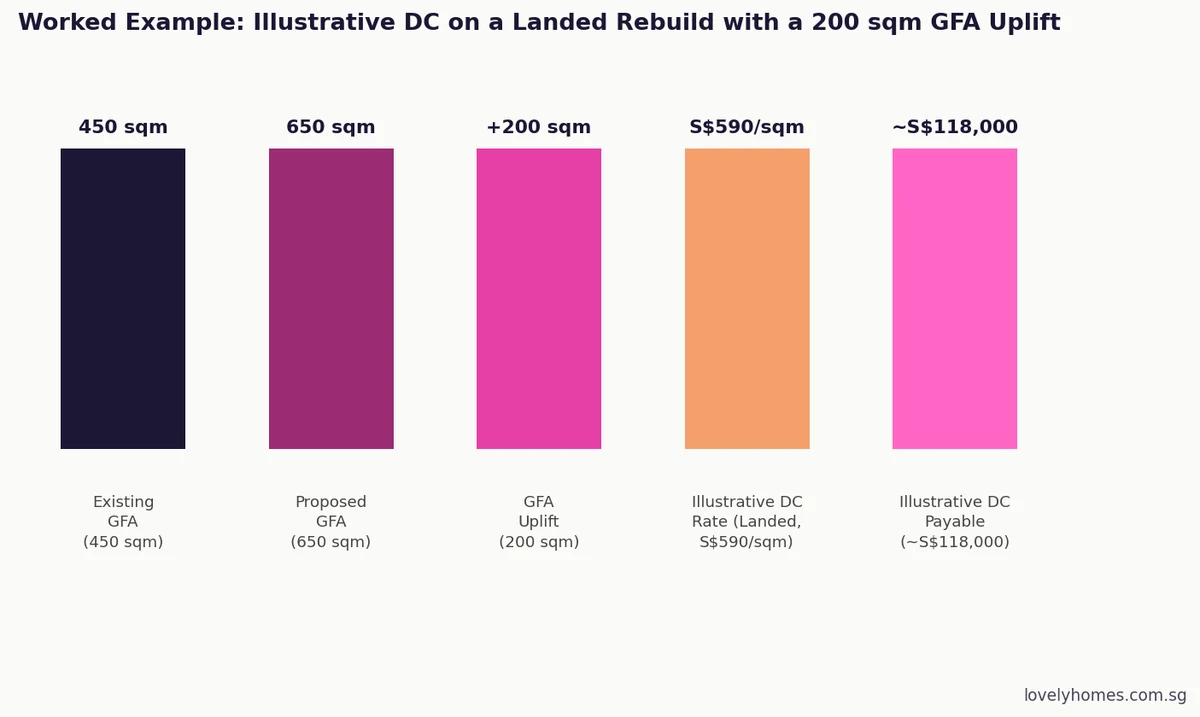
The scenario: a homeowner demolishes an ageing bungalow with an approved GFA of 450 sqm and rebuilds a new house with 650 sqm of GFA on the same freehold plot, an increase of 200 sqm.
The illustrative maths: using an illustrative landed-residential DC rate of S$590 per sqm for this sector (actual rates vary by sector and are revised twice yearly), the DC payable is calculated only on the 200 sqm uplift, not the full 650 sqm: 200 sqm x S$590/sqm = approximately S$118,000. This DC bill is entirely separate from the homeowner’s construction cost, professional fees, and any Buyer’s or Seller’s Stamp Duty that may separately apply to the underlying land transaction.
These figures are illustrative only. Actual DC rates depend on the specific sector, use group and the rate table in force on the date the Planning Permission application is submitted; a qualified architect or SLA’s published tables should always be checked for a current, site-specific figure.
Why This Matters for Owners and En Bloc Committees
DC and DP are easy to overlook because they sit outside the usual stamp-duty conversation that dominates most property due diligence, yet they can represent a substantial six- or seven-figure sum on a large redevelopment or en bloc sale. For an individual homeowner, failing to budget for DC on a rebuild with a GFA increase can materially change the economics of a project partway through design. For an en bloc sale committee, the DP payable on a lease top-up is typically factored into the developer’s bid and can affect the final sum distributed to each owner, which is why professional valuers and lawyers model DP exposure early in a collective sale process rather than leaving it as a late surprise. Both levies also interact with a site’s remaining tenure: a shorter lease generally means a larger DP if a top-up is sought, since the uplift in value from extending a near-expired lease is proportionally greater than extending one that still has decades left to run.
What Might Come Next
The following is informed speculation, not confirmed outcome. As redevelopment and en bloc activity continues across older private estates, including several ex-HUDC estates and ageing condominiums approaching the 99-year mark, DC and DP are likely to remain a recurring line item in collective sale negotiations and rebuild budgets. It is plausible that future DC rate revisions will need to keep pace with continued land value growth in sectors seeing strong GLS activity, which could widen the gap between DC rates in high-demand sectors and those in more mature, lower-growth areas. No specific rate change beyond the next scheduled March or September revision should be treated as confirmed.
Frequently Asked Questions
What is the difference between Development Charge and Differential Premium?
Development Charge applies when a development’s GFA increases or its use group changes, using published rate tables. Differential Premium applies when the State agrees to upgrade a site’s lease terms or tenure, such as a lease top-up in an en bloc sale, and is assessed on a case-by-case basis rather than from a table.
Does Development Charge apply to freehold land?
Yes. DC applies to any land where a development increases GFA or changes use group, regardless of whether the land is freehold or leasehold.
How often do Development Charge rates change?
DC rate tables are typically revised twice a year, with new rates usually taking effect from 1 September and 1 March, reflecting SLA and URA’s review of market land values.
Will I pay Development Charge if I rebuild my house without adding floor area?
Generally no. DC is calculated on the increase in GFA or a change in use group. A like-for-like rebuild that stays within the previously approved GFA typically does not attract DC, though it is still subject to the usual URA and BCA approvals.
Is Differential Premium the same as Buyer’s Stamp Duty?
No. DP is a development levy on a lease or tenure upgrade, payable to the State. BSD is a transaction-based stamp duty on the purchase price or market value of a property. They are separate charges and can both apply to the same underlying deal.
Who typically pays Differential Premium in an en bloc sale?
The DP for a lease top-up is usually factored into the developer’s overall bid for the site and is typically borne by the developer as part of the land acquisition cost, though the exact allocation depends on the specific sale and purchase agreement.
Where can I check the current Development Charge rates for my sector?
Current DC rate tables are published by the Singapore Land Authority and the Urban Redevelopment Authority. An appointed architect or qualified professional can also help identify the correct sector and use group for a specific site and model the DC payable.
Related Articles on LovelyHomes
Supporting graphics
Original article illustrations are available below.