
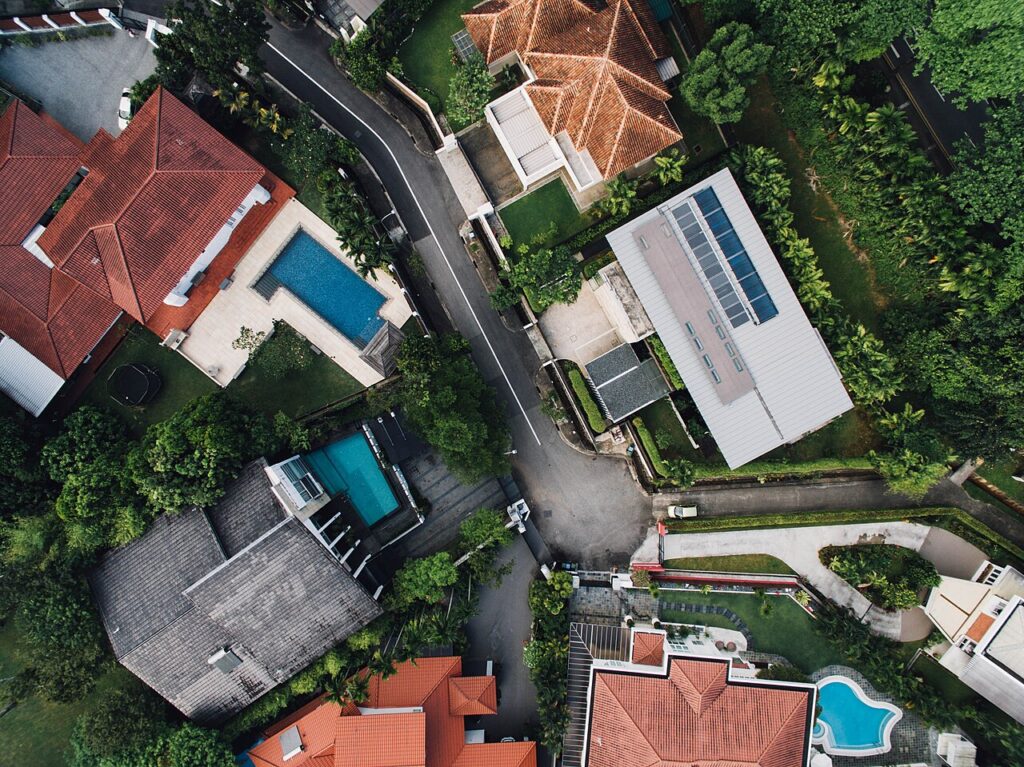
Good Class Bungalows (GCBs) have never been a volume market. They occupy roughly 2,800 plots across 39 gazetted GCB Areas, are limited to Singapore citizens (foreigners require Land Dealings Approval Unit approval, and approvals have tightened materially since 2023), and transact in single-digit monthly counts. Yet Q1 2026’s transaction record tells a coherent story: the S$50 million threshold has stopped being a headline number and started being an ordinary one.
Quick Answer — what shifted in Q1 2026?
- Volume held steady: first-quarter transaction count in the 39 GCB Areas stayed within the 8-14 deals range seen in the four prior quarters — no boom, no bust.
- Price floor re-set: deals below S$25 million are now unusual in the top 10 GCB Areas (Nassim, Cluny, Chatsworth, Dalvey, Ridout, Queen Astrid, White House Park, Gallop, Cornwall, Belmont).
- Land rate consolidated around S$1,900-2,500 psf depending on orientation, plot shape and approach road; corner and elevated plots now routinely cross S$2,500 psf.
- Buyer pool: almost exclusively Singapore Citizens. LDAU approvals for foreigners (including some Permanent Residents) have tightened since 2023 revisions.
- Financing: most transactions are cash-heavy; bank valuations have caught up with transacted prices, unlocking more mortgage-leveraged deals than the 2023-24 cycle.
The GCB framework — a very small, very protected segment
GCB Areas are gazetted under the URA’s 2019 Master Plan (and earlier plans going back to 1980), with specific planning parameters: minimum plot size of 1,400 sqm, minimum plot width of 18.5 m, maximum two storeys plus attic, a plot ratio capped at 0.4, and strict building-envelope controls including setbacks and landscaping. The 39 Areas are concentrated in the Bukit Timah, Tanglin, Holland and Chancery enclaves (most in Districts 10 and 11), with outliers in Districts 5 (Pasir Panjang, Ridout) and 21 (Binjai Park, Upper Bukit Timah).
These planning restrictions make GCBs a genuinely non-replicable product. No new GCB Areas have been gazetted since 1980, and because redevelopment is capped at 0.4 plot ratio with a two-storey envelope, you cannot “build your way out” of scarcity the way you could in a condominium district.
What the 2026 transactions are telling us
Looking across the publicly filed caveats in the Urban Redevelopment Authority’s property-data portal for January-March 2026, three patterns emerge:
| Pattern | What Q1 2026 caveats suggest |
|---|---|
| Prime-Area premium is widening | Top-ranked GCB Areas (Nassim, Dalvey, Cluny, Chatsworth) now routinely price at a 30-50% premium to outer Areas like Bin Tong Park or Binjai Park. |
| Condition arbitrage narrowing | Renovated or newly built homes are commanding closer land-rate parity with bare plots than in 2023 — buyers are increasingly willing to pay a premium for turnkey delivery. |
| Generational transfers | A growing share of Q1 2026 transactions are second-generation family owners decoupling or consolidating inherited holdings, rather than new outright buyers. |
Why S$50 million is no longer headline material
A S$50 million transaction in 2018 would have been headline news; in Q1 2026 it is a mid-range Nassim or Chatsworth deal. Two arithmetic reasons:
- Land rates: A typical 1,800 sqm (19,375 sqft) Nassim plot at S$2,500 psf on land is already S$48.4 million for the land alone. Add a built structure valued at construction-replacement cost (S$5-10m for a typical new-build) and total transacted value lands comfortably above S$50m.
- Currency anchoring: For regional UHNW buyers, S$50m converts to ~US$37m, which is not a stretch against equivalent ultra-prime markets in Hong Kong (the Peak), London (Mayfair) and New York (Upper East Side).
Worked example — a 1,800 sqm Nassim GCB in 2026:
- Land area: 1,800 sqm / 19,375 sqft.
- Land rate assumption: S$2,500 psf on land.
- Implied land value: S$48.4 million.
- Plus existing habitable house valued at replacement cost S$6 million (4,000 sqft built-up, S$1,500 psf).
- Total transacted value: S$54.4 million.
- Singapore Citizen buyer, first residential property: BSD (at progressive rates) ~ S$3.1m; ABSD 0%.
- SC buyer, second residential: ABSD 20% = S$10.88m additional.
- Singapore PR, first: ABSD 5% = S$2.72m; second: 30% = S$16.32m.
- Foreign buyer (non-PR, LDAU-approved): ABSD 60% = S$32.6m — total stamp cost ~S$35.7m on top of price.
Who is buying in 2026?
The eligibility rules effectively pre-filter the buyer pool:
- Singapore Citizens (SC): no LDAU approval required for landed residential property in GCB Areas. This is the dominant buyer category.
- Singapore Permanent Residents: require LDAU approval for landed residential, and applications are assessed on whether the applicant has made an exceptional economic contribution to Singapore.
- Foreigners (non-PR): require LDAU approval; approvals for foreign-national GCB purchasers have been the tightest category since a 2023 policy tightening.
The consequence: the GCB market is effectively a domestic ultra-wealthy-citizen market, with a narrow layer of LDAU-approved PR buyers and an even narrower layer of approved foreign nationals. This structural closing-off of foreign demand is why the GCB segment has been less volatile in response to the 60% ABSD regime than CCR condominiums have been.
Financing dynamics — cash-heavy but leverage returning
Because GCB buyers typically have balance-sheet depth, transactions in 2023-24 ran heavily cash. In 2026 we are seeing more buyers leverage meaningful mortgages again, for two reasons:
- Bank valuations have caught up with realised transaction prices. The 2023 gap between bank valuation and transacted price has largely closed in prime GCB Areas, unlocking 75% LTV on a realistic price.
- Mortgage rates have drifted down from the 2023-24 cycle high. A blended floating rate at or near 2.5% makes leverage more attractive as an asset-allocation tool rather than a financing necessity.
Note that the Monetary Authority of Singapore’s Total Debt Servicing Ratio (TDSR) still caps total debt service at 55% of gross income, which is the binding constraint for a growing number of high-income professionals entering the segment.
What to watch in Q2 2026
- Bidding intensity on listed assets: GCB-Area plots that go to the open market rarely take longer than 90 days in 2026; listings at a realistic valuation typically generate 3-5 shortlisted offers.
- Off-market share: an increasing percentage of transactions never list publicly; URA caveats capture them only after completion, so real-time market colour is hard to come by.
- Redevelopment pipeline: demolition / new-build starts are a forward indicator of inventory turnover.
- Cooling-measure sensitivity: the GCB segment has been comparatively insulated from ABSD moves because the SC buyer pool is not directly ABSD-liable on a first residential; watch instead for any moves on the LDAU framework or on land-use controls.
Key takeaway. The GCB market in Q1 2026 is neither frothy nor frozen — it is working. Volume sits in its long-run band, land rates have consolidated around S$1,900-2,500 psf in prime Areas, S$50m is a mid-range Nassim ticket rather than a headline, and financing is back in the mix without looking stretched against TDSR. The structural scarcity story has not changed: 2,800 plots, 39 gazetted Areas, no new supply, and a buyer pool pre-filtered by the LDAU framework.
Related reading
- Singapore Landed Property Guide 2026
- ABSD Singapore Complete Guide 2026
- Singapore Property Valuation 2026
- 21 Anderson: Tanglin Freehold Boutique
- 10 Evelyn: Newton Freehold Boutique
Source & authority references
- Source: Urban Redevelopment Authority (URA) — Property Data Portal caveats, Q1 2026. Figures in this article are compiled from URA’s public caveat records and MAS regulatory guidance, not from brokerage commentary.
- Urban Redevelopment Authority — 2019 Master Plan, Good Class Bungalow Area schedules.
- Singapore Land Authority (SLA) — Residential Property Act; Land Dealings Approval Unit.
- Monetary Authority of Singapore (MAS) — Notice 645 on Total Debt Servicing Ratio.
- Inland Revenue Authority of Singapore (IRAS) — BSD and ABSD rate tables.
Disclaimer: GCB transaction values and land-rate ranges in this article are indicative and based on publicly available URA caveat data at the date of publication. Individual GCB plots vary materially in value depending on plot shape, frontage, orientation, road width, elevation and redevelopment potential. Any decision to buy, sell, hold or redevelop a Good Class Bungalow should be grounded in a formal valuation by a licensed valuer and supported by legal advice from a solicitor regulated by the Singapore Institute of Legal Education. Nothing in this article constitutes investment advice or an offer for sale.