Quick Answer: Leasing Industrial Space as an SME
- Singapore SMEs can lease factory or warehouse space either from JTC, the Government’s industrial landlord, or from a private landlord in a strata-titled or whole-building development.
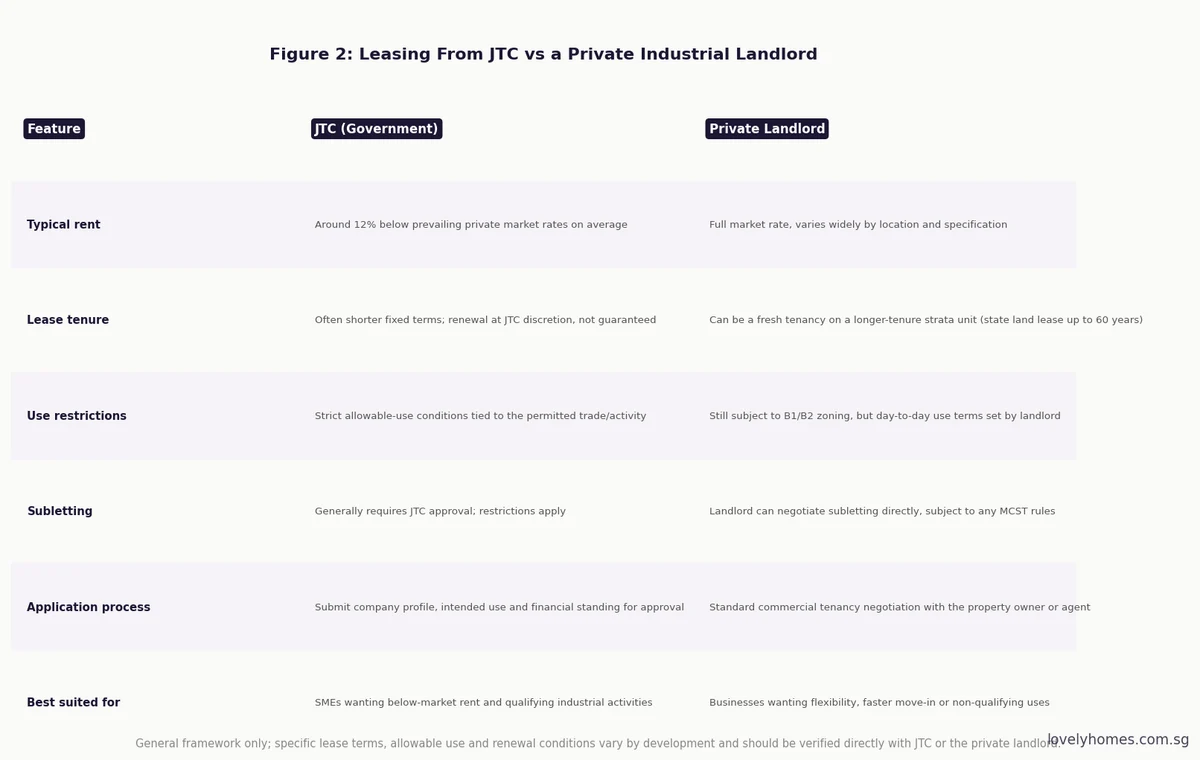
- JTC rents are typically around 12% below prevailing private market rates on average, but come with stricter allowable-use conditions and less flexibility on subletting and renewal.
- Industrial land and buildings are zoned B1 (clean and light industry, such as electronics, software and R&D) or B2 (general and heavy industry with a larger nuisance buffer); this zoning determines what a business can actually do on site.
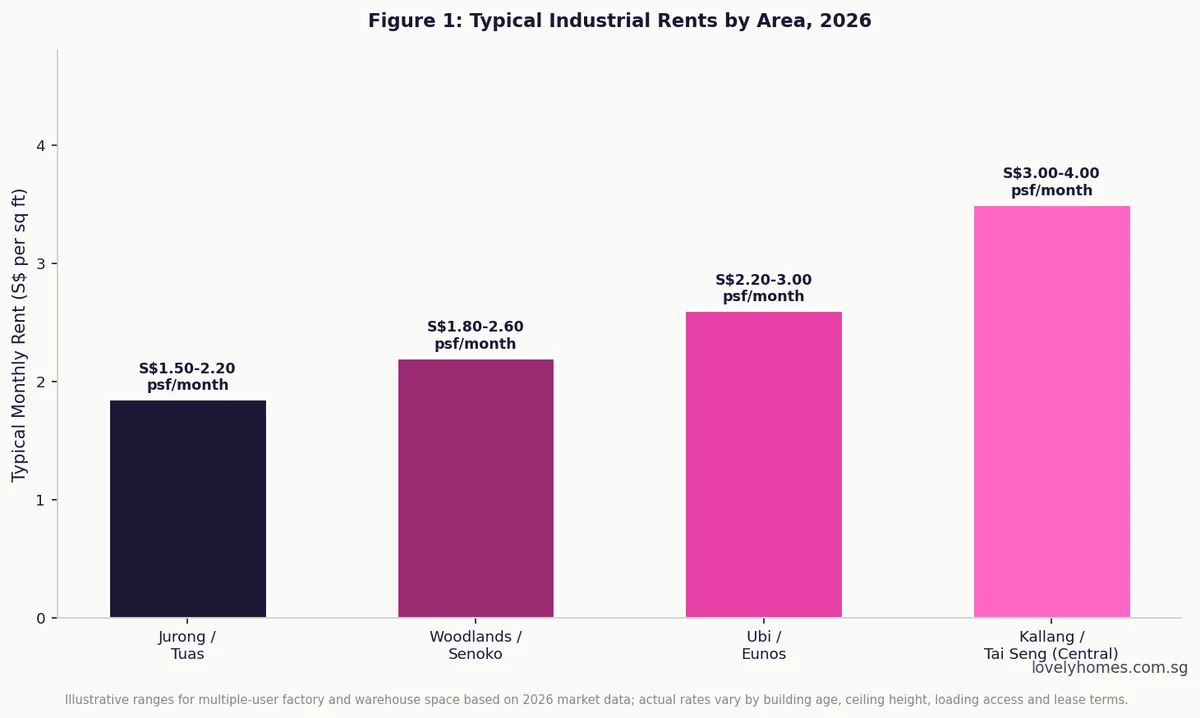
- Typical 2026 rents range from around S$1.50 to S$2.20 per sq ft per month in Jurong and Tuas, up to S$3.00 to S$4.00 per sq ft per month in central locations such as Kallang and Tai Seng.
- As at Q2 2026, the JTC all-industrial rental index stood at 113.8, up 0.5% quarter-on-quarter and 2.1% year-on-year, with occupancy at 89.1%.
- GST at 9% is chargeable on industrial rent where the landlord is GST-registered, which matters for SMEs below the GST registration threshold that cannot claim input tax credit.
- Both B1 and B2 developments must allocate a minimum 60% of gross floor area to core industrial activities under URA’s development rules.
For many Singapore SMEs, whether a small manufacturer, a logistics operator or a growing e-commerce business needing warehouse space, the decision of where and how to lease industrial premises is one of the largest fixed costs the business will take on. Unlike office or retail leasing, industrial leasing in Singapore runs through two quite different channels: JTC, a statutory board that owns and leases a large share of the nation’s industrial land and buildings, and private landlords, who own strata-titled units or whole industrial buildings developed on land originally sold by the Government. This guide explains how the two options differ, what B1 and B2 zoning actually means for what a business can do, typical rental rates by area, and the true all-in monthly cost once GST is factored in.
B1 vs B2: Why Zoning Determines What Your Business Can Actually Do
Before comparing landlords, an SME first needs to understand zoning, because it governs whether a particular unit can even be used for the intended purpose. Under URA’s Master Plan, industrial land is zoned either Business 1 (B1), intended for clean and light industries such as electronics assembly, software development, packaging, media production and research and development with minimal environmental impact, or Business 2 (B2), intended for general and heavier industrial uses that are noisier or more process-intensive. The practical difference shows up in the required nuisance buffer: the National Environment Agency generally requires a buffer of up to 50 metres around a B1 development, compared with up to 100 metres around a B2 development, reflecting the greater potential for noise, smell or emissions from B2 activities. Both B1 and B2 developments must also allocate a minimum 60% of gross floor area to core industrial use, limiting how much space within a building can be devoted to ancillary offices or ancillary retail.
An SME evaluating a unit should always check its specific trade or activity against the zoning and any development-specific allowable-use conditions before signing, since using a unit for a purpose outside its permitted use can trigger enforcement action regardless of what the landlord privately agrees to.
Leasing From JTC: Below-Market Rent, With Conditions
JTC is the statutory board responsible for developing and managing much of Singapore’s industrial land and space, and it leases directly to qualifying businesses rather than existing purely to maximise investment returns the way a private landlord does. On average, JTC rents run around 12% below prevailing private market rates, which is a meaningful saving for cost-sensitive SMEs. In exchange, JTC tenancies typically come with a shorter fixed lease tenure than a private strata purchase, renewal at the end of a JTC lease is not guaranteed and is decided at JTC’s discretion, and subletting the space to a third party generally requires JTC’s prior approval, unlike a private lease where the landlord can usually negotiate subletting terms directly with the tenant.
To lease from JTC, a business typically submits a company profile, a description of its intended use, and documents demonstrating financial standing as part of the application; approval timelines vary depending on how complex the intended use is and whether further planning permission or licensing (for example, from NEA or SCDF) is required before the space can be occupied.
Leasing From a Private Landlord: More Flexibility, Higher Rent
Private industrial buildings are typically developed on state land originally sold with a fixed tenure, often 60 years, and then sold as strata-titled units to individual investors or developers, who in turn lease the units out on ordinary commercial tenancy terms. This structure generally gives an SME more flexibility: subletting can usually be arranged directly with the landlord without a third-party approval step (beyond any Management Corporation rules on permitted use), lease terms are more freely negotiable, and move-in timelines are often faster since there is no government approval process to clear first. The trade-off is cost: private industrial rents in 2026 run meaningfully higher than JTC rents for comparable space, particularly in well-connected, central locations.
Businesses whose intended use does not neatly qualify for a JTC tenancy, or that place a high value on flexibility and speed of move-in, often find the private market the more practical route despite the rent premium.
The GST Factor: Why the Headline Rent Is Not the Whole Story
A rental quote of, say, S$1.80 per sq ft per month is only part of the picture. Where the landlord, whether JTC or a private owner, is GST-registered, Singapore’s 9% Goods and Services Tax is chargeable on top of the base rent. A GST-registered tenant with sufficient taxable turnover can usually claim this back as input tax, making it broadly cost-neutral. However, for smaller SMEs that are not GST-registered (generally because their annual taxable turnover is below the S$1 million registration threshold) or that make partially-exempt supplies, the 9% GST is a genuine, non-recoverable addition to the monthly rent bill, and should always be built into a lease budget rather than assumed away.
Summary: Industrial Leasing Facts at a Glance
| Question | Short Answer |
|---|---|
| Is JTC always cheaper than a private landlord? | On average, yes, around 12% below market, but with stricter use conditions, less guaranteed renewal and subletting restrictions. |
| What is the difference between B1 and B2? | B1 is for clean and light industry with a smaller nuisance buffer; B2 is for general and heavier industry with a larger buffer. |
| Do I pay GST on industrial rent? | Yes, 9% GST applies where the landlord is GST-registered; GST-registered tenants can generally claim this back as input tax. |
| What are typical 2026 rents? | Roughly S$1.50 to S$2.20 psf/month in Jurong/Tuas, up to S$3.00 to S$4.00 psf/month in central areas such as Kallang and Tai Seng. |
| Is JTC lease renewal guaranteed? | No, renewal at the end of a JTC lease term is at JTC’s discretion and is not guaranteed. |
| Minimum core industrial GFA allocation? | At least 60% of gross floor area must be allocated to core industrial activities under URA rules, for both B1 and B2. |
Worked Example: Comparing a 3,000 sq ft Unit
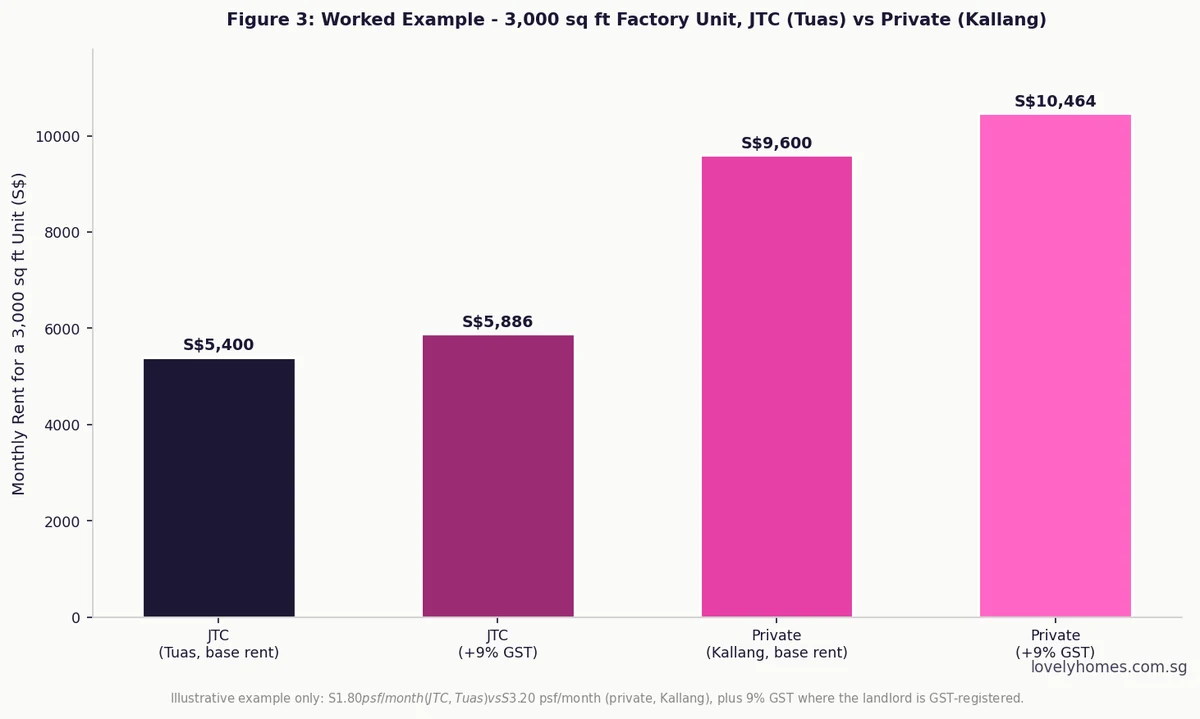
The scenario: A small precision-parts manufacturer needs a 3,000 sq ft factory unit and is comparing a JTC unit in Tuas against a private strata unit in Kallang.
JTC option: At an illustrative S$1.80 per sq ft per month, the base monthly rent is S$5,400. Adding 9% GST (assuming the JTC-appointed landlord entity is GST-registered) brings the total to approximately S$5,886 per month.
Private option: At an illustrative S$3.20 per sq ft per month in Kallang, the base monthly rent is S$9,600. Adding 9% GST brings the total to approximately S$10,464 per month.
The difference: The JTC option saves the business roughly S$4,578 per month, or close to S$55,000 per year, but comes with a Tuas location further from central business districts, a shorter, non-guaranteed lease tenure, and JTC’s approval requirement before subletting any unused space. The private option in Kallang costs considerably more but offers a more central location, greater flexibility, and a faster move-in process.
These figures are illustrative only; actual rents, GST treatment and lease terms vary by specific building, unit condition and negotiation.
Why This Matters for SME Owners and Property Investors
For SME owners, the JTC-versus-private decision is rarely just about the headline rent; it is a trade-off between cost savings and operational flexibility. A business with a stable, clearly-qualifying industrial activity and a long planning horizon may find JTC’s lower rent worth the reduced flexibility, while a fast-growing or logistics-dependent business that values a central location, faster fit-out and freer subletting rights may find the private market’s higher rent justified by the operational upside. For property investors who own strata-titled industrial units and lease them to SME tenants, understanding this dynamic matters too: an investor’s achievable rent is always benchmarked against the nearby JTC alternative, and units in locations or buildings that are meaningfully more convenient than the nearest JTC estate tend to command and sustain the rent premium more reliably over a full lease cycle.
Frequently Asked Questions
Can any SME apply to lease space directly from JTC?
Generally yes, subject to the business’s intended use qualifying under the relevant zoning and JTC’s approval of the application, which assesses the company profile, intended use and financial standing.
What happens if my business activity does not match the unit’s B1 or B2 zoning?
Using a unit for a purpose outside its permitted zoning and allowable use can breach planning conditions regardless of what a landlord privately agrees to; always verify the specific allowable use before signing a lease.
Is subletting allowed under a JTC lease?
Subletting is generally restricted and typically requires JTC’s prior approval, unlike most private industrial leases where the landlord can negotiate subletting terms directly with the tenant.
Do I need to pay GST if I rent from a small private landlord who is not GST-registered?
No. GST only applies where the landlord is GST-registered; if the landlord is not registered, no GST is chargeable on the rent, though this is less common for larger commercial landlords.
Is JTC lease renewal automatic?
No. Renewal at the end of a JTC lease term is at JTC’s discretion and is not guaranteed, unlike some private tenancies where renewal options can be negotiated upfront.
Why are rents so much higher in central locations like Kallang or Tai Seng?
Central industrial locations benefit from proximity to the city, better transport connectivity and a limited supply of older, well-located industrial stock, all of which support higher achievable rents than outlying areas such as Tuas or Jurong.
Can I buy an industrial unit instead of leasing one?
Yes, strata-titled industrial units are available for purchase from private developers and on the resale market, subject to eligibility rules and financing considerations that differ from residential property; this is a separate decision from the leasing options covered in this guide.
Related Articles on LovelyHomes
- Commercial Property Investment Singapore 2026: No ABSD, GST, Types & Yields Guide
- Singapore Property Investment Guide 2026: How to Buy, Rent and Build Wealth Through Property
- GLS Programme Guide Singapore 2026: How Confirmed List and Reserve List Land Tenders Work
- Singapore Leasehold vs Freehold Property Guide 2026: Price Premiums, CPF Rules and What to Buy
- Rental Income Tax in Singapore 2026: A Landlord’s Guide to Declaring, Deducting and Saving
- Property Tax Singapore 2026: Complete Guide to Annual Value, Owner-Occupier and Non-Owner-Occupier Rates
Supporting graphics
Original article illustrations are available below.