Singapore MOP Guide 2026: Minimum Occupation Period Rules Explained
Quick Answer — Singapore MOP at a Glance
- MOP stands for Minimum Occupation Period — the mandatory period during which you must physically occupy your flat as your primary residence before you can sell it on the open market.
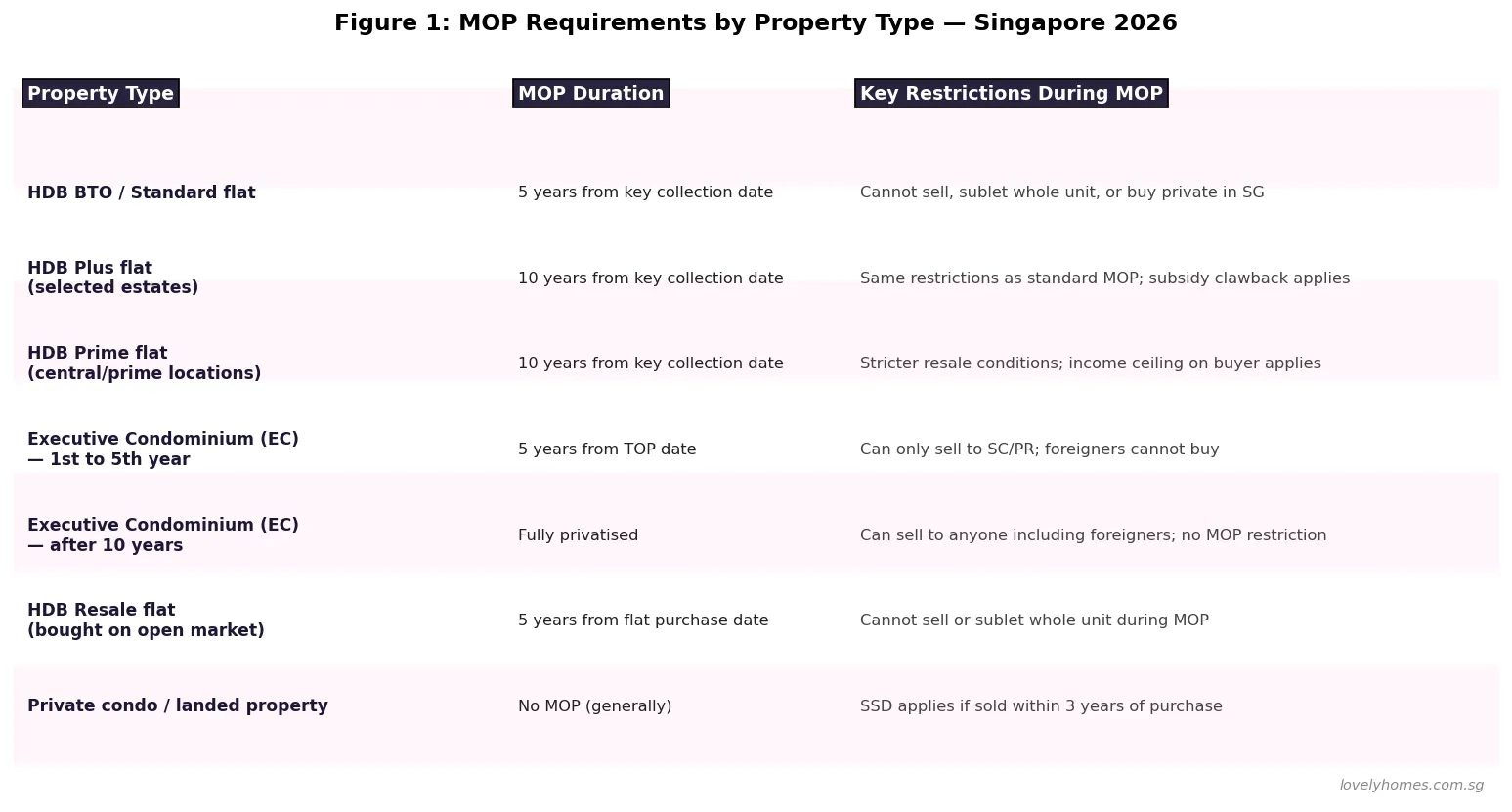
- Standard HDB flats (BTO, SBF, resale): 5 years from key collection date.
- HDB Plus and Prime flats (under the 2024 classification): 10 years from key collection date.
- Executive Condominiums (EC): 5 years from TOP, after which the EC is partially privatised (SC/PR buyers only); after 10 years, fully privatised and open to all buyers including foreigners.
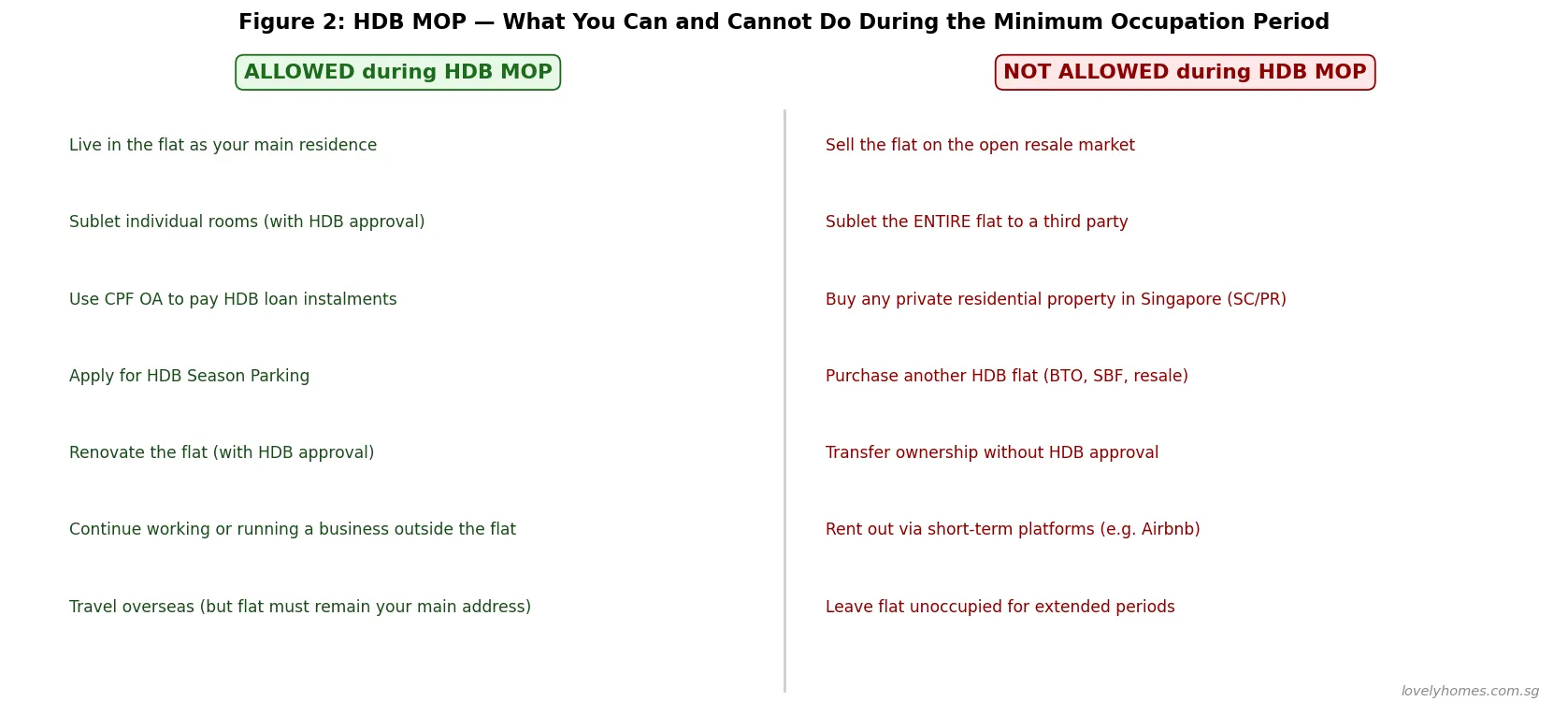
- During MOP, you cannot sell or sublet the entire flat, and you cannot own another private residential property in Singapore.
- You can sublet individual rooms (with HDB approval) and continue to enjoy the flat normally during MOP.
- Breaching MOP conditions is a serious offence: HDB may compulsorily acquire the flat, and the owner forfeits any subsidies received.
- After MOP, you may sell on the resale market, rent out the entire flat, and buy private property (subject to ABSD on the second property).
What Is the MOP and Why Does It Exist?
The Minimum Occupation Period (MOP) is a policy condition applied by the Housing & Development Board (HDB) to all subsidised public housing flats. At its core, MOP is a residency requirement: you must live in the flat as your primary home for the stipulated period before you are permitted to dispose of it on the open resale market or own another private residential property in Singapore.
The MOP exists for two interconnected policy reasons. First, it deters speculative “flipping” of HDB flats — short-term buying and selling that would inflate resale prices and undermine the Government’s objective of keeping public housing affordable and accessible for genuine owner-occupiers. Second, it reinforces the “owner-occupier” nature of HDB subsidies: the grants, concessionary loans, and ballot priorities extended to buyers are predicated on the flat being a home, not an investment vehicle.
MOP is not a new concept — it has been part of Singapore’s public housing policy for decades. What has changed is the duration: the 2024 classification of flats into Standard, Plus, and Prime tiers introduced a new 10-year MOP for Plus and Prime flats, reflecting the stronger subsidies and more desirable locations these flats carry.
HDB Standard Flats: The 5-Year MOP
The majority of HDB flats — whether obtained via Build-to-Order (BTO), Sale of Balance Flats (SBF), or bought on the open resale market — are subject to a 5-year MOP running from the date of key collection (for BTO and SBF) or the date of resale completion (for resale flat purchases).
Note that the clock starts from the date you physically take possession of the keys, not from the date you applied for the flat, paid the booking fee, or signed the Agreement for Lease. For BTO flats, this distinction matters because construction timelines mean the gap between application and key collection can be 3 to 5 years or more. Buyers who applied in 2019 and collected keys in 2023 started their 5-year MOP in 2023, not in 2019.
During the 5-year MOP, the flat must remain your registered residential address. Extended absences from Singapore do not automatically suspend or extend the MOP clock, but HDB monitors occupancy through its routine checks and may take action if a flat is found to be unoccupied or rented out in its entirety.
Owners of HDB resale flats who have already served an MOP in their previous HDB flat do not carry over any “MOP credit”: each flat purchase starts a fresh 5-year MOP from key collection or resale completion date.
HDB Plus and Prime Flats: The 10-Year MOP
From the August 2024 BTO exercise onwards, HDB introduced the Standard-Plus-Prime classification to differentiate flats by location desirability and the level of subsidy received. Plus flats are in choicer suburban or well-connected locations; Prime flats are in central or prime areas that would command premium private property prices if not for the public housing subsidy.
Both Plus and Prime flats carry a 10-year MOP and additional post-MOP resale conditions:
- Income ceiling on resale buyer: When you eventually sell a Plus or Prime flat after MOP, the buyer must satisfy an income ceiling (currently S$14,000 per month for families, S$7,000 for singles). This condition persists for the life of the flat.
- Subsidy clawback: On resale after MOP, a portion of the subsidy received at purchase is clawed back through a reduced resale levy or an explicit recovery mechanism specified in the flat purchase conditions.
- No private property ownership concurrently: Same as Standard MOP — you cannot own any private residential property in Singapore during the 10-year period.
These additional conditions reflect the Government’s intent that the deep subsidies in Plus and Prime flats benefit genuine long-term residents, not those who “subsidise-in, flip-out” as soon as the MOP expires.
Executive Condominiums: A Two-Stage MOP
Executive Condominiums (ECs) are a hybrid housing type — initially sold by private developers under HDB rules, then progressively privatised over time. Their MOP structure is unique:
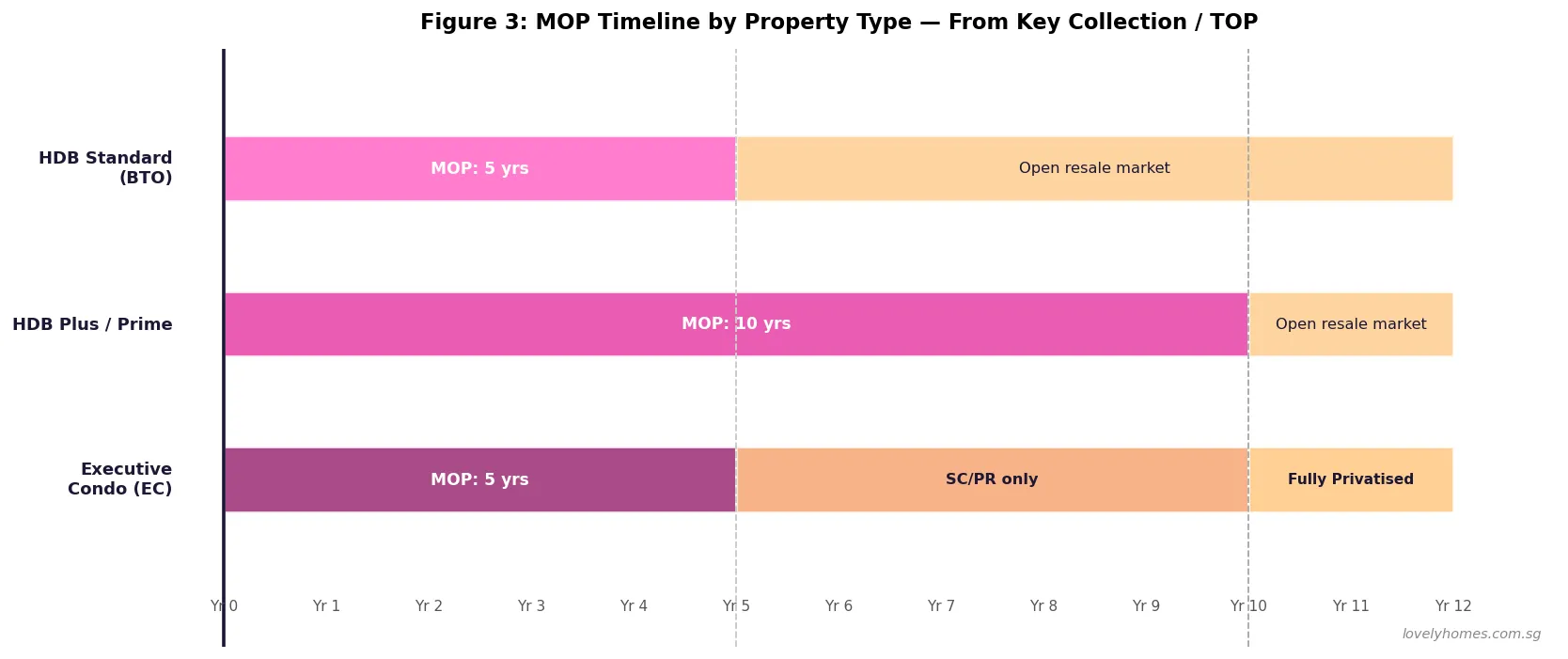
- Years 0–5 (first 5 years from TOP): MOP period. You must occupy the EC as your primary residence. You cannot sell or sublet the entire unit. You cannot own other private residential property in Singapore. Sale is restricted to Singapore Citizens and Permanent Residents only.
- Years 5–10 (partial privatisation): The EC is partially privatised. You may sell your unit on the open market, but only to Singapore Citizens or Permanent Residents. Foreigners are still excluded.
- After Year 10 (full privatisation): The EC is fully privatised. All restrictions are lifted. You may sell to anyone — including foreigners and corporate entities — at market price. The EC is now essentially indistinguishable from a private condominium in the resale market.
The EC MOP clock starts from the Temporary Occupation Permit (TOP) date of the development — not the individual unit’s handover date. This is different from HDB BTO, where the MOP runs from the individual key collection date. For ECs, all units in the same development share the same TOP date and therefore the same privatisation milestones.
Private Property Ownership During MOP
One of the most practically significant MOP restrictions concerns private property ownership. During the MOP of any HDB flat (Standard, Plus, or Prime) or EC (during the 5-year MOP), neither you nor any occupier listed on the flat’s registration can own any private residential property in Singapore.
This restriction extends to:
- Private condominiums (including those still under construction)
- Landed residential properties (terrace, semi-detached, bungalow)
- Private ECs in their own MOP period
- Residential properties held through a company or trust (in certain circumstances)
Overseas private properties are generally not caught by this rule, as HDB’s jurisdiction covers Singapore residential properties. However, owners should note that if they sell their HDB flat post-MOP and purchase a private property, they will need to manage their CPF usage carefully and ensure the ABSD position on their new purchase is correctly assessed.
The restriction does not prevent you from retaining commercial property, industrial property, or non-residential assets. It also does not prevent you from inheriting property during MOP — though you would need to dispose of the inherited private residential property promptly (within 6 months for local; varies for overseas). HDB must be informed of any inheritance of residential property during MOP.
Worked Example: The Tan Family MOP Journey
Mr and Mrs Tan, both Singapore Citizens, applied for a 4-room BTO in Tampines in April 2019. After a 3½-year construction timeline, they collected their keys on 15 October 2022. Their 5-year MOP ends on 15 October 2027.
During MOP (Oct 2022 – Oct 2027):
- The Tans live in the flat as their primary residence. They sublet one bedroom to a foreign worker (HDB approval granted; within the 6-person occupancy cap).
- In 2024, Mr Tan inherits a share in his late father’s HDB flat in Ang Mo Kio. Since it is another HDB flat (not private property), this does not breach MOP. However, HDB requires the Tans to dispose of the inherited HDB flat within 6 months, as households are generally not permitted to own two HDB flats simultaneously.
- The Tans do not purchase any private property during this period.
After MOP (from 15 October 2027):
- The Tans’ flat has appreciated from its purchase price of S$380,000 to an estimated resale value of S$620,000 based on comparable transactions in Tampines.
- They decide to upgrade to a S$1.5M OCR private condo. They sell their HDB flat first (netting approximately S$588,000 after CPF refund and outstanding loan).
- As SC buying their first private property (no other property after HDB sale): ABSD = S$0. BSD = S$44,600 on S$1.5M.
- HDB concessionary loan (2.6%) was discharged; bank loan for private condo at ~3.5% SORA-pegged.
- They could alternatively choose to retain the HDB flat (now permitted to rent out the entire flat post-MOP) and buy a private property — but ABSD of 20% (S$300,000 on a S$1.5M purchase) would apply as this would be their second residential property.
What Happens if You Breach MOP?
Breaching MOP conditions is treated seriously by HDB. The consequences are severe and non-negotiable:
- Compulsory acquisition: HDB may compulsorily acquire the flat and pay the owner the lower of the purchase price or the current valuation, effectively wiping out any appreciation in value. The owner also forfeits housing grants received at purchase.
- Financial penalties: In addition to or in lieu of compulsory acquisition, HDB may impose financial penalties. The quantum varies by severity and whether it is a first or repeat offence.
- Repayment of grants and concessions: All grants (EHG, Family Grant, PHG) and any concessionary loan interest rate benefits must be repaid with accrued interest.
- Legal proceedings: Persistent or egregious breaches (e.g., subletting the entire flat without approval, using the flat for illegal commercial purposes) can result in court action and criminal liability.
Common MOP breaches include: subletting the entire flat without approval; leaving the flat vacant for an extended period while residing elsewhere; and purchasing a private property or EC during the MOP period. HDB conducts periodic checks, and it also relies on tip-offs from neighbours and members of the public.
What Opens Up After MOP?
The end of MOP unlocks a range of options that were unavailable during the mandatory period:
- Sell on the resale market: You may list your flat for sale to eligible buyers on the HDB resale portal.
- Sublet the entire flat: With HDB approval, you may rent out your entire flat (not just individual rooms). Subletting rules include nationality requirements for tenants, minimum occupancy periods, and an overall cap on the number of occupants.
- Purchase private residential property: You (and co-applicants) may buy a private condo or landed property in Singapore, subject to ABSD at the prevailing rate for your buyer profile. If you retain the HDB flat, the private purchase is treated as a second property (ABSD at 20% for SC).
- Buy another HDB flat: You may apply for another BTO, SBF, or resale flat — though you must dispose of your current flat within 6 months of taking possession of the new one (for BTO/SBF) or before the new resale flat’s completion.
What Might Come Next: MOP Policy Trends
The introduction of the 10-year MOP for Plus and Prime flats in 2024 was a significant policy shift, and it would be unusual for HDB to further extend or tighten MOP conditions in the near term. However, several policy conversations are ongoing:
The Government has signalled that it will monitor the impact of the new classification carefully, particularly on resale prices in Plus and Prime estates. If Plus/Prime flats are seen to appreciate rapidly despite the longer MOP and tighter resale conditions, further administrative measures are not out of the question. Conversely, if the classification dampens demand for these flats at launch, HDB may recalibrate pricing or grant levels rather than adjusting MOP.
For standard 5-year MOP flats, no change is expected in the near term. The 5-year MOP has been a cornerstone of HDB policy stability and changing it would have significant knock-on effects on resale market liquidity and upgrader demand.
Summary: MOP Quick-Reference
| Property Type | MOP Duration | MOP Clock Starts From | Key Post-MOP Change |
|---|---|---|---|
| HDB Standard BTO / SBF | 5 years | Key collection date | Can sell, sublet entire flat, buy private |
| HDB Standard Resale | 5 years | Resale completion date | Same as above |
| HDB Plus flat | 10 years | Key collection date | Resale with income ceiling & subsidy clawback |
| HDB Prime flat | 10 years | Key collection date | Resale with income ceiling & subsidy clawback |
| Executive Condo (EC) | 5 years (TOP) | Development’s TOP date | Can sell to SC/PR; after 10 yrs, fully open |
| Private condo / landed | No MOP | N/A | SSD applies if sold within 3 yrs of purchase |
Frequently Asked Questions
Does the MOP clock pause if I go overseas for work?
No — the MOP clock runs continuously from the key collection date (or resale completion date) regardless of overseas travel. Extended absences from Singapore do not pause or reset the MOP. However, HDB requires that the flat remain your registered primary residence during MOP, and very prolonged absences (e.g., relocating overseas for 2 or more years) may draw scrutiny. If you are required to relocate for work, you should inform HDB, as there are limited administrative accommodations for exceptional circumstances, though these are assessed on a case-by-case basis and are not guaranteed.
Can I own a private property overseas during my HDB MOP?
Yes, generally. HDB’s MOP restriction applies to private residential properties in Singapore. Owning residential property overseas (e.g., a property in Malaysia, Australia, or the UK) does not breach HDB MOP conditions. However, you should note that some overseas properties may be relevant for ABSD purposes when you eventually sell your HDB flat and purchase private property in Singapore, and you should take professional advice on your specific cross-border situation.
What is the MOP for an HDB flat I bought on the resale market?
When you purchase an HDB flat on the resale market, a fresh 5-year MOP begins from the date your resale flat’s transaction is completed (i.e., your new flat’s resale completion date). It does not matter how long the previous owner owned the flat or whether they had already served MOP. Each sale resets the MOP obligation for the new buyer. This applies even if the selling owner had served 20 years of MOP — you start from zero again upon purchase.
Can I add or remove a co-owner during MOP?
Adding or removing an owner from an HDB flat’s title during MOP is generally not permitted without HDB’s approval. Approved exceptions include changes resulting from marriage, divorce, or the death of a co-owner. Attempting to transfer ownership (in whole or in part) to a third party during MOP, without satisfying one of these approved grounds, is treated as a breach of MOP conditions and may result in compulsory acquisition. If you need to make changes to the ownership structure, always seek HDB’s written approval first.
After MOP, do I need to inform HDB before buying private property?
You do not need HDB’s prior approval to purchase private property after your MOP has been fully served. However, if you choose to retain your HDB flat and buy a private property simultaneously, HDB imposes conditions: you must have fully paid off the HDB loan (or have a bank loan), and you must continue to reside in the HDB flat (you cannot sublet the entire HDB flat and simultaneously own private property without prior HDB authorisation). If you sell your HDB flat before or at the same time as buying private, there are no HDB-level restrictions (though ABSD and BSD will apply on the private purchase as normal).
What happens to my MOP if the HDB flat is repossessed or compulsorily acquired?
If HDB repossesses or compulsorily acquires your flat (e.g., due to a MOP breach or loan default), the compensation paid is the lower of the purchase price or the current market valuation. You do not receive the open-market resale value. Any housing grants received are deducted from the compensation. The experience is financially damaging and also affects your future HDB eligibility — individuals whose flats have been compulsorily acquired may face restrictions on purchasing another subsidised HDB flat. In cases involving serious breaches, HDB may refer the matter to the authorities for further action.
Related Articles
- Singapore BTO Application Guide 2026: How to Apply, Ballot and Buy an HDB Flat
- Singapore HDB Resale Procedure Guide 2026: Step-by-Step for Buyers and Sellers
- ABSD Singapore 2026: Complete Guide to Additional Buyer's Stamp Duty
- CPF Property Withdrawal Rules Singapore 2026: OA Limits, Accrued Interest and Short-Lease Explained
- Singapore First-Time Home Buyer Guide 2026: Grants, Steps and What You Need to Know
- Singapore Property Buying Checklist 2026: Step-by-Step Guide
- Singapore Seller's Stamp Duty (SSD) Guide 2026: Rates, Rules and Worked Examples
Disclaimer
This article is for general information only and does not constitute legal, financial, or housing advice. HDB policies, MOP rules, and resale conditions are updated periodically; always verify the current position with the Housing & Development Board (HDB) directly or through the HDB InfoWEB. Stamp duty rates and CPF rules are administered by IRAS and the CPF Board respectively. LovelyHomes is not a licensed property agent or housing advisory service.