Queenstown Neighbourhood Guide 2026: Property Prices, MRT, Schools and the Dawson Estate Renewal
Quick Answer: Living and Buying in Queenstown
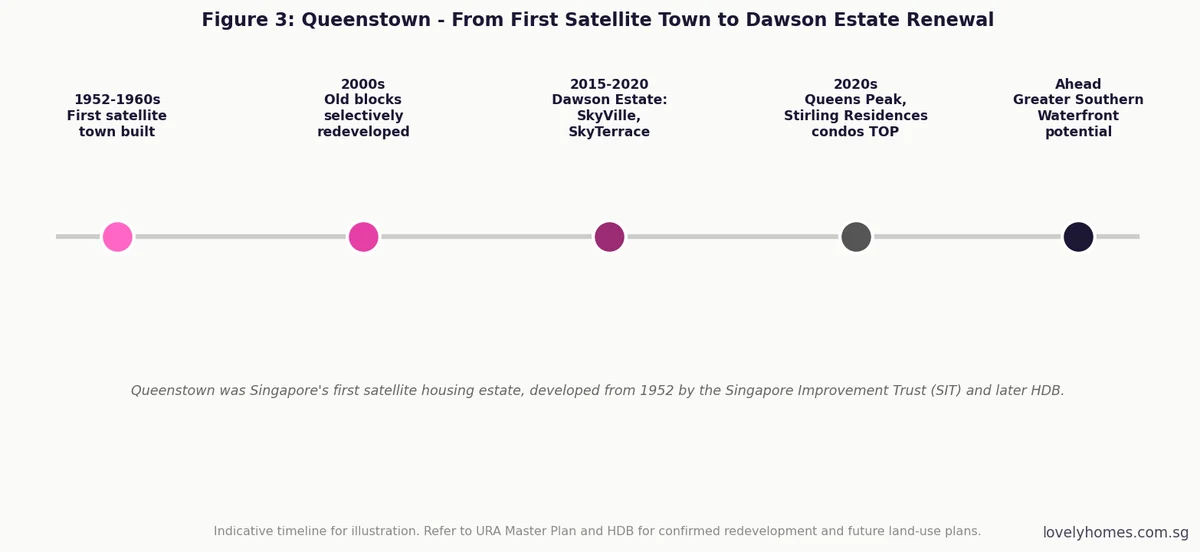
- Queenstown was Singapore’s first satellite housing estate, developed from 1952 by the Singapore Improvement Trust (SIT) and later handed to HDB, and today blends some of the country’s oldest HDB blocks with newer estates and private condominiums.
- The estate sits close to one-north (Biopolis and Fusionopolis), making it popular with tenants and buyers working in biotech, research and tech.
- Queenstown and Redhill MRT stations (East-West Line) serve the area, with Commonwealth and Tiong Bahru stations nearby, giving strong east-west connectivity into the CBD.
- The Dawson Estate redevelopment (SkyVille @ Dawson, SkyTerrace @ Dawson) brought some of HDB’s most architecturally distinctive public housing to the area from the mid-2010s.
- Private condominiums such as Queens Peak and Stirling Residences sit directly above or beside Queenstown MRT, appealing to buyers who want private property with HDB-estate convenience.
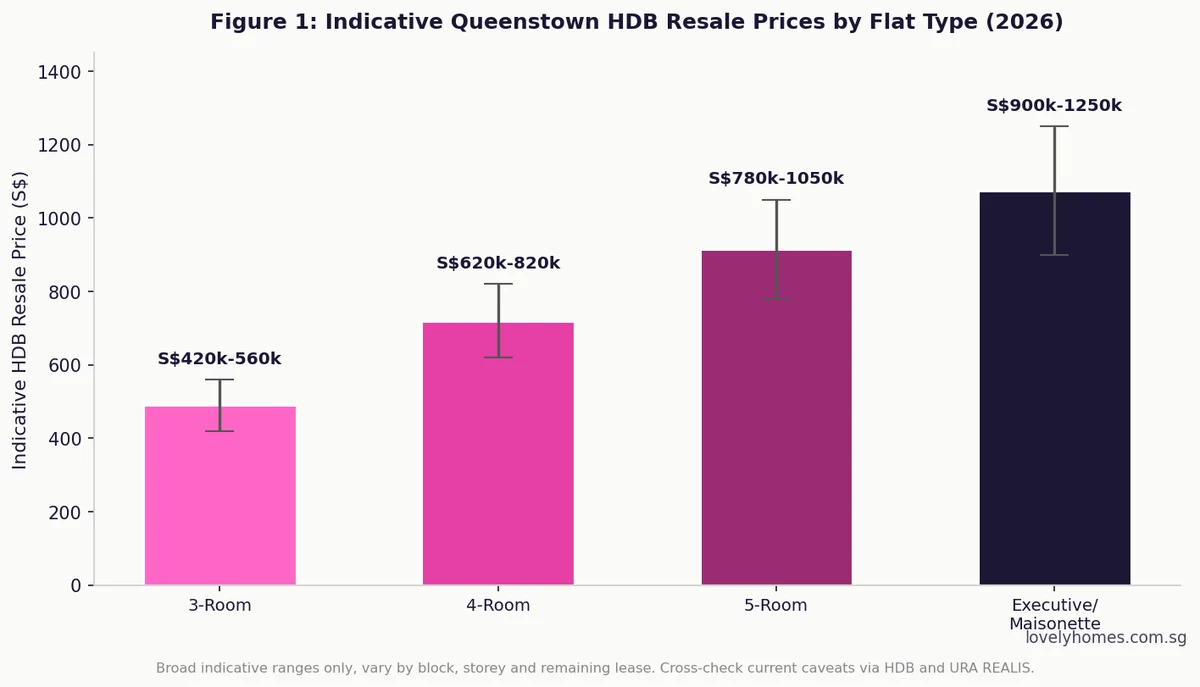
- Indicative HDB resale prices in Queenstown range roughly from the high S$400,000s for a 3-room flat to over S$1 million for a larger, well-located 5-room or executive unit, reflecting the estate’s mature, central location.
- As part of the Greater Southern Waterfront masterplan, areas near Queenstown’s southern fringe may see long-term redevelopment potential, though no confirmed timeline has been announced.
Queenstown at a Glance: Singapore’s First Satellite Town
Queenstown holds a unique place in Singapore’s housing history: it was the country’s first satellite housing estate, planned and built from 1952 by the Singapore Improvement Trust (SIT), the colonial-era precursor to HDB, and named in honour of the late Queen Elizabeth II’s coronation year. Early precincts like Tanglin Halt and Mei Ling Street still carry some of the oldest public housing blocks in Singapore, and parts of the estate have been progressively renewed over the decades since, most visibly through the Selective En bloc Redevelopment Scheme (SERS) and, more recently, the striking Dawson Estate redevelopment.
Today, Queenstown is a genuinely mixed and mature estate: older walk-up and point blocks sit within a short walk of architecturally ambitious newer HDB developments and full-facility private condominiums, all wrapped around excellent transport connectivity and proximity to one of Singapore’s key research and innovation clusters. This mix of heritage character, redevelopment, and accessibility is what makes Queenstown a recurring point of interest for both HDB upgraders and private property investors.
MRT, Transport and Connectivity
Queenstown sits on the East-West Line (EWL), served directly by Queenstown and Redhill MRT stations, with Commonwealth station also within the broader estate boundary and Tiong Bahru station a short ride further east. This gives residents a direct, one-line run into the Central Business District and Raffles Place in well under 20 minutes, alongside easy access to Orchard Road via an interchange transfer. The Ayer Rajah Expressway (AYE) also runs along the estate’s southern edge, giving drivers fast access to the CBD, Jurong, and, via the AYE-PIE network, most of the island.
The area’s proximity to one-north (home to Biopolis, Fusionopolis and a growing cluster of biotech, media and technology firms) is a significant draw for tenants and buyers who work in that ecosystem, supporting steady rental demand for both HDB flats (where subletting rules permit) and private condominiums in the estate.
Housing Options: From Heritage HDB to Dawson Estate to Private Condos
Queenstown’s housing stock spans several distinct eras and price points:
- Older heritage precincts (Tanglin Halt, Mei Ling Street, Commonwealth): some of Singapore’s earliest HDB blocks, several of which have gone through SERS or are earmarked for eventual redevelopment, appealing to buyers prioritising space and heritage character over newer finishes.
- Dawson Estate: a landmark HDB redevelopment completed from the mid-2010s, featuring SkyVille @ Dawson and SkyTerrace @ Dawson, known for sky gardens, communal terraces and design-led public housing that regularly features in architecture showcases.
- Private condominiums: including Queens Peak (directly above Queenstown MRT) and Stirling Residences, both completed in recent years and popular with both owner-occupiers and investors seeking MRT-linked convenience.
- Executive Condominiums and older private developments scattered through the estate’s fringes, offering a further price tier between HDB resale and the newest condo launches.
Schools, Amenities and Everyday Living
Families in Queenstown have access to established schools including Queenstown Primary School, New Town Primary School, and nearby Crescent Girls’ School and Anglo-Chinese School (Independent) in the wider vicinity, making the estate a consideration for buyers weighing school proximity under the Ministry of Education’s 1km/2km priority admission bands. Everyday amenities are anchored by Queensway Shopping Centre (long popular for sportswear and outdoor gear), IKEA Alexandra, and a wide spread of wet markets, hawker centres and neighbourhood malls typical of a mature estate. Alexandra Hospital, undergoing redevelopment as a community hospital, sits within the estate, and Queenstown Public Library, one of Singapore’s oldest branch libraries, remains a neighbourhood fixture. Recreational green space is well served by Tanglin Halt Park, Alexandra Canal Linear Park, and the wider Southern Ridges network within reach for hikers and cyclists.
Summary: Queenstown Facts at a Glance
| Question | Short Answer |
|---|---|
| What MRT lines serve Queenstown? | East-West Line, via Queenstown and Redhill stations. |
| What’s the estate best known for historically? | Singapore’s first satellite housing estate, built from 1952. |
| What are the standout newer HDB blocks? | SkyVille @ Dawson and SkyTerrace @ Dawson. |
| Which condos sit right by the MRT? | Queens Peak and Stirling Residences. |
| What’s nearby for work? | One-north (Biopolis, Fusionopolis) is a short ride away. |
| Any long-term redevelopment potential? | Southern fringes may be touched by the Greater Southern Waterfront masterplan, long-term. |
Worked Example: Comparing a Queenstown 4-Room Resale Flat to a Nearby Condo
Profile: The Koh family is deciding between a 4-room HDB resale flat in Dawson Estate and a 2-bedroom unit at a nearby MRT-linked private condominium.
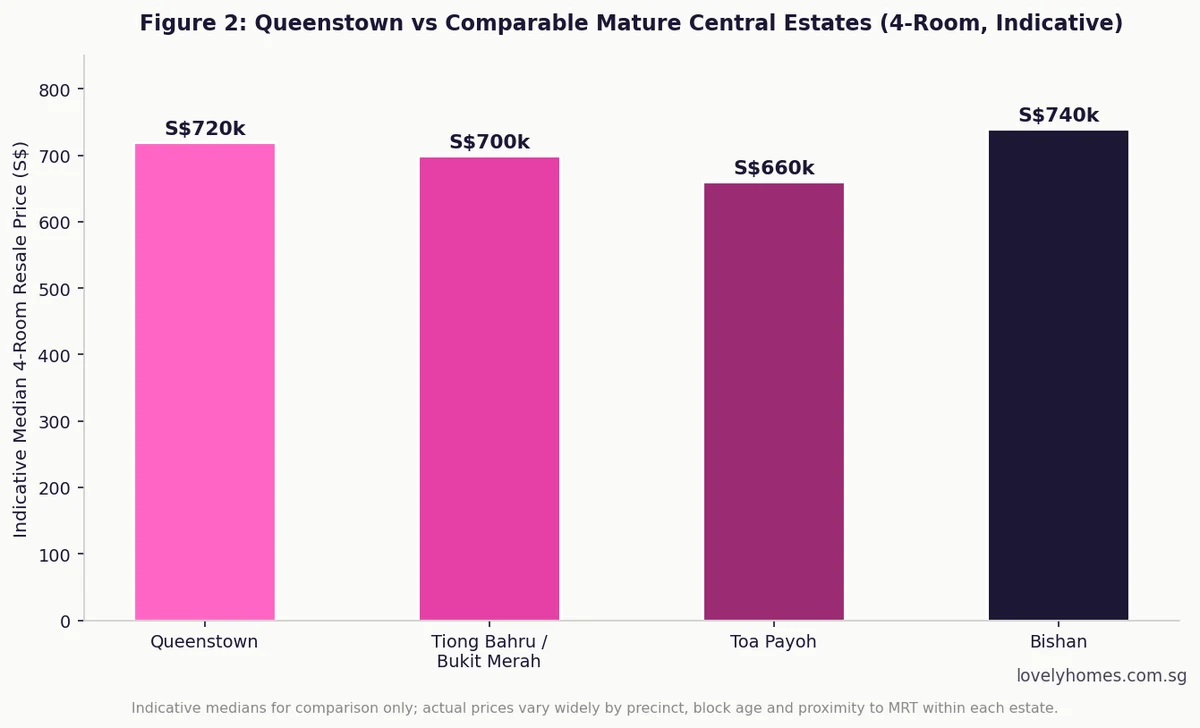
Option A: 4-Room HDB Resale (Dawson Estate). indicative price S$720,000. Buyer’s Stamp Duty (BSD) on this quantum comes to approximately S$16,500. As Singapore Citizens buying their first residential property, no Additional Buyer’s Stamp Duty (ABSD) applies. Assuming a 25-year HDB loan at the prevailing concessionary rate, the monthly instalment is comfortably within HDB’s Mortgage Servicing Ratio (MSR) cap of 30% of gross income for a typical dual-income household in this price band.
Option B: 2-Bedroom Private Condo (MRT-Linked, Queenstown). indicative price S$1,650,000. BSD comes to approximately S$52,000; again, no ABSD applies as a first property for Singapore Citizens. Monthly maintenance fees of roughly S$350–S$450 apply on top of the mortgage instalment, and the loan is tested against TDSR (55%) rather than MSR.
Takeaway: the HDB option offers substantially lower upfront stamp duty and monthly outlay, while the condo option trades a materially higher price for full condominium facilities and no MOP-style resale restrictions, illustrating the typical HDB-vs-condo trade-off that plays out across most mature, well-connected estates like Queenstown.
Why This Matters for Buyers and Investors
Queenstown’s combination of heritage character, strong MRT connectivity, proximity to a major employment cluster in one-north, and a genuine mix of older and newer housing stock makes it a useful case study in how mature, centrally located estates command a premium over newer, more peripheral towns, while still trading at a discount to the most exclusive central districts. For owner-occupiers, the choice between an older heritage block, a newer Dawson Estate flat, and an MRT-linked condo comes down to budget, space priorities and appetite for facilities. For investors, the one-north tenant pool and enduring appeal of an East-West Line address near the city are the estate’s most durable long-term demand drivers, though as with any mature estate, individual block age, remaining lease and precise walking distance to the MRT materially affect both price and rental achievability.
Renting in Queenstown: Tenant Demand and What Landlords Should Know
Queenstown’s rental market is shaped heavily by its proximity to one-north, drawing a steady pool of tenants working in biotech, pharmaceutical research, media and technology roles at Biopolis and Fusionopolis who value a short commute over a car-dependent one. This tenant profile tends to favour smaller, well-maintained units close to the MRT, whether HDB flats (where subletting rules permit, typically after the Minimum Occupation Period for whole-flat subletting) or private condominium units such as those at Queens Peak and Stirling Residences.
Landlords considering Queenstown should weigh the estate’s mixed housing stock carefully: newer precincts like Dawson Estate and the MRT-linked condos generally command a rental premium over older heritage blocks, reflecting both condition and proximity, but older units can still let reasonably well given the estate’s overall connectivity and amenity base. As with any estate, prospective landlords should benchmark asking rents against recently transacted caveats rather than listing prices, and factor in realistic vacancy periods between tenancies, particularly for larger units that appeal to a narrower pool of sharers or families.
For HDB flat owners, it’s worth remembering that subletting rules differ for whole-flat versus room-only arrangements, and that non-citizen tenant quotas can apply at the block and neighbourhood level; landlords should check current conditions directly with HDB before advertising a unit for rent, rather than relying on rules that may have applied in a previous tenancy cycle.
What Might Come Next
The following is informed speculation, not confirmed policy. Queenstown’s southern and western fringes lie within the broad footprint of URA’s long-term Greater Southern Waterfront vision, which could, over a multi-decade horizon, bring further transformation to the wider area as port and industrial land is progressively repurposed. No confirmed redevelopment plans or timelines specific to Queenstown’s existing residential precincts have been announced as at this writing, and prospective buyers should treat any such long-range masterplan potential as a multi-decade consideration rather than a near-term price driver.
Frequently Asked Questions
Is Queenstown considered a mature HDB estate?
Yes. As Singapore’s first satellite town, Queenstown is one of the country’s most mature HDB estates, with a mix of decades-old blocks, redeveloped precincts like Dawson Estate, and nearby private housing.
What’s the remaining lease like on Queenstown’s older flats?
This varies significantly by block, since some precincts date back to the 1950s-1970s while others (like Dawson Estate) are far newer. Always check a specific block’s lease commencement date via HDB’s records before making an offer, as remaining lease affects both financing (CPF usage, loan tenure) and resale value.
Are there new BTO launches in Queenstown?
As a fully built-out mature estate, new BTO supply in Queenstown is limited compared with newer towns, and typically arises only from selective redevelopment or infill sites when available. Check HDB’s BTO launch calendar for the latest confirmed sites.
How far is Queenstown from Orchard Road and the CBD?
Via the East-West Line with an interchange, Orchard Road is typically reachable within about 15-20 minutes, and the CBD/Raffles Place area within a similar timeframe, making Queenstown a genuinely central, well-connected estate.
Is Queenstown a good fit for renting to one-north workers?
Many landlords in the estate do target this tenant pool given the short commute to Biopolis and Fusionopolis, though actual rental demand and achievable rents should be checked against current listings and transacted rental caveats rather than assumed.
What’s the difference between Dawson Estate and the rest of Queenstown?
Dawson Estate refers specifically to the HDB precinct redeveloped from the mid-2010s around Dawson Road, featuring design-led blocks like SkyVille and SkyTerrace. It’s a newer, distinct precinct within the broader Queenstown planning area, which also includes much older sections like Tanglin Halt and Commonwealth.
Do the private condos in Queenstown have a minimum occupation period like HDB flats?
No. Private condominiums such as Queens Peak and Stirling Residences do not carry an HDB-style Minimum Occupation Period. Ordinary private property rules on stamp duties, financing and (where applicable) ABSD apply instead.
Related Articles on LovelyHomes
- Tampines Neighbourhood and Property Guide 2026
- Ang Mo Kio Neighbourhood Guide 2026
- Bukit Timah District 21 Property Investment Guide 2026
- Jurong East Singapore Neighbourhood Guide 2026
- Singapore HDB Resale Price Guide 2026: Complete Breakdown by Town and Flat Type
- Executive Condominium Buyer Guide 2026
Click anywhere outside to close