
VERS Explained: Voluntary Early Redevelopment for Ageing HDB Flats
For owners of older HDB flats, VERS is the biggest long-term question mark in their asset’s story. It was announced in 2018, and the first VERS precincts are only now coming into frame. The design is clear, even if the specifics for any one precinct will only be known when HDB tables the offer.
Why VERS exists
HDB flats are on 99-year leases. As a flat ages, its lease decays and its market value falls — the so-called “Bala’s Table” depreciation curve. Without a redevelopment mechanism, older HDB estates would eventually become uninhabitable and worthless at the end of their leases.
SERS (Selective En bloc Redevelopment Scheme) already handles this for a narrow set of high-value sites where the government is confident it can recover the compensation cost by redeveloping the land at much higher density. But only a tiny fraction of HDB flats sit on sites with enough redevelopment potential for SERS economics. VERS is designed to extend the option to a much bigger pool of ageing precincts by offering less generous terms and making the scheme voluntary.
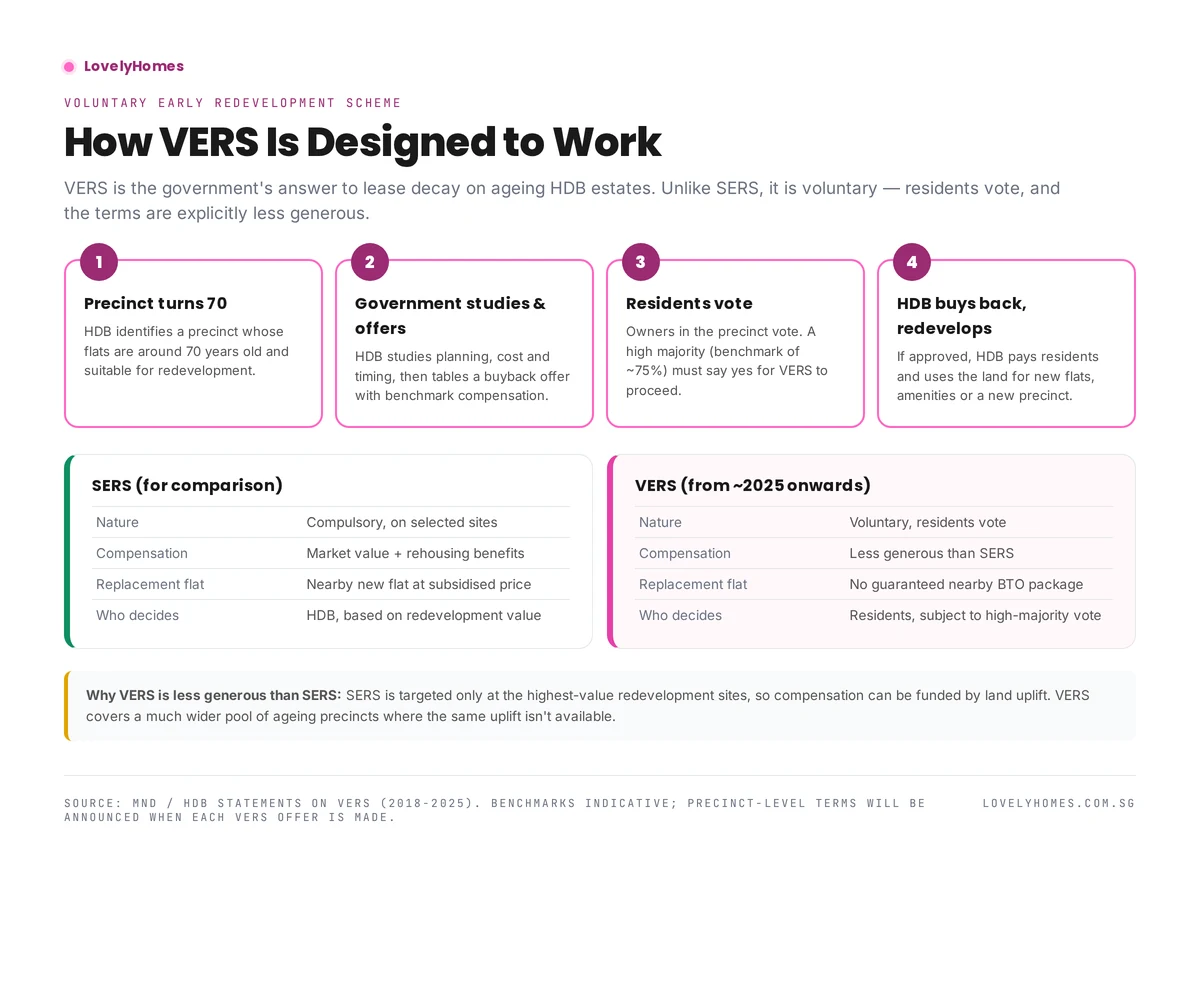
How VERS is designed to work
- Precinct reaches ~70 years old. HDB identifies precincts across Singapore that are reaching roughly the last 30 years of lease and are suitable candidates for redevelopment.
- HDB studies the site and tables an offer. The offer includes a benchmark compensation figure based on the precinct’s characteristics and market conditions, plus relocation support.
- Residents vote. Flat owners in the precinct vote. A high approval threshold (around 75%) is needed for VERS to proceed — a much higher bar than simple majority.
- HDB buys back and redevelops. If approved, HDB buys every flat, the precinct is demolished, and the land is redeveloped — for new flats, amenities, or a reshaped precinct layout.
VERS vs SERS in plain language
| Feature | SERS | VERS |
|---|---|---|
| Nature | Compulsory; HDB selects sites | Voluntary; residents vote |
| Compensation | Market value + rehousing benefits | Less generous than SERS |
| Replacement flat | Subsidised nearby new flat | No guaranteed BTO package |
| Coverage | Only highest-value sites | Wide pool of ageing precincts |
| Timing | Announced as sites are identified | From ~precinct age 70 onwards |
Compensation: why less than SERS?
The Ministry of National Development has been explicit that VERS will pay less than SERS. The reason is arithmetic: SERS works because the redevelopment uplift on a prime site can finance generous compensation. For a typical ageing precinct outside that prime band, the uplift does not stretch as far. If VERS paid SERS-level compensation across the board, the government would be effectively subsidising every ageing HDB owner out of the national reserves.
VERS compensation is still expected to be fair — it must be enough to induce a 75% approval vote, after all — but owners should calibrate expectations below SERS-style windfalls.
Practical impact on lease decay
Until VERS actually starts delivering in the late 2020s and 2030s, owners of older flats have to plan around the standard assumption that a flat’s value tracks Bala’s Table as it ages. VERS is an optionality on that trajectory — a chance, not a guarantee — and should not be priced as a certainty in any financial model.
What to watch before any VERS offer lands
- Annual MND / HDB announcements on VERS pilot precincts.
- Precinct demographics — an older, ageing-in-place population tends to vote differently from a younger one.
- Surrounding land use plans — what the URA intends to do with the reclaimed land affects HDB’s willingness to table an offer.
- CPF-refund mechanics — HDB has said CPF/loan refunds will be handled normally, but precinct-specific details will matter for owners with large CPF accrued interest.
Frequently asked questions
Is my flat guaranteed to go through VERS?
No. VERS is site-by-site and vote-by-vote. Some precincts may simply run down to the end of their leases without a VERS offer ever being tabled.
What happens if the VERS vote fails?
The precinct continues on its existing lease. A future VERS offer may or may not be tabled again — MND has not committed to repeat offers.
Does VERS come with a replacement flat?
Unlike SERS, there is no guaranteed subsidised nearby BTO package. Owners will need to buy a replacement flat in the normal market, using VERS proceeds plus any other grants they qualify for.
Is VERS taxable?
Compensation received from the government for a compulsory or voluntary buyback is not treated as taxable income under Singapore’s tax framework.
Related guides
- MOP rules.
- How to sell an HDB flat.
- Lease Buyback vs Silver Housing Bonus — another answer to lease decay.
This guide is for general information only and is accurate as of April 2026. CPF grants, scheme quantum and eligibility rules are set by HDB / the Ministry of National Development and can change. Always confirm current rules on the HDB Flat Portal or with an HDB officer before committing. We are not a financial or legal advisor.