HDB Resale Flat Buying Guide Singapore 2026

HDB Resale Flat Buying Guide Singapore 2026

⚡ Quick Answer: HDB Resale Flat Buying in 2026 — Key Points

  • Eligibility: At least one Singapore Citizen in the application; joint applicants may include Permanent Residents. Singles aged 35+ can buy resale flats. No income ceiling applies to HDB resale buyers (unlike BTO).
  • No BTO Waiting Time: HDB resale flats are available immediately — typical completion takes 8–12 weeks from Option to Purchase (OTP) to key collection.
  • Valuation Matters: HDB appoints a licensed valuer; if you pay above valuation, the difference (Cash-Over-Valuation, or COV) must be paid fully in cash.
  • Grants Available: Eligible buyers can stack CPF Housing Grants: EHG up to S$80,000, Family Grant up to S$50,000, and Proximity Housing Grant (PHG) up to S$30,000.
  • Stamp Duty: Buyer’s Stamp Duty (BSD) applies. A S$700,000 flat incurs BSD of approximately S$15,600. No Additional Buyer’s Stamp Duty (ABSD) for first-time residential property buyers who are Singapore Citizens.
  • Loan Options: HDB Concessionary Loan at 2.60% p.a. (up to 80% LTV) or a bank loan (up to 75% LTV). HDB loan requires an HDB Flat Eligibility (HFE) letter; bank loans require a Letter of Offer.
  • OTP Process: Seller grants the OTP with an option fee of S$1–S$1,000. Buyer has up to 21 calendar days to exercise the OTP by paying the full deposit (typically 5% of the agreed price, less the option fee).
  • MOP Applies to Buyer Too: After completing your resale purchase, you cannot sell the flat or purchase a private residential property for five years (the Minimum Occupation Period).
  • CPF Usage: CPF Ordinary Account (OA) can be used for the down payment, BSD, monthly repayments, and legal fees — subject to the Valuation Limit and Withdrawal Limit rules.
  • Market Context: HDB resale prices dipped 0.3% in Q2 2026 (second consecutive quarterly decline) as BTO supply expanded — potentially creating a more favourable buying environment in 2H 2026.

What Is an HDB Resale Flat, and Who Can Buy One?

An HDB resale flat is a Housing Development Board (HDB) flat that has completed its Minimum Occupation Period (MOP) of five years and is being sold by the existing owner on the open market — as opposed to a new Build-To-Order (BTO) flat purchased directly from HDB at a subsidised price.

Resale flats account for a significant portion of HDB transactions each year. They offer buyers the ability to choose their preferred floor, unit facing, and neighbourhood immediately, without the two-to-five-year BTO waiting time. Buyers of resale flats transact through the HDB Resale Portal, which is the official platform administered by HDB for all resale applications.

Who Is Eligible?

The key eligibility conditions for buying an HDB resale flat are as follows. At least one applicant must be a Singapore Citizen (SC). Joint applicants may include another SC or a Singapore Permanent Resident (SPR). Foreigners — including those on Employment Passes or Dependant’s Passes — are not eligible to purchase HDB flats regardless of tenure. An applicant must be at least 21 years old (or 35 years old if applying as a single). There is no income ceiling for HDB resale purchases (unlike BTO applications, which have income ceilings of S$7,000–S$14,000 depending on flat type).

Importantly, buyers who currently own or have an interest in private residential property (locally or overseas) are generally barred from purchasing an HDB resale flat without first disposing of the private property. Buyers also cannot own another HDB flat at the point of purchase, subject to certain exceptions.

Figure 1: 7-step HDB resale flat purchase process 2026 — from eligibility check to key collection
Figure 1: The 7-Step HDB Resale Flat Purchase Process (2026). Source: HDB.

Step 1: Check Your Eligibility and Financing

Before viewing any flat, confirm your eligibility using HDB’s HDB Flat Eligibility (HFE) letter application. The HFE letter (introduced in May 2023) consolidates in one document your eligibility to purchase, the housing grants you qualify for, and — if you are taking an HDB loan — the loan quantum and monthly repayment estimate.

If you are taking a bank loan instead of an HDB loan, you will need to obtain an in-principle approval (IPA) or Letter of Offer from a participating financial institution. Banks apply the Total Debt Servicing Ratio (TDSR) of 55% and the Mortgage Servicing Ratio (MSR) of 30% of gross monthly income when determining eligibility. The HDB loan applies the same MSR cap of 30% and uses a stress-test floor of 3.0% even though the concessionary rate is 2.60% p.a. (as at July 2026).

Step 2: Search for a Flat and Request Valuation

Buyers search for available resale flats on the HDB Flat Portal, property portals, or through a CEA-registered property agent. Once a suitable flat is identified and the seller is willing to transact, the buyer must request a HDB valuation before or concurrently with the grant of the OTP. HDB appoints a licensed valuer, and the valuation report is typically received within three to five working days. The valuation underpins the amount of CPF and HDB loan that can be used — both are capped at the lower of the purchase price or the valuation amount.

Figure 2: HDB resale buyer upfront costs and CPF housing grants by buyer profile 2026
Figure 2: HDB Resale Buyer Upfront Costs (left) and CPF Housing Grants by Buyer Profile (right). Source: HDB, IRAS 2026.

Step 3: The Option to Purchase (OTP)

When buyer and seller agree on a price, the seller grants the buyer an Option to Purchase (OTP). The option fee paid by the buyer at this stage is between S$1 and S$1,000 (set by the seller, capped at S$1,000 under HDB regulations). This gives the buyer 21 calendar days to decide whether to proceed.

Within the 21-day option period, the buyer must submit a resale application on the HDB Resale Portal (under “Intent to Sell/Buy”) to exercise the OTP. Exercising the OTP requires the buyer to pay the balance deposit — typically the remaining portion of a 5% deposit — along with completing the HDB portal application. From the date of exercise, both parties are contractually bound.

Step 4: HDB Application and Grant Disbursement

After both buyer and seller have submitted their respective portions of the resale application through the HDB Resale Portal, HDB reviews the application. This typically takes four to six weeks. HDB will issue an approval letter and a Letter of Offer for eligible grants. CPF housing grants — the Enhanced Housing Grant (EHG), Family Grant, and Proximity Housing Grant (PHG) — are disbursed directly into the buyer’s CPF Ordinary Account and credited towards the purchase.

The three main grants available to HDB resale buyers in 2026 are:

  • Enhanced Housing Grant (EHG): Up to S$80,000 for SC+SC couples with monthly household income not exceeding S$9,000. Available for both BTO and resale purchases.
  • Family Grant: Up to S$50,000 for SC+SC couples buying a 4-room or larger resale flat. SC+SPR couples may receive up to S$30,000 depending on flat size.
  • Proximity Housing Grant (PHG): Up to S$30,000 if you buy a flat within 4 km of parents’ or children’s home; S$20,000 if living with parents/children in the same flat.

Summary Table: HDB Resale vs BTO — Key Differences

Factor HDB Resale BTO
Waiting Time 8–12 weeks (completion) 3–5 years (construction)
Price Setting Market price (buyer+seller negotiate) Subsidised price set by HDB
Income Ceiling None (for purchase; grants have ceilings) S$7,000–S$14,000 (varies by flat type)
Flat Choice Immediate; choose specific unit, floor, town Balloted; limited choice of unit
CPF Grants EHG + Family Grant + PHG (up to S$160K) EHG up to S$80K
COV Risk Yes — cash if price > valuation None (priced by HDB)
MOP After Purchase 5 years from completion 5 years from key collection
Loan Options HDB loan or bank loan HDB loan or bank loan
Existing HDB Flat Owners Must sell within 6 months of completing purchase Must sell within 6 months of key collection

Figure 3: HDB resale completion timeline 2026 — typical 8 to 12 weeks from OTP to key collection
Figure 3: HDB Resale Completion Timeline — Typical 8 to 12 Weeks. Source: HDB 2026.

Step 5: Completion — Key Collection and Stamp Duties

At the HDB Hub completion appointment, the buyer pays the balance purchase price (after deducting down payment, grants, and any CPF already used), the HDB registration fee of S$80, and any outstanding legal fees. The Buyer’s Stamp Duty (BSD) — computed by the Inland Revenue Authority of Singapore (IRAS) on the higher of the purchase price or the HDB valuation — must be paid within 14 days of the OTP exercise date. BSD rates in 2026 are: 1% on the first S$180,000, 2% on the next S$180,000, 3% on the next S$640,000, and 4% on amounts above S$1 million. On a S$700,000 resale flat, BSD comes to S$15,600.

Worked Example: Mr and Mrs Tan Buy a 5-Room Resale Flat in Queenstown

💼 Worked Example: SC+SC Couple, 5-Room Queenstown Resale

Buyer Profile: Mr Tan Ah Beng (SC) and Mrs Tan Lay Tin (SC); joint monthly income S$9,200; first-time HDB purchasers

Property: 5-room HDB resale flat, Queenstown (near parents); agreed price S$830,000; HDB valuation S$810,000; COV S$20,000 (cash)

Grants Eligible: EHG S$45,000 (income S$9,200; stepped scale) + Family Grant S$40,000 (5-room) + PHG S$30,000 (within 4 km of parents) = S$115,000 total grants

Loan: HDB Concessionary Loan at 2.60% p.a.; 80% of valuation = S$648,000 (25-year term); monthly repayment ~S$2,930/mth; MSR = S$2,930 / S$9,200 = 31.8% — exceeds 30% MSR cap; reduce loan to S$625,000 (25 years) → S$2,831/mth; MSR 30.8% — still marginally above cap. Recommended: extend to 30 years → S$2,442/mth; MSR 26.5% — PASS

Upfront Cash Required:

  • COV (above valuation): S$20,000 (cash, cannot use CPF)
  • 20% down payment on valuation (S$810,000 × 20% = S$162,000) less grants (S$115,000) = S$47,000 (cash or CPF OA)
  • BSD on S$830,000: 1%×S$180K + 2%×S$180K + 3%×S$470K = S$19,500 (CPF OA)
  • Legal fees (est.): S$2,000 (CPF OA)

Total minimum cash upfront: S$67,000 (COV S$20,000 + 5% of S$810K S$40,500 rounded + HDB admin S$80 + 6 months buffer S$5,992)

HDB Loan: S$625,000 @ 2.60% p.a., 30 years → S$2,442/mth; MOP expires ~2031; PHG condition: must remain within 4 km of parents for at least 5 years

Why This Matters: The Resale Route Versus Waiting for BTO

The decision between buying a resale flat now versus balloting for a BTO flat depends on urgency, life stage, location preference, and price sensitivity. Resale flats in mature estates such as Queenstown, Bishan, or Toa Payoh often command a significant premium over BTO prices in the same estate — but they also offer immediate occupation, a predictable timeline, and the ability to choose a specific unit. Families with children in school, or those caring for ageing parents, frequently find the immediate certainty of a resale transaction worth the premium.

In Q2 2026, HDB resale prices declined 0.3% — the second consecutive quarterly dip and the first such back-to-back correction in nearly seven years. This moderation, driven partly by expanding BTO supply and a more cautious buyer sentiment, may create a more negotiable market for resale buyers in the second half of 2026.

What Might Come Next for the HDB Resale Market

HDB has committed to launching approximately 19,600 BTO flats in 2026, including the planned October sales exercise covering Bedok, Geylang, Sembawang, Tengah, Toa Payoh, and Yishun. A larger BTO supply tends to temper resale demand, particularly among first-time buyers who qualify for the highest grant amounts on BTO flats. The full Q2 2026 HDB resale statistics — including detailed town-by-town price and volume data — are expected to be released in late July 2026 and will provide a clearer picture of where prices are heading.

Policy watchers will also monitor whether CPF usage rules or the PHG eligibility criteria are adjusted as part of broader housing affordability measures. For now, eligible buyers remain able to stack multiple grants to significantly reduce their effective acquisition cost.

Frequently Asked Questions

Can a Singapore Permanent Resident buy an HDB resale flat without a Singaporean co-purchaser?

No. An SPR cannot purchase an HDB flat (resale or BTO) as a sole applicant. At least one SC must be listed as a co-purchaser. An SPR and their SC spouse can buy a resale flat jointly under the Public Scheme, and the SC applicant is treated as the primary buyer for eligibility purposes. SPR couples (without any SC) cannot buy HDB resale flats and are restricted to EC or private residential properties.

Can a single person buy an HDB resale flat?

Yes, but only if the single SC applicant is aged 35 or above. This applies under the Single Singapore Citizen Scheme. Singles aged 35+ can purchase a resale flat of any flat type (2-room to 5-room and Executive), subject to eligibility conditions such as not owning or having owned a private residential property in the previous 30 months. The EHG is available to eligible singles, with the grant quantum approximately half that available to couples at the same income level.

What happens if I pay more than the HDB valuation — do I need to pay the COV in cash?

Yes. Cash-Over-Valuation (COV) is the difference between the agreed purchase price and the HDB valuation. It must be paid entirely in cash — CPF Ordinary Account funds, HDB loan proceeds, and housing grants all cannot be used towards COV. CPF and HDB loan usage is capped at the valuation amount (not the purchase price). This means buyers should carefully consider whether the premium above valuation is justified before committing to a price above the valuation figure.

Can I use CPF to pay for stamp duty, legal fees, and the down payment on a resale flat?

Yes, with conditions. CPF Ordinary Account (OA) funds can be used towards the HDB resale purchase for: (1) the down payment (above the minimum cash requirement), (2) BSD, (3) legal fees, and (4) monthly mortgage repayments. However, CPF usage is subject to the Valuation Limit (VL) — the lower of the purchase price or valuation — and the Withdrawal Limit (WL), which equals 120% of the VL for most leasehold flats. For older flats with remaining leases below 30 years at the point the youngest buyer turns 55, CPF usage may be further restricted.

What is the Minimum Occupation Period (MOP), and how does it affect a resale buyer?

The MOP for HDB resale flats is five years from the date of completion (key collection). During the MOP, you cannot sell the flat on the resale market, rent out the whole flat (partial renting of spare bedrooms may be allowed subject to HDB approval and eligibility), or purchase another residential property (HDB or private) in Singapore. For SC buyers who already own a private property, they must sell the private property within six months of the HDB resale completion date. The MOP clock starts fresh from the date you collect the keys — not from when the original owner first moved in.

Do I need to pay ABSD on an HDB resale flat if it is my first property?

No. First-time SC buyers are exempt from ABSD on their first residential property purchase, regardless of property type. If you are a first-timer buying an HDB resale flat as your sole property, only BSD applies (not ABSD). ABSD is triggered only on a second or subsequent residential property purchase. SPR first-timers pay 5% ABSD; SPR second-timers pay 30% ABSD. Foreigners pay 60% ABSD on any residential property purchase in Singapore, and are in any case not eligible to purchase HDB flats.

What is the HDB HFE letter and how do I apply for one?

The HDB Flat Eligibility (HFE) letter is a mandatory document introduced in May 2023 that replaces the previous HDB Loan Eligibility (HLE) letter and Eligibility Check processes. It is applied for through the HDB Resale Portal using Singpass and provides a single, consolidated letter confirming: (a) your eligibility to purchase a resale HDB flat, (b) the housing grants you are eligible for and their quantum, and (c) if you are taking an HDB loan, the maximum loan amount and indicative monthly repayment. The HFE letter is valid for six months and must be obtained before you can submit a resale application on the HDB portal. It takes approximately one working day to be issued after all required information is submitted.
Disclaimer: This article is for general informational and educational purposes only. It does not constitute financial, legal, or property advice. Information on HDB eligibility, grant amounts, loan conditions, and stamp duty rates reflects publicly available data from the Housing Development Board (HDB), Inland Revenue Authority of Singapore (IRAS), and CPF Board as at July 2026. Rules and rates are subject to change. Readers should verify all information with the relevant government agencies and consult a licensed financial adviser, mortgage broker, or solicitor before making any property purchase decision. LovelyHomes.com.sg is not affiliated with HDB, IRAS, or the CPF Board.

HDB Key Collection Singapore 2026: Complete Guide to Defects Inspection, DLP and What to Do After Getting Your Keys

HDB Key Collection Singapore 2026: Complete Guide to Defects Inspection, DLP and What to Do After Getting Your Keys

Quick Answer: HDB Key Collection Singapore 2026 — Key Takeaways

  • Key collection is the final step in both the BTO and resale HDB purchase process — once keys are collected, the 5-year Minimum Occupation Period (MOP) clock starts immediately.
  • Before key collection, HDB invites you to a pre-completion inspection to identify and log defects in the flat.
  • Submit all defects within one month of key collection and before renovation begins — defects reported after renovation starts are much harder to attribute to the original construction.
  • The Defect Liability Period (DLP) is 12 months from the date of key collection — HDB’s main contractor is responsible for rectifying valid defects at no cost to you during this period.
  • Use the MyHDB Portal app (or visit your Building Service Centre) to submit defects electronically with photos — do this room by room within the first week.
  • Bring to key collection: NRIC for all owners, cashier’s orders for outstanding payments, HDB loan letter or bank acceptance, and CPF withdrawal authorisation if applicable.
  • Resale flat key collection follows a different process from BTO — completion happens at HDB Hub, and MOP is calculated from the date on the resale completion letter, not the original TOP date.

What Is HDB Key Collection and Why Does It Matter?

Key collection is the final milestone in the HDB flat purchase journey — the moment when legal ownership is formally transferred and the physical keys to your new home change hands. For a BTO (Build-to-Order) flat, this follows three to five years of waiting from the ballot exercise, triggered when the flat achieves its Temporary Occupation Permit (TOP) and HDB issues individual collection invitations. For a resale flat, key collection happens at the HDB-facilitated completion appointment, typically six to eight weeks after the Option to Purchase is exercised and HDB grants approval.

Beyond the emotional significance of receiving your keys, the date of key collection carries substantial legal and financial consequences. The five-year Minimum Occupation Period — the rule preventing most HDB owners from selling before they have physically occupied the flat — begins on the key collection date. The 12-month Defect Liability Period, during which HDB’s contractor must rectify construction defects at no charge, also starts on this date. Miss the one-month window for defect submission and you significantly weaken your ability to claim rectification from HDB.

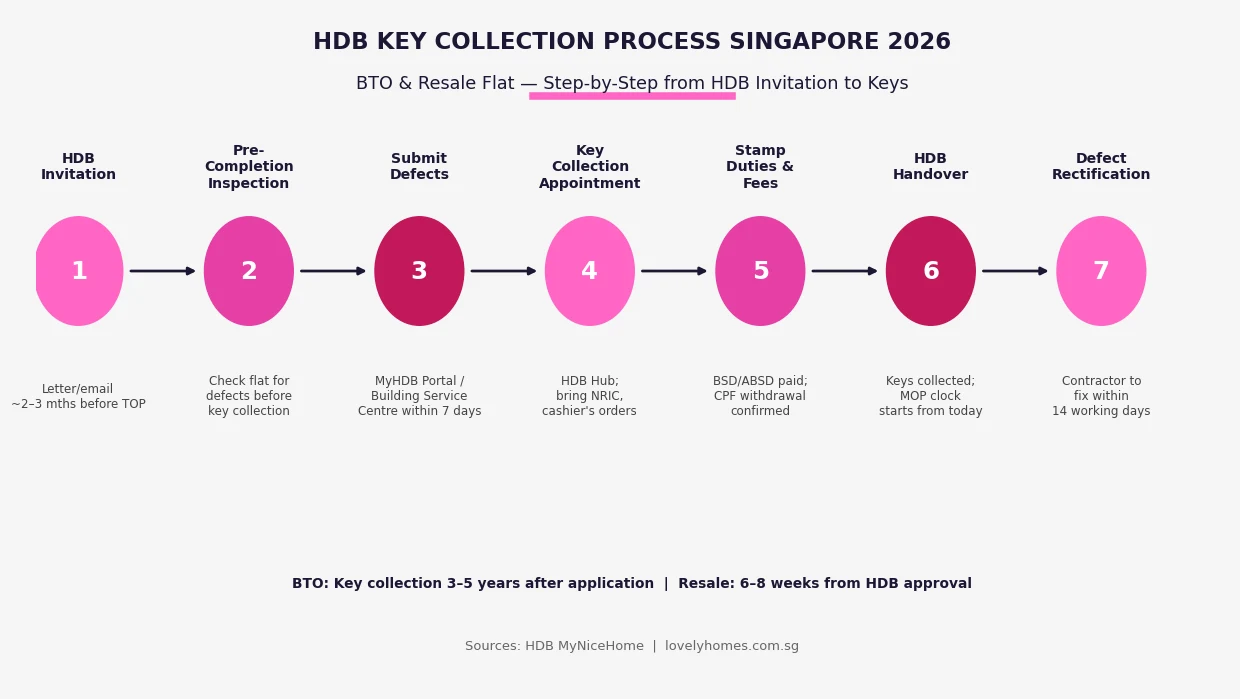
HDB key collection process step-by-step flowchart Singapore 2026
Figure 1: HDB key collection — seven-step process from HDB invitation to defect rectification. Source: HDB MyNiceHome 2026.
Click image to zoom

BTO Key Collection: Step-by-Step Process 2026

HDB sends a written invitation by post and through the MyHDB portal approximately two to three months before your flat’s key collection date. The invitation includes a date and time slot for the pre-completion inspection, and separately for the formal key collection appointment itself.

Step 1: Pre-Completion Inspection

Before keys are collected, HDB offers a pre-completion inspection of your flat. This is your first opportunity to walk through the unit with HDB’s building inspector and identify construction defects. Defects identified at this stage are formally logged and HDB’s main contractor is required to rectify them before or shortly after key collection. Do not skip this inspection — defects that are not formally logged during this appointment are more difficult to claim under the DLP later.

Bring a torch, a marble (for tile-tapping), a portable socket tester, a spirit level, and your phone for photography. Walk every room systematically. The inspection is free and takes approximately 45 minutes to one hour for a 4-room flat.

Step 2: Key Collection Appointment

The key collection appointment takes place at HDB Hub, Toa Payoh. You must attend in person (all registered owners must be present or represented by a Power of Attorney). Bring the following documents and payments:

  • NRIC of all flat owners (originals required)
  • Cashier’s order(s) for any outstanding payments (stamp duties, mortgage shortfall, admin fees)
  • HDB loan letter acceptance, or bank’s letter of offer and mortgage documents
  • CPF withdrawal authorisation forms, if CPF Ordinary Account funds are being used
  • Resale levy cashier’s order, if applicable (second-timer buyers)

At the appointment, HDB processes the stamp duties, confirms the CPF and cash components, and registers the transfer with the Singapore Land Authority (SLA). The SLA registration typically completes within a few working days, after which you are the registered owner in the land register. The keys are handed over upon completion of the administrative process — typically within the same appointment.

Step 3: Submit Defects Immediately

Immediately after collecting your keys, conduct a second, more thorough inspection at your own pace. Use the MyHDB Portal (web or mobile app) to submit defects with photographs. The submission system allows you to tag defects by room and type. HDB’s standard rectification target is 14 working days per defect batch, though complex defects such as waterproofing issues or structural cracks may take longer. Submit everything within the first week; all defects must be submitted within one month of key collection and before any renovation work begins.

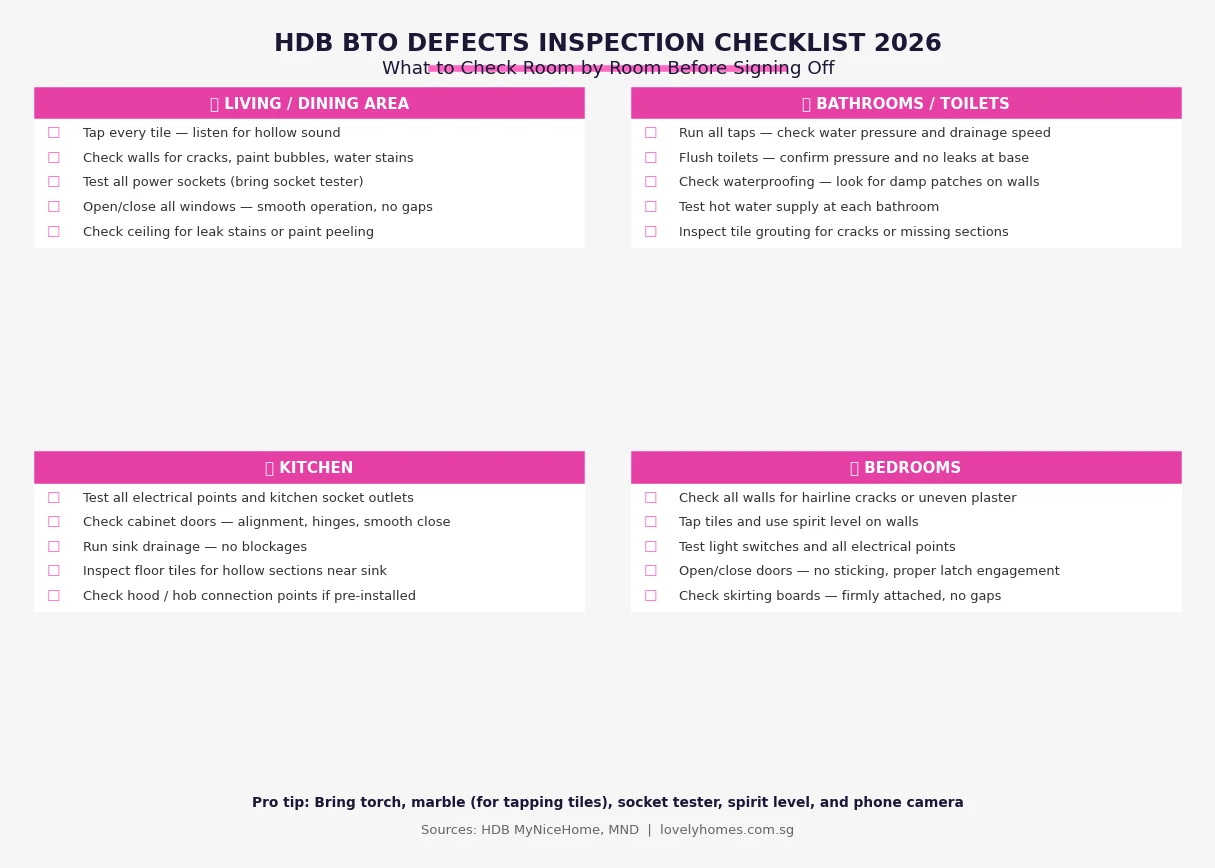
HDB BTO defects inspection checklist by room Singapore 2026
Figure 2: Room-by-room HDB BTO defects inspection checklist — what to check after key collection 2026. Source: HDB MyNiceHome, MND.
Click image to zoom

The Defects Inspection: What to Check Room by Room

A systematic inspection takes 60–90 minutes for a standard 4-room BTO flat. Work through each room methodically before moving to the next. Bring the following equipment: a torchlight (for dark corners and under cabinets); a marble or coin (for tile-tapping); a portable socket tester; a spirit level (for walls and floors); masking tape and a marker pen (to tag defects in situ); and your phone camera (photo evidence is essential for defect submissions).

Living Room and Dining Area

Tap every tile across the full floor area using a marble — a hollow or dull sound indicates poor bonding, which can cause tiles to crack or lift over time. Walk the entire floor and mark each hollow tile location with masking tape. Inspect all walls for hairline cracks, uneven plaster, paint bubbles, or water stains (especially around skirting boards). Test every power socket with a socket tester. Open and close all windows — they should slide or pivot smoothly with no significant gaps or draught ingress. Check the ceiling for water stains, paint peeling or cracks.

Bathrooms and Toilets

Run every tap and showerhead — check water pressure, drainage speed (should clear the basin within 10 seconds) and confirm no drips from joints. Flush all toilet cisterns — strong, clean flush with no leak at the base seal. Look for water stains or damp patches on walls adjacent to the shower zone, which may indicate waterproofing voids. Test the hot water supply at every bathroom. Inspect tile grouting for cracks, missing sections or staining around floor drains. Check that the bathroom door opens and closes properly and that the privacy lock engages fully.

Kitchen

Test all electrical points and the kitchen circuit — bring a socket tester and check the hood/hob electrical connection points if pre-fitted. Inspect cabinet doors for alignment, smooth hinges and proper magnetic or soft-close engagement. Run the kitchen sink to confirm drainage; check beneath the sink cabinet for moisture or drips. Tap floor tiles near the sink area for hollow sections. Confirm the gas pipe stub-out is present and capped if you are planning a gas hob installation.

Bedrooms

Check all walls for hairline cracks, especially at corners and around window frames. Use your spirit level on at least one wall per bedroom — significant lean may affect built-in carpentry. Test all light switches and power points. Open and close every bedroom door — it should close flush without sticking and the latch should engage cleanly. Check skirting boards for gaps or poor adhesion. Inspect ceiling corners and the top of walls for water staining, which may indicate condensation or waterproofing issues from the flat above.

Area Key Defects to Inspect Tool to Bring
Floor tiles (all rooms) Hollow sound, cracks, misalignment, lippage Marble or coin
Walls (all rooms) Hairline cracks, uneven plaster, paint bubbles, water stains Torch, phone camera
Power sockets Dead outlets, loose fittings, missing earth pin Socket tester
Windows and doors Stiff operation, gaps, misalignment, failed locks Hands only
Ceiling Water stains, paint peeling, cracks near corners Torch
Bathroom walls and floors Damp patches, grouting gaps, hollow tiles near drains Marble, torch
Sanitary fittings Drips from joints, slow drainage, weak flush Running water
Kitchen cabinet doors Misalignment, stiff hinges, failed soft-close Hands only

Resale HDB Key Collection: How It Differs from BTO

For resale flat buyers, the process is compressed into a single completion appointment at HDB Hub, typically held six to eight weeks after HDB approves the resale application. Both the buyer and seller (or their solicitors under the conveyancing process) attend. At the completion appointment: outstanding payments are exchanged; HDB processes the stamp duties and CPF withdrawals; SLA registers the ownership transfer; and the seller hands over the keys. There is no pre-completion inspection equivalent for resale flats — the buyer is expected to have inspected the flat thoroughly during the option exercise period.

A critical difference for resale buyers is that the Defect Liability Period does not apply — that protection only extends to new HDB flats during the original construction period. Resale buyers should instead conduct a thorough pre-purchase inspection, ideally with a professional building inspector, and negotiate any defects or renovation-required conditions into the purchase price or as a condition of the Option to Purchase.

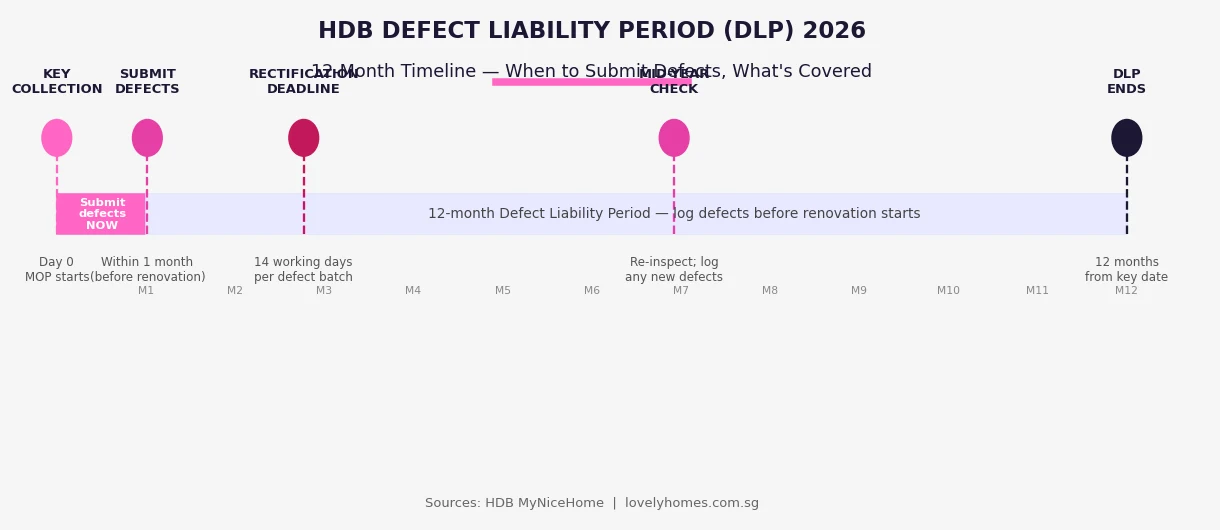
HDB defect liability period DLP 12-month timeline Singapore 2026
Figure 3: HDB Defect Liability Period — 12-month timeline, submission deadlines and what’s covered. Source: HDB MyNiceHome 2026.
Click image to zoom

The Defect Liability Period (DLP): Your Rights in the 12 Months After Key Collection

The Defect Liability Period is a 12-month statutory protection period commencing on the date of key collection. During this period, HDB’s appointed main contractor is contractually obligated to rectify valid construction defects — cracks, waterproofing failures, defective tiles, faulty electrical installations — at no cost to the flat owner. This is a significant consumer protection, particularly given that BTO flat construction typically takes three to five years and construction quality can vary.

How to Submit Defects Under the DLP

The recommended submission method is the MyHDB Portal (via browser at my.hdb.gov.sg or the MyHDB app). Submit photos with each defect, tag the location within the unit, and describe the issue specifically (for example: “living room floor tile at coordinates 2m from entrance door, 1m from left wall — hollow when tapped, produces dull sound across approximately 30×30cm area”). A specific, photo-supported submission is significantly harder to reject than a vague one. Alternatively, visit your Building Service Centre (BSC) and submit a physical Defects Feedback Form.

HDB targets 14 working days for contractors to complete each batch of rectification. For complex defects — waterproofing voids, structural cracks, systemic electrical issues — the timeline may extend. Follow up in writing via the portal if the 14-day window passes without completion.

Submit Before Renovation Begins

This is the most important practical rule of the DLP: submit all defects before your renovation contractor begins work. Once hacking, tiling and carpentry are underway, any pre-existing defect becomes extremely difficult to attribute to the original construction versus the renovation contractor. HDB may decline to rectify a defect that appears after renovation has commenced, even if the underlying cause was a construction fault. Log everything in the first week after key collection, before any furniture is moved in and certainly before a single tile is replaced.

Summary: BTO vs Resale Key Collection at a Glance

Aspect BTO Flat Resale HDB Flat
Timeline to key collection 3–5 years from ballot exercise 6–8 weeks from HDB approval
Pre-collection inspection Yes — HDB-organised pre-completion inspection No — buyer arranges own inspection
Key collection venue HDB Hub, Toa Payoh HDB Hub, Toa Payoh
Defect Liability Period 12 months from key collection date Not applicable
Defect submission window Within 1 month of key collection; before renovation Not applicable (negotiate pre-purchase)
MOP start date Date of key collection Date of key collection (completion date)
Stamp duties payable BSD at completion; no ABSD for eligible first-time buyers BSD and ABSD (if applicable) at completion
Keys from whom HDB (direct from developer) Seller (via completion appointment)

Worked Example: BTO Key Collection for a First-Timer Couple, Tengah 2026

Case Study: Mr Rahman (Singapore Citizen) and Ms Tan (Singapore Citizen) — 4-Room BTO, Tengah Garden Walk, TOP March 2026

Background: First-timer SC couple. Applied in October 2022 ballot. Estimated key collection: Q1 2026. HDB invitation received 10 January 2026.

Pre-completion inspection: 15 January 2026. Defects logged: 3 hollow tiles (living room), 1 hairline crack (bedroom 2 wall, corner), 2 stuck window hinges (bedroom 1 and study), slow drainage (master bathroom). All logged on HDB Defects Inspection Form on the day.

Key collection appointment: 28 January 2026, 10:00am, HDB Hub. Documents brought: NRIC for both owners; cashier’s order S$8,400 (balance stamp duty after CPF); HDB loan letter acceptance; CPF withdrawal authorisation. Time taken: 50 minutes. Keys received 28 January 2026 — MOP starts 28 January 2026, expires 28 January 2031.

Defect submissions: Second inspection conducted 28–29 January 2026. Additional defects found: 4 more hollow tiles (master bedroom), 1 dead power socket (study), grout cracking at master bathroom drain. Submitted via MyHDB Portal on 29 January 2026 (1 day after key collection). Total defects submitted: 11 items.

Rectification: Contractor began rectification 10 February 2026 (9 working days). All 11 items cleared by 21 February 2026.

Renovation commencement: Contractor engaged 1 February 2026; APEX permit issued 14 February 2026; renovation commenced 15 February 2026 — after all DLP defects confirmed submitted. ✓ Compliant.

Financial summary at completion: Purchase price S$510,000. CPF used: S$126,000 (down payment S$51,000 + BSD S$9,600 + legal S$3,400 + balance drawdown S$62,000). Cash: S$8,400. HDB loan: S$382,500 @2.60% pa, 25 years → S$1,728/month. MSR: 24.0% ✓ PASS.

Why Getting Key Collection Right Matters for Your Long-Term Investment

The 12-month DLP is one of the most valuable consumer protections available to a BTO flat buyer — and it is almost entirely wasted if defects are not logged promptly and correctly. HDB’s main contractors typically complete BTO projects at significant scale; individual flat defects, while minor in isolation, accumulate across a project and the contractor has both the obligation and the budget to rectify them during the DLP window. A thorough defect submission in the first week after key collection typically results in clean, contractor-funded rectifications that would otherwise cost S$3,000–S$15,000 to remedy out of pocket after the DLP expires.

Beyond the DLP, getting the MOP start date right matters for investment planning. A common misconception among first-time BTO buyers is that MOP runs from the date of ballot or the TOP date. It runs from key collection date. If you delay key collection — or if administrative issues push the date forward — your MOP and subsequent resale or investment timeline shifts accordingly.

What Might Come Next: HDB Defect Handling and Technology

HDB has been progressively digitalising the defect submission and inspection process. The MyHDB app now supports geo-tagged photo submissions with AI-assisted defect classification — automatically categorising submissions as structural, waterproofing, tiling, electrical or plumbing and routing them to the relevant sub-contractor. HDB’s pilot in selected BTO projects uses smart sensors embedded in wall and floor elements to flag waterproofing failures before they manifest as visible damp patches — potentially allowing proactive rectification before owners even move in. If expanded, this technology could substantially reduce the volume of owner-reported defects at key collection by the time BTO projects launching in 2024–2025 reach TOP around 2028–2030.

Frequently Asked Questions: HDB Key Collection Singapore 2026

What happens if I find defects after the 12-month DLP ends?

Once the 12-month Defect Liability Period expires, HDB’s contractor is no longer obligated to rectify construction defects at no charge. Structural defects — cracks in load-bearing elements, significant waterproofing failures — may still be covered under a longer structural warranty (HDB maintains a 15-year structural defect warranty on the building itself, distinct from the flat-level DLP). For cosmetic and minor defects discovered after the DLP, the cost of rectification falls entirely on the flat owner. This is why thorough and timely defect submission in the first month is so important — it is genuinely your only cost-free window for flat-level defect rectification by the original contractor.

Can I send someone else to collect my HDB keys on my behalf?

All registered flat owners are required to attend the key collection appointment in person, unless you have authorised a representative under a valid Power of Attorney (PA). The PA must be a notarised original, and the representative must bring it along with their own NRIC. HDB does not accept informal authorisation letters or verbal confirmation. If one co-owner genuinely cannot attend due to travel or medical reasons, arrange the PA in advance — the appointment cannot proceed with an absent owner who has not executed a PA.

Do I need to renovate immediately after collecting my BTO keys?

No. There is no obligation to renovate immediately. The BTO renovation permit window is three months from permit issuance — but you do not need to apply for the permit on the day you collect keys. Many flat owners wait several weeks after key collection to engage a contractor, finalise their design, and allow defect rectifications to complete before renovation begins. The practical constraint is that any defects you wish to claim under the DLP must be submitted before renovation work starts, so conduct your full defect inspection and submit to HDB before your renovation contractor commences hacking or tiling.

When does the MOP start for a resale HDB flat?

For a resale flat, the MOP begins on the date stated in the resale completion letter — the date on which the ownership transfer is formally registered by SLA and HDB. This is typically the date of the completion appointment at HDB Hub, at which point the buyer takes physical possession of the keys. The MOP does not start from the original TOP date of the resale flat, nor from the date the OTP was signed. If you are purchasing a resale flat specifically to use or sell after the MOP, count five years from your completion date, not from any earlier milestone in the transaction.

What is the difference between the pre-completion inspection and the defect submission after key collection?

The pre-completion inspection is an HDB-organised walk-through of your flat that takes place before key collection, typically one to four weeks prior. An HDB building inspector accompanies you, and any defects logged at this stage are formally recorded by HDB for contractor rectification. The post-key-collection defect submission is a second, self-conducted inspection that you carry out at your own pace after collecting the keys, submitted through the MyHDB portal or BSC. Both are important: the pre-completion inspection catches obvious construction issues early; the post-key-collection submission documents anything missed on the initial walk-through or discovered during a more thorough personal inspection. Submit all defects within one month and before renovation commences.

What is a Building Service Centre and what can it help me with?

A Building Service Centre (BSC) is an HDB service point located within or near major HDB estates. Each BSC handles the estate-specific management functions for the flats in its area, including defect submissions during the DLP, estate maintenance requests, lift breakdown reports, and minor statutory-regulated matters such as renovation permit endorsements for certain works. You can submit physical Defects Feedback Forms at your BSC as an alternative to the MyHDB portal. To find your BSC, search by your flat’s postal code on the HDB website under “Contact Us → Building Service Centre”.

What stamp duties are payable at BTO key collection?

For a BTO flat, Buyer’s Stamp Duty (BSD) is payable at the key collection appointment. The BSD rates (2026) are: 1% on the first S$180,000; 2% on the next S$180,000; 3% on the next S$640,000; 4% on the next S$500,000; and 5% on the remainder. For example, on a S$510,000 BTO flat: BSD = S$1,800 + S$3,600 + S$9,900 = S$15,300. Additional Buyer’s Stamp Duty (ABSD) does not apply to eligible first-timer Singapore Citizens buying an HDB flat as their first property. CPF Ordinary Account funds can be used to pay both BSD and legal fees at completion.

Related Articles

Disclaimer: This article is for general informational purposes only and does not constitute legal or financial advice. HDB processes, defect liability procedures and stamp duty rates are subject to change. Verify current requirements directly with HDB at www.hdb.gov.sg and IRAS at www.iras.gov.sg. For resale flat transactions and complex conveyancing matters, engage a qualified solicitor.

| Elegantly Designed by Little Big Red Dot | All Rights Reserved.

Translate »