Quick Answer: What Is the Thomson-East Coast Line?
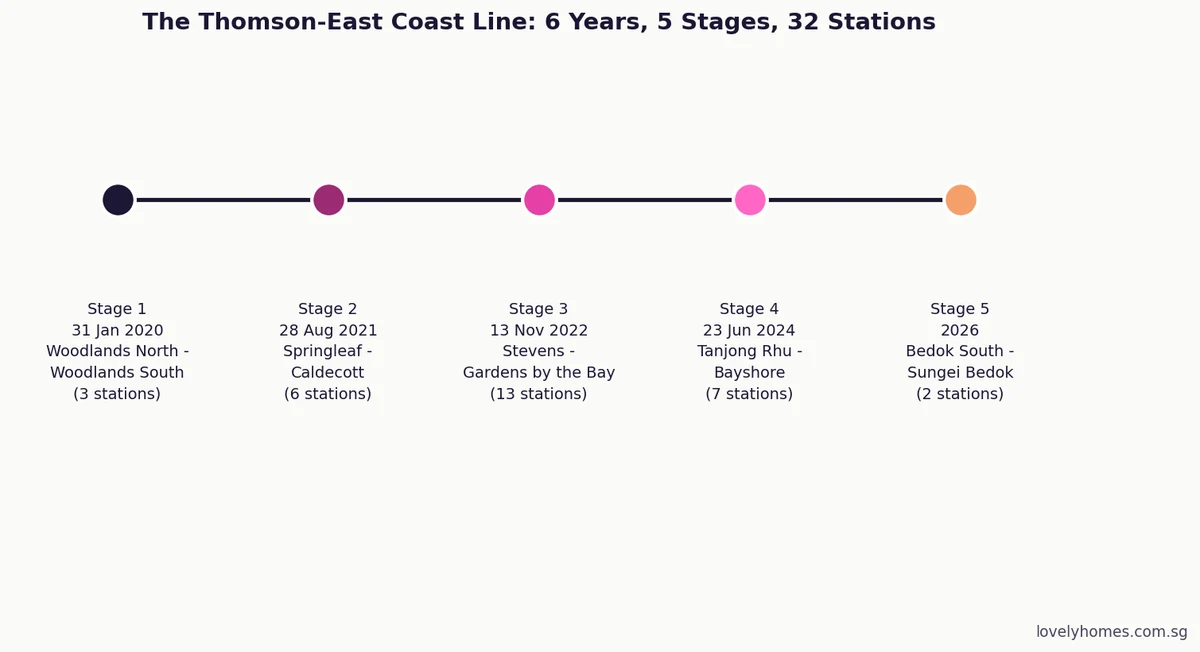
- The Thomson-East Coast Line (TEL) is Singapore’s newest MRT line, running 32 stations from Woodlands North in the north to Sungei Bedok in the east, built and opened in five stages between 31 January 2020 and 2026.
- Stage 4, opened 23 June 2024, brought the line through Tanjong Rhu, Katong Park, Tanjong Katong, Marine Parade, Marine Terrace, Siglap and Bayshore, giving the East Coast a direct MRT line for the first time in Singapore’s history.
- Stage 5 (Bedok South and Sungei Bedok) is scheduled to open in 2026, closing the final gap and creating a future interchange with the Downtown Line.
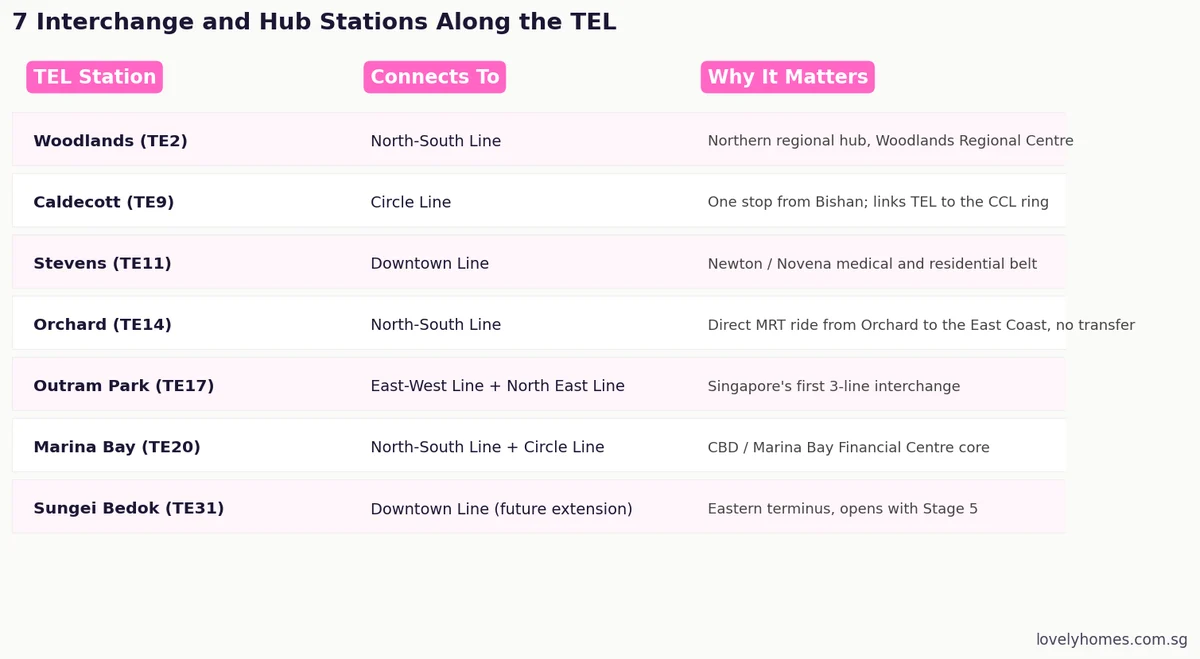
- The TEL touches seven interchange or hub stations: Woodlands (NSL), Caldecott (CCL), Stevens (DTL), Orchard (NSL), Outram Park (EWL + NEL, a rare 3-line interchange), Marina Bay (NSL + CCL) and, eventually, Sungei Bedok (future DTL extension).
- For the first time, Orchard is a direct, no-transfer MRT ride from the East Coast, and Woodlands in the far north is a direct ride to the CBD without changing trains.
- Districts newly served include parts of District 15 (Katong, Marine Parade, Siglap), long known for landed enclaves and low-rise condos but historically underserved by rail.
- New MRT connectivity is one factor among many, alongside tenure, unit mix, school proximity and broader market conditions, that can influence a property’s desirability and, over time, its price; it is not, on its own, a guarantee of capital appreciation.
- Buyers should treat “near a new MRT line” as one input into a wider due-diligence process, not a shortcut that replaces checking a specific project’s price history, tenure and fundamentals.
When the last stretch of the Thomson-East Coast Line opens in 2026, Singapore will have closed one of its most significant rail gaps: a direct, no-transfer MRT connection linking the northern dormitory towns around Woodlands, the medical and residential belt around Novena and Stevens, the prime Orchard shopping belt, the CBD around Marina Bay, and the long-underserved East Coast corridor around Katong, Marine Parade and Bayshore. For property buyers and owners, a new MRT line is one of the more reliable, publicly documented catalysts worth understanding properly, not because it guarantees a price uplift, but because it changes how a location is actually used and who is willing to live there. This guide walks through exactly how the TEL was built, which stations matter most, and what buyers should realistically expect from “new MRT line” property narratives.
How the TEL Was Built: Five Stages, Six Years
The Thomson-East Coast Line was not opened all at once. The Land Transport Authority (LTA) rolled it out in five stages: Stage 1 (31 January 2020) opened three stations from Woodlands North to Woodlands South; Stage 2 (28 August 2021) extended the line through six stations from Springleaf to Caldecott; Stage 3 (13 November 2022) was the largest single expansion, adding 13 stations from Stevens through Orchard, Outram Park and on to Gardens by the Bay; Stage 4 (23 June 2024) pushed the line east through seven stations from Tanjong Rhu to Bayshore, finally giving the East Coast a rail line of its own; and Stage 5, comprising Bedok South and Sungei Bedok, is due to open in 2026, completing the 32-station line. A handful of stations, including Mount Pleasant, Marina South and Founders’ Memorial, are built into the line but not yet operational, opening later in step with the developments around them.
The Interchange Stations That Matter Most
Not every TEL station carries equal weight for property buyers. What tends to matter most is where the TEL meets Singapore’s existing rail network, because an interchange station multiplies the number of destinations reachable without a bus ride or a long walk. Woodlands connects to the North-South Line and anchors the Woodlands Regional Centre in the north. Caldecott connects to the Circle Line, putting Bishan and the CCL ring one stop away. Stevens connects to the Downtown Line, serving the Newton and Novena medical and residential belt. Orchard is now a direct North-South Line interchange in the heart of the shopping district. Outram Park became Singapore’s first genuine three-line interchange, joining the East-West Line, North East Line and TEL. Marina Bay connects to both the North-South Line and Circle Line at the doorstep of the Marina Bay Financial Centre. And Sungei Bedok, opening with Stage 5, will eventually connect to a future Downtown Line extension, cementing the East Coast’s rail links for decades to come.
The East Coast: Singapore’s Biggest Rail Story of 2024
Of everything the TEL has done, opening the East Coast to a proper MRT line for the first time is arguably the most consequential for property buyers. The corridor covered by Stage 4, Tanjong Rhu, Katong Park, Tanjong Katong, Marine Parade, Marine Terrace, Siglap and Bayshore, sits within or close to District 15, an area long prized for its landed housing, low-rise condominiums, heritage shophouses and food culture, but historically reliant on buses or a longer drive to reach the CBD. Several major private residential launches in the years around Stage 4’s June 2024 opening, including projects along Thiam Siew Avenue and Meyer Road, were marketed partly on the strength of this new connectivity, alongside the area’s established appeal. The Bayshore precinct at the eastern end of Stage 4 is also earmarked for a large-scale Government Land Sales pipeline as part of URA’s long-term plans for the area, which will bring thousands of new homes to a station that did not exist before 2024.
Summary: TEL Facts at a Glance
| Question | Short Answer |
|---|---|
| How many stations does the TEL have? | 32 stations, Woodlands North to Sungei Bedok. |
| When did the line fully open? | Stage 5 (final stage) is due in 2026. |
| Which stage opened the East Coast? | Stage 4, 23 June 2024. |
| How many interchange stations are there? | Seven, including a rare 3-line interchange at Outram Park. |
| Is Orchard now a TEL interchange? | Yes, Orchard connects the TEL to the North-South Line. |
| Does living near the TEL guarantee price growth? | No. Connectivity is one factor among several. |
Worked Example: What the TEL Changes for a Daily Commute
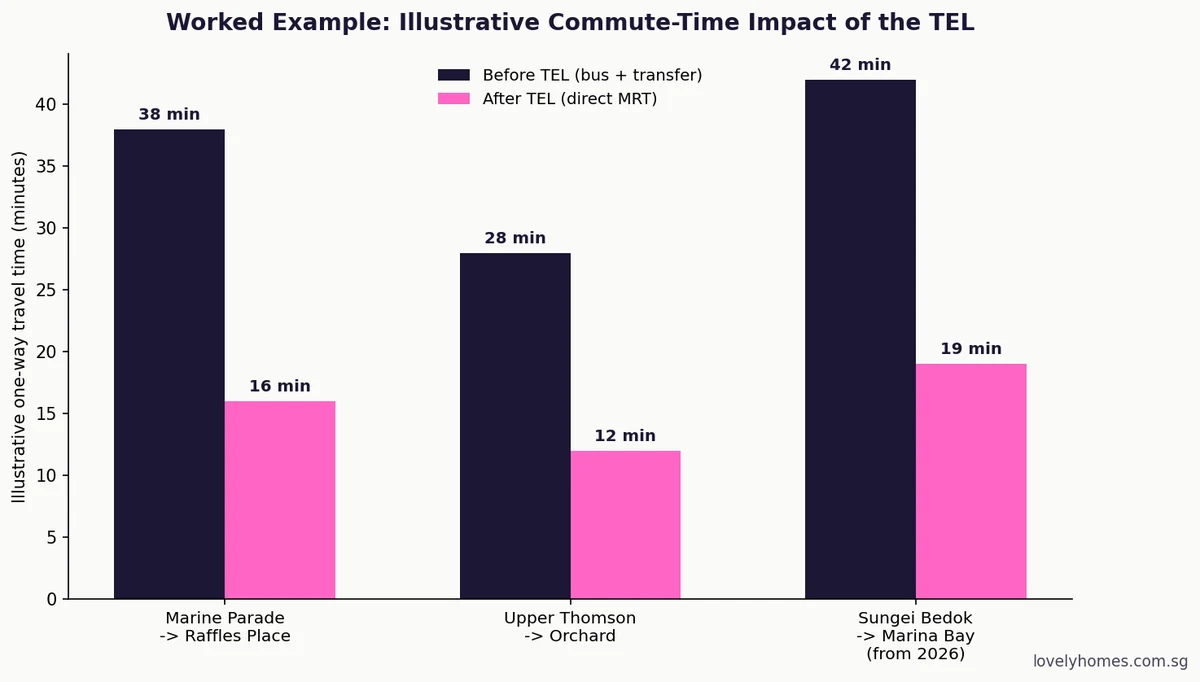
The scenario: illustrative one-way commute times for three journeys that were materially harder before their TEL station opened, based on the general shift from a bus-plus-transfer routing to a single direct MRT ride.
The illustrative maths: a resident near Marine Parade travelling to Raffles Place previously relied on a bus into the city or a bus-to-MRT transfer, a routing that could easily run 35 to 40 minutes depending on traffic; with a direct TEL ride via Marina Bay or Outram Park, the same journey can fall to roughly 15 to 18 minutes. A commuter near Upper Thomson heading to Orchard faced a similar bus-or-transfer routing before Stage 2 and Stage 3 opened; a direct TEL ride cuts this closer to 10 to 14 minutes. Once Stage 5 opens, a resident near Sungei Bedok travelling to Marina Bay should see a comparable step-change from a longer bus-and-transfer routing to a direct ride.
These figures are illustrative approximations based on typical pre-TEL routing patterns for these corridors, not a timed measurement for any specific address; actual commute times vary by exact origin, time of day and interchange waiting times.
Why This Matters for Buyers and Investors
New MRT connectivity is one of the few property catalysts that is publicly announced years in advance, precisely dated, and impossible for any single developer to control, which is exactly why it features so heavily in marketing material. The honest way to use it is as one layer of due diligence rather than the whole thesis: a unit’s walking distance to a TEL entrance (ideally under 500 metres), whether that station is a simple stop or a multi-line interchange, and how the surrounding precinct’s supply pipeline looks (a large upcoming Government Land Sales programme, as at Bayshore, can mean more competing new supply even as connectivity improves) all matter more than the line’s existence alone. Buyers should also remember that much of the price adjustment tied to a confirmed MRT alignment tends to happen gradually as each stage nears completion, not as a single jump on opening day, so “it’s near the new MRT line” is rarely, by itself, a mispricing waiting to be captured.
Frequently Asked Questions
How many stations does the Thomson-East Coast Line have in total?
32 stations from Woodlands North (TE1) to Sungei Bedok (TE31), including the not-yet-numbered Founders’ Memorial station, built in five stages between 2020 and 2026.
When does the final stage of the TEL open?
Stage 5, comprising Bedok South and Sungei Bedok, is scheduled to open in 2026, which will complete the line and create a future interchange with the Downtown Line at Sungei Bedok.
Which TEL station is the biggest interchange?
Outram Park, which became Singapore’s first three-line interchange, connecting the TEL to both the East-West Line and the North East Line.
Does being near a TEL station guarantee my property will go up in value?
No. Connectivity is one factor among several, alongside tenure, unit mix, supply pipeline and broader market conditions. It should inform, not replace, ordinary due diligence on a specific property.
Why did the East Coast not have an MRT line before 2024?
The East Coast corridor was historically served mainly by buses and the wider road network; the TEL’s Stage 4, opened 23 June 2024, was the first purpose-built MRT line to run directly through Katong, Marine Parade and the surrounding precincts.
What is happening at Bayshore?
Bayshore, at the eastern end of TEL Stage 4, is earmarked for a substantial Government Land Sales pipeline as part of URA’s long-term plans for the area, meaning significant new private housing supply is expected around this station over the coming years.
Are all 32 TEL stations currently operating?
No. Mount Pleasant, Marina South and Founders’ Memorial are built into the line but not yet operational, and Bedok South and Sungei Bedok are due to open with Stage 5 in 2026.
Related Articles on LovelyHomes
Supporting graphics
Original article illustrations are available below.