Jurong East Singapore Neighbourhood Guide 2026: Property Prices, MRT, Schools and Jurong Lake District

Jurong East Singapore Neighbourhood Guide 2026: Property Prices, MRT, Schools and Jurong Lake District

Quick Answer: Jurong East Singapore Neighbourhood Guide 2026

  • Jurong East is a mature HDB town and commercial node in the West Region (District 22), approximately 20 km from the city centre, anchored by the Jurong East MRT interchange (North-South and East-West Lines).
  • HDB resale median price for 4-room flats: approximately S$530,000 as at Q2 2026 — well below the national median, offering strong affordability relative to central districts.
  • Private condo PSF: approximately S$1,350 (Q1–Q2 2026), compared with S$2,100 in Queenstown and S$2,600+ in the Core Central Region.
  • Jurong East is the gateway to the Jurong Lake District (JLD) — Singapore’s designated second Central Business District — planned to deliver 100,000 jobs and 20,000 homes by approximately 2040.
  • The Jurong Region Line (JRL) is progressively opening, with Tukang and Bahar stations expected by 2027, adding a fourth MRT line to the area by 2032.
  • Key schools include Rulang Primary (top primary, within 0.4 km of Jurong East MRT), River Valley High School (Integrated Programme), and NUS High School of Mathematics and Science.
  • Three major retail malls — JEM, Westgate, and IMM — together house over 600 retail and food outlets, making Jurong East one of Singapore’s most well-served suburban shopping nodes.
  • Ng Teng Fong General Hospital (NTFGH), Singapore’s newest public hospital, opened in 2015 and serves the entire West Region from its Jurong East campus.
  • The URA launched a 3.72-hectare Town Hall Link white site in July 2026, capable of accommodating 1,200 residential units plus commercial space, signalling continued private-sector investment in the JLD precinct.

Overview: What Makes Jurong East Distinct?

Jurong East Town occupies a strategic position at the intersection of Singapore’s East-West and North-South MRT corridors, forming one of the city-state’s most important suburban transport hubs. It is simultaneously a mature residential town — home to roughly 78,000 residents — and the designated anchor of Jurong Lake District, Singapore’s most ambitious urban transformation project since the Marina Bay development of the 1990s and 2000s.

Unlike many mature HDB towns where the planning narrative is one of gradual decline followed by selective renewal, Jurong East is experiencing an accelerating investment arc. The JLD master plan, unveiled by the Urban Redevelopment Authority in 2019 and progressively implemented through Government Land Sales (GLS) tenders, envisages the area becoming Singapore’s second CBD — a place where residents can live, work, and access world-class amenities without travelling to the city centre.

For property buyers, this dual character — current affordability plus a credible long-term appreciation thesis anchored in government planning commitment — makes Jurong East one of the more compelling OCR (Outside Central Region) destinations in 2026.

Property Market Overview: Prices and Trends

Jurong East’s property market spans two distinct sub-markets: HDB resale flats, which account for the majority of residential stock, and a smaller but growing private condominium segment concentrated around the Jurong Gateway commercial core.

HDB resale: As at Q2 2026, the median transacted price for a 4-room resale flat in Jurong East is approximately S$530,000. This compares favourably against the national 4-room resale median of around S$600,000 and is significantly below mature central-town equivalents such as Queenstown (S$750,000+) or Buona Vista. Three-room flats in Jurong East typically transact between S$350,000 and S$450,000; five-room flats fetch S$650,000–S$800,000 depending on floor level, remaining lease, and proximity to transport.

Private condominiums: The private OCR segment in Jurong East transacts at approximately S$1,350 per square foot (psf) as at Q1–Q2 2026. This represents a significant discount of roughly 36% against Queenstown (approximately S$2,100 psf), 35% against Clementi (approximately S$1,750 psf), and over 48% against the broader CCR (S$2,600+ psf). For investors, this discount reflects the current stage of JLD’s development arc and may compress as the precinct matures.
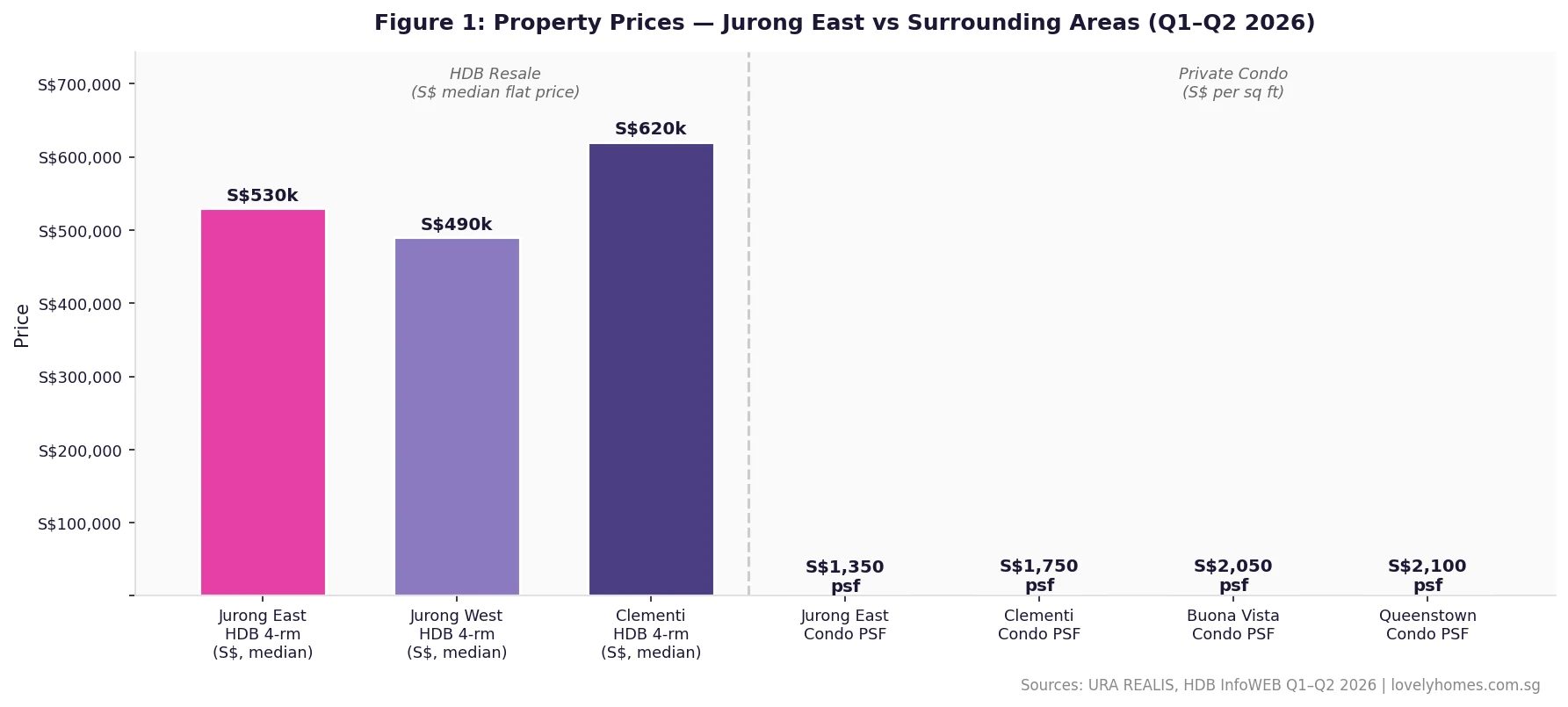
Jurong East property prices compared to surrounding areas Singapore Q1 Q2 2026
Figure 1: Property Prices — Jurong East vs Surrounding Areas (Q1–Q2 2026). HDB figures are median flat prices; condo figures are median PSF. Sources: URA REALIS, HDB InfoWEB.
Affordability context: A household earning S$14,000/month (the BTO income ceiling) can comfortably afford a Jurong East 4-room resale flat at S$530,000 using a bank loan at 30% MSR, a monthly instalment of approximately S$1,736 at 3.5% over 25 years — well within reach without CPF grants.

Jurong Lake District: Singapore’s Second CBD in the Making

The Jurong Lake District is the centrepiece of Singapore’s long-range planning for the West Region. Covering approximately 1,070 hectares — comparable in scale to Marina Bay and Orchard Road combined — JLD is designated to absorb Singapore’s next wave of commercial and mixed-use growth as the city-state’s population and economy expand towards 2040 and beyond.

The URA’s masterplan calls for JLD to deliver 100,000 new jobs and 20,000 new homes, supported by the convergence of four MRT lines at Jurong East station by 2032: the existing North-South Line (NSL) and East-West Line (EWL), plus the Jurong Region Line (JRL) and, in the longer term, the proposed Kuala Lumpur-Singapore High Speed Rail (HSR) terminus. This multi-modal integration would make Jurong East one of the best-connected nodes in the entire island — second only to Changi Airport in terms of transport convergence.

On 3 July 2026, the URA launched for tender a 3.72-hectare Town Hall Link white site within the JLD precinct. This mixed-use plot can accommodate approximately 1,200 residential units alongside office, retail, and community facilities. Its launch is one of several GLS tenders in the JLD pipeline and represents a signal of continued government commitment to activating the precinct through private-sector development.
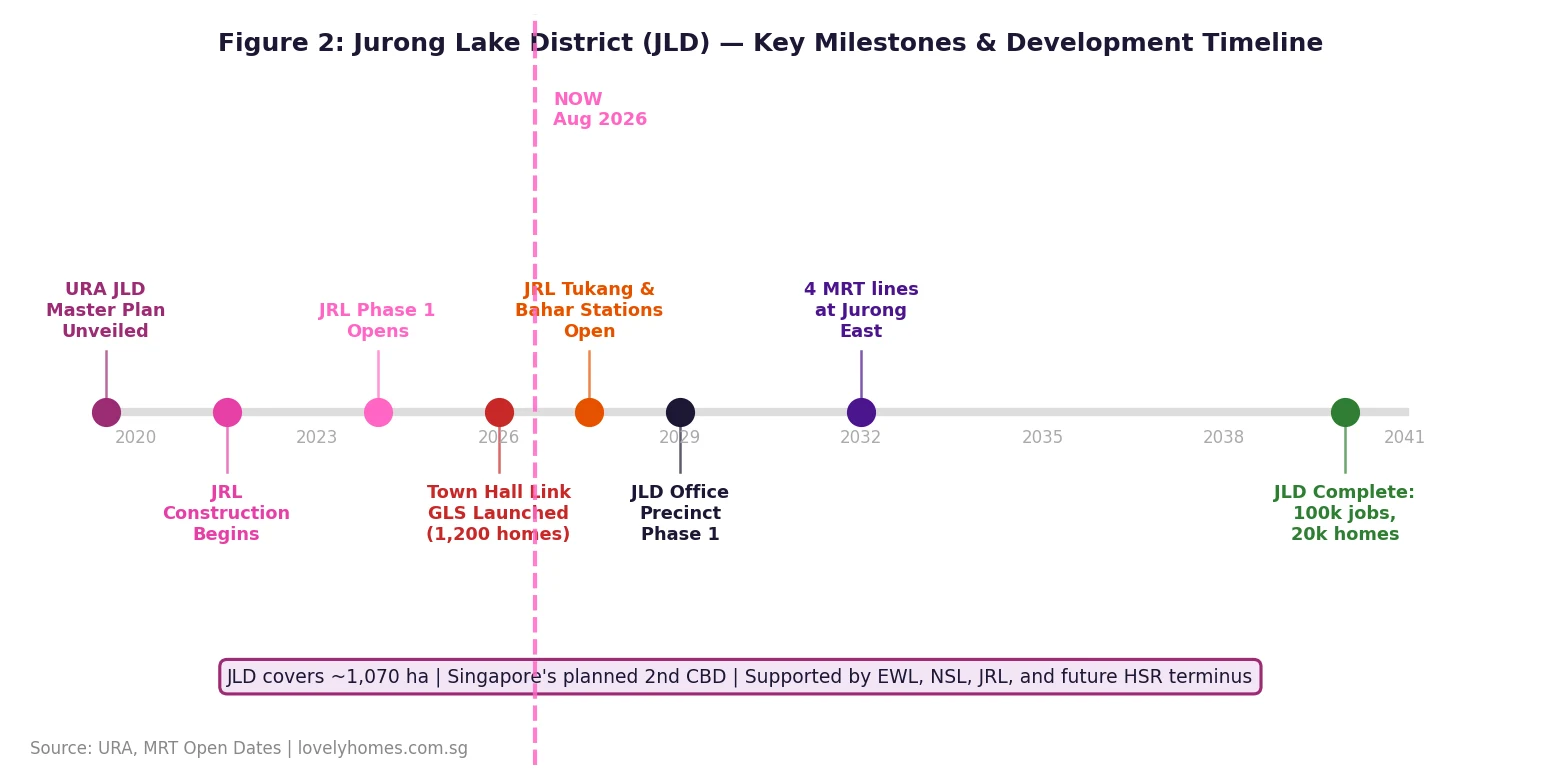
Jurong Lake District JLD development milestones and timeline 2019 to 2040 Singapore
Figure 2: Jurong Lake District — Key Development Milestones and Timeline 2019–2040. The vertical dashed line marks the current date (August 2026). Sources: URA Master Plan, MRT Open Dates.

MRT and Transport Connectivity

Transport connectivity is Jurong East’s strongest immediate selling point. The Jurong East MRT station (NS1/EW24) serves as the western terminus of the North-South Line and a major node on the East-West Line, placing the town approximately 30–35 minutes from Raffles Place and 25 minutes from Buona Vista by rail. The station is housed within the Jurong East Integrated Transport Hub — a purpose-built interchange that links MRT, 11 bus services, and the Jurong East Bus Interchange under one roof.

The Jurong Region Line (JRL) is being progressively brought into service. Phase 1 opened in 2024 (Choa Chu Kang to Boon Lay), and Tukang and Bahar MRT Stations are expected to open by 2027. When fully operational, the JRL will provide orbital connectivity across the western belt — linking the Tengah HDB new town, Nanyang Technological University (NTU), and Jurong Industrial Estate to Jurong East without requiring a transfer at Boon Lay or Jurong East. By 2032, four MRT lines are expected to converge at or near Jurong East station, a density of rail connectivity matched only by a handful of nodes in Singapore.

Road connectivity is equally strong. Jurong East is served by the Ayer Rajah Expressway (AYE), Pan-Island Expressway (PIE), and Kranji Expressway (KJE), offering direct highway access to the Central Business District, Tuas industrial zone, and Changi Airport (approximately 45 minutes by car without peak-hour congestion).

Schools and Education

Jurong East’s schooling landscape is anchored by Rulang Primary School, consistently one of Singapore’s most subscribed primary schools due to its outstanding academic outcomes and community engagement record. Rulang is located approximately 400 metres from Jurong East MRT station and typically receives a high volume of Phase 2C balloting applications each year.

Beyond Rulang, the area is served by Shuqun Primary and Westwood Primary, both within 1.5 km. At the secondary level, residents can access Jurong Secondary School and — slightly further — River Valley High School, which operates on the Integrated Programme (IP) track in partnership with the National University of Singapore (NUS). NUS High School of Mathematics and Science, a specialised independent school, is located approximately 2.9 km away and draws students from across the island via dedicated school buses.

At the post-secondary level, Jurong Pioneer Junior College (formed from the merger of Jurong JC and Pioneer JC in 2019) serves the western catchment area. NTU’s main campus at Nanyang Avenue is accessible via the JRL within approximately 20 minutes.
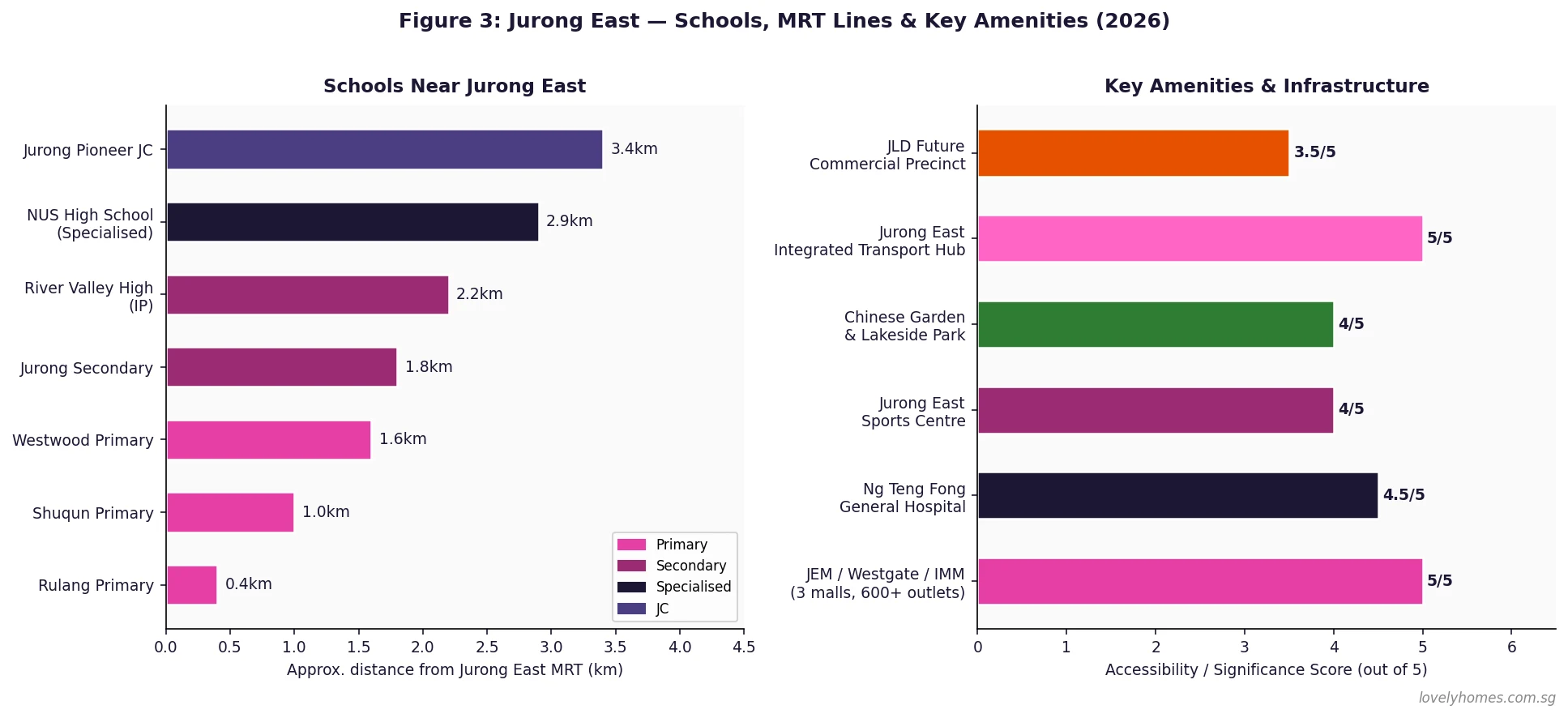
Jurong East schools MRT lines and amenities overview Singapore 2026
Figure 3: Schools Near Jurong East MRT and Key Amenities & Infrastructure (2026). Distance figures are approximate. Sources: MOE School Finder, URA, hospital websites.

Amenities and Lifestyle

Jurong East is home to JEM, Westgate, and IMM — three large-format retail malls collectively offering over 600 food, retail, and lifestyle outlets. JEM and Westgate, developed by Lendlease, anchor the Jurong Gateway commercial cluster that forms the precursor to the full JLD commercial buildout. IMM, Singapore’s largest factory outlet, draws shoppers from across the island and the region for its discounted brand goods and warehouse sales.

Healthcare is anchored by Ng Teng Fong General Hospital (NTFGH), a 700-bed acute care hospital opened in 2015 as one of Singapore’s most technologically advanced public facilities. NTFGH is co-located with Jurong Community Hospital, providing a continuum of care from acute to step-down and community settings within a single campus. Together they serve the entire West Region population of approximately 900,000 residents.

Recreational amenities include the Chinese Garden and Jurong Lake Park — a 86-hectare lakeside green space that is being progressively upgraded as part of JLD’s broader public realm enhancement. The Jurong East Sports Centre provides swimming pools, a gymnasium, and multi-purpose sports halls accessible to residents on a pay-per-use basis. The upcoming JLD precinct plans also include expanded waterfront promenades and cycling infrastructure along Jurong Lake.

At a Glance: Jurong East Summary (2026)

Attribute Detail
Planning area / District Jurong East, District 22, West Region
HDB resale median (4-room) ~S$530,000 (Q2 2026)
HDB resale median (5-room) ~S$660,000–S$800,000 (Q2 2026)
Private condo PSF (OCR) ~S$1,350 psf (Q1–Q2 2026)
MRT lines North-South Line (NSL), East-West Line (EWL); JRL by 2027
Top primary school Rulang Primary (~0.4 km from Jurong East MRT)
Key hospital Ng Teng Fong General Hospital (700 beds)
Major retail JEM, Westgate, IMM (600+ outlets combined)
JLD jobs target 100,000 new jobs by ~2040
JLD homes target 20,000 new homes by ~2040
Latest GLS activity Town Hall Link white site (3.72 ha, ~1,200 units), launched July 2026

Worked Example: The Chong Family Buy in Jurong East

Mr and Mrs Chong are a Singapore Citizen couple in their mid-30s with a combined household income of S$12,500 per month. They are first-time buyers looking for a four-room HDB resale flat in Jurong East for S$535,000.

Grants available: Their household income of S$12,500 falls below the Enhanced CPF Housing Grant (EHG) ceiling of S$14,000 for family applicants buying resale. The EHG tiers: at S$12,500 income, they may receive approximately S$20,000 EHG (based on the sliding scale — maximum S$120,000 for income S$9,000 and below; decreasing to S$0 at S$14,000). They also qualify for the Family Grant of S$50,000 for a 4-room or larger resale flat. Total estimated grants: S$70,000.

Financing:

  • Purchase price: S$535,000
  • Grants applied to reduce effective price: S$535,000 − S$70,000 = S$465,000 funded from CPF/loan
  • HDB concessionary loan (90% LTV): S$481,500 (90% of S$535,000) = S$481,500 — but assuming CPF OA of S$80,000 is used, loan required ≈ S$401,500
  • HDB loan @ 2.6% flat rate, 25 years: monthly instalment ≈ S$1,824/month
  • MSR check: S$1,824 / S$12,500 = 14.6% — well within the 30% MSR cap
  • BSD: 1% × S$180,000 + 2% × S$180,000 + 3% × S$175,000 = S$1,800 + S$3,600 + S$5,250 = S$10,650
  • ABSD: S$0 (SC first-time buyer)
  • Day-1 cash outlay: BSD S$10,650 + legal fees ~S$3,000 + 10% deposit (cash component ≈ S$13,375) ≈ S$27,025 in cash (remainder from CPF OA)

The Chongs’ total monthly housing cost of S$1,824 represents 14.6% of gross household income — a conservative, sustainable debt load that leaves significant capacity for savings, retirement contributions, and family expenses. With the JLD precinct expected to mature over the next 10–15 years, they are acquiring at a stage in the development arc where appreciation potential remains, while benefit from Jurong East’s already-excellent existing infrastructure.

Why Jurong East Stands Out Among OCR Estates

For most of the past two decades, Jurong East’s property market reflected its status as a functional but unremarkable western HDB town: affordable, well-served by transport, but lacking the aspirational pull of mature central estates. The JLD master plan changes this calculus materially. Singapore’s planning history provides multiple precedents — Marina Bay, one-north, Punggol — where long-horizon government commitment to an area creates durable property value appreciation over 15–20 year holding periods.

The JLD story is arguably the most ambitious of these, both in scale and in its integration of residential, commercial, hospitality, and public-realm elements. For buyers willing to adopt a patient, fundamentals-driven view, Jurong East’s current pricing — at a 36% discount to Queenstown and a fraction of CCR values — presents a case that other mature OCR estates cannot easily replicate.

What Might Come Next

The GLS pipeline for JLD remains active. Following the July 2026 Town Hall Link white site tender, further commercial and residential land releases in the JLD precinct are anticipated in the 2027–2029 Government Land Sale programmes. Each successive launch will provide data points on developer confidence in the precinct’s long-term valuation. Market observers are particularly watching the first JLD office component launch — when it comes to market, the quantum and quality of bids will signal how strongly the financial sector views JLD as a genuine rival to the CBD.

On transport, the full commissioning of the Jurong Region Line (all phases) and, in the longer term, the HSR terminus decision will be the two variables most likely to re-rate Jurong East’s property values materially. Both are subject to their own timelines and bilateral negotiations, but the direction of travel is clear.

Frequently Asked Questions

Is Jurong East a good place to buy property in 2026?

Jurong East offers a compelling combination of current affordability and long-term appreciation potential anchored in the Jurong Lake District masterplan. HDB resale flats are priced well below the national median, and private condominiums trade at a significant discount to Queenstown and CCR. Buyers with a 10–15 year horizon are acquiring at a stage in the JLD development arc where meaningful capital appreciation is plausible — though, as with any property investment in Singapore, outcomes depend on execution of the masterplan, transport infrastructure delivery, and broader market conditions.

How does Jurong East compare to Jurong West as a place to live?

Both Jurong East and Jurong West are mature HDB towns in District 22, but they serve somewhat different profiles. Jurong East is the commercial and transport hub — home to JEM/Westgate/IMM and the Jurong East MRT interchange — while Jurong West is larger, more predominantly residential, and generally priced slightly lower (HDB 4-room median approximately S$490,000 in Q2 2026). Jurong East has higher growth potential given the JLD precinct and transport convergence, while Jurong West offers slightly more affordable housing stock with a quieter residential character. Families who prioritise the Rulang Primary School catchment should note that Rulang is in Jurong East.

What are the best streets or blocks to buy in Jurong East?

Blocks within walking distance of Jurong East MRT, particularly along Jurong East Avenue 1 and Jurong East Street 21, tend to command premium prices within the town due to transport convenience and proximity to the mall cluster. Higher-floor units with unobstructed views towards Jurong Lake or the JLD development zone are also in demand. Buyers on a tighter budget should look at blocks further from the interchange, along Jurong West Street 91 and St Francis Road, which offer lower per-square-foot prices while still benefiting from the town’s infrastructure. Any specific purchase should be assessed on the basis of HDB REALIS comparable transactions and an independent valuation.

Is there a BTO launch planned for Jurong East in 2026?

As at August 2026, no BTO launch has been announced specifically for Jurong East town proper. The adjacent Tengah New Town (which draws on Jurong East’s infrastructure corridor) has been the primary focus of BTO supply in the western belt in recent years. Buyers seeking a BTO in the western region should monitor HDB’s quarterly BTO exercise announcements at flat.hdb.gov.sg for Tengah, Bukit Batok, and Jurong West options. The GLS Town Hall Link white site in JLD is a private residential development, not an HDB BTO project.

How long is the remaining lease on HDB flats in Jurong East?

HDB flats carry a 99-year lease from the date of original construction. Many Jurong East HDB blocks were built in the 1980s and 1990s, which means older blocks may have 55–70 years of lease remaining as at 2026. Buyers using CPF OA funds must be aware of the CPF Lease Buyback Scheme rules: CPF usage is restricted for flats where the remaining lease at the point of purchase is less than 60 years, or where the lease does not cover the youngest buyer to age 95. Buyers of shorter-lease Jurong East flats should conduct a CPF usage eligibility check via the CPF Board website before committing to a purchase.

What is the Jurong Region Line (JRL) and how does it affect Jurong East?

The Jurong Region Line is a 24.4 km MRT line with 24 stations serving the western belt of Singapore, linking Choa Chu Kang to Boon Lay via Tengah, Nanyang Technological University, and the Jurong Industrial Estate. Phase 1 (Choa Chu Kang to Boon Lay, eastern section) opened in 2024. Tukang and Bahar Stations, which serve the Tengah corridor adjacent to Jurong East, are expected to open by 2027. When the full JRL is operational and a fourth MRT line converges at the Jurong East interchange by 2032, the station will offer one of the broadest set of rail connections in Singapore, meaningfully reducing travel times to employment nodes across the island.

Are foreigners allowed to buy property in Jurong East?

Foreigners may purchase private condominium units in Jurong East without restriction, subject to the applicable stamp duties — including the 60% Additional Buyer’s Stamp Duty (ABSD) for foreign nationals purchasing residential property in Singapore. HDB resale flats are not available to foreigners; they may only be purchased by Singapore Citizens and, in co-purchase with an SC, by Permanent Residents under the eligibility schemes set out by HDB.

Related Articles

Disclaimer

This article is intended for general informational purposes only and does not constitute financial, legal, or investment advice. Property prices, MRT opening dates, and URA planning information cited are accurate as at 12 August 2026 but may change. Property price data is sourced from URA REALIS and HDB InfoWEB. School proximity distances are approximate. Readers should conduct their own due diligence and consult a licensed property agent and financial adviser before making any property purchase decision.

Newton Neighbourhood Guide Singapore 2026: Properties, Schools, MRT & Rental Yields

Newton Neighbourhood Guide Singapore 2026: Properties, Schools, MRT & Rental Yields

Quick Answer — Newton at a Glance

  • Location: Newton sits at the heart of Singapore’s Core Central Region (CCR), spanning parts of District 9 and District 11, roughly bounded by Bukit Timah Road, Newton Road, Dunearn Road, and Thomson Road.
  • Transport: Served by Newton MRT (North-South Line + Downtown Line interchange), with Stevens MRT (Thomson-East Coast Line + Downtown Line) on the northern fringe, giving residents direct access to the CBD, Orchard, Botanic Gardens, and Woodlands.
  • Property mix: Predominantly private — a blend of freehold and 99-year leasehold condominiums, good-class bungalows (GCBs) along Dunearn and Shelford Roads, and cluster landed housing. No HDB flats within the Newton planning area.
  • Price range: Non-landed condo PSF ranges from S$1,900 to S$3,100 (mid-tier Newton Road stock) up to S$2,500–S$4,200 for luxury freehold developments closer to District 9/10 borders. Landed prices range from S$2,200–S$3,600 PSF for semi-detached and terrace houses.
  • Gross rental yield: Approximately 3.2–3.6% for condominiums — competitive for a CCR address, driven by strong expat and PMET demand near medical and educational clusters.
  • Schools: One of the best school-dense micro-areas in Singapore — Anglo-Chinese School (Primary), St Joseph’s Institution Junior, Singapore Chinese Girls’ School, Raffles Girls’ Primary, and ACS (Barker Road) are all within 1–2 km.
  • Lifestyle: Newton Food Centre (one of Singapore’s most beloved hawker centres), proximity to the Orchard Road shopping belt, and a low-rise, leafy streetscape that feels surprisingly unhurried for a CCR address.
  • Investment outlook: CCR recovery and TEL completion have improved Newton’s connectivity story in 2025–2026. Vacancy rates remain manageable at approximately 6–7%, in line with the CCR average, driven by continued rental demand from medical professionals and corporate tenants.

Newton — Singapore’s Quiet Prime Core

In a city where “CCR” often conjures images of glass towers and Marina Bay skylines, Newton is something different: a residential prime, where quiet tree-lined streets, colonial-era conservation houses, and some of Singapore’s most sought-after school addresses coexist within 10 minutes of Orchard Road. It is a neighbourhood that serious property buyers have understood for decades, and one that continues to offer a compelling combination of capital preservation and liveable quality — even as some of the more glamorous CCR precincts capture the headlines.

This guide covers Newton’s property market comprehensively: where prices are in Q2 2026, what the rental market looks like, which schools fall within the 1-km and 2-km catchment, how the Thomson-East Coast Line (TEL) has changed connectivity, and what to expect if you are buying here as a long-term owner or investor.

Newton District 11 Singapore property PSF by type Q2 2026
Figure 1: Newton / District 11 Property PSF by Type — Q2 2026. Error bars indicate indicative transaction range; mid-point reflects median. Landed detached commands the widest premium. Source: URA REALIS / SRX Q2 2026 indicative data.

Location and Boundaries

The Newton Planning Area, as defined by the URA Master Plan 2019 (updated 2025), covers approximately 5.5 sq km of predominantly low-to-medium-density residential land. Its main arteries are Newton Road (linking Orchard Road to Balestier and Toa Payoh), Bukit Timah Road (the main corridor northwest toward Holland and Clementi), Dunearn Road (the address for many Good Class Bungalows), and Thomson Road. The neighbourhood is flanked by Novena to the northeast (with its dense medical cluster — TTSH, NUH@Novena, Novena Medical Centre), Orchard and River Valley to the south, and Bukit Timah to the west.

This central location gives Newton residents a rare advantage: they are equidistant from multiple employment nodes — the CBD (15 minutes by MRT), one-north (20 minutes via Buona Vista), the Novena medical cluster (two stops on the TEL), and Changi Business Park (direct on the TEL). Newton is genuinely accessible from any major employment centre in Singapore, which is one reason why expat corporate tenants — particularly those whose employers do not dictate a specific rental district — consistently list Newton and Novena as top residential preferences.

Property Market: Prices and Transaction Data

Newton’s non-landed condo market sits firmly in the S$2,000–S$3,100 PSF band for most transactions in Q2 2026, with older freehold developments toward the lower end and newer or luxury freehold projects (with full facilities and larger unit sizes) at the upper end. Key reference developments include:

  • Newton One (freehold, completed 2014) — transacting at approximately S$2,400–S$2,700 PSF.
  • Peak Residence (freehold, completed 2023) — transacting at S$2,800–S$3,100 PSF for 2–3BR units.
  • Pullman Residences Newton (99-year, 2022) — S$2,600–S$2,950 PSF, buoyed by the mixed-use Pullman hotel brand.
  • Residences at Newton (freehold, 2002) — transacting at S$1,950–S$2,300 PSF, reflecting age-related discount.

The Good Class Bungalow (GCB) market in Newton/Dunearn continues to command S$1,300–S$2,200 per land square foot for bungalow plots of 1,500 sq m and above, with transaction values typically in the S$20M–S$60M range. GCBs are the most illiquid segment of the Singapore property market but have historically appreciated strongly over 10–20 year holding periods, with minimal correlation to mass-market cycles.

Rental Market and Yields

Newton’s rental market is powered by a specific tenant profile: medical professionals at the nearby Novena medical cluster, corporate executives with CBD employment, and families seeking school-district access. Rental rates in Q2 2026 for non-landed units in Newton and immediate Novena fringe are approximately:

  • 1BR (500–700 sqft): S$3,800–S$5,200/mth
  • 2BR (800–1,050 sqft): S$6,500–S$9,000/mth
  • 3BR (1,200–1,600 sqft): S$9,500–S$14,000/mth
  • 4BR+ (above 1,700 sqft): S$14,000–S$22,000/mth

These rental rates translate to gross yields of approximately 3.2–3.6% for mid-tier Newton Road condominiums — lower than the OCR average of around 4.0% (reflecting the higher purchase price), but solid for a CCR address. Importantly, Newton’s rental demand has been relatively stable across the 2023–2026 normalisation period, supported by the structural driver of the Novena medical hub, which expanded significantly with the opening of Woodlands Health Campus in late 2023, creating additional cross-island medical employment that favours Newton as a midpoint.

Newton Singapore gross rental yield comparison prime districts 2026
Figure 2: Gross Rental Yield Comparison — Newton/D11 vs Prime Districts, Q2 2026. Newton’s 3.4% yield compares favourably to Orchard (2.9%) and Bukit Timah (2.8%), with a smaller gap to OCR (4.0%) than typical CCR districts. Source: URA / SRX Q2 2026 indicative data.

Schools — The Newton School Belt

Newton’s school proximity is one of its defining residential advantages. Singapore parents planning for primary school registration under Phase 2C (Home-School Distance) prioritise addresses within 1 km of their target school. Newton and its immediate surrounds offer more top primary school catchments within a compact area than almost any other neighbourhood in Singapore:

  • Anglo-Chinese School (Primary), ACS(P) — 40 Barker Road; approximately 0.8 km from the Newton MRT area.
  • St Joseph’s Institution Junior (SJIJ) — 58 Grange Road, approximately 1.4 km from Newton MRT.
  • Singapore Chinese Girls’ School (SCGS) — 37 Emerald Hill Road, approximately 1.3 km.
  • Raffles Girls’ Primary School (RGPS) — 21 Anderson Road, approximately 2.1 km from Newton MRT.
  • ACS Barker Road (Secondary) — adjacent to ACS(P); 0.8 km.

It is worth noting that Phase 2C registration allocates by ballot among applicants within 1 km, then 2 km. Living within 1 km of a top-ranked primary significantly improves Phase 2C chances. Buyers who prioritise ACS(P) access should target Newton Road and Dunearn Road addresses, which consistently fall within the 1-km radius, while SCGS and SJIJ are more accessible from the Orchard fringe of the Newton planning area.

Connectivity: Newton MRT and the TEL Uplift

Newton MRT station (NS21/DT11) is a dual-line interchange at the junction of the North-South Line (NSL) and Downtown Line (DTL), making it one of the most connected stations in Singapore outside of the major city-fringe interchanges. Travel times: Raffles Place (CBD) is 8 minutes on NSL; Botanic Gardens is 2 minutes on DTL; Marina Bay is 11 minutes on NSL; Changi Airport is approximately 48 minutes with one transfer.

The Thomson-East Coast Line (TEL) has added Stevens MRT (TE11/DT10) on the northern edge of Newton, approximately 700 m from Newton Road. Stevens station provides direct TEL access to Woodlands North (the RTS Link to Johor Bahru, which opened in 2026), Caldecott (Circle Line), Mount Pleasant, and eventually to Marine Parade, Tanjong Rhu, and Changi Airport (TEL Stage 5, expected 2029). For Newton residents working in the north or commuting to JB, the TEL is a material connectivity upgrade that was not priced into the Newton market prior to 2023.

Development Tenure Approx PSF (Q2 2026) TOP Year Dist. to Newton MRT
Peak Residence Freehold S$2,800–S$3,100 2023 ~350 m
Pullman Residences Newton 99-yr S$2,600–S$2,950 2022 ~500 m
Newton One Freehold S$2,400–S$2,700 2014 ~650 m
Residences at Newton Freehold S$1,950–S$2,300 2002 ~400 m
GCB (Dunearn/Shelford) Freehold S$1,300–S$2,200 /land sqft Various ~800–1,200 m

10-Year Price Appreciation

Newton D11 Singapore property price index appreciation 2016 2026
Figure 3: Newton/D11 Non-Landed PPI vs Overall Singapore Private Residential PPI — 2016 to Q2 2026 (rebased to 100). Newton/D11 non-landed appreciated +35.8% over the decade, slightly below the overall market (+40.9%), consistent with the CCR segment’s relative underperformance vs OCR in 2021–2022. Source: URA REALIS.

The 10-year data tells an instructive story. Newton/D11 non-landed properties appreciated approximately 35.8% from 2016 to Q2 2026, compared with 40.9% for the overall private residential PPI. This reflects the CCR segment’s underperformance versus OCR during the 2021–2022 mass-market surge, when suburban condominiums and HDB resale flats drove headline index gains. However, from 2023 onwards — as the OCR surge normalised and CCR fundamentals reasserted themselves — D11 price growth has broadly matched or exceeded the overall private market, with Q2 2026 CCR non-landed up +1.8% QoQ versus OCR -0.1% QoQ.

Worked Example: Buying a 2BR Condo in Newton — Full Cost Breakdown (Q2 2026)

James (SC, age 40) and Lisa (SC, age 38) are buying their second property — a 2BR condo at Peak Residence, Newton. Their first property is an HDB flat at Bishan (MOP cleared). Purchase price: S$2.2M (1 unit, 700 sqft, ~S$3,143 PSF, typical for 2BR at Peak Residence).

ABSD: Second residential property for Singapore Citizens — 20%. ABSD = S$2.2M × 20% = S$440,000 (cash only; CPF cannot be used for ABSD).

BSD: First S$180k at 1% = S$1,800; next S$180k at 2% = S$3,600; next S$640k at 3% = S$19,200; remaining S$1.2M at 4% = S$48,000. Total BSD = S$72,600 (payable from CPF OA or cash).

Loan: LTV 45% on second property (75% LTV applies to first only). Loan = S$2.2M × 45% = S$990,000. At 3.3% for 25 years: monthly repayment ≈ S$4,854/mth. TDSR check: assuming combined income S$22,000/mth, TDSR = S$4,854/S$22,000 = 22.1% — well within the 55% TDSR limit.

CPF: 55% of purchase price may be used from CPF OA for the property itself (after BSD is paid). CPF OA usage = S$2.2M × 55% = S$1.21M (subject to Valuation Limit and lease-age check — Peak Residence 2023 freehold passes easily).

Cash upfront: ABSD S$440k + 5% cash downpayment (S$110k) + BSD S$72.6k + legal fees ~S$5k + stamp fees S$1k = approximately S$629,000 in cash at completion. Plus CPF downpayment top-up of S$220k (remaining 10% deposit) from OA if available.

Rental scenario: Rented at S$7,800/mth, gross yield = S$7,800 × 12 / S$2.2M = 4.25% — above the Newton average, achievable for a newer development with brand-name facilities in a tight rental market.

What This Means for Buyers and Investors

Newton rewards patient, long-term thinking. It is not the neighbourhood for buyers chasing short-term momentum — the OCR has delivered that story in recent years. What Newton offers is structural scarcity (very limited new GLS supply in the immediate planning area), a multi-layered demand base (schools, medical, corporate), and a connectivity profile that has materially improved with TEL. For owner-occupiers with school-age children, Newton is arguably the most efficient school-access investment in Singapore on a PSF basis — access to ACS(P), SCGS, and SJIJ within 1.5 km is unmatched anywhere else at comparable price points.

For investors, Newton’s CCR positioning means it benefits from any improvement in foreigner sentiment (foreigners can buy freely, though at 60% ABSD) and from corporate relocation demand that typically channels into mid-tier CCR condominiums for PMET expat packages. The TEL uplift toward Woodlands and the RTS Link is a longer-term capital appreciation factor that the market has partially but not fully priced in.

What Might Come Next — Newton 2026–2030

No major new GLS sites are expected in the Newton planning area in the 2H 2026 or 2027 GLS programmes. Supply will therefore remain constrained, with resale transactions dominating. The URA Master Plan 2025 maintains the Newton area’s predominantly low-to-medium density residential zoning, with conservation guidelines protecting the older streetscapes along Stevens Road and Dunearn Road. One potential driver to watch: the Kampong Java Flyover site (near the junction of Newton and Kampong Java Roads) and any mixed-use development that may accompany the Urban Redevelopment of the Newton Circus precinct, which URA has identified as an area for placemaking improvement.

Frequently Asked Questions

Is Newton MRT an interchange station, and what lines does it serve?
Yes. Newton MRT (NS21/DT11) is an interchange between the North-South Line (NSL) and Downtown Line (DTL). It offers direct routes to the CBD (Raffles Place in 8 minutes on NSL), Orchard (2 minutes on NSL), Botanic Gardens (2 minutes on DTL), and connects at Bugis, Bayfront, and City Hall to the EWL and CCL respectively. The nearby Stevens MRT (TE11/DT10) — a 700-metre walk from Newton Road — adds Thomson-East Coast Line (TEL) access, making the Newton area one of the best-connected residential neighbourhoods outside the city centre.
Are there any HDB flats in Newton, and can I buy one?
There are no HDB flats within the Newton Planning Area as defined by URA. The Newton area is entirely private residential. The nearest HDB estates are in Toa Payoh (approximately 1.5 km to the northeast), Bishan (approximately 3 km), and the fringe of Queenstown (approximately 3.5 km to the southwest). If you are looking for a more affordable entry into the broader Newton/Novena/Thomson corridor, Toa Payoh HDB resale flats — particularly 4- and 5-room units along the TPY central corridor — offer proximity to Newton MRT within 4–5 MRT stops.
What is the 1-km school catchment for ACS Primary from Newton Road addresses?
ACS Primary (ACS(P)) is located at 40 Barker Road. Addresses along Newton Road, Shelford Road, Dunearn Road (northern stretches), and Victoria Park Road typically fall within 1 km of ACS(P), qualifying for Phase 2C registration priority. You should verify your specific address against the MOE School Finder before purchasing property for school-registration purposes, as catchment calculations use straight-line distances from your registered address to the school gate. Note that Phase 2C allocation is still subject to ballot if the number of eligible applicants exceeds available vacancies, so proximity is a necessary but not guaranteed advantage.
What is a Good Class Bungalow (GCB) and are there any in Newton?
Good Class Bungalows (GCBs) are the most exclusive form of landed residential property in Singapore. They must have a minimum land area of 1,400 sq m (15,069 sq ft), be single-storey or two-storey structures, and are located in one of 39 gazetted GCB Areas designated by URA. In Newton and its immediate surrounds, the Dunearn Road / Shelford Road / Whitley Road corridor includes established GCB Areas. GCBs may only be purchased by Singapore Citizens (not PRs or foreigners, except with LDAU approval which is very rarely granted). Prices for Newton-fringe GCBs in Q2 2026 ranged from approximately S$25M to S$65M depending on land size, existing building condition, and proximity to main roads.
How has the Thomson-East Coast Line (TEL) affected Newton property prices?
The TEL has added a new connectivity layer to the northern and eastern fringes of the Newton planning area via Stevens MRT (TE11/DT10). Before TEL, residents near Stevens Road had to travel to Newton or Orchard MRT first; now Stevens MRT offers a direct single-line connection to Woodlands North (and the JB RTS Link), Caldecott (for Circle Line interchange), and eventually all the way to Changi Airport (TEL Stage 5). Industry analysts estimate a 3–7% price premium for properties within 400–600 m of new MRT stations upon opening, though the TEL uplift in Newton has been partially absorbed into prices already as the line was operational before 2026. The more important medium-term factor is the RTS Link (Johor-Singapore Rapid Transit System), which opened in 2026, making Johor Bahru commutable from Newton in approximately 55–65 minutes door-to-door — a factor of growing relevance to Newton’s cross-border corporate tenant pool.
Is Newton considered CCR, RCR, or OCR?
Newton falls within the Core Central Region (CCR) for URA statistical and ABSD policy purposes. The CCR broadly covers Districts 1–4 and 9–11, and Newton spans Districts 9 and 11. Being in the CCR means that non-citizen buyers face the highest ABSD rates (60% for foreigners, 30% for PRs on second purchase), that URA reports Newton’s price movements under the CCR non-landed category (which was +1.8% QoQ in Q2 2026), and that the CCR supply constraints apply — there are far fewer new GLS launches per year in CCR than in RCR or OCR, which supports price stability over the long term.
What lifestyle amenities does Newton offer?
Newton’s most iconic amenity is the Newton Food Centre on Clemenceau Avenue North — one of Singapore’s most beloved hawker centres, open late and offering satay, char kway teow, carrot cake, oyster omelette, and stingray, among many other hawker staples. For everyday groceries, Cold Storage Newton and FairPrice Finest at United Square are within easy walking distance. The Orchard Road belt is a 5-minute MRT ride for major retail and dining. The vicinity also has a cluster of international schools and childcare centres, multiple private medical clinics and specialist centres in the Novena hub, and the Singapore Botanic Gardens (UNESCO World Heritage Site) 2 MRT stops away. The overall character of the neighbourhood is quieter and more residential than Orchard or Novena proper — with more greenery, lower retail density, and a walkable, low-rise streetscape that is increasingly rare in Singapore’s CCR.
Disclaimer: This neighbourhood guide is for informational purposes only and does not constitute property, financial, or investment advice. Property prices and rental yields quoted are indicative ranges drawn from URA REALIS and SRX data as at Q2 2026 and are subject to change. School catchment information is based on MOE data current at July 2026; buyers should verify directly with MOE School Finder before making purchase decisions based on school proximity. Consult a licensed property agent and financial adviser before making any purchase.

Marina Bay Neighbourhood Guide Singapore 2026: D01 Prices, MRT & Investment Outlook

Marina Bay Neighbourhood Guide Singapore 2026: D01 Prices, MRT & Investment Outlook

⚡ Quick Answer: Marina Bay Neighbourhood Guide Singapore 2026

  • District: D01 (Core Central Region, CCR) — Singapore’s premier waterfront financial and residential district.
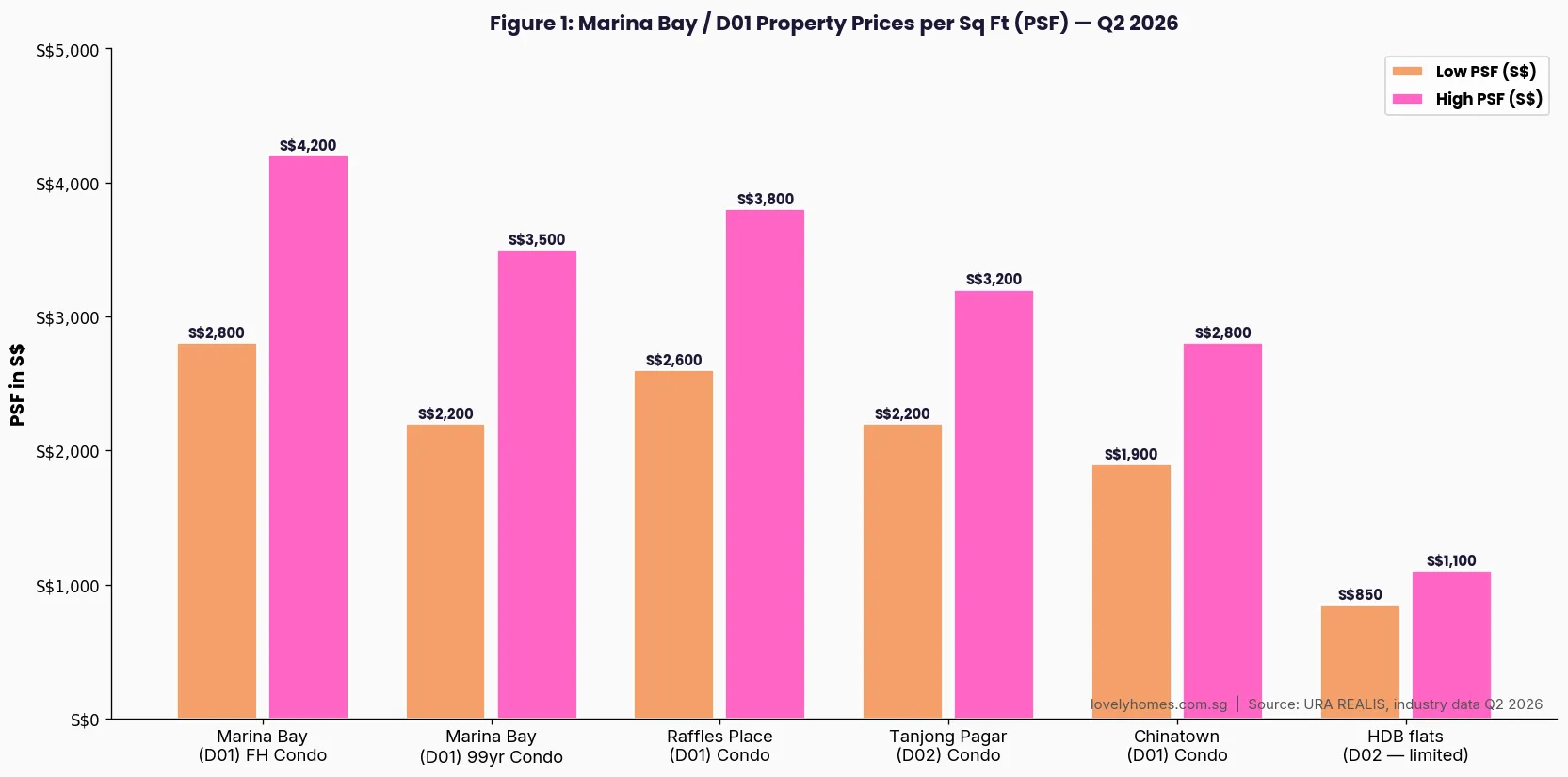
  • Condo PSF range: S$2,800–S$4,200 PSF for freehold units; S$2,200–S$3,500 PSF for 99-year leasehold condos. Among the highest in Singapore.
  • MRT access: Served by three MRT lines — Circle Line (CCL: Bayfront, Promenade, Marina Bay stations), East-West Line (EWL: Raffles Place), and Thomson–East Coast Line (TEL: Marina Bay station).
  • Key attractions: Marina Bay Sands, Gardens by the Bay, Marina Bay Financial Centre (MBFC), ArtScience Museum, Merlion Park, Esplanade.
  • Property types available: Luxury condominiums, Grade A office space, high-end serviced residences. No HDB flats within the core Marina Bay precinct; limited D02 HDB stock exists at Tanjong Pagar fringe.
  • New residential supply: Very limited — no major GLS residential sites released within the core Marina Bay waterfront since the early 2020s. Supply scarcity is a structural feature.
  • Rental yield: 3.0%–4.0% gross for residential; higher for serviced residences targeting expatriate tenants.
  • Major upcoming catalyst: Greater Southern Waterfront (GSW) — the 2,000-hectare master plan connecting Marina Bay to Pasir Panjang, representing a multi-decade transformation of Singapore’s southern coastline.

Marina Bay: Singapore’s Financial and Leisure Waterfront District

Marina Bay sits at the very heart of Singapore’s urban geography — literally so, as the bay itself is bounded by the Central Business District (CBD) on the west and north, the Marina Bay Sands integrated resort and Gardens by the Bay on the south and east, and the Esplanade arts precinct to the north-west. Administratively, the core precinct falls within District 01 (D01) of Singapore’s property map, which is part of the Core Central Region (CCR). Postal districts D01 and D02 together encompass the areas from Anson Road and Cecil Street northward to the Singapore River and Esplanade foreshore.

For property buyers and investors, Marina Bay represents Singapore’s aspirational ceiling. It is where the city-state presents itself to the world through its most iconic skyline — the triple towers of Marina Bay Sands, the supertrees of Gardens by the Bay, and the gleaming facades of Marina Bay Financial Centre. Residential property within walking distance of this precinct commands a persistent premium over the broader CCR, driven by the area’s ultra-low supply, strong expatriate rental demand, and its status as an address of unambiguous prestige.

Marina Bay D01 property PSF price ranges 2026 bar chart
Figure 1: Marina Bay / D01 Property Prices per Square Foot (PSF) — Q2 2026 (Source: URA REALIS, industry data)

Property Landscape: What Can You Buy in Marina Bay?

Marina Bay is primarily a commercial and hospitality district. Residential options are concentrated in a handful of high-end condominium developments along the waterfront and in the adjacent Raffles Place–Cecil Street corridor. Notable residential projects in D01 include The Sail @ Marina Bay, Marina Bay Residences, V on Shenton, and Icon (in the Tanjong Pagar fringe of D02). These are a mix of 99-year leasehold and freehold developments built predominantly between 2008 and 2015, reflecting the URA’s early-2000s vision to inject residential life into the CBD.

Freehold condominiums in D01 typically trade at a significant premium to 99-year leasehold equivalents — a PSF difference of S$400–S$700 is common, reflecting the long-term land value retention of perpetual ownership. Strata office units within Marina Bay Financial Centre and One Raffles Quay are also available on the open market, offering investors exposure to Grade A CBD commercial property. However, residential buyers should note that Marina Bay’s residential stock is relatively small — a few thousand units in total across all projects — which contributes directly to price resilience: in periods of broadly softening market conditions, D01 waterfront units tend to hold value better than most.

There are no new HDB flats in the core Marina Bay precinct. The nearest HDB estates are at Tanjong Pagar (D02) and across the Singapore River at Chinatown (D01 fringe), where older HDB blocks exist but represent a very different value proposition from the waterfront condominiums.

MRT Connectivity: Three Lines, Maximum Accessibility

Few locations in Singapore offer the MRT connectivity of Marina Bay. The district is served by three separate MRT lines at multiple stations:

  • Circle Line (CCL): Bayfront (interchange with DTL), Promenade (interchange with DTL), and Marina Bay stations. The CCL forms an orbital ring that connects directly to Harbour Front, Dhoby Ghaut, and Serangoon without requiring interchange at City Hall.
  • East-West Line (EWL): Raffles Place station, which also provides direct access to Tanjong Pagar. The EWL runs east to Changi Airport and west to Jurong.
  • Thomson–East Coast Line (TEL): Marina Bay station opened as part of TEL Stage 3. The TEL connects directly north to Orchard, Newton, and eventually Woodlands, and south to Shenton Way, Marina South Pier, and through to the East Coast districts (Stages 4 and 5).

This triple-line coverage means that residents of Marina Bay can reach virtually any part of Singapore — including Changi Airport, Jurong East, Woodlands, and the East Coast — without changing lines more than once. It is one of only a handful of locations in Singapore with such multi-modal MRT reach, and it is a key driver of the area’s premium rental yields, particularly from the expatriate professional community that values efficient commuting.

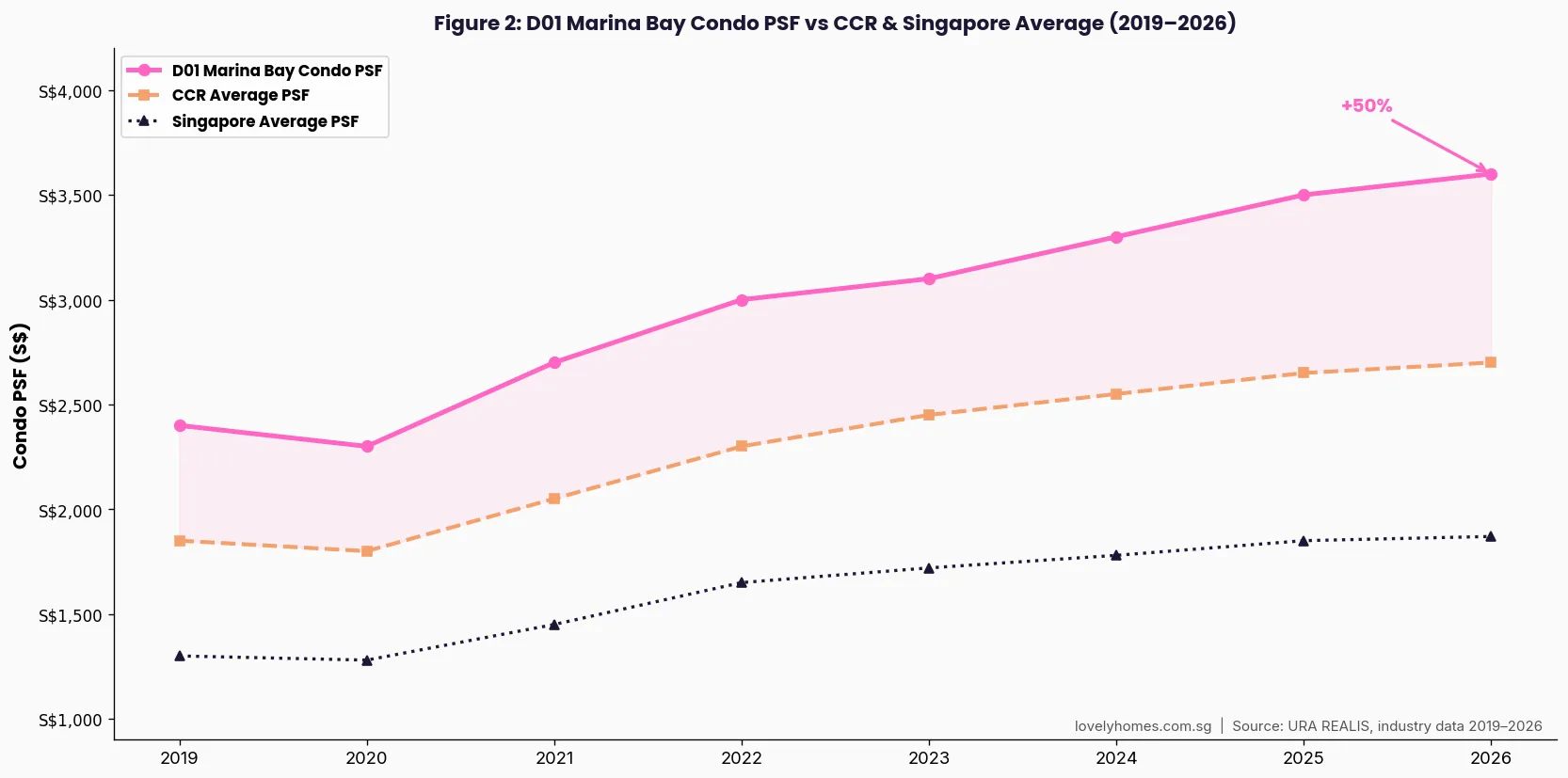
Marina Bay D01 condo PSF trend 2019 to 2026 vs CCR Singapore average line chart
Figure 2: D01 Marina Bay Condo PSF vs CCR & Singapore Average (2019–2026) — Long-term Capital Appreciation Trend (Source: URA REALIS)

Price Trends and Market Performance

D01 residential properties have delivered consistent capital appreciation over the 2019–2026 period, broadly in line with the CCR average despite — or perhaps because of — the area’s extreme supply scarcity. URA REALIS data indicates median transacted PSF for non-landed condominiums in D01 increased from approximately S$2,400 per square foot in 2019 to S$3,600 per square foot in Q2 2026, representing a compound appreciation of approximately 50% over seven years, or roughly 6% per annum.

The CCR as a whole — which includes Districts 9, 10, 11, 1, 2, 6, and 7 — registered price increases of 1.8% quarter-on-quarter in Q2 2026 according to URA’s Q2 2026 statistics (pr26-57, 24 July 2026), reversing the more modest 0.6% gain in Q1. This CCR outperformance was notable given that the broader private residential market grew only 0.5% over the same quarter. D01’s ultra-prime positioning within the CCR means it tracks — and often leads — the CCR cycle rather than the broader OCR or RCR market.

Rental performance has also remained solid. Marina Bay Grade A serviced residences and luxury condos command monthly rents in the range of S$6,000–S$15,000 for two-bedroom and three-bedroom units respectively, with gross yields of 3.0%–4.0% — lower than OCR condos in absolute yield terms, but with significantly stronger tenant quality and lower vacancy risk given the proximity to MBFC and the financial district’s employment base.

Key Property Statistics at a Glance

Marina Bay Singapore key property facts 2026 cards
Figure 3: Marina Bay / D01 — Key Property Facts at a Glance (2026)
Metric Marina Bay / D01 CCR Average Singapore Average
Condo median PSF (Q2 2026) ~S$3,600 ~S$2,700 ~S$1,870
QoQ price change (Q2 2026) +1.5% to +2.5% +1.8% +0.5%
Gross rental yield 3.0%–4.0% 2.8%–3.8% 3.5%–4.5%
MRT lines 3 (CCL, EWL, TEL) Varies Varies
Vacancy rate (CCR) 8.3% (Q2 2026) 8.3% 6.4%
New GLS residential supply Minimal since 2020 Limited 9,320 units FY2026 Confirmed List

The Greater Southern Waterfront: Marina Bay’s Long-Term Catalyst

No analysis of Marina Bay’s property investment outlook is complete without addressing the Greater Southern Waterfront (GSW) — URA’s 30-year master plan to transform approximately 2,000 hectares of Singapore’s southern coast from Pasir Panjang Port to Marina East. The GSW is arguably the single most significant urban planning initiative in Singapore since the transformation of Jurong Lake District, and Marina Bay sits at its north-eastern gateway.

Key elements of the GSW as they relate to Marina Bay-area property include: the relocation of Pasir Panjang Terminal (phases 1 and 2 already underway), which will free up large parcels of prime waterfront land for mixed residential and commercial development; the extension of the waterfront promenade from Tanjong Pagar southward; and the integration of Marina South (immediately south of Marina Bay Sands) into a new urban precinct with direct MRT (TEL) access at Marina South Pier station.

Near-term, the GSW catalyst is a decade-long narrative rather than an immediate price driver. But for buyers considering long-horizon holds of 10–20 years, Marina Bay’s positioning as the nucleus of Singapore’s most ambitious urban transformation project represents a structural support for values that few other Singapore districts can claim.

Worked Example: Purchasing a 2-Bedroom Condo in Marina Bay

📋 Case Study: Mr & Mrs Koh — First Property, SC + SC Couple

Profile: SC + SC married couple. Combined monthly income S$22,000. No prior residential property ownership. Targeting a 2-bedroom unit in a D01 99-year leasehold condominium.

Property: 2-bedroom, 818 sq ft, at S$2,800 PSF = S$2,290,400 (rounded to S$2,290,000).

Stamp duty:
BSD: first S$180,000 at 1% = S$1,800; next S$180,000 at 2% = S$3,600; next S$640,000 at 3% = S$19,200; next S$500,000 at 4% = S$20,000; remaining S$790,000 at 5% = S$39,500; total BSD ≈ S$84,100
ABSD (first property, SC + SC): S$0
Total stamp duty: S$84,100 (payable from CPF OA)

Financing: Bank loan at 75% LTV = S$1,717,500; down payment 25% = S$572,500 (minimum 5% cash = S$114,500; remaining S$458,000 from CPF OA)
At 3.5% fixed for 3 years, 30-year tenure: estimated monthly repayment ~S$7,715
TDSR: S$7,715 / S$22,000 = 35.1% — PASS (TDSR limit 55%)

Upfront cash required:
5% cash down payment: S$114,500
BSD: S$84,100 (CPF OA)
Legal fees (est.): S$4,500
Valuation fee: S$600
Total cash outlay: ~S$114,500 | Total CPF usage: ~S$542,500

Note: Marina Bay condominiums are predominantly 99-year leasehold, which means CPF usage is subject to CPF Withdrawal Limits — the Valuation Limit (VL) is the lower of the purchase price and market valuation, and CPF usage reduces as lease remaining falls below 95 years. For a new purchase with 99 years remaining, full CPF usage is permitted.

Why Marina Bay Matters: Investment and Lifestyle Analysis

Marina Bay occupies a unique position in Singapore’s property market: it is simultaneously Singapore’s busiest commercial district, its most dramatic waterfront, and one of its most sought-after luxury residential addresses. This combination — commercial vitality, leisure infrastructure, and residential prestige — is extremely difficult to replicate in other Singapore districts and explains why the area commands a persistent price premium.

For owner-occupiers, the trade-off is clear: you pay a significant PSF premium relative to the broader CCR or RCR, but you gain an address with unmatched lifestyle infrastructure (dining, entertainment, arts, waterfront), three-line MRT access, and the security of knowing that new supply is structurally limited. For investors, the case rests on rental yield from high-quality expatriate tenants, capital preservation through low supply, and long-horizon capital appreciation driven by the Greater Southern Waterfront transformation.

Compared with other global financial district residential markets — London’s Canary Wharf (where office-to-residential conversion is creating new supply pressure), Hong Kong’s Central (where geopolitical uncertainty has dampened demand), or New York’s Financial District (where vacancy remains elevated) — Marina Bay’s underlying demand drivers are arguably more durable. Singapore’s political stability, its status as Asia’s premier wealth management hub, and its continued attraction of Ultra-High-Net-Worth Individuals (UHNWIs) provide a structural demand floor that is not replicated in peers.

What Might Come Next: Marina Bay Property Outlook

(This section represents editorial analysis and speculation — not URA or government guidance.)

Several factors point to Marina Bay continuing to outperform the broader CCR over the medium term. The TEL Stage 3 connection, now fully operational, has improved accessibility for existing residents considerably. The forthcoming completion of Marina South — the new precinct directly south of Marina Bay Sands, anchored by TEL’s Marina South Pier station — will expand the premium residential footprint and attract further amenities to the D01 waterfront over the 2027–2032 horizon.

Supply remains the key support. Unless URA chooses to release major residential GLS sites within D01 (which has not occurred since the early 2010s), the existing stock of approximately 3,000–4,000 residential units in the core Marina Bay precinct is unlikely to grow materially in the next decade. In an environment where the broader Singapore private residential market sees 9,320 Confirmed List units annually, Marina Bay’s island of scarcity stands out distinctly for long-hold investors.

Frequently Asked Questions

Is Marina Bay good for families with children, or is it primarily for professionals and investors?

Marina Bay caters predominantly to professional couples, single expatriates, and investors rather than young families with school-age children. The district lacks the neighbourhood schools, parks, and community amenities (wet markets, hawker centres, heartland malls) that families typically prioritise. The nearest primary schools require a taxi or MRT ride. That said, the lifestyle infrastructure — Gardens by the Bay, Marina Bay Sands, the waterfront promenade — is world-class, and families who prioritise convenience and urban vibrancy over neighbourhood feel do choose Marina Bay. For families seeking school proximity in the CCR, Districts 9, 10, and 11 (Orchard, Tanglin, Newton) are typically better suited.

Are there any HDB flats I can buy in or near Marina Bay?

There are no HDB flats within the core Marina Bay precinct. The nearest HDB estates are at Tanjong Pagar (District 02), Chinatown (District 01 fringe), and across the river at Outram / Tiong Bahru. These are older HDB towns with resale prices typically in the range of S$800,000–S$1,200,000 for 4-room units, considerably below the private property market in the same district. If proximity to the CBD is a priority and HDB is the preferred tenure, these fringe D01/D02 HDB towns are the closest viable option.

What are the best condominiums to consider buying in Marina Bay?

Without naming or endorsing specific projects, the key considerations when evaluating Marina Bay condominiums are: (1) Lease type — freehold units command a significant premium but retain CPF flexibility over the long term; (2) Floor level and view — waterfront-facing units facing Marina Bay itself trade at a 10–20% premium over units facing inland; (3) Age and management — older developments from the 2008–2012 era have established MCST bodies and known sinking fund positions; (4) Unit size — Marina Bay condominiums skew toward larger layouts (800–1,500 sq ft) which suits the expatriate rental market; and (5) Facility quality — concierge-level facilities (pool, gym, function rooms) matter significantly to the tenant segment. Buyers should conduct thorough due diligence, including a title search, a review of MCST minutes, and an independent valuation.

What is the vacancy rate for rental properties in Marina Bay, and how stable is the rental market?

URA Q2 2026 data shows a CCR vacancy rate of 8.3% — among the higher rates in Singapore. Marina Bay specifically experiences some cyclicality tied to the expatriate professional population, which fluctuates with the financial services and tech sectors’ headcount. During periods of corporate downsizing (as occurred in 2022–2023 across global banking), Marina Bay rents softened. However, the area’s position as the de facto home for senior financial industry professionals — many of whom are on company housing allowances — provides a demand floor that less premium districts lack. Well-priced 2-bedroom units below S$8,000/month typically find tenants within 2–4 weeks in normal market conditions.

How does Marina Bay compare to Orchard Road as a residential investment?

Both precincts are CCR and command premium prices, but they serve different profiles. Orchard (Districts 9–10) has more diverse residential stock — from freehold bungalows to mass-market condominiums — larger family-friendly developments, and proximity to top international schools. Marina Bay is more concentrated on financial-district professionals, smaller luxury units, and waterfront lifestyle. Capital appreciation has been broadly similar over the medium term; Marina Bay enjoys a supply-scarcity advantage that Orchard does not, since Orchard has seen several new launches in recent years. For investors targeting the expatriate corporate-let market, Marina Bay’s proximity to MBFC is a distinct advantage. For owner-occupiers and family tenants, Orchard’s lifestyle infrastructure and school proximity make it the preferred choice.

Will the Greater Southern Waterfront raise Marina Bay property prices significantly?

The Greater Southern Waterfront (GSW) is a 30-year master plan — its full impact will unfold over multiple property market cycles. Near-term (2026–2030), the GSW’s effect on Marina Bay prices is likely to be sentiment-driven rather than supply-driven: awareness of the long-term plan reinforces buyer confidence in holding Marina Bay property for the long term, but new GSW residential units are not expected to reach the market in volume before 2030 at the earliest. When they do arrive, they will expand the premium southern waterfront neighbourhood rather than compete directly with the core Marina Bay precinct — URA has historically positioned new GSW precincts (such as Marina South) as complementary rather than competing with existing D01 stock.

Disclaimer: This neighbourhood guide is produced for general informational purposes only and does not constitute financial, investment, legal, or property advice. Property prices, rental yields, vacancy rates, and planning details are sourced from URA REALIS, URA press releases, and publicly available industry data as at Q2 2026, and may have changed since publication. Readers should conduct independent due diligence and consult licensed Singapore property professionals and financial advisers before making any property purchase or investment decision. LovelyHomes.com.sg is an independent editorial platform and is not affiliated with URA, HDB, MAS, CPF, or any government body or property agency.

×

Click anywhere to close

Orchard Road Singapore 2026: D09 Prices, Luxury Living & Investment Analysis

Orchard Road Singapore 2026: D09 Prices, Luxury Living & Investment Analysis

⚡ Quick Answer — Orchard Road Property 2026

  • Orchard Road sits in District 9 (D09), part of Singapore’s Core Central Region (CCR) — the island’s premier luxury residential address.
  • Freehold condo median prices range from S$2,800 to S$4,800 psf in 2026; leasehold units fetch S$2,200–S$3,200 psf.
  • TEL’s Orchard and Great World stations now give the precinct triple MRT access (Thomson–East Coast Line, North–South Line).
  • Gross rental yields average 2.5–3.2% — lower than OCR but underpinned by multinational corporate and diplomatic demand.
  • Freehold properties command a 15–25% premium over equivalent leasehold units in the same sub-district.
  • HDB supply is extremely limited (old Rochor/ Cairnhill estate stock only) — almost all residential stock here is private condo or landed.
  • ABSD applies to all purchases: Singapore Citizens buying a second property pay 20%, Permanent Residents 25% (first), foreigners 60%.
  • Capital appreciation over the 2019–2026 period has averaged +5–7% per annum for freehold D09 condos in the mid-luxury tier.

What Is District 9 and Why Does Orchard Road Matter?

District 9 — officially encompassing the planning areas of Orchard, Cairnhill, Leonie Hill, and River Valley — is Singapore’s best-known luxury address. The Orchard Road shopping belt, which stretches roughly 2.2 kilometres from Tanglin Road to Dhoby Ghaut, is both a retail landmark and the spine around which the surrounding residential market is priced. Properties within walking distance of Orchard MRT command a persistent scarcity premium: supply is structurally constrained by conservation zones, a dense grid of existing freehold developments, and the absence of Government Land Sales (GLS) Confirmed List sites since 2019.

The Urban Redevelopment Authority (URA) classifies D09 as part of the Core Central Region (CCR) — the most tightly regulated of Singapore’s three residential market segments. CCR properties attract the highest stamp duties for non-citizens and are subject to the full suite of Additional Buyer’s Stamp Duty (ABSD) cooling measures introduced and refined between 2011 and 2023.

Property Landscape: What You Can Buy in D09

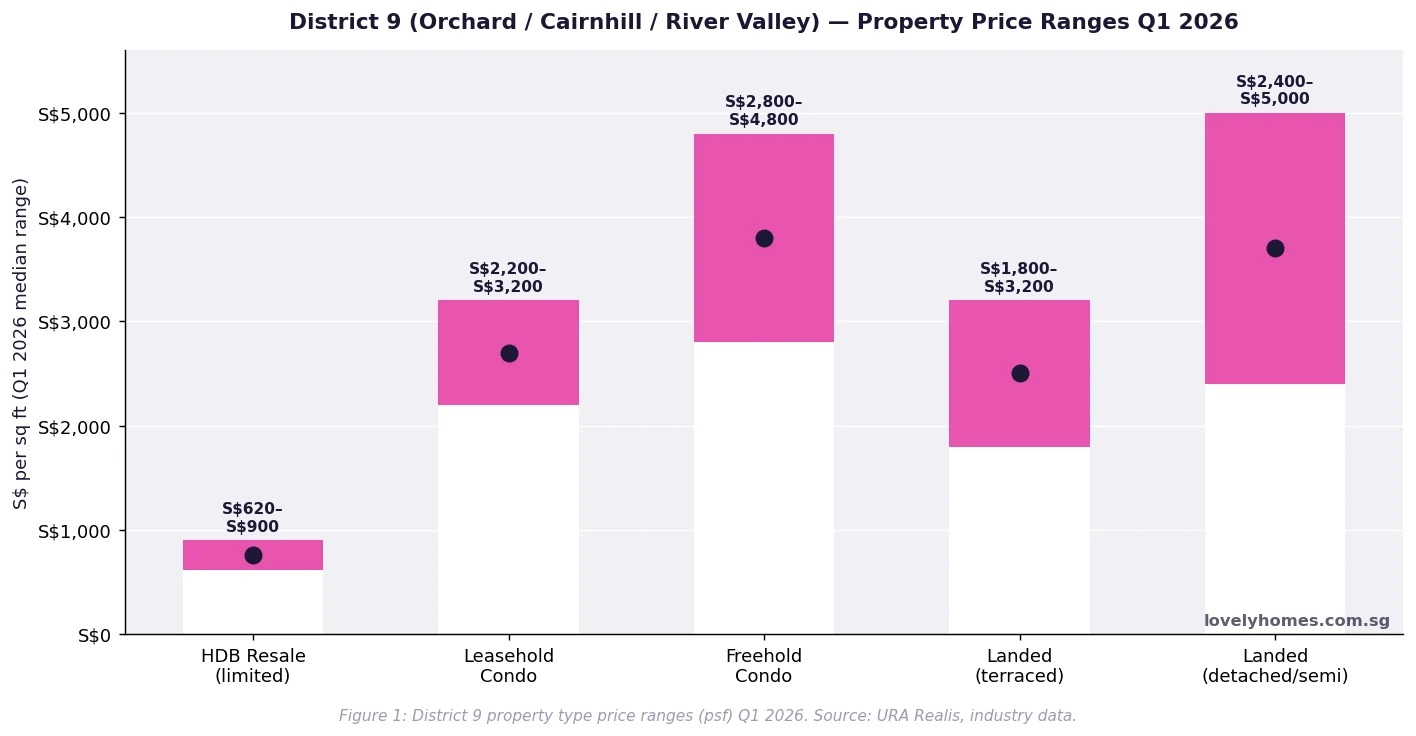
District 9 Orchard Road property price ranges by type Q1 2026
Figure 1: District 9 property type price ranges (psf), Q1 2026. Source: URA Realis, industry data.

The D09 residential market is almost entirely composed of private non-landed and landed properties. The key segments are:

Leasehold condominiums (99-year): typically newer developments built post-2000, PSF ranges S$2,200–S$3,200 in 2026. Examples include Highline Residences and 1919 (formerly Noisy Elephant). Leasehold developments offer more flexibility in financing but carry a lease-decay risk that buyers must factor in for re-sale after 2050.

Freehold condominiums: the dominant premium tier, with PSF ranging S$2,800–S$4,800 depending on storey, renovations, and project prestige. Established freehold addresses along Cairnhill, Emerald Hill, and Orchard Boulevard include projects whose 30-to-40-year-old vintages still command strong re-sale premiums due to their perpetual tenure and walk-to-Orchard-MRT location.

Landed (terrace and semi-detached): a small but significant segment, with terrace houses along Cairnhill Road and Ardmore Park environs transacting at S$1,800–S$3,200 psf on land. Semi-detached and detached bungalows (Good Class Bungalow fringe) sit at S$2,400–S$5,000+ psf on land. Foreigners are generally not permitted to purchase landed property in Singapore without Ministerial approval.

HDB resale flats: extremely rare in D09. The few remaining HDB blocks near Cairnhill and the old Rochor estate are among the most idiosyncratic properties in Singapore — priced S$620–S$900 psf due to their central location, but subject to stringent Ethnic Integration Policy (EIP) quotas and conventional HDB resale restrictions.

D09 at a Glance: Key Facts for Buyers

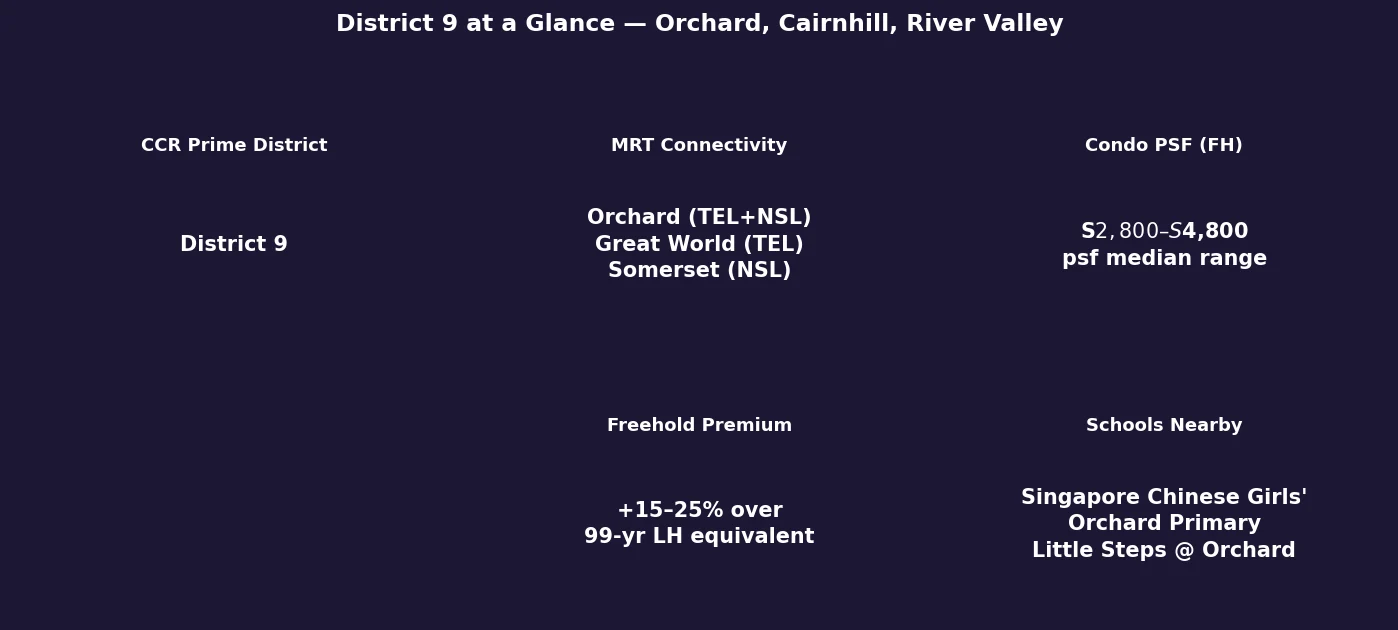
Orchard Road District 9 key property facts 2026 infographic
Figure 2: District 9 at a glance — Orchard, Cairnhill, River Valley.

MRT Connectivity: Why the TEL Changed Everything

For most of Singapore’s modern history, D09’s primary MRT connection was Orchard station on the North–South Line (NSL), opened in 1987. The Thomson–East Coast Line (TEL) Stage 3, which began operating in November 2022, transformed connectivity in the district in two significant ways.

First, Orchard station became an interchange between the NSL and TEL — dramatically cutting travel times to Thomson, Bishan, Woodlands, and the eastern corridor without changing trains. Second, Great World station (TEL), opened in 2022, gave the River Valley sub-district its own direct MRT access for the first time, adding a meaningful premium uplift to residential properties within 400 metres of the station. Industry estimates suggest the Great World TEL opening contributed a 6–10% PSF uplift to the immediately surrounding catchment.

Somerset station (NSL) anchors the Orchard Road retail strip’s southern end and serves as a secondary access point for Orchard sub-market properties. The combined station density — Orchard, Somerset, and Great World within roughly 1.5 km — gives D09 an MRT connectivity score that few other Singapore districts can match.

Rental Market and Investment Yields

D09 draws a high proportion of expatriate tenants from multinational corporations (particularly financial services, technology, and professional services firms) who prefer central locations with proximity to international schools and the CBD. This profile supports relatively stable rental demand even when broader market rental cycles soften.

Gross rental yields in D09 average 2.5–3.2% for condominiums in 2026. By comparison, OCR districts such as D27 (Yishun) or D23 (Bukit Panjang) offer 3.4–4.2%. The D09 yield discount is structural: absolute capital values are higher, which compresses the yield percentage even when absolute rental income is also elevated. A two-bedroom freehold condo at S$2.5M might fetch S$7,500–S$9,000 per month in rent — a 3.6–4.3% gross yield in dollar terms, but modest relative to the entry price.

Net yields after management fees, maintenance, property tax, and vacancy allowances typically run 1.8–2.5%. Investors in D09 are largely buying for capital appreciation and portfolio positioning rather than yield maximisation.

Summary Table: D09 Property at a Glance

Property Type Typical PSF (2026) Tenure Gross Yield Est. Best For
Leasehold Condo S$2,200–S$3,200 99-year LH 2.8–3.5% Capital appreciation, lower entry
Freehold Condo S$2,800–S$4,800 Freehold 2.5–3.2% Long-term hold, scarcity premium
Terrace (landed) S$1,800–S$3,200 (land psf) Freehold 1.5–2.5% Generational wealth, redevelopment
Semi-D / Bungalow S$2,400–S$5,000+ (land psf) Freehold 1.2–2.0% Ultra-prime, lowest yield segment
HDB Resale (rare) S$620–S$900 Remaining lease 3.0–4.0% Owner-occupiers; EIP restrictions apply

Worked Example: Buying a 2-Bedroom Freehold Condo in D09

📌 Case Study: Mr & Mrs Tan — 2-Bedroom Freehold Condo, D09

Profile: Singapore Citizen + Singapore Citizen, joint purchase of their first residential property. Combined gross monthly income S$18,000. Buying a 2-bedroom freehold condo at S$2,200,000.

Buyer’s Stamp Duty (BSD): First S$180,000 × 1% = S$1,800; next S$180,000 × 2% = S$3,600; next S$640,000 × 3% = S$19,200; next S$500,000 × 4% = S$20,000; next S$700,000 × 5% = S$35,000 ≈ S$79,600 BSD (effective rate ~3.62%)

ABSD: First property for both SC purchasers → S$0 ABSD

LTV and financing (bank loan): 75% LTV max → loan S$1,650,000. At 3.5% p.a., 25-year tenure: monthly repayment = S$8,272. TDSR: S$8,272 / S$18,000 = 45.9% — below the 55% TDSR cap → PASS.

Upfront cash requirement: 5% cash = S$110,000; balance 20% down (CPF or cash) = S$440,000; BSD S$79,600; legal/misc ~S$8,000. Total upfront ≈ S$637,600.

Note: If buying a second property or if either buyer is not SC, ABSD applies. A second-property SC purchase adds S$440,000 (20%) ABSD. Foreign buyers add S$1,320,000 (60%) ABSD. See our ABSD Complete Guide for full rates.

D09 Price Trend: How Orchard Road Condos Have Performed Since 2019

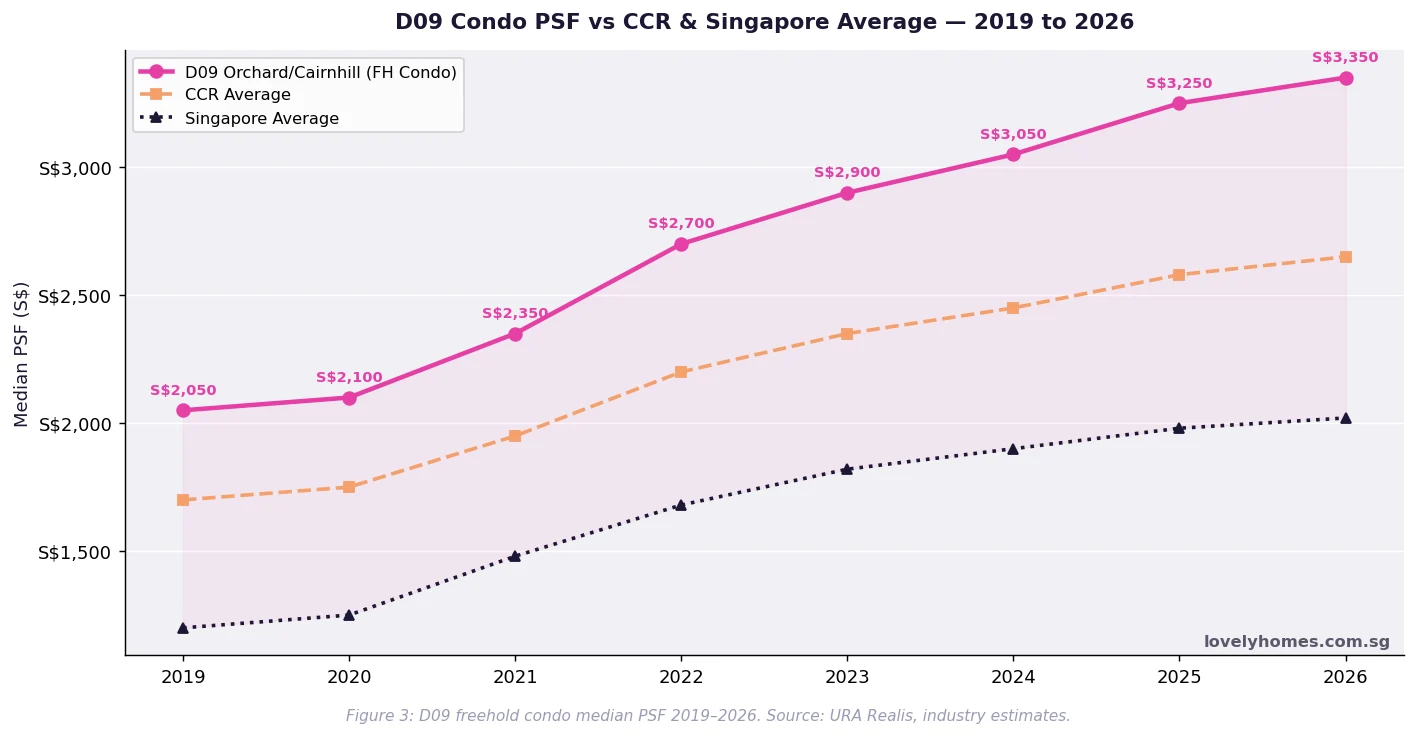
District 9 Orchard Road condo PSF price trend vs CCR and Singapore average 2019 to 2026
Figure 3: D09 freehold condo median PSF 2019–2026 vs CCR and Singapore averages. Source: URA Realis, industry estimates.

Freehold D09 condominiums appreciated from a median ~S$2,050 psf in 2019 to approximately S$3,350 psf by Q1 2026 — a 63% increase over seven years, or roughly 7% per annum compounded. This comfortably outpaced both the CCR average (+56%) and the Singapore-wide average (+68% from a much lower base).

The 2020 dip was shallow and brief: D09 benefited from an ultra-low interest rate environment and surging demand from ultra-high-net-worth buyers relocating to Singapore under the Global Investor Programme (GIP) and family office expansion. The 2023 ABSD increases (60% for foreigners, 65% for entities) dampened volume but exerted little downward pressure on freehold CCR pricing due to the structural scarcity of such units.

Why District 9 Matters in a Portfolio Context

For Singapore property investors, D09 serves a distinct portfolio role compared to OCR or RCR assets. Freehold tenure in D09 acts as a store-of-value comparable to a blue-chip equity position: low yield, low volatility in nominal terms, and a structural scarcity floor. The supply pipeline is thin — no major GLS site has been launched in the Orchard/Cairnhill sub-district since the 2010s — and the freehold nature of most existing stock means developers acquire sites only through collective sales, which cycle slowly and at significant cost.

Compared to peer markets such as Hong Kong’s Peak or Sydney’s Mosman, D09 freehold condo pricing at S$3,000–S$4,500 psf (approximately HK$26,000–HK$39,000 per sq ft or A$5,500–A$8,300 per sq ft) remains broadly competitive for a stable, AAA-sovereign-rated city with no capital gains tax, no inheritance tax, and full repatriation of rental income and sale proceeds.

What Might Come Next for Orchard Road Property

Two macro catalysts are worth watching. First, the URA Master Plan 2025 (gazetted December 2025) includes proposals to introduce limited residential GLS activity at the Orchard Boulevard fringe — potentially adding 600–800 new leasehold units to the precinct over the 2028–2032 horizon. If realised, this would modestly widen the leasehold–freehold PSF gap but is unlikely to cap freehold pricing. Second, TEL Stage 4 (Bayshore to Sungei Bedok) and Stage 5 completions are driving demand relocation from D09 toward D15/D16; while this eases upward pressure on D09 pricing, it also reflects a broader market deepening that historically lifts all CCR boats over the medium term.

Forward-looking commentary is speculative. Property markets are influenced by macro factors including interest rates, government cooling measures, and global capital flows that cannot be predicted with certainty.

Frequently Asked Questions

Can foreigners buy property on Orchard Road?

Yes, foreigners may purchase private condominiums in D09 (including Orchard Road and River Valley). However, the Additional Buyer’s Stamp Duty for foreign purchasers is 60% of the purchase price — a significant barrier. Foreigners are generally prohibited from purchasing landed residential property (terrace houses, semi-detached, detached bungalows) in Singapore without specific Ministerial approval. The restriction does not apply to units in strata-titled developments (condominiums). Foreigners who are Singapore Permanent Residents (SPR) pay a lower ABSD of 5% (first property), 30% (second), or 35% (third+), as at 2026.

What is the difference between Orchard Road, River Valley, and Cairnhill within D09?

District 9 covers three loosely overlapping sub-precincts. Orchard Road proper refers to the retail boulevard and its immediately flanking residential streets (Orchard Boulevard, Claymore Hill, Ardmore Park). Properties here command the sharpest freehold premiums. Cairnhill is the quieter residential enclave to the north of Orchard Road, characterised by mid-size freehold blocks on elevated terrain with city views. River Valley lies to the south and west, sloping towards the Singapore River; it is more mid-market relative to Cairnhill and has benefited most from the Great World TEL station opening, which added MRT-first access to a previously bus-dependent sub-precinct.

Are there HDB flats in Orchard Road / D09?

HDB flats in D09 are extremely rare. The handful of remaining HDB blocks near Cairnhill and the former Rochor estate are among the oldest in the stock (1970s–1980s vintage). They are resale only — no new BTO supply has been announced for D09 — and are subject to standard HDB resale eligibility rules including the Ethnic Integration Policy (EIP) quotas, which can constrain the buyer pool. The EIP quota for some blocks in the area is reached at times, particularly for Chinese-ethnicity buyers. Due to their central location, prices can reach S$700–S$900 psf, though resale volume is very low.

What ABSD do I pay on a second property purchase in D09?

ABSD rates (effective 2023) applicable to second-property purchases: Singapore Citizens 20%; Singapore PRs 30%; foreigners 60%. For a S$2,200,000 condo in D09, a Singapore Citizen buying their second property would pay S$440,000 in ABSD on top of BSD (~S$79,600), for total stamp duty of ~S$519,600. This significantly raises the break-even holding period. Most buyers paying ABSD at the 20% rate need to hold the property for approximately 8–12 years before capital appreciation covers the stamp duty cost, depending on leverage and rental income. Our ABSD complete guide has a full worked example with holding-period analysis.

Is D09 a good district for rental investment?

D09 is well-suited to investors who prioritise capital preservation and portfolio prestige over yield. Gross rental yields average 2.5–3.2%, which is among the lowest in Singapore by district. However, the tenant base — predominantly corporate expatriates, senior professionals, and high-net-worth individuals — is financially resilient and generates stable occupancy rates. Vacancy rates in D09 have historically tracked below the national condo vacancy average. The key risk is yield compression during interest rate cycles: when bank loan rates rise to 3.5–4.0%+, the carry cost of a highly leveraged D09 property can turn negative. Investors should stress-test their numbers at prevailing bank rates before committing.

What are the most established condo projects in Orchard Road?

Several freehold developments along Orchard Road and Cairnhill have maintained strong resale markets across multiple property cycles. Ardmore Park (Ardmore Park Road), Four Seasons Park (Cuscaden Road), Grange Infinite (Grange Road), The Ardmore (Ardmore Park), and Leonie Parc View (Leonie Hill) are among the well-regarded addresses. These projects typically offer large unit sizes (1,500–3,500 sq ft is common), high ceiling heights, and established common facilities. Newer freehold launches in the precinct include 15 Holland Hill (technically D10 fringe). Always verify the remaining lease, MCST management quality, and any outstanding special levies before committing to a specific project.

How does the Orchard Road masterplan affect property values?

The URA Orchard Road masterplan — actively implemented since the mid-2010s — repositions the district from a pure retail belt to a mixed-use “live, work, play” precinct. This includes the introduction of residential uses in selected retail podiums, increased greenery, pedestrianisation of side streets, and the long-term redevelopment of older hotel and commercial sites. For residential buyers, the masterplan signals continued public-sector investment in the streetscape and connectivity — a positive indicator for long-term capital values. The introduction of residential GLS sites flagged in the 2025 Master Plan, if confirmed, would add supply but also validate the URA’s confidence in the precinct’s long-term demand fundamentals.

Related Articles

Disclaimer

All property prices, PSF figures, rental yields, and market projections in this article are based on publicly available data from URA Realis, HDB, and industry sources as at Q1–Q2 2026. They are indicative estimates and do not constitute a valuation, investment advice, or recommendation to buy or sell. Singapore property transactions involve significant stamp duties, financing obligations, and regulatory constraints. Readers should consult a licensed property professional, licensed financial adviser, and legal counsel before making any property purchase decision. Official stamp duty rates and eligibility rules are published by the Inland Revenue Authority of Singapore (IRAS) at iras.gov.sg. Zoning and planning information should be verified with the Urban Redevelopment Authority (URA) at ura.gov.sg. HDB resale eligibility rules are published at hdb.gov.sg.

Orchard Road Singapore 2026: D09 Prices, Luxury Living & Investment Analysis

Orchard Road Singapore 2026: D09 Prices, Luxury Living & Investment Analysis

⚡ Quick Answer — Orchard Road Property 2026

  • Orchard Road sits in District 9 (D09), part of Singapore’s Core Central Region (CCR) — the island’s premier luxury residential address.
  • Freehold condo median prices range from S$2,800 to S$4,800 psf in 2026; leasehold units fetch S$2,200–S$3,200 psf.
  • TEL’s Orchard and Great World stations now give the precinct triple MRT access (Thomson–East Coast Line, North–South Line).
  • Gross rental yields average 2.5–3.2% — lower than OCR but underpinned by multinational corporate and diplomatic demand.
  • Freehold properties command a 15–25% premium over equivalent leasehold units in the same sub-district.
  • HDB supply is extremely limited (old Rochor/ Cairnhill estate stock only) — almost all residential stock here is private condo or landed.
  • ABSD applies to all purchases: Singapore Citizens buying a second property pay 20%, Permanent Residents 25% (first), foreigners 60%.
  • Capital appreciation over the 2019–2026 period has averaged +5–7% per annum for freehold D09 condos in the mid-luxury tier.

What Is District 9 and Why Does Orchard Road Matter?

District 9 — officially encompassing the planning areas of Orchard, Cairnhill, Leonie Hill, and River Valley — is Singapore’s best-known luxury address. The Orchard Road shopping belt, which stretches roughly 2.2 kilometres from Tanglin Road to Dhoby Ghaut, is both a retail landmark and the spine around which the surrounding residential market is priced. Properties within walking distance of Orchard MRT command a persistent scarcity premium: supply is structurally constrained by conservation zones, a dense grid of existing freehold developments, and the absence of Government Land Sales (GLS) Confirmed List sites since 2019.

The Urban Redevelopment Authority (URA) classifies D09 as part of the Core Central Region (CCR) — the most tightly regulated of Singapore’s three residential market segments. CCR properties attract the highest stamp duties for non-citizens and are subject to the full suite of Additional Buyer’s Stamp Duty (ABSD) cooling measures introduced and refined between 2011 and 2023.

Property Landscape: What You Can Buy in D09

District 9 Orchard Road property price ranges by type Q1 2026
Figure 1: District 9 property type price ranges (psf), Q1 2026. Source: URA Realis, industry data.

The D09 residential market is almost entirely composed of private non-landed and landed properties. The key segments are:

Leasehold condominiums (99-year): typically newer developments built post-2000, PSF ranges S$2,200–S$3,200 in 2026. Examples include Highline Residences and 1919 (formerly Noisy Elephant). Leasehold developments offer more flexibility in financing but carry a lease-decay risk that buyers must factor in for re-sale after 2050.

Freehold condominiums: the dominant premium tier, with PSF ranging S$2,800–S$4,800 depending on storey, renovations, and project prestige. Established freehold addresses along Cairnhill, Emerald Hill, and Orchard Boulevard include projects whose 30-to-40-year-old vintages still command strong re-sale premiums due to their perpetual tenure and walk-to-Orchard-MRT location.

Landed (terrace and semi-detached): a small but significant segment, with terrace houses along Cairnhill Road and Ardmore Park environs transacting at S$1,800–S$3,200 psf on land. Semi-detached and detached bungalows (Good Class Bungalow fringe) sit at S$2,400–S$5,000+ psf on land. Foreigners are generally not permitted to purchase landed property in Singapore without Ministerial approval.

HDB resale flats: extremely rare in D09. The few remaining HDB blocks near Cairnhill and the old Rochor estate are among the most idiosyncratic properties in Singapore — priced S$620–S$900 psf due to their central location, but subject to stringent Ethnic Integration Policy (EIP) quotas and conventional HDB resale restrictions.

D09 at a Glance: Key Facts for Buyers

Orchard Road District 9 key property facts 2026 infographic
Figure 2: District 9 at a glance — Orchard, Cairnhill, River Valley.

MRT Connectivity: Why the TEL Changed Everything

For most of Singapore’s modern history, D09’s primary MRT connection was Orchard station on the North–South Line (NSL), opened in 1987. The Thomson–East Coast Line (TEL) Stage 3, which began operating in November 2022, transformed connectivity in the district in two significant ways.

First, Orchard station became an interchange between the NSL and TEL — dramatically cutting travel times to Thomson, Bishan, Woodlands, and the eastern corridor without changing trains. Second, Great World station (TEL), opened in 2022, gave the River Valley sub-district its own direct MRT access for the first time, adding a meaningful premium uplift to residential properties within 400 metres of the station. Industry estimates suggest the Great World TEL opening contributed a 6–10% PSF uplift to the immediately surrounding catchment.

Somerset station (NSL) anchors the Orchard Road retail strip’s southern end and serves as a secondary access point for Orchard sub-market properties. The combined station density — Orchard, Somerset, and Great World within roughly 1.5 km — gives D09 an MRT connectivity score that few other Singapore districts can match.

Rental Market and Investment Yields

D09 draws a high proportion of expatriate tenants from multinational corporations (particularly financial services, technology, and professional services firms) who prefer central locations with proximity to international schools and the CBD. This profile supports relatively stable rental demand even when broader market rental cycles soften.

Gross rental yields in D09 average 2.5–3.2% for condominiums in 2026. By comparison, OCR districts such as D27 (Yishun) or D23 (Bukit Panjang) offer 3.4–4.2%. The D09 yield discount is structural: absolute capital values are higher, which compresses the yield percentage even when absolute rental income is also elevated. A two-bedroom freehold condo at S$2.5M might fetch S$7,500–S$9,000 per month in rent — a 3.6–4.3% gross yield in dollar terms, but modest relative to the entry price.

Net yields after management fees, maintenance, property tax, and vacancy allowances typically run 1.8–2.5%. Investors in D09 are largely buying for capital appreciation and portfolio positioning rather than yield maximisation.

Summary Table: D09 Property at a Glance

Property Type Typical PSF (2026) Tenure Gross Yield Est. Best For
Leasehold Condo S$2,200–S$3,200 99-year LH 2.8–3.5% Capital appreciation, lower entry
Freehold Condo S$2,800–S$4,800 Freehold 2.5–3.2% Long-term hold, scarcity premium
Terrace (landed) S$1,800–S$3,200 (land psf) Freehold 1.5–2.5% Generational wealth, redevelopment
Semi-D / Bungalow S$2,400–S$5,000+ (land psf) Freehold 1.2–2.0% Ultra-prime, lowest yield segment
HDB Resale (rare) S$620–S$900 Remaining lease 3.0–4.0% Owner-occupiers; EIP restrictions apply

Worked Example: Buying a 2-Bedroom Freehold Condo in D09

📌 Case Study: Mr & Mrs Tan — 2-Bedroom Freehold Condo, D09

Profile: Singapore Citizen + Singapore Citizen, joint purchase of their first residential property. Combined gross monthly income S$18,000. Buying a 2-bedroom freehold condo at S$2,200,000.

Buyer’s Stamp Duty (BSD): First S$180,000 × 1% = S$1,800; next S$180,000 × 2% = S$3,600; next S$640,000 × 3% = S$19,200; next S$500,000 × 4% = S$20,000; next S$700,000 × 5% = S$35,000 ≈ S$79,600 BSD (effective rate ~3.62%)

ABSD: First property for both SC purchasers → S$0 ABSD

LTV and financing (bank loan): 75% LTV max → loan S$1,650,000. At 3.5% p.a., 25-year tenure: monthly repayment = S$8,272. TDSR: S$8,272 / S$18,000 = 45.9% — below the 55% TDSR cap → PASS.

Upfront cash requirement: 5% cash = S$110,000; balance 20% down (CPF or cash) = S$440,000; BSD S$79,600; legal/misc ~S$8,000. Total upfront ≈ S$637,600.

Note: If buying a second property or if either buyer is not SC, ABSD applies. A second-property SC purchase adds S$440,000 (20%) ABSD. Foreign buyers add S$1,320,000 (60%) ABSD. See our ABSD Complete Guide for full rates.

D09 Price Trend: How Orchard Road Condos Have Performed Since 2019

District 9 Orchard Road condo PSF price trend vs CCR and Singapore average 2019 to 2026
Figure 3: D09 freehold condo median PSF 2019–2026 vs CCR and Singapore averages. Source: URA Realis, industry estimates.

Freehold D09 condominiums appreciated from a median ~S$2,050 psf in 2019 to approximately S$3,350 psf by Q1 2026 — a 63% increase over seven years, or roughly 7% per annum compounded. This comfortably outpaced both the CCR average (+56%) and the Singapore-wide average (+68% from a much lower base).

The 2020 dip was shallow and brief: D09 benefited from an ultra-low interest rate environment and surging demand from ultra-high-net-worth buyers relocating to Singapore under the Global Investor Programme (GIP) and family office expansion. The 2023 ABSD increases (60% for foreigners, 65% for entities) dampened volume but exerted little downward pressure on freehold CCR pricing due to the structural scarcity of such units.

Why District 9 Matters in a Portfolio Context

For Singapore property investors, D09 serves a distinct portfolio role compared to OCR or RCR assets. Freehold tenure in D09 acts as a store-of-value comparable to a blue-chip equity position: low yield, low volatility in nominal terms, and a structural scarcity floor. The supply pipeline is thin — no major GLS site has been launched in the Orchard/Cairnhill sub-district since the 2010s — and the freehold nature of most existing stock means developers acquire sites only through collective sales, which cycle slowly and at significant cost.

Compared to peer markets such as Hong Kong’s Peak or Sydney’s Mosman, D09 freehold condo pricing at S$3,000–S$4,500 psf (approximately HK$26,000–HK$39,000 per sq ft or A$5,500–A$8,300 per sq ft) remains broadly competitive for a stable, AAA-sovereign-rated city with no capital gains tax, no inheritance tax, and full repatriation of rental income and sale proceeds.

What Might Come Next for Orchard Road Property

Two macro catalysts are worth watching. First, the URA Master Plan 2025 (gazetted December 2025) includes proposals to introduce limited residential GLS activity at the Orchard Boulevard fringe — potentially adding 600–800 new leasehold units to the precinct over the 2028–2032 horizon. If realised, this would modestly widen the leasehold–freehold PSF gap but is unlikely to cap freehold pricing. Second, TEL Stage 4 (Bayshore to Sungei Bedok) and Stage 5 completions are driving demand relocation from D09 toward D15/D16; while this eases upward pressure on D09 pricing, it also reflects a broader market deepening that historically lifts all CCR boats over the medium term.

Forward-looking commentary is speculative. Property markets are influenced by macro factors including interest rates, government cooling measures, and global capital flows that cannot be predicted with certainty.

Frequently Asked Questions

Can foreigners buy property on Orchard Road?

Yes, foreigners may purchase private condominiums in D09 (including Orchard Road and River Valley). However, the Additional Buyer’s Stamp Duty for foreign purchasers is 60% of the purchase price — a significant barrier. Foreigners are generally prohibited from purchasing landed residential property (terrace houses, semi-detached, detached bungalows) in Singapore without specific Ministerial approval. The restriction does not apply to units in strata-titled developments (condominiums). Foreigners who are Singapore Permanent Residents (SPR) pay a lower ABSD of 5% (first property), 30% (second), or 35% (third+), as at 2026.

What is the difference between Orchard Road, River Valley, and Cairnhill within D09?

District 9 covers three loosely overlapping sub-precincts. Orchard Road proper refers to the retail boulevard and its immediately flanking residential streets (Orchard Boulevard, Claymore Hill, Ardmore Park). Properties here command the sharpest freehold premiums. Cairnhill is the quieter residential enclave to the north of Orchard Road, characterised by mid-size freehold blocks on elevated terrain with city views. River Valley lies to the south and west, sloping towards the Singapore River; it is more mid-market relative to Cairnhill and has benefited most from the Great World TEL station opening, which added MRT-first access to a previously bus-dependent sub-precinct.

Are there HDB flats in Orchard Road / D09?

HDB flats in D09 are extremely rare. The handful of remaining HDB blocks near Cairnhill and the former Rochor estate are among the oldest in the stock (1970s–1980s vintage). They are resale only — no new BTO supply has been announced for D09 — and are subject to standard HDB resale eligibility rules including the Ethnic Integration Policy (EIP) quotas, which can constrain the buyer pool. The EIP quota for some blocks in the area is reached at times, particularly for Chinese-ethnicity buyers. Due to their central location, prices can reach S$700–S$900 psf, though resale volume is very low.

What ABSD do I pay on a second property purchase in D09?

ABSD rates (effective 2023) applicable to second-property purchases: Singapore Citizens 20%; Singapore PRs 30%; foreigners 60%. For a S$2,200,000 condo in D09, a Singapore Citizen buying their second property would pay S$440,000 in ABSD on top of BSD (~S$79,600), for total stamp duty of ~S$519,600. This significantly raises the break-even holding period. Most buyers paying ABSD at the 20% rate need to hold the property for approximately 8–12 years before capital appreciation covers the stamp duty cost, depending on leverage and rental income. Our ABSD complete guide has a full worked example with holding-period analysis.

Is D09 a good district for rental investment?

D09 is well-suited to investors who prioritise capital preservation and portfolio prestige over yield. Gross rental yields average 2.5–3.2%, which is among the lowest in Singapore by district. However, the tenant base — predominantly corporate expatriates, senior professionals, and high-net-worth individuals — is financially resilient and generates stable occupancy rates. Vacancy rates in D09 have historically tracked below the national condo vacancy average. The key risk is yield compression during interest rate cycles: when bank loan rates rise to 3.5–4.0%+, the carry cost of a highly leveraged D09 property can turn negative. Investors should stress-test their numbers at prevailing bank rates before committing.

What are the most established condo projects in Orchard Road?

Several freehold developments along Orchard Road and Cairnhill have maintained strong resale markets across multiple property cycles. Ardmore Park (Ardmore Park Road), Four Seasons Park (Cuscaden Road), Grange Infinite (Grange Road), The Ardmore (Ardmore Park), and Leonie Parc View (Leonie Hill) are among the well-regarded addresses. These projects typically offer large unit sizes (1,500–3,500 sq ft is common), high ceiling heights, and established common facilities. Newer freehold launches in the precinct include 15 Holland Hill (technically D10 fringe). Always verify the remaining lease, MCST management quality, and any outstanding special levies before committing to a specific project.

How does the Orchard Road masterplan affect property values?

The URA Orchard Road masterplan — actively implemented since the mid-2010s — repositions the district from a pure retail belt to a mixed-use “live, work, play” precinct. This includes the introduction of residential uses in selected retail podiums, increased greenery, pedestrianisation of side streets, and the long-term redevelopment of older hotel and commercial sites. For residential buyers, the masterplan signals continued public-sector investment in the streetscape and connectivity — a positive indicator for long-term capital values. The introduction of residential GLS sites flagged in the 2025 Master Plan, if confirmed, would add supply but also validate the URA’s confidence in the precinct’s long-term demand fundamentals.

Related Articles

Disclaimer

All property prices, PSF figures, rental yields, and market projections in this article are based on publicly available data from URA Realis, HDB, and industry sources as at Q1–Q2 2026. They are indicative estimates and do not constitute a valuation, investment advice, or recommendation to buy or sell. Singapore property transactions involve significant stamp duties, financing obligations, and regulatory constraints. Readers should consult a licensed property professional, licensed financial adviser, and legal counsel before making any property purchase decision. Official stamp duty rates and eligibility rules are published by the Inland Revenue Authority of Singapore (IRAS) at iras.gov.sg. Zoning and planning information should be verified with the Urban Redevelopment Authority (URA) at ura.gov.sg. HDB resale eligibility rules are published at hdb.gov.sg.

Tanjong Pagar Neighbourhood Guide Singapore 2026: D02 Prices, GSW and Investment Outlook

Tanjong Pagar Neighbourhood Guide Singapore 2026: D02 Prices, GSW and Investment Outlook


Quick Answer: Tanjong Pagar (D02) at a Glance

  • Location: District 02, Core Central Region (CCR), southern edge of Singapore’s CBD — Chinatown, Tanjong Pagar, Anson Road corridor
  • HDB resale prices (Q1 2026): 3-room S$480k–S$640k; 4-room S$700k–S$970k; 5-room at Pinnacle@Duxton S$930k–S$1.18M
  • Private condo PSF: S$1,550–S$2,050 (older leasehold) to S$2,100–S$2,850 (newer/freehold)
  • MRT access: Tanjong Pagar EWL (EW15), Shenton Way TEL (TEL17), Cantonment CCL (CC28) — three-line connectivity
  • Rental yield: ~2.6–3.2% gross (CCR typical range); stronger for smaller-format units near CBD
  • Key catalyst: Greater Southern Waterfront (GSW) — ~2,000 ha of land transformation planned over the next two to three decades
  • Who buys here: Expat professionals, CBD workers, upgraders seeking CCR address, investors targeting GSW uplift
  • Watch: Supply is thin — no major new private residential GLS in D02 for several years; scarcity premium is real

Tanjong Pagar is one of Singapore’s most layered neighbourhoods. It is at once a bustling CBD business district, a conserved Peranakan and shophouse enclave, a mature HDB heartland anchored by the globally celebrated Pinnacle@Duxton, and the gateway to Singapore’s most ambitious land transformation project — the Greater Southern Waterfront (GSW). For property buyers and investors in 2026, the neighbourhood presents a rare combination: tight existing supply, a proven rental market, and a long-term government-backed regeneration catalyst that will reshape the southern coast of Singapore over the coming decades.

This guide covers everything you need to know about buying, renting, and investing in Tanjong Pagar — from live Q1 2026 price data across HDB resale and private condominiums, to the eligibility rules that govern who can buy what, a worked cost example, and an honest assessment of what the Greater Southern Waterfront means for property values in D02.

Figure 1: Tanjong Pagar D02 property price ranges 2026 — HDB resale and condo PSF
Figure 1: Tanjong Pagar (D02) property price ranges, Q1 2026. HDB resale prices are medians in S$’000; private condo data reflects median PSF (S$) for non-landed units ≤1,500 sqft. Sources: URA REALIS, HDB Resale Portal.

Where Is Tanjong Pagar and What Makes It Distinctive?

Tanjong Pagar sits in District 02, bounded roughly by Outram Road to the west, Maxwell Road and Neil Road to the north, Keppel Road to the south, and Anson Road to the east. The district is administered within the Outram planning area, and sits firmly within Singapore’s Core Central Region (CCR) — the premium market segment encompassing the traditional prime districts (D9, D10, D11), the CBD core (D1, D2, D6), and Sentosa.

What distinguishes Tanjong Pagar from the rest of the CCR is its mix. Unlike Orchard Road (D9/D10) or Holland Village (D10), which are predominantly private residential, Tanjong Pagar houses approximately 5,400 HDB flats alongside office towers, conserved shophouses, food courts, Chinatown Heritage Centre, and one of Singapore’s most recognisable public housing landmarks. This diversity of tenure and use gives the neighbourhood an urban texture that attracts a broad buyer and tenant base.

Figure 2: Tanjong Pagar D02 key facts 2026 — district, MRT, HDB, condo, rental yield, GSW
Figure 2: Tanjong Pagar (D02) key facts at a glance, 2026. Sources: URA, HDB, LTA.

Transport Connectivity: Three MRT Lines and Walking-Distance Access

Connectivity is one of D02’s strongest selling points. Residents can access three MRT lines without a bus transfer:

Tanjong Pagar MRT (EW15 — East-West Line): The original station, opened in 1987, connects directly west to Jurong and east to Tampines, Changi Airport, and Pasir Ris. The one-stop hop to Raffles Place (EW14) places the financial district within a two-minute train ride. Outram Park (EW16/NE3/TE17) — one stop west — offers further cross-platform access to the North-East Line and Thomson-East Coast Line.

Shenton Way TEL (TEL17 — Thomson-East Coast Line, Stage 3): Opened in November 2022, Shenton Way TEL sits a short walk north of the Tanjong Pagar residential cluster. The TEL offers seamless one-transfer connectivity to Woodlands (via Orchard and Newton), to East Coast (via Bayshore and Bedok South on TEL Stage 4), and eventually to Sungei Bedok where a cross-platform interchange with the East-West Line will complete the full loop. For Tanjong Pagar residents, the TEL meaningfully reduces commute times to the northern towns and to the Katong/Marine Parade corridor.

Cantonment MRT (CC28 — Circle Line): Opened in September 2022 as part of the Circle Line Stage 6 (closing the loop), Cantonment station sits on Cantonment Road just south of the Pinnacle@Duxton. The Circle Line connects Tanjong Pagar residents directly to one-north, Harbourfront, Dhoby Ghaut, and the eastern nodes of the CCL without going through the city centre interchange.

This three-line connectivity is uncommon even by Singapore standards. Most heartland towns have one or two lines; D02’s triple access gives it a commuting advantage that supports both tenant demand and rental premiums.

HDB Resale Market in Tanjong Pagar: Prices, What to Expect

The HDB resale market in Tanjong Pagar is among the most expensive in Singapore for public housing. The reasons are structural: limited supply (most of the area is private or commercial), exceptional connectivity, and the prestige associated with the Pinnacle@Duxton address. Buyers should expect to pay a meaningful premium over comparable flats in Queenstown or Buona Vista, let alone OCR towns like Tampines or Sengkang.

Flat Type Approx. Floor Area Q1 2026 Median Price Price Range Key Precinct
3-Room ~65–73 sqm S$555,000 S$480k–S$640k Tanjong Pagar Plaza, Cantonment Rd
4-Room ~90–105 sqm S$820,000 S$700k–S$970k Tanjong Pagar Plaza, Pinnacle (lower floors)
5-Room (Pinnacle) ~110–120 sqm S$1,050,000 S$930k–S$1.18M Pinnacle@Duxton exclusively

Pinnacle@Duxton — the seven-tower, 50-storey public housing development completed in 2010 — warrants special mention. Units here, particularly those on higher floors with city and sea views, have consistently transacted above S$1 million since 2021. The development enjoys Minimum Occupation Period (MOP) completed status, and resale units come with the added draw of the iconic sky bridge and rooftop gardens, which are open to the public. Buyers should note: as a leasehold HDB flat with a 99-year tenure commencing 2010, Pinnacle units have approximately 83 years remaining as at 2026 — factoring in lease decay is essential when assessing long-term value.

HDB Eligibility Rules That Apply in D02

The standard HDB resale eligibility framework applies — Singapore Citizens and Permanent Residents who meet the citizenship/family nucleus requirements may purchase. There are no specific restrictions unique to D02, but buyers should note: if any flat in the precinct falls within a Prime classification zone (under HDB’s August 2024 Prime/Plus/Standard framework for BTO), resale of those units after MOP will attract a clawback on subsidies received at purchase. As at 2026, most Tanjong Pagar resale flats are legacy stock not subject to new-framework clawbacks — but prospective buyers should verify the specific block’s classification with HDB before committing.

Private Condo and Freehold Market in D02

D02 Tanjong Pagar has a limited supply of private condominiums compared to neighbouring districts. Development sites are scarce in this dense, mixed-use environment. Notable private residential projects in and around the precinct include Icon (leasehold, completed 2007), One Shenton (leasehold, Shenton Way), V on Shenton (leasehold), 76 Shenton (freehold conservation shophouse redevelopment), and the Artra development at Alexandra View. Freehold conservation shophouses on Club Street, Tanjong Pagar Road, and Duxton Hill command premium valuations as alternative assets.

The PSF range varies significantly by age, tenure, and location within the precinct. As a general guide for Q1 2026:

Property Type Tenure PSF Range (S$) Typical Monthly Rent (2BR) Est. Gross Yield
Condo <10 yr old, LH 99-year S$2,100–S$2,850 S$5,800–S$7,500 ~2.8–3.1%
Condo >15 yr old, LH 99-year S$1,550–S$2,050 S$4,200–S$5,600 ~2.9–3.2%
Freehold shophouse resi Freehold S$2,400–S$3,200 S$6,000–S$9,000 ~2.5–2.9%

Figure 3: Tanjong Pagar condo PSF trend 2019–2026 versus CCR and Singapore average
Figure 3: D02 Tanjong Pagar median condo PSF (non-landed, ≤1,500 sqft) versus CCR average and Singapore overall, 2019–2026. Sources: URA REALIS, indicative median transaction data.

As Figure 3 illustrates, D02 has consistently traded at a premium above the CCR average — reflecting the district’s CBD-adjacency advantage. The gap widened between 2021 and 2023 as post-pandemic demand for city-fringe living spiked. Since 2024, the gap has stabilised, with D02 running approximately S$250–S$320 psf above the CCR mean. The absence of significant new supply — no major GLS site has been released in D02 in recent years — has supported prices even as broader CCR activity moderated in 2024.

The Greater Southern Waterfront: What It Means for Tanjong Pagar Property

The Greater Southern Waterfront (GSW) is the Singapore Government’s most ambitious urban transformation project south of the city. It encompasses approximately 2,000 hectares of land stretching from Pasir Panjang in the west to Marina East in the east — a stretch of southern coastline currently occupied by port terminals, industrial facilities, golf courses, and government land. As the Tanjong Pagar Port (the world’s largest container port by throughput when it operated) progressively relocates to Tuas by the early 2030s, this vast land bank becomes available for mixed-use development over the following two to three decades.

For Tanjong Pagar property owners, the GSW is both an opportunity and a long-dated one. Key facts that property buyers should understand:

Scale and timeline: At 2,000 ha, the GSW is larger than Marina Bay and Tampines combined. Development will be phased over 20–30 years. The first parcels to emerge will be around Keppel and Telok Blangah; those closest to Tanjong Pagar could see activity within 10–15 years.

Planned character: URA’s masterplan envisions a live-work-play precinct with new residential districts, public green spaces, a new waterfront promenade, cultural institutions, and a potential new MRT connection along the southern coast. The Keppel Club site (approximately 44 ha) was the first major GSW parcel to be tendered, with the winning developer awarded the white site in early 2023 for a mixed-use development that will include over 9,000 residential units — becoming one of Singapore’s largest planned private housing estates.

Property value implications: Historical precedent from Marina Bay and one-north suggests that government-planned transformations deliver measured but real uplift to surrounding residential values — typically concentrated in the 5–10 years before and during initial development. For D02 owners, the GSW catalyst is a hold thesis rather than an immediate trading play.

Key Takeaway: The GSW will materially reshape Singapore’s southern coast but on a multigenerational timeline. Buyers who purchase in Tanjong Pagar for own occupation benefit from the neighbourhood’s current strengths (connectivity, heritage, supply scarcity) and receive the GSW as optionality — not as a near-term flip thesis.

Worked Example: Buying a Tanjong Pagar Condo in 2026

The Scenario: Mr and Mrs Tan (SC/SC), first-time buyers, purchasing a 2-bedroom condo

Property: 2-bedroom leasehold condo near Tanjong Pagar, 700 sqft at S$2,400 psf = S$1,680,000

Stamp duty: Buyer’s Stamp Duty (BSD) = 1% on first S$180k + 2% on next S$180k + 3% on next S$640k + 4% on next S$500k + 5% on remainder
= S$1,800 + S$3,600 + S$19,200 + S$20,000 + S$9,000 = BSD S$53,600

ABSD: S$0 — SC first property, ABSD exempt

LTV and downpayment: With income of S$15,000/mth combined, TDSR ceiling is 55% → max monthly debt S$8,250. Assume 75% LTV bank loan at 3.5% over 25 years:
Loan = S$1,260,000; monthly repayment ≈ S$6,310 → TDSR 42.1% PASS

Cash required upfront:
— 5% cash downpayment: S$84,000 (cash only; CPF cannot cover first 5%)
— 20% balance: S$336,000 (cash or CPF OA)
— BSD: S$53,600
— Legal fees / stamp duty / valuation: ~S$6,000
Total upfront: approx. S$479,600 (depending on CPF OA balance)

Note: SPR or SC second-property buyers would pay ABSD of 5% (SPR first) or 20% (SC second) respectively, materially increasing the total cost. Always compute your personal profile’s ABSD liability before committing.

Why Tanjong Pagar Matters for Property Investors in 2026

In a market where OCR prices have risen sharply since 2020 and the gap between CCR and OCR has narrowed, Tanjong Pagar offers a rare proposition: a CCR address at a price point that, in historical context, is more accessible than it has been. The CCR-to-OCR price differential compressed significantly between 2021 and 2024 as mass-market demand pushed OCR prices upward while CCR remained relatively range-bound.

For long-term holders, D02 has three structural advantages that distinguish it from comparable CCR districts. First, the supply pipeline is thin — no significant new private residential completions are expected in D02 through 2028, meaning existing stock bears no dilution risk from new units coming online. Second, the tenant pool is diversified across CBD professionals, Chinatown heritage seekers, and increasingly, short-stay visitors and digital nomads who value the neighbourhood’s walkable character. Third, the GSW represents a call option on Singapore’s next major urban precinct — one that, unlike speculative GLS bids, requires no premium payment.

Comparable CCR districts (D9 Orchard, D10 Bukit Timah, D11 Novena) all carry higher average PSFs and lower yield profiles. D02’s position as the undervalued cousin of the prime districts has been a persistent feature of the Singapore market, partly because of the neighbourhood’s historic industrial associations and partly because of its relative unfamiliarity to overseas buyers. Both factors are changing.

What Might Come Next for Tanjong Pagar Property

This section reflects editorial analysis and speculation based on current trends. It should not be treated as a forecast or investment advice.

The most consequential near-term catalyst for D02 values is likely the Keppel integrated development — the first major GSW residential project — which, if it proceeds on schedule, could deliver initial units by the late 2020s to early 2030s. When Marina Bay Sands and the Marina Bay Financial Centre arrived, surrounding Districts 1 and 2 saw demonstrable price appreciation driven by improved amenity, connectivity, and perception uplift. A similar dynamic is plausible as the first GSW precincts activate, though the scale and timeline introduce significant uncertainty.

The URA Q2 2026 price index (released 1 July 2026, URA pr26-51) showed the CCR rebounding +2.0% quarter-on-quarter, outperforming the RCR (-1.4%) and OCR (-0.2%). If the CCR rebound is sustained, D02 stands to benefit disproportionately given its supply constraints and improving sentiment around the GSW. That said, global interest rate trajectories and Singapore’s continued vigilance on cooling measures (ABSD rates remain elevated since 2023) remain the key headwinds for any near-term price acceleration.

Frequently Asked Questions: Tanjong Pagar Property

Can a foreigner buy property in Tanjong Pagar?

Foreigners may purchase private condominiums in Tanjong Pagar freely, but may not purchase HDB flats (including Pinnacle@Duxton). Foreign buyers pay a 60% ABSD on their purchase price, on top of BSD. Freehold conservation shophouses classified as strata commercial or strata residential may be available, but restrictions apply — consult a licensed property agent and conveyancing solicitor before proceeding. Singapore Permanent Residents (SPRs) pay 5% ABSD on their first residential property purchase.

What is the MOP for HDB flats in Tanjong Pagar?

HDB resale flats in Tanjong Pagar (including Pinnacle@Duxton) have a standard Minimum Occupation Period of 5 years from the date the seller obtained the keys. You cannot resell or rent out the entire flat during MOP. After MOP, the full flat may be rented out, subject to HDB’s rental eligibility rules. New BTO flats in prime-classified zones carry an extended 10-year MOP under the framework introduced in August 2024.

How does buying a Pinnacle@Duxton flat differ from a standard HDB purchase?

Pinnacle@Duxton units transact as standard HDB resale flats under the HDB resale process — there is no special purchase mechanism. However, buyers should be aware of several unique features: the 50-storey height means piped gas is unavailable above certain floors; the sky bridge and rooftop garden access was previously charged (S$6 for residents) and open to the public; and the premium commanded by higher floors can be substantial. Lease decay is an important consideration: with a 99-year lease commencing 2010, the remaining lease in 2026 is approximately 83 years. HDB’s loan eligibility will be affected by the lease duration — ensure the flat meets the remaining-lease requirement for your desired loan tenure.

Is there a significant COV (Cash Over Valuation) in Tanjong Pagar?

In a tight supply market like D02, COV is common. COV is the amount a buyer pays above the HDB-commissioned bank valuation — it must be paid entirely in cash, not CPF. For popular blocks and high floors at Pinnacle@Duxton, COV of S$30,000–S$80,000 has been observed in recent transactions. Buyers should budget for COV explicitly and factor it into their cash liquidity planning alongside the standard 5% cash downpayment and BSD.

What is the Greater Southern Waterfront and when will it affect property prices?

The Greater Southern Waterfront (GSW) is Singapore’s government-planned transformation of approximately 2,000 hectares of southern coastal land, from Pasir Panjang to Marina East, as the Tanjong Pagar Port relocates to Tuas by the early 2030s. Development will proceed in phases over 20–30 years. The Keppel integrated development (white site awarded 2023) is the first major residential precinct to emerge from the GSW, with an estimated 9,000+ homes planned. Property values in D02 are unlikely to see an immediate step-change from GSW; the effect will be gradual, strongest when the first GSW precincts open and new amenities, waterfront access, and additional MRT nodes materialise. Buyers today are effectively pre-positioning.

What rental income can I expect from a Tanjong Pagar condo?

Based on Q1 2026 rental market data, a 2-bedroom unit (600–800 sqft) in a leasehold condo in D02 typically commands S$4,200–S$7,500 per month, depending on age of the building, floor level, and furnishing. Smaller studio or 1-bedroom units (400–500 sqft) rent in the S$3,200–S$5,000 range and are popular with single CBD professionals. Gross rental yields typically fall in the 2.6–3.2% range for private condos at current price levels — not the highest in Singapore but supported by consistently low vacancy given the CBD tenant base. HDB flats may be rented out after MOP; rental returns on HDB in D02 can be relatively attractive given the lower absolute price relative to nearby private units.

Are there upcoming GLS or new launch condos in Tanjong Pagar?

As at July 2026, there are no confirmed GLS sites in District 02 Tanjong Pagar on the URA Confirmed List for 1H or 2H 2026. The GSW Keppel integrated development is the closest major upcoming supply, but it is physically distinct from the current D02 residential cluster and is expected to be launched as a new growth node rather than a competitor to existing D02 stock. Supply scarcity in D02 proper is expected to persist through at least 2028, which supports both rental and capital values.

Disclaimer: This article is produced for general information and educational purposes only. Price data represents indicative medians drawn from publicly available URA REALIS, HDB Resale Portal, and industry sources for Q1 2026; individual transactions may differ materially. Nothing in this article constitutes financial, investment, legal, or property advice. The Greater Southern Waterfront projections are based on URA planning documents and are subject to change. Readers should conduct their own due diligence and consult a licensed property agent, conveyancing solicitor, and independent financial adviser before making any property purchase decision. Official resources: URA, HDB, IRAS, MAS.

×

Click anywhere to close

Translate »