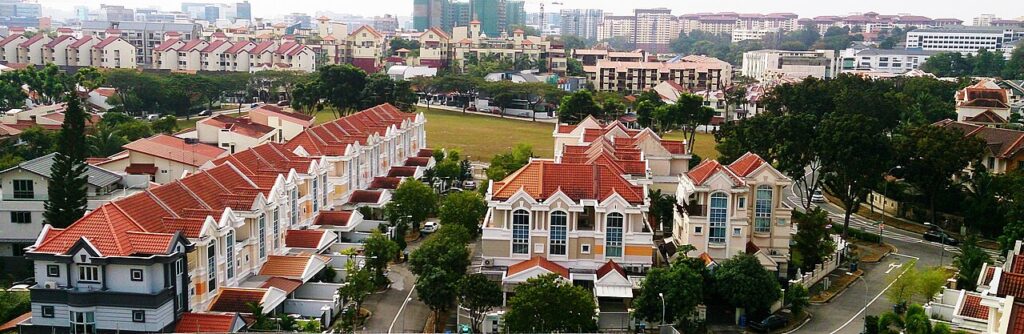
- Serangoon spans Districts 13 and 19, covering Serangoon town (HDB-dominant, D19), Serangoon Gardens (D13, landed enclave), and the Kovan/Upper Serangoon corridor.
- The area is served by four MRT stations: Serangoon (NEL NE12 / CCL CC13 interchange), Bartley (CC12), Lorong Chuan (CC14), and Kovan (NEL NE13) , placing residents on both the North East and Circle lines.
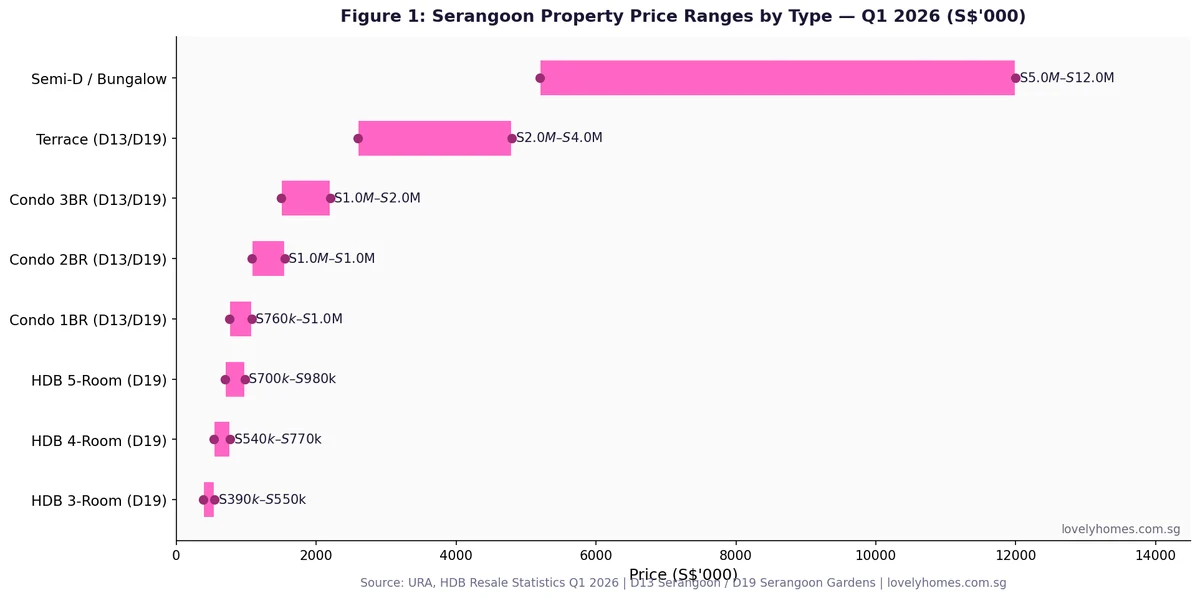
- HDB 4-room resale prices in the D19 Serangoon precinct range from approximately S$540,000 to S$770,000 (Q1 2026), reflecting mature-estate premiums.
- Condominiums in D13/D19 range from S$760,000 (1BR) to S$2.2M+ (3BR); Serangoon Gardens terraces command S$2.6M–S$4.8M.
- NEX mall , one of Singapore’s largest suburban malls , anchors the Serangoon MRT interchange and draws the entire north-east catchment.
- Schools nearby include CHIJ Our Lady of Good Counsel, Maris Stella High, and St Gabriel’s Secondary , making the area popular with families.
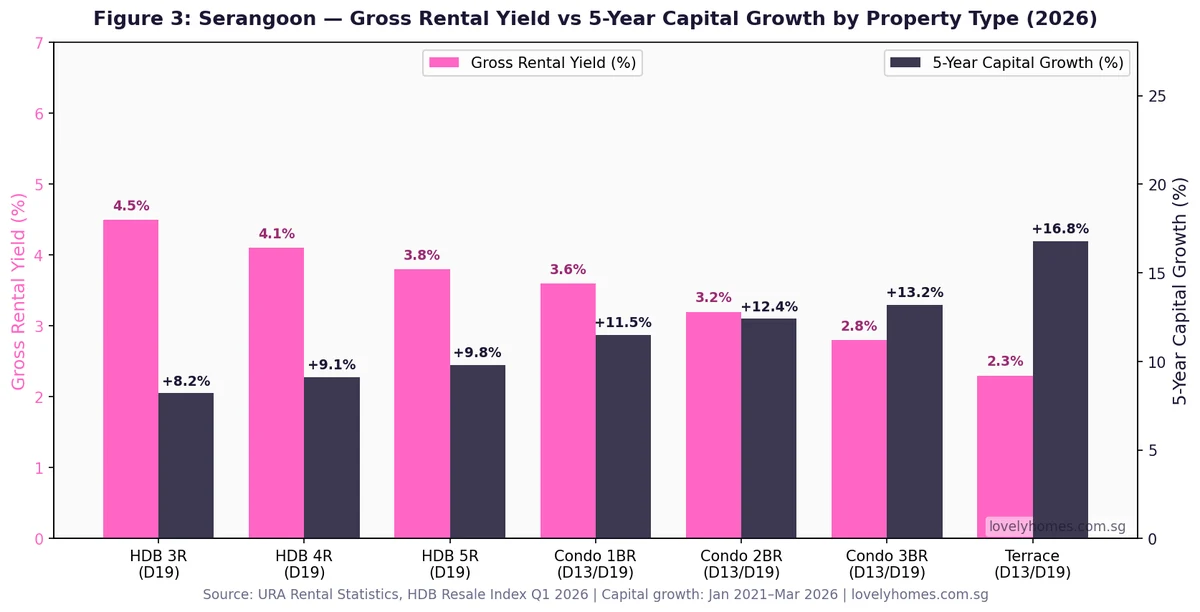
- Gross rental yields run from 4.5% (HDB 3-room) down to 2.3% (landed terrace), with 5-year capital growth of 8.2% to 16.8% by property type.
- The Cross Island Line (CRL) Phase 2, targeting completion around 2032, will add further connectivity to this already well-served corridor.
Why Serangoon?
Serangoon occupies a unique position in Singapore’s property landscape. It is at once a mature HDB town with affordable family flats, a landed enclave in Serangoon Gardens prized for its low-rise, leafy character, a retail hub anchored by the colossal NEX mall, and a corridor that sits at the intersection of two MRT lines with onward connections to the city, Changi Airport, and the north-east growth belt. For buyers, this variety means Serangoon can be tailored to a remarkable range of budgets and lifestyles , from first-timer families buying an HDB flat near good schools, to upgraders targeting a freehold condominium with MRT access, to landlords drawn by a stable tenant pool from nearby tertiary institutions and the medical cluster.
This guide covers everything a prospective buyer, seller, or tenant needs to know about Serangoon in 2026: property price ranges, MRT connectivity, schools, amenities, rental yields, capital growth history, and a full worked financial example.
Location and District Overview
Serangoon as a neighbourhood straddles two URA planning districts. The town centre and HDB heartland sit primarily within District 19 (Hougang, Punggol, Sengkang, Serangoon , all classified as Outside Central Region or OCR). The landed enclave of Serangoon Gardens, Lorong Chuan, and the private condominium corridor along Upper Serangoon Road fall partly within District 13 (MacPherson, Potong Pasir, Serangoon , also OCR). The Upper Thomson / Bishan fringe to the west and the Kovan / Hougang corridor to the north complete the immediate neighbourhood context.
For property investors, the OCR classification matters: URA’s private residential property price index for OCR rose by +2.2% in Q1 2026, leading all regional market segments, and by approximately +73% since Q1 2019 , the strongest long-run appreciation of the three market segments (CCR +40%, RCR +49%, OCR +73%). Serangoon’s dual-district footprint means its properties have generally tracked OCR index growth while benefiting from proximity to mature estate infrastructure.
MRT Connectivity , Four Lines, Two Interchanges
Serangoon’s MRT coverage is its standout transport asset. The Serangoon station (NEL NE12 / CCL CC13) is one of Singapore’s few true dual-line interchanges outside the city core, giving residents seamless access to both the North East Line (direct to Dhoby Ghaut, Orchard, Clarke Quay, and Punggol) and the Circle Line (direct to Bishan, Botanic Gardens, one-north, HarbourFront, and Paya Lebar). Additional stations serving the neighbourhood include:
- Bartley (CCL CC12): Serves the Upper Paya Lebar Road and Bartley Road corridor; direct CCL link to MacPherson and Marymount.
- Lorong Chuan (CCL CC14): Adjacent to St Andrew’s Village schools complex; walking distance to The Scala and several mid-tier condominiums.
- Kovan (NEL NE13): Serves the Kovan / Upper Serangoon Road shophouse belt and Heartland Mall; popular with foodies and families.
Commute times to the city: Serangoon → Dhoby Ghaut (Orchard fringe) is approximately 18 minutes by NEL. Serangoon → Paya Lebar interchange (East-West Line connection) is approximately 12 minutes by CCL. Bus services from multiple stops in the area cover Ang Mo Kio, Bishan, Hougang, and the Pan Island Expressway (PIE) feeder corridors.
Property Prices , Q1 2026
| Property Type | Price Range (S$) | Typical PSF (S$) | Tenure | Key Sub-market |
|---|---|---|---|---|
| HDB 3-Room (D19) | S$390k – S$550k | S$530 – S$720 | Leasehold (99yr) | Serangoon North Ave, Upper Serangoon Rd |
| HDB 4-Room (D19) | S$540k – S$770k | S$560 – S$750 | Leasehold (99yr) | Lorong Lew Lian, Serangoon Central |
| HDB 5-Room (D19) | S$700k – S$980k | S$560 – S$740 | Leasehold (99yr) | Serangoon North, Upper Serangoon Rd |
| Condo 1BR (D13/D19) | S$760k – S$1.08M | S$1,680 – S$2,100 | 99yr / FH mix | Lorong Chuan, Bartley corridor |
| Condo 2BR (D13/D19) | S$1.08M – S$1.55M | S$1,600 – S$2,000 | 99yr / FH mix | Serangoon Gardens fringe, Upper Serangoon |
| Condo 3BR (D13/D19) | S$1.5M – S$2.2M | S$1,480 – S$1,900 | 99yr / FH mix | The Scala, Kovan Regency, D’Nest |
| Terrace (D13/D19) | S$2.6M – S$4.8M | S$900 – S$1,500 | Freehold | Serangoon Gardens, Kovan area |
| Semi-D / Bungalow | S$5.2M – S$12M+ | S$950 – S$1,800 | Freehold | Serangoon Gardens enclave |
Serangoon Gardens , the predominantly landed preclave bounded by Serangoon Garden Way, Yio Chu Kang Road, and Upper Serangoon Road , is one of Singapore’s most established freehold landed enclaves. Its proximity to the CCL and the NEL interchange, combined with a strong school cluster and a village-style food and retail strip (Chomp Chomp, Serangoon Garden Market), underpins strong demand and limited supply. Freehold terrace turnover is sparse, with many owners holding generationally.
Amenities and Lifestyle
Retail and Dining
NEX mall at Serangoon MRT is the centrepiece of the precinct’s commercial life. With approximately 467,000 sq ft of net lettable area across six retail floors and an indoor ice skating rink, NEX is one of the largest suburban malls in Singapore and a key driver of foot traffic to the Serangoon MRT interchange. Tenants include a full-format FairPrice Xtra, Golden Village cineplex, major fashion and electronics retailers, and an extensive F&B floor. The mall’s direct connection to the Serangoon bus interchange and MRT concourse makes it effectively carless-accessible for most residents.
Beyond NEX, Heartland Mall at Kovan (NEL NE13) caters to the upper Serangoon Road catchment with a neighbourhood mall format. The Serangoon Gardens food belt , Chomp Chomp Food Centre, Serangoon Garden Market and Food Centre , draws diners from across the north-east and is widely regarded as one of Singapore’s top outdoor dining precincts, with celebrated carrot cake, satay, and hokkien prawn mee stalls.
Schools
Serangoon’s school cluster is a significant pull factor for families. Within 1–2 km of the Serangoon MRT area: CHIJ Our Lady of Good Counsel (Serangoon Road); Yangzheng Primary School; St Gabriel’s Primary and Secondary (Upper Serangoon Road); Maris Stella High School (Bartley Road , a Catholic boys’ school affiliated to the La Salle Brothers, with a strong academic and co-curricular reputation). The St Andrew’s Village complex near Lorong Chuan houses St Andrew’s Junior College, St Andrew’s Secondary, and St Andrew’s Junior School within a single campus , a clustering that makes the Lorong Chuan corridor popular with families targeting secondary and JC education.
At the tertiary level, Nanyang Polytechnic (NYP) at Ang Mo Kio, a short bus ride away, generates student rental demand in the HDB heartland.
Parks and Green Corridors
The Bishan-Ang Mo Kio Park (62 hectares, bounded by Bishan Street 22 and Upper Thomson Road) is a short drive or cycling distance from Serangoon Central , one of Singapore’s largest urban parks, featuring naturalised rivers, extensive cycling paths, and the iconic Alexandra Canal life habitat restoration by Ramboll Studio Dreiseitl. The Serangoon River park connector runs east through Kovan and into Hougang, offering a low-traffic cycling and jogging corridor. The Rail Corridor northern extension and the Park Connector Network provide further active-mobility links to Bishan, MacRitchie Reservoir (approximately 8 km by trail), and the Central Catchment Nature Reserve.
Healthcare
Tan Tock Seng Hospital (TTSH) , one of Singapore’s largest public hospitals with approximately 1,700 beds , is located in Novena, approximately 3 km from Serangoon MRT by car or taxi (15–20 minutes in off-peak traffic). Mount Alvernia Hospital, a private Catholic hospital, is approximately 2 km away in Thomson Road. For routine primary care, multiple polyclinics in Serangoon and Hougang serve the HDB population, while numerous GP and specialist clinics line Upper Serangoon Road.
Investment Analysis , Yields and Capital Growth
As with all Singapore property, Serangoon presents the classic yield-versus-growth trade-off by property type. HDB flats deliver the highest gross rental yields (4.5% for 3-room, 4.1% for 4-room) but the slowest 5-year capital appreciation (8.2–9.8%). Freehold terraces in Serangoon Gardens, by contrast, offer modest yields (approximately 2.3%) but have delivered approximately 16.8% capital growth over the same period, benefiting from freehold status and the structural scarcity of landed supply in the north-east.
Condominium investments in the D13/D19 corridor occupy the middle ground: 1-bedroom units yield approximately 3.6% gross with 11.5% five-year appreciation, while 3-bedroom units offer 2.8% yield with 13.2% growth. These returns compare favourably to many OCR markets, particularly given Serangoon’s MRT density and the rental demand buffer from NYP, Nanyang Polytechnic, and the north-east medical and commercial clusters.
Tenant profile: The primary rental market in Serangoon is domestic , young HDB families upgrading to renting a condominium while waiting for their BTO, and professionals working in Bishan, Ang Mo Kio, or the NEL/CCL corridor. The Serangoon Gardens enclave attracts a subset of expatriate tenants , particularly families from nearby international schools (Stamford American International School at Woodleigh is approximately 3 km away; St Joseph’s Institution International is accessible by bus) , who value the village atmosphere and landed living at price points significantly below Bukit Timah or Holland Village equivalents.
Worked Example: Mr & Mrs Lim , First-Time Buyers in Serangoon
Mr and Mrs Lim are Singapore Citizens, first-timer married couple, with a combined monthly income of S$9,500. They wish to purchase a 4-room resale HDB flat in the Serangoon North precinct (D19). Their target flat is priced at S$680,000.
| Item | Amount | Notes |
|---|---|---|
| Purchase price | S$680,000 | 4-room resale, Serangoon North |
| EHG (Enhanced CPF Housing Grant) | (S$25,000) | Family income S$9,500 → EHG S$25k (income-banded) |
| PHG (Proximity Housing Grant) | (S$10,000) | Buying within 4 km of parents |
| Effective purchase price after grants | S$645,000 | Grants deducted from HDB loan quantum |
| BSD | S$16,200 | Progressive rates: 1% on first S$180k + 2% on next S$180k + 3% on next S$640k |
| ABSD | NIL | SC first property , exempt |
| HDB loan (80% LTV) | S$516,000 | At HDB concessionary rate 2.6% p.a. |
| Monthly instalment (25yr) | S$2,338/month | MSR: S$2,338 ÷ S$9,500 = 24.6% ✓ (below 30% MSR cap) |
| Cash upfront (BSD + 5% downpayment) | ~S$50,200 | 5% cash/CPF = S$34,000; BSD = S$16,200; net of CPF OA available |
The purchase is comfortably feasible. The MSR of 24.6% is well within the 30% cap. Mr and Mrs Lim also retain the option to apply for a Step-Up CPF Housing Grant of S$15,000 if they are currently renting an HDB flat, or the AHG/FHG (for couples with children) in addition to the EHG. Over a 25-year loan at 2.6% p.a., total interest paid is approximately S$178,000 , on a flat that, based on 5-year HDB resale price trend data for the area, has historically appreciated by 8–10% in comparable periods.
Is Serangoon a Good Area to Buy Property?
For the right buyer profile, Serangoon scores highly across most dimensions. Its MRT depth (four stations, two lines) is exceptional for an OCR location. Its school cluster is among the strongest in the north-east. Its retail and dining infrastructure , centred on NEX and Serangoon Gardens , reduces the need to travel out of the neighbourhood for most daily needs. And its property price range spans from sub-S$400,000 HDB flats to S$12M+ freehold bungalows, making it accessible to a very wide segment of the buying market.
The cautions worth noting: some HDB blocks in the Serangoon North precinct were built in the 1980s and 1990s and may have shorter remaining leases , buyers should verify the exact lease tenure and the CPF lease adequacy rules before committing. The Serangoon Gardens enclave is zoned exclusively for landed housing; no new condominiums can be built inside the estate, which preserves its character but also means resupply pressure from new launches is absent. The CRL Phase 2 catalyst (expected around 2032) is meaningful for the northern fringes of the neighbourhood (Ang Mo Kio–Serangoon–Hougang corridor) but will not add a station at Serangoon MRT itself , its uplift will be felt more in the Upper Thomson and Ang Mo Kio nodes.
What Might Come Next for Serangoon
The URA Draft Master Plan 2025 identified several precincts around the Serangoon-Kovan-Hougang corridor for potential intensification, including additional mixed-use plots along Upper Serangoon Road. The Cross Island Line (CRL) Phase 2 will connect Bright Hill (upper Thomson Road, adjacent to Bishan park) through to Hougang and eventually Marina Bay , improving east-west connectivity for residents in the northern fringe of the Serangoon catchment. The Serangoon MRT interchange itself is expected to undergo a capacity upgrade in the coming years to accommodate growing NEL ridership from the expanding Punggol-Tengah-Hougang corridor. Any GLS release on the remaining privately-zoned plots along the Lorong Chuan and Bartley corridors would provide a new supply benchmark for the area’s condominium market.
Frequently Asked Questions
Is Serangoon a good place to buy property in 2026?
Yes, for buyers who prioritise MRT accessibility, school proximity, and lifestyle infrastructure. The dual NEL/CCL interchange at Serangoon gives exceptional connectivity at OCR prices. HDB affordability remains strong relative to CCR/RCR; freehold landed in Serangoon Gardens offers genuine generational wealth potential. The main risk is lease-aging on older HDB blocks and the absence of a new GLS pipeline in the immediate area, which limits fresh supply catalysts for condominium capital growth.
Which MRT stations serve Serangoon?
Four stations: Serangoon (NEL NE12 / CCL CC13 , dual-line interchange), Bartley (CCL CC12), Lorong Chuan (CCL CC14), and Kovan (NEL NE13). The Serangoon interchange is the anchor, offering direct CCL access to Botanic Gardens, one-north, and HarbourFront, and direct NEL access to Orchard, Dhoby Ghaut, and Punggol. Most D13/D19 condominiums are within 800 metres of one of these four stations.
Can foreigners and PRs buy property in Serangoon?
Foreigners (non-PR) may purchase condominium units (strata-titled) and commercial properties in Serangoon but may NOT purchase HDB flats (HDB is restricted to Singapore Citizens and eligible PRs under specific conditions) or landed property (restricted to Singapore Citizens; PRs require approval from the Land Dealings Approval Unit). Non-PR foreigners purchasing residential property pay ABSD at 60% on any purchase. Singapore PRs purchasing their first residential property pay ABSD at 5%, and 30% on their second and subsequent properties. ABSD rates are applied on the total purchase price.
What are the best condominiums in Serangoon?
Several well-regarded condominiums in the D13/D19 Serangoon corridor have strong resale and rental track records. The Scala (99-year, ~468 units, Lorong Chuan , CCL CC14) is popular with families for its proximity to St Andrew’s Village and Lorong Chuan MRT. Kovan Regency (99-year, ~393 units, Kovan MRT) offers integrated mall access. Rosyth School condominium cluster near Upper Serangoon Road attracts families targeting the popular Rosyth School ballot. D’Nest (99-year, ~912 units, Pasir Ris fringe but Upper Serangoon Road address) serves larger families seeking 4-bedroom units. For freehold options, older boutique developments along Serangoon Avenue and Upper Serangoon Road offer better value per square foot than newer 99-year projects, albeit with smaller pool and gym facilities.
How does Serangoon compare to Bishan or Ang Mo Kio?
All three are established mature OCR towns with strong school clusters and HDB dominance. Bishan (D20) is served by the NSL/CCL interchange at Bishan MRT and commands slight price premiums for its proximity to the Bishan-AMK Park and a very popular school belt (Raffles Institution, Catholic High). Ang Mo Kio (D20) is served by the NSL and will gain CRL Phase 2 connectivity; it has the largest HDB town in Singapore by flat count. Serangoon differentiates itself via the freehold landed enclave in Serangoon Gardens (unique among these three), its retail anchoring by NEX (larger than Junction 8 in Bishan), and the Kovan shophouse and food belt. Condo prices in Serangoon are broadly in line with Bishan and slightly above AMK. HDB resale prices are similar across all three mature towns.
Are there new HDB BTO flats available in Serangoon in 2026?
As of mid-2026, there are no announced BTO projects in the Serangoon Central planning area. HDB BTO supply in the north-east is concentrated in Hougang, Tampines, Punggol, Sengkang, and Woodlands. The Serangoon planning area’s HDB stock is primarily mature-estate resale, which means buyers looking for new flats at below-market prices typically look to neighbouring Hougang or Bishan/AMK BTO exercises. The June 2026 BTO exercise offers flats in Ang Mo Kio, Bishan, Bukit Merah, Sembawang, and Woodlands , not Serangoon directly.
What income do I need to buy a condominium in Serangoon?
For a 2-bedroom condominium at S$1.2M using a bank loan at 75% LTV: loan quantum S$900,000 at 3.0% p.a. over 25 years = S$4,267/month. TDSR at 55%: minimum income required = S$4,267 ÷ 0.55 ≈ S$7,758/month (individual or joint). Cash/CPF downpayment needed: 25% = S$300,000 plus BSD S$34,200 = S$334,200 total upfront. ABSD: nil for SC first property; 5% (S$60,000) for SPR first property. The income threshold is accessible for dual-income couples in their 30s, which is the typical buyer profile for the D13/D19 corridor.
Related Articles
- Bedok Neighbourhood Guide Singapore 2026: Property Prices, Schools, MRT and Investment Outlook
- Tampines Neighbourhood Guide Singapore 2026: Property Prices, Schools, MRT and Investment Outlook
- Novena and Newton Neighbourhood Guide Singapore 2026: Property Prices, Schools, MRT and Investment Outlook
- Bukit Timah Neighbourhood Guide Singapore 2026: Property Prices, Schools, DTL MRT and Investment Outlook
- ABSD Singapore 2026: Complete Guide to Additional Buyer’s Stamp Duty
- First-Time Property Buyer Guide Singapore 2026: HDB, EC and Condo , Every Step Explained
- Singapore CPF Property Withdrawal Limits 2026
Disclaimer: This article is for general informational purposes only and does not constitute property, legal, or financial advice. All price ranges, yields, and growth figures cited are indicative estimates derived from publicly available data (URA REALIS, HDB Resale Portal, URA Rental Statistics Q1 2026) and are subject to change. Actual transaction prices vary by unit, floor, facing, condition, and prevailing market conditions at the time of sale. ABSD, BSD, and CPF rules are current as at 1 June 2026 and may be revised by the relevant authorities. Always engage a licensed property agent and seek independent legal and financial advice before any property transaction. For official guidance, refer to: hdb.gov.sg, ura.gov.sg, iras.gov.sg, cpf.gov.sg.
Supporting graphics
Original article illustrations are available below.
- Figure 1: Serangoon Property Price Ranges by Type , Q1 2026. HDB prices reflect D19 resale transactions; condo and landed prices reflect D13/D19 transactions. Source: URA REALIS, HDB Resale Portal.
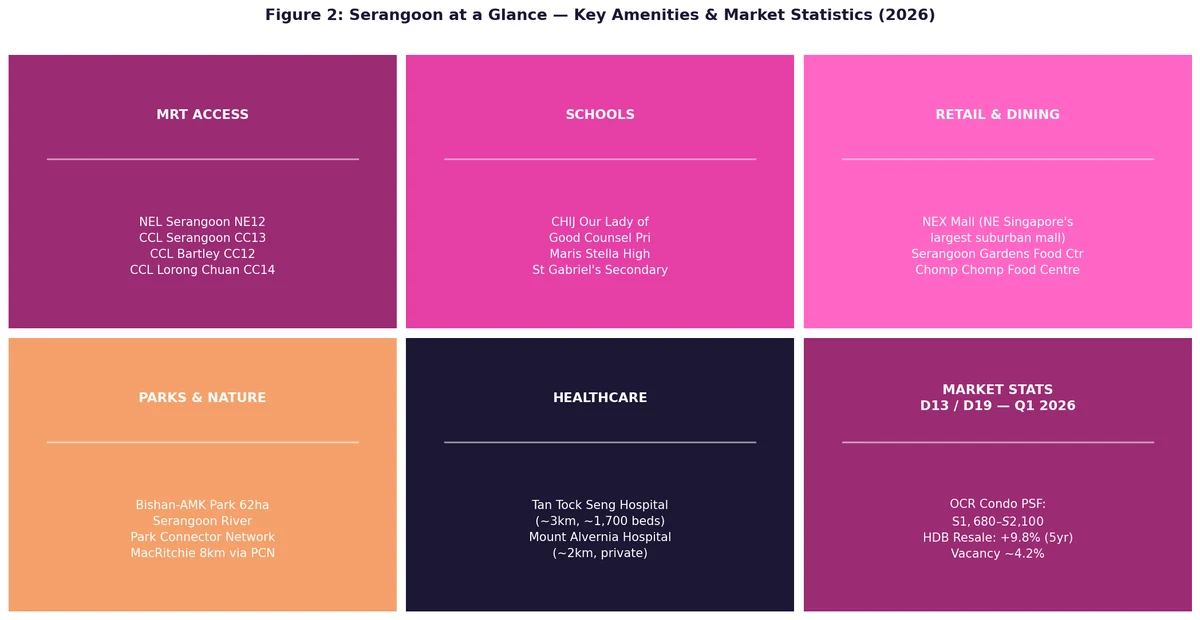
- Figure 2: Serangoon at a Glance , Key Amenities and Market Statistics (2026). Source: LovelyHomes research, URA, HDB.
- Figure 3: Serangoon , Gross Rental Yield vs 5-Year Capital Growth by Property Type (2026). Capital growth measured January 2021 – March 2026. Source: URA Rental Statistics, HDB Resale Index Q1 2026.