

Singapore BTO Application Guide 2026: How to Apply, Ballot and Buy an HDB Flat
Quick Answer: BTO Applications in 2026 — Key Points at a Glance
- What BTO means: Build-To-Order (BTO) flats are new HDB flats sold at government-subsidised prices during four annual exercises (typically February, May, August and November). Buyers commit upfront and wait 3–5 years for construction.
- Priority balloting: First-timers receive two ballot chances versus one for second-timers, significantly improving their odds in oversubscribed launches.
- Income ceilings: S$7,000/month for 2-room Flexi flats in mature or Plus-classified locations; S$14,000/month for most 3-room to executive flat types.
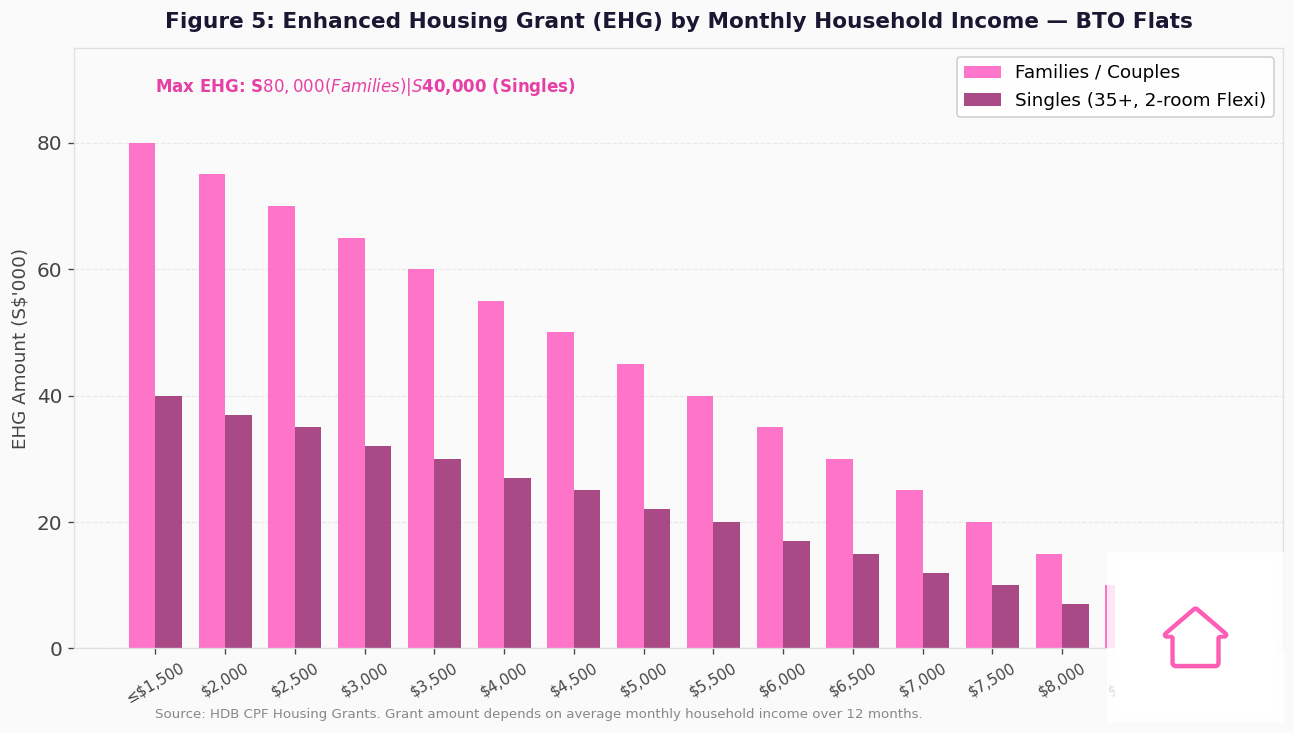
- Enhanced Housing Grant (EHG): Up to S$80,000 for eligible families; up to S$40,000 for eligible singles. Income-scaled and administered by CPF Board.
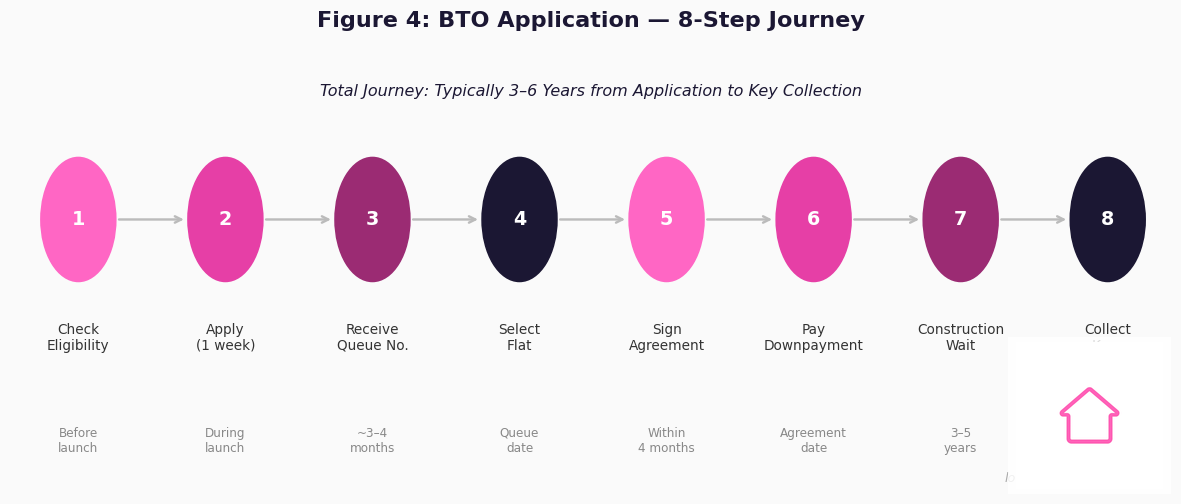
- Total timeline: From application to key collection is typically 3–6 years, including the construction wait. This requires careful long-term financial planning.
- New classification from 2024: HDB’s Standard / Plus / Prime framework replaced the Mature / Non-Mature distinction. Plus and Prime flats carry additional resale restrictions and subsidy clawback conditions.
- MOP: Five-year Minimum Occupation Period for Standard flats before the flat can be sold on the open market or rented out in its entirety.
What is a BTO Flat — and How Does the Scheme Work?
Build-To-Order (BTO) flats are new public housing units offered by the Housing and Development Board (HDB) at prices set below comparable private market rates, reflecting a direct government subsidy. Unlike buying an existing flat on the resale market, BTO buyers do not move in immediately — they commit to a flat that has yet to be built, then wait for construction to complete before collecting their keys.
The BTO scheme is the primary vehicle through which Singapore Citizens (and, in limited circumstances, Singapore Permanent Residents) access new, affordable public housing. It was introduced in 2001 to replace the earlier Registration for Flats system, allowing HDB to build flats closer to actual demand, reducing unsold inventory and the government’s financial exposure.
HDB administers eligibility, the ballot, construction, and key collection. The CPF Board manages housing grants and CPF contribution tracking used in the purchase. The Ministry of National Development (MND) sets overarching housing policy, including the annual BTO supply target. The Inland Revenue Authority of Singapore (IRAS) handles Buyer’s Stamp Duty (BSD), which applies even to new BTO flats.
BTO Eligibility: Who Can Apply?
To apply for a BTO flat, you must satisfy HDB’s eligibility criteria at the time of application. The requirements have been updated in tandem with the 2024 HDB flat classification reform, which replaced the Mature/Non-Mature distinction with a Standard/Plus/Prime framework carrying differentiated subsidies and resale conditions.
Citizenship: At least one applicant must be a Singapore Citizen for most BTO flat types. Two Singapore Permanent Residents forming a household are generally limited to the HDB resale market; SPR families with at least one SC spouse may apply for BTO flats under specific schemes. Singles must be SC, aged 35 or above, and may only apply for 2-room Flexi flats under the Single Singapore Citizen (SSC) Scheme.
Age: Applicants must be at least 21 years old (35 for singles buying under the SSC Scheme or the Joint Singles Scheme).
Family nucleus: You must form an eligible family nucleus — for example, a married or engaged couple, parent-and-child family, multi-generational household, or an eligible singles arrangement.
Property ownership: Applicants must not own or have disposed of any private property (local or overseas) within 30 months before the BTO application. Existing HDB flat owners wishing to upgrade to a new BTO flat are subject to additional conditions, including selling their existing flat within six months of the new flat’s key collection.
Income ceiling: S$7,000/month for singles applying under the SSC Scheme for 2-room Flexi flats; S$14,000/month for families buying 3-room to executive flat types in Standard or Plus locations. The income ceiling is assessed based on the average gross monthly household income over 12 months.
How the BTO Ballot Works
BTO applications are made online during the sales exercise launch window, which is typically open for approximately one week. HDB publishes the flat types, locations, indicative prices, and application details in advance of each exercise. There is no fee to apply.
Ballot priority: HDB’s computerised ballot gives first-timer applicants two ballot chances, significantly improving their odds compared to second-timers who receive one chance. Within the first-timer pool, additional sub-priority is extended to multi-generational families, married couples with children applying under the Parenthood Priority Scheme (PPS), and essential workers applying in their work zone.
Oversubscription: Oversubscription rates vary considerably by project location, flat type, and classification. Four-room and five-room flats in Plus or Prime locations in central areas regularly see application-to-unit ratios of 5 to 15 or higher. Standard flats in less central towns are typically less oversubscribed, offering first-timers a realistic chance of securing a queue number within one or two applications.
Queue number: If selected in the ballot, you receive a queue number. Lower numbers are invited earlier to select their preferred unit from remaining inventory. As selection progresses, unit choice narrows — applicants with higher queue numbers face reduced choice, and in oversubscribed launches some applicants may find no suitable units remaining when their number is called.
Flat Selection, Agreement for Lease and Downpayment
When your queue number is reached, HDB issues an invitation to attend a flat selection appointment — conducted either in person at HDB Hub or virtually. You select a specific unit (block, floor, orientation, facing) from inventory remaining at the time of your appointment.
After selecting your flat, you sign the Agreement for Lease and pay a booking fee of approximately 5% of the flat price, payable using CPF Ordinary Account (OA) savings or cash. The remaining 15% of the purchase price (net of CPF Housing Grants) is paid in instalments during the construction period, using CPF OA and/or cash as progress payment requests are issued at defined construction milestones.
At Temporary Occupation Permit (TOP) — when the building is structurally complete — HDB invites you for key collection. You pay the final balance (if any), sign the lease, and collect your keys. Legal fees are payable at this stage.
CPF Housing Grants for BTO Flats
The CPF Housing Grant framework for BTO flats centres on the Enhanced Housing Grant (EHG), which replaced the previous combination of the Additional CPF Housing Grant (AHG) and Special CPF Housing Grant (SHG). The EHG is income-tested, tiered, and applies to both BTO and resale flat purchases by eligible first-timer households.
| Grant | Applicable Flat Type | Maximum Amount | Income Ceiling |
|---|---|---|---|
| Enhanced Housing Grant (EHG) — Families | BTO and Resale | S$80,000 | S$9,000/month or below |
| Enhanced Housing Grant (EHG) — Singles | 2-room Flexi BTO and Resale | S$40,000 | S$4,500/month or below |
| Singles Grant | Resale only (not BTO) | S$25,000 | S$7,000/month |
| Family Grant | Resale only (not BTO) | S$50,000 (SC+SC couple) | S$14,000/month |
| Proximity Housing Grant (PHG) | Resale only (not BTO) | S$30,000 | S$14,000/month |
Note: The Family Grant and Proximity Housing Grant are available for resale flat purchases only, not BTO. BTO buyers’ main grant is the EHG. Households earning S$9,000/month receive S$5,000 EHG; those earning S$1,500/month or less receive the maximum S$80,000. The grant is credited at key collection and reduces the amount financed by loan or CPF.
BTO vs Resale vs Executive Condominium: At a Glance
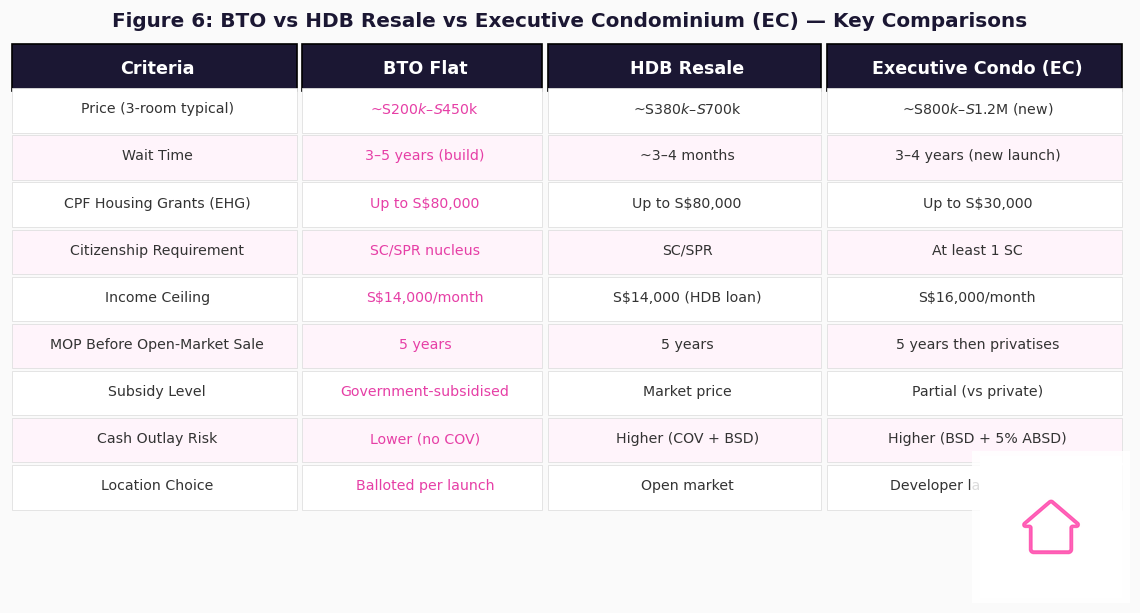
Choosing between a BTO flat, a resale flat, or an Executive Condominium (EC) depends on your timeline, financial capacity, location needs, and long-term plans. BTO flats offer the lowest entry price and highest grant eligibility but require a 3–5 year wait. Resale flats are available quickly but at market prices, with potential Cash Over Valuation (COV) risk. ECs occupy a middle ground — privately built but subject to HDB income and eligibility conditions, with a 5-year Minimum Occupation Period (MOP) before privatisation and sale to foreigners becomes possible. Figure 6 above summarises the key differentiators.
Worked Example: Mr & Mrs Tan Applying for a 4-Room Tengah BTO
Profile: Both Singapore Citizens, combined gross monthly income S$5,000. First-timer applicants. Ages 28 and 27.
BTO flat: 4-room flat, Tengah (Standard classification). Indicative price: S$390,000. Estimated wait: 4 years.
EHG: Income S$5,000/month → EHG = S$55,000 (family, income-scaled). Credited at key collection.
BSD: 1% × S$180k = S$1,800 + 2% × S$180k = S$3,600 + 3% × S$30k = S$900 = S$6,300
ABSD: S$0 (first property, both SC)
HDB loan: 80% LTV of (S$390k − S$55k EHG) = 80% × S$335k = S$268,000 @ 2.6% p.a., 25 years. Monthly repayment ≈ S$1,220/month. MSR check: S$1,220 ÷ S$5,000 = 24.4% < 30% ✓
Down payment (20%): S$390k × 20% = S$78,000. Net of EHG: effective down payment from CPF/cash = S$78,000 − S$55,000 = S$23,000. Assuming CPF OA balance of S$25,000 at key collection (built up over 4 construction years), the Tans can cover the down payment entirely from CPF OA.
Booking fee (at flat selection): ~5% = S$19,500 (from CPF OA or cash); credited towards purchase price.
Net cash at key collection: BSD S$6,300 + legal fees ~S$2,500 = approximately S$8,800 in cash. The EHG and CPF OA cover the remaining obligations. Without the grant, the Tans would need to fund S$78,000 down payment from savings — the EHG reduces their effective purchase price to S$335,000.
Why the BTO Route Matters in 2026
The BTO scheme remains Singapore’s most affordable entry point to home ownership. For eligible first-timer families at median income levels, the combination of government-subsidised prices and EHG grants can reduce the effective purchase price by S$50,000–S$100,000 compared to comparable resale flats.
However, the construction delays experienced during the COVID-19 period — which pushed some BTO completion dates out by one to two years beyond original estimates — highlighted the risks of the BTO model. HDB has since accelerated construction pipelines and moved to earlier contractor appointment, but buyers should build contingency planning into their BTO journey. The 2024 Standard/Plus/Prime classification also introduces new nuances: Plus-classified BTO flat buyers face a 10-year MOP (versus 5 for Standard), restrictions on sub-letting, and a requirement to return a proportion of resale proceeds to HDB above a prescribed threshold — reflecting the higher subsidies embedded in these locations.
What Might Come Next for BTO
HDB has committed to launching 19,000–20,000 BTO flats annually through the mid-2020s to address the supply backlog accumulated in prior years, with a focus on Standard flats in growing towns such as Tengah, Kallang/Whampoa, and the Greater Southern Waterfront precinct. Industry observers anticipate potential refinements to the priority ballot framework — particularly regarding the treatment of applicants who have repeatedly been unsuccessful despite multiple applications. The government has also signalled ongoing review of the Plus/Prime subsidy and resale restriction model, with the first cohort of Plus flats expected to reach MOP in the early 2030s. Buyers should monitor MND and HDB announcements for any policy changes affecting upcoming sales exercises.
Frequently Asked Questions: BTO Application 2026
How many times can I apply for BTO before losing first-timer priority status?
You retain first-timer status until you are actually offered a unit and sign the Agreement for Lease, or until you have previously purchased a subsidised HDB flat. Simply applying multiple times — even if you receive and decline queue numbers — does not immediately strip you of first-timer priority, though HDB may deduct a ballot chance after a certain number of declined offers (currently, two declined queue number offers result in losing one ballot chance). The safest approach is to apply seriously to each exercise and, if you receive a queue number, assess carefully before declining, as each decline reduces your future advantage.
What happens if I miss my flat selection appointment?
If you miss your scheduled flat selection appointment without prior arrangement with HDB, you may forfeit your queue number for that exercise. HDB does allow rescheduling under exceptional circumstances — such as a medical emergency or overseas work travel — but you must notify HDB in advance and provide supporting documentation. If your queue number is forfeited, you will need to reapply in a subsequent BTO exercise. Given that obtaining a queue number may take multiple exercises for popular flat types, missing a selection appointment is a costly outcome that should be avoided through careful diary management and early appointment of a solicitor.
Can I sell or rent out my BTO flat before the MOP is completed?
The Minimum Occupation Period (MOP) for Standard BTO flats is 5 years from the date of key collection. During this period, you may not sell the flat on the open market, rent out the entire flat, or purchase another HDB flat. You may, however, rent out spare bedrooms (subject to HDB approval and applicable limits on the number of tenants). Plus-classified BTO flats carry a 10-year MOP, reinforcing the long-term commitment required when purchasing in subsidised high-value locations. Violations of the MOP carry financial penalties and may result in HDB compulsorily acquiring the flat.
How are BTO flat prices set — and are they genuinely below market value?
HDB sets BTO prices using a market-minus-discount approach: it benchmarks comparable private and resale properties in the same area, then applies a subsidy to arrive at the BTO selling price. The subsidy is larger for Standard classification flats (lower-value areas) and smaller for Plus or Prime flats (higher-value locations), reflecting HDB’s commitment to keeping BTO prices affordable across the income spectrum. Industry analysis consistently shows that BTO flats at launch are priced 20–40% below comparable resale HDB flats in the same town, and substantially below equivalent private properties. However, the actual benefit realised by the buyer is partly tied to the MOP — if you hold for 5 or more years before selling, you benefit from the full price appreciation; some of this is recouped by HDB for Plus/Prime flats through the subsidy recovery mechanism.
What is the difference between Standard, Plus and Prime BTO flats under the 2024 classification?
From the October 2024 BTO exercise, HDB replaced the Mature/Non-Mature classification with a three-tier framework. Standard flats are located in less central areas, carry a standard subsidy, and have a 5-year MOP with no subsidy clawback on resale. Plus flats are in more accessible or better-served locations with a higher subsidy (meaning a lower purchase price), but carry a 10-year MOP, restrictions on whole-flat sub-letting, and a requirement to return to HDB a proportion of the resale proceeds above a prescribed threshold if sold within a defined period. Prime flats are in the most central, high-value locations (such as near the city centre), carry the largest subsidies, and have the most stringent resale conditions, including income restrictions on future buyers of the resold flat. Buyers should review the specific conditions for the flat classification of any BTO project before applying.
Can Singapore Permanent Residents apply for BTO flats?
Singapore Permanent Residents (SPRs) face significant restrictions on BTO flat eligibility. An SPR household applying as a family must include at least one Singapore Citizen (SC) spouse or child; two SPR applicants forming a family without an SC component generally cannot apply for new BTO flats from HDB. SPR families that do include at least one SC may apply under the relevant scheme. Single SPRs cannot apply for BTO flats. The more accessible route for SPR households is the open HDB resale market, where eligibility conditions are less restrictive, though grant eligibility is also more limited than for SC households.
Disclaimer: This article is intended for general information only and does not constitute financial, legal or property advice. BTO policies, income ceilings, grant amounts, flat classification rules and HDB procedures are subject to revision. Always verify current information directly with the Housing and Development Board (hdb.gov.sg), the CPF Board (cpf.gov.sg), and the Ministry of National Development (mnd.gov.sg). Consult a licensed financial adviser or CEA-registered property professional for personalised guidance.