HDB Upgrader’s Guide Singapore 2026: How to Upgrade from HDB to Private Property
📌 Quick Answer: HDB Upgrader’s Checklist (2026)
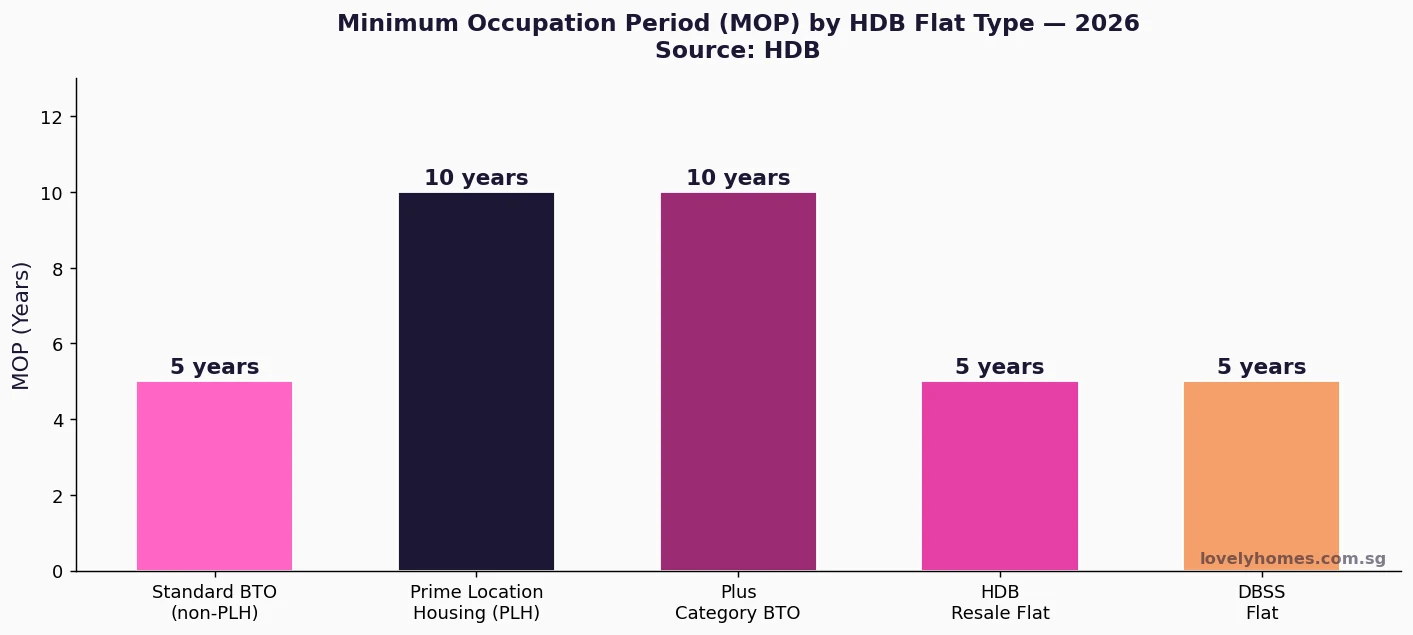
- MOP first: You must fulfil the Minimum Occupation Period — 5 years for standard BTO and resale flats, 10 years for PLH and Plus-category BTOs — before you can sell your HDB flat or purchase a private residential property.
- Concurrent ownership is restricted: Once you exercise the Option to Purchase (OTP) for a private property, you must sell your HDB flat within 6 months of the private property’s completion (TOP or CSC). You cannot own both simultaneously for long without ABSD implications.
- ABSD hits hard on the second property: A Singapore Citizen buying a second residential property pays 20% ABSD. On a $1.5M condo, that is $300,000 on top of BSD — a substantial cash outlay.
- Decoupling is one strategy: Married HDB owners sometimes transfer the flat to one spouse (retaining the other as “first-time” buyer for ABSD purposes) before purchasing private property. This strategy has become more complex after 2022 rule changes and carries legal and financial risks.
- CPF refund reduces cash: When your HDB flat is sold, you must return CPF principal + accrued interest (at 2.5% p.a.) to your CPF Ordinary Account. This directly reduces your cash proceeds and may affect your ability to fund the private purchase.
- TDSR and MSR apply: New mortgage eligibility is computed under the Total Debt Servicing Ratio (TDSR) framework (55% of gross monthly income). For HDB loans, the Mortgage Servicing Ratio (MSR) cap (30%) also applies. Private property mortgages use TDSR only.
- Timeline matters: The entire upgrade sequence — MOP fulfilment, HDB sale, private property OTP, BSD/ABSD payment — must be orchestrated carefully. Errors in sequencing can trigger additional taxes or legal complications.
The HDB Upgrade: Singapore’s Most Important Property Decision
For the majority of Singaporeans, upgrading from an HDB flat to private residential property is the single most consequential financial decision they will make in their working lives. It involves the intersection of HDB regulations, IRAS stamp duty rules, MAS lending requirements, CPF Board policies, and market timing — all of which must be navigated simultaneously and in the right sequence.
The upgrade pathway has become significantly more complex since 2021. The introduction of the Prime Location Housing (PLH) model in November 2021 (extended as the “Plus” category under the new HDB BTO classification framework from 2024) imposed 10-year MOPs on flats in high-demand locations. Simultaneously, ABSD for Singapore Citizens buying second properties was raised from 12% to 17% in December 2021, and then to 20% in April 2023, materially increasing the stamp duty cost of holding two residential properties concurrently. These changes have reset the economics of upgrading in ways many buyers underestimate.
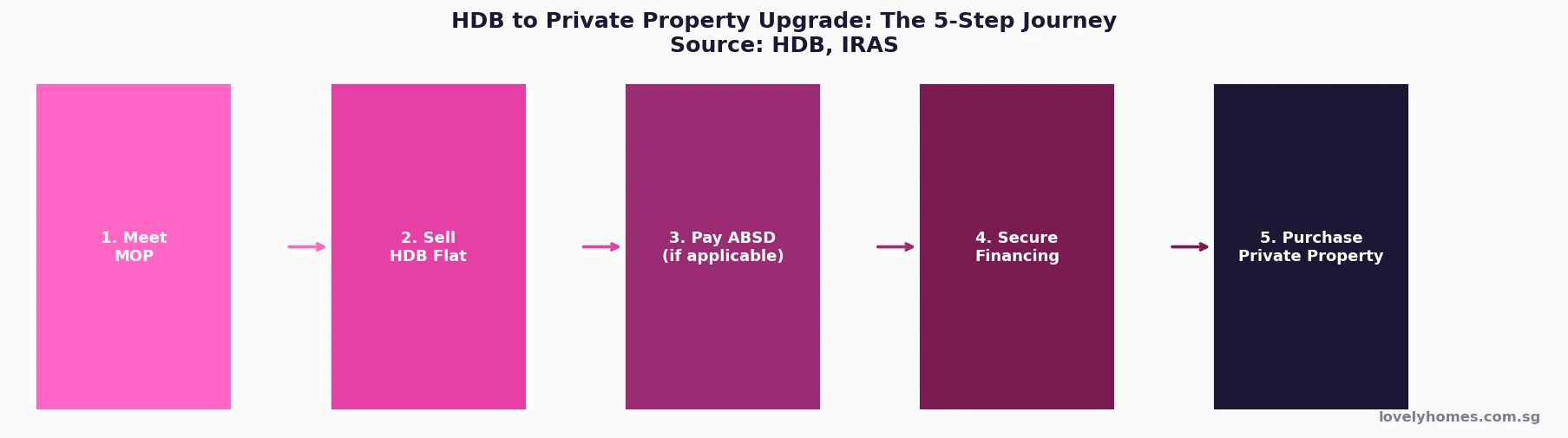
This guide walks through every stage of the HDB upgrade journey — MOP, HDB sale, ABSD strategy, financing, and private property purchase — with specific figures, timelines, and regulatory references accurate as at July 2026.
Step 1: Fulfilling the Minimum Occupation Period (MOP)
The Minimum Occupation Period is the foundational constraint for every HDB upgrader. Until MOP is fulfilled, HDB flat owners cannot: (a) sell their flat on the open resale market, (b) rent out the entire flat, or (c) purchase a private residential property in Singapore. The MOP clock starts from the date of flat key collection (for new BTO purchases) or from the date the resale transaction is completed.
| Flat Type | MOP | Can Sell After | Notes |
|---|---|---|---|
| Standard BTO (non-PLH/Plus) | 5 years | 5 years from key collection | Standard resale market conditions apply |
| Prime Location Housing (PLH) | 10 years | 10 years from key collection | Subsidy recovery applies on resale; buyer must be SC/PR |
| Plus Category BTO (from 2024) | 10 years | 10 years from key collection | Successor scheme to PLH; similar resale restrictions |
| HDB Resale Flat (purchased on open market) | 5 years | 5 years from completion of resale purchase | MOP runs from resale completion date, not original seller’s MOP |
| Design, Build and Sell Scheme (DBSS) | 5 years | 5 years from key collection | DBSS is a discontinued scheme; remaining flat owners follow standard 5-year MOP |
One important nuance: the MOP restriction on purchasing private property applies to both owners. If the HDB flat is jointly owned by a married couple, neither spouse can hold a private residential property during the MOP period — even if only one spouse’s name is on the HDB title. After MOP, one spouse may purchase a private property while the other retains the HDB flat, though ABSD rules then apply to the private purchase as a second residential property for the purchasing spouse (unless decoupling has been done).
Step 2: Selling Your HDB Flat — Timeline, CPF Refund, and Proceeds
The HDB resale process follows a well-defined statutory timeline. From agreement on price to completion typically takes 8–12 weeks, governed by the HDB Resale Portal and the following key milestones:
The CPF refund is one of the most significant and often-underestimated elements of the HDB sale. Upon completion, CPF Board automatically calculates the total CPF monies used for the flat — including principal drawn down and accrued interest at 2.5% per annum — and routes this amount back to your CPF Ordinary Account. Only the net proceeds after CPF refund are available as cash for the upgrade purchase. For many long-term HDB owners, the CPF refund absorbs the majority of the sale proceeds.
For example: an HDB flat sold at $700,000 where $250,000 in CPF principal has been drawn down over 15 years yields a CPF refund of approximately $250,000 + $102,500 in accrued interest = $352,500. Cash in hand: $700,000 − $352,500 = $347,500 (before outstanding mortgage redemption, if any).
Step 3: Understanding ABSD on Your Private Property Purchase
This is the most financially consequential element of the HDB upgrade for most buyers. When an HDB flat owner — who still owns the flat at the time of purchasing a private property — is counted as a “second property” buyer under ABSD rules, they face the following rates as at July 2026:
| Buyer Profile | ABSD Rate (2026) | ABSD on $1.5M Condo | ABSD on $2M Condo |
|---|---|---|---|
| Singapore Citizen (2nd property) | 20% | $300,000 | $400,000 |
| Singapore PR (1st property) | 5% | $75,000 | $100,000 |
| Singapore PR (2nd property) | 30% | $450,000 | $600,000 |
The key point: ABSD is assessed at the time the OTP is exercised based on your property ownership count at that moment. If you still own your HDB flat when you exercise the private property OTP, you pay 20% ABSD on the private property as a SC second-property buyer. You then have a statutory window to sell the HDB flat and apply for ABSD remission — but this requires careful sequencing and comes with conditions.
ABSD remission for married SC couples purchasing a second residential property: If both spouses are Singapore Citizens and at least one of them is a first-time private property buyer, the couple may apply for ABSD remission on the private property — but only if they sell their existing HDB flat within 6 months of the private property’s completion (TOP or CSC issuance). This is commonly referred to as the “one-year rule” in the industry, though the actual window is tied to the TOP date rather than a fixed 12-month period. ABSD must be paid upfront at OTP exercise; the remission is refunded only after the HDB sale is completed within the window.
Step 4: Securing Financing — TDSR, LTV, and the Bridging Loan
Financing a private property purchase while still holding an HDB flat (with or without an outstanding HDB loan) requires careful planning under MAS’s regulatory framework.
| Loan Parameter | Rule / Limit | Administered By |
|---|---|---|
| Total Debt Servicing Ratio (TDSR) | ≤ 55% of gross monthly income | MAS (MAS Notice 645) |
| Loan-to-Value (LTV) — 1st mortgage (no outstanding loans) | Up to 75% | MAS |
| LTV — if existing HDB loan is outstanding | Reduced to 45% (if HDB loan) or variable | MAS |
| Minimum cash downpayment (LTV ≤ 75%) | 5% cash; 20% cash+CPF | MAS |
| Stress test rate | +1.5% p.a. above prevailing rate (banks internal) | MAS Guidelines |
The most important financing implication for upgraders: if you still have an outstanding HDB housing loan, the LTV for your private property mortgage may be reduced significantly (to as low as 45%), substantially increasing the required cash and CPF contribution at downpayment. For this reason, many upgraders choose to fully redeem their HDB loan before or at the time of the HDB flat sale, using the sale proceeds — and then begin the private property purchase with a clean slate for mortgage eligibility.
A bridging loan is sometimes used to bridge the gap between the private property downpayment date and the receipt of HDB sale proceeds. Bridging loans are short-term (typically 6 months), interest-only, and carry rates significantly above standard mortgage rates. They are appropriate when the timing of the two transactions does not perfectly align — for instance, when the private property OTP is exercised before the HDB flat has been sold and completed.
Step 5: Purchasing the Private Property
Once MOP is cleared, HDB sale is in progress or completed, ABSD strategy is decided, and financing is secured, the private property purchase proceeds along standard lines. The stamp duty costs are as follows on common private property price points at 2026 rates:
| Property Price | BSD | ABSD (SC 2nd property, 20%) | Total Stamp Duty | Effective Total Rate |
|---|---|---|---|---|
| $1,200,000 | $27,000 | $240,000 | $267,000 | 22.25% |
| $1,500,000 | $43,800 | $300,000 | $343,800 | 22.92% |
| $2,000,000 | $69,600 | $400,000 | $469,600 | 23.48% |
| $2,500,000 | $93,800 | $500,000 | $593,800 | 23.75% |
| $3,000,000 | $118,800 | $600,000 | $718,800 | 23.96% |
Worked Example: The Chen Family’s Upgrade
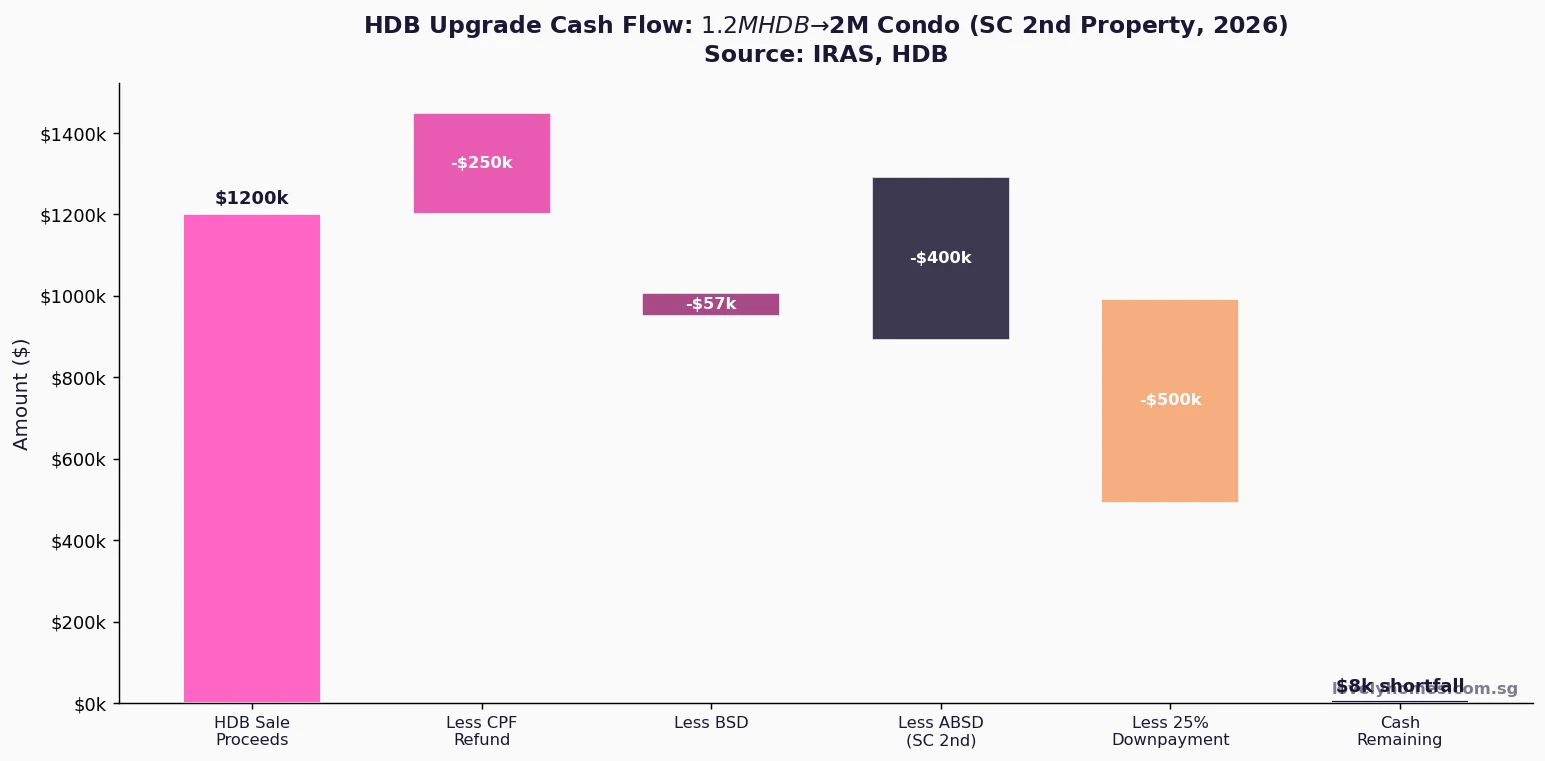
Mr and Mrs Chen are Singapore Citizens who purchased a standard BTO in Punggol in 2019. They collected keys in early 2020. Their MOP is fulfilled in early 2025. They decide to upgrade to a $2,000,000 condominium in the Rest of Central Region (RCR) in 2026.
HDB flat details: Sold for $720,000. CPF principal drawn: $220,000. Accrued CPF interest over 15 years (approximate): $55,000. CPF refund = $275,000. Outstanding HDB loan (fully redeemed at sale): $0. Cash proceeds: $720,000 − $275,000 = $445,000.
Private property purchase ($2,000,000):
- BSD: $69,600 (paid within 14 days of OTP exercise)
- ABSD: $400,000 (SC, 2nd property — paid upfront, remission application submitted within 6 months of TOP)
- Downpayment (25%): $500,000 (5% cash = $100,000; 20% CPF/cash = $400,000)
- Legal and conveyancing fees (approx.): $4,000
Total cash/CPF needed at exercise: $69,600 (BSD) + $400,000 (ABSD) + $100,000 (5% cash downpayment) = $569,600 cash, before the HDB sale proceeds arrive. The remaining $400,000 of the downpayment can come from the HDB sale CPF refund going to CPF OA.
After HDB sale completes and ABSD remission is granted (within 6 months of TOP): ABSD of $400,000 is refunded. Net total cost of upgrade (excluding mortgage): $69,600 (BSD) + $500,000 (downpayment, part CPF) + $4,000 (legal fees) = $573,600, against which the HDB cash proceeds of $445,000 partially offset, leaving a net additional cash requirement of approximately $128,600.
What This Means for You: Is Upgrading Still Worth It in 2026?
The economics of upgrading have changed materially over the past five years. The combination of a 20% ABSD on second properties, a significantly elevated private property price environment (the URA Private Residential Property Price Index rose approximately 38% from Q1 2020 to Q2 2026), and a HDB resale market that has simultaneously appreciated (pushing up CPF refund obligations) means that the “upgrade trade” is more capital-intensive than at any previous point in Singapore’s property history.
That said, upgraders who fulfil certain conditions may still find the economics compelling: those who purchased their HDB BTO at a subsidised price in the 2015–2019 period (when BTOs were priced conservatively relative to resale), have seen significant flat appreciation, and can absorb the ABSD upfront with the intention of applying for remission within the required window. The underlying equity gain from holding HDB — particularly in mature estates — has in many cases fully funded the stamp duty cost of upgrading.
The peer-country comparison is instructive: no major Asia Pacific city imposes a comparable ABSD-like layer on second residential property purchases. Hong Kong’s stamp duty structure for permanent residents buying a second property runs at 15%. Australia’s stamp duty (all buyers, all properties) varies by state but typically runs at 4%–5% of purchase price. Singapore’s combined BSD + ABSD of approximately 23%–24% on a second property purchase is among the highest effective transaction tax rates globally, by design — the government uses stamp duty as its primary lever for demand management.
What Might Change: HDB Upgrade Policy Outlook to 2028
The 20% ABSD for SC second-property buyers, introduced in April 2023, was presented by the Ministry of Finance as a permanent structural rate rather than a temporary cooling measure. As at mid-2026, there is no public indication of an imminent ABSD rollback for this category. Private residential prices have moderated relative to their 2023 peak but remain elevated, and household balance sheets remain stretched. MAS’s Financial Stability Review (November 2025) highlighted continued vigilance on property-related leverage — a signal that macro-prudential constraints on mortgage lending are unlikely to relax materially in the near term.
HDB BTO supply has been ramped up significantly from 2024 onwards. If supply-demand dynamics in the BTO market normalise, resale HDB prices may moderate, which would reduce HDB upgraders’ sale proceeds and, by extension, the net equity available for private property downpayments. Conversely, any reduction in private property new launch supply (through a tighter GLS programme) could support private prices — a mixed picture for upgraders depending on their relative timing in each market.
HDB Upgrade Frequently Asked Questions
Can I buy a private property before selling my HDB flat?
Yes, but you will pay 20% ABSD upfront as a Singapore Citizen buying a second residential property. You can subsequently apply for ABSD remission if you are married, both spouses are Singapore Citizens, and at least one of you is a first-time private property buyer — provided you sell your HDB flat within 6 months of the private property’s completion (TOP or CSC). The ABSD is paid upfront in cash and refunded after the conditions are met. If you cannot sell the HDB flat within the window, you forfeit the ABSD refund and have paid a substantial tax cost.
What happens to my CPF when I sell my HDB flat?
CPF Board automatically recovers all CPF principal drawn down for the flat (for both the downpayment and mortgage repayments, if any) plus accrued interest at 2.5% per annum from the date of each CPF drawdown. This amount is refunded to your CPF Ordinary Account and cannot be taken out as cash unless you are above 55 and have met your Full Retirement Sum. The refunded CPF can be used for the next property purchase (downpayment and mortgage repayments) subject to CPF usage limits for the new property. Importantly, the CPF refund reduces your cash proceeds from the HDB sale but restores your CPF balance.
Is decoupling still a viable ABSD avoidance strategy in 2026?
Decoupling — where one spouse’s name is removed from the HDB flat title, and that spouse then buys a private property as a “first-time buyer” — has become significantly less viable since HDB announced in September 2022 that it would no longer allow partial share transfers of HDB flats between spouses except in specific circumstances (divorce, death, financial hardship). This effectively closed the most common decoupling route for HDB upgraders. Couples who own private property jointly can still consider decoupling via a partial share transfer, but this carries its own stamp duty costs (BSD on the transferred share) and legal risks, and professional legal and financial advice is essential before proceeding.
How does the TDSR affect my upgrade mortgage?
The Total Debt Servicing Ratio (TDSR) limits total monthly debt obligations — including the new private property mortgage, any outstanding HDB loan, car loan, personal loan, credit card minimum payments — to 55% of gross monthly income. Banks compute TDSR using a stressed interest rate (typically their internal benchmark rate plus 1.5%), which is higher than the actual prevailing rate, to stress-test affordability. In practice, a household with $10,000 gross monthly income can service no more than $5,500 in total monthly debt obligations, including the new mortgage. If you still have an outstanding HDB loan, it reduces your TDSR headroom for the private property mortgage. Most upgraders clear the HDB loan using sale proceeds at completion to maximise their private property borrowing capacity.
What is the 6-month ABSD remission window, and when does it start?
The 6-month window for married SC couples to sell their existing property and apply for ABSD remission begins from the date of completion or TOP (Temporary Occupation Permit) of the private residential property, not from the date of OTP exercise. For new launches, TOP may be several years after OTP exercise. For resale condominiums, completion is typically 8–12 weeks after OTP exercise. This means for new launch purchases, upgraders who exercise an OTP today may not face the 6-month sell-down pressure until TOP — often 3–5 years later. The remission application must be submitted to IRAS within the 6-month window after TOP, along with evidence of HDB flat sale completion.
Can I rent out my HDB flat and use the rental income to fund the private property mortgage?
After MOP, HDB flat owners may rent out the entire flat (with HDB’s approval, valid for 3 years per application). Rental income from the HDB flat can be declared to the bank as part of your assessable income for TDSR computation, subject to the bank’s underwriting standards (typically a haircut of 30% on rental income for conservatism). However, owning an HDB flat and a private property simultaneously means the HDB flat owner remains a “second property” owner from ABSD’s perspective — the ABSD already paid cannot be recovered unless the HDB flat is sold and the couple meets the remission conditions. The renting-and-holding strategy works only after ABSD has been paid and remission is not being pursued.
What is the difference between PLH and Plus category flats for upgraders?
Both Prime Location Housing (PLH) flats (launched from November 2021) and Plus-category BTO flats (introduced from the revised BTO classification system in 2024) carry a 10-year MOP, as opposed to the standard 5-year MOP for Mature and Non-Mature category flats. In addition to the longer MOP, PLH and Plus flats have resale restrictions — they can only be sold to Singaporean Citizens (not PRs) on the resale market, and sellers must refund a portion of the HDB grant received to HDB upon resale (subsidy recovery). For upgraders in PLH or Plus flats, the longer MOP simply means a delayed start to the upgrade journey — all the ABSD, financing, and CPF rules apply identically once MOP is fulfilled.
Related Articles
- ABSD Singapore 2026: Complete Guide to Additional Buyer’s Stamp Duty
- Buyer’s Stamp Duty (BSD) Singapore 2026: Complete Guide
- Property Decoupling in Singapore 2026: A Complete Guide
- TDSR and MSR Singapore 2026: Complete Guide to Loan Eligibility
- CPF for Property in Singapore: How to Use Your Ordinary Account
- HDB Resale Flat Guide 2026: Everything You Need to Know
- Freehold vs Leasehold Property in Singapore: 2026 Guide
- Mortgage Refinancing in Singapore 2026: Complete Guide
Disclaimer
This article provides general educational information about the HDB upgrade process in Singapore. It does not constitute legal, financial, or tax advice. HDB policies, IRAS stamp duty rules, MAS mortgage guidelines, and CPF Board regulations are subject to change and may have been updated after the date of publication. Readers should verify current rules with HDB (hdb.gov.sg), IRAS (iras.gov.sg), MAS (mas.gov.sg), and CPF Board (cpf.gov.sg), and engage a licensed conveyancing solicitor, financial adviser, and CPF-accredited consultant before making property purchase or sale decisions. LovelyHomes does not warrant the completeness, currency, or accuracy of any figures or timelines cited herein.