Singapore HDB Downsizing Guide 2026: How to Rightsize and Unlock Cash from Your Flat

Singapore HDB Downsizing Guide 2026: How to Rightsize and Unlock Cash from Your Flat

Quick Answer: HDB Downsizing in Singapore 2026

  • You may sell your HDB flat once the Minimum Occupation Period (MOP) is met — 5 years for Standard flats, 10 years for Plus and Prime flats.
  • Sale proceeds after repaying your HDB or bank loan and refunding CPF with accrued interest form your net cash proceeds.
  • Buying a smaller HDB resale flat as your only property incurs no ABSD for Singapore Citizens; Permanent Residents pay 5% on the first property.
  • Buying private property instead: SCs pay 0% ABSD on the first private purchase but must sell the HDB within 6 months (if still held).
  • CPF accrued interest — the HDB concessionary rate of 2.6% p.a. compounded — significantly reduces your net cash; plan ahead.
  • The Ethnic Integration Policy (EIP) and Singapore Permanent Resident (SPR) quota may limit your pool of eligible buyers in some estates.
  • Sellers bear agent commission of ~1–2% of sale price, legal and HDB admin fees of approximately S$3,000–S$5,000.
  • A retirement-minded downsize — selling a 5-room and buying a 3-room — can free S$200,000–S$400,000 in cash depending on town, storey, and loan balance.

What Does Downsizing Your HDB Mean?

HDB downsizing — also called rightsizing — refers to the deliberate decision to sell a larger HDB flat and purchase a smaller or less expensive property once you no longer need the space. It is one of Singapore’s most practical wealth-unlocking strategies for older homeowners, and the Housing and Development Board (HDB) actively encourages it through the Silver Housing Bonus and the Lease Buyback Scheme for eligible seniors.

The motivation varies: adult children have moved out, retirement is approaching, the family needs liquidity, or parents simply want to trade a 5-room flat in a mature estate for a 3-room near their children. Whatever the reason, the mechanics are the same: sell the HDB flat at market value, repay all outstanding obligations, then deploy the net proceeds toward your next home or retirement plan.

HDB resale prices hit record highs in 2025–2026, with median prices for 5-room flats in popular estates like Bishan, Queenstown, and Toa Payoh routinely exceeding S$800,000. This price environment makes downsizing financially attractive for many households that bought their flats in the 2000s at a fraction of today’s valuations.

HDB flat types market prices 2026 BTO vs resale grouped bar chart
Figure 1: HDB flat types — approximate median market prices in 2026, comparing BTO subsidised prices against resale open market values. Source: HDB, URA (indicative; actual prices vary by town, storey, and condition).

Who Can Sell and Who Can Buy Your HDB Flat?

Before you can sell, you must have fulfilled the Minimum Occupation Period (MOP). For flats classified as Standard (the majority of existing stock), MOP is five years from the date the keys were collected. For newer Plus and Prime flats launched from the August 2023 classification exercise onwards, MOP is ten years and is accompanied by an income ceiling and a subsidy clawback on resale — factors that will depress the resale market for those specific flats when they eventually transact.

Buyers of your HDB flat must meet HDB’s eligibility criteria: they must form a valid family nucleus or qualify under one of the single-buyer schemes, and they must satisfy the prevailing income ceiling (S$14,000 per month for families, or S$7,000 for singles buying a 2- or 3-room flat). This narrows your buyer pool compared to the open private market, though mature-estate flats near MRT stations tend to attract strong demand regardless.

The Ethnic Integration Policy (EIP) further constrains your buyer pool. Each block and neighbourhood has ethnic quotas for Chinese, Malay, and Indian/Other buyers. If the Chinese quota in your block is already full, you can only sell to a non-Chinese buyer — which may lengthen your marketing period or push your achieved price below valuations. Check your flat’s EIP status on the HDB website before setting a price.

Eligibility Factor Requirement Where to Check
MOP 5 years (Standard); 10 years (Plus/Prime) HDB My Flat Dashboard
Outstanding loan Must repay in full at completion HDB loan statement
CPF refund Principal drawn + 2.6% p.a. accrued interest must be refunded to CPF OA CPF website — property withdrawal history
EIP / SPR quota Check block/neighbourhood quota before listing HDB Resale Portal
Buyer eligibility Valid family nucleus; income ceiling S$14k family / S$7k single HDB Resale Portal — Check Eligibility
Flat condition Must not be under outstanding HDB infringement orders HDB My Flat Details

Understanding CPF Accrued Interest: The Silent Cost of Downsizing

Many sellers are surprised to learn that the CPF they withdraw for housing must be refunded with interest when the flat is sold. The interest rate applied is HDB’s concessionary rate of 2.6% per annum, compounded annually — the same rate used for HDB loans. This accrued interest accumulates from the date each CPF withdrawal is made, meaning a S$180,000 CPF withdrawal made ten years ago could carry roughly S$52,000 in accrued interest by the time of sale, requiring a total refund of approximately S$232,000.

The CPF refund goes back into your CPF Ordinary Account, where it earns 2.5%–3.5% interest. If you intend to use CPF again for your next purchase, the refunded amount is immediately available. If you are at or near retirement, the refund may trigger the Basic Retirement Sum (BRS) top-up rule, redirecting some OA funds into your Retirement Account.

Importantly, the CPF refund is not optional. HDB or your conveyancing lawyer will handle the refund automatically at completion. Your net cash proceeds are therefore: Sale Price − Outstanding Loan − CPF Principal − CPF Accrued Interest − Agent Commission − Legal Fees.

HDB downsizing cash proceeds waterfall 5-room resale S740k Singapore 2026
Figure 2: Illustrative cash-proceeds waterfall for a 5-room HDB resale at S$740,000 — showing loan repayment, CPF refund (principal + accrued interest), agent commission, and net cash. Actual figures depend on individual circumstances.

What Are Your Options After Selling?

Once you have your net cash proceeds, you face a strategic choice that is as much about lifestyle as it is about finances.

Buy a smaller HDB resale flat — A 3-room flat in a mature estate costs S$380,000–S$500,000 and carries no ABSD for Singapore Citizens purchasing their only property. You can finance it with an HDB loan (if you have not previously taken two HDB loans) or a bank loan, and use your CPF OA balance and cash proceeds for the purchase. This is the most common rightsizing path for older Singaporeans who wish to remain in the HDB system.

Buy OCR private condo — If your net proceeds are substantial enough, some downsizers use the freed cash as a down payment on an Outside Central Region (OCR) private condominium. A Singapore Citizen buying private property for the first time pays zero ABSD. However, if you still hold the HDB flat when exercising the private option, you are technically owning two properties and incur ABSD — you have six months from the private completion date to sell the HDB to claim an ABSD refund (subject to conditions).

Rent and invest — Some downsizers sell the HDB flat, move into a rental property, and invest the proceeds in diversified assets (unit trusts, Singapore Savings Bonds, REITs). This preserves flexibility, particularly for those uncertain about their long-term location or care needs.

Silver Housing Bonus — If you are aged 55 or above and are downsizing to a shorter-lease or 3-room (or smaller) flat, the Silver Housing Bonus provides a cash bonus of up to S$30,000 when you top up your CPF Retirement Account with at least S$60,000 from your sale proceeds. Eligible couples may each receive up to S$30,000.

Lease Buyback Scheme — For seniors aged 65 and above in a 3-room or smaller flat, the Lease Buyback Scheme allows you to sell the tail end of your flat’s lease back to HDB in exchange for cash plus CPF RA top-up, while continuing to live in the flat. This is not downsizing per se, but it serves a similar liquidity-release purpose without the disruption of moving.

Post-downsizing options Singapore HDB cash proceeds vs requirements 2026
Figure 3: Post-downsizing options compared — cash proceeds available from an illustrative 5-room sale (S$428.6k net) versus additional cash required for each pathway. Figures are illustrative; ABSD applies to second or subsequent property purchases.

Worked Example: The Tan Family’s Downsizing Journey

Scenario: Mr and Mrs Tan, both Singapore Citizens, purchased their 5-room HDB flat in Bishan in October 2016 for S$430,000 using an HDB loan. They have three adult children, all of whom have their own homes. The Tans retire in 2026 and decide to rightsize to a 3-room flat in Toa Payoh.

Their 5-room flat (selling):
• Sale price achieved: S$740,000
• Outstanding HDB loan: S$80,000
• CPF OA withdrawn over 9+ years: S$180,000 principal + S$42,000 accrued interest = S$222,000 CPF refund
• Agent commission (1%): S$7,400
• Legal and admin fees: S$4,000
Net cash proceeds: S$740,000 − S$80,000 − S$222,000 − S$7,400 − S$4,000 = S$426,600

Their 3-room flat in Toa Payoh (buying):
• Purchase price: S$450,000
• Buyer’s stamp duty (BSD): 1% × S$180k + 2% × S$180k + 3% × S$90k = S$1,800 + S$3,600 + S$2,700 = S$8,100
• ABSD: S$0 (SC buying only property)
• CPF OA available after refund: S$222,000
• CPF used for new flat: S$222,000
• Cash needed: S$450,000 + S$8,100 − S$222,000 = S$236,100
• Paid from proceeds: S$236,100
Cash remaining after new purchase: S$426,600 − S$236,100 = S$190,500

The Tans emerge with S$190,500 in cash and a fully paid (CPF-financed) 3-room flat — a meaningful retirement cushion achieved by simply rightsizing their home.

Stamp Duty: BSD and ABSD Implications When Downsizing

Selling your HDB flat itself does not attract stamp duty for the seller — Seller’s Stamp Duty (SSD) only applies if you sell within three years of purchase, and most downsizers are well past that window. When you buy your replacement property, Buyer’s Stamp Duty (BSD) and Additional Buyer’s Stamp Duty (ABSD) apply on the normal tiered schedules.

Buyer Profile ABSD on 1st Property ABSD on 2nd Property BSD (all buyers)
Singapore Citizen 0% 20% 1–6% tiered
Singapore PR 5% 30% 1–6% tiered
Foreigner 60% 60% 1–6% tiered
Entity (company/trust) 65% 65% 1–6% tiered

Key BSD tiers (effective 15 Feb 2023): 1% on first S$180,000; 2% on next S$180,000; 3% on next S$640,000; 4% on next S$500,000; 5% on next S$1,500,000; 6% on amount exceeding S$3,000,000.

The critical timing rule: if you buy a private property and still hold your HDB flat at the time of private completion, you are temporarily holding two properties. ABSD of 20% (SC) applies immediately on the private purchase. You may apply for an ABSD refund if you sell the HDB within six months of the private property’s completion date (or six months from the date the HDB OTP is exercised, if that is earlier). The refund application must be made within six months of meeting the condition.

What Does This Mean for Downsizers?

Singapore’s property market in 2026 remains one of the most expensive in Asia, but also one of the most orderly — HDB prices have appreciated substantially since the 2020s cooling measures without the volatility seen in less regulated markets. For older homeowners who bought at 2010–2015 prices, the uplift has created genuine wealth: a Queenstown 5-room flat that cost S$380,000 in 2012 regularly transacts at S$850,000–S$950,000 today.

This appreciation means downsizing is genuinely capable of releasing retirement capital rather than merely reshuffling debt. Combine the net cash with CPF Life payouts and medisave, and a rightsized household often has more financial security in retirement than they did during their working years.

The friction points — CPF accrued interest, EIP quotas, ABSD if buying private — are real but manageable with proper sequencing. The recommended order is: (1) confirm MOP is met; (2) obtain HDB resale valuation; (3) check CPF accrued interest amount; (4) model net proceeds; (5) identify replacement property; (6) apply for HDB resale Intent to Sell; (7) obtain OTP from replacement property; (8) sell HDB flat.

What Might Come Next for HDB Downsizing Policy

HDB periodically reviews schemes to support older Singaporeans in aging in place or rightsizing. The Silver Housing Bonus payout has been enhanced several times since its 2013 introduction, and further enhancements to its income ceiling and bonus quantum are plausible as Singapore’s population ages. There is active policy debate around simplifying the CPF accrued interest mechanism for elderly sellers, as the current compounding structure can significantly erode net proceeds for long-term occupants.

The Plus and Prime classification — introduced in August 2023 — will create a two-tier resale market when those flats exit MOP between 2028 and 2033. Their subsidy clawback mechanism means sellers of Plus/Prime flats will net less than sellers of equivalent Standard flats, a factor buyers and town planners will need to internalise in the coming years. This is speculative commentary and not confirmed government policy.

Frequently Asked Questions

Do I have to sell my HDB flat before buying private property?

No — you can buy private property first and sell your HDB flat within six months of private completion. However, you will pay ABSD (20% for SC, 30% for PR) on the private purchase upfront, and must apply for a refund after selling the HDB. The refund process typically takes 3–6 months. If you prefer to avoid the upfront ABSD outlay, sell the HDB first, then buy private — but you will need interim rental accommodation. Most downsizers opt for an HDB-first, private-second sequence to avoid the ABSD cash outlay.

How much CPF accrued interest will I owe on my HDB flat?

Log into the CPF website (my.cpf.gov.sg) under “My Statements → Property”. You will see the exact CPF principal withdrawn and the accrued interest to date, calculated at 2.6% p.a. compounded. The CPF Board also provides a CPF Property Withdrawal Calculator. As a rough guide: S$200,000 withdrawn 10 years ago accumulates approximately S$58,000 in accrued interest, requiring a total refund of S$258,000.

Can I use CPF to buy my smaller replacement flat after downsizing?

Yes. The CPF that is refunded to your Ordinary Account when you sell the HDB flat is immediately available for use in your next property purchase, subject to CPF OA limits (Valuation Limit and Withdrawal Limit for the new flat). If you are 55 or older, some of the refund may be directed to your Retirement Account first if it is below the Basic Retirement Sum.

Is there a minimum flat size I must buy when downsizing?

No minimum flat size is mandated by HDB for downsizing. You may buy a 2-room Flexi flat, a 3-room resale flat, or even a studio apartment in the private market. The only relevant constraint is your eligibility under HDB’s purchase schemes (you must form a valid family nucleus or qualify under single-buyer rules) and your financial assessment (MSR 30% and TDSR 55% for any loan component).

What is the Silver Housing Bonus and who qualifies?

The Silver Housing Bonus (SHB) is an HDB scheme for Singapore Citizens aged 55 and above who downsize to a shorter-lease or smaller flat (3-room or smaller, or a 2-room Flexi flat with 30-year lease or shorter). Eligible sellers receive a cash bonus of up to S$30,000 per eligible owner (maximum S$30,000 per household) when they top up their CPF Retirement Account with at least S$60,000 from their flat-sale proceeds. The SHB is not available for all downsizing scenarios — check HDB’s eligibility conditions on hdb.gov.sg.

Will EIP or SPR quotas affect my ability to sell?

Potentially, yes. If your flat’s block or neighbourhood has already met the ethnic or SPR quota, only buyers of the eligible ethnic group or citizenship status can purchase your unit. This does not prevent sale altogether but may reduce your pool of eligible buyers, lengthen the marketing timeline, or — in extreme cases — cause you to accept a lower offer. You can check your flat’s EIP and SPR quota status on the HDB Resale Portal before listing.

Are there tax implications from the sale of my HDB flat?

Capital gains from property are not taxed in Singapore. The profit you make from selling your HDB flat is entirely tax-free. Stamp duties (BSD/ABSD) apply only on the purchase of a new property, not on the sale. The exception is Seller’s Stamp Duty (SSD), which applies if you sell within three years of the date of purchase — but virtually all downsizers are well past this window. Rental income received if you sublet your flat while searching for a new home is taxable as personal income and must be declared in your IRAS tax return.

Related Articles

Disclaimer

This article is for general information and educational purposes only. It does not constitute financial, legal, or property advice. Singapore property taxes, CPF rules, HDB eligibility criteria, and stamp duty rates are subject to change. All figures, prices, and examples are illustrative and based on information available as of August 2026. Readers should verify current rates and eligibility conditions directly with HDB (hdb.gov.sg), IRAS (iras.gov.sg), the CPF Board (cpf.gov.sg), and URA (ura.gov.sg), and consult a licensed property agent, conveyancing solicitor, and/or financial adviser before making any property transaction or financial decision.
CPF Property Withdrawal Rules Singapore 2026: OA Limits, Accrued Interest and Short-Lease Explained

CPF Property Withdrawal Rules Singapore 2026: OA Limits, Accrued Interest and Short-Lease Explained

CPF property withdrawal rules Singapore 2026 hero image – sunset skyline

Quick Answer — Key Takeaways

  • CPF Ordinary Account (OA) savings can fund the down payment and monthly mortgage instalments for eligible HDB and private property purchases.
  • For private property, CPF usage is capped at the Valuation Limit (VL) — the lower of purchase price or market valuation — and up to a Withdrawal Limit (WL) of 120% of VL.
  • CPF OA amounts withdrawn for housing accrue interest at 2.5% per annum and must be refunded (principal + accrued interest) into your CPF account when the property is sold.
  • Properties with fewer than 30 years of remaining lease cannot be purchased using CPF OA savings.
  • Properties with 30–59 years of remaining lease are subject to proportional CPF usage limits — the remaining lease must be able to cover the youngest buyer to at least age 95.
  • For HDB flats, there is no Valuation Limit cap — CPF OA can be used up to the purchase price, subject to loan and grant rules.
  • CPF OA cannot be used for commercial or industrial property, regardless of remaining lease.
  • Members aged 55 and above who have not set aside the Basic Retirement Sum (BRS) face additional restrictions on CPF OA housing withdrawals.
  • The CPF accrued interest obligation compounds over time — the longer you hold the property, the larger the CPF refund on sale.
  • All CPF housing rules are set and administered by the CPF Board under the Central Provident Fund Act.

What Is the CPF OA and Why Does It Matter for Property?

The Central Provident Fund (CPF) is Singapore’s mandatory social security savings scheme, administered by the CPF Board under the Ministry of Manpower. Every working Singapore Citizen and Permanent Resident contributes a portion of their monthly salary to three CPF accounts: the Ordinary Account (OA), the Special Account (SA), and the Medisave Account (MA). For employees below age 55, the OA receives the largest share of contributions — currently 23% of wages (employer contribution 17% + employee 6% for those earning above S$750/month, with rates varying by age band).

The OA earns interest at 2.5% per annum (with a floor guarantee and an additional 1% on the first S$60,000 of combined CPF balances for members below 55). This steady accumulation makes CPF OA a significant source of property financing for most Singaporeans. By the time a buyer in their early 30s is ready to purchase their first property, their CPF OA balance may easily exceed S$100,000 — enough to cover a substantial portion of the downpayment on an HDB flat or even a private condo.

Understanding the rules governing CPF OA use for property is therefore not merely academic — it directly affects how much cash you need at the time of purchase, what you will receive in net proceeds when you eventually sell, and how much you will have in your CPF for retirement.

What Can CPF OA Be Used For in a Property Purchase?

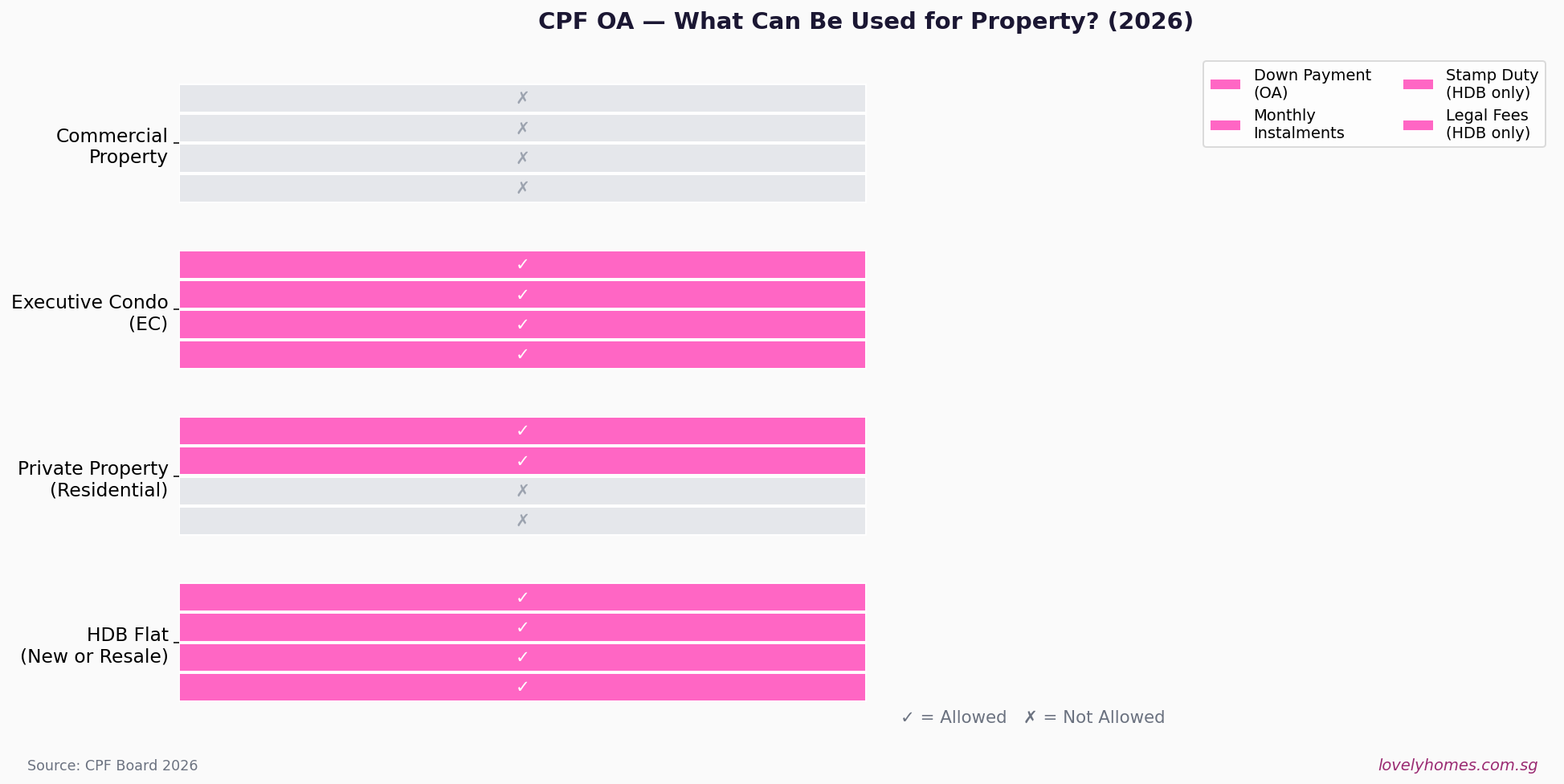
The CPF Board permits CPF OA to be used across several components of a residential property purchase, subject to the property type and eligibility conditions:

CPF OA uses for property types Singapore 2026 chart
Click image to enlarge
Figure 1: CPF OA — permitted uses by property type (2026). Source: CPF Board.

For HDB flats (new BTO and resale) and Executive Condominiums (ECs), CPF OA may be used for: the down payment (above the minimum 5% cash for bank loans), monthly mortgage instalments, Buyer’s Stamp Duty and Additional Buyer’s Stamp Duty, legal and conveyancing fees on HDB purchases, and Home Protection Scheme (HPS) premiums (compulsory for HDB flats financed with CPF).

For private residential property, CPF OA covers: the down payment (above minimum 5% cash) and monthly mortgage instalments. It cannot be used for stamp duties or legal fees on private property purchases — these must be paid in cash.

For commercial or industrial property, CPF OA cannot be used at all, regardless of the property’s remaining lease or valuation. If you purchase a shophouse with a residential component, the CPF usage rules are assessed based on the residential portion of the valuation only.

The Valuation Limit and Withdrawal Limit Explained

For private residential property, two CPF Board concepts govern the maximum CPF OA you may withdraw: the Valuation Limit (VL) and the Withdrawal Limit (WL).

The Valuation Limit is the lower of the property’s purchase price or its market valuation at the time of purchase. If you buy a condo for S$1.2 million and the CPF Board-accepted valuation is S$1.15 million, your VL is S$1.15 million. CPF OA withdrawals for down payment plus monthly instalments are first allowed up to the VL.

The Withdrawal Limit is the maximum total CPF OA that may be withdrawn for a property, set at 120% of the VL for properties with a remaining lease of at least 60 years. This means you may continue drawing CPF OA for monthly instalments beyond the initial VL — up to 120% of VL — provided your CPF OA balance is sufficient and the property’s remaining lease meets the requirement.

For HDB flats, there is no VL or WL cap. CPF OA (together with CPF housing grants) may be used throughout the loan tenure to service the HDB Concessionary Loan or a bank loan taken for an HDB flat, without a ceiling tied to the flat’s valuation.

Rule HDB Flat EC Private Residential
Valuation Limit None None Lower of price / valuation
Withdrawal Limit None None 120% of VL (≥60 yr lease)
CPF for Down Payment ✓ (above 5% cash min)
CPF for Monthly Instalments ✓ (up to WL)
CPF for Stamp Duty / Legal ✗ (cash only)

CPF Accrued Interest: What It Is and Why It Matters

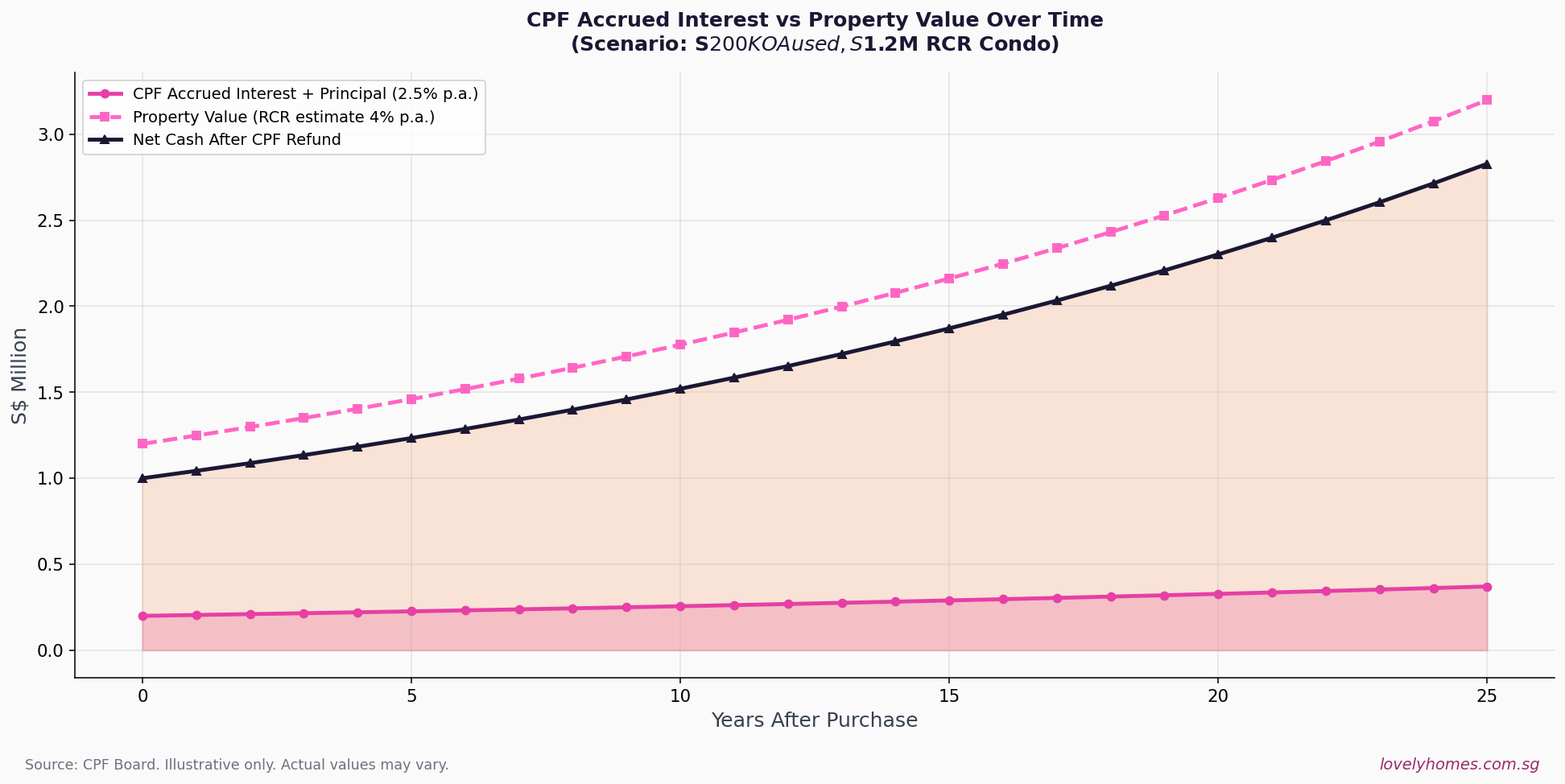
This is the most frequently misunderstood aspect of using CPF for property. When you withdraw CPF OA savings for housing — whether for a down payment or for monthly instalments — the CPF Board continues to charge interest at 2.5% per annum on those amounts as if they had remained in your OA. This notional interest is called accrued interest.

The accrued interest is not deducted from any account during the loan tenure — it accumulates silently. However, when you sell the property, you are required to refund into your CPF OA account: (a) the total principal amount withdrawn, plus (b) all the accrued interest accumulated from the date of each withdrawal to the date of refund. Only after this CPF refund can you access any remaining cash proceeds from the sale.

The practical implication is significant: the longer you hold the property, the larger the CPF refund obligation, which directly reduces your net cash from the sale. If property values have not risen sufficiently to outpace both the CPF accrued interest and the loan repayment, you may find yourself with less cash after the sale than expected — or even needing to top up in cash if sale proceeds are insufficient to fully cover the CPF refund and the outstanding mortgage.

CPF accrued interest vs property value over time Singapore line chart
Click image to enlarge
Figure 2: CPF accrued interest vs property value over time — illustrative scenario using S$200K CPF OA, S$1.2M RCR condo. Source: CPF Board; illustrative only.

Short-Lease Property: CPF Usage Restrictions

Singapore has a significant stock of older Housing and Development Board flats and private leasehold properties with relatively short remaining lease terms. The CPF Board applies a tiered framework to govern CPF use for these assets, designed to protect buyers from using retirement savings on properties that will have little residual value by the time of retirement.

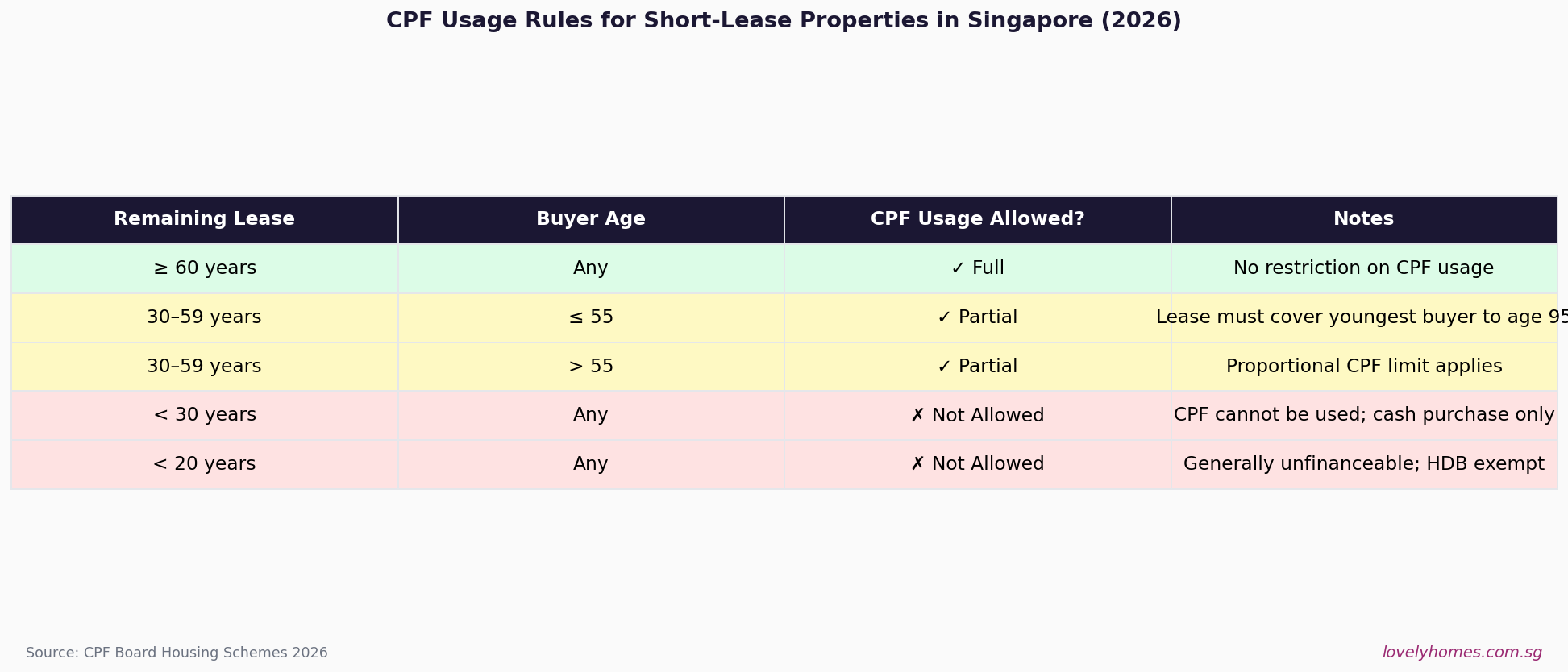
CPF usage rules short lease property Singapore 2026 table
Click image to enlarge
Figure 3: CPF OA usage rules for short-lease properties in Singapore (2026). Source: CPF Board.

The key rule for properties with a remaining lease of 30 to 59 years: CPF may be used, but only up to a proportional limit. Specifically, the remaining lease at the time of purchase must be long enough to cover the youngest buyer to at least age 95. If a 40-year-old buyer purchases a flat with 52 years remaining, the lease covers them to age 92 — which falls below the age-95 threshold, so CPF usage would be restricted proportionally. The formula compares the “lease coverage years” against the loan tenure and buyer’s age to compute the allowed CPF fraction.

For properties with fewer than 30 years of remaining lease, CPF OA cannot be used at all. These properties must be purchased entirely with cash and any bank loan that the lender is willing to offer (banks are generally also reluctant to lend on very short-lease properties). For HDB flats, additional restrictions apply under HDB’s own rules for resale flats with short remaining lease — HDB may refuse to grant a loan for certain short-lease flats, and some may not qualify for specific grants.

CPF Refund on Sale: What Happens When You Sell?

When a property is sold, the sequence of financial flows is: (1) conveyancing solicitors settle the outstanding mortgage from sale proceeds; (2) the remaining proceeds are used to refund the CPF OA for the full principal withdrawn plus all accrued interest; (3) any balance after these two obligations is paid to the seller as cash proceeds.

If the sale proceeds are insufficient to cover both the outstanding mortgage and the full CPF refund — for example, if the property was sold at a loss or at a price insufficient to cover both obligations — the CPF refund is made from sale proceeds up to the amount available. The buyer is not required to top up the shortfall in CPF from personal cash in most cases (there is no forced CPF top-up from personal savings). However, the CPF Board may impose conditions if the shortfall is significant or if there has been a voluntary reduction in selling price.

The practical implication for property investors and upgraders is that the CPF accrued interest must be factored into any net-of-cost property return calculation. A condo purchased for S$1.2M and sold for S$1.5M represents a gross gain of S$300,000 — but if CPF accrued interest of S$180,000 is outstanding and the mortgage payoff is S$600,000, the net cash in hand is only S$720,000 before transaction costs, not the apparent S$900,000 (S$1.5M minus S$600,000 loan).

Worked Example: Mr Wong’s Private Condo Purchase

Mr Wong (SC, age 35) purchases a private condo in the Outside Central Region (OCR) for S$1,200,000. The property is a 99-year leasehold unit; at purchase, 92 years of lease remain — well above the 60-year minimum for full CPF and WL access.

Financing structure:

  • Purchase price: S$1,200,000
  • Down payment (25%): S$300,000
    • Minimum cash (5%): S$60,000 cash
    • CPF OA (balance of 20%): S$240,000 from OA
  • Bank loan (75% LTV): S$900,000 at 3.3% p.a. over 25 years
  • Buyer’s Stamp Duty (BSD): (1%×S$180K)+(2%×S$180K)+(3%×S$640K)+(4%×S$200K) = S$1,800+S$3,600+S$19,200+S$8,000 = S$32,600 cash
  • Legal and conveyancing fees: approx S$5,500 (cash)
  • ABSD: S$0 (SC, 1st property)

CPF accrued interest projection:

  • CPF OA withdrawn at purchase: S$240,000
  • Accrued interest after 10 years (2.5% p.a. compound): S$240,000 × (1.02510 − 1) ≈ S$67,200
  • Total CPF refund obligation at year 10: S$240,000 + S$67,200 = S$307,200

If sold after 10 years (estimated property value at 4% p.a. appreciation):

  • Estimated sale price: S$1,200,000 × 1.0410S$1,776,000
  • Outstanding mortgage at year 10 (principal remaining): approx S$620,000
  • CPF refund obligation: S$307,200
  • Agent commission (1%, negotiable): approx S$17,760
  • Estimated net cash proceeds: S$1,776,000 − S$620,000 − S$307,200 − S$17,760 ≈ S$831,000

Without factoring in the CPF refund, Mr Wong might have estimated his net proceeds at roughly S$1,138,000 — the difference of S$307,200 is the CPF accrued interest obligation that buyers often overlook. Planning for this obligation is essential for any exit strategy.

What This Means for Property Buyers in 2026

The CPF housing rules represent a deliberate policy balance: the CPF Board wants members to be able to use accumulated savings to fund housing — a primary wealth-building vehicle for most Singaporeans — while simultaneously protecting their retirement adequacy. The accrued interest mechanism and the short-lease restrictions both serve this dual objective.

For younger buyers, the CPF OA is a powerful tool that substantially reduces the cash outflow at purchase. For buyers approaching 55 — the age at which CPF rules transition to a retirement focus — the interplay between housing CPF usage and the Full Retirement Sum (FRS) becomes more complex. Members who have used significant CPF OA for housing may find that the refund on sale partially or fully replenishes their CPF accounts to support retirement, but this requires careful planning and should be discussed with a licensed financial adviser.

One frequently overlooked planning point: CPF OA accrues interest at 2.5% p.a. If your property appreciates at a rate meaningfully above 2.5% per annum, deploying CPF for housing is financially rational. If property appreciation is below this rate — a risk in shorter-lease or lower-demand properties — the CPF OA might have been better preserved in the account itself. This is not merely theoretical: older HDB flats in non-mature estates have at times seen stagnant resale prices even as CPF accrued interest compounds.

What Might Come Next

The CPF Board periodically reviews its housing rules to adapt to changing property market conditions and demographic shifts. Two areas that analysts have flagged as possible future policy review points are: (1) the age-95 short-lease threshold, which may be revisited if Singaporean life expectancy data warrants an upward revision; and (2) the Withdrawal Limit of 120% of VL for private property, which has remained unchanged since 2008. Any change would primarily affect buyers of older private leasehold condominiums and pre-war conservation properties with short remaining tenures. These remain speculative at this stage and are not confirmed policy directions.

Frequently Asked Questions

Can I use CPF OA to pay the stamp duty on a private property purchase?

No. For private residential property, CPF OA cannot be used to pay Buyer’s Stamp Duty (BSD), Additional Buyer’s Stamp Duty (ABSD), or legal and conveyancing fees. These must be paid in cash. For HDB flat purchases, CPF OA may be used for stamp duties and HDB-scale legal fees. This distinction is important when budgeting upfront cash requirements for a private purchase — BSD alone on a S$1.5 million condo is approximately S$44,600, which must be funded entirely from cash or available credit.

What happens to my CPF accrued interest if I sell the property at a loss?

If the property is sold at a price insufficient to cover both the outstanding mortgage and the full CPF refund (principal + accrued interest), the CPF refund is made up to the amount available from sale proceeds after settling the mortgage. You are generally not required to top up the shortfall from personal savings. However, you will not be able to retain any cash from the sale until the CPF refund is addressed, and if proceeds are insufficient for even the CPF refund, the CPF Board will receive what is available. This scenario underscores the importance of not overpaying for a property relative to its realistic resale value.

Can I use CPF OA to buy a property for my parents or children?

No. CPF OA may only be used to purchase property for your own residential occupation (or co-purchaser’s occupation). You cannot use your CPF to fund a property in which you will have no beneficial ownership or right to reside. However, you may co-purchase a property together with your parents or children as co-owners, in which case each co-owner’s CPF OA may be used up to their respective ownership share of the Valuation Limit and Withdrawal Limit. All co-owners must comply with their individual CPF eligibility rules.

Does the Withdrawal Limit apply to HDB flats as well?

No. The Valuation Limit and Withdrawal Limit framework applies to private residential property only. For HDB flats — new BTO, resale, and Executive Condominiums purchased from HDB-approved developers — there is no cap on the total CPF OA that may be withdrawn relative to the flat’s valuation. CPF OA (together with housing grants credited to CPF) may be used throughout the loan tenure without reaching a WL ceiling, provided the flat’s remaining lease and other eligibility criteria are met. This is one of the key advantages of HDB flat financing relative to private property.

Can I use my CPF OA for a second property purchase?

Yes, subject to conditions. CPF OA may be used for a second residential property, but the CPF Board requires that you first set aside the prevailing Basic Retirement Sum (BRS) in your CPF accounts before applying CPF OA savings to a second property. For 2026, the BRS is S$102,900 (indexed annually). This means buyers approaching retirement age who have not yet met the BRS may find their CPF OA usage for a second property significantly restricted. You should check your CPF balance against the BRS before committing to a second-property purchase strategy that relies on CPF OA.

How do I calculate the CPF refund I will owe on sale?

The CPF Board provides an online CPF Property Withdrawal Calculator on its website (cpf.gov.sg). Alternatively, you can estimate it as follows: for each CPF OA withdrawal (down payment tranche and each monthly instalment drawn via CPF), add 2.5% compound interest from the date of withdrawal to the date of sale. The sum of all these amounts (principal + accrued interest) is your total CPF refund obligation. Your conveyancing solicitor will obtain the precise figure from CPF Board during the sale process. It is prudent to model this refund when deciding whether to upgrade, downsize, or liquidate a property investment.

Related Articles

Disclaimer: This article is produced for general informational and educational purposes only. It does not constitute financial, legal, or property advice. CPF housing rules, withdrawal limits, accrued interest rates, retirement sum figures, and related policies are set and periodically reviewed by the CPF Board, the Ministry of Manpower, MAS, and the Ministry of Finance. All figures, rates, examples and calculations are illustrative and based on information available as at 2 August 2026. Readers should verify current rules directly with the CPF Board, HDB, IRAS, MAS, and URA, and obtain advice from a licensed financial adviser and conveyancing solicitor before making any property or CPF decision.

Translate »