Singapore HDB Downsizing Guide 2026: How to Rightsize and Unlock Cash from Your Flat

Singapore HDB Downsizing Guide 2026: How to Rightsize and Unlock Cash from Your Flat

Quick Answer: HDB Downsizing in Singapore 2026

  • You may sell your HDB flat once the Minimum Occupation Period (MOP) is met — 5 years for Standard flats, 10 years for Plus and Prime flats.
  • Sale proceeds after repaying your HDB or bank loan and refunding CPF with accrued interest form your net cash proceeds.
  • Buying a smaller HDB resale flat as your only property incurs no ABSD for Singapore Citizens; Permanent Residents pay 5% on the first property.
  • Buying private property instead: SCs pay 0% ABSD on the first private purchase but must sell the HDB within 6 months (if still held).
  • CPF accrued interest — the HDB concessionary rate of 2.6% p.a. compounded — significantly reduces your net cash; plan ahead.
  • The Ethnic Integration Policy (EIP) and Singapore Permanent Resident (SPR) quota may limit your pool of eligible buyers in some estates.
  • Sellers bear agent commission of ~1–2% of sale price, legal and HDB admin fees of approximately S$3,000–S$5,000.
  • A retirement-minded downsize — selling a 5-room and buying a 3-room — can free S$200,000–S$400,000 in cash depending on town, storey, and loan balance.

What Does Downsizing Your HDB Mean?

HDB downsizing — also called rightsizing — refers to the deliberate decision to sell a larger HDB flat and purchase a smaller or less expensive property once you no longer need the space. It is one of Singapore’s most practical wealth-unlocking strategies for older homeowners, and the Housing and Development Board (HDB) actively encourages it through the Silver Housing Bonus and the Lease Buyback Scheme for eligible seniors.

The motivation varies: adult children have moved out, retirement is approaching, the family needs liquidity, or parents simply want to trade a 5-room flat in a mature estate for a 3-room near their children. Whatever the reason, the mechanics are the same: sell the HDB flat at market value, repay all outstanding obligations, then deploy the net proceeds toward your next home or retirement plan.

HDB resale prices hit record highs in 2025–2026, with median prices for 5-room flats in popular estates like Bishan, Queenstown, and Toa Payoh routinely exceeding S$800,000. This price environment makes downsizing financially attractive for many households that bought their flats in the 2000s at a fraction of today’s valuations.

HDB flat types market prices 2026 BTO vs resale grouped bar chart
Figure 1: HDB flat types — approximate median market prices in 2026, comparing BTO subsidised prices against resale open market values. Source: HDB, URA (indicative; actual prices vary by town, storey, and condition).

Who Can Sell and Who Can Buy Your HDB Flat?

Before you can sell, you must have fulfilled the Minimum Occupation Period (MOP). For flats classified as Standard (the majority of existing stock), MOP is five years from the date the keys were collected. For newer Plus and Prime flats launched from the August 2023 classification exercise onwards, MOP is ten years and is accompanied by an income ceiling and a subsidy clawback on resale — factors that will depress the resale market for those specific flats when they eventually transact.

Buyers of your HDB flat must meet HDB’s eligibility criteria: they must form a valid family nucleus or qualify under one of the single-buyer schemes, and they must satisfy the prevailing income ceiling (S$14,000 per month for families, or S$7,000 for singles buying a 2- or 3-room flat). This narrows your buyer pool compared to the open private market, though mature-estate flats near MRT stations tend to attract strong demand regardless.

The Ethnic Integration Policy (EIP) further constrains your buyer pool. Each block and neighbourhood has ethnic quotas for Chinese, Malay, and Indian/Other buyers. If the Chinese quota in your block is already full, you can only sell to a non-Chinese buyer — which may lengthen your marketing period or push your achieved price below valuations. Check your flat’s EIP status on the HDB website before setting a price.

Eligibility Factor Requirement Where to Check
MOP 5 years (Standard); 10 years (Plus/Prime) HDB My Flat Dashboard
Outstanding loan Must repay in full at completion HDB loan statement
CPF refund Principal drawn + 2.6% p.a. accrued interest must be refunded to CPF OA CPF website — property withdrawal history
EIP / SPR quota Check block/neighbourhood quota before listing HDB Resale Portal
Buyer eligibility Valid family nucleus; income ceiling S$14k family / S$7k single HDB Resale Portal — Check Eligibility
Flat condition Must not be under outstanding HDB infringement orders HDB My Flat Details

Understanding CPF Accrued Interest: The Silent Cost of Downsizing

Many sellers are surprised to learn that the CPF they withdraw for housing must be refunded with interest when the flat is sold. The interest rate applied is HDB’s concessionary rate of 2.6% per annum, compounded annually — the same rate used for HDB loans. This accrued interest accumulates from the date each CPF withdrawal is made, meaning a S$180,000 CPF withdrawal made ten years ago could carry roughly S$52,000 in accrued interest by the time of sale, requiring a total refund of approximately S$232,000.

The CPF refund goes back into your CPF Ordinary Account, where it earns 2.5%–3.5% interest. If you intend to use CPF again for your next purchase, the refunded amount is immediately available. If you are at or near retirement, the refund may trigger the Basic Retirement Sum (BRS) top-up rule, redirecting some OA funds into your Retirement Account.

Importantly, the CPF refund is not optional. HDB or your conveyancing lawyer will handle the refund automatically at completion. Your net cash proceeds are therefore: Sale Price − Outstanding Loan − CPF Principal − CPF Accrued Interest − Agent Commission − Legal Fees.

HDB downsizing cash proceeds waterfall 5-room resale S740k Singapore 2026
Figure 2: Illustrative cash-proceeds waterfall for a 5-room HDB resale at S$740,000 — showing loan repayment, CPF refund (principal + accrued interest), agent commission, and net cash. Actual figures depend on individual circumstances.

What Are Your Options After Selling?

Once you have your net cash proceeds, you face a strategic choice that is as much about lifestyle as it is about finances.

Buy a smaller HDB resale flat — A 3-room flat in a mature estate costs S$380,000–S$500,000 and carries no ABSD for Singapore Citizens purchasing their only property. You can finance it with an HDB loan (if you have not previously taken two HDB loans) or a bank loan, and use your CPF OA balance and cash proceeds for the purchase. This is the most common rightsizing path for older Singaporeans who wish to remain in the HDB system.

Buy OCR private condo — If your net proceeds are substantial enough, some downsizers use the freed cash as a down payment on an Outside Central Region (OCR) private condominium. A Singapore Citizen buying private property for the first time pays zero ABSD. However, if you still hold the HDB flat when exercising the private option, you are technically owning two properties and incur ABSD — you have six months from the private completion date to sell the HDB to claim an ABSD refund (subject to conditions).

Rent and invest — Some downsizers sell the HDB flat, move into a rental property, and invest the proceeds in diversified assets (unit trusts, Singapore Savings Bonds, REITs). This preserves flexibility, particularly for those uncertain about their long-term location or care needs.

Silver Housing Bonus — If you are aged 55 or above and are downsizing to a shorter-lease or 3-room (or smaller) flat, the Silver Housing Bonus provides a cash bonus of up to S$30,000 when you top up your CPF Retirement Account with at least S$60,000 from your sale proceeds. Eligible couples may each receive up to S$30,000.

Lease Buyback Scheme — For seniors aged 65 and above in a 3-room or smaller flat, the Lease Buyback Scheme allows you to sell the tail end of your flat’s lease back to HDB in exchange for cash plus CPF RA top-up, while continuing to live in the flat. This is not downsizing per se, but it serves a similar liquidity-release purpose without the disruption of moving.

Post-downsizing options Singapore HDB cash proceeds vs requirements 2026
Figure 3: Post-downsizing options compared — cash proceeds available from an illustrative 5-room sale (S$428.6k net) versus additional cash required for each pathway. Figures are illustrative; ABSD applies to second or subsequent property purchases.

Worked Example: The Tan Family’s Downsizing Journey

Scenario: Mr and Mrs Tan, both Singapore Citizens, purchased their 5-room HDB flat in Bishan in October 2016 for S$430,000 using an HDB loan. They have three adult children, all of whom have their own homes. The Tans retire in 2026 and decide to rightsize to a 3-room flat in Toa Payoh.

Their 5-room flat (selling):
• Sale price achieved: S$740,000
• Outstanding HDB loan: S$80,000
• CPF OA withdrawn over 9+ years: S$180,000 principal + S$42,000 accrued interest = S$222,000 CPF refund
• Agent commission (1%): S$7,400
• Legal and admin fees: S$4,000
Net cash proceeds: S$740,000 − S$80,000 − S$222,000 − S$7,400 − S$4,000 = S$426,600

Their 3-room flat in Toa Payoh (buying):
• Purchase price: S$450,000
• Buyer’s stamp duty (BSD): 1% × S$180k + 2% × S$180k + 3% × S$90k = S$1,800 + S$3,600 + S$2,700 = S$8,100
• ABSD: S$0 (SC buying only property)
• CPF OA available after refund: S$222,000
• CPF used for new flat: S$222,000
• Cash needed: S$450,000 + S$8,100 − S$222,000 = S$236,100
• Paid from proceeds: S$236,100
Cash remaining after new purchase: S$426,600 − S$236,100 = S$190,500

The Tans emerge with S$190,500 in cash and a fully paid (CPF-financed) 3-room flat — a meaningful retirement cushion achieved by simply rightsizing their home.

Stamp Duty: BSD and ABSD Implications When Downsizing

Selling your HDB flat itself does not attract stamp duty for the seller — Seller’s Stamp Duty (SSD) only applies if you sell within three years of purchase, and most downsizers are well past that window. When you buy your replacement property, Buyer’s Stamp Duty (BSD) and Additional Buyer’s Stamp Duty (ABSD) apply on the normal tiered schedules.

Buyer Profile ABSD on 1st Property ABSD on 2nd Property BSD (all buyers)
Singapore Citizen 0% 20% 1–6% tiered
Singapore PR 5% 30% 1–6% tiered
Foreigner 60% 60% 1–6% tiered
Entity (company/trust) 65% 65% 1–6% tiered

Key BSD tiers (effective 15 Feb 2023): 1% on first S$180,000; 2% on next S$180,000; 3% on next S$640,000; 4% on next S$500,000; 5% on next S$1,500,000; 6% on amount exceeding S$3,000,000.

The critical timing rule: if you buy a private property and still hold your HDB flat at the time of private completion, you are temporarily holding two properties. ABSD of 20% (SC) applies immediately on the private purchase. You may apply for an ABSD refund if you sell the HDB within six months of the private property’s completion date (or six months from the date the HDB OTP is exercised, if that is earlier). The refund application must be made within six months of meeting the condition.

What Does This Mean for Downsizers?

Singapore’s property market in 2026 remains one of the most expensive in Asia, but also one of the most orderly — HDB prices have appreciated substantially since the 2020s cooling measures without the volatility seen in less regulated markets. For older homeowners who bought at 2010–2015 prices, the uplift has created genuine wealth: a Queenstown 5-room flat that cost S$380,000 in 2012 regularly transacts at S$850,000–S$950,000 today.

This appreciation means downsizing is genuinely capable of releasing retirement capital rather than merely reshuffling debt. Combine the net cash with CPF Life payouts and medisave, and a rightsized household often has more financial security in retirement than they did during their working years.

The friction points — CPF accrued interest, EIP quotas, ABSD if buying private — are real but manageable with proper sequencing. The recommended order is: (1) confirm MOP is met; (2) obtain HDB resale valuation; (3) check CPF accrued interest amount; (4) model net proceeds; (5) identify replacement property; (6) apply for HDB resale Intent to Sell; (7) obtain OTP from replacement property; (8) sell HDB flat.

What Might Come Next for HDB Downsizing Policy

HDB periodically reviews schemes to support older Singaporeans in aging in place or rightsizing. The Silver Housing Bonus payout has been enhanced several times since its 2013 introduction, and further enhancements to its income ceiling and bonus quantum are plausible as Singapore’s population ages. There is active policy debate around simplifying the CPF accrued interest mechanism for elderly sellers, as the current compounding structure can significantly erode net proceeds for long-term occupants.

The Plus and Prime classification — introduced in August 2023 — will create a two-tier resale market when those flats exit MOP between 2028 and 2033. Their subsidy clawback mechanism means sellers of Plus/Prime flats will net less than sellers of equivalent Standard flats, a factor buyers and town planners will need to internalise in the coming years. This is speculative commentary and not confirmed government policy.

Frequently Asked Questions

Do I have to sell my HDB flat before buying private property?

No — you can buy private property first and sell your HDB flat within six months of private completion. However, you will pay ABSD (20% for SC, 30% for PR) on the private purchase upfront, and must apply for a refund after selling the HDB. The refund process typically takes 3–6 months. If you prefer to avoid the upfront ABSD outlay, sell the HDB first, then buy private — but you will need interim rental accommodation. Most downsizers opt for an HDB-first, private-second sequence to avoid the ABSD cash outlay.

How much CPF accrued interest will I owe on my HDB flat?

Log into the CPF website (my.cpf.gov.sg) under “My Statements → Property”. You will see the exact CPF principal withdrawn and the accrued interest to date, calculated at 2.6% p.a. compounded. The CPF Board also provides a CPF Property Withdrawal Calculator. As a rough guide: S$200,000 withdrawn 10 years ago accumulates approximately S$58,000 in accrued interest, requiring a total refund of S$258,000.

Can I use CPF to buy my smaller replacement flat after downsizing?

Yes. The CPF that is refunded to your Ordinary Account when you sell the HDB flat is immediately available for use in your next property purchase, subject to CPF OA limits (Valuation Limit and Withdrawal Limit for the new flat). If you are 55 or older, some of the refund may be directed to your Retirement Account first if it is below the Basic Retirement Sum.

Is there a minimum flat size I must buy when downsizing?

No minimum flat size is mandated by HDB for downsizing. You may buy a 2-room Flexi flat, a 3-room resale flat, or even a studio apartment in the private market. The only relevant constraint is your eligibility under HDB’s purchase schemes (you must form a valid family nucleus or qualify under single-buyer rules) and your financial assessment (MSR 30% and TDSR 55% for any loan component).

What is the Silver Housing Bonus and who qualifies?

The Silver Housing Bonus (SHB) is an HDB scheme for Singapore Citizens aged 55 and above who downsize to a shorter-lease or smaller flat (3-room or smaller, or a 2-room Flexi flat with 30-year lease or shorter). Eligible sellers receive a cash bonus of up to S$30,000 per eligible owner (maximum S$30,000 per household) when they top up their CPF Retirement Account with at least S$60,000 from their flat-sale proceeds. The SHB is not available for all downsizing scenarios — check HDB’s eligibility conditions on hdb.gov.sg.

Will EIP or SPR quotas affect my ability to sell?

Potentially, yes. If your flat’s block or neighbourhood has already met the ethnic or SPR quota, only buyers of the eligible ethnic group or citizenship status can purchase your unit. This does not prevent sale altogether but may reduce your pool of eligible buyers, lengthen the marketing timeline, or — in extreme cases — cause you to accept a lower offer. You can check your flat’s EIP and SPR quota status on the HDB Resale Portal before listing.

Are there tax implications from the sale of my HDB flat?

Capital gains from property are not taxed in Singapore. The profit you make from selling your HDB flat is entirely tax-free. Stamp duties (BSD/ABSD) apply only on the purchase of a new property, not on the sale. The exception is Seller’s Stamp Duty (SSD), which applies if you sell within three years of the date of purchase — but virtually all downsizers are well past this window. Rental income received if you sublet your flat while searching for a new home is taxable as personal income and must be declared in your IRAS tax return.

Related Articles

Disclaimer

This article is for general information and educational purposes only. It does not constitute financial, legal, or property advice. Singapore property taxes, CPF rules, HDB eligibility criteria, and stamp duty rates are subject to change. All figures, prices, and examples are illustrative and based on information available as of August 2026. Readers should verify current rates and eligibility conditions directly with HDB (hdb.gov.sg), IRAS (iras.gov.sg), the CPF Board (cpf.gov.sg), and URA (ura.gov.sg), and consult a licensed property agent, conveyancing solicitor, and/or financial adviser before making any property transaction or financial decision.

Singapore HDB Resale Procedure Guide 2026: Step-by-Step for Buyers and Sellers

Singapore HDB Resale Procedure Guide 2026: Step-by-Step for Buyers and Sellers

Quick Answer: HDB Resale in 2026 — Key Points at a Glance

  • Who can buy: Singapore Citizens (SC) and Permanent Residents (SPR) who form an eligible family nucleus. At least one applicant must be SC for most schemes. No private property ownership within 30 months.
  • 10-step process: From eligibility check through key collection, the full process typically spans 3–4 months after the Option to Purchase (OTP) is granted.
  • OTP mechanics: Seller grants the OTP upon receiving a 1% option fee (cash). Buyer has 21 calendar days to exercise it by paying an additional 4%. Total deposit = 5% of purchase price.
  • Stamp duty deadlines: Buyer’s Stamp Duty (BSD) and any Additional Buyer’s Stamp Duty (ABSD) must be paid within 14 days of exercising the OTP.
  • Cash Over Valuation (COV): If the agreed price exceeds HDB’s assessed value, the difference is COV — payable entirely in cash. CPF and loans cannot cover COV.
  • Application window: Both buyer and seller must submit their resale applications via the HDB Flat Portal within 7 days of OTP exercise. HDB approval takes approximately 8 weeks.
  • HDB loan income ceiling: S$14,000/month for families. Above this, buyers must take a bank loan.

What is an HDB Resale Flat — and Who Oversees the Process?

An HDB resale flat is a public housing unit sold by an existing owner on the open market, as opposed to a Build-To-Order (BTO) flat purchased directly from the Housing and Development Board at a subsidised price. Resale flats offer immediate or near-term occupation (subject to the 3–4 month processing period), access to more established locations, and a wider choice of unit types — including larger flat sizes such as 5-room and executive flats that are rarely available in new BTO exercises.

The Housing and Development Board (HDB) administers buyer and seller eligibility, the Minimum Occupation Period (MOP), the resale application and approval process, and housing loan eligibility. The Inland Revenue Authority of Singapore (IRAS) collects Buyer’s Stamp Duty and Additional Buyer’s Stamp Duty. The Council for Estate Agencies (CEA) licenses and regulates property agents involved in the transaction. The Central Provident Fund (CPF) Board oversees the use of CPF Ordinary Account (OA) savings for the purchase price and, in some cases, for monthly loan repayments.

Understanding which body governs which step — and the strict deadlines attached to each — is the foundation of a smooth HDB resale transaction.

Singapore HDB resale procedure 2026 10-step process overview infographic
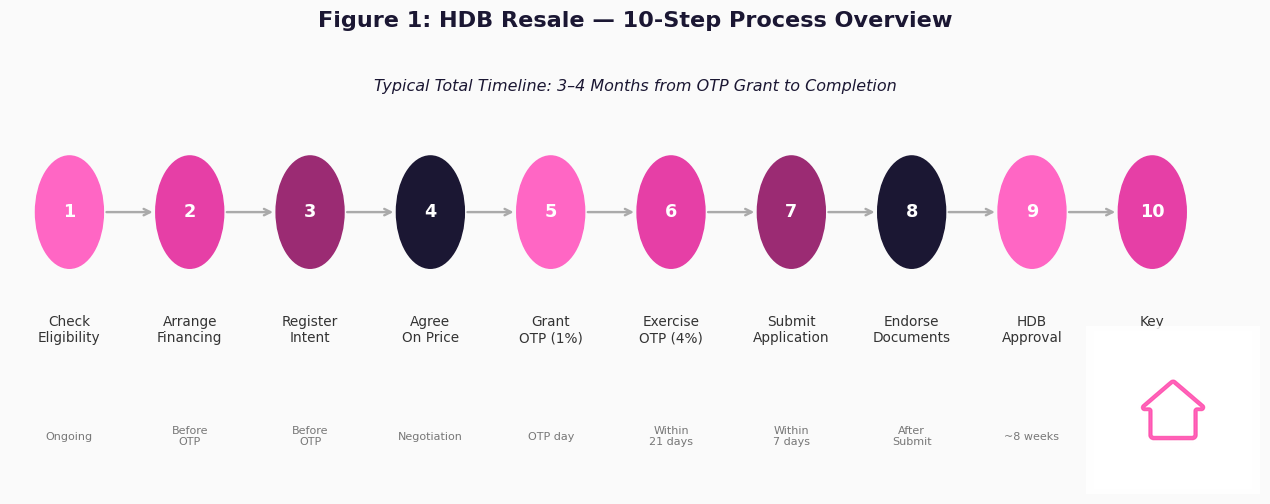
Figure 1: The HDB resale procedure involves 10 distinct steps from eligibility check to key collection, typically spanning 3–4 months from OTP grant to completion. Source: HDB, lovelyhomes.com.sg.

Eligibility Requirements for HDB Resale

Before proceeding, both buyers and sellers must confirm their eligibility under HDB’s framework. Sellers must have satisfied the five-year Minimum Occupation Period (MOP) before listing a flat that was purchased directly from HDB or under a resale grant. Buyers must meet citizenship, family nucleus, and (if using an HDB loan) income ceiling requirements.

Citizenship: At least one buyer must be a Singapore Citizen. SPR families may purchase resale flats but receive no priority in newer BTO exercises. Single Singapore Citizens aged 35 and above may purchase 2-room Flexi flats under the Single Singapore Citizen Scheme, or 5-room and smaller resale flats in non-mature estates in certain conditions.

Family nucleus: Acceptable family nuclei include married or engaged couples, parent-and-child families, children orphaned before 35, and the Joint Singles Scheme (two eligible SC singles aged 35+). The family nucleus requirement ensures public housing reaches genuine households.

Income ceiling for HDB housing loan: S$14,000/month combined gross income for families; S$7,000 for singles. If household income exceeds the applicable ceiling, you must finance your purchase with a bank loan. There is no income ceiling simply to buy a resale flat — the ceiling only triggers when applying for an HDB concessionary loan or certain CPF Housing Grants.

Property ownership restriction: Buyers must not own any private residential property (local or overseas) at the time of application, and must not have disposed of any private property within 30 months before the resale application date.

HFE Letter: If you intend to use an HDB housing loan or CPF Housing Grants, you must obtain a valid HDB Flat Eligibility (HFE) letter before the OTP stage. Apply via the HDB Flat Portal at hdb.gov.sg. The HFE letter confirms your eligibility, the loan quantum you qualify for, and any grants you are entitled to.

Step-by-Step: The 10-Stage HDB Resale Process

The HDB resale process unfolds across ten distinct stages, each with its own actors, documents, and deadlines. Buyers and sellers typically engage separate law firms and, optionally, CEA-registered property agents to navigate the process.

Step 1 — Check eligibility. Use HDB’s eligibility checker and apply for your HFE letter if you plan to use an HDB loan or grants. This step should be completed well before you start viewing flats.

Step 2 — Arrange financing. Obtain an HFE letter (for HDB loan) or an In-Principle Approval (IPA) from a bank. The IPA indicates how much the bank is prepared to lend and at what indicative rate. Having pre-approved financing strengthens your negotiating position.

Step 3 — Register intent on HDB Flat Portal. Sellers register their intent to sell; buyers register their intent to buy. This activates the resale portal for your transaction and confirms that both parties are eligible to proceed.

Step 4 — Negotiate and agree on price. Buyer and seller negotiate the transaction price. Check recent resale transaction data via HDB’s Resale Statistics and URA’s REALIS portal (ura.gov.sg) to benchmark the price. Note that if the agreed price exceeds HDB’s valuation, the difference (COV) must be paid entirely in cash.

Step 5 — Seller grants the OTP. The seller issues the Option to Purchase and receives a 1% option fee from the buyer (minimum $1, maximum 1% of the agreed price). This fee is non-refundable if the buyer does not exercise the OTP.

Step 6 — Buyer exercises the OTP. Within 21 calendar days of the OTP date, the buyer pays an additional 4% of the agreed price to exercise the option. The total deposit (1% + 4% = 5%) is credited towards the purchase price at completion. If the buyer does not exercise, the 1% option fee is forfeited and the seller may proceed with other buyers.

Step 7 — Submit resale application. Within 7 days of exercising the OTP, both buyer and seller independently submit their portions of the resale application via the HDB Flat Portal. Required documents include identity documents, the OTP, HFE letter (buyer), and financial data.

Step 8 — Endorse resale documents. HDB issues the resale documents for endorsement, including the Certificate of Eligibility. Both parties (and their solicitors) review and sign the required documents.

Step 9 — HDB approval. HDB reviews the application and issues an approval notice, typically within approximately 8 weeks of submission. The approval notice contains the completion date.

Step 10 — Completion and key collection. On the scheduled completion date, the buyer pays the balance of the purchase price (using CPF OA and/or cash), legal fees are settled, and keys are handed over at HDB Hub or via a virtual appointment. The buyer becomes the registered owner upon completion.

HDB resale median prices by town Singapore H1 2026 4-room and 5-room flat bar chart
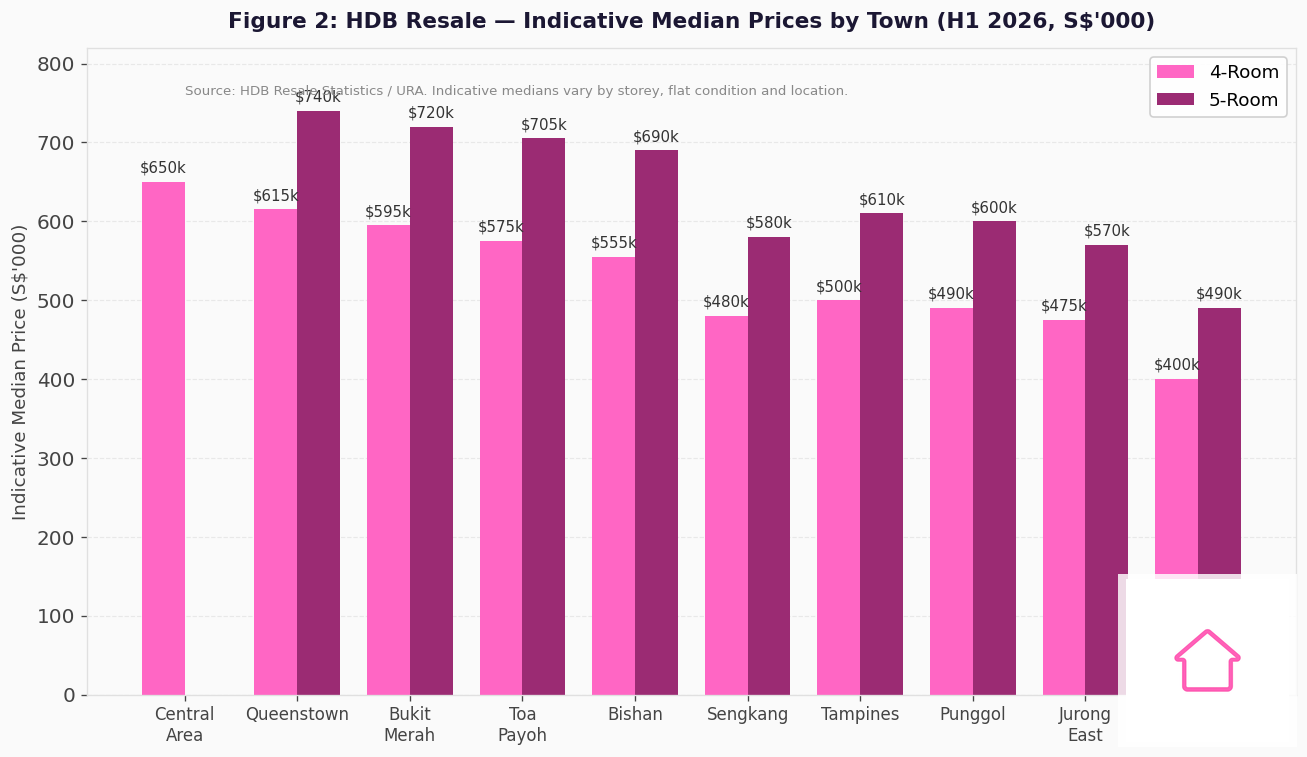
Figure 2: Indicative HDB resale median prices by town, H1 2026. Central-area and mature-estate flats command significant premiums. Figures are indicative and vary by storey, flat condition and exact location. Source: HDB Resale Statistics, lovelyhomes.com.sg.

Option to Purchase: Mechanics, Deadlines and Risks

The Option to Purchase is a legally binding contract that gives the buyer the exclusive right — but not the obligation — to purchase the flat at the agreed price within the option period. Understanding its mechanics is critical, as several major financial commitments are triggered by the OTP date.

1% option fee: Paid by the buyer to the seller upon grant of OTP. This sum is deducted from the purchase price at completion if the buyer proceeds. It is forfeited entirely if the buyer does not exercise.

21-day exercise window: The buyer has 21 calendar days from the OTP date to decide whether to proceed. This period allows time to finalise financing, conduct legal due diligence, and confirm CPF usage. Do not grant or exercise an OTP before securing your In-Principle Approval or HFE letter.

4% exercise fee: Paid when exercising the OTP. Combined with the 1% option fee, the buyer has now paid 5% of the purchase price as a deposit. This sum is credited towards the purchase price at completion.

7-day submission window: Within 7 days of OTP exercise, both buyer and seller must submit their portions of the resale application to HDB. Missing this deadline can delay the entire transaction and may require the parties to restart certain steps.

Stamp duty deadline: BSD (and ABSD, if applicable) must be paid to IRAS within 14 days of the OTP exercise date — not from completion. For a S$720,000 resale flat, BSD totals S$16,200. Penalties apply for late payment.

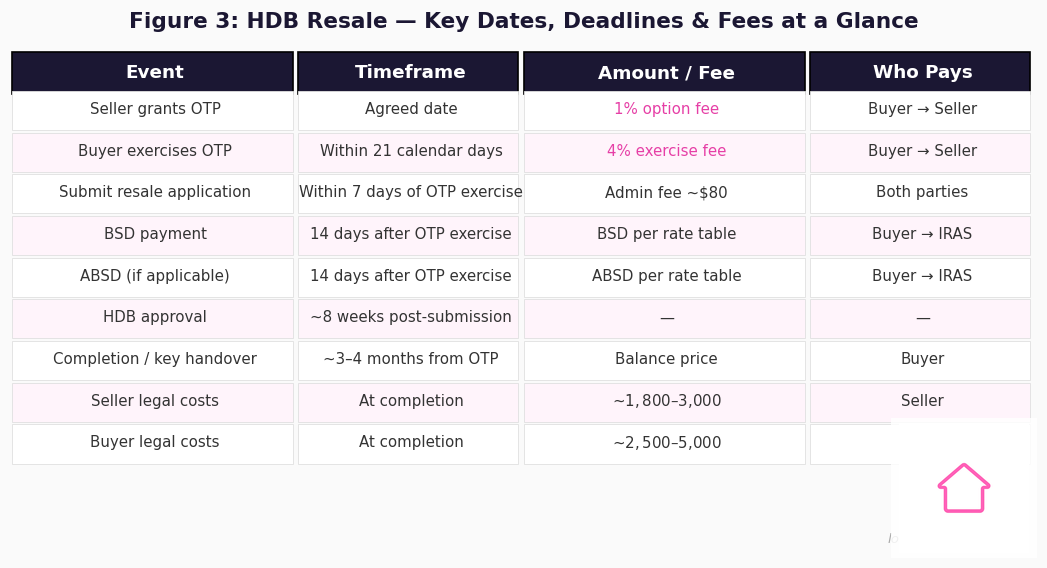
HDB resale OTP timeline key dates deadlines and fees at a glance table infographic
Figure 3: HDB resale key dates, deadlines, and fees from OTP grant through to completion. Source: HDB, IRAS, lovelyhomes.com.sg.

Stamp Duty, COV and Upfront Costs

Buyers of HDB resale flats are subject to Buyer’s Stamp Duty (BSD) on all properties and, depending on their citizenship status and number of properties owned, Additional Buyer’s Stamp Duty (ABSD).

BSD Tier (as at 3 August 2026) Rate BSD on S$720,000 Flat
First S$180,000 1% S$1,800
Next S$180,000 2% S$3,600
Next S$640,000 3% S$10,800 (on S$360k portion)
Total BSD (S$720,000 flat) S$16,200

ABSD rates in 2026: Singapore Citizens pay 0% ABSD on their first residential property, 20% on their second, and 30% on their third and beyond. Singapore Permanent Residents pay 5% on their first and 30% on their second. Foreigners pay 60% on all purchases. ABSD is calculated on the higher of the purchase price or market value, and must be paid within the same 14-day window as BSD.

Cash Over Valuation (COV): HDB conducts a valuation of the flat during the resale process. If the agreed transaction price exceeds this valuation, the difference is considered COV. COV cannot be financed by an HDB or bank loan, nor can it be paid using CPF OA savings. It must be paid entirely in cash. Buyers should factor COV risk into their cash-available calculation before entering into an OTP.

Financing Your HDB Resale Purchase

Buyers may finance an HDB resale flat using an HDB concessionary loan, a bank loan, or a combination of CPF savings and cash. The Mortgage Servicing Ratio (MSR) cap of 30% of gross monthly income applies to both HDB and bank loans for HDB flat purchases, limiting the maximum loan quantum. The Total Debt Servicing Ratio (TDSR) cap of 55% of gross monthly income also applies, covering all debt obligations.

HDB loan: Fixed interest rate of 2.6% per annum (0.1% above CPF Ordinary Account rate as at 2026). Maximum LTV is 80% of the lower of the purchase price or valuation. Requires an HFE letter. Allows flexible early repayment. Available only to SC and SPR buyers meeting income ceiling requirements.

Bank loan: Rates are typically SORA-based, currently ranging from approximately 3.0–4.0% per annum for typical packages in 2026. Maximum LTV is 75% for the first housing loan (50% for second, 35% for third and beyond). Requires an IPA from the bank. May offer more competitive rates in a low-rate environment but carries repricing risk.

Worked Example: The Lim Family Buying S$720,000 Queenstown Resale Flat

Profile: Mr & Mrs Lim, both Singapore Citizens, combined gross monthly income S$9,000. First residential property. Mr Lim aged 38, Mrs Lim aged 36.

Property: 5-room HDB resale flat, Queenstown. Agreed price: S$720,000. HDB valuation: S$710,000. COV = S$10,000.

BSD: 1% × S$180k = S$1,800 + 2% × S$180k = S$3,600 + 3% × S$360k = S$10,800 = S$16,200

ABSD: S$0 (first property, both SC)

HDB loan: 80% LTV = S$576,000 @ 2.6% p.a., 25-year tenure. Monthly repayment ≈ S$2,617. MSR check: S$2,617 ÷ S$9,000 = 29.1% < 30% ✓. TDSR check: S$2,617 ÷ S$9,000 = 29.1% < 55% ✓ (no other debts assumed).

Down payment: 20% × S$720k = S$144,000 (from CPF OA, assumed sufficient).

  • Day 0 (OTP grant): Cash option fee = S$7,200 (1%)
  • Day 21 (OTP exercise): Cash exercise fee = S$28,800 (4%)
  • Within 14 days of exercise: BSD S$16,200 + COV S$10,000 = S$26,200 (cash)
  • At completion: Remaining CPF OA used: S$144,000 − S$7,200 − S$28,800 = S$108,000. Legal fees: ~S$3,800 (cash). HDB loan S$576,000 disbursed directly to seller.

Total upfront cash required: approximately S$66,200 (S$7,200 + S$28,800 + S$26,200 + S$3,800 + S$300 for HDB admin). CPF OA covers the remaining S$108,000 of the down payment at completion.

Why the HDB Resale Market Matters in 2026

HDB resale prices have risen consistently since 2021, driven by supply constraints during the COVID-19 construction pause, strong upgrader demand from the large cohort of BTO buyers who completed their MOP, and a preference among buyers for larger, immediately available flats in established locations. The resale market serves a critical function: it provides housing for Singaporeans who need a home faster than BTO timelines allow, particularly newlyweds, growing families, and those with elderly parents nearby.

Industry figures show that resale median prices for 5-room flats in central areas now regularly breach the S$700,000 mark, with prime Queenstown and Bishan transactions exceeding S$800,000 for desirable units. For prospective buyers, this underscores the importance of understanding COV risk, having sufficient cash reserves, and calibrating loan quantum carefully against the MSR ceiling.

For sellers, the strong market represents an opportunity to realise significant appreciation — but proper understanding of CPF accrued interest (which must be returned to your CPF account upon sale) and outstanding loan balances is essential to accurately calculate net proceeds.

What Might Come Next for HDB Resale

Industry observers anticipate that HDB may introduce targeted policy refinements if resale flat prices for standard flat types in mature estates continue to trend above S$700,000 at the median. Potential measures discussed include extending the MOP for certain flat types, adjusting the CPF usage limits for older flats, or introducing enhanced grant frameworks to moderate demand in specific segments. The government has consistently stated that maintaining housing affordability is a key policy objective, and the full resale market cycle — including cooling measures — should be considered in long-term financial planning. These remain speculative; buyers should rely on current official policies at HDB and IRAS when transacting.

Frequently Asked Questions: HDB Resale Procedure 2026

Can Singapore Permanent Residents buy HDB resale flats?

Yes, Singapore Permanent Residents (SPRs) may purchase HDB resale flats, subject to forming an eligible family nucleus. A family comprising two SPRs (without an SC) may purchase a resale flat, though they are not eligible for the most favourable CPF Housing Grants, which are reserved for SC households. SPRs pay a higher ABSD rate (5% on first, 30% on second property) compared to SCs. Note that SPRs cannot buy BTO flats directly from HDB — only resale flats on the open market.

What happens if I miss the 7-day window to submit the resale application after exercising the OTP?

The 7-day submission window after OTP exercise is strictly enforced. If both parties fail to submit on time, the resale application cannot proceed under that OTP, and the transaction may need to restart with a new OTP. This effectively means the buyer forfeits the 5% deposit (1% + 4%) unless both parties agree to an extension and can justify the delay to HDB. Property agents and solicitors routinely track these deadlines; ensure your legal advisers are appointed before the OTP stage.

Can I use CPF Ordinary Account savings to pay the option fee and exercise fee?

No. The option fee (1%) and exercise fee (4%) paid at the OTP stage must be paid in cash. CPF OA savings can only be used at the completion stage — specifically to pay the down payment (above the loan quantum), partial BSD in some cases, and subsequent monthly loan repayments (subject to HDB or bank approval). This means you need at least 5% of the purchase price in cash available before entering into an OTP. For a S$720,000 flat, that is S$36,000 in cash, plus BSD and legal fees.

How is HDB’s valuation of a resale flat determined, and what if the market price is higher?

HDB engages a Certified Appraiser (registered with the Singapore Institute of Surveyors and Valuers) to conduct a market valuation of the flat, typically shortly after the resale application is submitted. The valuation is based on comparable transactions, flat condition, storey, and location. If the agreed price exceeds the valuation, the difference is Cash Over Valuation (COV) — the buyer must pay this entirely in cash (no CPF, no loan). Sellers typically price above valuation in a strong market; buyers who cannot accommodate COV may need to negotiate the price down to valuation or seek a flat where the transaction price matches or falls below the assessed value.

What is the difference between an HDB resale flat and a Design, Build and Sell Scheme (DBSS) flat?

Design, Build and Sell Scheme (DBSS) flats were a now-discontinued category of public housing developed by private developers but sold under HDB rules. They are indistinguishable from standard HDB resale flats in terms of the resale procedure — DBSS flats go through the same HDB resale process, are subject to the same MOP, and can be purchased using CPF OA and HDB loans. The DBSS scheme produced 13 projects between 2006 and 2012; no new DBSS projects have been launched since. Buyers will encounter DBSS flats on the resale market like any other HDB unit.

How long does HDB approval take, and can the completion date be accelerated?

HDB approval for a resale application currently takes approximately 8 weeks from the submission date, provided all documents are in order and there are no eligibility issues. The completion date is set by HDB in the approval notice — typically 6–8 weeks after approval, giving a total end-to-end timeline of approximately 3–4 months from OTP exercise. Completion dates generally cannot be significantly accelerated, as HDB coordinates across multiple parties (buyer, seller, solicitors, CPF Board). Sellers who need to synchronise with a new home purchase should factor this timeline carefully into their planning.

Disclaimer: This article is provided for general information only and does not constitute legal, financial, or property advice. HDB resale policies, stamp duty rates, CPF rules, and grant frameworks are subject to change. Always verify current policies directly with the Housing and Development Board (hdb.gov.sg), the Inland Revenue Authority of Singapore (iras.gov.sg), the CPF Board (cpf.gov.sg), and consult a licensed solicitor or CEA-registered property professional for advice specific to your situation.

Translate »