Singapore First-Timer Property Guide 2026: BTO, Resale, Grants and Stamp Duty Explained
Quick Answer — First-Timer Property Buyer Essentials 2026
- First-timers are eligible for the full suite of HDB grants: EHG up to S$80,000, CHG up to S$50,000, and PHG up to S$30,000, depending on income and property type.
- Eligibility gates: at least one Singapore Citizen applicant, a qualifying family nucleus, combined income within the ceiling (S$14,000 for BTO/resale HDB; S$16,000 for EC), and no prior private property ownership.
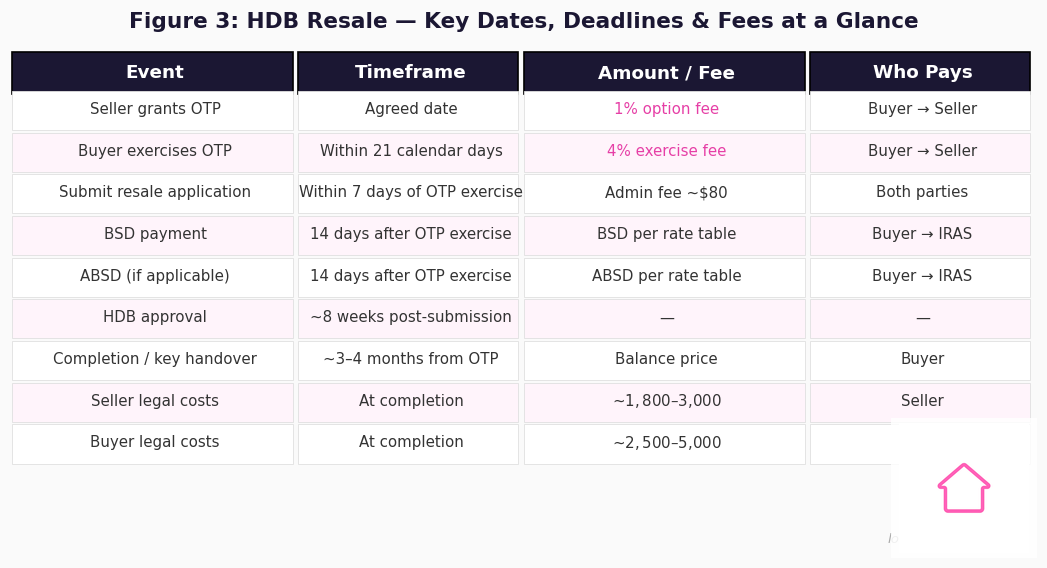
- The HFE letter from HDB is mandatory before applying for a BTO flat, exercising an OTP for a resale flat, or signing an EC sales and purchase agreement. Valid for 6 months.
- BSD applies to all residential purchases — S$44,600 on a S$1.5M condo, S$14,100 on a S$710k resale flat. First-timer SC-SC couples pay 0% ABSD on their first property.
- TDSR cap: total debt repayments cannot exceed 55% of gross monthly income, stress-tested at 4% p.a. MSR cap of 30% applies to HDB and EC loans.
- CPF OA can be used for the down payment above the 5% cash component, monthly instalments, and BSD — subject to the Valuation Limit and lease restrictions.
- MOP: Standard HDB flats require 5 years; Plus and Prime BTO categories require 10 years before sale or private property purchase.
What Does “First-Timer” Mean in Singapore?
In the Singapore property context, a first-timer applicant is a Singapore Citizen (SC) who has never received a housing subsidy from HDB, never owned an HDB flat, and has not previously acquired a private residential property. The Housing & Development Board (HDB) and the CPF Board jointly define the term, because subsidy eligibility, grant amounts, and CPF usage rules all hinge on this status.
The distinction matters enormously at the point of purchase: a confirmed first-timer family buying a 4-room BTO in a non-mature estate at S$430,000 may access grants totalling S$80,000 (EHG at maximum), whereas a second-timer faces a Resale Levy of S$15,000–S$55,000 and loses access to most grants entirely.
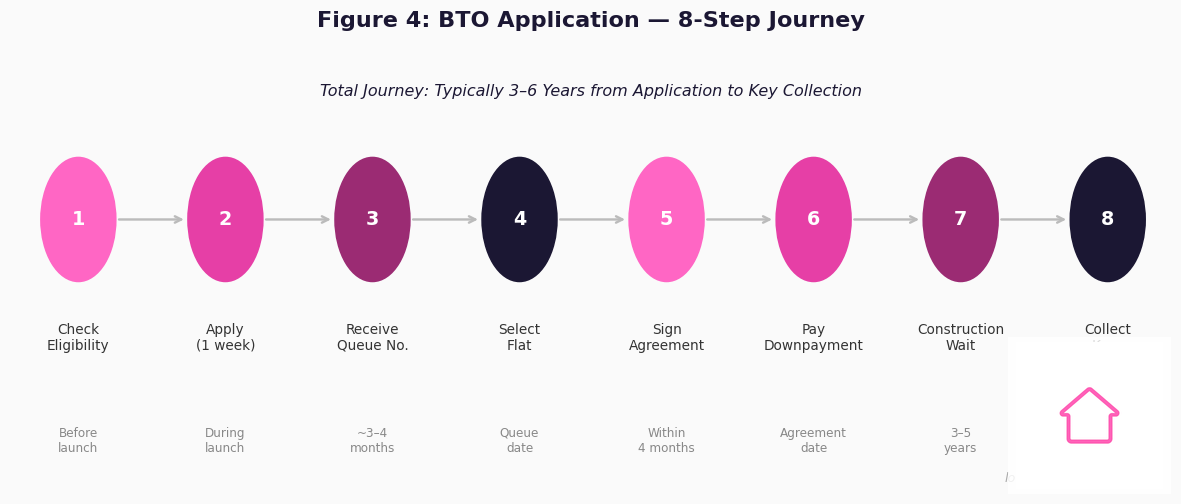
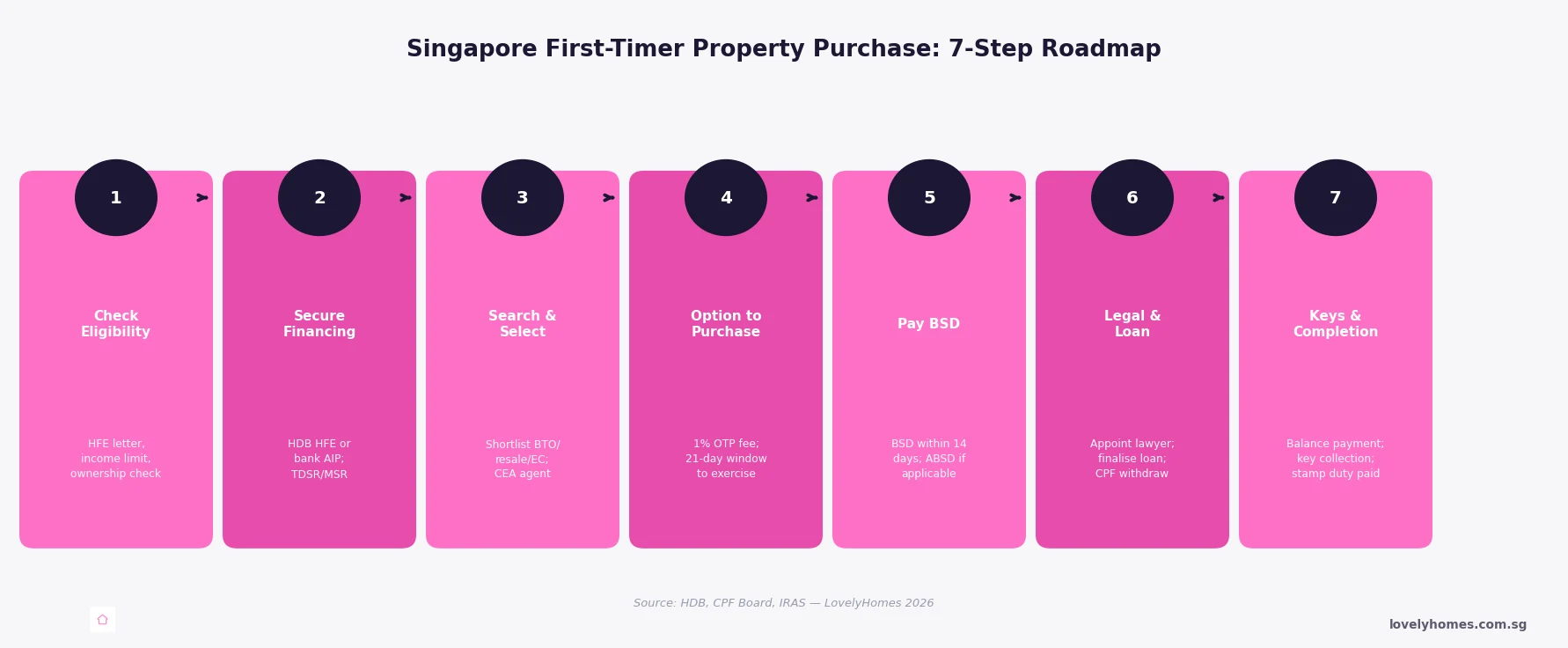
This guide covers the full first-timer journey — from checking eligibility to collecting keys — with current 2026 figures on grants, BSD rates, TDSR, CPF rules, and what the government is likely to change next.
Step 1 — Am I Eligible?
HDB administers eligibility through the HFE (HDB Flat Eligibility) letter, which replaced the old Eligibility Letter in May 2023. Before browsing flats, check these gates:
Citizenship: At least one applicant must be a Singapore Citizen. A Permanent Resident couple may purchase a resale HDB flat under the Non-Citizen Family Scheme after 3 years of PR status, but cannot access the EHG.
Age: Applicants must be at least 21, or 35 if purchasing as a single SC under the Single Singapore Citizen Scheme.
Family nucleus: You must form a qualifying household — a married or engaged couple, a parent-and-child unit, an orphan sibling group, or a lone single SC aged 35 or above.
Income ceiling: S$14,000/month gross for BTO and resale HDB purchases; S$7,000 for singles; S$16,000 for EC. Assessed over the most recent 12 months.
Ownership restrictions: You must not own or have disposed of any private residential property within 30 months before applying for a BTO or before resale flat completion. No undischarged interest in private property at time of EC application.
Step 2 — Grants: How Much Can You Get?
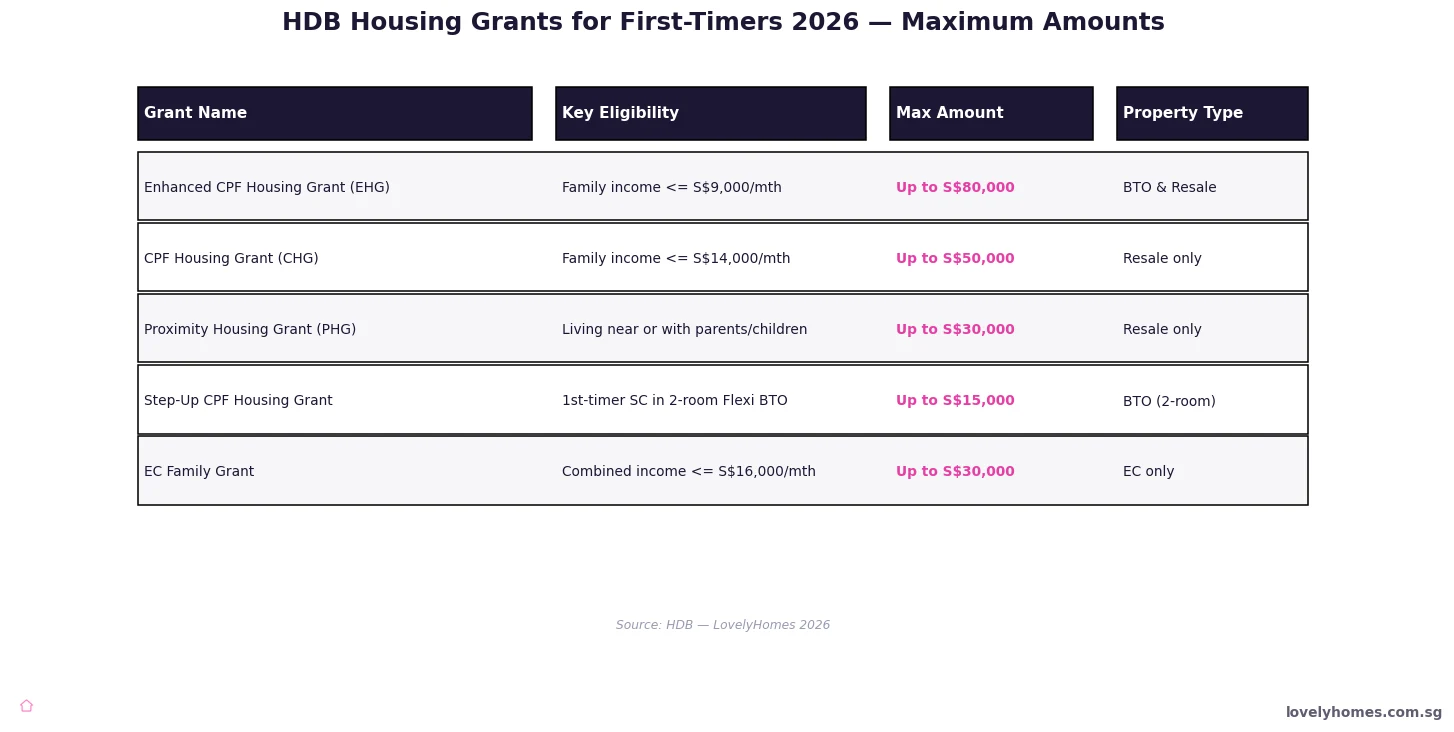
Singapore’s housing grant system is administered by HDB and the CPF Board. First-timers can stack multiple grants, but only certain combinations apply depending on whether you are buying a BTO, resale, or EC unit.
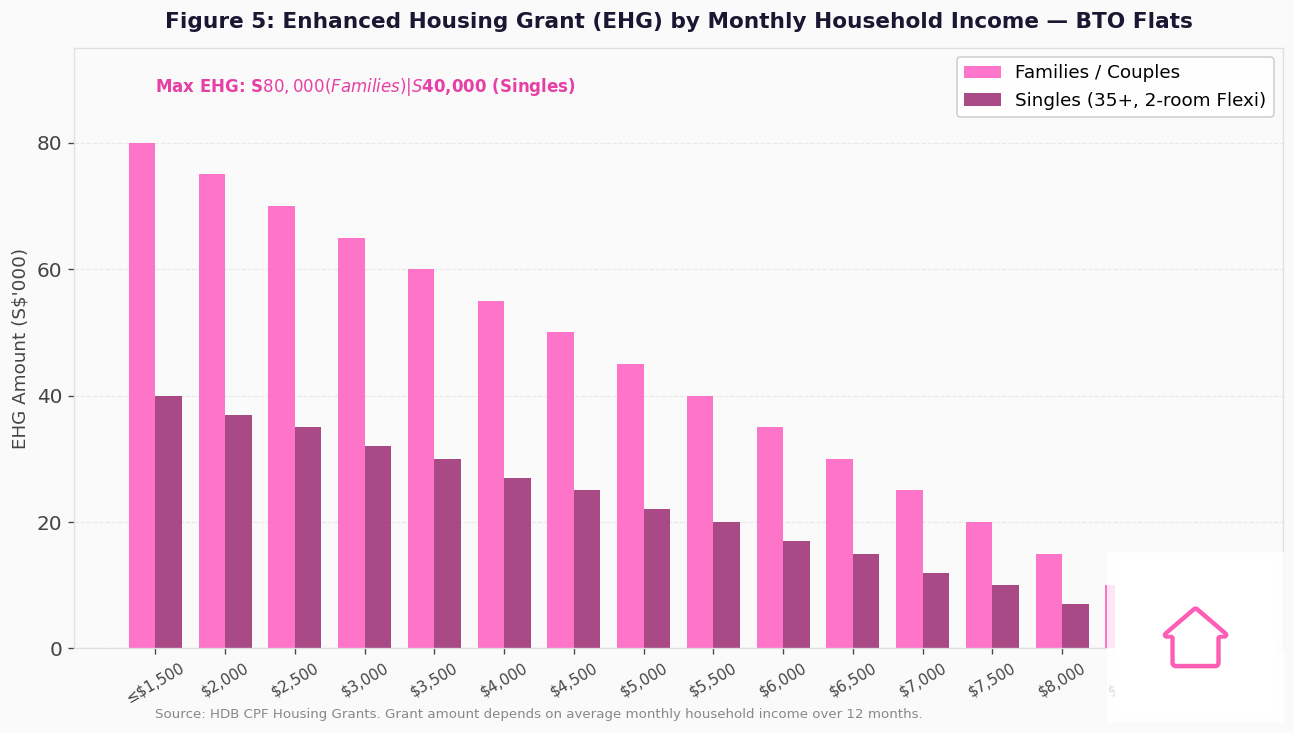
Enhanced CPF Housing Grant (EHG): Introduced in September 2019, the EHG applies to first-timer SC families with a combined gross monthly income of S$9,000 or below. The maximum S$80,000 applies at incomes up to S$1,500/month, stepping down to S$5,000 at the S$8,501–S$9,000 bracket. The EHG applies to both BTO and resale HDB purchases, and the flat’s remaining lease must cover the youngest buyer to age 95.
CPF Housing Grant (CHG): Available for resale HDB purchases only, the CHG provides up to S$50,000 for SC-SC families earning up to S$14,000/month. An SC-PR family receives up to S$40,000. Not applicable to BTO or EC purchases.
Proximity Housing Grant (PHG): Up to S$30,000 when buying a resale flat to live with or near parents or children within 4 km. SC-PR couples receive up to S$20,000. Not applicable to BTO or EC.
Step-Up CPF Housing Grant: S$15,000 for first-timer SC families earning up to S$7,000/month who are buying a 2-room Flexi BTO while living in a rental flat — designed to assist the lowest-income renter households into ownership.
Executive Condominium Family Grant: S$30,000 for SC-SC families or S$20,000 for SC-PR families, when buying a new EC directly from a developer with combined income not exceeding S$16,000/month.
Step 3 — Financing: TDSR, MSR, and Your Borrowing Limit
Singapore’s loan framework is governed by the Monetary Authority of Singapore (MAS). Two caps constrain how much you may borrow:
Total Debt Servicing Ratio (TDSR): Total monthly debt obligations — new mortgage, car loans, credit card minimums, personal loans — must not exceed 55% of gross monthly income. MAS stress-tests bank mortgage repayments at a floor rate of 4% per annum. For HDB concessionary loans at 2.6%, TDSR applies at the contracted rate without a floor.
Mortgage Servicing Ratio (MSR): For HDB flats and ECs, a stricter cap of 30% of gross monthly income applies to the housing loan instalment alone. This prevents over-commitment on subsidised housing.
Loan-to-Value (LTV): HDB concessionary loans are at 80% LTV (effective August 2024). Bank loans are at 75% LTV for the first property. Minimum cash down payment is 5% of purchase price for bank loans; the remaining 20% may come from CPF OA.
Step 4 — BSD: What You Pay in Stamp Duty
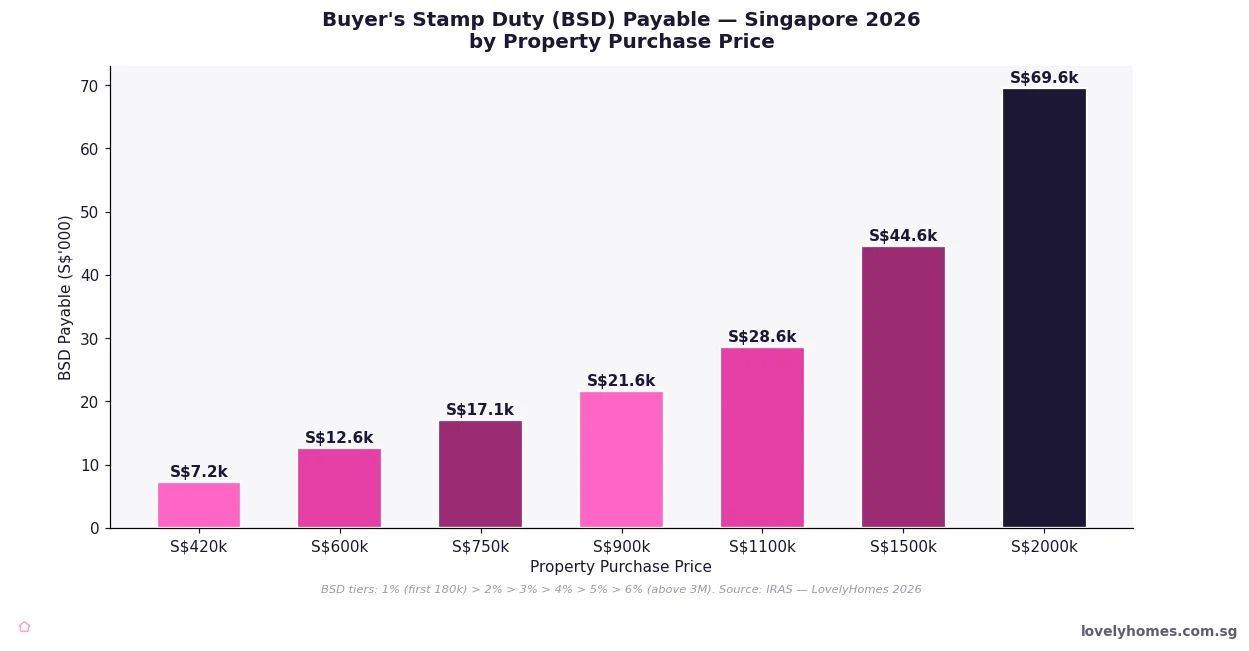
Buyer’s Stamp Duty (BSD), administered by IRAS, applies to every residential property purchase in Singapore. The tiered rates are:
| Portion of Purchase Price | BSD Rate | Effective Date |
|---|---|---|
| First S$180,000 | 1% | 15 February 2023 |
| Next S$180,000 | 2% | 15 February 2023 |
| Next S$640,000 | 3% | 15 February 2023 |
| Next S$500,000 | 4% | 15 February 2023 |
| Next S$1,500,000 | 5% | 15 February 2023 |
| Remainder above S$3,000,000 | 6% | 15 February 2023 |
First-timer SC-SC couples pay 0% ABSD on their first property. This is one of the most significant advantages in Singapore’s property market: a SC-SC couple buying a S$1.5M condo as their first home saves S$300,000 in ABSD compared to purchasing a second property, where 20% ABSD would apply from the day of purchase.
Step 5 — Using CPF OA to Buy Property
The Central Provident Fund (CPF) Ordinary Account (OA) is Singapore’s primary homeownership savings vehicle. First-timers may use CPF OA to pay the down payment above the 5% cash component, monthly mortgage instalments, BSD, and legal fees — subject to two limits:
Valuation Limit (VL): For private properties and ECs, CPF usage is capped at the lower of purchase price and market valuation. Excess above valuation must be funded in cash only.
Withdrawal and lease rules: For HDB flats, the remaining lease must cover the youngest buyer to age 95 for full CPF usage. For private properties with shorter remaining leases, prorated or blocked CPF usage applies. On eventual sale, CPF principal withdrawn plus accrued interest at 2.5% per annum must be refunded to your CPF OA, reducing your net cash proceeds.
Worked Example: Mr and Mrs Ahmad — BTO vs Resale Comparison
Scenario: SC-SC Couple, Combined Income S$11,200 per month
Option A: 4-Room Standard BTO, Tengah — S$445,000 (indicative, 2026 launch)
- EHG: S$25,000 (income S$9,001–S$11,000 sliding scale)
- Effective price after grant: S$420,000
- HDB loan 80% LTV: S$336,000 at 2.6% p.a. over 25 years = S$1,522/month
- MSR: 13.6% — within 30% cap
- BSD on S$445k: 1% x S$180k + 2% x S$180k + 3% x S$85k = S$7,350
- Upfront cash: S$1,000 OTP + 5% cash downpayment S$22,250 = S$23,250
- CPF used: balance 10% down S$22,750 + BSD S$7,350 + legal S$2,000
- ABSD: S$0 — first property SC-SC
- Estimated key collection: Q3 2029–2030
Option B: 4-Room Resale HDB, Toa Payoh — S$710,000
- EHG: S$25,000 + CHG: S$30,000 = S$55,000 total grants
- HDB valuation (estimated): S$695,000; Cash Over Valuation (COV): S$15,000
- HDB loan 80% LTV on valuation: S$556,000 at 2.6% p.a., 25 years = S$2,519/month
- MSR: 22.5% — within 30% cap
- BSD on S$710k: 1% x S$180k + 2% x S$180k + 3% x S$350k = S$14,100
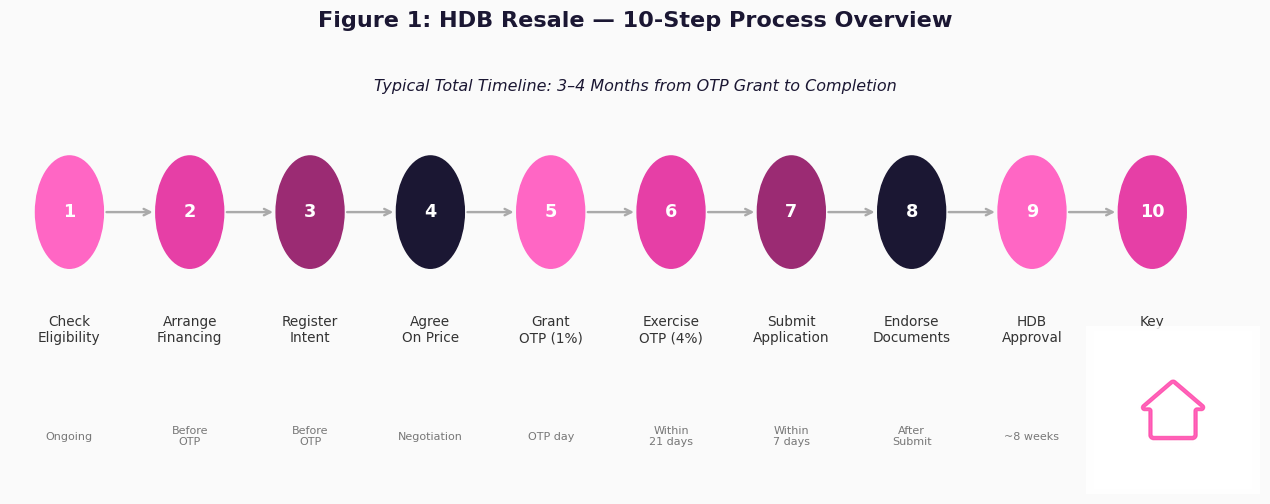
- Upfront cash: OTP 1% S$7,100 + COV S$15,000 + 5% downpayment + BSD, approx S$70,000
- ABSD: S$0 — first property SC-SC
- Keys: approximately 2–3 months from legal completion
Verdict: BTO is cheaper by roughly S$100,000+ in effective outlay and requires a 3–5 year wait. Resale gives immediate occupancy at higher total cost. Both attract 0% ABSD as first-timer SC-SC buyers.
Why This Matters: Singapore’s First-Timer Advantage
Singapore’s first-timer subsidy framework is among the most generous in the Asia-Pacific region. Australia’s First Home Owner Grant of A$10,000–A$30,000 is dwarfed by Singapore’s EHG maximum of S$80,000 — and Australian buyers must compete in a fully open market without any MSR constraint, meaning mortgage sizes can reach 8–10 times annual income versus Singapore’s effective 4–5 times. Hong Kong’s subsidised Home Ownership Scheme (HOS) provides a comparable grant, but ballot wait times can span decades.
The combination of BTO pricing below market, grant stacking, an HDB concessionary loan at 2.6%, 0% ABSD on the first property, and CPF OA contributions means a Singapore SC couple on a combined S$10,000/month income can achieve homeownership in a new flat with a total upfront cash outlay of roughly S$20,000–S$30,000. That is a remarkable policy outcome by global standards.
What Might Come Next for First-Timers
Based on signals from HDB, MAS, and the Ministry of National Development (MND) as of August 2026, the following are areas to watch. These represent editorial judgement, not official announcements:
The BTO classification framework (Standard, Plus, and Prime categories, introduced October 2024) is still bedding in. MND has indicated it will review the 10-year MOP for Plus and Prime flats after the first cohort reaches TOP around 2029–2031. First-timers choosing Plus or Prime flats today commit to a decade of illiquidity.
Income ceilings were last raised in August 2019. Another revision may be warranted given cumulative wage growth since then, but has not been signalled for the remainder of 2026. Watch the annual Budget in February 2027.
EHG adequacy: The S$80,000 maximum EHG was calibrated against 2019 BTO prices. With 4-room mature-estate BTOs now indicatively priced at S$500,000–S$600,000, the maximum grant covers only 13–16% of the purchase price. An upward revision would disproportionately benefit lower-income first-timers.
Summary: Key Numbers for First-Timers in 2026
| Item | HDB BTO (4-rm, non-mature) | HDB Resale (4-rm, mature) | New EC / Private Condo |
|---|---|---|---|
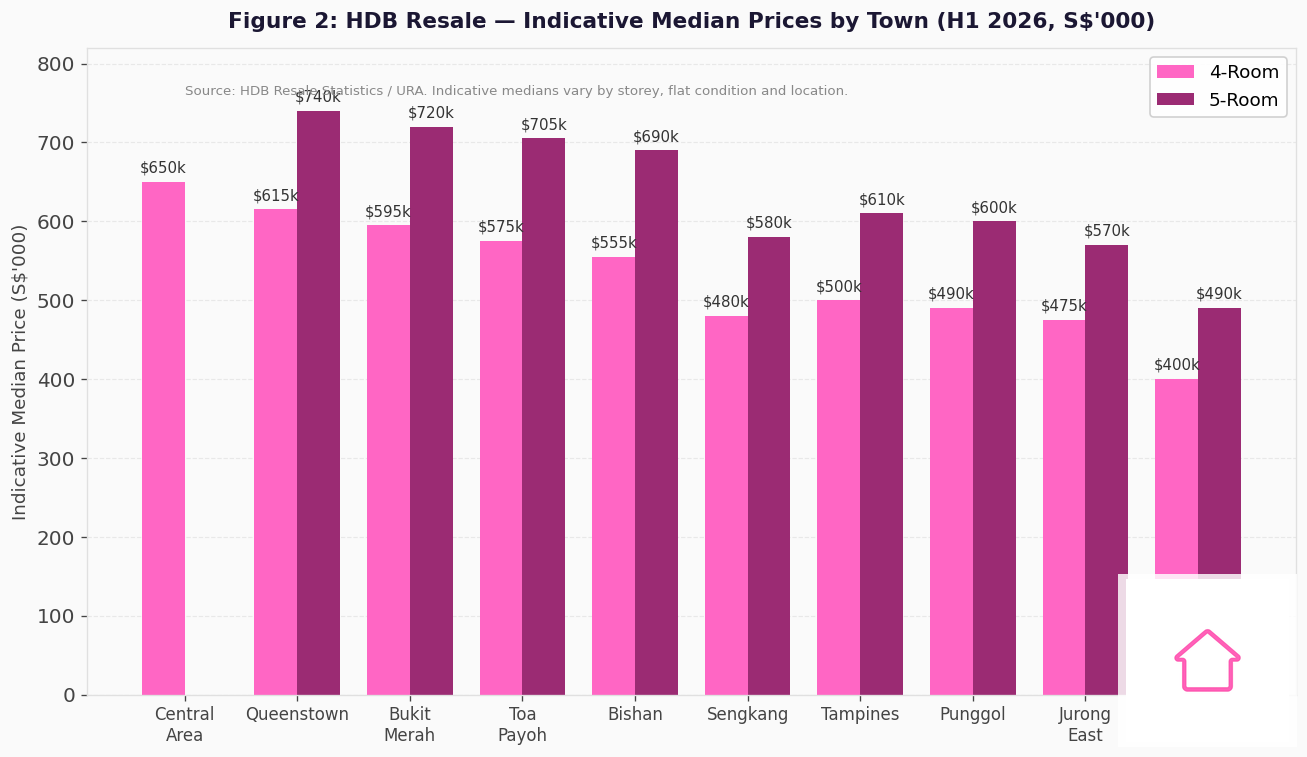
| Indicative price range | S$400k–S$500k | S$600k–S$800k | S$1.1M–S$1.4M / S$1.3M–S$2M+ |
| Max EHG | S$80,000 | S$80,000 | N/A (EC: Family Grant S$30k) |
| Max CHG | Not applicable | S$50,000 | Not applicable |
| ABSD (SC-SC, 1st property) | 0% | 0% | 0% |
| LTV (HDB loan) | 80% | 80% | Not applicable |
| LTV (bank loan) | 75% | 75% | 75% |
| MSR cap | 30% gross income | 30% gross income | 30% (EC); none (private) |
| TDSR cap | 55% stress-tested at 4% | 55% | 55% |
| MOP before sale | 5yr Standard / 10yr Plus-Prime | 5yr Standard / 10yr Plus-Prime | 5yr (EC); none (private) |
Frequently Asked Questions
My spouse is a Permanent Resident. Are we still considered first-timers?
Yes, if neither of you has received an HDB housing subsidy before and neither owns a private residential property. An SC-PR couple qualifies for BTO under the relevant HDB scheme and for most grants, though at slightly lower amounts. The EHG maximum is the same S$80,000 for qualifying SC-PR couples as for SC-SC couples, since EHG is calibrated by income level. The CHG for SC-PR resale is up to S$40,000 versus S$50,000 for SC-SC. The Proximity Housing Grant is S$20,000 for SC-PR versus S$30,000 for SC-SC. Your HFE letter will confirm exact grant amounts based on your household composition and income.
Can I use CPF OA to pay the mandatory 5% cash downpayment?
No. For bank loans, the first 5% of the purchase price must be paid in cash — CPF cannot substitute for this mandatory cash component. The next 20% of the purchase price, to reach the 75% LTV ceiling for bank loans, may come from CPF OA or additional cash. For HDB concessionary loans, the minimum downpayment is 20% of the lower of purchase price or valuation, of which a minimum 10% must be in cash. The other 10% may come from CPF OA. In practice, HDB loan borrowers need at least 10% in cash as a hard floor.
What is the difference between a Standard, Plus, and Prime BTO flat?
HDB introduced the Standard-Plus-Prime classification in October 2024 for all new BTO launches. Standard flats are in non-prime heartland towns such as Tengah, Woodlands, or Bukit Batok, with a 5-year Minimum Occupation Period and no special resale restrictions. Plus flats are in more centrally located or well-connected towns with a 10-year MOP; on resale they may only be sold to SC or PR buyers, and a subsidy clawback applies to proceeds. Prime flats are in the most central or sought-after locations such as Rochor or Kallang, with a 10-year MOP and stricter resale restrictions including income ceilings for subsequent buyers. First-timers who choose Plus or Prime flats gain affordability in prime locations but sacrifice liquidity for at least a decade.
What happens if my income rises above the ceiling after I apply for a BTO?
HDB assesses your gross monthly household income at the point of application, averaging the preceding 12 months. If you exceeded the ceiling at that assessment point, you would be ineligible for that launch. However, once your application is submitted and income is confirmed within the ceiling, subsequent rises in income do not generally affect your eligibility for that specific application. For the HFE letter, the income snapshot is taken when you submit the application — so time your application carefully if your income is near the ceiling boundary.
Can a first-timer buy a private condominium instead of an HDB flat?
Absolutely. SC first-timers are entirely entitled to purchase private condominiums, strata units, or landed property subject to the relevant residency rules. The first-timer advantage in the private market is primarily the 0% ABSD on the first property — saving 20% ABSD that would apply on a second purchase. For private purchases there are no income ceilings, no HFE letter requirement, and no MSR restriction (only TDSR at 55%). The trade-off is no access to HDB grants, no HDB concessionary loan, and full market pricing without subsidy buffering. Note also that buying private forecloses the BTO route: you cannot apply for a BTO or resale HDB flat while you own a private residential property, and must wait 30 months after disposal before applying.
What is the Resale Levy, and does it affect me now as a first-timer?
The Resale Levy applies when a second-timer buys a new subsidised flat from HDB, whether a BTO or an EC. As a first-timer, you do not pay any Resale Levy on your current purchase. However, once you sell your first HDB flat after the MOP, you become a second-timer and will be subject to the Resale Levy on any subsequent purchase of a new HDB flat or EC. The levy ranges from S$15,000 for a 2-room flat to S$55,000 for a 5-room or executive flat, depending on the type previously sold. There is no Resale Levy when purchasing a resale HDB flat on the open market as a second-timer — it only applies to new purchases from HDB.
Should I buy a BTO or resale HDB flat as a first-timer in 2026?
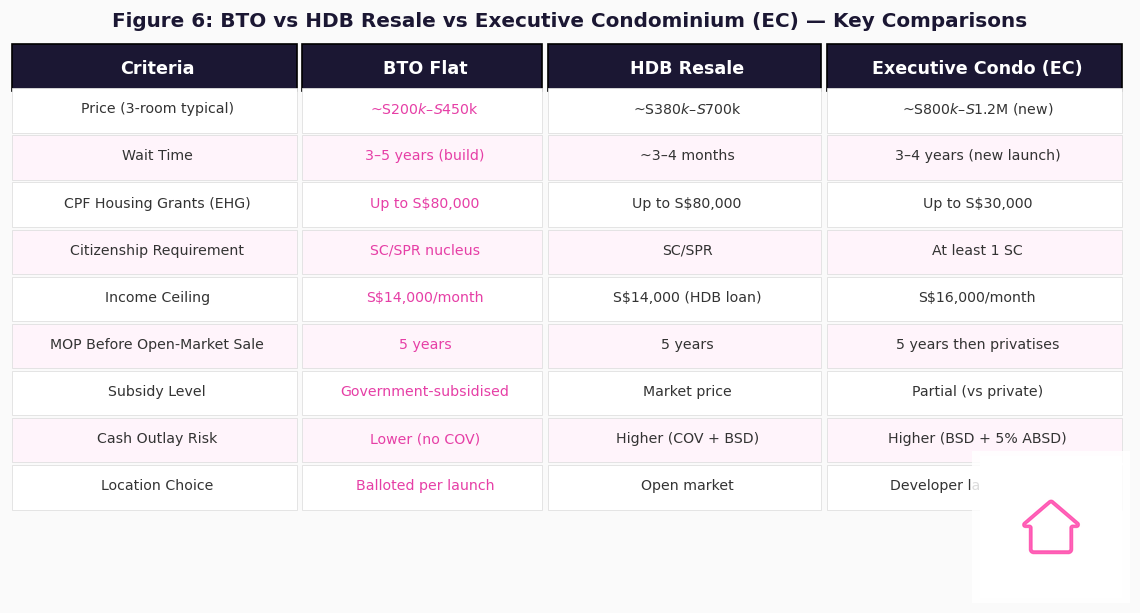
The decision depends on your timeline, budget, and location preferences. BTO advantages include: lower entry price — often S$100,000–S$200,000 cheaper than equivalent resale in the same town — full EHG eligibility, no COV risk, and brand-new condition. BTO disadvantages include: 3–5 year wait for keys, limited location options for Standard flats, and a ballot process that may require multiple attempts. Resale advantages include: immediate occupancy, full market choice of location and floor level, grant stacking with CHG and PHG, and the ability to inspect the exact unit. Resale disadvantages include: COV risk, larger BSD, older leases in mature estates progressively reducing CPF usability, and significantly higher total outlay. For couples with flexible timelines who prioritise cost efficiency, BTO remains the more financially sound choice in 2026.
Related Articles
- ABSD Singapore 2026: Complete Guide to Additional Buyer’s Stamp Duty
- Singapore HDB Eligibility Guide 2026: Who Can Buy an HDB Flat?
- Singapore HDB BTO Ballot Guide 2026: How to Apply and Win a Flat
- Singapore HDB Resale Price Guide 2026: What You Really Pay
- CPF Property Guide 2026: Using Your OA to Buy Property in Singapore
- Singapore Property Loan Refinancing Guide 2026
- Singapore Leasehold vs Freehold Guide 2026
Disclaimer
This article is for general informational purposes only and does not constitute financial, legal, or property advice. Grant amounts, loan limits, income ceilings, BSD rates, and ABSD rates are current as at 8 August 2026 and may be revised by HDB, CPF Board, MAS, or IRAS at any time. Verify current figures directly with HDB (hdb.gov.sg), CPF Board (cpf.gov.sg), IRAS (iras.gov.sg), and MAS (mas.gov.sg). Engage a CEA-registered property agent and a licensed financial adviser for advice tailored to your personal circumstances before committing to any property transaction.