
Singapore Property Buying Checklist 2026: Step-by-Step Guide for HDB, EC and Condo Buyers
Buying property in Singapore is one of the most significant financial decisions a household makes. The process involves government eligibility rules, loan approvals, legal documentation, stamp duty payments, and a carefully timed sequence of steps — and getting any one of them wrong can cause delays, penalties, or lost deposits. This comprehensive checklist covers every stage of the Singapore property buying process in 2026, from working out your budget through to collecting your keys, for HDB flats, executive condominiums (ECs), and private condominiums.
Quick Answer — Singapore Property Buying Checklist
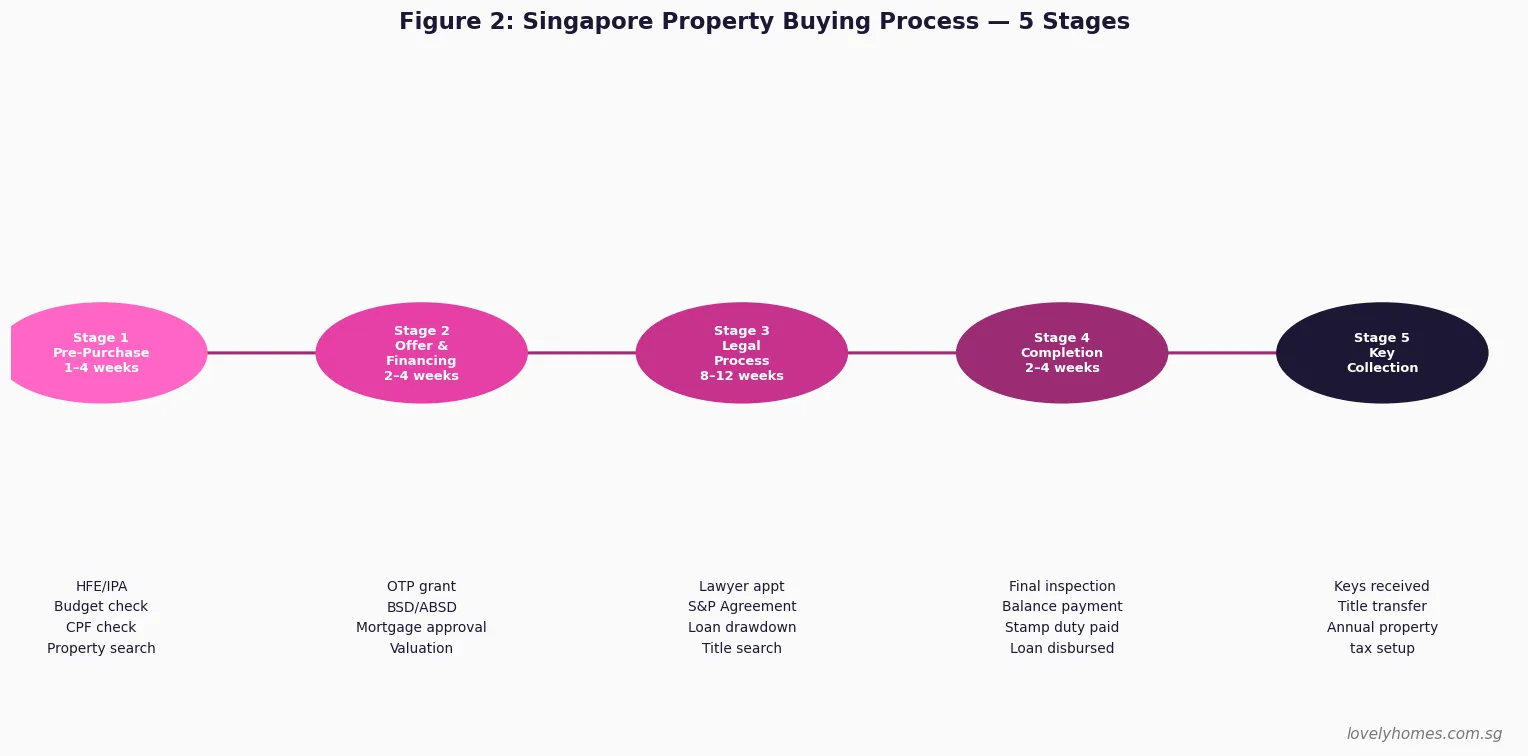
- Stage 1 (Pre-purchase): check eligibility, obtain HFE Letter or bank IPA, confirm budget and ABSD profile
- Stage 2 (Offer & financing): grant OTP, pay 1% booking fee, engage lawyer, confirm loan, pay BSD/ABSD within 14 days
- Stage 3 (Legal process): sign S&P Agreement, drawdown loan, complete title search, await completion
- Stage 4 (Completion): pay balance 19% (or balance purchase price), sign transfer documents, pay remaining stamp duty
- Stage 5 (Key collection): receive keys, inspect property, register title, set up property tax and utilities
- Total timeline: 8–16 weeks for private/resale; 3–5 years for BTO flats
Before You Start: Establishing Your Budget and Eligibility
Every Singapore property purchase begins with a clear-eyed assessment of what you can afford and what you are eligible to buy. Singapore’s property market is structured around specific eligibility rules — citizenship status, marital status, income ceilings, and prior property ownership all determine which types of property you can purchase, and at what stamp duty rates.
The two frameworks that govern affordability for mortgage borrowers are the Total Debt Servicing Ratio (TDSR) and, for HDB flats and ECs, the Mortgage Servicing Ratio (MSR). TDSR caps total debt obligations at 55% of gross monthly income (using a stress-tested rate of at least 4.0% p.a.); MSR caps housing loan repayment for HDB/EC at 30% of gross monthly income. See our TDSR & MSR Guide 2026 for the full breakdown.
For ABSD planning, confirm how many residential properties you and your co-purchaser currently own. A Singapore Citizen buying their first property pays 0% ABSD; buying a second pays 20%; buying a third pays 30%. For Singapore PRs, the first property attracts 5% ABSD. These are upfront, non-negotiable costs that must be paid in cash (CPF cannot be used for ABSD). See our ABSD Complete Guide 2026.
Stage 1: Pre-Purchase Checklist (1–4 Weeks)
This stage covers the groundwork before you make any offer on a property. Completing it thoroughly saves significant time and stress later in the process.
HDB purchases — HFE Letter: Apply for an HDB Flat Eligibility (HFE) Letter at the HDB website (MyHDBPage portal). This single letter tells you which HDB flats you are eligible to buy, your CPF grant amounts, your HDB loan eligibility, and the maximum HDB loan quantum. The HFE Letter is valid for 6 months and is mandatory before exercising any OTP for an HDB flat. Allow 2–3 weeks for processing.
Private/EC purchases — Bank IPA: Apply for an In-Principle Approval (IPA) from your preferred bank(s) before making any offer. The IPA tells you your maximum loan quantum and is typically valid for 30 days. It is not legally required before signing an OTP, but it is strongly advisable — discovering post-OTP that you cannot secure financing risks losing your 1% booking fee.
CPF check: Log in to your CPF account and confirm your OA balance. For HDB purchases, your CPF OA can cover the downpayment and monthly instalments. For private property, CPF OA usage is subject to the Valuation Limit and Withdrawal Limit rules.
Property search and shortlisting: Research your target neighbourhoods and property types. Confirm the remaining lease (critical for CPF usage and bank loan eligibility on resale properties), check URA Master Plan zoning, and look at recent transaction data from URA’s REALIS portal.
Stage 2: Making an Offer — OTP and Financing (2–4 Weeks)
Once you identify a property, the process moves quickly. In Singapore, the formal process of making an offer starts with the Option to Purchase (OTP).
Granting the OTP: The seller grants you the OTP upon receipt of a 1% booking fee (of purchase price), paid in cash. The OTP is a legal option giving you the exclusive right to purchase the property within the option period, typically 14 days for private property and 21 days for HDB resale.
BSD and ABSD payment deadline: Stamp duty (both BSD and ABSD) must be paid within 14 days of exercising the OTP (or signing the S&P Agreement). Failure to pay on time incurs penalties. IRAS administers stamp duty and accepts payment via e-Stamping on the IRAS website. Importantly, ABSD must be paid in cash only — CPF cannot be used for ABSD. BSD may be paid from CPF OA.
Engaging a property lawyer: Appoint a conveyancing lawyer as soon as the OTP is received. Your lawyer will conduct a title search, advise on any encumbrances on the property, prepare the Sale and Purchase Agreement, and coordinate the completion process. Legal fees for a standard private property purchase are typically S$2,500–S$4,500.
Confirming bank loan: Submit your formal loan application to the bank (not just IPA). The bank will order a valuation of the property. If the valuation comes in lower than the purchase price, your loan amount is based on the valuation figure — the “valuation shortfall” must be topped up in cash or CPF from your own funds. This is why many experienced buyers commission their own valuation before offering a price.
Exercising the OTP: Pay the additional 4% exercise fee (i.e. 1% booking + 4% exercise = 5% of purchase price) at the time you exercise the OTP within the option period. For private property, this is typically 5% of the purchase price. For HDB resale, the exercise fee to HDB is the balance of the deposit up to 5% (cash or CPF).
Understanding Upfront Costs: What You Actually Need at Each Stage
One of the most common surprises for first-time buyers is the quantum of upfront cash required before completion. The chart below shows the estimated upfront costs for a first-time Singapore Citizen buyer across four property types. Note that ABSD is zero for a first-time SC buyer on any property type.
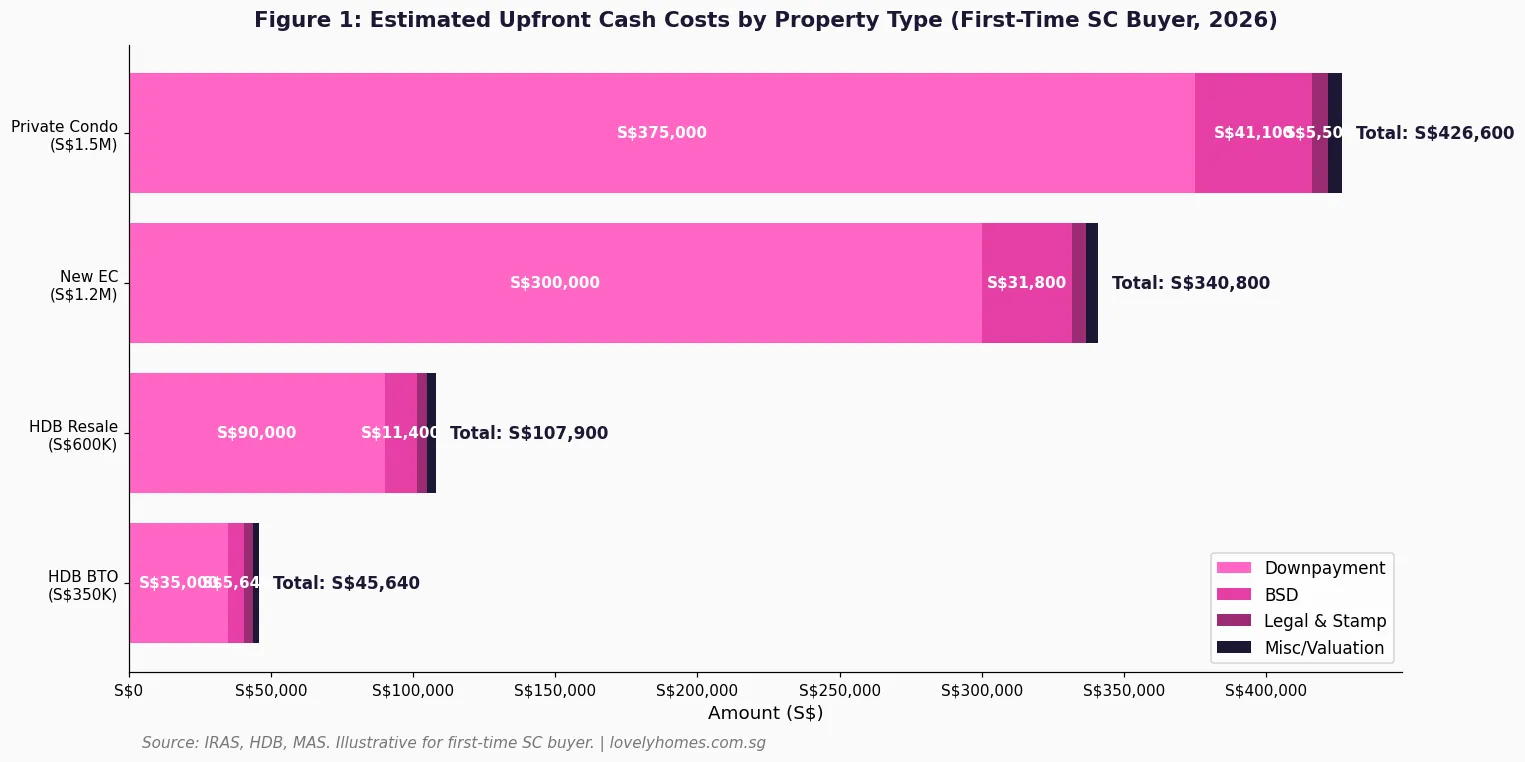
| Cost Item | HDB BTO (~S$350K) | HDB Resale (~S$600K) | EC (~S$1.2M) | Private Condo (~S$1.5M) |
|---|---|---|---|---|
| Booking fee (1% cash) | S$3,500 | S$6,000 | S$12,000 | S$15,000 |
| Exercise fee (4% cash/CPF) | S$14,000 | S$24,000 | S$48,000 | S$60,000 |
| BSD (cash or CPF) | S$5,640 | S$11,400 | S$31,800 | S$41,100 |
| ABSD (1st SC buyer) | S$0 | S$0 | S$0 | S$0 |
| Legal fees (approx) | S$2,500 | S$3,000 | S$4,500 | S$5,000 |
| Remaining downpayment | From CPF OA | From CPF OA | S$240,000+ | S$300,000+ |
| Est. upfront cash required | ~S$4K–6K | ~S$6K–10K | ~S$60K–80K | ~S$75K–100K |
Note: BSD payable from CPF OA; ABSD must be in cash. EC 1% booking fee and 4% exercise fee must be in cash (no CPF for downpayment). HDB BTO/Resale downpayment may be entirely from CPF OA if taking HDB loan (no mandatory cash). Assumes first-time SC buyer with no other outstanding loans.
Stage 3: The Legal Process (8–12 Weeks)
After exercising the OTP, your lawyer and the seller’s lawyer prepare the Sale and Purchase Agreement (S&P Agreement), which sets out all terms of the sale, the completion date, and any conditions. The S&P Agreement is typically signed within 2 weeks of the OTP exercise date.
Loan drawdown: Your bank will require the S&P Agreement to be signed before releasing the loan. The bank typically disburses the loan directly to the seller’s conveyancing account at completion. Ensure your loan offer letter has not expired and all conditions (e.g. fire insurance) are met.
Title search: Your lawyer will search the land registry (Singapore Land Authority) to confirm the seller holds clean title, check for any caveats, mortgages, or restrictions registered against the property, and flag any issues that could delay completion.
Completion date: Standard completion is typically 8–12 weeks from the S&P Agreement date for private property. HDB resale completion is set by HDB and typically 8–10 weeks from the HDB appointment.
Stage 4: Completion Day — What Happens on the Day
Completion day is when legal ownership of the property transfers from seller to buyer. Your lawyer coordinates the following:
Balance purchase price payment: The bank transfers the loan funds to the seller’s conveyancer; your CPF is transferred by the CPF Board; your cash balance (if any remains) is transferred from your lawyer’s client account. The seller receives the total price and in turn discharges their mortgage and hands over vacant possession.
Document signing: You will sign the transfer instrument, the mortgage document, and several other legal forms at your lawyer’s office.
Remaining stamp duty: If you have not already stamped all relevant documents, your lawyer will ensure payment is made on completion day.
Title register update: The Singapore Land Authority (SLA) will update the land registry to show you as the new owner. This process takes 2–4 weeks after completion.
Stage 5: After Key Collection — Your Post-Purchase Checklist
Collecting your keys is not the end of the process. Several administrative steps remain.
Property inspection: Conduct a thorough walk-through before accepting the keys. For new property (BTO, new launch condo), this is the formal defects inspection — note all defects in writing and submit the defects list to the developer within the defects liability period (typically 12 months for private property, 1 year for HDB BTO).
Property tax: IRAS will issue your first property tax notice based on the Annual Value (AV) assessed for your property. Owner-occupied residential properties attract a progressive tax rate (0% on first S$8,000 AV, then 4–32% progressively). Update your owner-occupier status with IRAS at iras.gov.sg to ensure you are taxed at the concessionary owner-occupier rate rather than the higher non-owner-occupier rate.
Utilities and services: Transfer or open SP Group electricity and utilities accounts. Set up broadband, cable, and household insurance.
CPF charge registration: Your lawyer will register the CPF charge on the property with SLA to reflect the CPF monies withdrawn. This is automatic as part of the completion process but confirm with your lawyer that it is done.
Fire insurance and mortgage reducing term assurance (MRTA): Fire insurance is mandatory for all mortgaged properties (arranged by the bank). MRTA (which pays off your outstanding loan if you die or are permanently disabled) is not legally required but strongly recommended, especially for the first decade of a long loan tenure when the outstanding balance is at its highest.
Choosing the Right Property Type: HDB, EC, or Private Condo
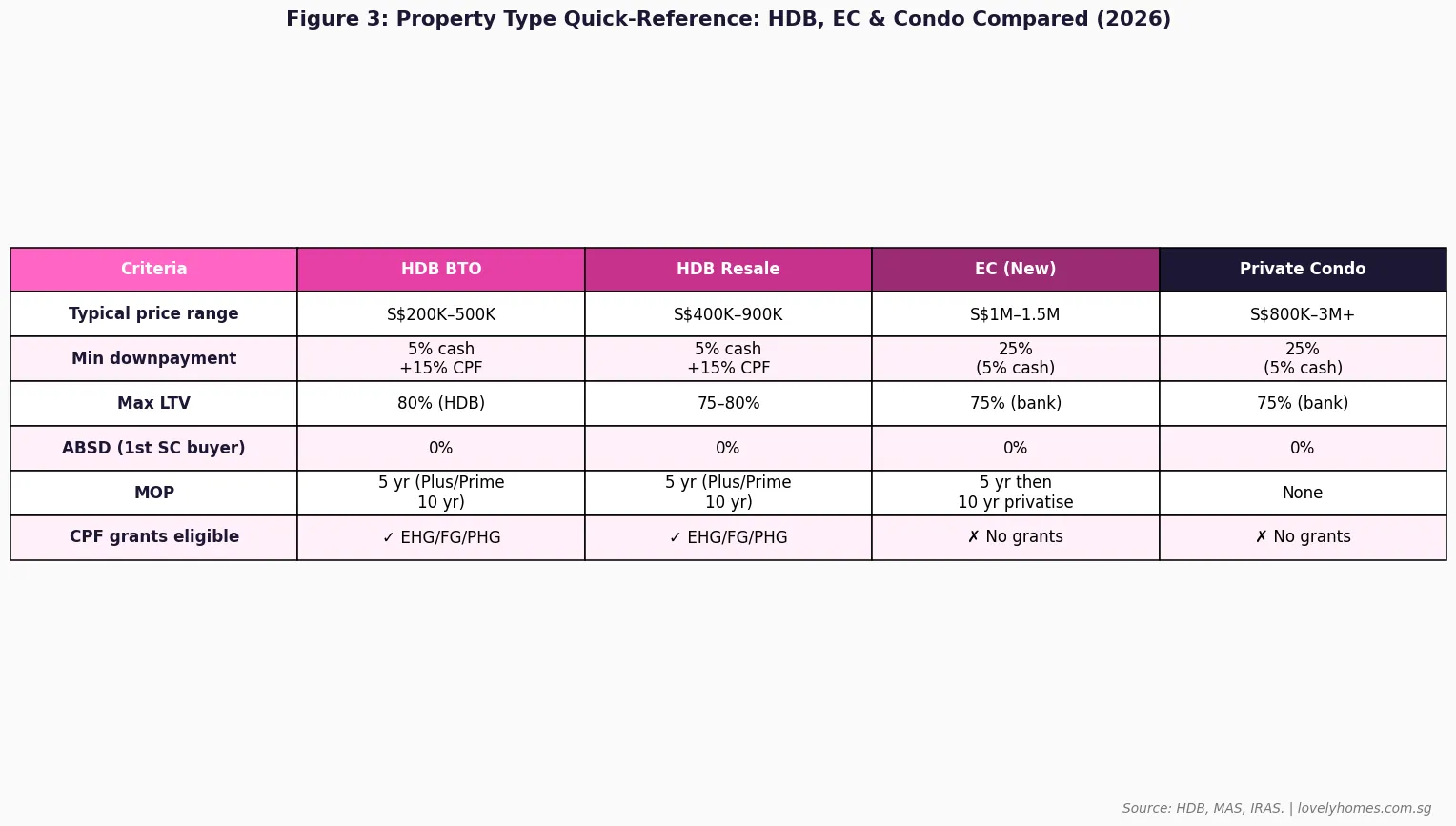
Understanding which property type suits your needs, income, and long-term strategy is the starting point of the whole process. The table below summarises the key differences.
Worked Example: The Lim Family Buys an HDB Resale Flat
Mr and Mrs Lim, both Singapore Citizens aged 32, have a combined gross monthly income of S$9,000. They wish to buy a 5-room HDB resale flat in Bishan for S$780,000 and take a bank loan.
ABSD: Both are first-time buyers; 0% ABSD. No ABSD cost.
BSD: On S$780,000: first S$180,000 @ 1% = S$1,800; next S$180,000 @ 2% = S$3,600; next S$440,000 @ 3% = S$13,200. Total BSD = S$18,600 (payable from CPF OA).
Bank loan eligibility: MSR 30%: max monthly housing payment at stress-test 4.0% p.a. = S$9,000 × 30% = S$2,700. At 4.0% over 25 years, S$2,700/month ≈ max loan S$517,000. LTV 75%: S$780,000 × 75% = S$585,000. MSR is the binding constraint at S$517,000.
Downpayment: S$780,000 − S$517,000 = S$263,000 (CPF OA: S$200,000; cash: S$63,000).
Monthly repayment (actual rate 3.5% p.a.): S$517,000 at 3.5% over 25 years = approximately S$2,587/month (MSR 28.7% — PASS).
CPF grants: As first-time buyers with income S$9,000/month, they receive Family Grant S$50,000 + PHG S$20,000 (if within 4km of parents) = up to S$70,000, reducing effective loan to S$447,000 and monthly repayment to approximately S$2,237/month.
Total cash at exercise: 1% booking S$7,800 cash + 4% exercise S$31,200 (CPF) + BSD S$18,600 (CPF) + legal S$3,500 = approximately S$10,800 cash at the time of exercising the OTP.
What Might Change in the Singapore Property Buying Process
The MAS and HDB periodically review the rules governing property purchases. In 2026, key items to monitor include: any revision to TDSR or LTV limits (MAS last updated these in September 2022); changes to HDB grant amounts or income ceilings (HDB last revised these in September 2019); and any adjustments to the EC eligibility or income ceiling (currently S$16,000/month). The ABSD framework set on 27 April 2023 remains intact with no announced changes as of August 2026. For the latest cooling measures timeline, see our Property Cooling Measures Timeline.
Summary: Singapore Property Buying Checklist
| Stage | Key Actions | Timeline |
|---|---|---|
| 1. Pre-purchase | HFE Letter or bank IPA; budget check; ABSD profile; CPF balance | 1–4 weeks |
| 2. Offer & financing | Grant/receive OTP; pay 1% booking; formal loan app; BSD/ABSD within 14 days; engage lawyer | 2–4 weeks |
| 3. Legal process | Sign S&P Agreement; bank valuation; title search; await completion date | 8–12 weeks |
| 4. Completion | Pay balance; sign transfer; bank disburses loan; CPF Board transfers funds | 1–2 days |
| 5. Post-completion | Keys; defects inspection; property tax owner-occupier status; utilities; fire insurance | 2–4 weeks |
Frequently Asked Questions
What is the Option to Purchase (OTP) and what happens if I do not exercise it?
The Option to Purchase is a legally binding agreement where the seller grants you the exclusive right to buy the property within a specified period (typically 14 days for private property, 21 days for HDB resale). The 1% booking fee is paid when the OTP is granted to you. If you choose not to exercise the OTP within the option period, you forfeit the 1% booking fee but have no further obligation to complete the purchase. The seller may then offer the property to other buyers. If you exercise the OTP, you become contractually committed to completing the purchase, and failing to complete after that point puts your entire deposit (usually 5% to 10% of the purchase price) at risk.
How long does the entire buying process take in Singapore?
For a private resale or new launch condo, the typical timeline from OTP exercise to key collection is 8–16 weeks (some new launches can be longer depending on the developer’s completion date). For an HDB resale flat, the HDB appointment-to-completion timeline is usually 8–10 weeks after HDB grants approval. For an HDB BTO flat, the wait from booking to key collection is typically 3–5 years depending on when the project was launched and the construction schedule. For an EC, the completion wait is also 3–5 years (these are new launches).
Can a foreigner buy an HDB flat or EC in Singapore?
No. Foreigners (non-Singapore Citizens and non-Singapore PRs) are not permitted to buy HDB flats (new BTO or resale) or new ECs (during the 5-year MOP period). ECs are treated as private property after 10 years from the date of issue of the Temporary Occupation Permit, at which point foreigners may buy them on the open market — subject to paying the 60% ABSD. Foreigners may buy private condominiums, apartments, and some landed property with prior approval from the Land Dealings Approval Unit (LDAU), but they pay the significant 60% ABSD surcharge. See our ABSD Singapore Guide 2026 for the full foreigner and FTA national rules.
What is COV (Cash Over Valuation) and does it still apply in 2026?
Cash Over Valuation refers to the amount a buyer pays above the bank’s (or HDB’s) assessed valuation of the property. If you agree to buy a resale flat for S$650,000 but the valuation comes in at S$610,000, the S$40,000 difference is COV and must be paid entirely in cash (no CPF, no loan). COV has reappeared in the HDB resale market during high-demand periods, particularly for popular flat types in mature estates. It adds a significant cash buffer requirement. Before committing to a price, request the seller’s or HDB’s indicative valuation, or commission your own from an IRAS-approved valuer, to reduce the risk of a COV surprise.
What documents do I need to prepare for a home loan application?
The standard document checklist for a Singapore home loan application includes: NRIC (for Singapore Citizens and PRs); proof of income (last 3 months’ payslips, latest CPF contribution history, last 2 years’ Income Tax Notices of Assessment for self-employed borrowers); CPF statement (available on CPF website); existing loan statements (for TDSR calculation); OTP or S&P Agreement; and property particulars (postal address, title number). For foreigners, a passport and work pass (EP/SP) are also required. Banks may request additional documents for variable income earners, commission-based employees, or borrowers with business income.
What is the Minimum Occupation Period (MOP) and does it affect when I can sell?
The MOP is the minimum period you must physically occupy your HDB flat or EC before selling it on the open market or renting it out in its entirety. For standard HDB flats, the MOP is 5 years from the date of key collection. For HDB Plus and Prime flats (under the new 2023 housing classification), the MOP is 10 years. For ECs, the MOP is 5 years, after which you may sell to Singapore Citizens or PRs; full privatisation (open to all including foreigners) occurs at the 10-year mark. The MOP clock starts from the date of key collection (for BTO/EC) or the date of resale completion. Subletting individual rooms is permitted during MOP for HDB flats (subject to HDB’s subletting rules and approvals).
Do I need a buyer’s agent, and will it cost me anything?
Using a buyer’s property agent is optional but often recommended for first-time buyers navigating the process for the first time. Under the Council for Estate Agencies (CEA)’s guidelines, commission is a negotiable item — there is no legally mandated rate. For HDB resale, the conventional buyer’s agent commission is around 1% of the purchase price. For private property, it is also around 1–1.5%. Many developers of new launches offer co-broke arrangements where they pay the buyer’s agent directly, meaning no cost to you. Ensure your agent is CEA-registered (verify at the CEA public register at cea.gov.sg).
Related Articles
- Singapore Home Loan Guide 2026: HDB Loan, Bank Loan and SORA Rates
- Singapore First-Time Home Buyer Guide 2026: Grants, Steps and What You Need to Know
- ABSD Singapore 2026: Complete Guide to Additional Buyer’s Stamp Duty
- Singapore BSD Complete Guide 2026: Buyer’s Stamp Duty Rates & Calculator
- TDSR & MSR Singapore 2026: Complete Guide to Borrowing Limits
- CPF Property Withdrawal Rules Singapore 2026: OA Limits & Accrued Interest
- Singapore LTV Limit Guide 2026: Loan-to-Value Rules Explained
Disclaimer
This article is intended as general educational information about the Singapore property buying process and does not constitute legal, financial, or property advice. Eligibility rules, stamp duty rates, loan limits, and grant amounts are subject to change by the relevant government bodies. All figures are indicative and based on information available as of 2 August 2026. Buyers should consult a qualified conveyancing lawyer, licensed mortgage broker, and financial adviser before committing to any property purchase. For HDB eligibility, refer to HDB.gov.sg. For stamp duty, refer to IRAS.gov.sg. For loan rules, refer to MAS.gov.sg.