Co-Living in Singapore 2026: Complete Guide to Room Rental, Co-Living Operator Rules and Tenant Rights
Quick Answer: Co-Living in Singapore
- Co-living is a rental model where an operator master-leases a private residential unit or building, furnishes and subdivides the bedrooms, and rents them out individually with bundled utilities, wifi, cleaning and community programming.
- This differs from traditional master-tenant subletting, where an individual tenant or owner sublets a spare room directly to another person, informally, with terms negotiated bilaterally and no bundled services.
- URA planning rules require a minimum stay of around three consecutive months for private residential property, which is why co-living operators typically set a similar minimum lease term rather than offering true short-term or hotel-style stays.
- HDB flats have stricter rules than private property: whole-flat subletting requires meeting the Minimum Occupation Period (MOP) and getting HDB approval; room-only subletting doesn’t require MOP but still needs HDB approval and is subject to occupancy caps.
- Co-living rooms typically cost more per month than a comparable master-tenant room, reflecting the bundled services, flexibility and furnishing, but usually work out cheaper than renting an entire studio apartment alone.
- Tenants should always check the tenancy agreement, security deposit terms and notice period carefully, and know that unresolved rental disputes below a certain amount can be brought to the Small Claims Tribunal.
- Landlords and master tenants subletting rooms, whether through a co-living platform or informally, remain responsible for complying with HDB or URA rules depending on the property type.
What Is Co-Living, and How Is It Different From Traditional Room Rental?
Co-living has grown into a distinct segment of Singapore’s rental market over the past several years, sitting between a hotel-style serviced apartment and a traditional flatshare. In the typical co-living model, an operator signs a master lease with the property owner for an entire unit, or sometimes an entire building, then furnishes and subdivides the bedrooms, and markets each room individually to tenants. The monthly rent usually bundles in utilities, wifi, regular cleaning of common areas, basic furnishings and appliances, and often some form of community programming or shared workspace, all managed through a single point of contact rather than a private landlord.
This is a meaningfully different arrangement from traditional master-tenant subletting, where an existing tenant (or the property owner) simply rents out a spare bedroom directly to another individual on an informal, bilaterally negotiated basis. In a master-tenant setup, utilities and wifi are typically split manually between housemates, furnishing standards vary widely, and there’s no dedicated operator managing the property, disputes, or maintenance requests. Both models exist across HDB flats and private property, though co-living operators concentrate almost entirely on private residential units, since HDB’s subletting framework does not accommodate a commercial operator business model.
URA’s Minimum Stay Rules and Licensed Co-Living Operators
A key regulatory backdrop shaping how co-living operates in Singapore is URA’s planning framework around minimum stay periods for private residential property. To prevent private homes from effectively operating as unlicensed hotels, URA generally requires that private residential units be leased out for a minimum of three consecutive months per stay, rather than being let out on a nightly or weekly short-term basis. This is why most co-living operators in Singapore structure their standard lease terms around a similar minimum, commonly three months or longer, even though the pitch is often “flexible” compared to a conventional twelve-month tenancy.
Some co-living operators hold specific approvals or operate in properties zoned or approved for a use that allows shorter stays (broadly comparable to serviced apartments), but this is the exception rather than the norm for ordinary private residential co-living spaces. Tenants and landlords considering co-living arrangements shorter than three months should clarify directly with the operator what approval basis, if any, permits this, since operating outside URA’s planning rules can carry consequences for the property owner and the operator managing the unit.
HDB Flats vs Private Property: Subletting and Occupancy Rules
The rules governing room rental differ substantially depending on whether the property is an HDB flat or private residential unit, and this is one of the most important distinctions for anyone comparing co-living against a traditional HDB room rental.
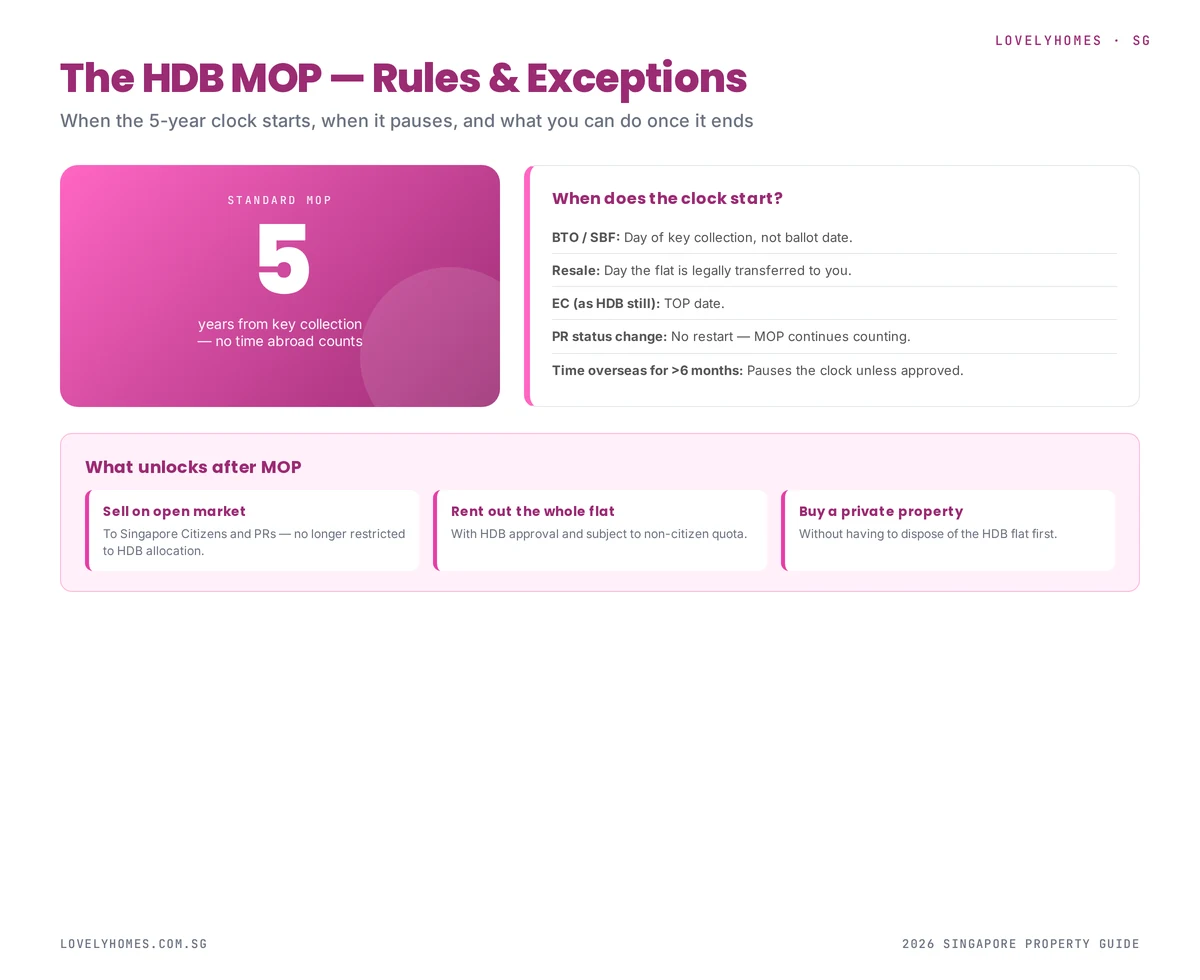
For HDB flats, subletting the whole flat requires the owner to have met the Minimum Occupation Period (MOP), typically five years from the point of key collection, and to obtain HDB’s approval before subletting. Subletting individual rooms within a flat the owner still occupies does not require MOP to be met, but still requires HDB approval and is subject to an occupancy cap that varies by flat type (roughly four occupants for a one- or two-room flat, up to around nine for a five-room or executive flat, though owners and any existing tenants count towards this cap). There are also quota restrictions on subletting to non-Singapore Citizens and non-PRs in certain blocks and neighbourhoods, so HDB owners should always check current conditions before advertising a room.
For private property, there is no MOP-style lock-in period and no need for government approval to sublet, whether the whole unit or individual rooms, though owners should check their mortgage terms and any tenancy restrictions in their title. The main constraint is URA’s minimum stay rule discussed above, plus practical considerations like MCST by-laws in condos, which sometimes restrict short-term letting or the number of unrelated occupants per unit. This more permissive framework for private property is a major reason why commercial co-living operators concentrate almost exclusively on private residential units rather than HDB flats.
What Co-Living Rooms Typically Include
Without endorsing any specific operator, co-living rooms in Singapore’s private residential market generally fall into a few common configurations: a private ensuite or shared-bathroom bedroom, fully furnished with a bed, wardrobe and desk, with utilities, wifi and regular common-area cleaning bundled into a single monthly fee. Many operators also offer flexible lease lengths starting from three months, a simplified move-in process without the need to separately arrange furniture or utility accounts, and shared amenities such as a communal kitchen, lounge or occasionally a coworking space, along with periodic social or networking events aimed at tenants who are new to the neighbourhood or to Singapore. The trade-off for this convenience and flexibility is typically a higher monthly rent compared to a bare, unfurnished room rented directly from a private landlord.
Tenant Rights, Deposits and Lease Terms
Whether renting through a co-living operator or a traditional master tenant, a few protections and practices apply broadly across Singapore’s rental market. A security deposit of around one to two months’ rent is standard, refundable at the end of the tenancy subject to the unit being returned in good condition and all outstanding payments settled; tenants should document the room’s condition with photos at move-in to avoid disputes later. The tenancy agreement, even for a co-living room, should clearly set out the rent, deposit, notice period for termination, what’s included (utilities, wifi, cleaning) and any house rules, and tenants should read this carefully before signing rather than relying on verbal assurances. For disputes over deposits or other tenancy-related claims within its monetary jurisdiction, tenants can bring a claim to the Small Claims Tribunal, which offers a relatively fast, low-cost avenue compared to formal litigation. Tenants should also confirm early on whether their room rental (co-living or informal) is being conducted in compliance with the applicable HDB or URA rules described above, since a rental arrangement that breaches these rules can create complications for the tenant as well as the landlord or operator.
Summary: Co-Living and Room Rental Facts at a Glance
| Question | Short Answer |
|---|---|
| Minimum stay for private co-living? | Typically around 3 months, following URA’s minimum-stay planning rule. |
| Does HDB room subletting need MOP? | No, but it still needs HDB approval and is subject to occupancy caps. |
| Does whole-flat HDB subletting need MOP? | Yes, the flat must have met MOP, plus HDB approval. |
| Typical co-living deposit? | Around 1-2 months’ rent, refundable subject to condition and payments. |
| Where to resolve a deposit dispute? | The Small Claims Tribunal, for claims within its monetary jurisdiction. |
| Do co-living operators run in HDB flats? | Rarely; the commercial model concentrates on private residential units. |
Worked Example: Comparing Monthly Costs for a Working Professional
Profile: Ms Wong, a working professional earning S$5,500 a month, is comparing three rental options in the Central region for a single-person budget.
Option 1 – Co-living private room: a furnished private room with ensuite in a co-living operated unit, all-inclusive of utilities, wifi and cleaning, at S$1,800 per month, on a 3-month minimum lease with a 1-month deposit (S$1,800).
Option 2 – Traditional master-tenant room rental: an unfurnished room rented directly from a condo owner acting as master tenant, at S$1,300 per month plus an estimated S$150 per month for her share of utilities and wifi, totalling S$1,450 per month, on a 6-month minimum lease with a 2-month deposit (S$2,600), and Ms Wong would need to source and pay for her own furniture separately.
Option 3 – Studio apartment, renting alone: a small private studio apartment at S$3,000 per month plus around S$250 per month in utilities and wifi, totalling S$3,250 per month, typically on a 12-month lease with a 2-month deposit (S$6,500).
Comparison: the co-living option costs S$350 more per month than the master-tenant room but requires a smaller upfront deposit, no furniture purchase, and offers the shortest minimum commitment. The studio apartment costs roughly 80% more per month than co-living, reflecting the premium of having an entire unit to herself, and requires the largest upfront cash outlay and longest lock-in. For a professional prioritising flexibility and low upfront cost over privacy of an entire unit, co-living or a master-tenant room are the more budget-efficient choices; the studio suits someone valuing full independence and willing to pay for it.
Why This Matters for Tenants and Landlords
Singapore’s co-living sector has grown because it solves a genuine friction point for young professionals, students and newly arrived expatriates: the difficulty of quickly finding a furnished room with clear, all-inclusive pricing and no need to negotiate directly with an individual landlord or set up utility accounts from scratch. For landlords and property owners, master-leasing a private unit to a co-living operator can also simplify management, since the operator typically handles tenant sourcing, rent collection and day-to-day issues. The trade-off, for both sides, is that this convenience is priced in, and tenants comparing options purely on headline monthly rent without accounting for bundled utilities, furnishing, deposit size and lease flexibility risk comparing apples to oranges.
What Might Come Next
The following is informed speculation, not confirmed policy. As co-living continues to mature as a rental category in Singapore, it’s plausible that clearer, more standardised guidance around operator licensing, minimum stay enforcement, and tenant protections specific to co-living arrangements could develop over time, particularly if the sector’s share of the private rental market continues to grow. Some industry commentary has also raised the question of whether HDB might explore more structured room-rental frameworks given persistent rental demand from students and young workers, though no specific policy change extending a co-living-style model to HDB flats has been signalled as at this writing.
Frequently Asked Questions
Is co-living legal in HDB flats?
HDB’s subletting framework does not accommodate the commercial co-living operator model. Individual HDB owners can sublet rooms directly to tenants with HDB approval, subject to occupancy caps, but this is traditional room subletting rather than an operator-run co-living arrangement.
Can I rent a co-living room for less than 3 months?
Generally no, for ordinary private residential co-living spaces, because URA’s planning rules require a minimum stay of around three consecutive months for private residential property. Some operators may offer shorter stays only where the specific property holds separate approval for shorter-term use.
What’s the difference between subletting a whole HDB flat and subletting just a room?
Subletting the whole flat requires the owner to have met the Minimum Occupation Period (MOP) and get HDB approval. Subletting just a room while the owner continues living there does not require MOP but still needs HDB approval and is subject to an occupancy cap based on flat type.
Is my deposit protected if a co-living operator or master tenant disappears?
There is no government-run deposit protection scheme for private residential tenancies in Singapore, unlike some other countries. Tenants should choose reputable operators or landlords, keep clear written records of payment and the tenancy agreement, and pursue unresolved disputes through the Small Claims Tribunal if needed.
Do foreigners face any restrictions renting a co-living room or HDB room?
Private property co-living rooms are generally open to any tenant with a valid pass or visa status. HDB room subletting to non-Singapore Citizens and non-PRs is subject to quota restrictions in certain blocks and neighbourhoods, so this should be checked with HDB or the flat owner before committing.
Can my landlord raise the rent partway through a co-living lease?
Not during a fixed lease term, unless the tenancy agreement specifically allows for it. Rent can typically only be adjusted at renewal, so tenants should check the agreement’s terms on rent review and renewal notice periods before signing.
Is co-living cheaper than renting a whole condo unit by myself?
Usually yes, on a per-month basis, since co-living splits the cost of a unit’s utilities, furnishing and space across multiple tenants. Renting an entire unit alone offers full privacy and independence but at a substantially higher monthly cost, as shown in the worked example above.
Related Articles on LovelyHomes
Click anywhere outside to close