
Singapore Property Ownership Types 2026: Freehold, Leasehold, Strata & HDB Explained
Quick Answer — Key Takeaways
- Singapore recognises five main property ownership types: freehold, 999-year leasehold, 99-year leasehold, HDB 99-year lease, and strata title (including ECs).
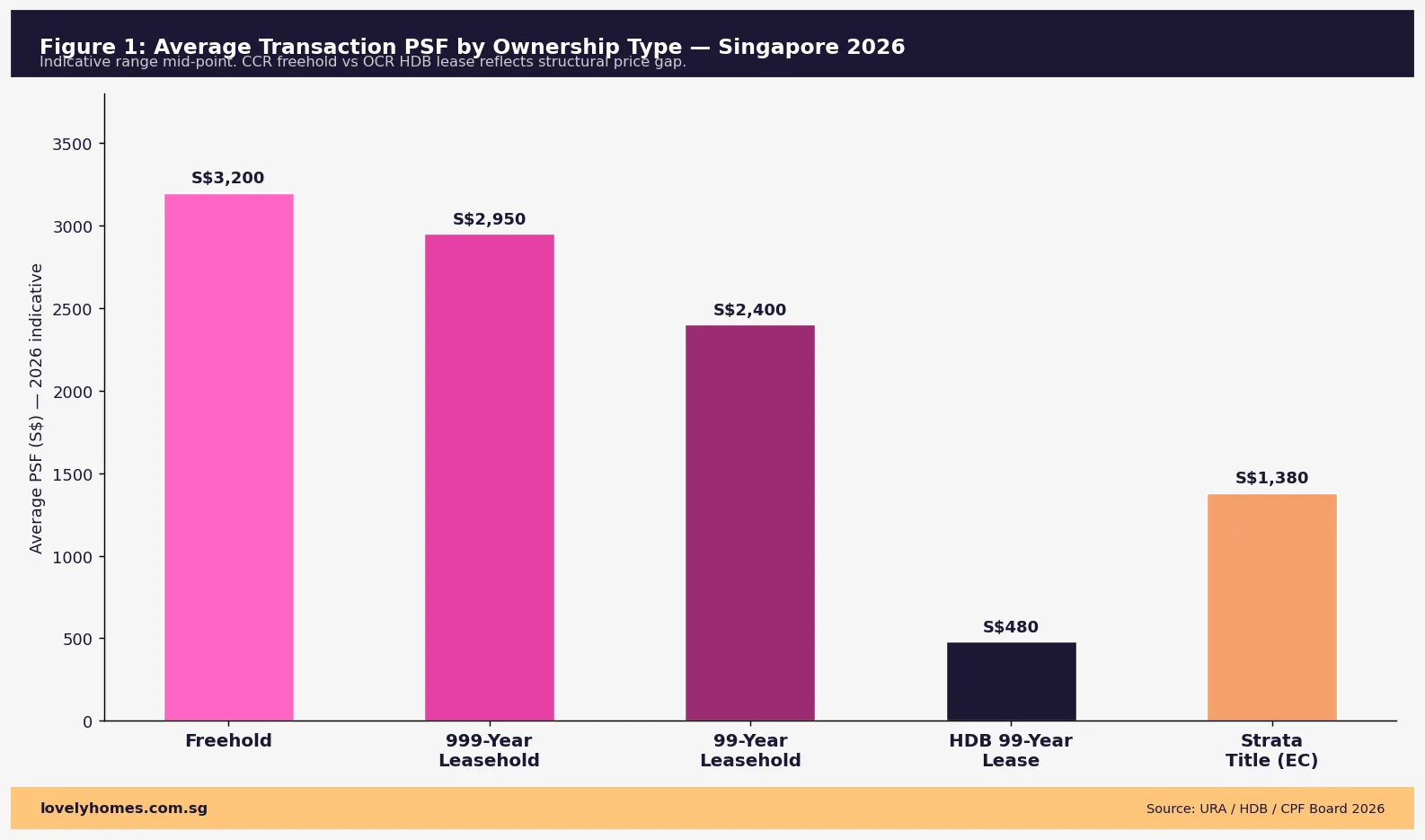
- Freehold properties are held in perpetuity and command a price premium of roughly 10–20% over comparable 99-year leasehold units, though the gap has narrowed in OCR.
- 999-year leasehold is functionally equivalent to freehold for most buyers’ lifetimes but can face the same decay risks as 99-year leases once significantly shortened.
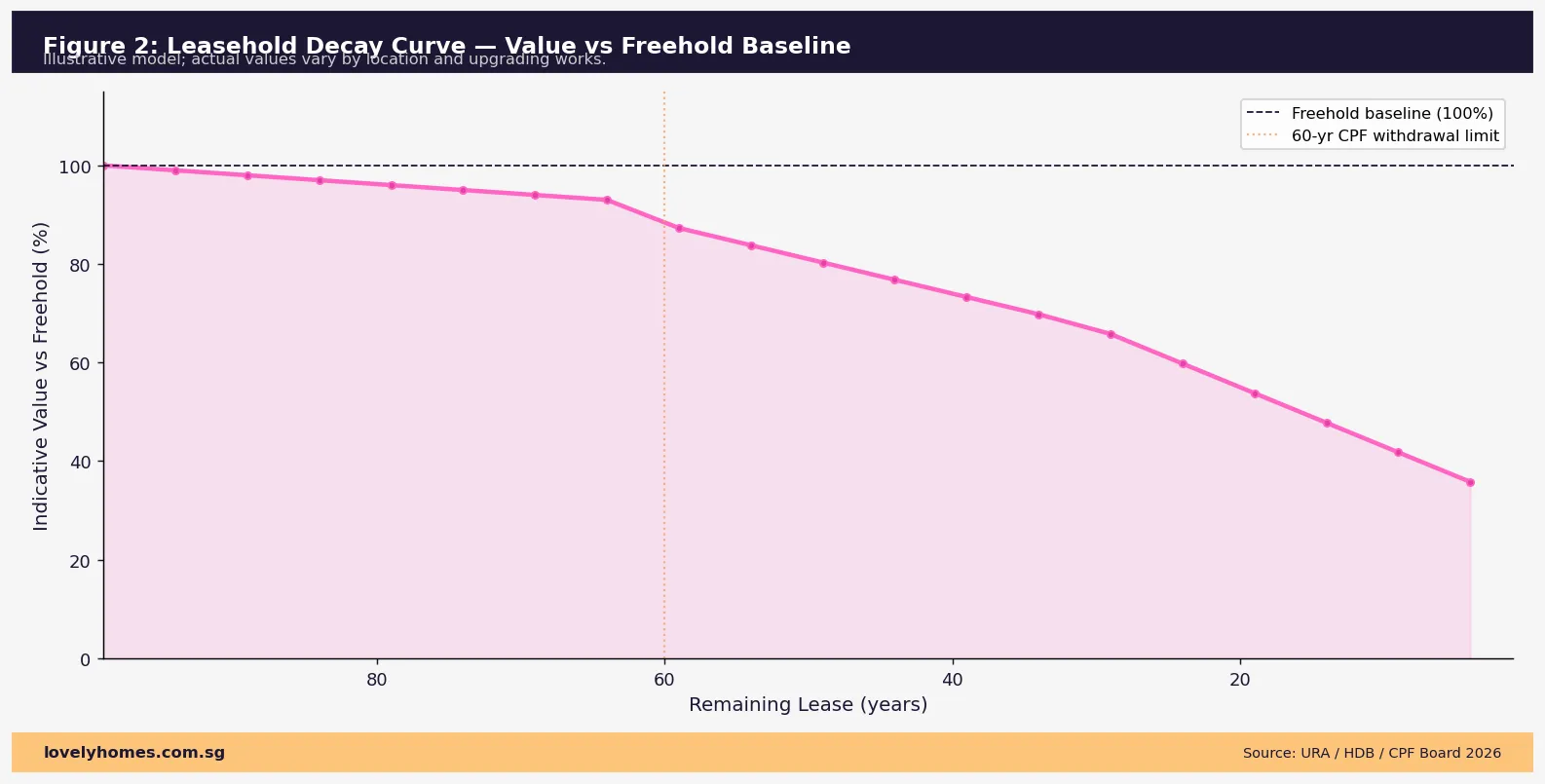
- Leasehold decay accelerates below 60 remaining years — CPF withdrawals are also restricted once the remaining lease falls below 20 years (for loans) or below the buyer’s age-adjusted requirement.
- HDB flats are held on a 99-year lease from HDB, not on a title deed, and come with occupancy and resale restrictions (Minimum Occupation Period, ethnic integration quotas).
- Strata title grants individual title to a unit within a development, shared common property governed by the Management Corporation Strata Title (MCST) under the Building Maintenance and Strata Management Act (BMSMA).
- Foreigners may generally only purchase non-landed private residential property freely; they require Land Dealings Approval Unit (LDAU) approval for landed and are barred from HDB ownership entirely.
- CPF Ordinary Account (OA) funds can be withdrawn for any ownership type within limits, but are subject to Lease Requirements — the property’s remaining lease must cover the youngest buyer’s age to 95.
What Are Property Ownership Types in Singapore?
When you buy property in Singapore, what you are actually acquiring is a bundle of rights defined by the legal ownership type. Unlike some countries where “owning” land means owning it outright in perpetuity, Singapore operates a sophisticated multi-tenure system administered by the Singapore Land Authority (SLA). The type of ownership determines how long you may hold the land, whether you can pass it to heirs, whether CPF funds may be used, whether foreigners may purchase, and how any collective sale (en bloc) would be structured.
Getting the ownership type right is one of the first decisions a buyer must make — and it has direct implications for purchase price, loan quantum, CPF usage, rental rights, and eventual resale value. This guide explains each type comprehensively and compares them across the dimensions that matter most to Singapore property buyers in 2026.
Freehold — Permanent Land Title
Freehold ownership (also called fee simple) conveys the land and anything permanently fixed to it to the owner in perpetuity, with no expiry. In Singapore, freehold land is governed by the Land Titles Act (Cap. 157) and registered at the SLA. The owner may use, lease, mortgage, subdivide (subject to planning approval), gift, or bequeath the property freely. There are no occupation restrictions under the Residential Property Act (RPA) for citizens or permanent residents.
The Singapore government retains the right of compulsory acquisition under the Land Acquisition Act, which means that even freehold land can, in theory, be acquired for public purposes at statutory compensation. In practice, modern public-sector acquisitions are relatively rare for established residential freehold estates, but owners of ageing freehold developments sometimes participate in en-bloc redevelopment to crystallise land value.
Freehold property in Singapore is predominantly found in District 9, 10, and 11 (Core Central Region), parts of Districts 15 and 21, and in older landed housing estates. New freehold launches are increasingly rare in the CCR as the government allocates more 99-year leasehold sites through GLS, making existing freehold stock more scarce and — structurally — more valuable.
999-Year Leasehold — Functionally Freehold
A 999-year leasehold is a legacy tenure form from Singapore’s colonial era, when developers bought very long-term leases from the Crown. These properties are still governed by the SLA and enjoy the same CPF and loan terms as freehold. For any buyer under 80 years old, a 999-year lease starting in the 1800s will have at least 700-plus years remaining — making the practical difference from freehold negligible for investment purposes within a 30-year horizon.
However, once the remaining tenure falls significantly — say, below 200 years due to partial sale or new grant — the same lease-decay economics that apply to 99-year properties begin to emerge. Most Singapore 999-year properties date from 1950–1990 and retain 700+ years, so this is largely theoretical for current buyers.
99-Year Leasehold — The Market Standard
The vast majority of new private residential launches in Singapore since the 1990s have been on 99-year leasehold land sold through the Government Land Sales (GLS) programme administered by the Urban Redevelopment Authority (URA). The lease is counted from the date of award of the tender, not the completion of the building — so a development built in 2024 on a site tendered in 2022 begins its lease in 2022.
The principal risk for 99-year leasehold is lease decay. Once a property’s remaining lease falls below 60 years, CPF withdrawal eligibility is reduced on a pro-rated basis. Below 30 years, bank loans become difficult or impossible to obtain, and TDSR-compliant loan tenors are further constrained. Below 20 years, CPF may not be used at all. This means the property effectively becomes a cash-purchase market with a shrinking buyer pool — and therefore lower resale prices, particularly in the mass-market OCR.
HDB 99-Year Lease — A Distinct Framework
HDB flats are not sold on a title deed. Instead, buyers purchase a 99-year lease from the Housing & Development Board under the Housing and Development Act (Cap. 129). The HDB retains ultimate ownership of the land and the building, and the flat comes with substantial occupancy conditions: a Minimum Occupation Period (MOP) of five years before the flat may be sold on the open market or rented out as a whole, ethnic integration quotas per block and neighbourhood, and income ceilings for initial purchase.
Despite these restrictions, HDB resale flats — particularly 4- and 5-room flats in mature estates — have appreciated significantly. The HDB Resale Price Index (RPI) rose approximately 44% from 2015 to Q2 2026, slightly outpacing the overall private residential PPI over the same period on a percentage-points basis, driven by the 2021–2022 resale surge.
HDB also operates the Selective En bloc Redevelopment Scheme (SERS) for older HDB estates — HDB acquires aging blocks compulsorily and offers replacement flats — and the Voluntary Early Redevelopment Scheme (VERS), which allows mature-estate flat owners to vote for early redevelopment in exchange for market-compensated replacement units. Neither scheme is a collective sale equivalent: residents cannot block or initiate them independently.
Strata Title — Owning a Unit in a Shared Development
Strata title is not a tenure type in itself — it is a legal mechanism that allows individual ownership of a defined space (a unit) within a multi-unit development, with co-ownership of common property shared among all unit owners. In Singapore, strata-titled properties include private condominiums, apartments, commercial shophouses, industrial units, and executive condominiums (ECs). Strata title is created under the Land Titles (Strata) Act (Cap. 158A) upon the subdivision of a building into units.
Each strata-titled development is managed by a Management Corporation Strata Title (MCST) elected by unit owners at the Annual General Meeting. The MCST levies monthly maintenance fees (service and sinking fund contributions) and is responsible for upkeep of common areas, structural maintenance, and facilities management. Disputes may be referred to the Strata Titles Board (STB).
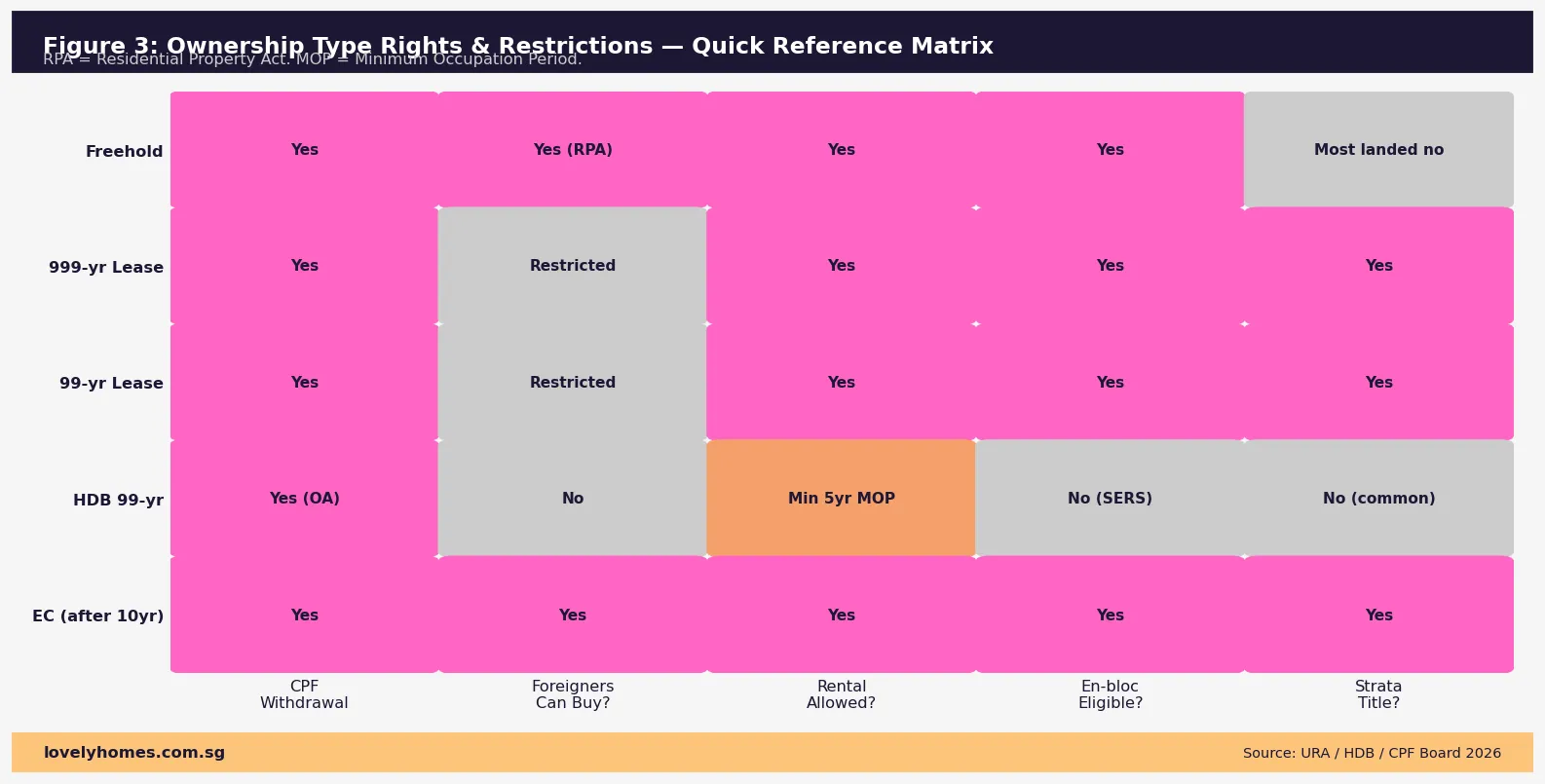
| Ownership Type | Tenure | SLA Registered? | Foreign Purchase? | CPF OA Eligible? | MCST / MOP? |
|---|---|---|---|---|---|
| Freehold | Perpetual | Yes | Yes (RPA applies) | Yes | MCST if strata; no MOP |
| 999-Year Leasehold | ~999 yrs from grant | Yes | Yes (RPA applies) | Yes | MCST if strata; no MOP |
| 99-Year Leasehold | 99 yrs from tender award | Yes | Yes (RPA; non-landed) | Yes (lease-age check) | MCST; no MOP |
| HDB 99-Year Lease | 99 yrs from flat key collection | No (HDB lease) | No | Yes (OA, lease check) | TC / RC; 5-yr MOP |
| EC (Strata, 99-yr) | 99 yrs | Yes (after MOP) | After 10 years | Yes | MCST; 5-yr MOP for subsidy |
Foreign Ownership Rules in Singapore
The Residential Property Act (RPA) administers what foreigners — defined as anyone who is not a Singapore citizen — may purchase. Foreigners (including permanent residents, unless they qualify for exemptions) may buy:
- Non-landed private residential: condominiums and apartments — freely, subject to ABSD at 60% for foreigners (as of 2023 policy).
- Executive condominiums (ECs): only after the development is 10 years old (fully privatised).
- Landed residential property: requires LDAU approval, granted only in limited circumstances (typically for exceptional economic contribution or Sentosa Cove residential plots).
- HDB flats: not at all.
Singapore PRs are treated similarly to foreigners for ABSD purposes (5% on first purchase, 30% on second) and cannot buy HDB flats from HDB (only resale from the open market, with a 3-year PR residency requirement and the same MOP conditions).
Worked Example: CPF Implications — 99-Year vs Freehold Purchase
Consider a Singapore Citizen couple buying a S$1.5M condominium in 2026. Husband is 38, wife is 36. They plan to hold for 25 years and sell at age 63/61.
Option A: Freehold condo. No lease-age restriction applies. CPF OA contributions (combined ~S$3,100/mth at current salary) may be withdrawn fully toward the purchase price, up to the Valuation Limit and then the Additional Withdrawal Limit. No decay risk on resale — value depends purely on market conditions.
Option B: 99-year leasehold condo with lease starting 2024. In 2026, remaining lease = 97 years. When they sell in 2051 (25 years later), remaining lease = 72 years. CPF is still fully available for the buyer at that point (72-year lease covers a buyer aged 23 to 95 comfortably). Value haircut versus freehold is modest at 72 years.
Option C: 99-year leasehold completed in 2001, starting lease in 1999. In 2026, remaining lease = 72 years. When they sell in 2051, remaining lease = 47 years. At 47 years, a buyer’s CPF is pro-rated; bank loans are capped at a shorter tenor. The couple’s exit is materially constrained — the buyer pool narrows and the price will likely reflect a discount to comparable newer leaseholds. They may achieve only 60–70% of what a comparable 2024-built leasehold would fetch.
Lesson: For a 99-year leasehold, what matters is not just the current remaining lease but the remaining lease at your intended selling date. Buy with at least 70 years remaining to maintain full CPF eligibility and a healthy buyer pool at exit.
What This Means for You as a Buyer or Investor
Ownership type interacts with your investment strategy at every step. For an owner-occupier buying a family home with no immediate plans to sell, a 99-year leasehold in a well-located estate bought with 85-plus years remaining is entirely rational — the family will enjoy the property for 20–30 years and resell while the lease is still above 55 years, retaining strong resale demand. For an investor seeking long-term wealth preservation across generations, freehold — particularly for landed property — removes the lease-decay variable entirely, at a higher entry cost.
HDB ownership delivers the best value per square foot in Singapore by a wide margin, and the HDB Grant ecosystem (EHG, Family Grant, PHG, Staggered Down Payment Scheme) reduces the effective purchase cost substantially for first-time buyers. The trade-off is the five-year MOP — you cannot monetise the flat until MOP is cleared — and the restrictions on subletting the whole flat.
What Might Come Next — Ownership Type Policy Outlook 2026–2030
Several policy themes are likely to shape property ownership types over the next five years. First, the government’s introduction of the Long-Stay Serviced Apartment (LSSA) category in 2024 creates a new strata-title accommodation class for purpose-built co-living, which may introduce a new ownership hybrid in future GLS sites. Second, the HDB VERS programme is being expanded, and details on compensation frameworks for upcoming mature-estate VERS estates are expected in late 2026 or 2027, which will directly affect owners’ view of HDB lease risk. Third, there is ongoing academic and policy discussion — though no official announcement — about whether GLS should ever allocate freehold land, given the concentration of freehold in older, wealthier districts and its impact on long-term land use flexibility.