
Singapore Home Loan Guide 2026: HDB Loan, Bank Loan, SORA Rates and How to Choose
A home loan in Singapore is the single largest financial commitment most households will ever make. Whether you are buying a HDB resale flat, a new executive condominium, or a private condo, the loan you choose determines your monthly cash flow, your total interest cost over decades, and your flexibility to refinance as rates move. This guide covers everything you need to know about home loans in Singapore in 2026 — who offers them, what the rates look like, how the loan rules work, and what to watch out for before you sign.
Quick Answer — Singapore Home Loan at a Glance
- Two main options: HDB concessionary loan (2.6% p.a.) or bank loan (SORA-pegged or fixed, typically 3.0–4.5% p.a.)
- HDB loan: max 80% LTV, HDB flats only, must pass HFE Letter; bank loan: max 75% LTV, all property types
- All borrowers subject to TDSR 55%; HDB/EC buyers also subject to MSR 30%
- Minimum cash downpayment: 5% (HDB loan); 5% cash + 20% cash/CPF (bank loan 1st property)
- Maximum loan tenure: 30 years (bank); 25 years (HDB); subject to age 65 cap
- CPF Ordinary Account (OA) may be used for downpayment and monthly instalments, subject to the CPF withdrawal rules
HDB Loan vs Bank Loan — Which Should You Choose?
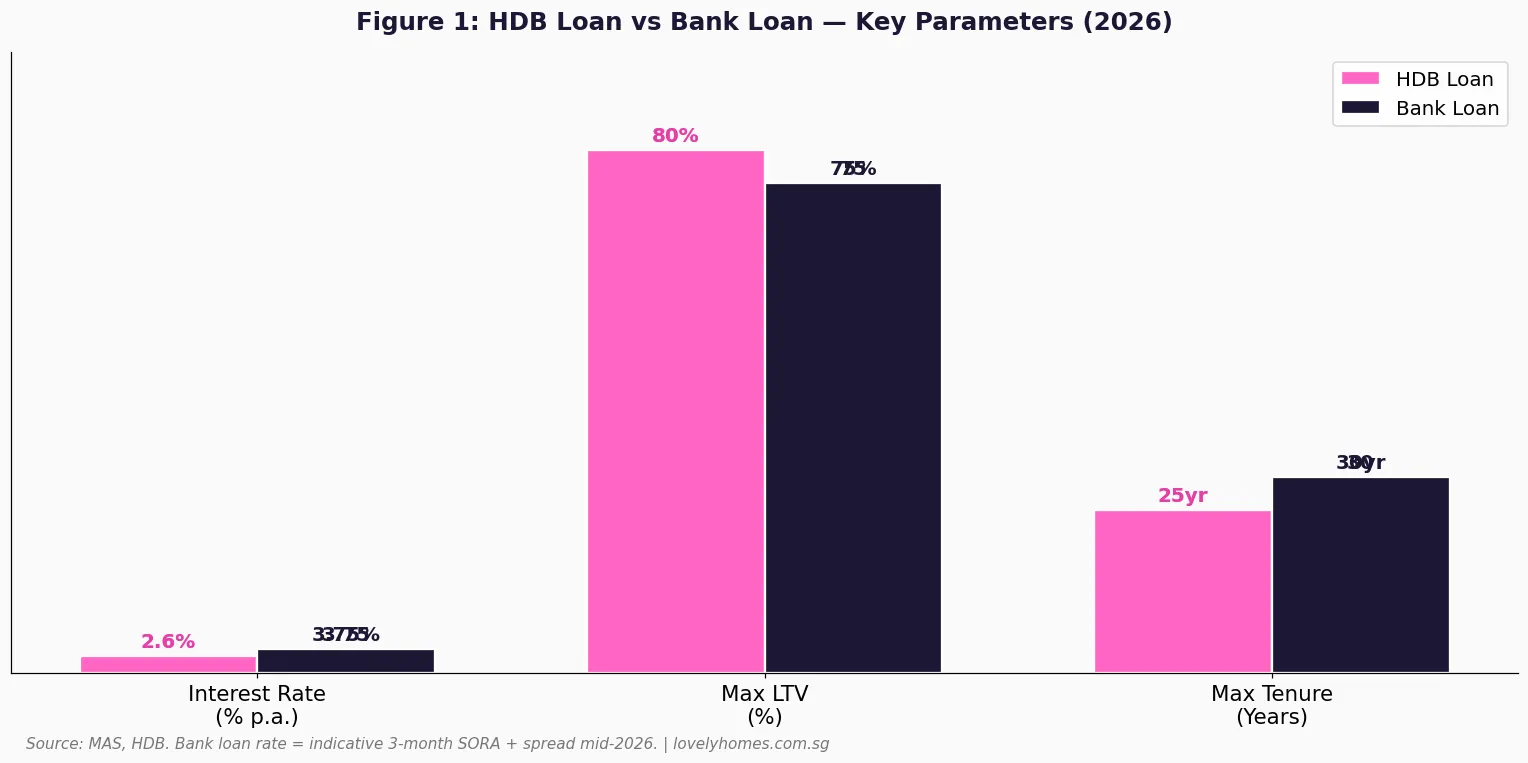
Singapore home buyers borrowing for a HDB flat have a choice that private condo buyers do not: they can take a HDB concessionary loan administered by HDB itself, or a bank loan from a licensed financial institution. Each has meaningfully different terms, and the decision can affect your total interest outlay by tens of thousands of dollars over a 25-year term.
| Feature | HDB Concessionary Loan | Bank Loan |
|---|---|---|
| Eligible properties | HDB flats only | HDB, EC, private condo, landed |
| Interest rate (2026) | 2.6% p.a. (CPF OA rate + 0.1%) | ~3.0–4.5% p.a. (SORA-pegged or fixed) |
| Maximum LTV | 80% of purchase price / valuation | 75% (1st property); 45% (2nd); 35% (3rd+) |
| Maximum tenure | 25 years (or up to age 65) | 30 years (or up to age 65) |
| Downpayment (cash) | Min 5% cash (rest from CPF/cash) | Min 5% cash; 20% cash or CPF |
| Prepayment penalty | None | Usually 1.5% within lock-in period (1–3 yr) |
| Refinancing allowed | No (HDB loan stays with HDB) | Yes — reprice or refinance after lock-in |
| Rate variability | Pegged to CPF OA; rarely changes | Moves with 3-month SORA or fixed for 2–3 yr |
The HDB loan offers stability and simplicity — the rate has historically changed only when the CPF OA rate moves, which is infrequent. It also allows a higher 80% LTV (versus 75% for a bank), meaning your cash outlay is smaller at the point of purchase. The trade-off is that you forgo the possibility of locking in a bank fixed rate that might be lower than 2.6% p.a. in a falling-rate environment, and you cannot refinance to a cheaper package once rates fall.
Bank loans offer more flexibility and potential savings when rates are low. A SORA-pegged package in a low-rate environment can sit meaningfully below 2.6% p.a., reducing your total interest cost. The risk is rate volatility — if SORA rises sharply (as it did in 2022–2023), monthly repayments can jump. Fixed-rate bank packages provide certainty for the first 2–3 years but typically revert to floating rates afterwards.
How Home Loan Interest Rates Work in Singapore (2026)
Understanding how your rate is set is critical for long-term budgeting. Singapore bank mortgages are predominantly benchmarked to the Singapore Overnight Rate Average (SORA), which replaced SIBOR as the primary benchmark. SORA is administered by the Monetary Authority of Singapore (MAS) and reflects actual overnight interbank lending rates.
A typical bank package in 2026 reads something like: 3-month compounded SORA + 0.85% p.a., meaning your rate moves every quarter. Fixed-rate packages lock in a rate (commonly 3.20–3.80% p.a. in 2026) for a 2-year or 3-year period, after which the loan typically reverts to a floating SORA-based rate.
The HDB concessionary loan rate is set at 0.1 percentage point above the CPF OA interest rate, which itself is mandated by statute to be at least 2.5% p.a. As a result, the HDB loan rate has sat at 2.6% p.a. for many years, and would only change if the Government revises the CPF OA rate — something that last happened in 2008.
Monthly Repayment: What You Actually Pay Each Month
Your monthly repayment is determined by three variables: the loan principal, the interest rate, and the remaining tenure. The formula is a standard amortising mortgage calculation — each month you pay accrued interest on the outstanding balance plus a portion of the principal. In the early years, the repayment is almost entirely interest; by the final years, it is almost entirely principal.
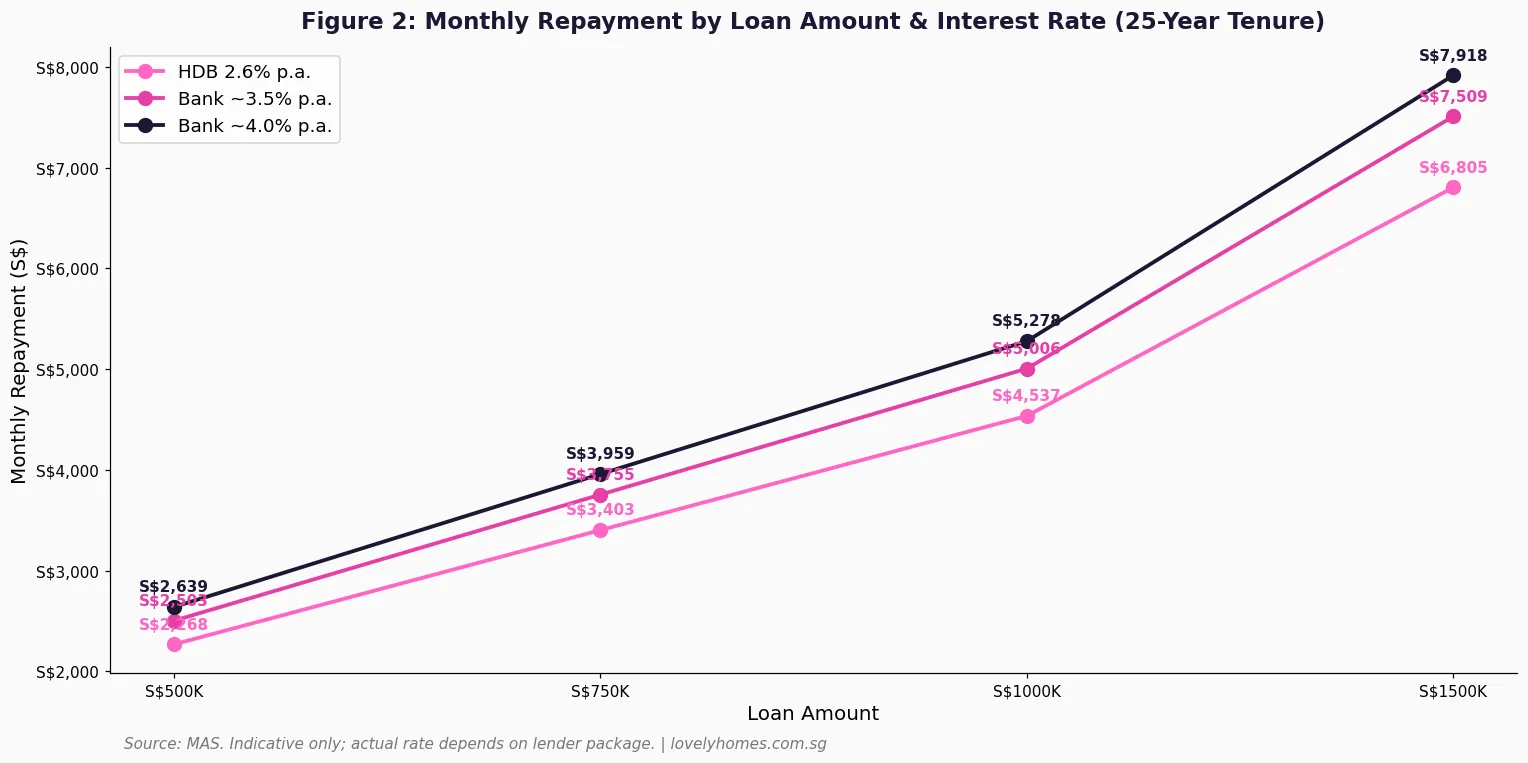
One practical implication: if you are assessing your TDSR eligibility (which caps total debt servicing at 55% of gross monthly income), the repayment figure that lenders use for the stress test is not your actual repayment but a stress-tested rate of at least 4.0% p.a., regardless of the package rate. MAS requires this to ensure borrowers can withstand a rate increase. If you are buying an HDB flat or EC, the additional MSR 30% cap applies — your housing loan servicing must not exceed 30% of gross monthly income.
Total Interest Cost Over the Loan Lifetime
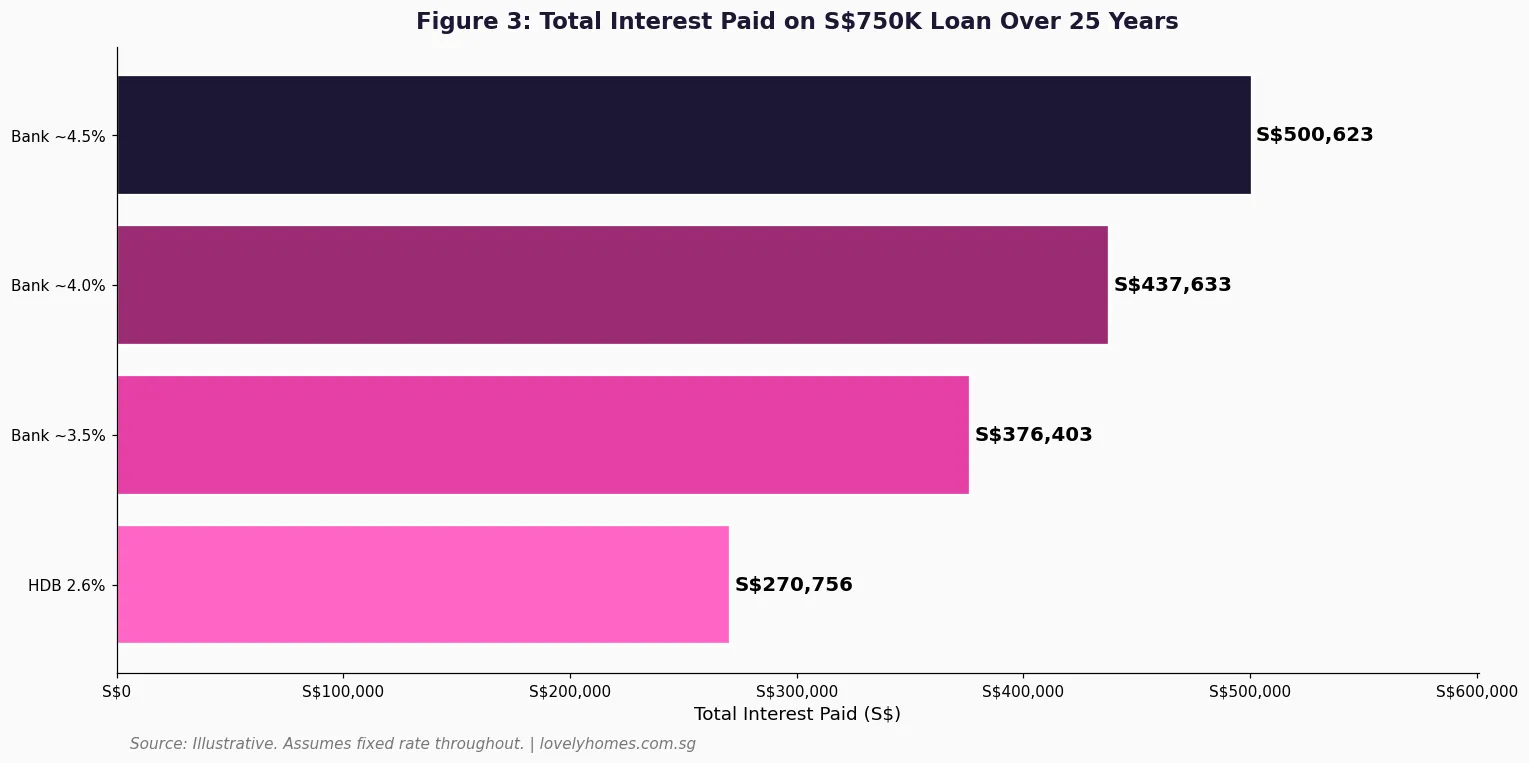
Borrowers often focus on the monthly repayment without considering the total interest they will pay over the full tenure. On a S$750,000 loan at 25 years, even a 1 percentage point difference in interest rate costs over S$90,000 more in total interest. This is why choosing between a bank fixed rate and the HDB rate, or deciding whether to refinance, has substantial long-term consequences.
Loan-to-Value Limits and Downpayment Requirements
The LTV limit determines how much of the purchase price or valuation (whichever is lower) a lender will finance. MAS sets these limits for bank loans; HDB sets them for its concessionary loan. Buyers with outstanding home loans face reduced LTV limits.
For a first-time buyer taking a bank loan on a private property:
- Maximum LTV: 75%, meaning a minimum 25% downpayment
- Of that 25%, at least 5% must be in cash; the remaining 20% can come from CPF OA or cash
- For a S$1,500,000 condo: cash S$75,000 + CPF/cash S$300,000 + bank loan S$1,125,000
For a first-time buyer taking an HDB loan on a flat:
- Maximum LTV: 80%, meaning a minimum 20% downpayment
- The full 20% can be paid from CPF OA; no mandatory cash component beyond a S$1,000 booking fee
If you or your co-borrower has an outstanding residential home loan, your LTV drops to 45% (bank) or 55% (if HDB loan for a second flat, subject to strict conditions). A third loan reduces the LTV to 35%. These rules are set out in MAS Notices 632 and 1115.
Eligibility: What Lenders Check Before Approving Your Loan
A home loan approval in Singapore involves three main tests administered by lenders under MAS guidelines:
1. TDSR (Total Debt Servicing Ratio) — 55% cap: All monthly debt obligations (housing loan + car loan + credit card minimum payments + personal loans) must not exceed 55% of gross monthly income, using a stress-tested rate of at least 4.0% p.a. for the housing loan component. Income is haircut for variable components (bonuses, rental income) and must be verifiable.
2. MSR (Mortgage Servicing Ratio) — 30% cap (HDB and EC only): The monthly repayment on a HDB flat or EC loan specifically must not exceed 30% of gross monthly income, again at the stress-tested rate. MSR is more restrictive than TDSR for most borrowers and is the binding constraint for HDB buyers at higher loan amounts.
3. LTV limit: Described above — the maximum loan quantum relative to the property value.
For the HDB concessionary loan, eligibility also requires an HDB Flat Eligibility (HFE) Letter, which you apply for via the HDB website. The HFE Letter also tells you your estimated grant amounts and HDB loan eligibility at a glance, valid for 6 months. For a bank loan, you apply for an In-Principle Approval (IPA) from the bank, typically valid for 30 days.
Worked Example: The Wong Family Buys a 4-Room HDB Resale Flat
Mr and Mrs Wong are both Singapore Citizens aged 35. Their combined gross monthly income is S$8,500. They wish to buy a 4-room HDB resale flat in Tampines for S$580,000.
Step 1 — Financing choice: They decide to take an HDB concessionary loan at 2.6% p.a.
Step 2 — Eligibility check:
- MSR 30%: maximum monthly housing payment = S$8,500 × 30% = S$2,550/month
- At 2.6% p.a. stress-tested at 4.0% p.a. (MAS minimum), over 25 years: monthly repayment at 4.0% for S$X = S$2,550 → X ≈ S$487,000 max loan
- LTV 80% of S$580,000 = S$464,000 → LTV is the binding cap at S$464,000
Step 3 — Downpayment: S$580,000 − S$464,000 = S$116,000 downpayment (all from CPF OA; no mandatory cash if HDB loan)
Step 4 — Monthly repayment (actual rate): S$464,000 at 2.6% p.a. over 25 years = approximately S$2,102/month (well within MSR S$2,550)
Step 5 — Grants check: As first-time buyers with income S$8,500/month, they qualify for: Enhanced Housing Grant (EHG) up to S$40,000 + Family Grant S$50,000 = S$90,000 in CPF grants, reducing the effective loan to S$374,000 and monthly repayment to approximately S$1,694/month.
Total upfront cash required: BSD S$10,800 (from CPF) + legal fees ~S$3,000 + booking fee S$1,000 = approximately S$4,000 cash out of pocket, with the rest from CPF OA and grants.
Refinancing and Repricing: Managing Your Rate After Purchase
If you take a bank loan, you are not locked into your initial package forever. After the lock-in period (typically 1–3 years), you have two options:
Repricing: Switching to a new package with the same bank. Usually costs S$200–S$800 in administrative fees and takes 2–4 weeks. Faster and simpler than refinancing but limited to that bank’s current packages.
Refinancing: Moving your loan to a different bank. Can secure a significantly better rate but requires a new property valuation, new legal work, and takes 8–12 weeks. Legal subsidy of S$1,800–S$3,000 is typically offered by the new bank to offset costs.
A general rule of thumb: refinancing is worth the effort if you can save at least 0.5 percentage points on your rate and you have more than 10 years remaining on your tenure — the interest savings over time will far outweigh the one-time costs. See our dedicated Mortgage Refinancing Guide 2026 for a full worked example.
CPF and Your Home Loan: What You Can and Cannot Use
CPF Ordinary Account (OA) savings can be used to pay your downpayment and service your monthly loan instalments, subject to limits set by the CPF Board and MAS. Key rules:
- CPF OA can be used for both HDB and private property, subject to the Valuation Limit (VL) — withdrawals are capped at the lower of the purchase price or market valuation
- After reaching the VL, CPF usage continues up to the Withdrawal Limit (120% of VL), but only if you have set aside the current Basic Retirement Sum (BRS) in your Retirement Account or Special Account
- For properties with remaining lease < 60 years, CPF usage is restricted and the loan is capped — see our CPF Property Withdrawal Rules Guide for the short-lease rules
- CPF cannot be used to pay ABSD, Buyer’s Stamp Duty (on ABSD amounts), agent commission, renovation costs, or moving expenses
What Might Change for Home Loans in Singapore
The MAS has signalled it will continue monitoring the property market closely. Key factors to watch in the second half of 2026 include: further movement in 3-month SORA as global central banks adjust policy; any revision to MAS Notice 632 or 1115 that might adjust LTV limits or TDSR stress-test rates; and whether the Government considers adjusting CPF housing withdrawal rules in light of the June 2023 housing policy update. The HDB loan rate, at 2.6% p.a., is unlikely to change unless the CPF OA rate is revised — a relatively rare event. Most analysts do not anticipate rate changes in 2026, but prudent borrowers should always stress-test their repayments at 4.5–5.0% p.a. when budgeting.
Summary: Singapore Home Loan Rules at a Glance
| Rule | HDB Loan | Bank Loan (1st Property) |
|---|---|---|
| Max LTV | 80% | 75% |
| Min cash downpayment | 0% (5% recommended buffer) | 5% cash |
| Interest rate (2026) | 2.6% p.a. | ~3.0–4.5% p.a. |
| TDSR cap | 55% | 55% |
| MSR cap (HDB/EC) | 30% | 30% |
| Max tenure | 25 yr (age 65 cap) | 30 yr (age 65 cap) |
| Stress test rate | 4.0% p.a. | 4.0% p.a. |
| Eligibility document | HFE Letter | In-Principle Approval (IPA) |
Frequently Asked Questions
Can I switch from an HDB loan to a bank loan after purchase?
Yes. You can refinance from an HDB concessionary loan to a bank loan at any time — there is no lock-in period on the HDB side. However, you cannot switch back from a bank loan to an HDB loan once you have refinanced. This means the decision is one-way. Most buyers refinance to a bank when bank rates fall below 2.6% p.a., but they should factor in the permanence of that switch before acting.
What is the SORA rate and how does it affect my mortgage?
SORA (Singapore Overnight Rate Average) is the volume-weighted average rate of overnight interbank SGD cash transactions in Singapore, published daily by MAS. Most bank home loan packages in Singapore are now benchmarked to the 3-month compounded SORA. This means your effective rate adjusts quarterly based on where SORA has been over the prior three months. In mid-2026, the 3-month compounded SORA stood at approximately 2.8–3.2% p.a. (indicative), so a package with a spread of 0.80% would result in an all-in rate of ~3.6–4.0% p.a. MAS publishes daily SORA data at mas.gov.sg/monetary-policy/sora.
How much income do I need to borrow S$800,000 for a home loan?
Using the MAS stress-test rate of 4.0% p.a. over 30 years, a S$800,000 bank loan requires a monthly repayment of approximately S$3,819. Under TDSR 55%, this requires gross monthly income of at least S$6,944 (S$3,819 ÷ 0.55) — assuming no other debt obligations. If you have a car loan of S$1,000/month, your required income rises to S$8,762/month. For an HDB flat with MSR 30%, the same S$800,000 loan (adjusted to the S$750,000 max LTV) over 25 years at the stress-test rate requires income of approximately S$11,370/month under the 30% cap.
Can I use CPF to pay all of my monthly home loan instalments?
Yes, in most cases — as long as you have sufficient CPF OA balance and your property meets the age-of-lease requirements. The CPF Board allows OA savings to be used for both downpayment and monthly instalments for HDB flats and eligible private properties. The key restriction is the Valuation Limit: once cumulative CPF withdrawals reach the lower of the purchase price or valuation, further CPF usage is permitted only up to 120% of the VL and only if you have set aside the BRS. After that, all instalments must be serviced in cash.
What happens to my home loan if I sell the property?
When you sell, the outstanding loan balance is repaid from the sale proceeds at completion. The sequence of payment is: (1) bank redeems the outstanding loan; (2) CPF refunds are made to your OA (including accrued interest at 2.5% p.a.); (3) any remaining cash proceeds go to you. If you have taken an HDB loan on a flat, CPF accrued interest applies the same way. If the sale price is insufficient to cover the outstanding loan plus CPF refund, you are responsible for topping up the shortfall in cash — a situation that can arise if prices have fallen significantly or the loan is in its early years when the outstanding balance is still very high.
Is it better to take a shorter or longer loan tenure?
A shorter tenure means higher monthly repayments but substantially lower total interest cost. A 20-year loan on S$700,000 at 3.5% p.a. costs approximately S$234,000 in total interest; a 30-year loan at the same rate costs approximately S$369,000 — a difference of S$135,000. The right choice depends on your cash flow. If your TDSR and MSR allow you to comfortably service a shorter tenure, the interest savings are compelling. However, many borrowers prefer a longer tenure for cash-flow flexibility, intending to make voluntary capital repayments when possible — this strategy works well provided you actually follow through on the extra payments.
What is an In-Principle Approval (IPA) and do I need one before making an offer?
An IPA (sometimes called an Agreement-in-Principle) is a non-binding letter from a bank confirming that, based on the financial information you have provided, they are prepared to lend you up to a stated amount. It does not guarantee the final loan — the bank will conduct a full credit assessment and property valuation before formal approval. An IPA is valid for about 30 days. You do not legally need an IPA before granting or receiving an OTP, but having one is strongly advisable: it confirms your budget, speeds up the formal approval, and prevents the situation where you exercise an OTP only to find you cannot secure financing.
Related Articles
- TDSR & MSR Singapore 2026: Complete Guide to Borrowing Limits
- Singapore LTV Limit Guide 2026: Loan-to-Value Rules Explained
- Singapore Mortgage Refinancing Guide 2026: When to Refinance
- CPF Property Withdrawal Rules Singapore 2026: OA Limits & Accrued Interest
- Singapore First-Time Home Buyer Guide 2026: Grants, Steps and More
- ABSD Singapore 2026: Complete Guide to Additional Buyer’s Stamp Duty
- Singapore BSD Complete Guide 2026: Buyer’s Stamp Duty Rates & Calculator
Disclaimer
This article is intended as general educational information about home loans in Singapore and does not constitute financial, legal, or mortgage advice. Home loan eligibility, interest rates, and regulatory rules are subject to change by MAS, HDB, and individual lenders. All figures are indicative and based on information available as of 2 August 2026. You should seek advice from a licensed mortgage broker or financial adviser and verify current rates and terms with your preferred lender. For CPF usage rules, refer to the CPF Board website. For TDSR and LTV rules, refer to MAS.gov.sg. For HDB loan eligibility, refer to HDB.gov.sg.