Singapore Tenants’ Rights Guide 2026: Laws, Deposits and Dispute Resolution
Quick Answer: Singapore Tenants’ Rights at a Glance (2026)
- Tenants are protected under the Residential Tenancies Act (RTA) 2022, administered by the Community Disputes Resolution Tribunals (CDRT).
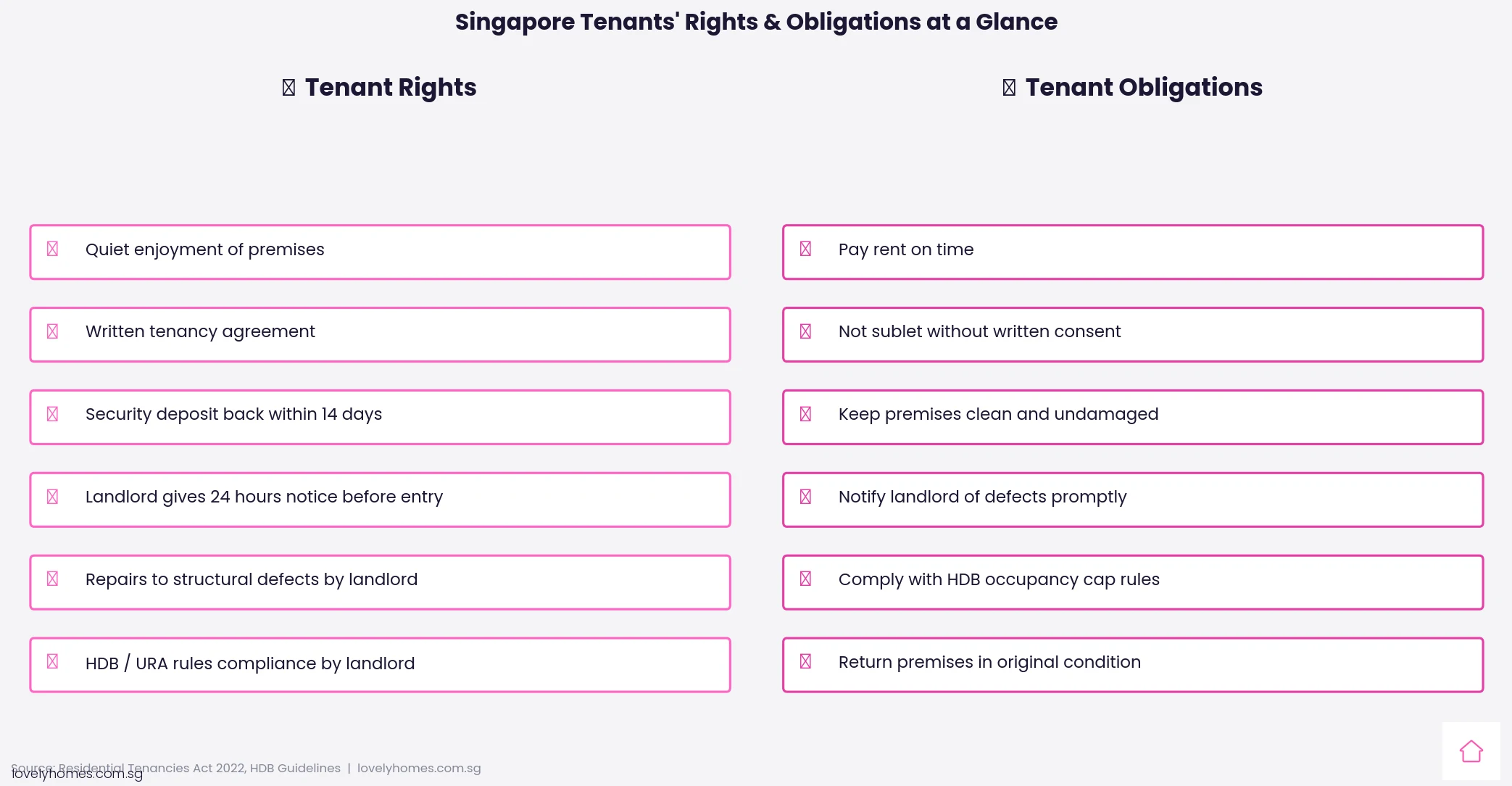
- Your security deposit is capped at two months’ rent for a two-year tenancy; one month for a one-year tenancy. The landlord must return it within 14 days of lease end, less deductions supported by receipts.
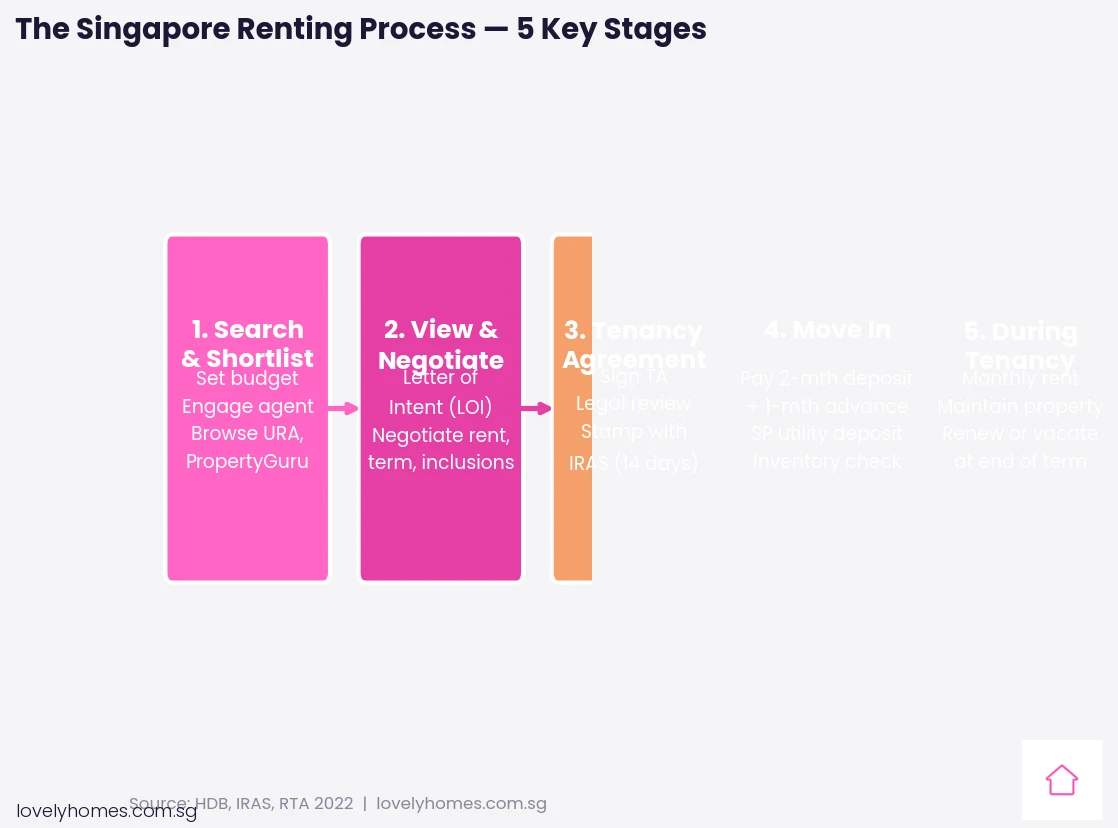
- Every tenancy should be stamped with the Inland Revenue Authority of Singapore (IRAS) within 14 days of signing. The rental stamp duty rate is 0.4% of total rent for leases up to four years.
- HDB flat owners may only sublet to Singapore Citizens, Singapore Permanent Residents, or approved non-citizens. The flat must have met the five-year Minimum Occupation Period (MOP).
- The URA caps occupancy for private residential units at six unrelated persons per unit; HDB caps at six persons per flat (eight for five-room and larger).
- Landlords must give tenants at least 24 hours’ notice before entering the premises except in emergencies.
- Rental disputes can be brought before the Small Claims Tribunal (SCT) for claims up to S$30,000, or the CDRT for neighbour and landlord-tenant disputes.
- As at Q2 2026, the URA All Residential Rental Index stands at approximately 137 (2009 = 100), down from the peak of 143.9 in Q3 2023 but still 28% above pre-pandemic levels.
What Is the Residential Tenancies Act 2022 — and Why Does It Exist?
Singapore’s private residential rental market handles roughly 200,000 active tenancies at any given time. Until 2022, rental disputes between landlords and tenants were resolved primarily through contract law — meaning whoever had the better-drafted tenancy agreement often won. The Residential Tenancies Act (RTA) 2022, which commenced on 1 July 2023, changed that by establishing a set of baseline rights and obligations that cannot be contracted away, regardless of what the tenancy agreement says.
The RTA is administered by the Ministry of Law (MinLaw). It creates a dedicated Rental Disputes Resolution Centre (RDRC) to handle disputes under S$30,000, making it faster and cheaper to resolve common complaints about security deposits, unauthorised deductions, landlord entry, and property conditions. Claims above S$30,000 continue to be heard by the State Courts.
Separately, HDB-flat rentals are governed by the Housing and Development Board (HDB) under the Housing and Development Act. The URA governs private residential properties under the Planning Act. Both agencies set rules on who may rent, how many occupants are permitted, and what disclosures are required.
Security Deposit Rules: Your Rights and the Landlord’s Obligations
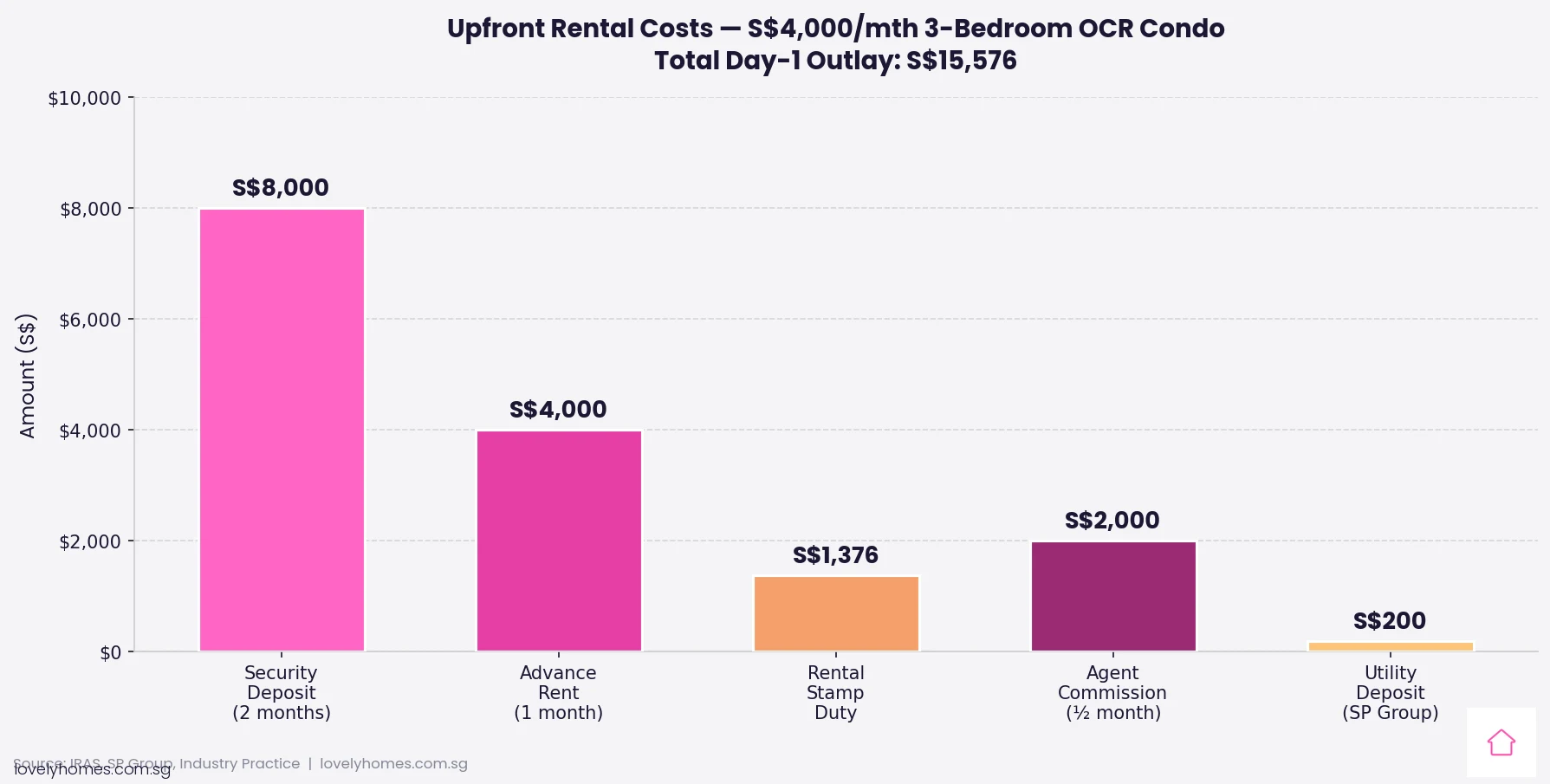
The security deposit is typically the largest single upfront cost for a renter. Under Singapore market practice — now codified in the RTA — the deposit is:
| Tenancy Length | Market Standard Deposit | Return Timeline | Governing Body |
|---|---|---|---|
| 1-year lease | 1 month’s rent | 14 days from lease end | MinLaw / RDRC |
| 2-year lease | 2 months’ rent | 14 days from lease end | MinLaw / RDRC |
| 3-year lease (uncommon) | 2–3 months’ rent | 14 days from lease end | MinLaw / RDRC |
Landlords may deduct from the deposit only for: unpaid rent, damage beyond fair wear and tear, unpaid utilities, and reinstatement costs (returning the property to its original condition). Every deduction must be supported by a receipt or contractor’s invoice. Deductions for “cleaning fees” without evidence of actual cleaning costs are not permissible under the RTA.
If the landlord fails to return the deposit within 14 days, the tenant may file a claim with the RDRC. The RDRC can order the landlord to repay the deposit plus interest. Importantly, the burden of proof shifts to the landlord to justify deductions — not the tenant to disprove them.
Rental Stamp Duty: What You Pay and When
The rental stamp duty is a government tax administered by the Inland Revenue Authority of Singapore (IRAS). It applies to all residential tenancy agreements in Singapore. The duty is calculated as follows:
| Lease Duration | Stamp Duty Rate | Payment Deadline |
|---|---|---|
| 1 year or less | 0.4% of total rent | Within 14 days of signing |
| More than 1 year to 4 years | 0.4% of average annual rent | Within 14 days of signing |
| More than 4 years | 0.4% of 4 × average annual rent | Within 14 days of signing |
Worked example: A 2-year tenancy at S$4,000/mth has total annual rent of S$48,000. The stamp duty is 0.4% × S$48,000 = S$192/year × 2 years = S$384 total. In practice, agents use the IRAS e-Stamping portal. By convention in Singapore, the stamp duty is paid by the tenant (though this is a market convention, not a legal requirement, and can be negotiated).
An unstamped tenancy agreement is still legally binding between the parties, but it cannot be used as evidence in court without paying the duty (plus a penalty). IRAS penalties for late stamping range from S$10 or the duty amount (whichever is higher) to four times the duty amount for deliberate evasion.
HDB Rental Rules: What Tenants and Landlords Must Know
Renting an HDB flat involves an additional layer of regulation beyond the RTA. The Housing and Development Board requires flat owners to obtain prior written approval before subletting their flat. Without this approval, the sublet is illegal — and the tenant could be asked to vacate on short notice with limited recourse.
Key HDB rental rules as at 10 August 2026:
| Rule | Requirement |
|---|---|
| Minimum Occupation Period | Owner must have occupied the flat for 5 years (Standard), 10 years (Plus), or 10 years (Prime) before subletting |
| Eligible tenants | Singapore Citizens, Singapore Permanent Residents, or non-citizens approved by HDB (excluding visitor pass holders for whole-flat sublet) |
| Minimum tenancy period | 6 months per application (no short-stay, Airbnb-style lettings) |
| Maximum subletting period | 3 years at a time; application must be renewed |
| Occupancy cap — standard flat | Maximum 6 occupants (all persons residing, including owner’s family if any) |
| Occupancy cap — 5-room and larger | Maximum 8 occupants |
| HDB approval renewal | Must apply to renew approval before expiry; non-renewal means sublet becomes unauthorised |
As a tenant, it is your right — and responsibility — to verify that the flat has HDB approval before signing the tenancy agreement. You can ask the landlord to produce the HDB approval letter. If the landlord cannot, walk away. Renting an unapproved HDB flat exposes you to sudden eviction, as HDB can order the unauthorised sublet to cease.
Private Property Rental: URA Rules and Occupancy Limits
For private residential properties (condominiums, apartments, landed houses), the Urban Redevelopment Authority (URA) sets the rules. Since 2022, the occupancy cap for private residential units is six unrelated persons. This applies regardless of the unit size. “Unrelated” means persons not belonging to the same family unit; a family of eight can still stay in a unit because family members are not counted individually under this rule.
Short-term rentals (fewer than 3 consecutive months for any single tenant) are prohibited for all private residential properties except those with specific planning permission. This means platforms like Airbnb, Booking.com, and similar operate illegally in standard private condominiums. Landlords who violate this face fines of up to S$200,000. Tenants subletting on a nightly basis without the landlord’s knowledge also risk early termination of their lease.
The Tenancy Agreement: What Must Be In It
While there is no standard government-prescribed tenancy agreement form in Singapore, a legally sound agreement should include all of the following:
| Clause | Why It Matters |
|---|---|
| Parties’ full legal names and NRIC/passport numbers | Identifies who is bound; needed for IRAS stamping |
| Property address and description | Defines the leased premises |
| Tenancy duration (start and end dates) | Determines notice period and renewal rights |
| Monthly rent and payment date | Establishes payment obligation and late-payment trigger |
| Security deposit amount and return conditions | Governs RTA deposit rules; specifies permissible deductions |
| Permitted use (residential only) | Required by URA; running a business is not permitted without change of use |
| Maintenance obligations (landlord vs tenant) | Structural repairs by landlord; fair-wear-and-tear items by tenant |
| Diplomatic clause | Allows early termination if tenant is relocated overseas (typically after 12 months with 2-month notice) |
| Access clause (24-hour notice) | Codifies RTA requirement for notice before landlord entry |
| HDB/URA approval reference (if applicable) | Confirms regulatory compliance |
The Council for Estate Agencies (CEA) — the government body that licenses property agents — provides a standard tenancy agreement template on its website. Both landlords and tenants are encouraged to use it as a starting point.
Resolving Rental Disputes: Your Options in 2026
If something goes wrong — the landlord refuses to return the deposit, enters without notice, or fails to repair a structural fault — you have several escalation pathways:
| Forum | Jurisdiction | Claim Limit | Typical Timeline |
|---|---|---|---|
| Rental Disputes Resolution Centre (RDRC) | Security deposits, unauthorised deductions, landlord entry | S$30,000 | 4–8 weeks |
| Small Claims Tribunal (SCT) | Tenancy disputes, damages, unpaid rent | S$30,000 (S$20,000 for hire-purchase) | 1–3 months |
| Community Disputes Resolution Tribunal (CDRT) | Neighbour nuisance, interference with enjoyment | No monetary cap | 3–6 months |
| Magistrate’s Court / District Court | Large claims, eviction proceedings | Unlimited | 6–18+ months |
For most common disputes — primarily security deposit disagreements — the RDRC is the fastest and cheapest avenue. Filing fees start at S$10 for claims up to S$1,000, scaling to S$120 for claims up to S$30,000. Adjudicators are empowered to make binding orders. There is no need to engage a lawyer for RDRC proceedings, though both parties may bring legal representation if they choose.
Before escalating, it is strongly advisable to send the landlord a formal written notice (email with read receipt, or registered post) specifying the dispute, the amount claimed, and a 7-day deadline to respond. This creates a paper trail and satisfies the RDRC’s requirement to demonstrate that direct resolution was attempted.
Worked Example: Mr & Mrs Cheng’s 2-Year OCR Condo Tenancy
Mr and Mrs Cheng (Singapore Permanent Residents) move into a 3-bedroom OCR condominium in Tampines at S$4,200/mth on a 2-year tenancy commencing 1 September 2026.
Upfront costs on move-in day:
| Item | Calculation | Amount |
|---|---|---|
| Security deposit | 2 months × S$4,200 | S$8,400 |
| Advance rent (1 month) | September rent | S$4,200 |
| Rental stamp duty | 0.4% × S$50,400 (annual rent) | S$403 |
| Agent commission (co-broke) | ½ month (co-broke split) | S$2,100 |
| SP Group utility deposit | Estimated (owner-occupied meter) | S$200 |
| Total Day-1 Outlay | S$15,303 | |
When the tenancy ends on 31 August 2028, the landlord has 14 days (i.e., by 14 September 2028) to return the deposit of S$8,400, less any documented deductions. The landlord deducts S$350 for touch-up painting with a contractor receipt. The Chengs receive S$8,050 within the 14-day window. If the landlord had withheld the full deposit without justification, the Chengs could file with the RDRC from 15 September 2028.
What This Means for Singapore Renters in 2026
The combination of the RTA 2022, the RDRC’s operational launch in 2023, and updated HDB subletting guidelines has materially strengthened tenant protections in Singapore over the past three years. The key practical shifts are:
First, the security deposit return obligation is now legally enforceable (not just contractual), with RDRC adjudicators able to award interest and costs on late returns. Second, the burden of proof for deposit deductions has shifted to landlords, meaning tenants no longer need to prove the deduction was unjustified — landlords must prove it was justified. Third, the occupancy caps — both HDB’s 6/8-person rules and URA’s 6-unrelated-person rule — are increasingly enforced through anonymous tips to HDB’s hotline and URA’s enforcement team.
The rental market itself has softened from the 2022–2023 peak. URA data shows the All Residential Rental Index at approximately 137 as of Q2 2026, down 4.8% from the peak. For tenants, this means better negotiating leverage on rent, but also more landlords seeking to maximise income through subtle cost-shifting (e.g., demanding tenants pay for minor repairs that are legally the landlord’s responsibility). Knowing your rights under the RTA is the best defence.
What Might Come Next for Singapore Rental Policy
MinLaw has indicated it is monitoring the RTA’s effectiveness with a view to potential amendments in 2027. Areas under review include: extending mandatory deposit return deadlines to individual-room rentals (currently excluded from the RTA), introducing a standardised government-issue tenancy agreement template (similar to HDB’s template), and potentially capping the security deposit at two months’ rent by statute (currently a market convention, not a legal cap). HDB is also considering extending its digital subletting approval portal to allow real-time tenant verification — currently, tenants can only verify approval by requesting the letter from the landlord.
Frequently Asked Questions: Singapore Tenants’ Rights 2026
Can my landlord enter the property without telling me?
My landlord is deducting money from my deposit for “general wear and tear”. Is this legal?
My HDB landlord is now overseas. How do I verify that the sublet is properly approved by HDB?
What is a diplomatic clause, and should I insist on one?
Can a landlord increase the rent during the tenancy?
What happens if the landlord sells the property while I am still renting it?
I found mould in my rental unit. Who is responsible for fixing it?
Related Articles
- Singapore Rental Yield Guide 2026: How to Calculate, Compare and Maximise Returns
- Singapore HDB Resale Price Guide 2026: What You Really Pay Across Singapore’s Towns
- Singapore Property Cooling Measures 2026: Buyer Impact Guide
- Singapore Property Conveyancing Guide 2026: Legal Fees, Timeline and Tips
- Singapore Private Property Market Outlook H2 2026
- ABSD Singapore 2026: Complete Guide to Additional Buyer’s Stamp Duty
Disclaimer: This article is for general informational purposes only and does not constitute legal advice. Rental regulations, stamp duty rates, HDB subletting rules, and court procedures change periodically. Always verify current requirements directly with the relevant authorities: Ministry of Law (MinLaw), Housing and Development Board (HDB), Urban Redevelopment Authority (URA), and Inland Revenue Authority of Singapore (IRAS). For specific tenancy disputes or legal advice, consult a practising Singapore advocate and solicitor.