Singapore HDB Resale Procedure Guide 2026: Step-by-Step for Buyers and Sellers

Singapore HDB Resale Procedure Guide 2026: Step-by-Step for Buyers and Sellers

Quick Answer: HDB Resale in 2026 — Key Points at a Glance

  • Who can buy: Singapore Citizens (SC) and Permanent Residents (SPR) who form an eligible family nucleus. At least one applicant must be SC for most schemes. No private property ownership within 30 months.
  • 10-step process: From eligibility check through key collection, the full process typically spans 3–4 months after the Option to Purchase (OTP) is granted.
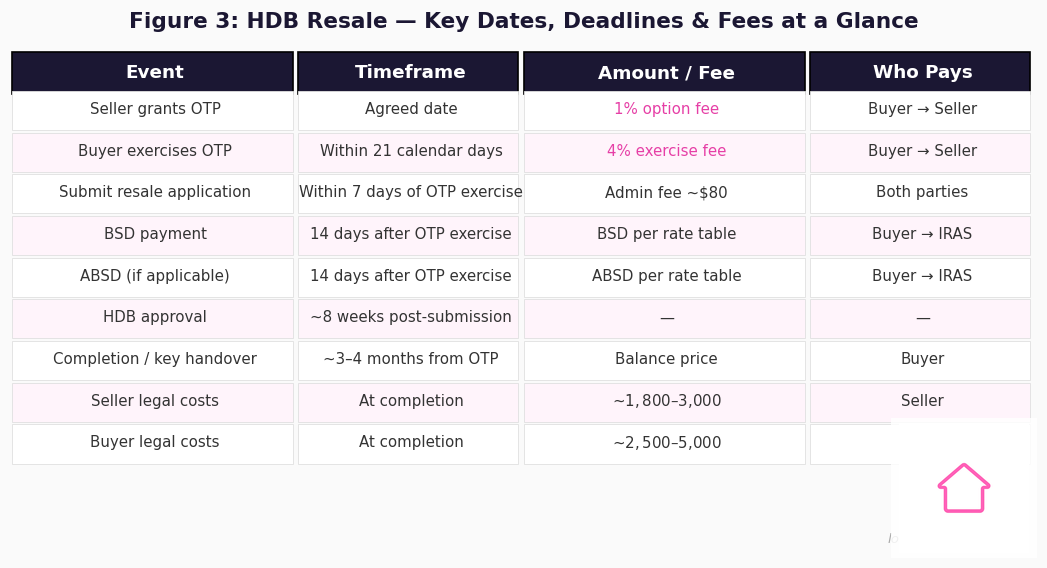
  • OTP mechanics: Seller grants the OTP upon receiving a 1% option fee (cash). Buyer has 21 calendar days to exercise it by paying an additional 4%. Total deposit = 5% of purchase price.
  • Stamp duty deadlines: Buyer’s Stamp Duty (BSD) and any Additional Buyer’s Stamp Duty (ABSD) must be paid within 14 days of exercising the OTP.
  • Cash Over Valuation (COV): If the agreed price exceeds HDB’s assessed value, the difference is COV — payable entirely in cash. CPF and loans cannot cover COV.
  • Application window: Both buyer and seller must submit their resale applications via the HDB Flat Portal within 7 days of OTP exercise. HDB approval takes approximately 8 weeks.
  • HDB loan income ceiling: S$14,000/month for families. Above this, buyers must take a bank loan.

What is an HDB Resale Flat — and Who Oversees the Process?

An HDB resale flat is a public housing unit sold by an existing owner on the open market, as opposed to a Build-To-Order (BTO) flat purchased directly from the Housing and Development Board at a subsidised price. Resale flats offer immediate or near-term occupation (subject to the 3–4 month processing period), access to more established locations, and a wider choice of unit types — including larger flat sizes such as 5-room and executive flats that are rarely available in new BTO exercises.

The Housing and Development Board (HDB) administers buyer and seller eligibility, the Minimum Occupation Period (MOP), the resale application and approval process, and housing loan eligibility. The Inland Revenue Authority of Singapore (IRAS) collects Buyer’s Stamp Duty and Additional Buyer’s Stamp Duty. The Council for Estate Agencies (CEA) licenses and regulates property agents involved in the transaction. The Central Provident Fund (CPF) Board oversees the use of CPF Ordinary Account (OA) savings for the purchase price and, in some cases, for monthly loan repayments.

Understanding which body governs which step — and the strict deadlines attached to each — is the foundation of a smooth HDB resale transaction.
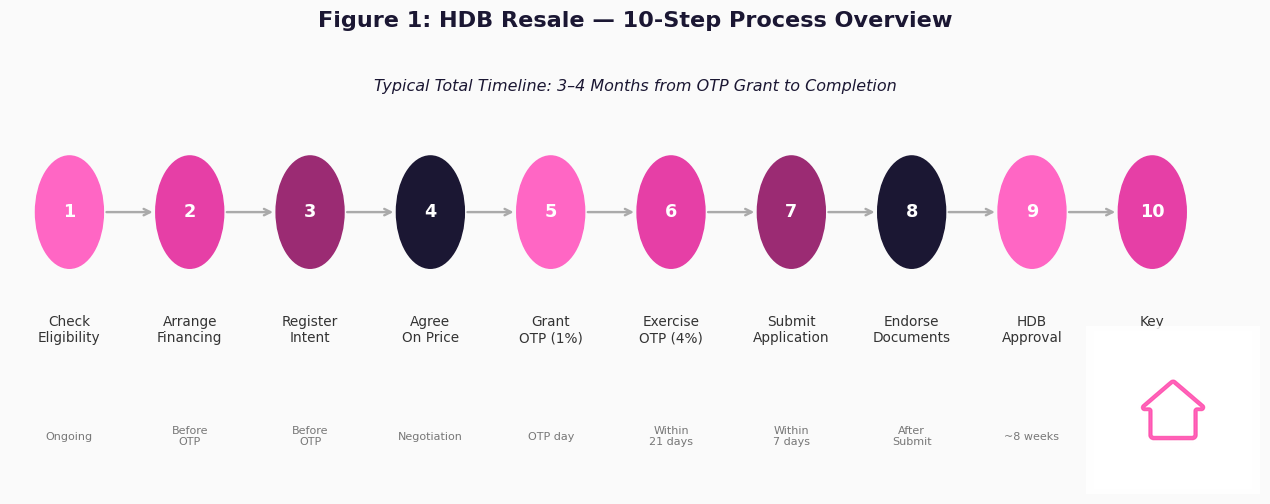
Singapore HDB resale procedure 2026 10-step process overview infographic
Figure 1: The HDB resale procedure involves 10 distinct steps from eligibility check to key collection, typically spanning 3–4 months from OTP grant to completion. Source: HDB, lovelyhomes.com.sg.

Eligibility Requirements for HDB Resale

Before proceeding, both buyers and sellers must confirm their eligibility under HDB’s framework. Sellers must have satisfied the five-year Minimum Occupation Period (MOP) before listing a flat that was purchased directly from HDB or under a resale grant. Buyers must meet citizenship, family nucleus, and (if using an HDB loan) income ceiling requirements.

Citizenship: At least one buyer must be a Singapore Citizen. SPR families may purchase resale flats but receive no priority in newer BTO exercises. Single Singapore Citizens aged 35 and above may purchase 2-room Flexi flats under the Single Singapore Citizen Scheme, or 5-room and smaller resale flats in non-mature estates in certain conditions.

Family nucleus: Acceptable family nuclei include married or engaged couples, parent-and-child families, children orphaned before 35, and the Joint Singles Scheme (two eligible SC singles aged 35+). The family nucleus requirement ensures public housing reaches genuine households.

Income ceiling for HDB housing loan: S$14,000/month combined gross income for families; S$7,000 for singles. If household income exceeds the applicable ceiling, you must finance your purchase with a bank loan. There is no income ceiling simply to buy a resale flat — the ceiling only triggers when applying for an HDB concessionary loan or certain CPF Housing Grants.

Property ownership restriction: Buyers must not own any private residential property (local or overseas) at the time of application, and must not have disposed of any private property within 30 months before the resale application date.

HFE Letter: If you intend to use an HDB housing loan or CPF Housing Grants, you must obtain a valid HDB Flat Eligibility (HFE) letter before the OTP stage. Apply via the HDB Flat Portal at hdb.gov.sg. The HFE letter confirms your eligibility, the loan quantum you qualify for, and any grants you are entitled to.

Step-by-Step: The 10-Stage HDB Resale Process

The HDB resale process unfolds across ten distinct stages, each with its own actors, documents, and deadlines. Buyers and sellers typically engage separate law firms and, optionally, CEA-registered property agents to navigate the process.

Step 1 — Check eligibility. Use HDB’s eligibility checker and apply for your HFE letter if you plan to use an HDB loan or grants. This step should be completed well before you start viewing flats.

Step 2 — Arrange financing. Obtain an HFE letter (for HDB loan) or an In-Principle Approval (IPA) from a bank. The IPA indicates how much the bank is prepared to lend and at what indicative rate. Having pre-approved financing strengthens your negotiating position.

Step 3 — Register intent on HDB Flat Portal. Sellers register their intent to sell; buyers register their intent to buy. This activates the resale portal for your transaction and confirms that both parties are eligible to proceed.

Step 4 — Negotiate and agree on price. Buyer and seller negotiate the transaction price. Check recent resale transaction data via HDB’s Resale Statistics and URA’s REALIS portal (ura.gov.sg) to benchmark the price. Note that if the agreed price exceeds HDB’s valuation, the difference (COV) must be paid entirely in cash.

Step 5 — Seller grants the OTP. The seller issues the Option to Purchase and receives a 1% option fee from the buyer (minimum $1, maximum 1% of the agreed price). This fee is non-refundable if the buyer does not exercise the OTP.

Step 6 — Buyer exercises the OTP. Within 21 calendar days of the OTP date, the buyer pays an additional 4% of the agreed price to exercise the option. The total deposit (1% + 4% = 5%) is credited towards the purchase price at completion. If the buyer does not exercise, the 1% option fee is forfeited and the seller may proceed with other buyers.

Step 7 — Submit resale application. Within 7 days of exercising the OTP, both buyer and seller independently submit their portions of the resale application via the HDB Flat Portal. Required documents include identity documents, the OTP, HFE letter (buyer), and financial data.

Step 8 — Endorse resale documents. HDB issues the resale documents for endorsement, including the Certificate of Eligibility. Both parties (and their solicitors) review and sign the required documents.

Step 9 — HDB approval. HDB reviews the application and issues an approval notice, typically within approximately 8 weeks of submission. The approval notice contains the completion date.

Step 10 — Completion and key collection. On the scheduled completion date, the buyer pays the balance of the purchase price (using CPF OA and/or cash), legal fees are settled, and keys are handed over at HDB Hub or via a virtual appointment. The buyer becomes the registered owner upon completion.
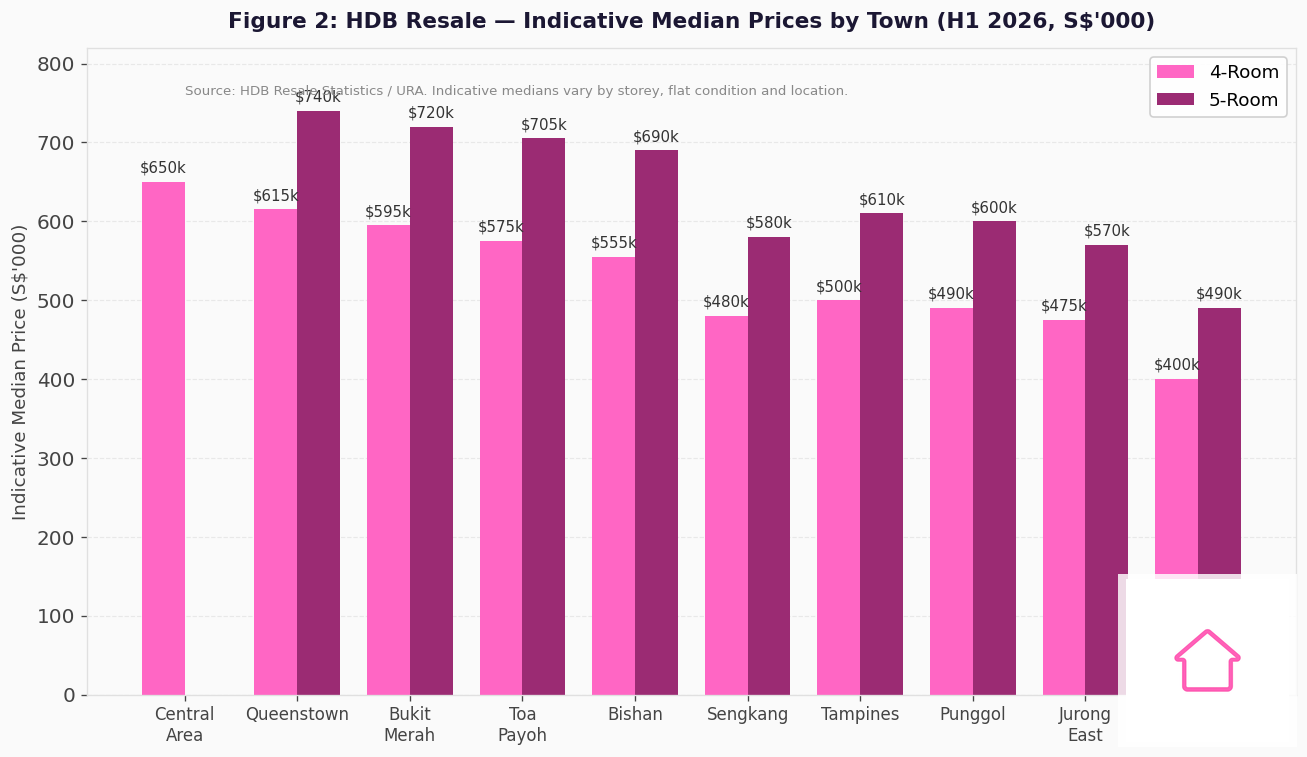
HDB resale median prices by town Singapore H1 2026 4-room and 5-room flat bar chart
Figure 2: Indicative HDB resale median prices by town, H1 2026. Central-area and mature-estate flats command significant premiums. Figures are indicative and vary by storey, flat condition and exact location. Source: HDB Resale Statistics, lovelyhomes.com.sg.

Option to Purchase: Mechanics, Deadlines and Risks

The Option to Purchase is a legally binding contract that gives the buyer the exclusive right — but not the obligation — to purchase the flat at the agreed price within the option period. Understanding its mechanics is critical, as several major financial commitments are triggered by the OTP date.

1% option fee: Paid by the buyer to the seller upon grant of OTP. This sum is deducted from the purchase price at completion if the buyer proceeds. It is forfeited entirely if the buyer does not exercise.

21-day exercise window: The buyer has 21 calendar days from the OTP date to decide whether to proceed. This period allows time to finalise financing, conduct legal due diligence, and confirm CPF usage. Do not grant or exercise an OTP before securing your In-Principle Approval or HFE letter.

4% exercise fee: Paid when exercising the OTP. Combined with the 1% option fee, the buyer has now paid 5% of the purchase price as a deposit. This sum is credited towards the purchase price at completion.

7-day submission window: Within 7 days of OTP exercise, both buyer and seller must submit their portions of the resale application to HDB. Missing this deadline can delay the entire transaction and may require the parties to restart certain steps.

Stamp duty deadline: BSD (and ABSD, if applicable) must be paid to IRAS within 14 days of the OTP exercise date — not from completion. For a S$720,000 resale flat, BSD totals S$16,200. Penalties apply for late payment.
HDB resale OTP timeline key dates deadlines and fees at a glance table infographic
Figure 3: HDB resale key dates, deadlines, and fees from OTP grant through to completion. Source: HDB, IRAS, lovelyhomes.com.sg.

Stamp Duty, COV and Upfront Costs

Buyers of HDB resale flats are subject to Buyer’s Stamp Duty (BSD) on all properties and, depending on their citizenship status and number of properties owned, Additional Buyer’s Stamp Duty (ABSD).

BSD Tier (as at 3 August 2026) Rate BSD on S$720,000 Flat
First S$180,000 1% S$1,800
Next S$180,000 2% S$3,600
Next S$640,000 3% S$10,800 (on S$360k portion)
Total BSD (S$720,000 flat) S$16,200

ABSD rates in 2026: Singapore Citizens pay 0% ABSD on their first residential property, 20% on their second, and 30% on their third and beyond. Singapore Permanent Residents pay 5% on their first and 30% on their second. Foreigners pay 60% on all purchases. ABSD is calculated on the higher of the purchase price or market value, and must be paid within the same 14-day window as BSD.

Cash Over Valuation (COV): HDB conducts a valuation of the flat during the resale process. If the agreed transaction price exceeds this valuation, the difference is considered COV. COV cannot be financed by an HDB or bank loan, nor can it be paid using CPF OA savings. It must be paid entirely in cash. Buyers should factor COV risk into their cash-available calculation before entering into an OTP.

Financing Your HDB Resale Purchase

Buyers may finance an HDB resale flat using an HDB concessionary loan, a bank loan, or a combination of CPF savings and cash. The Mortgage Servicing Ratio (MSR) cap of 30% of gross monthly income applies to both HDB and bank loans for HDB flat purchases, limiting the maximum loan quantum. The Total Debt Servicing Ratio (TDSR) cap of 55% of gross monthly income also applies, covering all debt obligations.

HDB loan: Fixed interest rate of 2.6% per annum (0.1% above CPF Ordinary Account rate as at 2026). Maximum LTV is 80% of the lower of the purchase price or valuation. Requires an HFE letter. Allows flexible early repayment. Available only to SC and SPR buyers meeting income ceiling requirements.

Bank loan: Rates are typically SORA-based, currently ranging from approximately 3.0–4.0% per annum for typical packages in 2026. Maximum LTV is 75% for the first housing loan (50% for second, 35% for third and beyond). Requires an IPA from the bank. May offer more competitive rates in a low-rate environment but carries repricing risk.

Worked Example: The Lim Family Buying S$720,000 Queenstown Resale Flat

Profile: Mr & Mrs Lim, both Singapore Citizens, combined gross monthly income S$9,000. First residential property. Mr Lim aged 38, Mrs Lim aged 36.

Property: 5-room HDB resale flat, Queenstown. Agreed price: S$720,000. HDB valuation: S$710,000. COV = S$10,000.

BSD: 1% × S$180k = S$1,800 + 2% × S$180k = S$3,600 + 3% × S$360k = S$10,800 = S$16,200

ABSD: S$0 (first property, both SC)

HDB loan: 80% LTV = S$576,000 @ 2.6% p.a., 25-year tenure. Monthly repayment ≈ S$2,617. MSR check: S$2,617 ÷ S$9,000 = 29.1% < 30% ✓. TDSR check: S$2,617 ÷ S$9,000 = 29.1% < 55% ✓ (no other debts assumed).

Down payment: 20% × S$720k = S$144,000 (from CPF OA, assumed sufficient).

  • Day 0 (OTP grant): Cash option fee = S$7,200 (1%)
  • Day 21 (OTP exercise): Cash exercise fee = S$28,800 (4%)
  • Within 14 days of exercise: BSD S$16,200 + COV S$10,000 = S$26,200 (cash)
  • At completion: Remaining CPF OA used: S$144,000 − S$7,200 − S$28,800 = S$108,000. Legal fees: ~S$3,800 (cash). HDB loan S$576,000 disbursed directly to seller.

Total upfront cash required: approximately S$66,200 (S$7,200 + S$28,800 + S$26,200 + S$3,800 + S$300 for HDB admin). CPF OA covers the remaining S$108,000 of the down payment at completion.

Why the HDB Resale Market Matters in 2026

HDB resale prices have risen consistently since 2021, driven by supply constraints during the COVID-19 construction pause, strong upgrader demand from the large cohort of BTO buyers who completed their MOP, and a preference among buyers for larger, immediately available flats in established locations. The resale market serves a critical function: it provides housing for Singaporeans who need a home faster than BTO timelines allow, particularly newlyweds, growing families, and those with elderly parents nearby.

Industry figures show that resale median prices for 5-room flats in central areas now regularly breach the S$700,000 mark, with prime Queenstown and Bishan transactions exceeding S$800,000 for desirable units. For prospective buyers, this underscores the importance of understanding COV risk, having sufficient cash reserves, and calibrating loan quantum carefully against the MSR ceiling.

For sellers, the strong market represents an opportunity to realise significant appreciation — but proper understanding of CPF accrued interest (which must be returned to your CPF account upon sale) and outstanding loan balances is essential to accurately calculate net proceeds.

What Might Come Next for HDB Resale

Industry observers anticipate that HDB may introduce targeted policy refinements if resale flat prices for standard flat types in mature estates continue to trend above S$700,000 at the median. Potential measures discussed include extending the MOP for certain flat types, adjusting the CPF usage limits for older flats, or introducing enhanced grant frameworks to moderate demand in specific segments. The government has consistently stated that maintaining housing affordability is a key policy objective, and the full resale market cycle — including cooling measures — should be considered in long-term financial planning. These remain speculative; buyers should rely on current official policies at HDB and IRAS when transacting.

Frequently Asked Questions: HDB Resale Procedure 2026

Can Singapore Permanent Residents buy HDB resale flats?

Yes, Singapore Permanent Residents (SPRs) may purchase HDB resale flats, subject to forming an eligible family nucleus. A family comprising two SPRs (without an SC) may purchase a resale flat, though they are not eligible for the most favourable CPF Housing Grants, which are reserved for SC households. SPRs pay a higher ABSD rate (5% on first, 30% on second property) compared to SCs. Note that SPRs cannot buy BTO flats directly from HDB — only resale flats on the open market.

What happens if I miss the 7-day window to submit the resale application after exercising the OTP?

The 7-day submission window after OTP exercise is strictly enforced. If both parties fail to submit on time, the resale application cannot proceed under that OTP, and the transaction may need to restart with a new OTP. This effectively means the buyer forfeits the 5% deposit (1% + 4%) unless both parties agree to an extension and can justify the delay to HDB. Property agents and solicitors routinely track these deadlines; ensure your legal advisers are appointed before the OTP stage.

Can I use CPF Ordinary Account savings to pay the option fee and exercise fee?

No. The option fee (1%) and exercise fee (4%) paid at the OTP stage must be paid in cash. CPF OA savings can only be used at the completion stage — specifically to pay the down payment (above the loan quantum), partial BSD in some cases, and subsequent monthly loan repayments (subject to HDB or bank approval). This means you need at least 5% of the purchase price in cash available before entering into an OTP. For a S$720,000 flat, that is S$36,000 in cash, plus BSD and legal fees.

How is HDB’s valuation of a resale flat determined, and what if the market price is higher?

HDB engages a Certified Appraiser (registered with the Singapore Institute of Surveyors and Valuers) to conduct a market valuation of the flat, typically shortly after the resale application is submitted. The valuation is based on comparable transactions, flat condition, storey, and location. If the agreed price exceeds the valuation, the difference is Cash Over Valuation (COV) — the buyer must pay this entirely in cash (no CPF, no loan). Sellers typically price above valuation in a strong market; buyers who cannot accommodate COV may need to negotiate the price down to valuation or seek a flat where the transaction price matches or falls below the assessed value.

What is the difference between an HDB resale flat and a Design, Build and Sell Scheme (DBSS) flat?

Design, Build and Sell Scheme (DBSS) flats were a now-discontinued category of public housing developed by private developers but sold under HDB rules. They are indistinguishable from standard HDB resale flats in terms of the resale procedure — DBSS flats go through the same HDB resale process, are subject to the same MOP, and can be purchased using CPF OA and HDB loans. The DBSS scheme produced 13 projects between 2006 and 2012; no new DBSS projects have been launched since. Buyers will encounter DBSS flats on the resale market like any other HDB unit.

How long does HDB approval take, and can the completion date be accelerated?

HDB approval for a resale application currently takes approximately 8 weeks from the submission date, provided all documents are in order and there are no eligibility issues. The completion date is set by HDB in the approval notice — typically 6–8 weeks after approval, giving a total end-to-end timeline of approximately 3–4 months from OTP exercise. Completion dates generally cannot be significantly accelerated, as HDB coordinates across multiple parties (buyer, seller, solicitors, CPF Board). Sellers who need to synchronise with a new home purchase should factor this timeline carefully into their planning.

Disclaimer: This article is provided for general information only and does not constitute legal, financial, or property advice. HDB resale policies, stamp duty rates, CPF rules, and grant frameworks are subject to change. Always verify current policies directly with the Housing and Development Board (hdb.gov.sg), the Inland Revenue Authority of Singapore (iras.gov.sg), the CPF Board (cpf.gov.sg), and consult a licensed solicitor or CEA-registered property professional for advice specific to your situation.
Singapore Property Buying Checklist 2026: Step-by-Step Guide for HDB, EC and Condo Buyers

Singapore Property Buying Checklist 2026: Step-by-Step Guide for HDB, EC and Condo Buyers

Buying property in Singapore is one of the most significant financial decisions a household makes. The process involves government eligibility rules, loan approvals, legal documentation, stamp duty payments, and a carefully timed sequence of steps — and getting any one of them wrong can cause delays, penalties, or lost deposits. This comprehensive checklist covers every stage of the Singapore property buying process in 2026, from working out your budget through to collecting your keys, for HDB flats, executive condominiums (ECs), and private condominiums.

Quick Answer — Singapore Property Buying Checklist

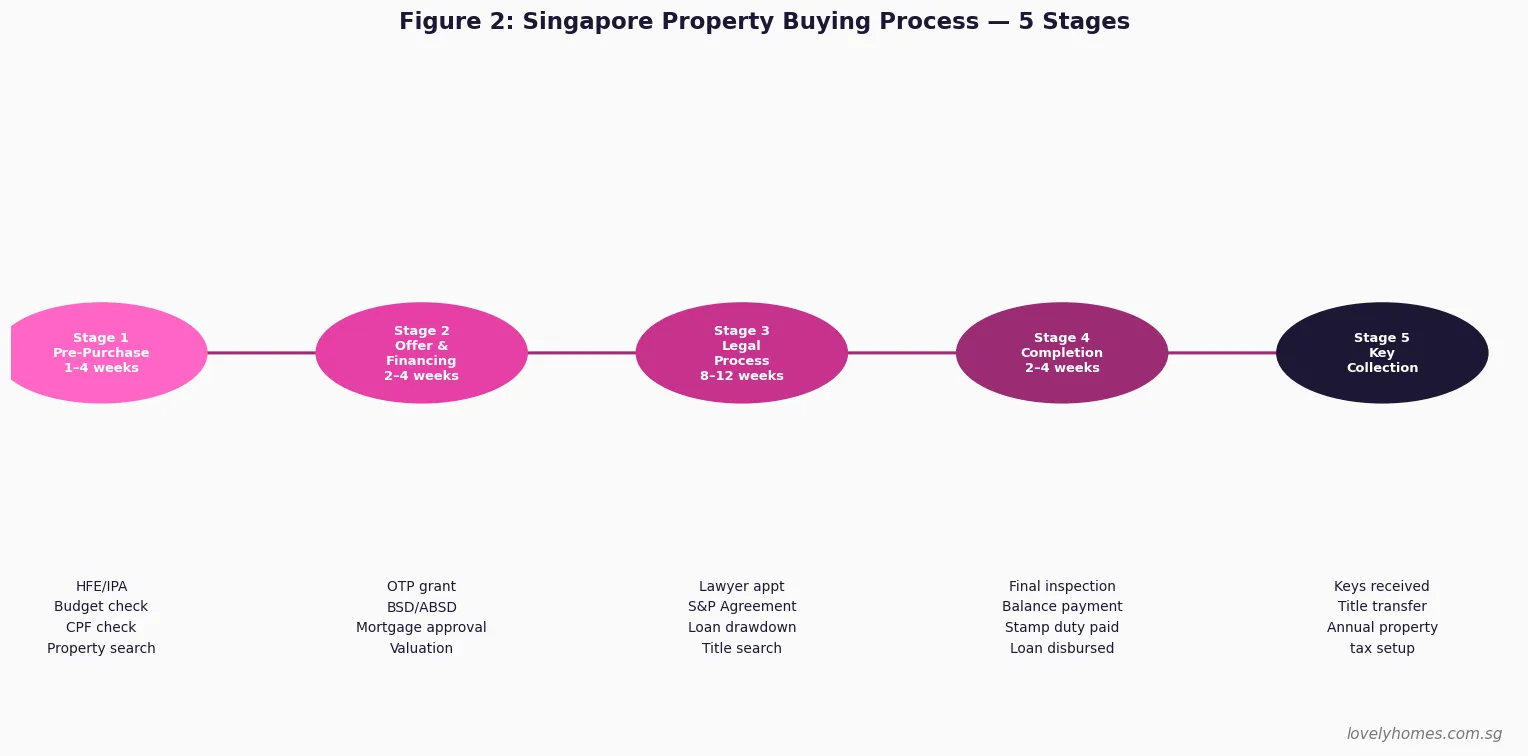
  • Stage 1 (Pre-purchase): check eligibility, obtain HFE Letter or bank IPA, confirm budget and ABSD profile
  • Stage 2 (Offer & financing): grant OTP, pay 1% booking fee, engage lawyer, confirm loan, pay BSD/ABSD within 14 days
  • Stage 3 (Legal process): sign S&P Agreement, drawdown loan, complete title search, await completion
  • Stage 4 (Completion): pay balance 19% (or balance purchase price), sign transfer documents, pay remaining stamp duty
  • Stage 5 (Key collection): receive keys, inspect property, register title, set up property tax and utilities
  • Total timeline: 8–16 weeks for private/resale; 3–5 years for BTO flats

Before You Start: Establishing Your Budget and Eligibility

Every Singapore property purchase begins with a clear-eyed assessment of what you can afford and what you are eligible to buy. Singapore’s property market is structured around specific eligibility rules — citizenship status, marital status, income ceilings, and prior property ownership all determine which types of property you can purchase, and at what stamp duty rates.

The two frameworks that govern affordability for mortgage borrowers are the Total Debt Servicing Ratio (TDSR) and, for HDB flats and ECs, the Mortgage Servicing Ratio (MSR). TDSR caps total debt obligations at 55% of gross monthly income (using a stress-tested rate of at least 4.0% p.a.); MSR caps housing loan repayment for HDB/EC at 30% of gross monthly income. See our TDSR & MSR Guide 2026 for the full breakdown.

For ABSD planning, confirm how many residential properties you and your co-purchaser currently own. A Singapore Citizen buying their first property pays 0% ABSD; buying a second pays 20%; buying a third pays 30%. For Singapore PRs, the first property attracts 5% ABSD. These are upfront, non-negotiable costs that must be paid in cash (CPF cannot be used for ABSD). See our ABSD Complete Guide 2026.

Stage 1: Pre-Purchase Checklist (1–4 Weeks)

This stage covers the groundwork before you make any offer on a property. Completing it thoroughly saves significant time and stress later in the process.

HDB purchases — HFE Letter: Apply for an HDB Flat Eligibility (HFE) Letter at the HDB website (MyHDBPage portal). This single letter tells you which HDB flats you are eligible to buy, your CPF grant amounts, your HDB loan eligibility, and the maximum HDB loan quantum. The HFE Letter is valid for 6 months and is mandatory before exercising any OTP for an HDB flat. Allow 2–3 weeks for processing.

Private/EC purchases — Bank IPA: Apply for an In-Principle Approval (IPA) from your preferred bank(s) before making any offer. The IPA tells you your maximum loan quantum and is typically valid for 30 days. It is not legally required before signing an OTP, but it is strongly advisable — discovering post-OTP that you cannot secure financing risks losing your 1% booking fee.

CPF check: Log in to your CPF account and confirm your OA balance. For HDB purchases, your CPF OA can cover the downpayment and monthly instalments. For private property, CPF OA usage is subject to the Valuation Limit and Withdrawal Limit rules.

Property search and shortlisting: Research your target neighbourhoods and property types. Confirm the remaining lease (critical for CPF usage and bank loan eligibility on resale properties), check URA Master Plan zoning, and look at recent transaction data from URA’s REALIS portal.

Singapore property buying process 5 stages — pre-purchase to key collection 2026
Figure 2: Singapore property buying process — 5 stages from pre-purchase to key collection. Private/resale completion takes 8–16 weeks; BTO completion takes 3–5 years. Source: HDB, SLA, IRAS.

Stage 2: Making an Offer — OTP and Financing (2–4 Weeks)

Once you identify a property, the process moves quickly. In Singapore, the formal process of making an offer starts with the Option to Purchase (OTP).

Granting the OTP: The seller grants you the OTP upon receipt of a 1% booking fee (of purchase price), paid in cash. The OTP is a legal option giving you the exclusive right to purchase the property within the option period, typically 14 days for private property and 21 days for HDB resale.

BSD and ABSD payment deadline: Stamp duty (both BSD and ABSD) must be paid within 14 days of exercising the OTP (or signing the S&P Agreement). Failure to pay on time incurs penalties. IRAS administers stamp duty and accepts payment via e-Stamping on the IRAS website. Importantly, ABSD must be paid in cash only — CPF cannot be used for ABSD. BSD may be paid from CPF OA.

Engaging a property lawyer: Appoint a conveyancing lawyer as soon as the OTP is received. Your lawyer will conduct a title search, advise on any encumbrances on the property, prepare the Sale and Purchase Agreement, and coordinate the completion process. Legal fees for a standard private property purchase are typically S$2,500–S$4,500.

Confirming bank loan: Submit your formal loan application to the bank (not just IPA). The bank will order a valuation of the property. If the valuation comes in lower than the purchase price, your loan amount is based on the valuation figure — the “valuation shortfall” must be topped up in cash or CPF from your own funds. This is why many experienced buyers commission their own valuation before offering a price.

Exercising the OTP: Pay the additional 4% exercise fee (i.e. 1% booking + 4% exercise = 5% of purchase price) at the time you exercise the OTP within the option period. For private property, this is typically 5% of the purchase price. For HDB resale, the exercise fee to HDB is the balance of the deposit up to 5% (cash or CPF).

Understanding Upfront Costs: What You Actually Need at Each Stage

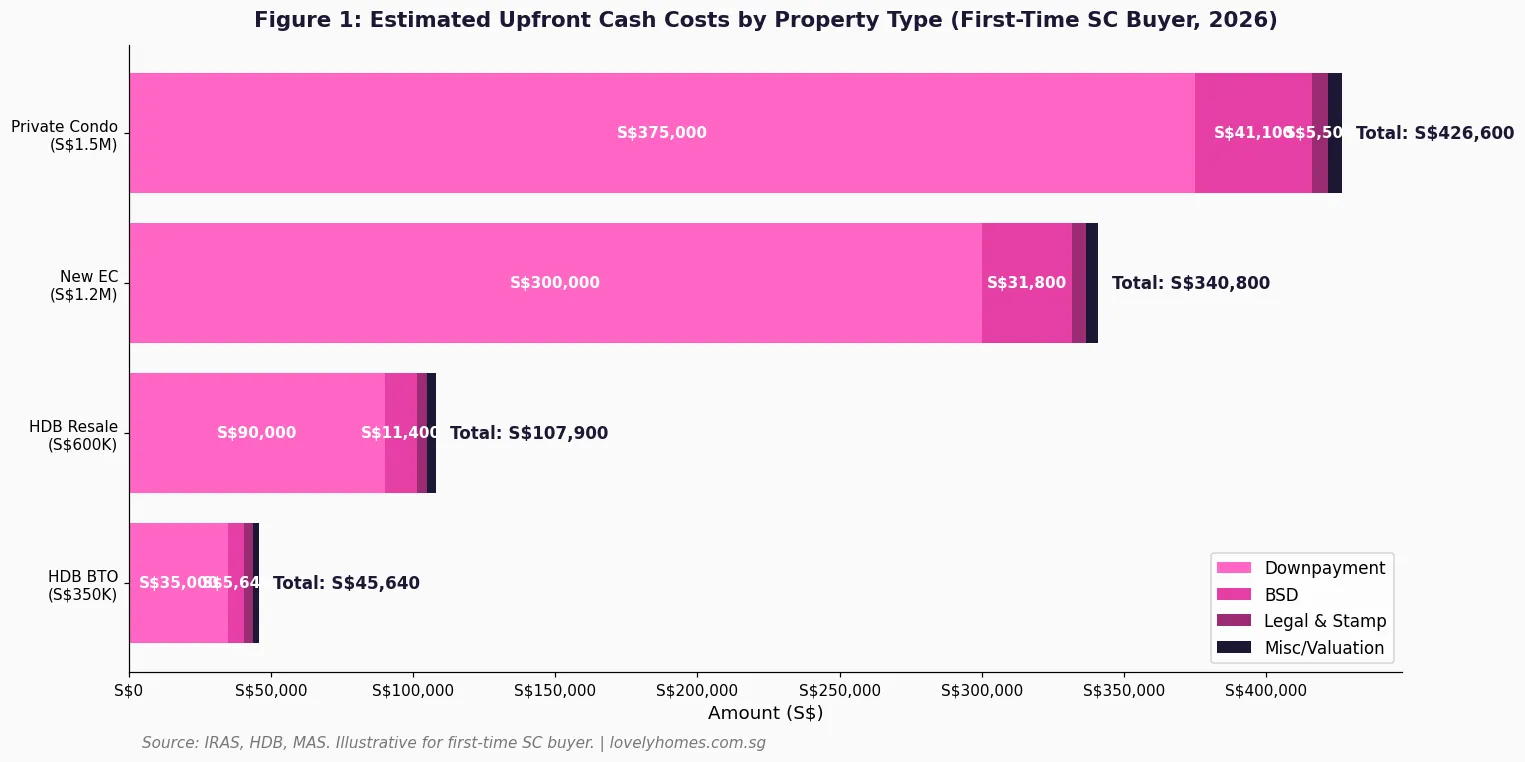
One of the most common surprises for first-time buyers is the quantum of upfront cash required before completion. The chart below shows the estimated upfront costs for a first-time Singapore Citizen buyer across four property types. Note that ABSD is zero for a first-time SC buyer on any property type.

Estimated upfront costs by property type Singapore 2026 — HDB BTO, HDB resale, EC and private condo
Figure 1: Estimated upfront costs by property type for a first-time Singapore Citizen buyer (2026). HDB BTO has the lowest cash requirement; private condo requires the most. Amounts are illustrative and assume a bank loan for EC/private condo. Source: IRAS, HDB, MAS.
Cost Item HDB BTO (~S$350K) HDB Resale (~S$600K) EC (~S$1.2M) Private Condo (~S$1.5M)
Booking fee (1% cash) S$3,500 S$6,000 S$12,000 S$15,000
Exercise fee (4% cash/CPF) S$14,000 S$24,000 S$48,000 S$60,000
BSD (cash or CPF) S$5,640 S$11,400 S$31,800 S$41,100
ABSD (1st SC buyer) S$0 S$0 S$0 S$0
Legal fees (approx) S$2,500 S$3,000 S$4,500 S$5,000
Remaining downpayment From CPF OA From CPF OA S$240,000+ S$300,000+
Est. upfront cash required ~S$4K–6K ~S$6K–10K ~S$60K–80K ~S$75K–100K

Note: BSD payable from CPF OA; ABSD must be in cash. EC 1% booking fee and 4% exercise fee must be in cash (no CPF for downpayment). HDB BTO/Resale downpayment may be entirely from CPF OA if taking HDB loan (no mandatory cash). Assumes first-time SC buyer with no other outstanding loans.

Stage 3: The Legal Process (8–12 Weeks)

After exercising the OTP, your lawyer and the seller’s lawyer prepare the Sale and Purchase Agreement (S&P Agreement), which sets out all terms of the sale, the completion date, and any conditions. The S&P Agreement is typically signed within 2 weeks of the OTP exercise date.

Loan drawdown: Your bank will require the S&P Agreement to be signed before releasing the loan. The bank typically disburses the loan directly to the seller’s conveyancing account at completion. Ensure your loan offer letter has not expired and all conditions (e.g. fire insurance) are met.

Title search: Your lawyer will search the land registry (Singapore Land Authority) to confirm the seller holds clean title, check for any caveats, mortgages, or restrictions registered against the property, and flag any issues that could delay completion.

Completion date: Standard completion is typically 8–12 weeks from the S&P Agreement date for private property. HDB resale completion is set by HDB and typically 8–10 weeks from the HDB appointment.

Stage 4: Completion Day — What Happens on the Day

Completion day is when legal ownership of the property transfers from seller to buyer. Your lawyer coordinates the following:

Balance purchase price payment: The bank transfers the loan funds to the seller’s conveyancer; your CPF is transferred by the CPF Board; your cash balance (if any remains) is transferred from your lawyer’s client account. The seller receives the total price and in turn discharges their mortgage and hands over vacant possession.

Document signing: You will sign the transfer instrument, the mortgage document, and several other legal forms at your lawyer’s office.

Remaining stamp duty: If you have not already stamped all relevant documents, your lawyer will ensure payment is made on completion day.

Title register update: The Singapore Land Authority (SLA) will update the land registry to show you as the new owner. This process takes 2–4 weeks after completion.

Stage 5: After Key Collection — Your Post-Purchase Checklist

Collecting your keys is not the end of the process. Several administrative steps remain.

Property inspection: Conduct a thorough walk-through before accepting the keys. For new property (BTO, new launch condo), this is the formal defects inspection — note all defects in writing and submit the defects list to the developer within the defects liability period (typically 12 months for private property, 1 year for HDB BTO).

Property tax: IRAS will issue your first property tax notice based on the Annual Value (AV) assessed for your property. Owner-occupied residential properties attract a progressive tax rate (0% on first S$8,000 AV, then 4–32% progressively). Update your owner-occupier status with IRAS at iras.gov.sg to ensure you are taxed at the concessionary owner-occupier rate rather than the higher non-owner-occupier rate.

Utilities and services: Transfer or open SP Group electricity and utilities accounts. Set up broadband, cable, and household insurance.

CPF charge registration: Your lawyer will register the CPF charge on the property with SLA to reflect the CPF monies withdrawn. This is automatic as part of the completion process but confirm with your lawyer that it is done.

Fire insurance and mortgage reducing term assurance (MRTA): Fire insurance is mandatory for all mortgaged properties (arranged by the bank). MRTA (which pays off your outstanding loan if you die or are permanently disabled) is not legally required but strongly recommended, especially for the first decade of a long loan tenure when the outstanding balance is at its highest.

Choosing the Right Property Type: HDB, EC, or Private Condo

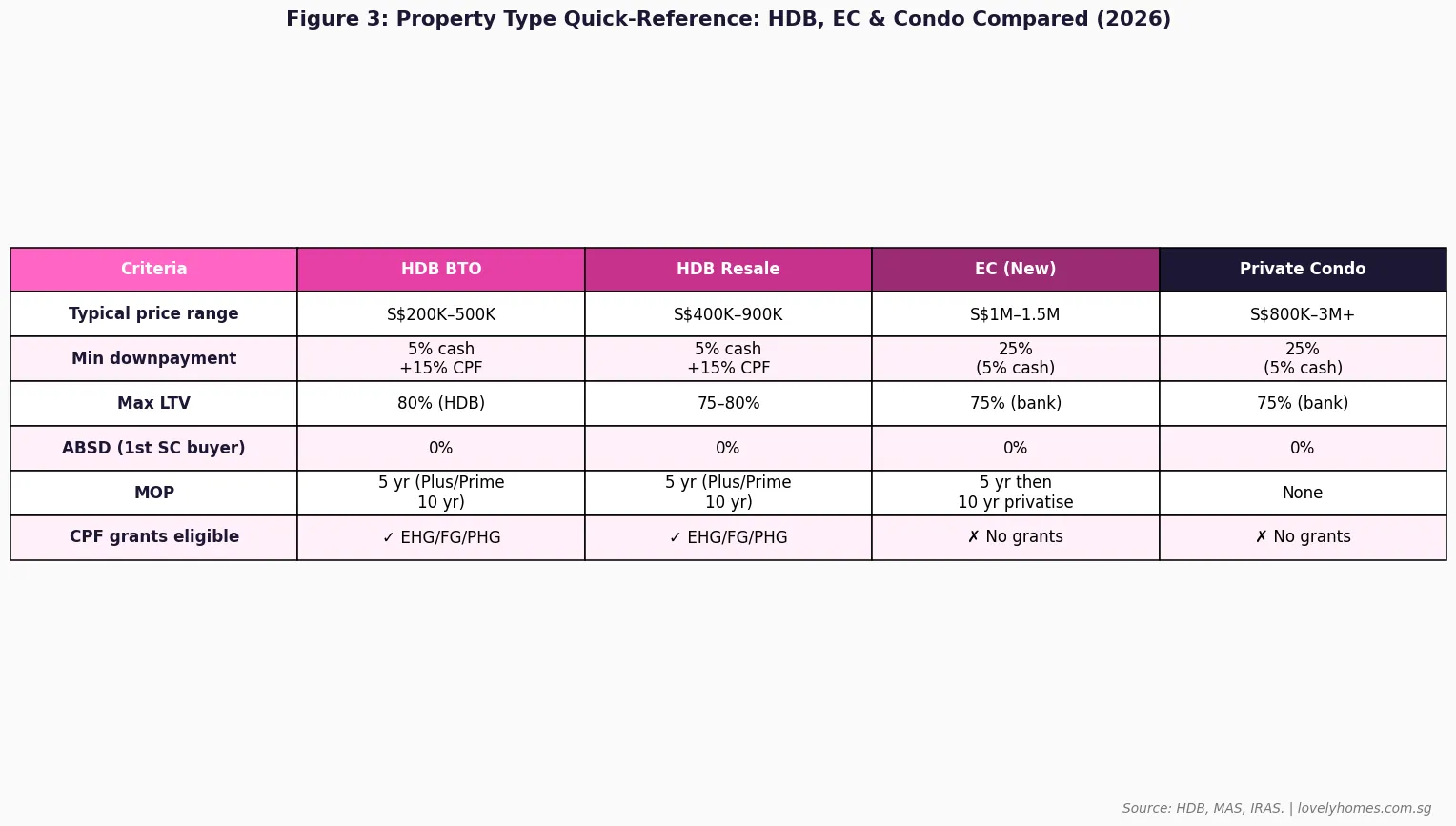
Understanding which property type suits your needs, income, and long-term strategy is the starting point of the whole process. The table below summarises the key differences.

Singapore property type comparison table 2026 — HDB BTO vs HDB resale vs EC vs private condo
Figure 3: Property type comparison 2026 — HDB BTO, HDB resale, EC and private condo. ECs represent a middle ground: subsidised pricing but MOP and privatisation rules apply. Source: HDB, MAS, IRAS.

Worked Example: The Lim Family Buys an HDB Resale Flat

Mr and Mrs Lim, both Singapore Citizens aged 32, have a combined gross monthly income of S$9,000. They wish to buy a 5-room HDB resale flat in Bishan for S$780,000 and take a bank loan.

ABSD: Both are first-time buyers; 0% ABSD. No ABSD cost.

BSD: On S$780,000: first S$180,000 @ 1% = S$1,800; next S$180,000 @ 2% = S$3,600; next S$440,000 @ 3% = S$13,200. Total BSD = S$18,600 (payable from CPF OA).

Bank loan eligibility: MSR 30%: max monthly housing payment at stress-test 4.0% p.a. = S$9,000 × 30% = S$2,700. At 4.0% over 25 years, S$2,700/month ≈ max loan S$517,000. LTV 75%: S$780,000 × 75% = S$585,000. MSR is the binding constraint at S$517,000.

Downpayment: S$780,000 − S$517,000 = S$263,000 (CPF OA: S$200,000; cash: S$63,000).

Monthly repayment (actual rate 3.5% p.a.): S$517,000 at 3.5% over 25 years = approximately S$2,587/month (MSR 28.7% — PASS).

CPF grants: As first-time buyers with income S$9,000/month, they receive Family Grant S$50,000 + PHG S$20,000 (if within 4km of parents) = up to S$70,000, reducing effective loan to S$447,000 and monthly repayment to approximately S$2,237/month.

Total cash at exercise: 1% booking S$7,800 cash + 4% exercise S$31,200 (CPF) + BSD S$18,600 (CPF) + legal S$3,500 = approximately S$10,800 cash at the time of exercising the OTP.

What Might Change in the Singapore Property Buying Process

The MAS and HDB periodically review the rules governing property purchases. In 2026, key items to monitor include: any revision to TDSR or LTV limits (MAS last updated these in September 2022); changes to HDB grant amounts or income ceilings (HDB last revised these in September 2019); and any adjustments to the EC eligibility or income ceiling (currently S$16,000/month). The ABSD framework set on 27 April 2023 remains intact with no announced changes as of August 2026. For the latest cooling measures timeline, see our Property Cooling Measures Timeline.

Summary: Singapore Property Buying Checklist

Stage Key Actions Timeline
1. Pre-purchase HFE Letter or bank IPA; budget check; ABSD profile; CPF balance 1–4 weeks
2. Offer & financing Grant/receive OTP; pay 1% booking; formal loan app; BSD/ABSD within 14 days; engage lawyer 2–4 weeks
3. Legal process Sign S&P Agreement; bank valuation; title search; await completion date 8–12 weeks
4. Completion Pay balance; sign transfer; bank disburses loan; CPF Board transfers funds 1–2 days
5. Post-completion Keys; defects inspection; property tax owner-occupier status; utilities; fire insurance 2–4 weeks

Frequently Asked Questions

What is the Option to Purchase (OTP) and what happens if I do not exercise it?

The Option to Purchase is a legally binding agreement where the seller grants you the exclusive right to buy the property within a specified period (typically 14 days for private property, 21 days for HDB resale). The 1% booking fee is paid when the OTP is granted to you. If you choose not to exercise the OTP within the option period, you forfeit the 1% booking fee but have no further obligation to complete the purchase. The seller may then offer the property to other buyers. If you exercise the OTP, you become contractually committed to completing the purchase, and failing to complete after that point puts your entire deposit (usually 5% to 10% of the purchase price) at risk.

How long does the entire buying process take in Singapore?

For a private resale or new launch condo, the typical timeline from OTP exercise to key collection is 8–16 weeks (some new launches can be longer depending on the developer’s completion date). For an HDB resale flat, the HDB appointment-to-completion timeline is usually 8–10 weeks after HDB grants approval. For an HDB BTO flat, the wait from booking to key collection is typically 3–5 years depending on when the project was launched and the construction schedule. For an EC, the completion wait is also 3–5 years (these are new launches).

Can a foreigner buy an HDB flat or EC in Singapore?

No. Foreigners (non-Singapore Citizens and non-Singapore PRs) are not permitted to buy HDB flats (new BTO or resale) or new ECs (during the 5-year MOP period). ECs are treated as private property after 10 years from the date of issue of the Temporary Occupation Permit, at which point foreigners may buy them on the open market — subject to paying the 60% ABSD. Foreigners may buy private condominiums, apartments, and some landed property with prior approval from the Land Dealings Approval Unit (LDAU), but they pay the significant 60% ABSD surcharge. See our ABSD Singapore Guide 2026 for the full foreigner and FTA national rules.

What is COV (Cash Over Valuation) and does it still apply in 2026?

Cash Over Valuation refers to the amount a buyer pays above the bank’s (or HDB’s) assessed valuation of the property. If you agree to buy a resale flat for S$650,000 but the valuation comes in at S$610,000, the S$40,000 difference is COV and must be paid entirely in cash (no CPF, no loan). COV has reappeared in the HDB resale market during high-demand periods, particularly for popular flat types in mature estates. It adds a significant cash buffer requirement. Before committing to a price, request the seller’s or HDB’s indicative valuation, or commission your own from an IRAS-approved valuer, to reduce the risk of a COV surprise.

What documents do I need to prepare for a home loan application?

The standard document checklist for a Singapore home loan application includes: NRIC (for Singapore Citizens and PRs); proof of income (last 3 months’ payslips, latest CPF contribution history, last 2 years’ Income Tax Notices of Assessment for self-employed borrowers); CPF statement (available on CPF website); existing loan statements (for TDSR calculation); OTP or S&P Agreement; and property particulars (postal address, title number). For foreigners, a passport and work pass (EP/SP) are also required. Banks may request additional documents for variable income earners, commission-based employees, or borrowers with business income.

What is the Minimum Occupation Period (MOP) and does it affect when I can sell?

The MOP is the minimum period you must physically occupy your HDB flat or EC before selling it on the open market or renting it out in its entirety. For standard HDB flats, the MOP is 5 years from the date of key collection. For HDB Plus and Prime flats (under the new 2023 housing classification), the MOP is 10 years. For ECs, the MOP is 5 years, after which you may sell to Singapore Citizens or PRs; full privatisation (open to all including foreigners) occurs at the 10-year mark. The MOP clock starts from the date of key collection (for BTO/EC) or the date of resale completion. Subletting individual rooms is permitted during MOP for HDB flats (subject to HDB’s subletting rules and approvals).

Do I need a buyer’s agent, and will it cost me anything?

Using a buyer’s property agent is optional but often recommended for first-time buyers navigating the process for the first time. Under the Council for Estate Agencies (CEA)’s guidelines, commission is a negotiable item — there is no legally mandated rate. For HDB resale, the conventional buyer’s agent commission is around 1% of the purchase price. For private property, it is also around 1–1.5%. Many developers of new launches offer co-broke arrangements where they pay the buyer’s agent directly, meaning no cost to you. Ensure your agent is CEA-registered (verify at the CEA public register at cea.gov.sg).

Related Articles

Disclaimer

This article is intended as general educational information about the Singapore property buying process and does not constitute legal, financial, or property advice. Eligibility rules, stamp duty rates, loan limits, and grant amounts are subject to change by the relevant government bodies. All figures are indicative and based on information available as of 2 August 2026. Buyers should consult a qualified conveyancing lawyer, licensed mortgage broker, and financial adviser before committing to any property purchase. For HDB eligibility, refer to HDB.gov.sg. For stamp duty, refer to IRAS.gov.sg. For loan rules, refer to MAS.gov.sg.

Translate »