
Shoebox Units in Singapore: Are They Still a Good Investment? (2026)
Shoeboxes have been polarising since URA first named them in 2012. Sceptics call them “yield traps” with poor resale mobility. Defenders point at sold-out launches in Geylang, Paya Lebar and Bugis, and at the arithmetic of getting into private property on one income.
This guide sets out the URA rules, the current quantum and yield picture, and the situations where the shoebox format genuinely still works. For broader investor comparison, read alongside our CCR vs RCR vs OCR guide.
What counts as a shoebox
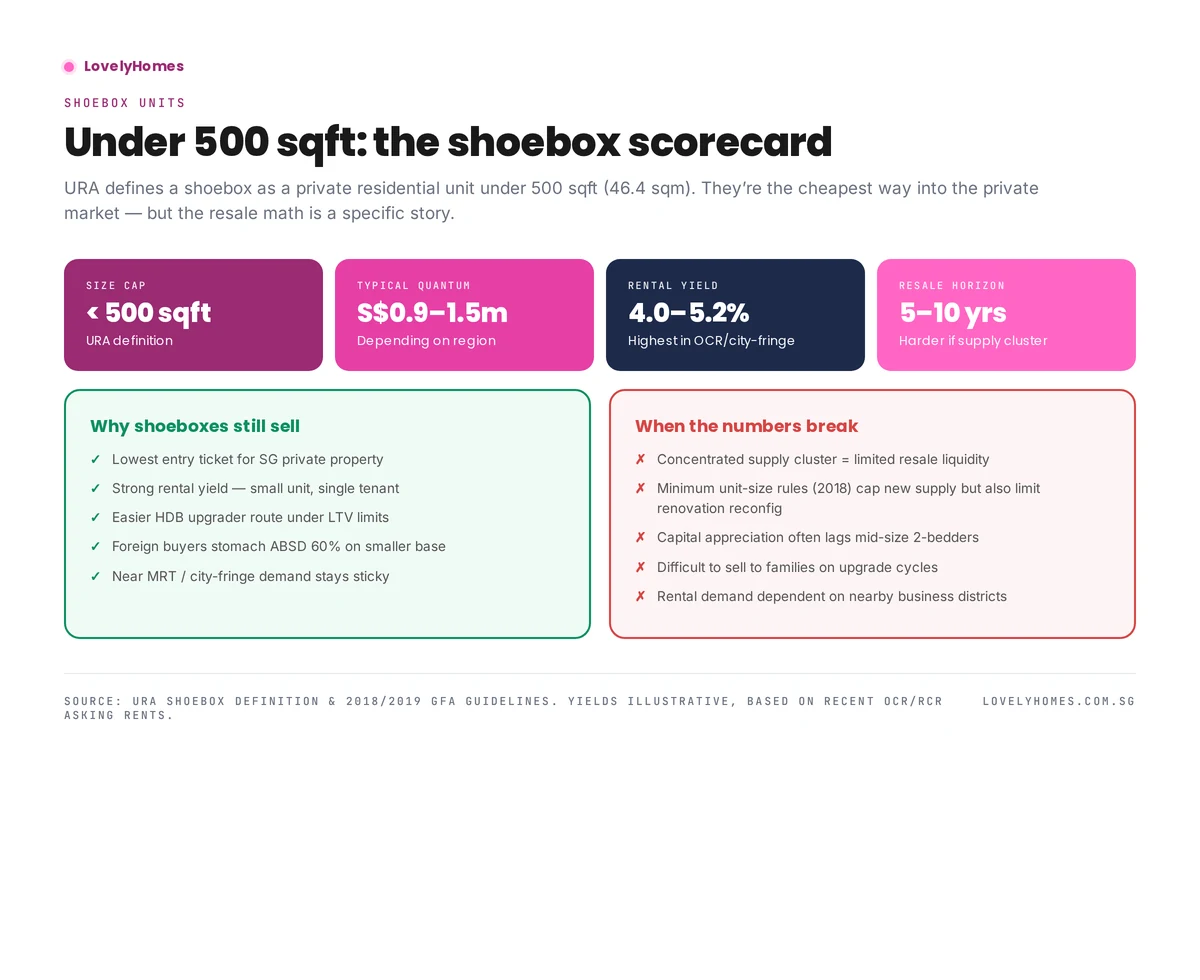
URA classifies any non-landed private residential unit under 500 sqft as a shoebox. Some of these are pure studios; others are 1-bedders with a defined bedroom. The common thread is minimal circulation space and a single main living area.
Since 2018 / 2019 URA guidelines, developers face minimum-size rules at project level outside the Central Area: typical average unit sizes must be above a floor (raised further in 2023 for selected districts), which caps how many shoeboxes go into a new OCR project.
Quantum and PSF
| Region | Typical quantum (new + resale) | PSF (shoebox) |
|---|---|---|
| CCR | S$1.2m–S$1.6m | ~S$3,200 |
| RCR | S$1.0m–S$1.4m | ~S$2,600 |
| OCR | S$0.9m–S$1.2m | ~S$2,100 |
Shoebox PSF always runs above larger units in the same project — developers price the scarcity of small-unit entry tickets.
Rental yield
Rental yields run 4.0–5.2% gross across regions. The drivers:
- Single-occupant tenant profile willing to pay a rent-per-head premium
- Shorter vacancy cycles in business-park / CBD-fringe locations
- Lower total maintenance cost base
Net yield (after maintenance fees, property tax, insurance, agent fees) is typically 70–80% of gross.
Who shoeboxes suit
- Singles / young couples without children: entry ticket into private property from one income.
- Upgraders from HDB wanting a second income stream (inside LTV limits).
- Foreign buyers absorbing ABSD 60% on a smaller base.
- Near-workplace pied-à-terres in Marina South / Paya Lebar.
Where the numbers break
Four failure modes:
- Supply concentration. A 500-unit shoebox-heavy OCR project produces a resale queue where nothing moves.
- Capital appreciation lag. Over 5–10 year horizons, 2-bedders have outperformed shoeboxes in most tracked projects.
- Family-upgrade demand ceiling. Hard to sell to growing families.
- Rental concentration risk. Yield dependence on proximity to specific employment nodes.
Worked example — OCR shoebox, 10-year horizon
A S$1.1m OCR shoebox bought at launch in 2016, rented at S$2,800/month from year 2, with 3% annual rent escalation and a 1.5% net of gross conversion:
- Gross rent over 10 years: ~S$385,000
- Net rent (70%): ~S$270,000
- Capital appreciation at 2%/year: ~S$245,000 price uplift
- Transaction costs (BSD, agent, legal): ~S$45,000
Simple pre-SSD, pre-CPF-accrued-interest total return: roughly S$470,000 on a ~S$250,000 net cash outlay (assuming 75% LTV). Attractive on paper — but highly sensitive to vacancy and rental softness.
Frequently asked questions
Can I buy a shoebox in an HDB estate?
HDB flats are not shoeboxes under URA’s definition (they’re public housing). The 2-room Flexi at ~430 sqft is the closest HDB analogue; the Fresh Start scheme uses it. See our Fresh Start guide.
Are shoeboxes eligible for CPF usage?
Yes, same as any private residential. Lease-to-95 test still applies.
What’s the smallest shoebox allowed?
URA’s minimum internal gross floor area for new developments is 35 sqm (~377 sqft). Some pre-rule stock goes smaller.
Does URA measurement exclude balconies?
URA applies a minimum GFA excluding balcony. Resale listings typically quote strata area including balcony, so always check the GFA.
This guide is for general information only and is accurate as of April 2026. Singapore property rules, taxes and cooling measures change frequently — always verify current figures with URA, IRAS, HDB or a licensed professional before committing. LovelyHomes is not a financial, legal or tax advisor.