Singapore BTO Application Guide 2026: How to Apply, Ballot and Buy an HDB Flat

Singapore BTO Application Guide 2026: How to Apply, Ballot and Buy an HDB Flat

Quick Answer: BTO Applications in 2026 — Key Points at a Glance

  • What BTO means: Build-To-Order (BTO) flats are new HDB flats sold at government-subsidised prices during four annual exercises (typically February, May, August and November). Buyers commit upfront and wait 3–5 years for construction.
  • Priority balloting: First-timers receive two ballot chances versus one for second-timers, significantly improving their odds in oversubscribed launches.
  • Income ceilings: S$7,000/month for 2-room Flexi flats in mature or Plus-classified locations; S$14,000/month for most 3-room to executive flat types.
  • Enhanced Housing Grant (EHG): Up to S$80,000 for eligible families; up to S$40,000 for eligible singles. Income-scaled and administered by CPF Board.
  • Total timeline: From application to key collection is typically 3–6 years, including the construction wait. This requires careful long-term financial planning.
  • New classification from 2024: HDB’s Standard / Plus / Prime framework replaced the Mature / Non-Mature distinction. Plus and Prime flats carry additional resale restrictions and subsidy clawback conditions.
  • MOP: Five-year Minimum Occupation Period for Standard flats before the flat can be sold on the open market or rented out in its entirety.

What is a BTO Flat — and How Does the Scheme Work?

Build-To-Order (BTO) flats are new public housing units offered by the Housing and Development Board (HDB) at prices set below comparable private market rates, reflecting a direct government subsidy. Unlike buying an existing flat on the resale market, BTO buyers do not move in immediately — they commit to a flat that has yet to be built, then wait for construction to complete before collecting their keys.

The BTO scheme is the primary vehicle through which Singapore Citizens (and, in limited circumstances, Singapore Permanent Residents) access new, affordable public housing. It was introduced in 2001 to replace the earlier Registration for Flats system, allowing HDB to build flats closer to actual demand, reducing unsold inventory and the government’s financial exposure.

HDB administers eligibility, the ballot, construction, and key collection. The CPF Board manages housing grants and CPF contribution tracking used in the purchase. The Ministry of National Development (MND) sets overarching housing policy, including the annual BTO supply target. The Inland Revenue Authority of Singapore (IRAS) handles Buyer’s Stamp Duty (BSD), which applies even to new BTO flats.
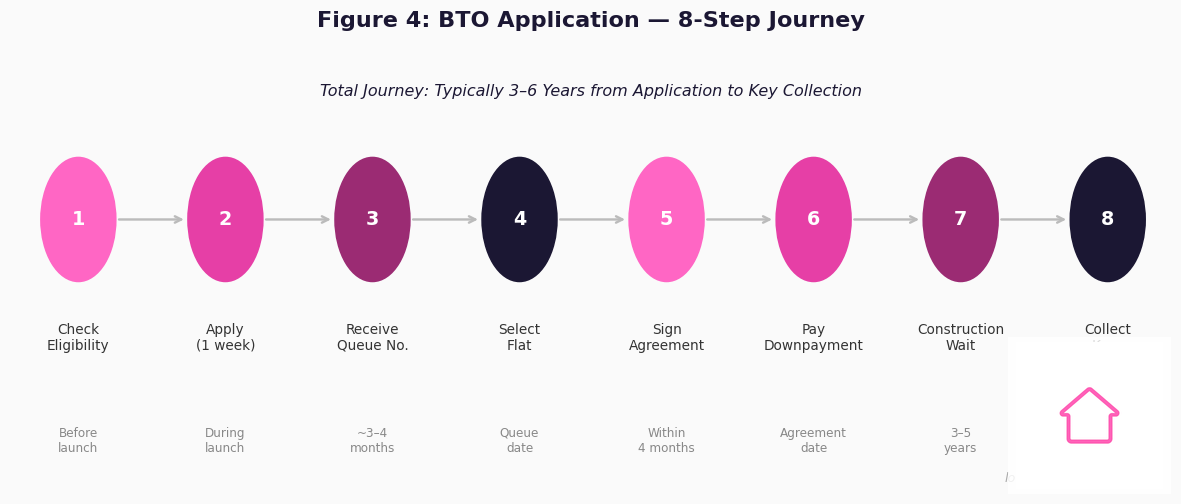
Singapore BTO application process 2026 8-step journey from application to key collection infographic
Figure 4: The BTO journey spans 8 key steps across 3–6 years from application to key collection. Understanding each stage reduces surprises and aids financial planning. Source: HDB, lovelyhomes.com.sg.

BTO Eligibility: Who Can Apply?

To apply for a BTO flat, you must satisfy HDB’s eligibility criteria at the time of application. The requirements have been updated in tandem with the 2024 HDB flat classification reform, which replaced the Mature/Non-Mature distinction with a Standard/Plus/Prime framework carrying differentiated subsidies and resale conditions.

Citizenship: At least one applicant must be a Singapore Citizen for most BTO flat types. Two Singapore Permanent Residents forming a household are generally limited to the HDB resale market; SPR families with at least one SC spouse may apply for BTO flats under specific schemes. Singles must be SC, aged 35 or above, and may only apply for 2-room Flexi flats under the Single Singapore Citizen (SSC) Scheme.

Age: Applicants must be at least 21 years old (35 for singles buying under the SSC Scheme or the Joint Singles Scheme).

Family nucleus: You must form an eligible family nucleus — for example, a married or engaged couple, parent-and-child family, multi-generational household, or an eligible singles arrangement.

Property ownership: Applicants must not own or have disposed of any private property (local or overseas) within 30 months before the BTO application. Existing HDB flat owners wishing to upgrade to a new BTO flat are subject to additional conditions, including selling their existing flat within six months of the new flat’s key collection.

Income ceiling: S$7,000/month for singles applying under the SSC Scheme for 2-room Flexi flats; S$14,000/month for families buying 3-room to executive flat types in Standard or Plus locations. The income ceiling is assessed based on the average gross monthly household income over 12 months.

How the BTO Ballot Works

BTO applications are made online during the sales exercise launch window, which is typically open for approximately one week. HDB publishes the flat types, locations, indicative prices, and application details in advance of each exercise. There is no fee to apply.

Ballot priority: HDB’s computerised ballot gives first-timer applicants two ballot chances, significantly improving their odds compared to second-timers who receive one chance. Within the first-timer pool, additional sub-priority is extended to multi-generational families, married couples with children applying under the Parenthood Priority Scheme (PPS), and essential workers applying in their work zone.

Oversubscription: Oversubscription rates vary considerably by project location, flat type, and classification. Four-room and five-room flats in Plus or Prime locations in central areas regularly see application-to-unit ratios of 5 to 15 or higher. Standard flats in less central towns are typically less oversubscribed, offering first-timers a realistic chance of securing a queue number within one or two applications.

Queue number: If selected in the ballot, you receive a queue number. Lower numbers are invited earlier to select their preferred unit from remaining inventory. As selection progresses, unit choice narrows — applicants with higher queue numbers face reduced choice, and in oversubscribed launches some applicants may find no suitable units remaining when their number is called.
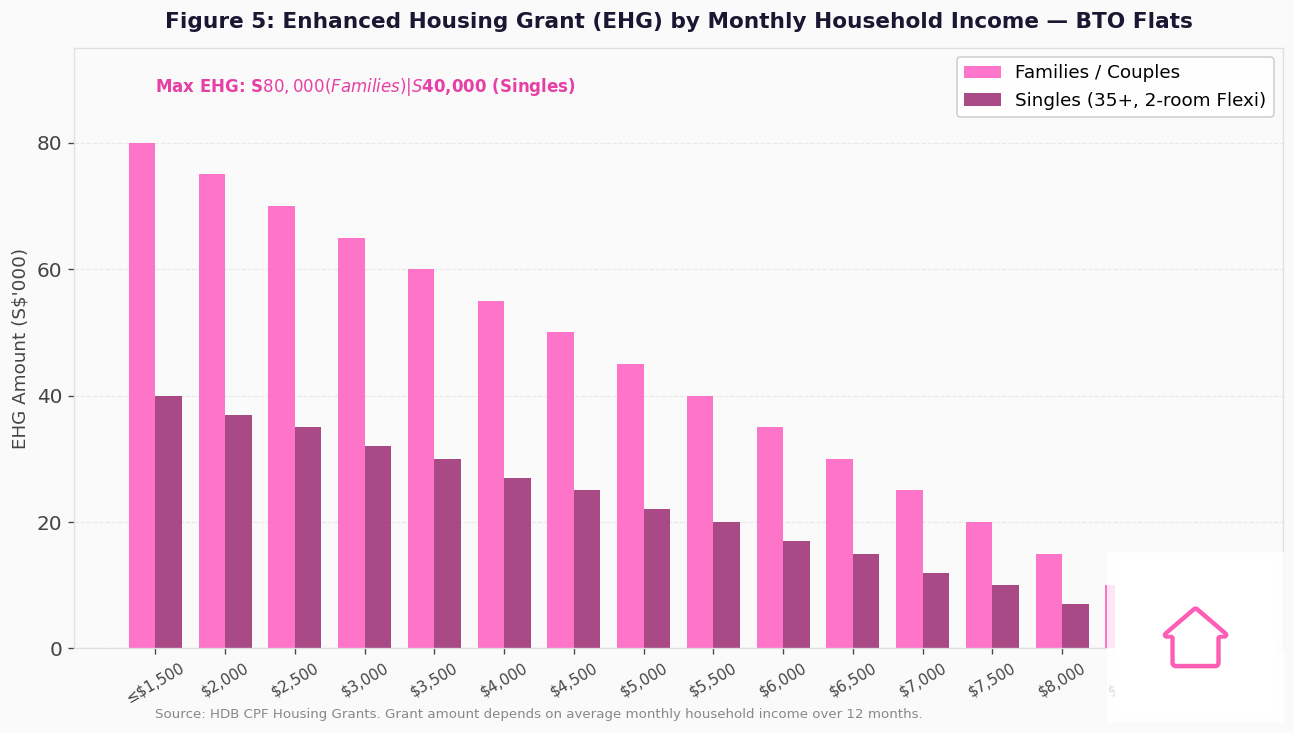
Singapore BTO Enhanced Housing Grant EHG by monthly household income 2026 family and singles bar chart
Figure 5: Enhanced Housing Grant (EHG) amounts by monthly household income for BTO flat purchases. Families are eligible for up to S$80,000; singles for up to S$40,000. Income is assessed as the average gross monthly household income over 12 months. Source: HDB, CPF Board, lovelyhomes.com.sg.

Flat Selection, Agreement for Lease and Downpayment

When your queue number is reached, HDB issues an invitation to attend a flat selection appointment — conducted either in person at HDB Hub or virtually. You select a specific unit (block, floor, orientation, facing) from inventory remaining at the time of your appointment.

After selecting your flat, you sign the Agreement for Lease and pay a booking fee of approximately 5% of the flat price, payable using CPF Ordinary Account (OA) savings or cash. The remaining 15% of the purchase price (net of CPF Housing Grants) is paid in instalments during the construction period, using CPF OA and/or cash as progress payment requests are issued at defined construction milestones.

At Temporary Occupation Permit (TOP) — when the building is structurally complete — HDB invites you for key collection. You pay the final balance (if any), sign the lease, and collect your keys. Legal fees are payable at this stage.

CPF Housing Grants for BTO Flats

The CPF Housing Grant framework for BTO flats centres on the Enhanced Housing Grant (EHG), which replaced the previous combination of the Additional CPF Housing Grant (AHG) and Special CPF Housing Grant (SHG). The EHG is income-tested, tiered, and applies to both BTO and resale flat purchases by eligible first-timer households.

Grant Applicable Flat Type Maximum Amount Income Ceiling
Enhanced Housing Grant (EHG) — Families BTO and Resale S$80,000 S$9,000/month or below
Enhanced Housing Grant (EHG) — Singles 2-room Flexi BTO and Resale S$40,000 S$4,500/month or below
Singles Grant Resale only (not BTO) S$25,000 S$7,000/month
Family Grant Resale only (not BTO) S$50,000 (SC+SC couple) S$14,000/month
Proximity Housing Grant (PHG) Resale only (not BTO) S$30,000 S$14,000/month

Note: The Family Grant and Proximity Housing Grant are available for resale flat purchases only, not BTO. BTO buyers’ main grant is the EHG. Households earning S$9,000/month receive S$5,000 EHG; those earning S$1,500/month or less receive the maximum S$80,000. The grant is credited at key collection and reduces the amount financed by loan or CPF.
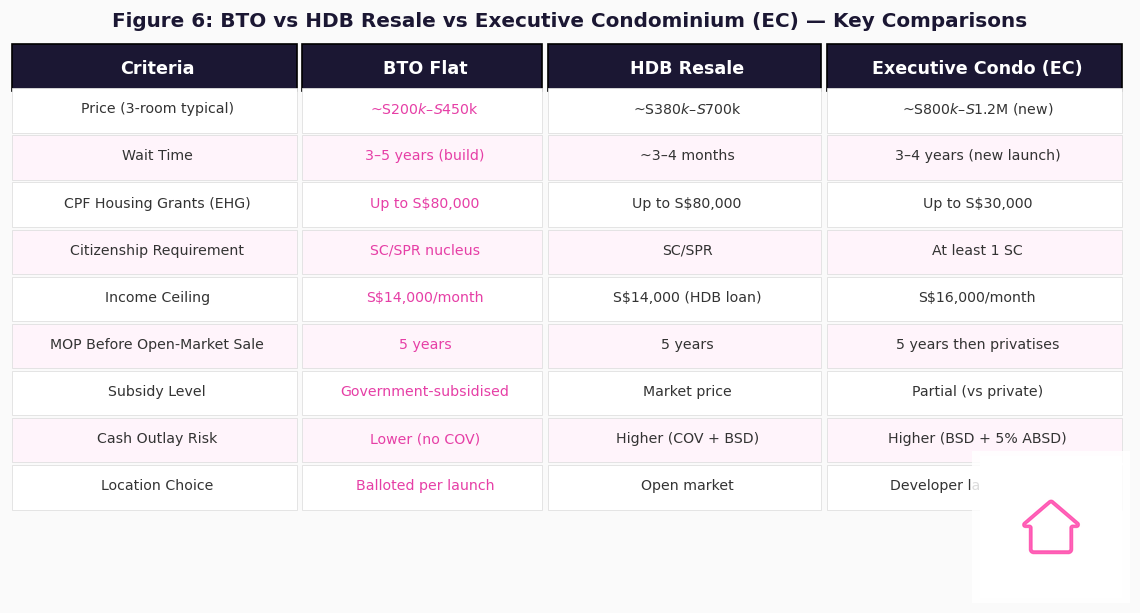
BTO vs HDB resale vs executive condominium EC comparison table 2026 Singapore key features
Figure 6: Comparing the key features of BTO flats, HDB resale flats, and Executive Condominiums (ECs) in Singapore 2026. Each route involves distinct trade-offs in price, timeline, grants eligibility and resale conditions. Source: HDB, lovelyhomes.com.sg.

BTO vs Resale vs Executive Condominium: At a Glance

Choosing between a BTO flat, a resale flat, or an Executive Condominium (EC) depends on your timeline, financial capacity, location needs, and long-term plans. BTO flats offer the lowest entry price and highest grant eligibility but require a 3–5 year wait. Resale flats are available quickly but at market prices, with potential Cash Over Valuation (COV) risk. ECs occupy a middle ground — privately built but subject to HDB income and eligibility conditions, with a 5-year Minimum Occupation Period (MOP) before privatisation and sale to foreigners becomes possible. Figure 6 above summarises the key differentiators.

Worked Example: Mr & Mrs Tan Applying for a 4-Room Tengah BTO

Profile: Both Singapore Citizens, combined gross monthly income S$5,000. First-timer applicants. Ages 28 and 27.

BTO flat: 4-room flat, Tengah (Standard classification). Indicative price: S$390,000. Estimated wait: 4 years.

EHG: Income S$5,000/month → EHG = S$55,000 (family, income-scaled). Credited at key collection.

BSD: 1% × S$180k = S$1,800 + 2% × S$180k = S$3,600 + 3% × S$30k = S$900 = S$6,300

ABSD: S$0 (first property, both SC)

HDB loan: 80% LTV of (S$390k − S$55k EHG) = 80% × S$335k = S$268,000 @ 2.6% p.a., 25 years. Monthly repayment ≈ S$1,220/month. MSR check: S$1,220 ÷ S$5,000 = 24.4% < 30% ✓

Down payment (20%): S$390k × 20% = S$78,000. Net of EHG: effective down payment from CPF/cash = S$78,000 − S$55,000 = S$23,000. Assuming CPF OA balance of S$25,000 at key collection (built up over 4 construction years), the Tans can cover the down payment entirely from CPF OA.

Booking fee (at flat selection): ~5% = S$19,500 (from CPF OA or cash); credited towards purchase price.

Net cash at key collection: BSD S$6,300 + legal fees ~S$2,500 = approximately S$8,800 in cash. The EHG and CPF OA cover the remaining obligations. Without the grant, the Tans would need to fund S$78,000 down payment from savings — the EHG reduces their effective purchase price to S$335,000.

Why the BTO Route Matters in 2026

The BTO scheme remains Singapore’s most affordable entry point to home ownership. For eligible first-timer families at median income levels, the combination of government-subsidised prices and EHG grants can reduce the effective purchase price by S$50,000–S$100,000 compared to comparable resale flats.

However, the construction delays experienced during the COVID-19 period — which pushed some BTO completion dates out by one to two years beyond original estimates — highlighted the risks of the BTO model. HDB has since accelerated construction pipelines and moved to earlier contractor appointment, but buyers should build contingency planning into their BTO journey. The 2024 Standard/Plus/Prime classification also introduces new nuances: Plus-classified BTO flat buyers face a 10-year MOP (versus 5 for Standard), restrictions on sub-letting, and a requirement to return a proportion of resale proceeds to HDB above a prescribed threshold — reflecting the higher subsidies embedded in these locations.

What Might Come Next for BTO

HDB has committed to launching 19,000–20,000 BTO flats annually through the mid-2020s to address the supply backlog accumulated in prior years, with a focus on Standard flats in growing towns such as Tengah, Kallang/Whampoa, and the Greater Southern Waterfront precinct. Industry observers anticipate potential refinements to the priority ballot framework — particularly regarding the treatment of applicants who have repeatedly been unsuccessful despite multiple applications. The government has also signalled ongoing review of the Plus/Prime subsidy and resale restriction model, with the first cohort of Plus flats expected to reach MOP in the early 2030s. Buyers should monitor MND and HDB announcements for any policy changes affecting upcoming sales exercises.

Frequently Asked Questions: BTO Application 2026

How many times can I apply for BTO before losing first-timer priority status?

You retain first-timer status until you are actually offered a unit and sign the Agreement for Lease, or until you have previously purchased a subsidised HDB flat. Simply applying multiple times — even if you receive and decline queue numbers — does not immediately strip you of first-timer priority, though HDB may deduct a ballot chance after a certain number of declined offers (currently, two declined queue number offers result in losing one ballot chance). The safest approach is to apply seriously to each exercise and, if you receive a queue number, assess carefully before declining, as each decline reduces your future advantage.

What happens if I miss my flat selection appointment?

If you miss your scheduled flat selection appointment without prior arrangement with HDB, you may forfeit your queue number for that exercise. HDB does allow rescheduling under exceptional circumstances — such as a medical emergency or overseas work travel — but you must notify HDB in advance and provide supporting documentation. If your queue number is forfeited, you will need to reapply in a subsequent BTO exercise. Given that obtaining a queue number may take multiple exercises for popular flat types, missing a selection appointment is a costly outcome that should be avoided through careful diary management and early appointment of a solicitor.

Can I sell or rent out my BTO flat before the MOP is completed?

The Minimum Occupation Period (MOP) for Standard BTO flats is 5 years from the date of key collection. During this period, you may not sell the flat on the open market, rent out the entire flat, or purchase another HDB flat. You may, however, rent out spare bedrooms (subject to HDB approval and applicable limits on the number of tenants). Plus-classified BTO flats carry a 10-year MOP, reinforcing the long-term commitment required when purchasing in subsidised high-value locations. Violations of the MOP carry financial penalties and may result in HDB compulsorily acquiring the flat.

How are BTO flat prices set — and are they genuinely below market value?

HDB sets BTO prices using a market-minus-discount approach: it benchmarks comparable private and resale properties in the same area, then applies a subsidy to arrive at the BTO selling price. The subsidy is larger for Standard classification flats (lower-value areas) and smaller for Plus or Prime flats (higher-value locations), reflecting HDB’s commitment to keeping BTO prices affordable across the income spectrum. Industry analysis consistently shows that BTO flats at launch are priced 20–40% below comparable resale HDB flats in the same town, and substantially below equivalent private properties. However, the actual benefit realised by the buyer is partly tied to the MOP — if you hold for 5 or more years before selling, you benefit from the full price appreciation; some of this is recouped by HDB for Plus/Prime flats through the subsidy recovery mechanism.

What is the difference between Standard, Plus and Prime BTO flats under the 2024 classification?

From the October 2024 BTO exercise, HDB replaced the Mature/Non-Mature classification with a three-tier framework. Standard flats are located in less central areas, carry a standard subsidy, and have a 5-year MOP with no subsidy clawback on resale. Plus flats are in more accessible or better-served locations with a higher subsidy (meaning a lower purchase price), but carry a 10-year MOP, restrictions on whole-flat sub-letting, and a requirement to return to HDB a proportion of the resale proceeds above a prescribed threshold if sold within a defined period. Prime flats are in the most central, high-value locations (such as near the city centre), carry the largest subsidies, and have the most stringent resale conditions, including income restrictions on future buyers of the resold flat. Buyers should review the specific conditions for the flat classification of any BTO project before applying.

Can Singapore Permanent Residents apply for BTO flats?

Singapore Permanent Residents (SPRs) face significant restrictions on BTO flat eligibility. An SPR household applying as a family must include at least one Singapore Citizen (SC) spouse or child; two SPR applicants forming a family without an SC component generally cannot apply for new BTO flats from HDB. SPR families that do include at least one SC may apply under the relevant scheme. Single SPRs cannot apply for BTO flats. The more accessible route for SPR households is the open HDB resale market, where eligibility conditions are less restrictive, though grant eligibility is also more limited than for SC households.

Disclaimer: This article is intended for general information only and does not constitute financial, legal or property advice. BTO policies, income ceilings, grant amounts, flat classification rules and HDB procedures are subject to revision. Always verify current information directly with the Housing and Development Board (hdb.gov.sg), the CPF Board (cpf.gov.sg), and the Ministry of National Development (mnd.gov.sg). Consult a licensed financial adviser or CEA-registered property professional for personalised guidance.
Singapore First-Time Home Buyer Guide 2026: Grants, Steps and What You Need to Know

Singapore First-Time Home Buyer Guide 2026: Grants, Steps and What You Need to Know

Singapore first-time home buyer guide 2026 hero image – sunset skyline

Quick Answer — Key Takeaways

  • Singapore Citizens buying their first residential property pay 0% ABSD — a significant saving versus second or subsequent purchases.
  • First-time HDB buyers may qualify for up to S$80,000 in CPF housing grants (EHG, Family Grant, Proximity Housing Grant combined).
  • You must obtain an HDB Flat Eligibility (HFE) Letter before booking a BTO flat or viewing HDB resale flats.
  • HDB loans cap at 80% LTV; bank loans cap at 75% LTV for the first property.
  • The Mortgage Servicing Ratio (MSR) is 30% of gross income — the binding constraint for most HDB and EC purchases.
  • The Total Debt Servicing Ratio (TDSR) is 55% of gross income — applies to all property loans including private condos.
  • HDB resale flats take roughly 3–4 months to complete; BTO flats take 4–5 years from ballot to keys.
  • Private property purchases incur Buyer’s Stamp Duty (BSD) starting at 1% on the first S$180,000 of the purchase price.
  • CPF Ordinary Account (OA) savings can fund the down payment and monthly instalments for eligible properties.
  • As a first-time buyer, you are entitled to a longer loan tenure — up to 25 years for bank loans (30 years for HDB loans, subject to age limits).

Who Qualifies as a First-Time Home Buyer in Singapore?

In Singapore, the definition of a first-time home buyer is specific and administered by different agencies depending on the property type you intend to purchase. For HDB purposes, you and your co-purchasers must not have previously owned an HDB flat, received an HDB housing grant, or own any private residential property at the time of application. For private property, the primary significance of being a first-time buyer is that Singapore Citizens (SCs) and Singapore Permanent Residents (SPRs) acquiring their first residential property are exempt from Additional Buyer’s Stamp Duty (ABSD) — or, in the case of SPRs, pay a lower rate than for subsequent purchases.

The Housing and Development Board (HDB) imposes these eligibility rules to ensure that public housing benefits are directed at genuine first-time buyers who need a home to live in, rather than those acquiring additional investment properties. The Inland Revenue Authority of Singapore (IRAS) administers ABSD, which similarly distinguishes between first, second, and third-or-more property acquisitions.

Grant Benefits for First-Time Buyers

The Singapore Government provides several targeted grants to assist first-time buyers of HDB flats. These grants are administered by CPF Board and HDB and are credited directly into the buyer’s CPF Ordinary Account (OA), where they reduce the cash requirement for the purchase.

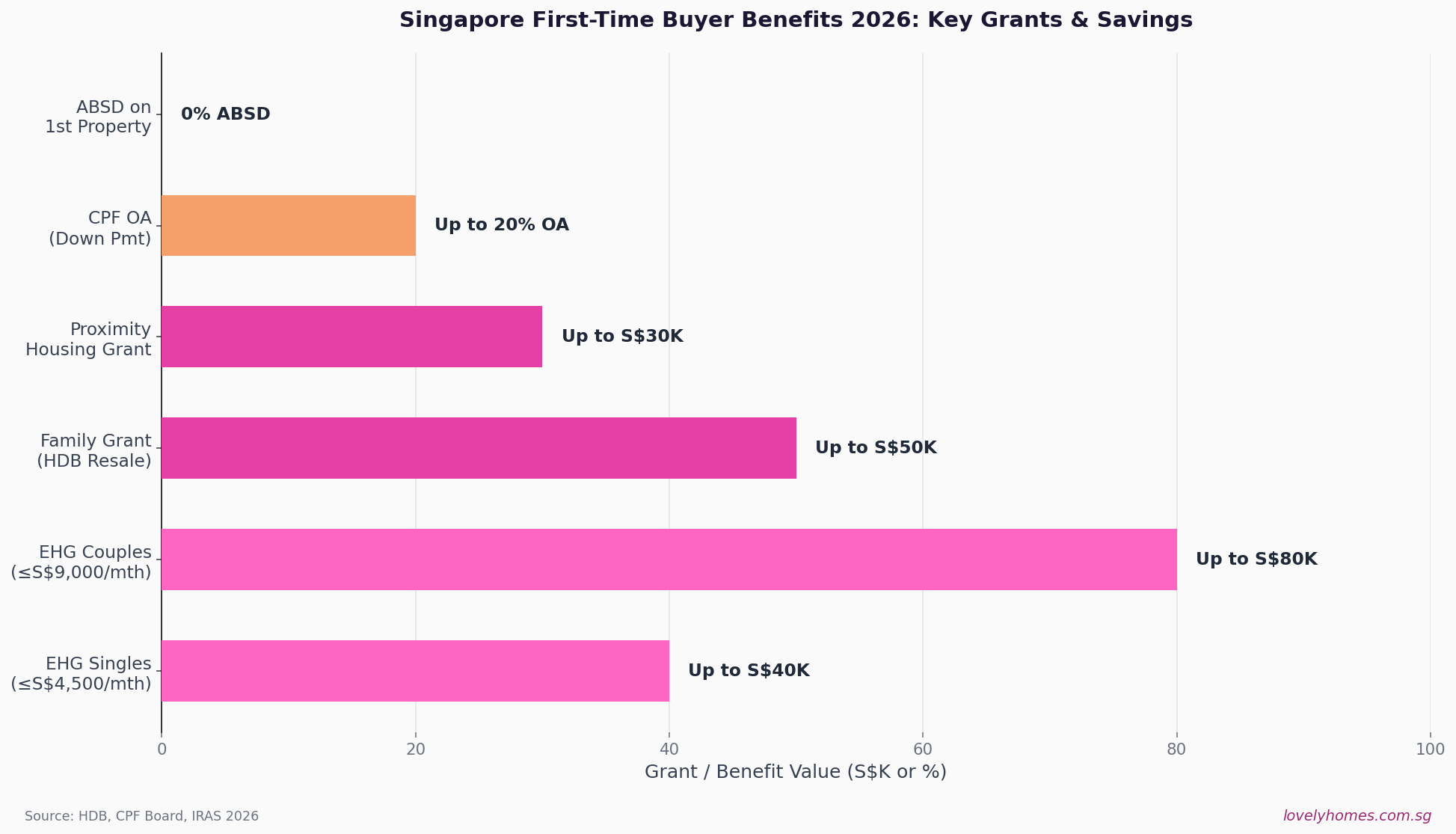
The Enhanced CPF Housing Grant (EHG) — introduced in 2019 and replacing the earlier Additional CPF Housing Grant — is the most generous and broadly available. For couples or families, the EHG provides up to S$80,000 if the household income is S$1,500 per month or below, tapering down in increments as income rises. The grant is zero for households earning above S$9,000 per month. Singles applying for a 2-room Flexi BTO flat in a non-mature estate can receive up to S$40,000, subject to a S$4,500 per month income ceiling. There is no minimum income floor.

The Family Grant applies specifically to resale HDB purchases and supports couples and families buying their first resale flat. An SC-SC couple can receive up to S$50,000, while an SC-SPR couple receives up to S$40,000. The grant is higher for 2-room and 3-room units. The Proximity Housing Grant (PHG) adds up to S$30,000 for those buying a resale flat within 4 kilometres of their parents’ or children’s flat, or up to S$20,000 if buying in the same town.

Singapore first-time buyer grants and benefits 2026 horizontal bar chart
Click image to enlarge
Figure 1: First-time buyer grants and key savings in Singapore (2026). Source: HDB, CPF Board, IRAS.

Step 1 — Obtain Your HDB Flat Eligibility (HFE) Letter

Before you can book a Build-To-Order (BTO) flat or submit an intent to buy for an HDB resale flat, you must hold a valid HDB Flat Eligibility (HFE) Letter. The HFE Letter, introduced in May 2023 as a replacement for the earlier Eligibility Letter, consolidates your housing eligibility, CPF housing grant eligibility, and HDB loan eligibility into a single document. You apply online via the HDB Flat Portal using your Singpass credentials.

The HFE application takes approximately two to three weeks to process. Once issued, the letter is valid for six months for BTO applications and nine months for resale purchases. You will need to reapply if it expires before your purchase is completed. HDB assesses your citizenship status, family nucleus, existing property holdings, and income during the application process. If you are taking an HDB Concessionary Loan, the HFE Letter will also state your approved loan amount based on your income and financial commitments.

Step 2 — Setting Your Budget: Loans, MSR and TDSR

Two key financial ratios govern how much you can borrow for a first-home purchase in Singapore: the Mortgage Servicing Ratio (MSR) and the Total Debt Servicing Ratio (TDSR). These are administered by the Monetary Authority of Singapore (MAS) under MAS Notices 632 and 1115.

For HDB flats and Executive Condominiums (ECs), the MSR caps your monthly home loan repayment at 30% of your gross monthly income. This is the more restrictive of the two ratios for most buyers in the HDB price range. For example, a couple with a combined gross income of S$7,500 per month can service a maximum of S$2,250 per month in mortgage repayments — regardless of how much the bank would otherwise lend.

The TDSR caps total monthly debt obligations at 55% of gross income. This includes all debts: car loans, personal loans, credit card balances and any property loan. For private property purchases (where MSR does not apply), the TDSR is often the binding constraint.

The Loan-to-Value (LTV) ratio determines the maximum percentage of the purchase price (or valuation, whichever is lower) you can borrow. For a first property, an HDB Concessionary Loan offers up to 80% LTV; a bank loan offers up to 75% LTV. The remaining 20–25% must come from cash and/or CPF OA savings, subject to the CPF usage rules.

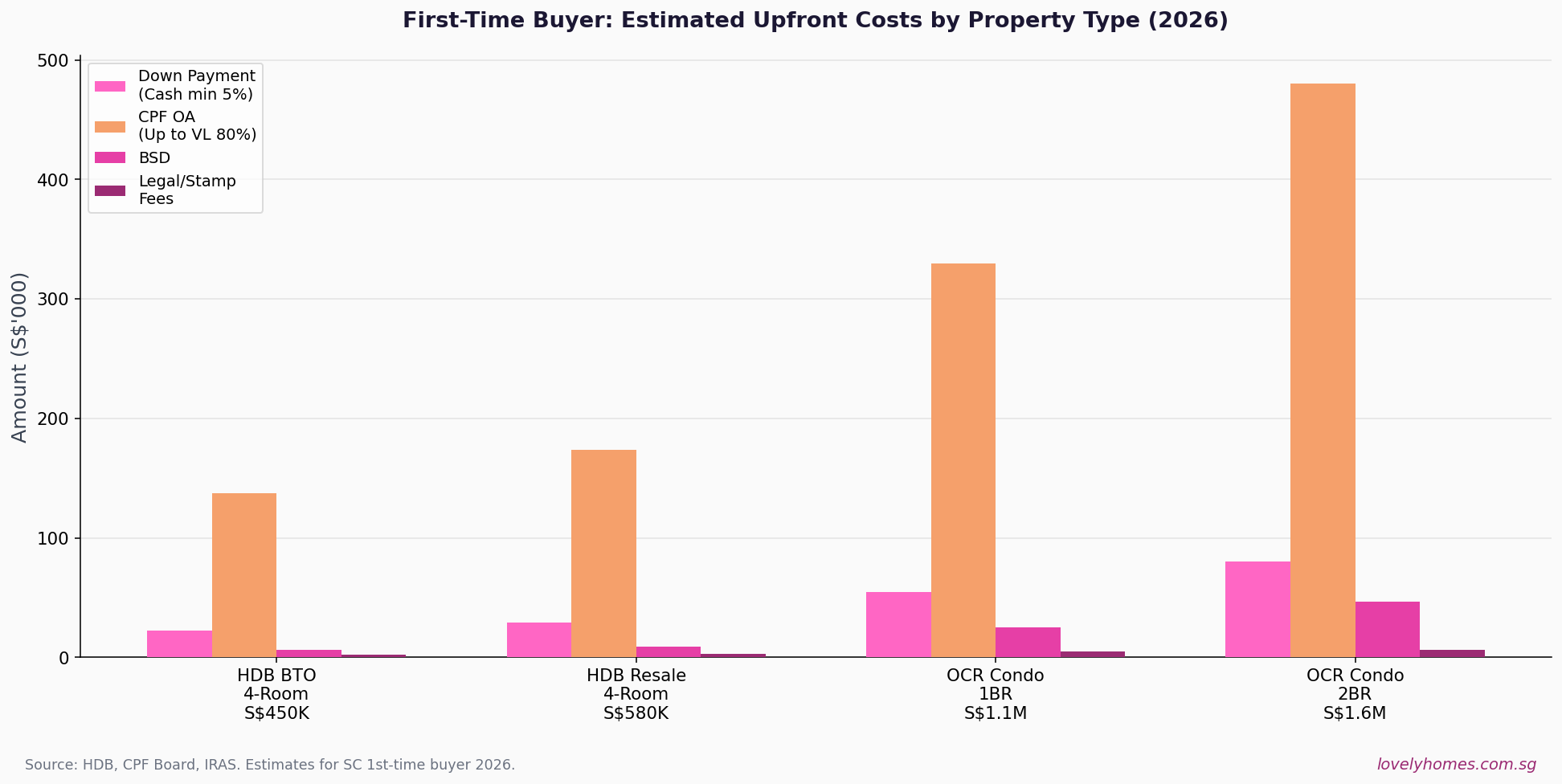
First-time buyer upfront costs by property type 2026 grouped bar chart
Click image to enlarge
Figure 2: Estimated upfront costs for a first-time buyer by property type (2026). Source: HDB, CPF Board, IRAS.

Step 3 — HDB vs Private Property: Which Is Right for You?

The most fundamental choice for a first-time buyer in Singapore is whether to purchase a public housing (HDB) flat or a private residential property. This choice determines your grant eligibility, loan terms, Minimum Occupation Period (MOP) obligations, and future flexibility.

HDB flats come with significant advantages for first-time buyers: access to CPF housing grants (which are not available for private property), the option of an HDB Concessionary Loan at a lower interest rate (pegged at CPF OA rate + 0.1%, currently 2.6% per annum), and a more affordable entry price in most locations. The trade-off is a 5-year Minimum Occupation Period (MOP) during which you cannot sell or rent out the entire flat, and HDB flats are leasehold (99 years).

Private property — condominiums, apartments and landed homes — offers no MOP (you can sell at any time, though Seller’s Stamp Duty applies if sold within the first three years). Private property can be freehold or leasehold. It does not attract any additional ABSD for a first-time SC buyer. The entry price is substantially higher, and you do not qualify for CPF housing grants on a private purchase. You will need to fund 25% of the purchase price from cash and CPF OA savings (at least 5% in cash), plus Buyer’s Stamp Duty and legal fees.

Executive Condominiums (ECs) occupy a hybrid position: they are developed by private developers but sold by HDB-approved developers at subsidised prices. First-time SC buyers of ECs qualify for CPF housing grants (EHG applies). ECs carry a 5-year MOP and become fully privatised after 10 years. Income ceilings apply: a household income cap of S$16,000 per month (as of 2024) for new EC purchases.

Step 4 — Stamp Duties on Your First Purchase

Buyer’s Stamp Duty (BSD) applies to all property purchases and is administered by IRAS. The rates are progressive: 1% on the first S$180,000 of the purchase price (or market value, whichever is higher), 2% on the next S$180,000, 3% on the next S$640,000, and 4% on the next S$500,000. For residential property above S$1.5 million, additional tiers apply (4% to 6%). BSD is payable within 14 days of signing the Option to Purchase (OTP) or Sales and Purchase Agreement (SPA).

Additional Buyer’s Stamp Duty (ABSD) for a Singapore Citizen purchasing their first residential property: 0%. This is a significant benefit — on a S$800,000 HDB resale flat, a second purchase by an SC would attract S$160,000 in ABSD (at 20%). First-time SPR buyers pay 5% ABSD; first-time foreign buyers pay 60% ABSD. ABSD rates are current as of February 2023 and are subject to revision by MAS and the Ministry of Finance.

Buyer Profile 1st Property ABSD 2nd Property ABSD 3rd+ Property ABSD
Singapore Citizen (SC) 0% 20% 30%
Singapore Permanent Resident (SPR) 5% 30% 35%
Foreigner 60% 60% 60%

Step 5 — CPF Usage for Your First Property

CPF Ordinary Account (OA) savings can be deployed for several aspects of a first-home purchase. For HDB flats, CPF OA funds may cover the down payment, monthly mortgage instalments, stamp duties, and legal fees. For private property, CPF OA covers the down payment (beyond the minimum 5% cash) and monthly instalments, but not stamp duties or legal costs.

For private property, CPF usage is governed by the Valuation Limit (VL) — the lower of the purchase price or market valuation — and the Withdrawal Limit (WL), which is typically 120% of the VL for properties with a remaining lease of at least 60 years. If the property’s remaining lease cannot cover the youngest buyer to age 95, CPF usage is proportionally restricted. Properties with fewer than 30 years remaining lease cannot be purchased using CPF. These rules are set and administered by the CPF Board.

Critically, CPF amounts withdrawn for housing — including monthly instalments — accrue interest at 2.5% per annum. When you sell the property, you must refund the CPF principal withdrawn plus the accrued interest back into your CPF accounts. This is not a penalty; it is a mechanism to preserve your retirement savings. Buyers should model this refund carefully when planning a sale, as the CPF refund obligation reduces your net cash proceeds.

Step 6 — The Buyer’s Journey: Timeline and Key Milestones

The timeline from decision to keys depends heavily on the property type:

HDB BTO: Application → Ballot results (1–3 months) → Flat selection appointment (6–18 months post-ballot) → Agreement for Lease signing → Construction (3–4 years) → Key collection. Total: typically 4–5 years. You pay a booking fee (S$500–S$2,000) and a downpayment at the Agreement for Lease stage, not at ballot.

HDB Resale: Property search → OTP granted (S$1–S$1,000 option fee) → HFE check + financials → Resale application submitted to HDB → HDB inspection + valuation (2–4 weeks) → Completion appointment. Total: approximately 3–4 months from OTP to keys.

Private New Launch (uncompleted): Sales gallery → OTP → Sales and Purchase Agreement within 3 weeks → Deferred Payment Scheme possible → TOP (Temporary Occupation Permit) typically 3–5 years from launch → Legal completion 1 year after TOP. Total: 4–6 years from OTP to keys.

Private Resale: OTP → S&P Agreement (3 weeks) → Legal completion (8–12 weeks). Total: approximately 10–16 weeks from OTP.

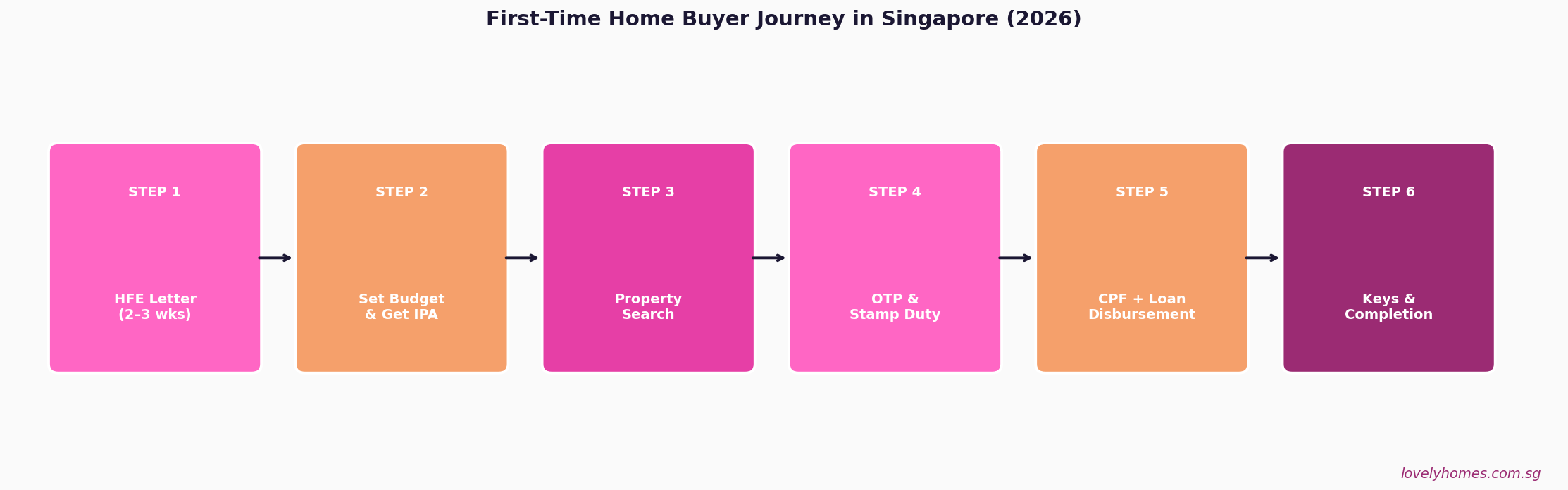
Singapore first-time home buyer journey 6 steps flowchart 2026
Click image to enlarge
Figure 3: The first-time home buyer journey in Singapore — 6 key steps from HFE to keys (2026).

Worked Example: The Tan Family Buys a Queenstown Resale HDB

Mr and Mrs Tan are Singapore Citizens in their late 20s, both working, with a combined gross monthly income of S$7,500. They have no existing property and no prior grants received. They want to buy a 4-room HDB resale flat in Queenstown priced at S$600,000.

Grant entitlement:

  • EHG (couples): Income S$7,500 ≤ S$9,000 ceiling → S$40,000
  • Family Grant (SC-SC, 4-room resale): S$50,000
  • PHG: Not applicable (parents not in same town)
  • Total CPF grants: S$90,000 (credited to CPF OA on application)

Financing:

  • Purchase price: S$600,000
  • HDB loan LTV 80%: max loan = S$480,000
  • Minimum cash down payment (5%): S$30,000 (cash)
  • Remaining down payment (15%): S$90,000 — fully covered by CPF grants
  • CPF OA balance remaining for ongoing instalments: any OA savings above the grant drawdown

Stamp duties and fees:

  • BSD: (1% × S$180K) + (2% × S$180K) + (3% × S$240K) = S$1,800 + S$3,600 + S$7,200 = S$12,600
  • ABSD: S$0 (SC, first property)
  • HDB conveyancing fee: approximately S$2,000 (fixed HDB scale)

Monthly instalment check (MSR):

  • Loan: S$480,000 at 2.6% p.a. (HDB Concessionary rate) over 25 years
  • Monthly instalment: approximately S$2,182
  • MSR: S$2,182 ÷ S$7,500 = 29.1% ✓ (below 30% ceiling)
  • TDSR: Assuming no other debts — S$2,182 ÷ S$7,500 = 29.1% ✓ (well below 55%)

Summary — cash outlay on day of completion:

  • Cash down payment: S$30,000
  • BSD (payable at OTP exercise): S$12,600 (cash or CPF OA where applicable, but IRAS requires CPF authorisation; HDB resale allows CPF for BSD)
  • Legal fees: ~S$2,000
  • Total cash needed: approximately S$44,600 (grants cover down payment balance; monthly CPF contributions service the loan)

This illustrates the powerful effect of combining EHG + Family Grant: the Tans effectively halved their cash requirement at purchase while securing a flat in a mature Queenstown estate.

What This Means for First-Time Buyers in 2026

The first-time buyer policy environment in Singapore in 2026 remains one of the most structured and intentionally supportive in the Asia-Pacific region. The 0% ABSD for a first SC purchase, combined with the EHG and Family Grant stack, creates a measurable financial cushion that reduces the entry barrier for younger households. However, the MSR at 30% remains the binding constraint for many buyers targeting HDB resale flats in higher-priced estates — particularly central-region locations where prices have risen significantly since 2020.

For buyers considering private property as their first purchase, the landscape is more demanding. The minimum 5% cash downpayment, BSD, legal fees and the absence of housing grants mean the total upfront cash outlay on a S$1.2M OCR condo could easily exceed S$100,000. TDSR at 55% provides meaningful borrowing headroom for dual-income couples, but rising interest rates in recent years have reduced the effective loan quantum relative to income compared to the low-rate environment of 2018–2021.

What Might Come Next (Looking Ahead)

Property analysts and policy observers have noted that the HDB grant framework has not been materially adjusted since the EHG was last recalibrated in 2021. Should HDB resale prices continue to rise — the HDB resale price index rose by around 4.9% in 2025 — there is a possibility that the income ceilings or grant amounts may be reviewed upward to maintain affordability for median-income households. The Government has in the past adjusted grant quantum in response to resale price escalation.

Separately, MAS periodically reviews the MSR and TDSR thresholds in light of macroeconomic conditions. Neither threshold has changed since 2013 (TDSR) and 2014 (MSR for HDB). Any upward revision — even minor — would meaningfully expand the eligible loan quantum for first-time HDB buyers. This remains speculative and is flagged here as an area to monitor, not a confirmed policy direction.

Frequently Asked Questions

Can I use my CPF OA to buy a private property as my first home?

Yes. CPF OA savings may be used to fund the down payment (beyond the minimum 5% cash) and monthly mortgage instalments on eligible private residential property. However, CPF housing grants — EHG, Family Grant, PHG — are only available for HDB flat purchases. You will also need to comply with CPF Board’s Valuation Limit and Withdrawal Limit rules, and CPF cannot be used for stamp duties or legal fees on a private purchase.

Does buying a property under a family member’s name affect my first-time buyer status?

Yes, it can. HDB checks ownership records for all applicants including co-owners. If you have previously held a financial interest in any HDB flat — even as a co-owner — you may not qualify as a first-time HDB buyer. For ABSD purposes, IRAS assesses each individual owner’s residential property count. Being a co-owner of a property generally counts as ownership for ABSD calculation purposes, even if you did not pay for it directly.

What is the minimum cash downpayment for a first property purchase?

For a first property purchased with a bank loan, the minimum cash component is 5% of the purchase price (the remaining 20% of the 25% minimum downpayment may come from CPF OA). For an HDB Concessionary Loan (where the LTV is 80%), there is no mandatory cash minimum — the full 20% downpayment can be funded from CPF OA or grants, though in practice most buyers have some cash savings beyond this. Stamp duties and legal fees are additional cash or CPF outlays.

Can singles buy an HDB flat as a first-time buyer?

Yes, with conditions. Singapore Citizens aged 35 and above may purchase a new 2-Room Flexi BTO flat in non-mature estates, or a resale HDB flat of any size (as long as they meet income ceilings and eligibility conditions). Singles are also eligible for the EHG (up to S$40,000) and, under certain schemes, may apply for a 5-room or larger resale flat from age 35. The Public Scheme and Single Singapore Citizen Scheme govern these purchases. SPR singles may purchase resale HDB flats only from age 35.

What is the HDB Minimum Occupation Period (MOP) and does it apply to private property?

The Minimum Occupation Period (MOP) for HDB flats is 5 years from the date you collect the keys (BTO) or the date of flat purchase (resale). During the MOP, you cannot sell the flat, sublet the entire flat (you can sublet rooms), or purchase another HDB flat. Executive Condominiums (ECs) also carry a 5-year MOP before privatisation, and a 10-year full privatisation period. Private condominiums and landed property have no MOP — you can sell at any time, though Seller’s Stamp Duty (SSD) applies if sold within 3 years of purchase.

How long does the HFE Letter application take?

The HDB Flat Eligibility (HFE) Letter typically takes approximately 2 to 3 weeks to process after a complete application is submitted via the HDB Flat Portal using Singpass. Processing time may be longer during periods of high BTO exercise volume. The letter is valid for 6 months for BTO applications and 9 months for resale flat purchases. You should apply well in advance of your intended property search to avoid delays.

Related Articles

Disclaimer: This article is produced for general informational and educational purposes only. It does not constitute financial, legal, or property advice. Policies, grant amounts, interest rates, ABSD rates, LTV limits, MSR and TDSR thresholds are subject to change by the relevant Singapore government authorities including HDB, MAS, CPF Board, IRAS and the Ministry of Finance. Figures, examples and calculations are illustrative and based on information available as at 2 August 2026. Readers should verify all information with the official sources — HDB, IRAS, CPF Board, MAS, URA — and seek advice from a licensed financial adviser and conveyancing solicitor before making any property purchase decision.

Translate »