TDSR (Total Debt Servicing Ratio) caps all your monthly debt repayments, mortgage plus everything else, at 55% of your gross monthly income, and applies to every residential property loan in Singapore.
MSR (Mortgage Servicing Ratio) is a stricter, narrower limit that applies only to HDB flats and Executive Condominiums (ECs) bought directly from a developer, capping the mortgage instalment alone at 30% of gross monthly income.
Both ratios are administered under rules set by the Monetary Authority of Singapore (MAS); HDB applies the same underlying framework to bank loans used for HDB purchases.
Banks must calculate your eligibility using a stress test interest rate (an MAS-set floor, commonly cited at 4% per annum) rather than the actual rate on your loan, which is almost always lower.
The TDSR framework was introduced by MAS in June 2013 with a 60% ceiling, then tightened to 55% as part of the December 2021 cooling measures.
Variable income (commission, bonus, rental) is only counted after a haircut, commonly 30% for rental income and 30% for variable/self-employed income, before it’s added to your TDSR/MSR calculation.
For an HDB flat or EC, both MSR and TDSR must be satisfied simultaneously: MSR is almost always the tighter constraint for these property types.
What Are TDSR and MSR, and Why Do They Exist?
Every home loan application in Singapore is tested against one or both of two affordability ceilings set by the Monetary Authority of Singapore (MAS): the Total Debt Servicing Ratio (TDSR) and, for HDB flats and Executive Condominiums, the Mortgage Servicing Ratio (MSR). Both exist for the same underlying reason: to stop households from borrowing more than they can realistically service, and to keep systemic household leverage at a level the banking system and the wider economy can absorb if interest rates rise or incomes fall. Neither ratio is a suggestion; they are hard caps built into every bank’s and HDB’s loan approval system, and a loan application that fails either test simply cannot be approved at the requested quantum.
TDSR was introduced on 29 June 2013, in the wake of a prolonged period of low interest rates and rapid private-property price growth, as the definitive framework for assessing a borrower’s total debt burden across every loan they hold, not just the mortgage being applied for. MSR is the older, narrower sibling; it has applied to HDB flats and ECs bought from a developer for considerably longer, reflecting the public-housing policy goal of keeping mortgage burdens on subsidised or grant-supported flats conservative relative to household income.
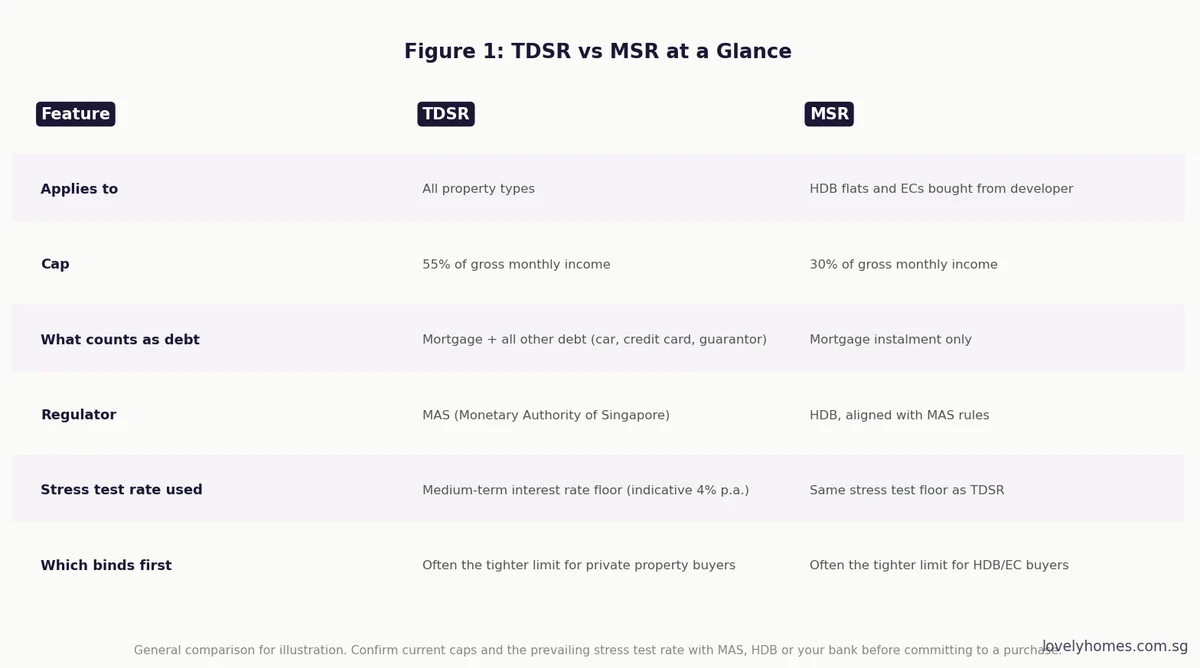
Figure 1: TDSR and MSR side by side: who they apply to, the caps, and what counts as debt.
TDSR in Detail: The 55% Ceiling That Applies to Every Property Loan
TDSR looks at the whole picture of your finances, not just the loan you’re applying for. The formula is straightforward in concept: add up all your monthly debt obligations (the proposed new mortgage instalment, any existing home loan, car loan, renovation loan, personal loan, education loan, and the minimum payment due on every credit card you hold) and divide that total by your gross monthly income. The result cannot exceed 55%. If it does, the bank cannot approve the loan at that quantum; you would need to either apply for a smaller loan, pay down existing debt first, or bring in a co-borrower whose income can be added to the calculation.
Crucially, TDSR is not limited to property-related debt. A large car loan, a chunk of outstanding credit card balances, or a sizeable personal loan for a wedding can all quietly eat into your TDSR headroom well before you ever start comparing condo units, which is why mortgage brokers routinely advise clearing high-interest short-term debt in the months before a home loan application.
MSR in Detail: The Tighter 30% Rule for HDB and EC Buyers
MSR is narrower in scope but stricter in effect. It applies only to HDB flats (whether new BTO, resale, or SBF) and Executive Condominiums bought directly from a developer, and it looks only at the mortgage instalment for that specific property: not your car loan, not your credit cards, not any other debt. The cap is 30% of gross monthly income. For most HDB and EC buyers, MSR bites before TDSR does, since 30% is a materially tighter ceiling than 55%; a buyer with no other debt at all can still be constrained purely by MSR.
Both ratios must be satisfied at the same time for an HDB or EC purchase financed with a bank loan: the mortgage instalment alone must stay under 30% of income (MSR), and the mortgage instalment plus every other debt obligation must stay under 55% of income (TDSR). HDB’s own concessionary loan, used by many first-time flat buyers, applies MSR using HDB’s own assessment framework, which is administered in step with the same underlying MAS policy intent even though the concessionary loan itself sits outside the bank lending system.
The Stress Test Rate: Why Your Loan Eligibility Isn’t Based on Your Actual Interest Rate
This is the detail that surprises the most first-time buyers. Banks are required by MAS to compute your TDSR and MSR using a stress test interest rate: a conservative, MAS-set floor rate, rather than the actual, usually lower, interest rate quoted on your home loan package. The stress test rate is commonly cited at a floor of 4% per annum (or the loan’s own reference rate plus a margin, whichever is higher), regardless of whether your actual mortgage package charges something closer to 2.5%–3.5%.
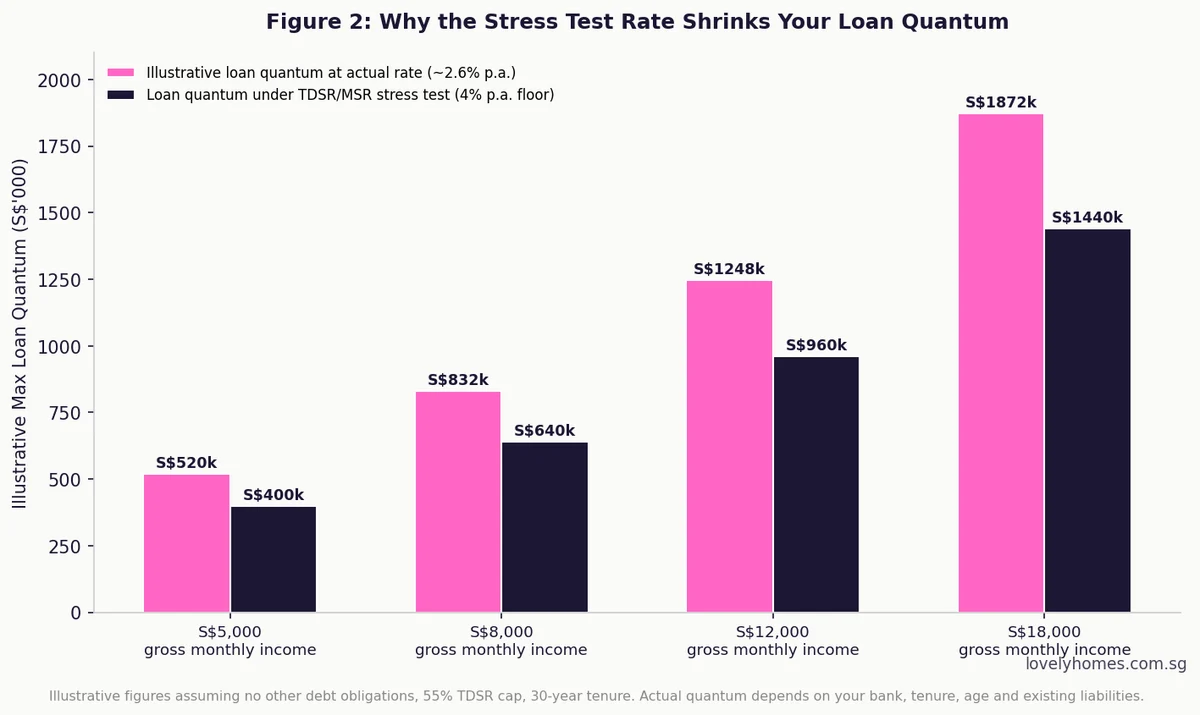
The logic is deliberately conservative: if interest rates were to rise materially over your loan’s 20–30 year tenure, MAS wants confidence that you could still service the mortgage at a meaningfully higher rate than today’s prevailing rate, without becoming financially distressed. The practical effect is that your maximum loan quantum is smaller than a simple calculation using your actual mortgage rate would suggest, sometimes substantially so, as illustrated below.
Figure 2: Illustrative maximum loan quantum at an actual mortgage rate versus the same household under the TDSR/MSR stress test floor.
What Counts as Income and Debt: The Details That Catch Buyers Out
Not all income is treated equally in a TDSR or MSR calculation, and this is where self-employed buyers, commission-based earners, and landlords most often find their expectations don’t match the bank’s numbers:
Fixed employment income (basic salary) is generally counted in full.
Variable income (bonuses, commissions, and income for the self-employed) is typically counted only after a haircut, commonly 30%, applied to a multi-year average rather than the most recent (and possibly best) year alone.
Rental income from other properties you own is likewise typically included only after a haircut, commonly around 30%, and usually requires evidence such as a signed tenancy agreement or recent rental transaction history.
Existing debt counted against you includes other mortgages, car loans, renovation loans, education loans, personal loans, and the minimum monthly payment on every credit card you hold, even if you pay your statement in full each month and carry no actual interest-bearing balance.
Guarantor obligations (if you’ve guaranteed someone else’s loan) can also be pulled into your own TDSR calculation, a detail many guarantors are unaware of until they apply for their own mortgage.
Worked Example: The Tans’ TDSR Headroom
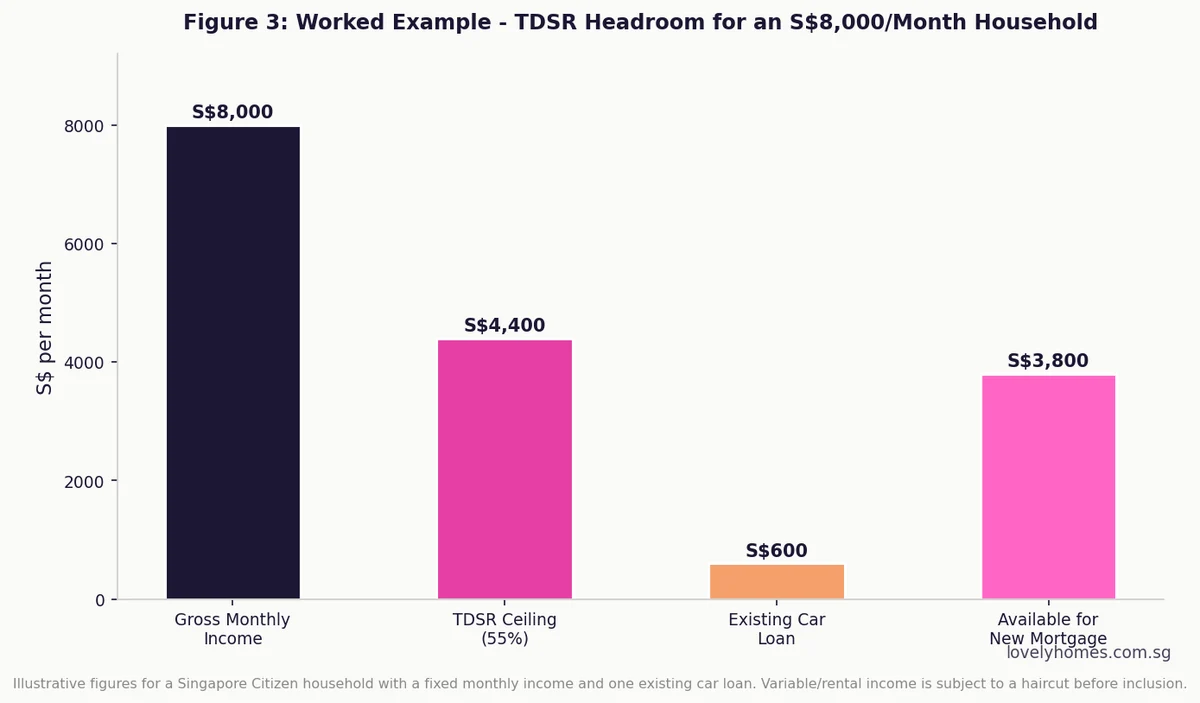
Profile: Mr and Mrs Tan have a combined gross monthly income of S$8,000. They currently service one existing car loan with a monthly instalment of S$600, and they hold no other outstanding debt.
Step 1: TDSR Ceiling. 55% of S$8,000 = S$4,400 is the maximum total monthly debt obligation the Tans can carry across everything, mortgage included.
Step 2: Deduct Existing Debt. S$4,400 − S$600 (car loan) = S$3,800 available for a new mortgage instalment.
Step 3: Translate Into a Loan Quantum. at the MAS stress test floor of 4% per annum over a 30-year tenure, roughly S$3,800 of monthly instalment headroom supports an indicative loan quantum in the region of S$790,000–S$800,000, notably lower than a calculation using the couple’s actual, lower contracted mortgage rate would suggest.
Step 4: If Buying an HDB Resale Flat Instead. MSR would also need to be checked. At 30% of S$8,000 = S$2,400 maximum mortgage instalment, MSR would be the binding constraint rather than TDSR, since S$2,400 is lower than the S$3,800 TDSR headroom calculated above, meaning the Tans’ loan quantum for an HDB purchase would be capped by MSR, not TDSR.
Figure 3: Worked example: how existing debt reduces TDSR headroom for a new mortgage.
Summary: TDSR and MSR Facts at a Glance
Question
Short Answer
What is the TDSR cap?
55% of gross monthly income, all property types.
What is the MSR cap?
30% of gross monthly income, HDB flats and ECs only.
Which rate is used to test eligibility?
An MAS stress test floor (commonly cited at 4% p.a.), not your actual rate.
Who regulates TDSR/MSR?
The Monetary Authority of Singapore (MAS), applied by HDB for HDB loans.
Does variable income count in full?
No, typically only after a haircut (commonly around 30%).
Which limit binds for HDB/EC buyers?
Usually MSR (30%), since it’s tighter than TDSR (55%).
Why This Matters: Who Gets Caught Out
TDSR and MSR are most likely to bind unexpectedly for a specific set of buyers: self-employed individuals and commission-based earners, whose variable-income haircut can shrink their apparent income considerably relative to what actually lands in their bank account; guarantors, who may not realise a loan they’ve guaranteed for a family member is quietly counted against their own future borrowing capacity; upgraders who haven’t yet sold their existing home and are trying to qualify for a new mortgage while still servicing the old one; and buyers relying heavily on rental income from an investment property, which is haircut and often requires documentary proof most first-time landlords haven’t yet assembled. For all these groups, getting an informal affordability check from a mortgage broker or bank before making an offer, rather than after, avoids the disappointment of a signed Option to Purchase that a bank later can’t finance at the assumed quantum.
What Might Come Next
The following is informed speculation, not confirmed policy. The TDSR/MSR framework, and the stress test rate in particular, is periodically reviewed by MAS in response to prevailing interest rate conditions and household debt trends, as seen when the stress test floor was last adjusted upward. Should mortgage rates fall meaningfully and household borrowing appetite pick up again, some industry commentary suggests MAS could revisit the stress test floor to keep effective borrowing capacity in check without necessarily changing the headline 55%/30% caps themselves. No such change has been announced as at this writing, and the caps and stress test rate discussed in this guide should always be verified against MAS’s current published rules before making financing decisions.
Frequently Asked Questions
Do TDSR and MSR apply to me if I’m paying cash, with no bank loan?
No. TDSR and MSR are lending safeguards that apply only when you’re taking a housing loan from a bank (or, for MSR-equivalent purposes, an HDB concessionary loan). A fully cash purchase with no loan is not subject to either ratio.
Can I use my parents’ or children’s income to boost my TDSR?
Some banks allow a family member to be added as a co-borrower or guarantor, which can bring their income into the calculation, subject to the bank’s own credit assessment and MAS rules on income-weighted average age for loan tenure. This is a case-by-case discussion best had directly with your mortgage banker or broker.
Why is my maximum loan quantum lower than a simple online calculator suggested?
Most simple calculators use your actual, contracted mortgage rate. Banks are required to test your eligibility using the higher stress test rate, which produces a smaller maximum loan quantum than a calculation based on your real interest rate.
Does refinancing my existing mortgage get tested against TDSR/MSR again?
Refinancing an existing property loan without increasing the loan quantum is generally not re-tested against TDSR/MSR in the same way as a new purchase loan, though banks retain discretion and individual policies can vary; always confirm directly with your bank.
If I clear my car loan, will my loan quantum increase immediately?
Once the car loan is fully settled and no longer appears in your credit record, it should no longer count against your TDSR, freeing up that portion of your income for mortgage servicing. Processing time for the update to reflect in a bank’s assessment can vary, so it’s worth allowing a short buffer before your loan application.
Is MSR checked for HDB flats bought entirely with a bank loan, not an HDB loan?
Yes. MSR applies to HDB flats and ECs regardless of whether the financing comes from a bank loan or an HDB concessionary loan; both are subject to the 30% mortgage servicing ceiling, alongside TDSR where applicable.
Do private condo purchases get checked against MSR too?
No. MSR applies only to HDB flats and Executive Condominiums bought from a developer. Private condominium and landed property purchases are assessed against TDSR only, not MSR.
Disclaimer: This article is intended for general informational purposes only and does not constitute financial advice. TDSR and MSR caps, the applicable stress test interest rate, and income haircut percentages are set by the Monetary Authority of Singapore and are subject to change. Always confirm the current framework with the Monetary Authority of Singapore (MAS), the Housing & Development Board (HDB), or your bank/mortgage broker before making any home financing decision.
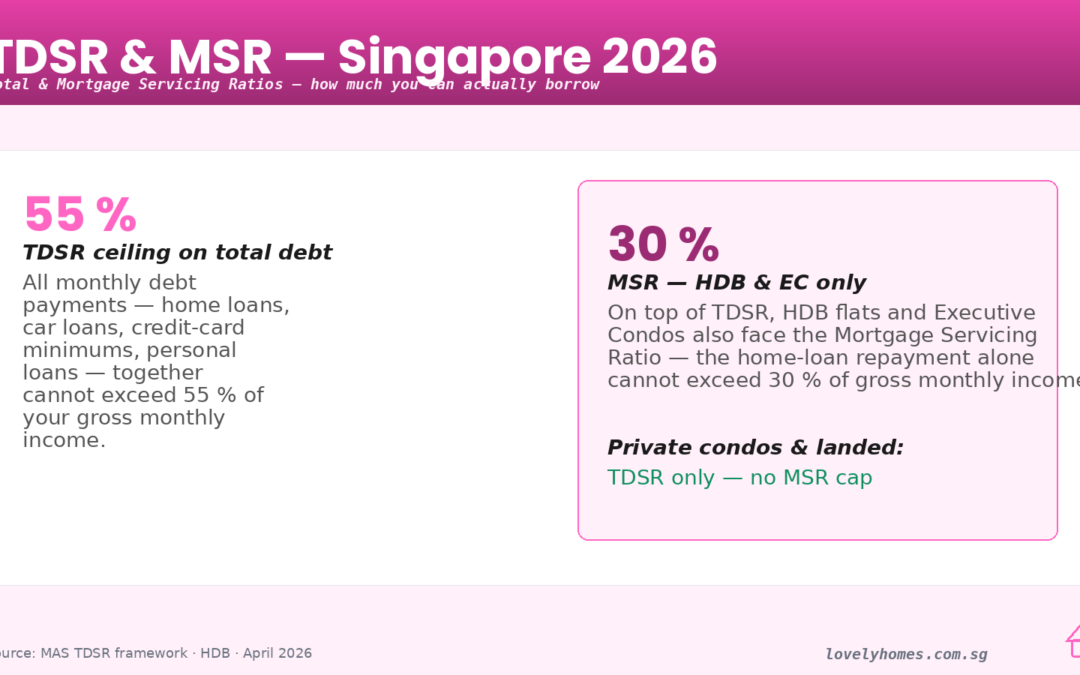
Figure 1: The two numbers that decide every Singapore home loan — TDSR at 55% of income and MSR at 30% for HDB and EC purchases.
If you have ever wondered why the bank’s pre-approval letter gave you a smaller loan than you budgeted for — or why a friend on the same salary can borrow noticeably more than you — the answer almost always comes down to two acronyms: TDSR and MSR. These are the two borrowing limits the Monetary Authority of Singapore (MAS) bakes into every residential mortgage, and in 2026 they are the single biggest determinants of how much home you can actually finance.
This guide is the 2026 edition. It covers exactly how TDSR and MSR are calculated, how they interact with the loan-to-value (LTV) cap, where the 4.0% stress-test rate comes from, what counts as income, what doesn’t, and — crucially — how to game the numbers in your favour without breaking any rules. We walk through a fully-worked Singapore example end-to-end and finish with the policy trajectory so you know what to watch for next.
Quick Answer: The 10 Things Every Singapore Borrower Should Know
TDSR is 55%. Total monthly debt repayments — including the new mortgage — cannot exceed 55% of your gross monthly income. Applies to every residential property loan.
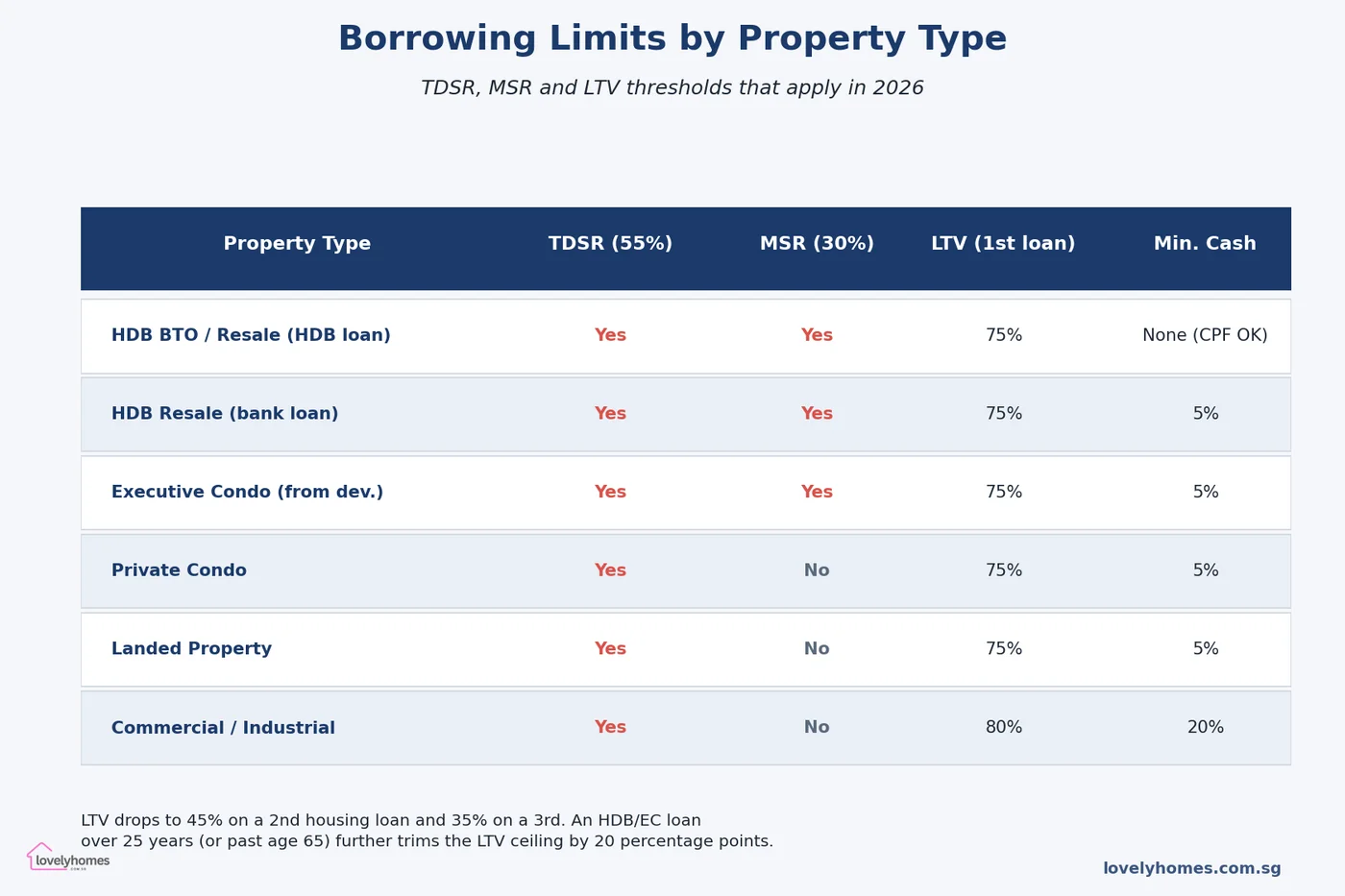
MSR is 30%. Mortgage repayments on an HDB flat or Executive Condominium (EC) bought from the developer cannot exceed 30% of gross monthly income. Private condos and landed property have no MSR.
Stress-test rate is 4.0%. TDSR and MSR are calculated at a medium-term interest rate of 4.0% for residential loans, regardless of the rate you actually pay today.
LTV caps layer on top. First housing loan: up to 75% of purchase price. Second housing loan: up to 45%. Third and beyond: up to 35%.
Age and tenure matter. If the loan tenure pushes past age 65, or exceeds 30 years (25 for HDB), the LTV cap drops by 20 percentage points.
Variable income is haircut by 30%. Commission, bonus, rental and freelance earnings are only counted at 70% of the proven figure.
Existing debts eat into headroom. Car loans, credit-card minimum payments, student loans, and other mortgages all hit your TDSR ceiling before the new home loan does.
Guarantors are counted too. If you guarantee a sibling’s loan, it may sit in your TDSR — not theirs.
Cash down-payment rules mirror LTV. The first 5% (25% at higher LTV tiers) must be paid in cash; the balance can be CPF Ordinary Account funds.
Refinancing carve-out. Borrowers refinancing an owner-occupied property with no cash-out may be exempted from TDSR — a narrow but useful escape hatch.
What Is TDSR — The Framework That Underpins Every Home Loan
The Total Debt Servicing Ratio was introduced in June 2013 as part of MAS’s cooling-measures programme (see our full cooling measures timeline for the wider context). Its purpose is simple: to stop households from levering up to a level where a modest rise in interest rates would push them into negative cash flow. The 2010s saw Singapore’s household debt-to-GDP ratio climb past 70%, and MAS wanted a circuit-breaker that worked the same way regardless of which bank a buyer walked into.
TDSR caps all monthly debt obligations at 55% of gross monthly income. “All debt” is deliberately broad: it includes the prospective home-loan instalment (calculated at the stress-test rate), existing mortgages, car loans, personal loans, renovation loans, student loans, credit-card minimum repayments and any loans you have personally guaranteed. Even a dormant credit card with a S$20,000 limit is counted if the bank uses the 3% minimum-payment convention.
The ratio was originally set at 60% in 2013 and tightened to 55% in December 2021, where it remains in 2026. That three-percentage-point shave looks small on paper but at a typical Singapore household income removes roughly S$150,000–S$200,000 of borrowing capacity.
What Is MSR — The Second Ratio You Cannot Ignore for HDB and EC Buyers
The Mortgage Servicing Ratio is narrower but stricter. Introduced for HDB loans in 2011 and extended to bank loans on HDB flats in 2013, MSR caps the mortgage portion alone at 30% of gross monthly income for purchases of HDB flats and Executive Condominiums bought directly from the developer.
MSR is a subset of TDSR, not a substitute. HDB and new-EC buyers must clear both ratios — the tighter of the two binds. In practice MSR is almost always the binding constraint for HDB buyers because existing debt rarely adds up to the 25-percentage-point gap between MSR (30%) and TDSR (55%). For EC buyers the numbers narrow as the project moves through its 10-year maturation period — after the five-year minimum occupation period and the ten-year privatisation, a resale EC is treated like a private condo for borrowing-limit purposes, so TDSR alone applies.
For a side-by-side look at which ratios hit which property type, the matrix below summarises 2026 rules.
Figure 2: 2026 borrowing limits by property type. HDB flats and ECs face both MSR and TDSR; private condos, landed property and commercial assets only face TDSR.
How the 4.0% Stress-Test Rate Works — And Why It Matters More Than Your Actual Rate
Here is the trap that catches most first-time buyers: banks must calculate your monthly instalment using an assumed rate of 4.0% for residential mortgages, even if your actual rate is 2.5% or 3.0%. This is the medium-term interest rate, set by MAS and reviewed from time to time. It was revised upward from 3.5% to 4.0% in September 2022 and has not moved since.
Why 4.0%? The rate is designed to approximate the long-run average that Singapore floating-rate loans have oscillated around over a 30-year horizon. It is deliberately punitive — regulators would rather have borrowers told “you qualify for less” at origination than have the same borrowers go into arrears when rates spike. Anyone who lived through the 2022–2023 rate cycle, when three-month SORA went from 0.2% to 3.8% in 18 months, will appreciate the logic.
The mechanic: the bank plugs a 4.0% rate into the standard amortisation formula using your chosen loan tenure, derives an assumed monthly instalment, and tests that figure against your TDSR (55%) and, if applicable, MSR (30%). Your actual repayment — calculated at whatever rate the bank is offering — will be lower in most cases, leaving you with a margin of safety that MAS consciously engineered.
What Counts as Income — And Why Variable Pay Is Penalised
Income for TDSR/MSR purposes is not what you see on your IRAS tax statement. MAS prescribes a structured treatment:
Fixed salary. Counted at 100%. Evidenced by payslips (usually three to six months) and the latest CPF contribution history.
Variable income. Commission, bonus, overtime, and freelance earnings are haircut by 30%, so only 70% of the verified average is recognised. The haircut applies to the entire variable component, even if you can show multiple years of steady track record.
Rental income. Counted at 70% of the gross rent receivable, net of void periods. A two-year tenancy agreement is strong evidence; month-to-month leases are viewed more sceptically.
Self-employed / business income. Two years of Notice of Assessment (NOA) are the default evidentiary bar, with the 30% haircut applied.
Allowances and AWS. Typically 100% if contractual and evidenced; otherwise haircut.
This is where the seemingly simple 55% number becomes surprisingly individual. A banker earning S$12,000 monthly but with 40% of that as variable gets assessed on S$7,200 fixed + S$3,360 post-haircut variable = S$10,560 — so the TDSR ceiling drops to S$5,808 per month rather than the nominal S$6,600.
What Counts as Debt — The Items Borrowers Miss
The other half of the equation is debt. The headline items — the new home loan instalment, existing mortgages, and car loans — are obvious. Less obvious items often catch borrowers out:
Credit-card minimum payments. Banks use a 3% minimum convention on the outstanding balance (or sometimes on the total credit limit). If you carry S$30,000 revolving credit across cards, that is a S$900 monthly hit on your TDSR — shaving S$192,000 off your loan ceiling at a 4.0% stress rate over 30 years.
Renovation and personal loans. Unsecured loan instalments count in full.
Student loans. Included in TDSR from the date repayments begin.
Guarantor obligations. If you have co-signed a relative’s loan and there is no formal debt-transfer, some banks will count the full instalment against you. Others use 50%. Ask the relationship manager explicitly.
Outstanding ABSD remission obligations. If you are on a remission schedule (e.g. from selling a prior property to claim remission on a new purchase), the existing loan remains in TDSR until the sale completes.
A Fully-Worked Example: A S$10,000-a-Month Household Buying a Private Condo
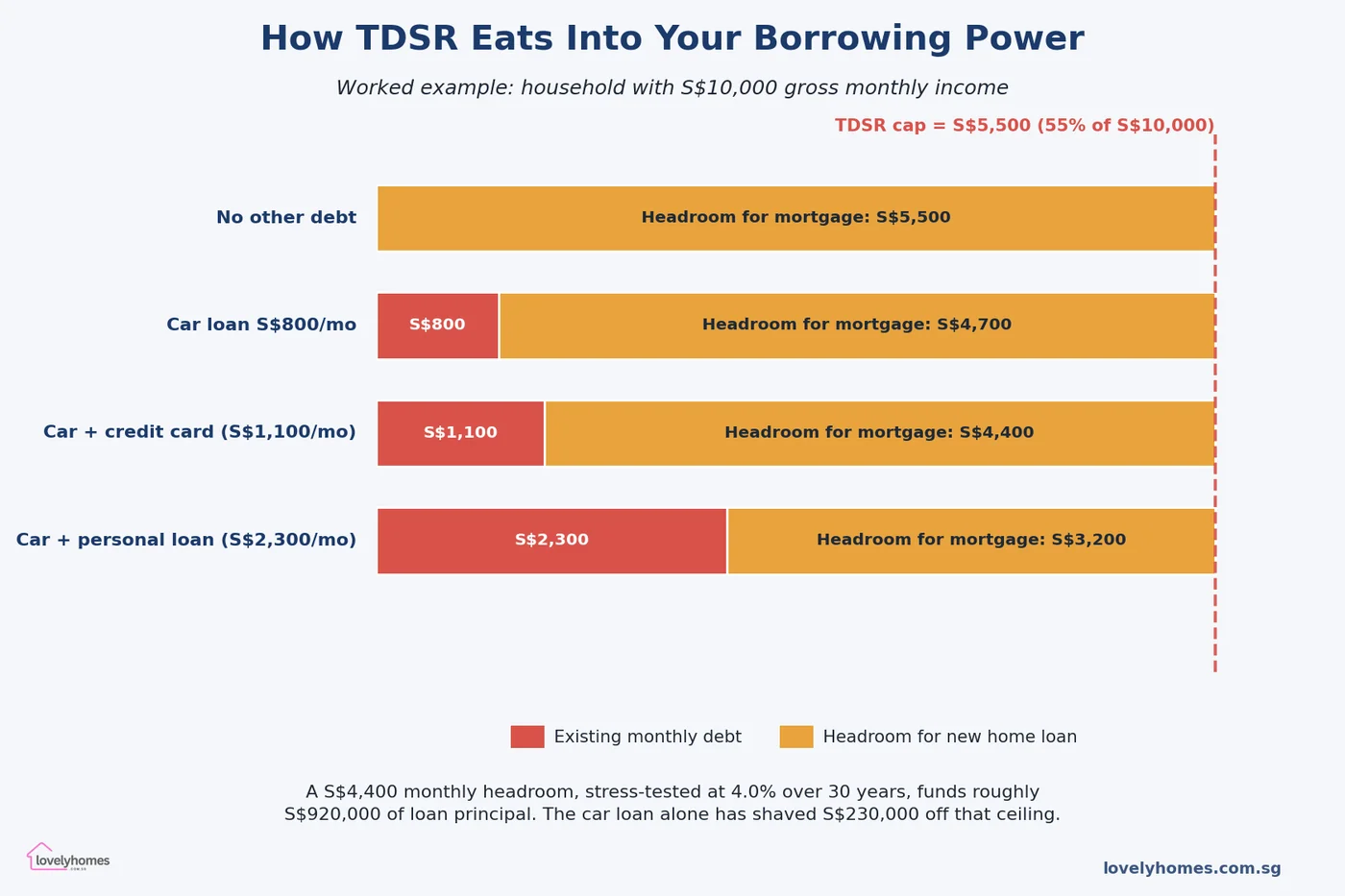
Figure 3: How different existing-debt profiles crater the monthly headroom available for a new mortgage, given a household earning S$10,000 gross.
Consider a dual-income couple: combined gross monthly salary S$10,000, both on fixed pay, no variable component. They are looking at a S$1.8 million resale private condo in District 15.
Step 1 — TDSR cap. 55% × S$10,000 = S$5,500. No MSR applies because this is a private condo.
Step 2 — Existing debts. One car loan at S$800/month and revolving credit balances generating a S$300/month minimum payment. Total existing obligations: S$1,100.
Step 3 — Headroom for the new mortgage. S$5,500 − S$1,100 = S$4,400 per month available for the new home loan instalment.
Step 4 — Maximum loan principal. At the 4.0% stress rate over a 30-year tenure, S$4,400 monthly funds approximately S$922,000 of loan principal (standard amortisation formula: P = M × [(1 − (1 + r)^(−n)) / r]).
Step 5 — LTV cap. At 75% LTV on an S$1.8m purchase, the bank could lend up to S$1,350,000 — but TDSR limits them to S$922,000 here, so TDSR binds, not LTV. The couple needs S$878,000 of combined cash and CPF equity.
Flip the same household to an HDB flat at S$700,000: now MSR binds first. 30% × S$10,000 = S$3,000 maximum mortgage instalment. That fundamentally funds roughly S$628,000 — well below the 75% LTV ceiling of S$525,000… wait. In this case the 75% LTV actually binds below MSR, because S$525,000 of loan needs only about S$2,500/month at 4.0% over 25 years, comfortably inside MSR. So the couple’s CPF-plus-cash needs to fill the remaining S$175,000.
These two scenarios show the recurring pattern: for HDB/EC buyers, MSR or LTV usually binds; for private/landed buyers, TDSR usually binds. The flow of the calculation matters, and every added dollar of existing debt has a disproportionate impact through the 30-year amortisation lever.
How to Legitimately Maximise Your Borrowing Ceiling
Nothing below involves gaming the system — each lever is recognised by banks and MAS. Together they can add S$200,000–S$400,000 to a buyer’s loan ceiling.
Close dormant credit facilities. A S$50,000 unused overdraft or a clutch of credit cards still hits TDSR via the 3% minimum rule. A week of admin before you apply for pre-approval can move the needle.
Pay down the car loan. High-instalment vehicle finance is the single most common TDSR killer. A S$1,000 monthly car note costs you roughly S$210,000 of home-loan capacity at 4.0%/30yr.
Lengthen the tenure (cautiously). A 30-year tenure beats a 25-year one on headline TDSR because the stress-rate instalment is lower — but watch the age-65 and 30-year triggers that knock the LTV down 20 points.
Co-apply with a higher earner. Joint applications aggregate income and debt. If spouses have different debt loads, consider which combination maximises the pooled headroom.
Formalise variable income. A commissioned sales professional with one year of written contracts may be haircut more heavily than one with two years of NOAs. Waiting one tax cycle can unlock meaningful capacity.
Use a Loan Assessment before committing. Banks in Singapore offer in-principle approval (IPA) at no cost. Three IPAs from different banks let you benchmark the figure.
How Singapore’s Framework Compares Globally
Singapore is not alone in prescribing debt-service ratios, but its combination is unusually strict. Hong Kong applies a 50% debt-service ratio with a 70% LTV cap for first-time owner-occupiers — broadly comparable but no separate MSR for public housing. The United Kingdom uses a 4.5× income loan-to-income ratio at most lenders (soft cap), with affordability stress-tested at 3 percentage points over the reversion rate. Australia’s prudential regulator APRA applies a serviceability buffer of 3 percentage points over the contracted rate — a rule-of-thumb approach rather than a hard ratio.
The common thread in all four jurisdictions is a stress-test mechanism designed to withstand a rate spike. Singapore’s 4.0% medium-term rate is higher (more conservative) than the contracted-rate buffers used in the UK and Australia, which is one reason Singaporean household debt has been more resilient through recent cycles than peers. MAS has been explicit that this is by design: household leverage is viewed as a systemic risk, not purely a consumer-protection issue.
What Might Come Next — The Forward View
The 4.0% stress rate has held since September 2022. Three scenarios could prompt a revision in the next 12–18 months:
Sustained higher long-term rates. If three-month SORA settles above 3.5% on a durable basis, MAS may nudge the medium-term rate to 4.25% or 4.5% to preserve the buffer it represents.
Renewed leverage in the private condo segment. If luxury-segment TDSR headroom is being used aggressively to bid up prime-district prices, expect tighter LTV on second/third loans rather than a TDSR change.
Public housing affordability stress. If HDB resale prices outrun wage growth materially, MSR could tighten from 30% to 25%. This would be the single most consequential move for first-time buyers.
None of the above is signalled by MAS at the time of writing (April 2026) — but the Financial Stability Review due in November 2026 is the data release to watch. Historically MAS has adjusted TDSR and MSR in the December statement that accompanies the cooling-measures package.
Frequently Asked Questions
1. Does TDSR apply to refinancing my existing mortgage?
For owner-occupied properties, a clean refinance without any cash-out and without extending the principal is generally exempted from TDSR under a carve-out MAS introduced to avoid penalising existing borrowers. If you take a cash-out top-up or increase the principal, the full TDSR test applies. For investment-property refinancing, TDSR applies in full regardless of cash-out status, so build in a review of your current debt profile before signing any refinance Letter of Offer.
2. How is TDSR calculated if I am self-employed with irregular income?
Banks use two years of Notice of Assessment (NOA) as the primary evidentiary source, take the simple average, apply the 30% haircut, and treat the resulting figure as your recognised gross monthly income. A particularly strong year — say a bumper bonus — will be smoothed. If you have less than two years of NOAs the bank will often decline or require a significantly larger down-payment. Incorporating yourself through a Pte Ltd does not change this; director’s remuneration drawn as salary is still subject to the haircut.
3. Can I borrow more by stretching the loan tenure?
Up to a point, yes. A 30-year tenure reduces the stress-rate instalment versus a 25-year tenure, increasing how much loan principal S$4,400 (in our worked example) can support. But two triggers cap the benefit: if your loan extends past age 65 or exceeds 30 years (25 for HDB), the LTV cap drops by 20 percentage points — from 75% to 55% on a first loan. The net effect is usually worse, not better. Most brokers recommend landing the tenure such that the loan concludes at or just before age 65.
4. Are joint-borrower applications better than going solo?
Usually, because they aggregate income while both parties still share the TDSR ceiling. The nuance is “income-weighted average age” for tenure calculations — if a 55-year-old and a 35-year-old co-apply, the bank blends their ages by income share to determine the maximum allowable tenure. Adding a much older co-applicant to a younger borrower can shorten the tenure and reduce the headroom on paper. Structured correctly, joint applications reliably produce higher approvals than solo for dual-income households.
5. What happens to TDSR if interest rates fall sharply?
Nothing, in the short run. The 4.0% stress rate is a regulatory input, not a market rate. Falling SORA means your actual monthly instalment shrinks and your actual debt-service ratio improves, but the ceiling at which MAS sets the TDSR bar is unchanged. Over a multi-year horizon, if rates settle well below 4.0% on a sustained basis, MAS may consider lowering the stress rate — but the precedent is that adjustments are infrequent (the last move was September 2022).
6. Does CPF Ordinary Account balance count as income for TDSR?
No. CPF OA is treated as equity (part of the down-payment and subsequent instalments), not as income. The monthly CPF contribution inflow also does not count as additional income — your CPF contributions are already a reduction from your gross pay, and gross pay is what banks use. The only way CPF affects borrowing capacity indirectly is through the Home Protection Scheme (for HDB loans) and through the cash-CPF split in the down-payment.
7. I was denied because of TDSR — what are my options?
First, get the denial reasoning in writing and compare it with a second IPA at a different bank — underwriting interpretations vary on edge cases, particularly around variable income and guarantor obligations. Second, tackle the debt side: clear a car loan, consolidate or close credit cards, discharge a guarantor role. Third, stretch the timeline: a fresh NOA next April may unlock the variable-income shortfall. Fourth, reduce the target property price — a 10% lower purchase price typically requires a proportionally smaller loan and therefore a smaller headroom. Finally, consider a joint application with a fixed-income parent (though this binds their future TDSR too).
This article is an editorial guide for general information only and does not constitute financial, legal or mortgage advice. The figures quoted reflect rules in force on the date of publication (April 2026) and may change. Confirm the authoritative position with the Monetary Authority of Singapore (MAS), the Housing & Development Board (HDB), your bank’s credit officer and a licensed mortgage broker before committing to any loan or property purchase. Interest-rate scenarios and worked examples are illustrative; your actual borrowing ceiling depends on the full underwriting review at application.