VERS (Voluntary Early Redevelopment Scheme) is the government’s framework for buying back ageing HDB precincts once they reach around 70 years old, so the land can be redeveloped. Unlike SERS, VERS is voluntary — residents vote, a high majority is needed, and compensation is deliberately less generous than SERS because VERS is meant to cover the much wider pool of ageing flats, not just prime redevelopment sites.
For owners of older HDB flats, VERS is the biggest long-term question mark in their asset’s story. It was announced in 2018, and the first VERS precincts are only now coming into frame. The design is clear, even if the specifics for any one precinct will only be known when HDB tables the offer.
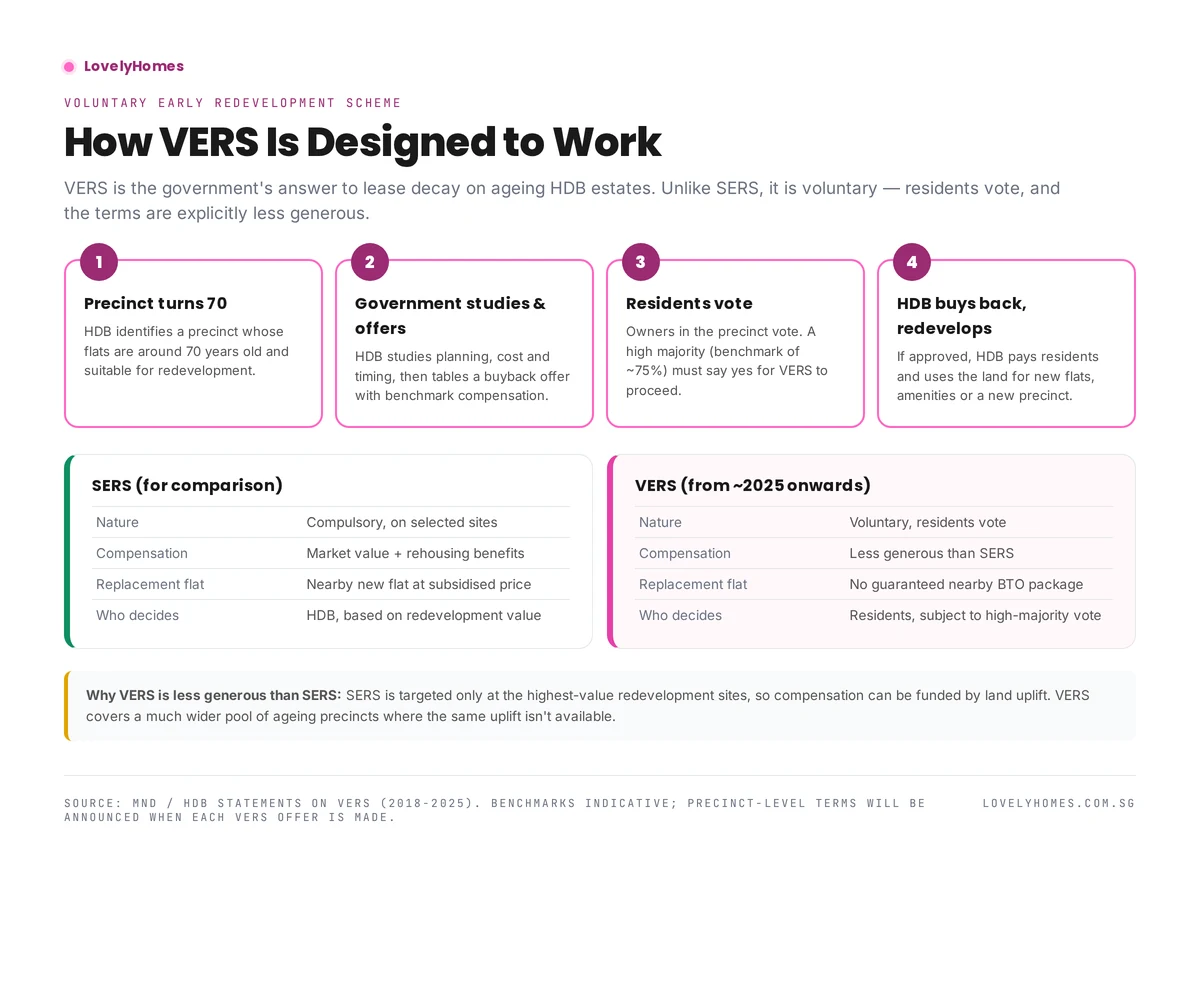
How VERS is structured to work, and how it differs from compulsory SERS.
Why VERS exists
HDB flats are on 99-year leases. As a flat ages, its lease decays and its market value falls — the so-called “Bala’s Table” depreciation curve. Without a redevelopment mechanism, older HDB estates would eventually become uninhabitable and worthless at the end of their leases.
SERS (Selective En bloc Redevelopment Scheme) already handles this for a narrow set of high-value sites where the government is confident it can recover the compensation cost by redeveloping the land at much higher density. But only a tiny fraction of HDB flats sit on sites with enough redevelopment potential for SERS economics. VERS is designed to extend the option to a much bigger pool of ageing precincts by offering less generous terms and making the scheme voluntary.
How VERS is designed to work
Precinct reaches ~70 years old. HDB identifies precincts across Singapore that are reaching roughly the last 30 years of lease and are suitable candidates for redevelopment.
HDB studies the site and tables an offer. The offer includes a benchmark compensation figure based on the precinct’s characteristics and market conditions, plus relocation support.
Residents vote. Flat owners in the precinct vote. A high approval threshold (around 75%) is needed for VERS to proceed — a much higher bar than simple majority.
HDB buys back and redevelops. If approved, HDB buys every flat, the precinct is demolished, and the land is redeveloped — for new flats, amenities, or a reshaped precinct layout.
VERS vs SERS in plain language
Feature
SERS
VERS
Nature
Compulsory; HDB selects sites
Voluntary; residents vote
Compensation
Market value + rehousing benefits
Less generous than SERS
Replacement flat
Subsidised nearby new flat
No guaranteed BTO package
Coverage
Only highest-value sites
Wide pool of ageing precincts
Timing
Announced as sites are identified
From ~precinct age 70 onwards
Compensation: why less than SERS?
The Ministry of National Development has been explicit that VERS will pay less than SERS. The reason is arithmetic: SERS works because the redevelopment uplift on a prime site can finance generous compensation. For a typical ageing precinct outside that prime band, the uplift does not stretch as far. If VERS paid SERS-level compensation across the board, the government would be effectively subsidising every ageing HDB owner out of the national reserves.
VERS compensation is still expected to be fair — it must be enough to induce a 75% approval vote, after all — but owners should calibrate expectations below SERS-style windfalls.
Practical impact on lease decay
Until VERS actually starts delivering in the late 2020s and 2030s, owners of older flats have to plan around the standard assumption that a flat’s value tracks Bala’s Table as it ages. VERS is an optionality on that trajectory — a chance, not a guarantee — and should not be priced as a certainty in any financial model.
What to watch before any VERS offer lands
Annual MND / HDB announcements on VERS pilot precincts.
Precinct demographics — an older, ageing-in-place population tends to vote differently from a younger one.
Surrounding land use plans — what the URA intends to do with the reclaimed land affects HDB’s willingness to table an offer.
CPF-refund mechanics — HDB has said CPF/loan refunds will be handled normally, but precinct-specific details will matter for owners with large CPF accrued interest.
Frequently asked questions
Is my flat guaranteed to go through VERS?
No. VERS is site-by-site and vote-by-vote. Some precincts may simply run down to the end of their leases without a VERS offer ever being tabled.
What happens if the VERS vote fails?
The precinct continues on its existing lease. A future VERS offer may or may not be tabled again — MND has not committed to repeat offers.
Does VERS come with a replacement flat?
Unlike SERS, there is no guaranteed subsidised nearby BTO package. Owners will need to buy a replacement flat in the normal market, using VERS proceeds plus any other grants they qualify for.
Is VERS taxable?
Compensation received from the government for a compulsory or voluntary buyback is not treated as taxable income under Singapore’s tax framework.
This guide is for general information only and is accurate as of April 2026. CPF grants, scheme quantum and eligibility rules are set by HDB / the Ministry of National Development and can change. Always confirm current rules on the HDB Flat Portal or with an HDB officer before committing. We are not a financial or legal advisor.
Fresh Start Housing Scheme gives second-timer families with at least one child (aged 16 or below) who are living in rental or transitional housing a pathway to buy a 2-room Flexi short-lease BTO flat with up to S$75,000 of Fresh Start Grant. The scheme comes with a 20-year Minimum Occupation Period and mandatory financial counselling.
Fresh Start is Singapore’s second-chance scheme: a narrow but meaningful door back into HDB ownership for families who have already owned a flat, fallen out of ownership, and are raising children in rental housing. It is small in numbers — HDB allocates only a few hundred flats to it each year — but it is consequential for the families who qualify.
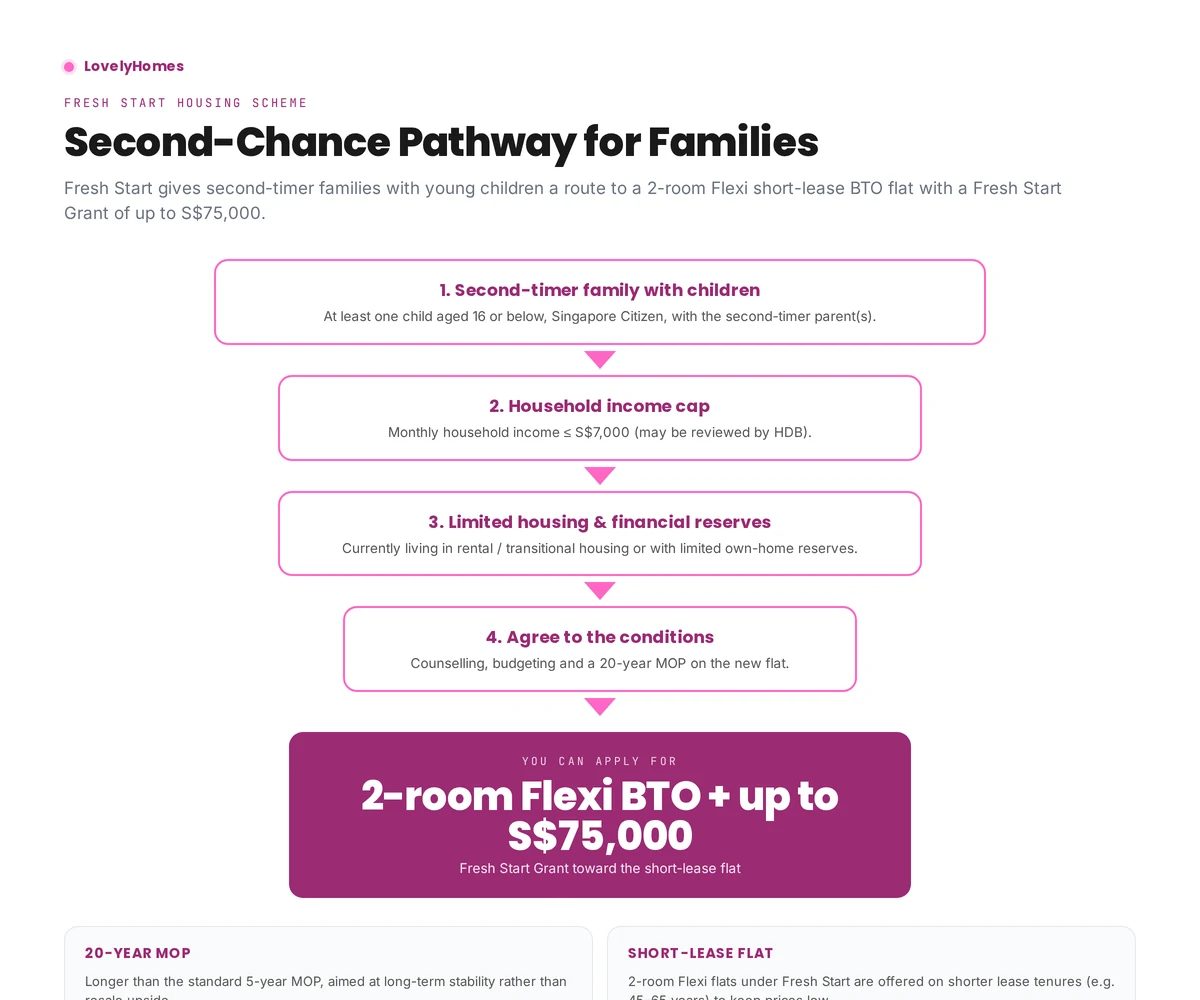
The four eligibility gates and the 2-room Flexi + S$75,000 Fresh Start Grant outcome.
Who Fresh Start is designed for
The scheme is aimed at low-income, second-timer families with young children who are currently in public rental flats or transitional housing under HDB’s schemes like the Interim Rental Housing Programme. HDB’s intention is to help the family stabilise rather than to offer a general upgrade path, so the scheme comes with heavier conditions than standard BTO.
The four eligibility gates
Second-timer family with children. At least one SC child aged 16 or below, living with the applicant family nucleus. Both parents — or a single-parent applicant — must have previously owned a flat.
Household income cap. Monthly household income is typically ≤ S$7,000 (HDB reviews this on a case-by-case basis).
Limited housing & financial reserves. The family is currently in public rental, transitional housing, or otherwise living with very limited financial and housing reserves.
Agree to the conditions. Mandatory counselling, a budgeting programme, and a 20-year MOP on the new flat.
The Fresh Start Grant
The grant is up to S$75,000, disbursed in stages rather than all at once. The structure HDB has published:
Disbursement stage
Amount
On key collection
S$25,000
Over the following years (as the family remains in the flat)
Up to S$50,000
Total
Up to S$75,000
The phased structure is intentional: it nudges families to stay in the flat long enough to stabilise, rather than viewing Fresh Start as a quick cash-out.
What you actually buy
Fresh Start families buy a 2-room Flexi flat on a short-lease tenure (often 45 to 65 years, depending on the applicant’s age and the precinct). Short leases keep prices affordable, but they also mean that the flat does not carry the same long-term resale upside as a standard 99-year flat.
The 20-year MOP trade-off
The 20-year Minimum Occupation Period is the biggest non-monetary cost. You cannot sell the flat on the open market or rent out the whole flat for 20 years. That is four times the standard MOP and is a clear signal that the scheme is designed for long-term stability, not trading.
Breaking the MOP without HDB’s approval has serious consequences, including the possibility of HDB repossessing the flat. HDB does allow sale back to HDB in genuine hardship cases, with grant clawback.
How to apply
Applications run through HDB’s Housing & Development Office (HDO) rather than the usual BTO portal. The process is more involved than a regular BTO application:
Approach HDB via your rental flat officer or a Family Service Centre.
Counselling & budgeting assessment over several sessions — non-negotiable.
Flat offer once HDB confirms eligibility and matches you to an available 2-room Flexi unit.
Financial plan signed off — HDB makes sure the family can afford the mortgage plus utilities.
Key collection with the first S$25,000 disbursed into CPF.
Frequently asked questions
Can Fresh Start applicants apply for other HDB grants?
The Fresh Start Grant is designed as the main support for this scheme. Stacking with other grants (like EHG) is generally not available — HDB consolidates the support into the Fresh Start Grant.
What happens if circumstances improve after I move in?
The phased disbursements continue as long as you remain in the flat and comply with the scheme conditions. Rising income does not trigger clawback.
Is the 20-year MOP negotiable?
No. It is a scheme condition, not a default. HDB considers early sale only in genuine hardship cases.
Can single parents qualify?
Yes. A single-parent household with a SC child qualifies subject to the same income and reserves tests.
This guide is for general information only and is accurate as of April 2026. CPF grants, scheme quantum and eligibility rules are set by HDB / the Ministry of National Development and can change. Always confirm current rules on the HDB Flat Portal or with an HDB officer before committing. We are not a financial or legal advisor.