First-Time Landlord Checklist: Renting Out Your Condo in Singapore 2026
Quick Answer — what every first-time landlord must do
- Check you can rent — MOP (if HDB), mortgage terms, condominium MCST by-laws, and URA’s minimum rental tenure (3 months private; 6 months HDB).
- Price your unit using URA rental caveats plus a realistic weighted-average of last 6-month comparables — not wishful-thinking anchor listings.
- Draft a tenancy agreement with a compliant Diplomatic Clause, Minor Repairs Clause (typically S$150–S$250 cap), and Tenant-Pays-Utilities clause.
- Stamp the lease with IRAS within 14 days of signing — via e-Stamping Portal. Rental stamp duty is ~0.4% of total rent for leases up to 4 years.
- Declare rental income in your annual tax return — net of allowable deductions, or the 15% deemed-expense route.
Why this checklist exists
Renting out a Singapore condo for the first time is deceptively simple in concept and unexpectedly intricate in execution. The number of moving parts — URA minimum-stay rules, the Income Tax Act, IRAS e-Stamping, MCST by-laws, your own bank’s covenants, the Residential Property Act, the Immigration & Checkpoints Authority’s occupancy checks — is the real source of first-year landlord mistakes. This checklist walks you through the end-to-end process in the order a first-time landlord actually encounters each task.
The framing throughout is practical. We are not going to rehearse abstract property law. We will assume you own a private condominium in Singapore, you are considering renting it out, and you need a dependable sequence from “should I do this?” to “my tenant has handed back the keys”.
Step 1 — Check you can legally rent out your unit
Five checks come before anything else. Skip any one and you risk a voided tenancy, a penalty from IRAS, or a breach of your mortgage.
MCST by-laws. Your condominium’s Management Corporation Strata Title (MCST) may have short-tenancy restrictions, pet rules, or fit-out limits. Request a copy of the current by-laws and confirm they permit a lease of the intended length.
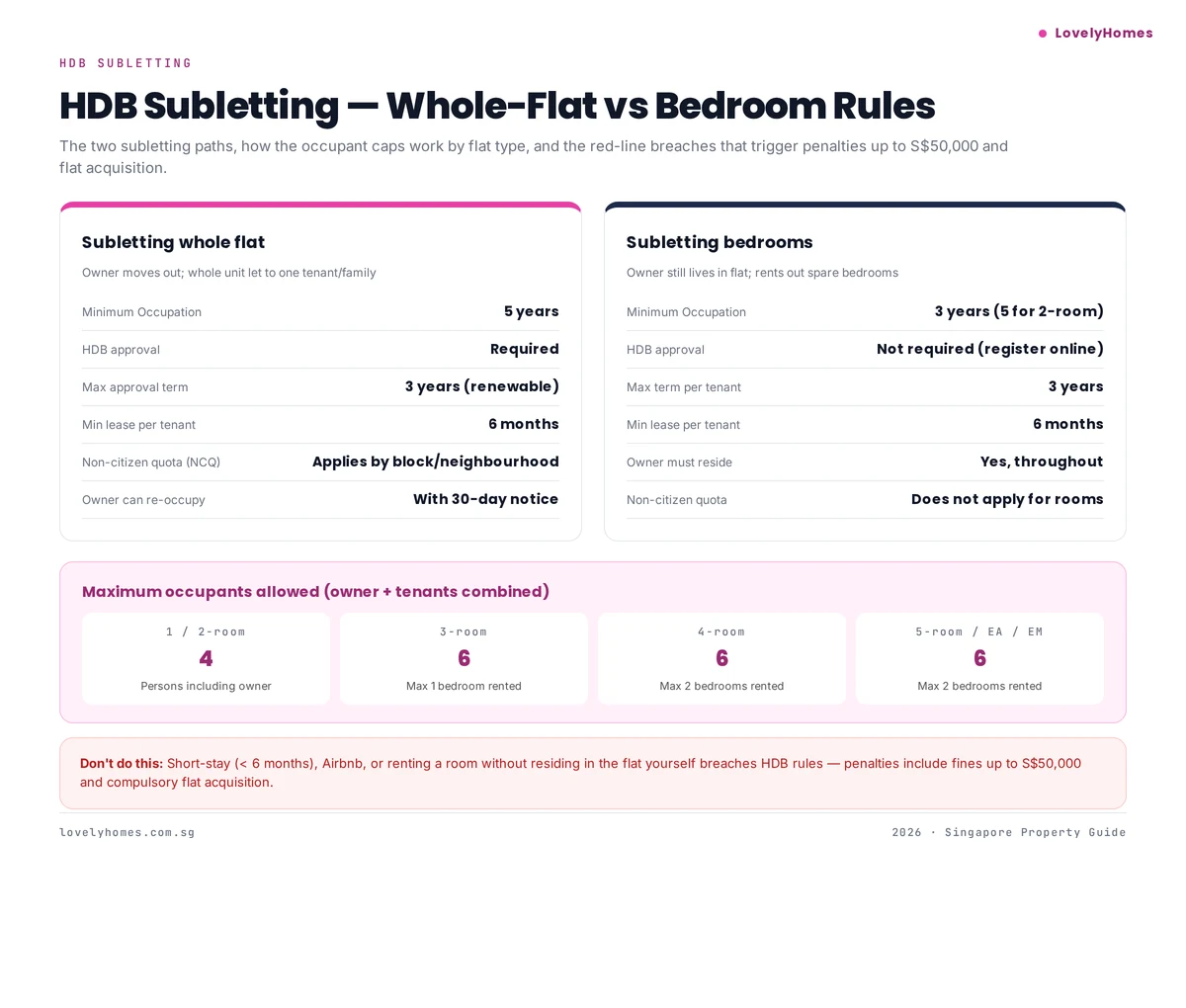
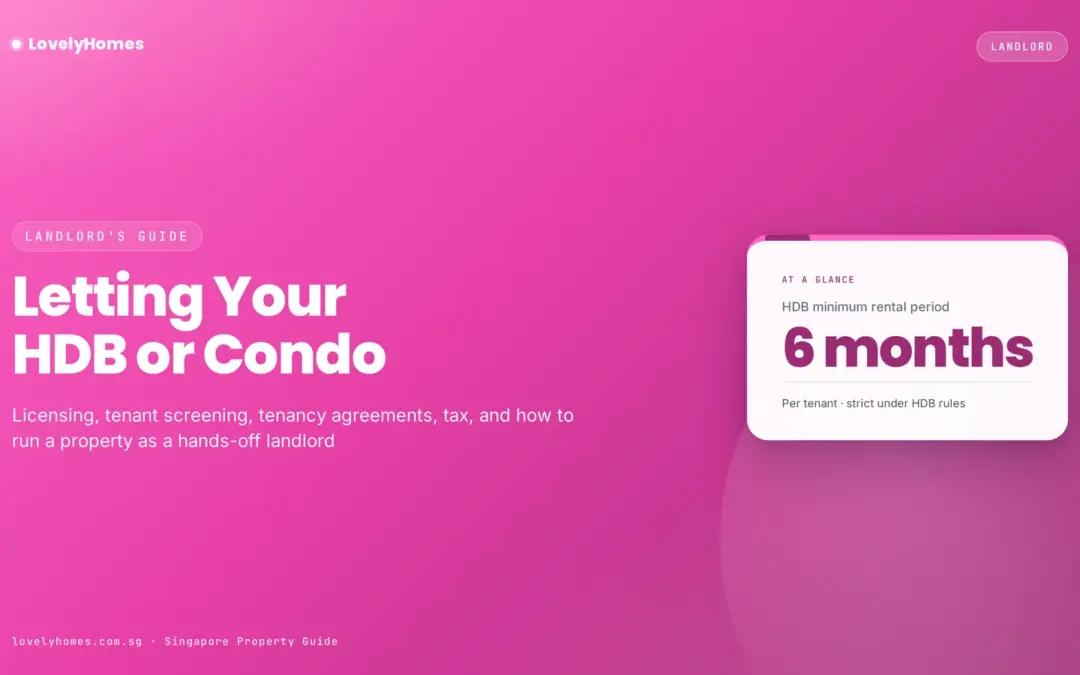
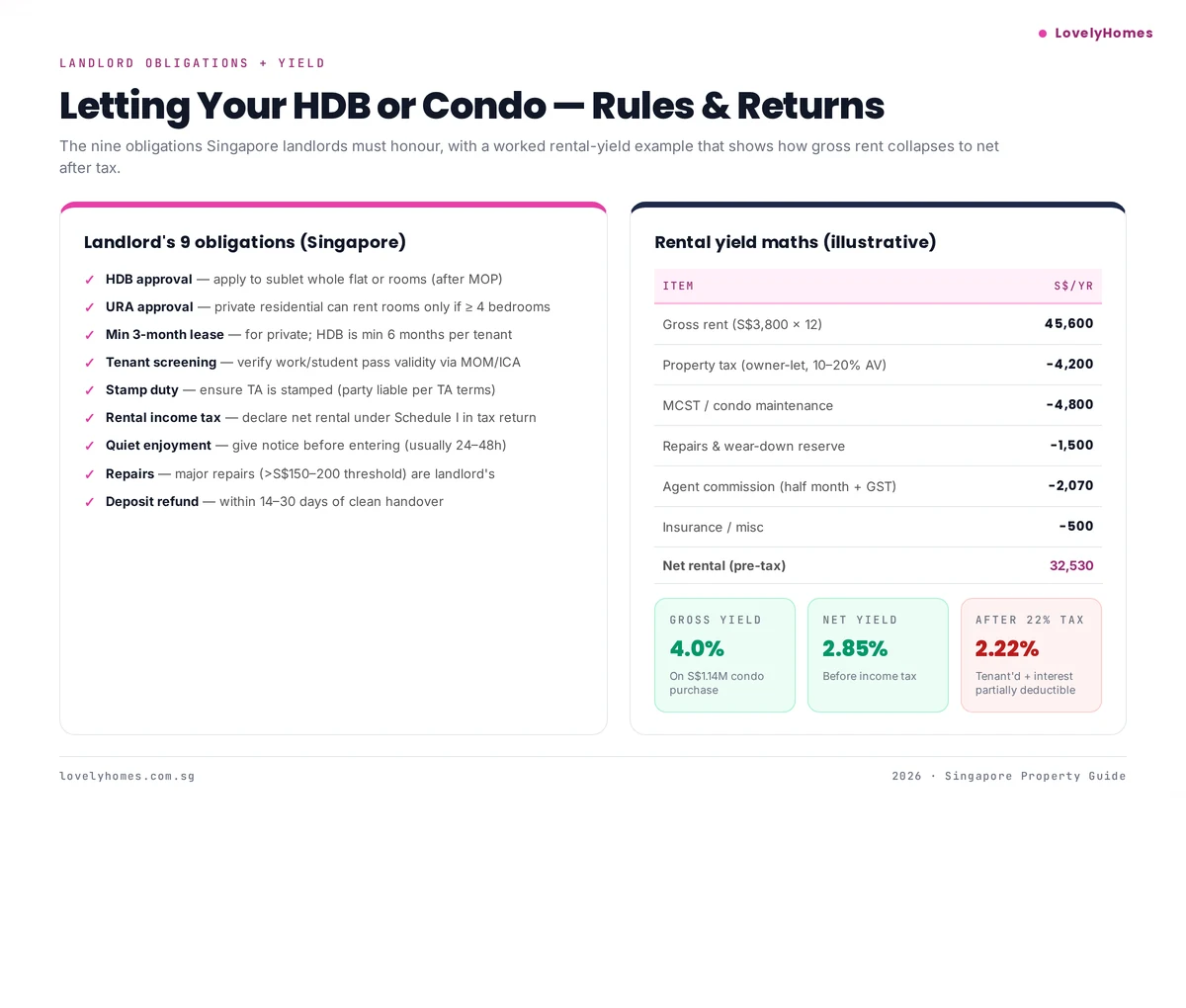
URA minimum rental tenure. For private residential property, URA mandates a minimum continuous stay of 3 months per tenancy. Anything shorter (short-term / holiday / Airbnb-style) is illegal and subject to a fine of up to S$200,000 under the Planning Act. For HDB flats, the minimum is 6 months and subletting rules are stricter.
Mortgage covenants. Most bank mortgages allow owner-occupation and arm’s-length tenancy without objection, but some lower-rate promotional home loans require owner-occupation as a condition. Check your Letter of Offer.
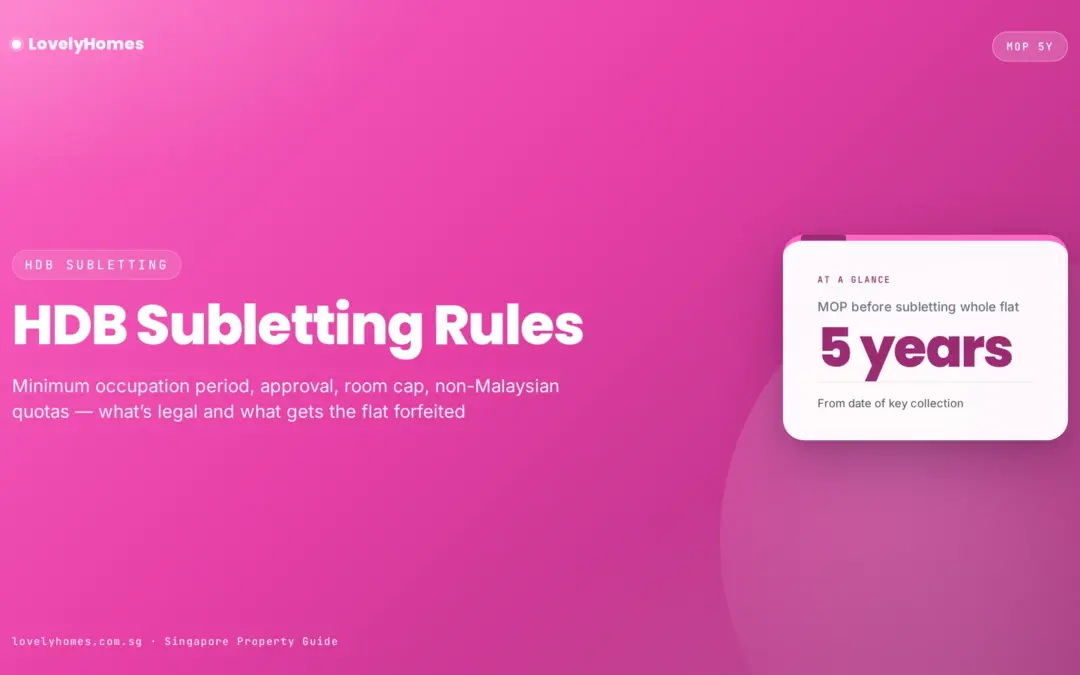
HDB MOP. If the unit is an Executive Condominium within 5 years of TOP, or an HDB flat within the 5-year Minimum Occupation Period, renting out the entire unit is prohibited. Room rental is permitted for HDB after certain thresholds.
Residential Property Act. Foreign buyers of landed property must have URA approval. For condos, this matters less for leasing purposes but still shapes the tenant pool (e.g. corporate leases often require company-to-company contracts).
Step 2 — Decide your target tenant profile
The rental market in 2026 is fragmented across tenant archetypes, each with different lease length, rent ceiling, and fit-out expectations.
| Tenant archetype | Typical lease | Sensitivities |
|---|---|---|
| Corporate expat (regional HQ) | 2 years with Diplomatic Clause after year 1 | Fully furnished; near international schools; building quality |
| Finance / professional services | 1–2 years | CBD walkability; ultra-fast fibre; gym |
| Tech professional (single / young couple) | 1 year, flexible renewals | Orchard/Rochor/one-north access; work-from-home setup |
| Local family in transition | 1–2 years | Primary school proximity; pet-friendly building |
| Students (IB / university) | 1 year + renewal | Near NUS / NTU / SMU / international school; broadband; parental guarantor |
Choose the archetype first, then calibrate the asking rent, fit-out, and marketing channel accordingly. A corporate-expat lease on a D10 condo targets a different price ceiling than a tech-couple lease on a D3 condo, even when gross psf rent is similar.
Step 3 — Price the unit correctly
The single most common first-time landlord mistake is pricing the unit from the highest asking listings in the building. Landlords who do this leave their unit vacant for 6–10 weeks and then let it on the original fair-market rent anyway.
Use URA’s Rental Contracts Data (updated monthly on the URA eservice portal) to extract the last six months’ rental contracts for your exact project. Calculate a weighted-average psf monthly rent; weigh larger units more heavily; discount short-lease and unfurnished contracts to a like-for-like basis. Aim your asking rent at 2%–5% above the weighted average to leave negotiating headroom.
If you are within 500 metres of an MRT and the building has functioning pool/gym/BBQ amenity, you can price at the upper end. If your unit faces a noisy road, is low-floor, or has a cramped layout, price at or below the median.
Worked example — 2BR at a D3 condo
Your project’s last 6 months showed 8 rental contracts for 2BR units ranging from S$4,200 to S$5,300 monthly, weighted average S$4,750. Your unit is mid-floor, fully furnished, south-facing.
- Asking: S$5,000 / month (5% above weighted average).
- Minimum accept: S$4,700 (just below weighted average) if you want to lease within 3 weeks.
- Target lease: 2 years with Diplomatic Clause at year 1 exit — stabilises cash flow.
Step 4 — Prepare the unit for marketing
A well-prepared unit typically lets 30%–50% faster than a “lived-in” unit at the same asking rent. Before photographs, complete:
Deep clean. Pay for a professional clean — kitchen extractor, bathroom grout, washing machine filter, air-con servicing with gas top-up.
Repaint. Freshly painted white walls read as new on listing photos. Budget S$1,500–S$3,500 for a 2BR condo depending on size.
Small repairs. Silicone re-beading in bathrooms, replace chipped grout, re-polish wood flooring, replace yellowed power sockets and light switches.
Furnish correctly for archetype. For corporate expat, the unit must be fully furnished including crockery, washing machine, and curtains. For local family, a part-furnished option (white goods + curtains only) is often welcomed.
Photographs. Commission a professional property photographer — S$200–S$400 for a 2BR shoot. Wide-angle lenses, white balance, twilight shots. Professional photos translate directly into listing click-through.
Step 5 — Engage help (or go solo)
You have three routes:
Engage an exclusive salesperson. A registered salesperson under the Council for Estate Agencies can market the unit across their channels, screen tenants, draft the tenancy agreement, and manage the handover. Commission is typically half a month’s rent for a one-year lease, one month for two-year. Pay only on successful tenancy.
List yourself on property portals. Free or low-cost direct listing on the major Singapore property portals. You handle enquiries, showings, draft the tenancy agreement, and carry all the risk of under-pricing or picking the wrong tenant. Best for landlords with time and prior experience.
Use a corporate-relocation broker. For premium addresses, dedicated corporate-relocation specialists can introduce multi-national company tenants directly. Fees are higher but tenants are pre-vetted and leases are longer.
Whichever route, insist that any salesperson you engage is registered and CEA-accredited — verify on the CEA Public Register.
Step 6 — Screen the tenant
Screening protects you from the most expensive landlord mistake: the non-paying or damaging tenant. At minimum, collect:
- Copy of NRIC / passport + visa / Work Pass.
- Latest 3 months’ payslips or bank statements.
- Employment letter confirming role, start date, and notice period.
- Reference from previous landlord (ask for a WhatsApp call).
- For corporate tenants: letter of employment from the corporate HR, plus the corporate tenancy agreement signatory authority.
Ask directly about number of occupants and relationship. Under ICA rules, only permitted occupants may live at the address, and their names and identification documents must be on file.
Step 7 — Issue the Letter of Intent and collect the booking deposit
The tenant typically signs a Letter of Intent (LOI) and pays a 1-month booking deposit (also called the “good faith deposit”). The LOI sets out key terms: rent amount, lease period, commencement date, Diplomatic Clause presence, and any special conditions. On signing the tenancy agreement, the booking deposit converts into the first month’s rent or security deposit per the LOI terms.
Step 8 — Draft and sign the tenancy agreement
A compliant Singapore residential tenancy agreement should contain:
- Parties — landlord(s) and tenant(s), full legal names and NRIC/passport numbers.
- Demise — unit address, inclusive items (furniture inventory attached as Schedule).
- Term — commencement and expiry dates.
- Rent — monthly amount, payment day, bank-transfer details.
- Security deposit — 1 month for 12-month lease, 2 months for 24-month lease (market standard).
- Utilities — tenant pays SP Group, conservancy, gas, internet.
- Diplomatic Clause — after 12 months, tenant may break lease with 2 months’ notice on loss of employment or repatriation (applies to expats only).
- Minor Repairs Clause — tenant pays first S$150–S$250 of each repair; landlord pays above.
- Right of quiet enjoyment — tenant undertaking to use the unit as residential.
- Tenant’s covenants — no unauthorised sub-letting, no illegal use, comply with MCST by-laws.
- Landlord’s covenants — maintain structural integrity, maintain white goods at commencement.
- Termination — notice periods, breach provisions, repossession mechanics.
- Governing law and dispute resolution — Singapore law, Singapore courts.
Attach a detailed inventory Schedule with photographs of every furniture item and appliance, timestamped.
Step 9 — Stamp the tenancy agreement with IRAS
All residential tenancies must be stamped via the IRAS e-Stamping Portal within 14 days of signing. Rental stamp duty rates:
| Lease length | Stamp duty rate |
|---|---|
| Up to 4 years | 0.4% on total rent over the lease term |
| Over 4 years | 0.4% on four times the Average Annual Rent (AAR) for the period |
Typically either party can pay; custom is for the tenant to pay. Keep the stamp certificate — you will need it for any dispute and for IRAS tax returns.
Step 10 — Handover the unit
On commencement day, meet the tenant at the unit. Walk through the inventory Schedule together and sign a handover checklist. Photograph meters (water, electricity, gas) and log them on the checklist. Hand over keys, access cards, season parking labels, fob keys and remote controls. Confirm the forwarding address for bills and the tenant’s emergency contact.
If utilities are not already transferred, go through the SP Group transfer together on the spot. For condos, file the tenant’s details with the MCST so the security office admits the tenant and guests.
Step 11 — Manage the tenancy
During the lease:
- Collect rent on the agreed day. Set up a GIRO standing instruction or a calendar reminder.
- Log repair requests via email, not WhatsApp voice — you want a paper trail.
- Conduct annual inspection (often in month 6) on 14 days’ written notice, during reasonable daylight hours.
- Service air-conditioners quarterly — tenant responsibility under standard TA, but landlord should confirm it happens.
Step 12 — Declare rental income
IRAS requires all rental income to be reported in your annual tax return, even if you made a cash-flow loss. Two routes are possible:
Route A — actual deductions. Deduct property tax, bank mortgage interest, MCST fees, condo maintenance charges, agent commission, insurance, and allowable repairs. Keep all invoices and receipts for 5 years.
Route B — 15% deemed-expense option. Take a flat 15% of gross rent as a deemed allowance for expenses, plus the actual property-tax paid and actual mortgage interest separately. Simpler, but worse outcome if your actual expenses exceed 15%.
Compute both routes each tax year; pick the higher deduction. IRAS provides worksheets on its website.
Key takeaway
First-time landlord success is 80% process and 20% market. Follow the checklist: clear the legal checks, price against URA caveats (not aspiration), prepare the unit properly, screen rigorously, stamp within 14 days, and document everything. Landlords who short-cut the checklist typically pay for it at lease end — disputes over the security deposit, unpaid minor repairs, or tax penalty letters. Landlords who run the checklist end the first tenancy profitably and with a confident call on whether to renew, re-let, or sell.
Step 13 — Renew, re-let, or end the tenancy
In month 9 of a 12-month lease (or month 21 of a 24-month lease), open the renewal conversation. Market rent has moved; your existing tenant’s departure is your blank canvas to re-price. Three outcomes are common:
Renew at a new rent. Market has risen; propose a 3%–8% increase. Tenant accepts — draft a renewal tenancy agreement and re-stamp.
Tenant gives notice. Serve the standard handover notice. Conduct the exit inspection against the original inventory Schedule. Refund the security deposit minus damages within 7–14 days.
Re-market. If no renewal and no replacement via the outgoing tenant, restart from Step 3. The second lease typically signs faster because you already have fresh photos, inventory, and process.
Frequently asked questions
Can I rent out my HDB flat as a first-time landlord?
Only after the 5-year Minimum Occupation Period. Rules for HDB whole-unit rental differ from room rental and are stricter than private condo rental.
How long is the minimum tenancy?
3 months for private residential (URA), 6 months for HDB.
Is Airbnb or short-term rental allowed?
No. Short-term rentals under 3 months for private residential are illegal and carry fines up to S$200,000.
How much is the security deposit?
1 month for a 12-month lease; 2 months for a 24-month lease is market standard, though parties can negotiate.
Who pays stamp duty?
Custom: tenant. Legal position: either party, but standard template puts it on the tenant.
What is a Diplomatic Clause?
A clause allowing expat tenants to terminate the lease after the minimum 12 months with 2 months’ notice if transferred or repatriated by the employer. Applies only to holders of Employment Pass or equivalent.
Must I use an agent?
No. You can self-manage, but many first-time landlords benefit from the risk management an experienced salesperson provides.
Can I disallow pets?
Yes — put a “no pets” clause in the tenancy agreement. Some condominiums have MCST-level pet restrictions independent of your lease.
Do I pay GST on residential rent?
No. Residential leasing is exempt from GST.
What if the tenant damages the unit?
The inventory Schedule, entry-day photos and exit inspection are your evidence. Deduct repair cost from the security deposit. If damages exceed the deposit, send a formal demand letter; escalate via Small Claims Tribunal for claims up to S$30,000.
What if the tenant stops paying rent?
Serve written notice per the tenancy agreement; give the cure period (typically 7–14 days). If unpaid, engage a lawyer for repossession. Stopping utilities or changing locks without a court order is illegal.
Do I need landlord insurance?
Not mandatory, but contents insurance covering your furniture plus optional rent-protection cover is widely available at S$300–S$800 per year.
Related guides on LovelyHomes
- Landlord guide for HDB and condo owners in Singapore (2026)
- Tenant guide to renting in Singapore (2026)
- HDB subletting rules in Singapore
- Rental stamp duty in Singapore
- Singapore rental yield guide 2026
- Property tax and Annual Value in Singapore
Authoritative external references
- URA Rental Contracts Data — real rental caveats for comparable pricing.
- IRAS — Stamp Duty for Renting a Property.
- IRAS — Rental income and expenses.
- Council for Estate Agencies (CEA) Public Register.
- HDB — Renting out your flat / bedrooms.
- Immigration and Checkpoints Authority.
Disclaimer: This guide is general information, current as at publication. Tax rates, URA and HDB rules, and standard tenancy terms are subject to change. Consult a CEA-registered salesperson, a conveyancing lawyer or tax adviser for your specific transaction. LovelyHomes is an independent editorial publication, not a real-estate agency.