En bloc sales are Singapore’s redevelopment pressure valve. Old, land-inefficient stock comes down; new, plot-ratio-maxed stock goes up. For owners, a successful collective sale can deliver a premium that no private resale would ever produce. For minority owners, it can feel like a forced uprooting.
This guide sets out the 2026 legal framework, the five-stage timeline, how payouts are apportioned, and why a large share of launched en blocs never complete. For the investment-return angle see our freehold vs 99-year comparison.
The 80% (or 90%) consent rule
Under the Land Titles (Strata) Act, the required consent threshold is:
| Building age | Consent required | Measured by |
|---|---|---|
| Less than 10 years old | 90% | Share value AND strata area |
| 10 years old and above | 80% | Share value AND strata area |
The dual-test is crucial: a block can fail en bloc because the consenting owners, while ≥80% by share value, collectively occupy <80% of strata area (or vice versa).
The five-stage timeline
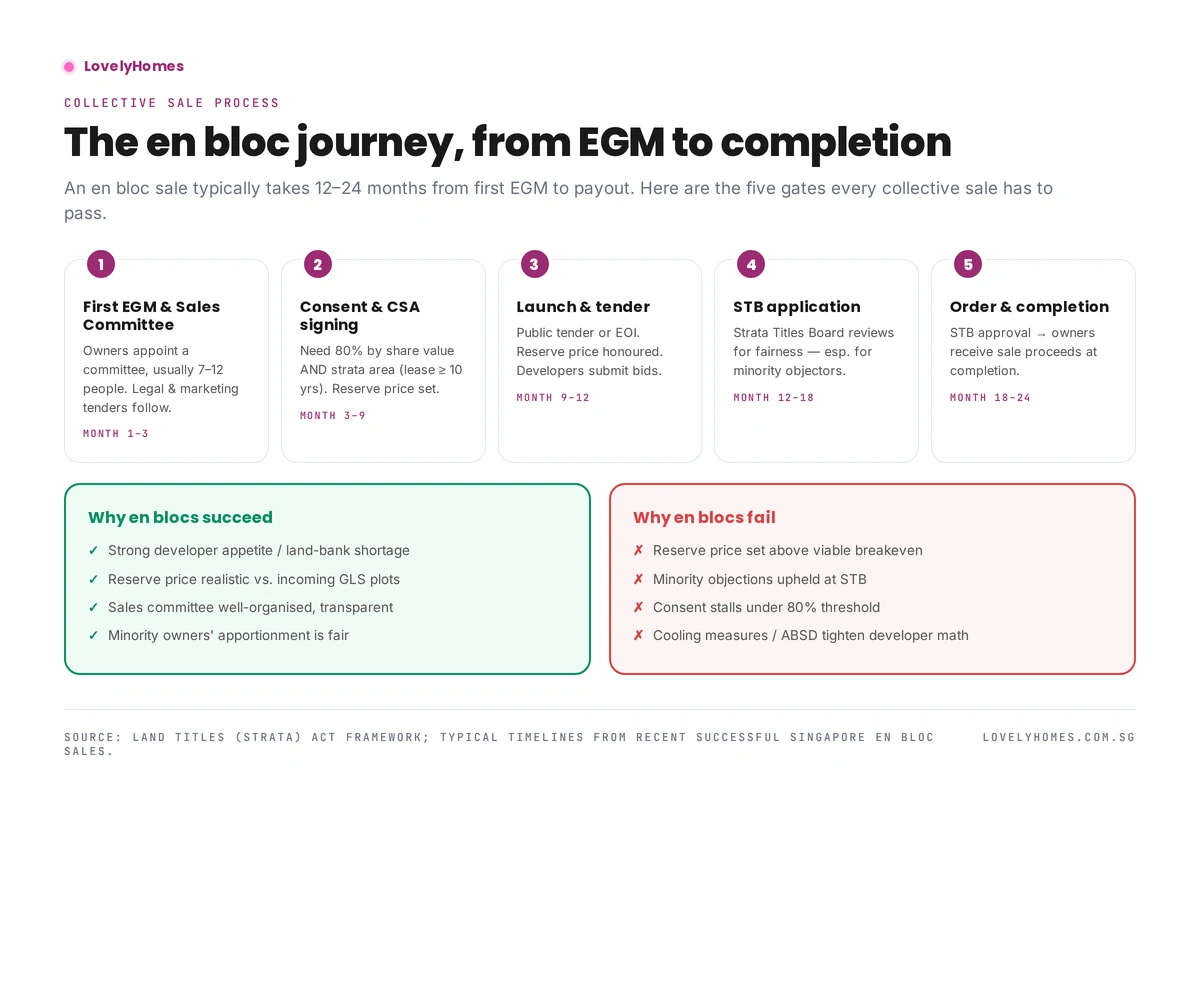
Stage 1 — First EGM and Sales Committee (month 1–3)
Owners convene, table a resolution and elect a Sales Committee (usually 7–12 people). The committee tenders for a marketing agent and a law firm.
Stage 2 — Consent and CSA signing (month 3–9)
The Collective Sale Agreement (CSA) sets out reserve price, apportionment formula, and minimum sale period. Owners sign in waves. The committee must hit the consent threshold within a defined window.
Stage 3 — Launch and tender (month 9–12)
Public tender or expressions-of-interest exercise. The reserve price is the floor; the Sales Committee can negotiate private treaty if the tender under-bids.
Stage 4 — STB approval (month 12–18)
The Strata Titles Board reviews objections from minority owners. STB looks for procedural compliance and “good faith”.
Stage 5 — Order and completion (month 18–24)
Once the STB issues its Order, completion follows at the agreed long-stop date. Owners receive their share of the sale proceeds at completion — which is how most feel the payout, not in monthly instalments.
How the payout is apportioned
Three common methods:
- Method 1 — Share value. Pure pro-rata to each unit’s share value.
- Method 2 — Strata area. Pro-rata to unit size.
- Method 3 — Weighted. A formula (often an equal-weight blend of methods 1, 2, and valuation). Used when unit mix is very uneven.
The apportionment formula is the single biggest source of minority objections — which is why professional advisors draft it very carefully before the CSA is circulated.
Why en blocs fail
- Reserve price set above developer breakeven after ABSD + cooling measures.
- Minority objections upheld at STB (procedural failure, apportionment unfairness, good-faith concerns).
- Consent stalls under the 80% threshold.
- Tightening market conditions between CSA and launch.
Worked example — a typical mid-sized en bloc
Take a 200-unit RCR condo bought for S$800m, with a total strata area of 250,000 sqft. An owner of a 1,100-sqft unit with a share value of 10 (out of a total 2,000) would, under pure share-value apportionment, receive S$4.0m (10/2000 × S$800m). If they originally paid S$2.2m and still owe S$800k, their net payout is S$3.2m — roughly 80% above their effective basis. The exact figure depends entirely on the CSA formula and outstanding mortgage.
Frequently asked questions
Can I opt out if I refuse to sign?
If 80% (or 90% for under-10-years) consent is reached, a minority owner cannot block the sale outright — but they can file an objection with STB. STB can adjust apportionment but rarely stops a well-drafted en bloc.
What tax applies on en bloc payouts?
Seller’s Stamp Duty (SSD) applies if the owner has held the property for less than three years. See our SSD guide. Capital gain itself is not taxed in Singapore for individuals.
Do HDB flats go en bloc?
No. HDB redevelopment happens via SERS (compulsory) or VERS (voluntary). See our VERS guide.
What triggers a ‘good-faith’ challenge at STB?
Typical flags: conflict of interest on the Sales Committee, undisclosed side deals, apportionment that under-values specific unit types, procedural lapses in EGMs.
This guide is for general information only and is accurate as of April 2026. Singapore property rules, taxes and cooling measures change frequently — always verify current figures with URA, IRAS, HDB or a licensed professional before committing. LovelyHomes is not a financial, legal or tax advisor.
Need a brochure, price list or professional introduction?
Planning your next property purchase? Contact Lin Xuan at 82222556 or Ade at 81888871 to request a project’s full brochure and latest available price list, discuss a viewing, or ask for introductions to bankers who can help you compare home-loan rates and packages to find the best available option for your needs.
WhatsApp Lin Xuan | WhatsApp Ade. Please include the project name and your question. Brochures, prices and unit availability are subject to developer confirmation; loan eligibility, rates and approval are determined by the bank.
Lin Xuan: ONG LIN XUAN, CEA registration R069812H. Ade: CHUA MUAY MUAY (ADE CHUA), CEA registration R014252F. ERA REALTY NETWORK PTE LTD, estate agent licence L3002382K. If you need legal advice, contact Lin Xuan or Ade and we can introduce you to property lawyers.
Supporting graphics
Original article illustrations are available below.