Singapore En Bloc Sale Process Guide 2026: How Collective Sales Work, Rules and What Owners Can Expect
Quick Answer: Singapore En Bloc Sale — 8 Key Facts
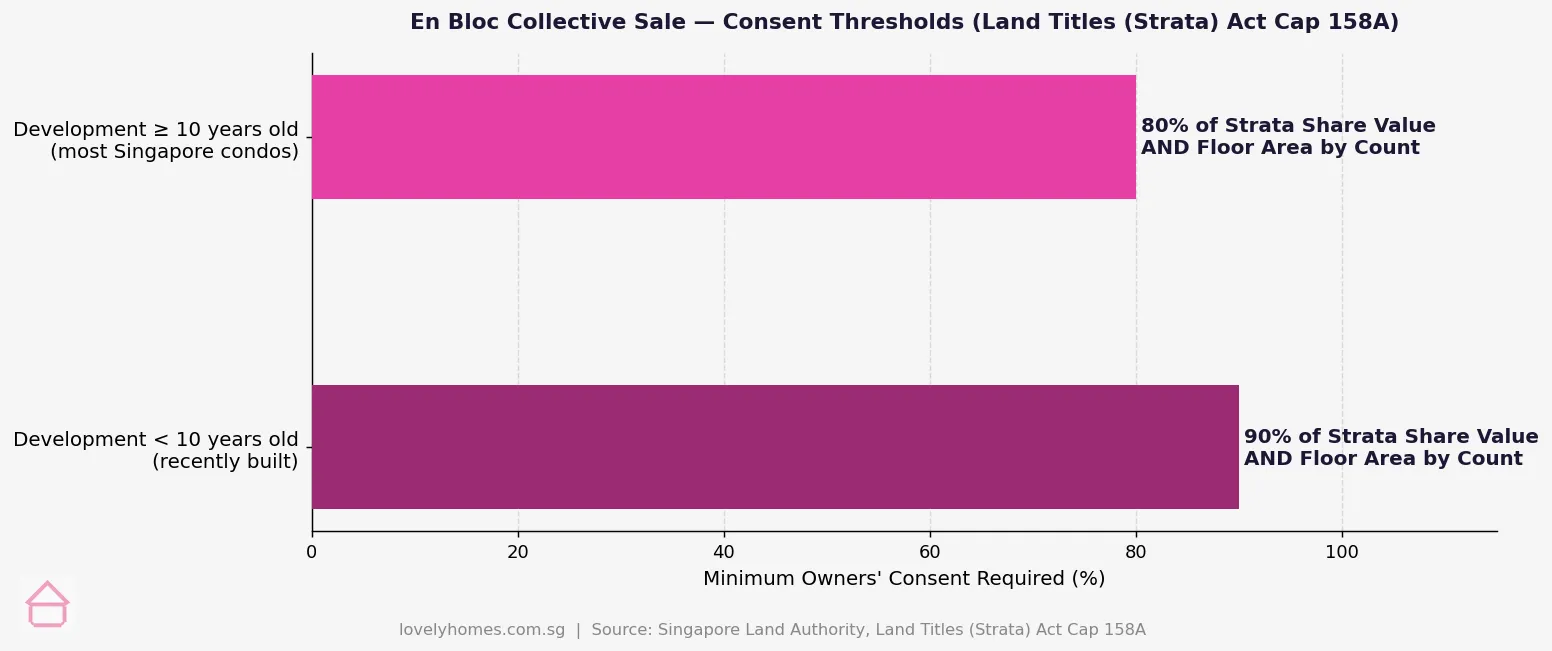
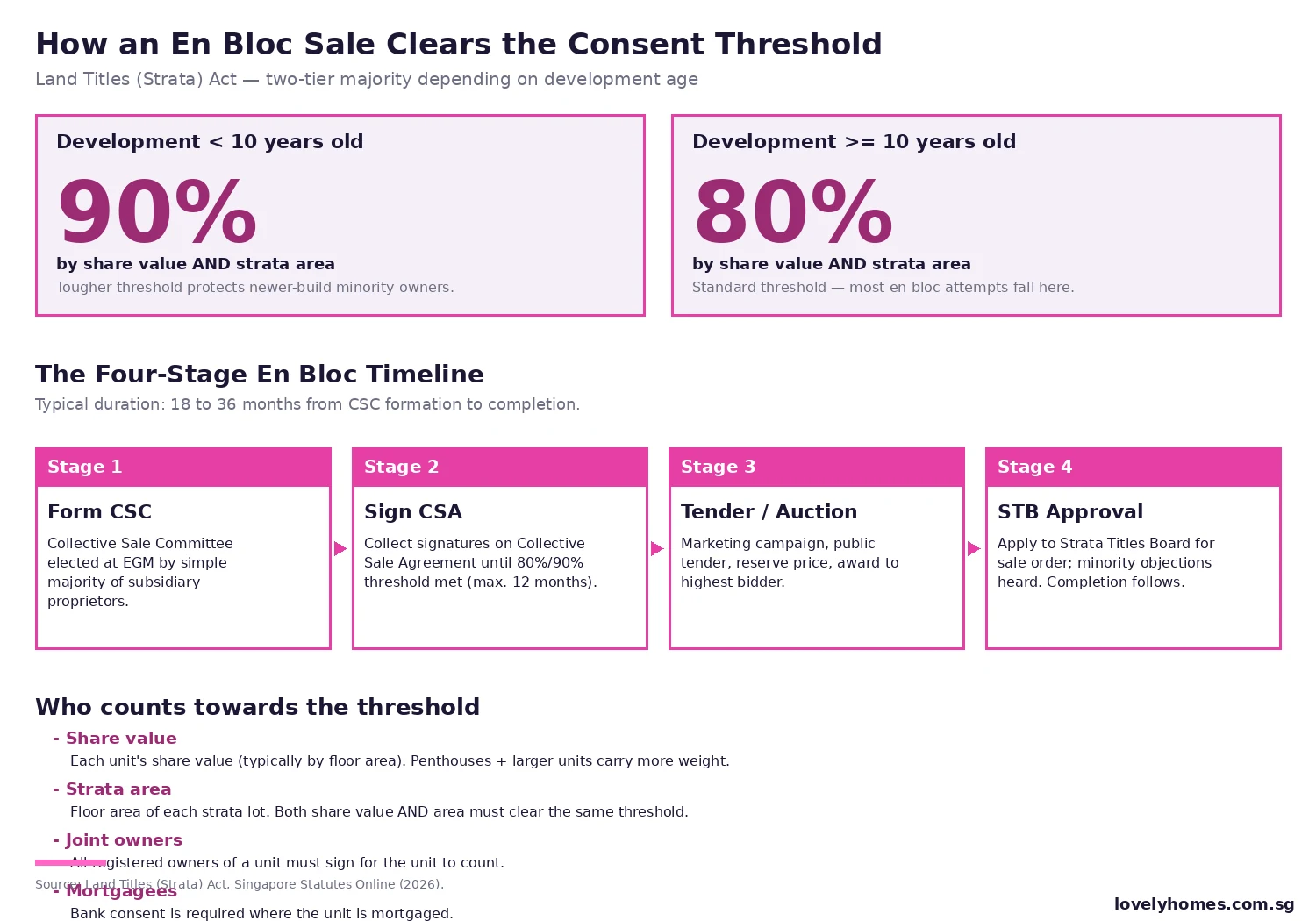
- An en bloc (collective sale) requires 80% consent by share value and strata area for developments aged 10 years or more; 90% for those under 10 years.
- The legal framework is the Land Titles (Strata) Act (LTSA), administered by the Strata Titles Board (STB) under the Ministry of Law.
- Owners elect a Sale Committee (SC) at an Extraordinary General Meeting (EGM) to manage the process on their behalf.
- A Collective Sale Agreement (CSA) sets the reserve price, distribution formula and other binding terms — all consenting owners sign it.
- STB reviews the application and mediates objections; dissenting minority owners have limited grounds for challenge once the consent threshold is met.
- Proceeds are split by share value, strata area, or a hybrid of both — the formula is agreed in the CSA before marketing begins.
- There is no capital gains tax on en bloc proceeds in Singapore; proceeds are treated as capital receipts for most owner-occupiers.
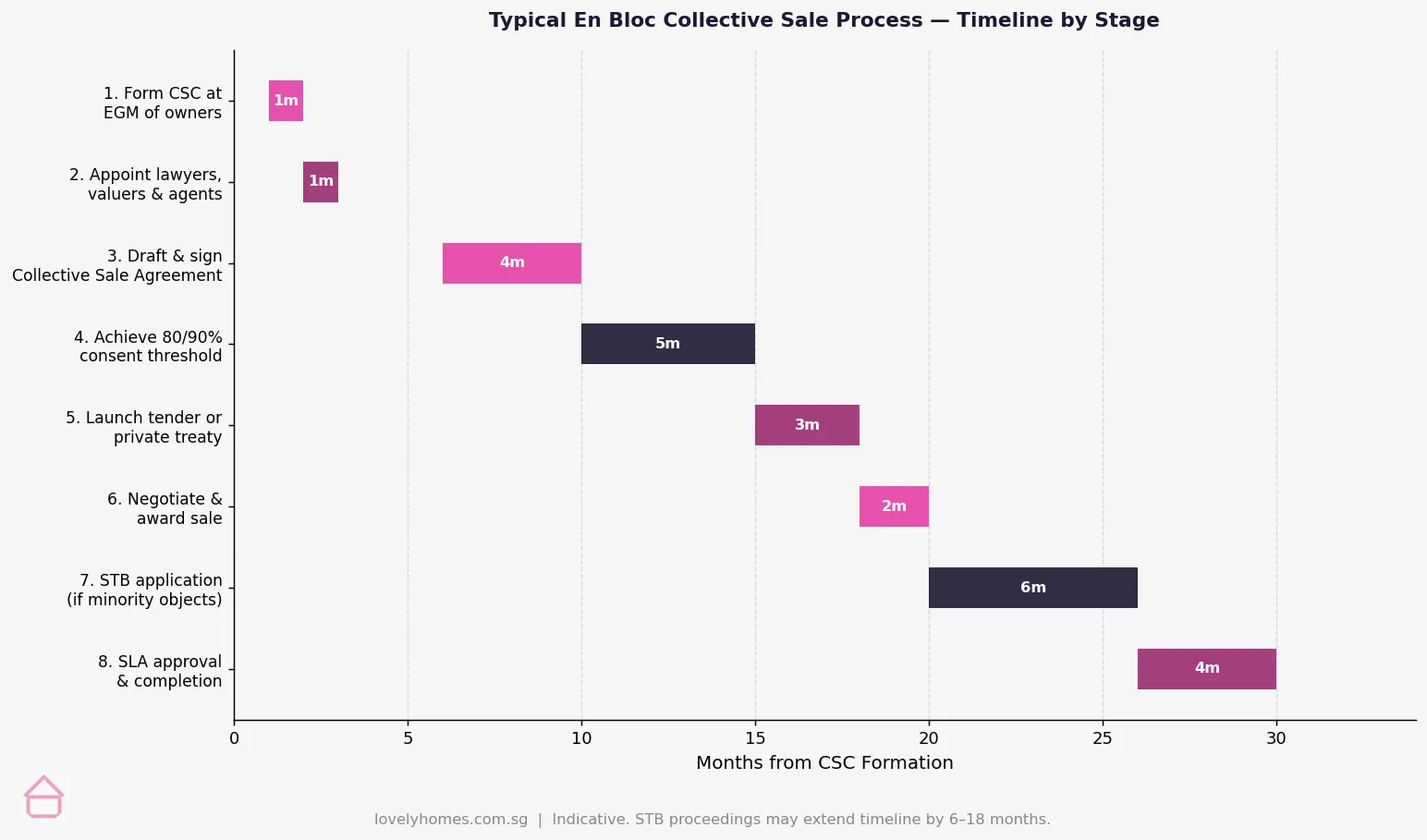
- The average en bloc cycle runs 18–36 months from Sale Committee formation to final distribution of funds.
Introduction: What Is an En Bloc Sale and Why Does It Matter?
An en bloc sale — derived from the French phrase meaning “all together” — is a mechanism unique to Singapore’s strata-titled property market. It allows the entire ownership of a development (every unit, every owner) to be sold simultaneously to a single purchaser, typically a property developer. Unlike a standard private sale where one owner transacts independently, an en bloc overrides individual preference: once the statutory consent threshold is achieved and the Strata Titles Board (STB) approves the sale, all owners — including those who voted against — must sell at the agreed price.
For Singapore’s urban renewal, en bloc is a critical tool. It allows ageing, low-density developments on prime land to be redeveloped into higher-density housing, bringing new supply to the market and allowing developers to assemble large contiguous sites that would otherwise be impossible to acquire piecemeal. For the individual owner, it can represent a windfall — or an unwelcome forced exit. Understanding how the process works, what your rights are, and how the proceeds are calculated is essential for any property owner in a strata development.
This guide covers the full en bloc process under the Land Titles (Strata) Act (LTSA), the consent thresholds, the 8-step collective sale timeline, how distribution formulas work, what minority owners can do, and a worked example of how the numbers are calculated.
I. Legal Framework and Consent Thresholds
En bloc sales in Singapore are governed by the Land Titles (Strata) Act (LTSA), Chapter 158A, specifically Sections 84A to 84G. The Urban Redevelopment Authority (URA) issues development controls that dictate what a developer can build on the acquired site, and the Strata Titles Board (STB) — a quasi-judicial body under the Ministry of Law — adjudicates all en bloc applications.
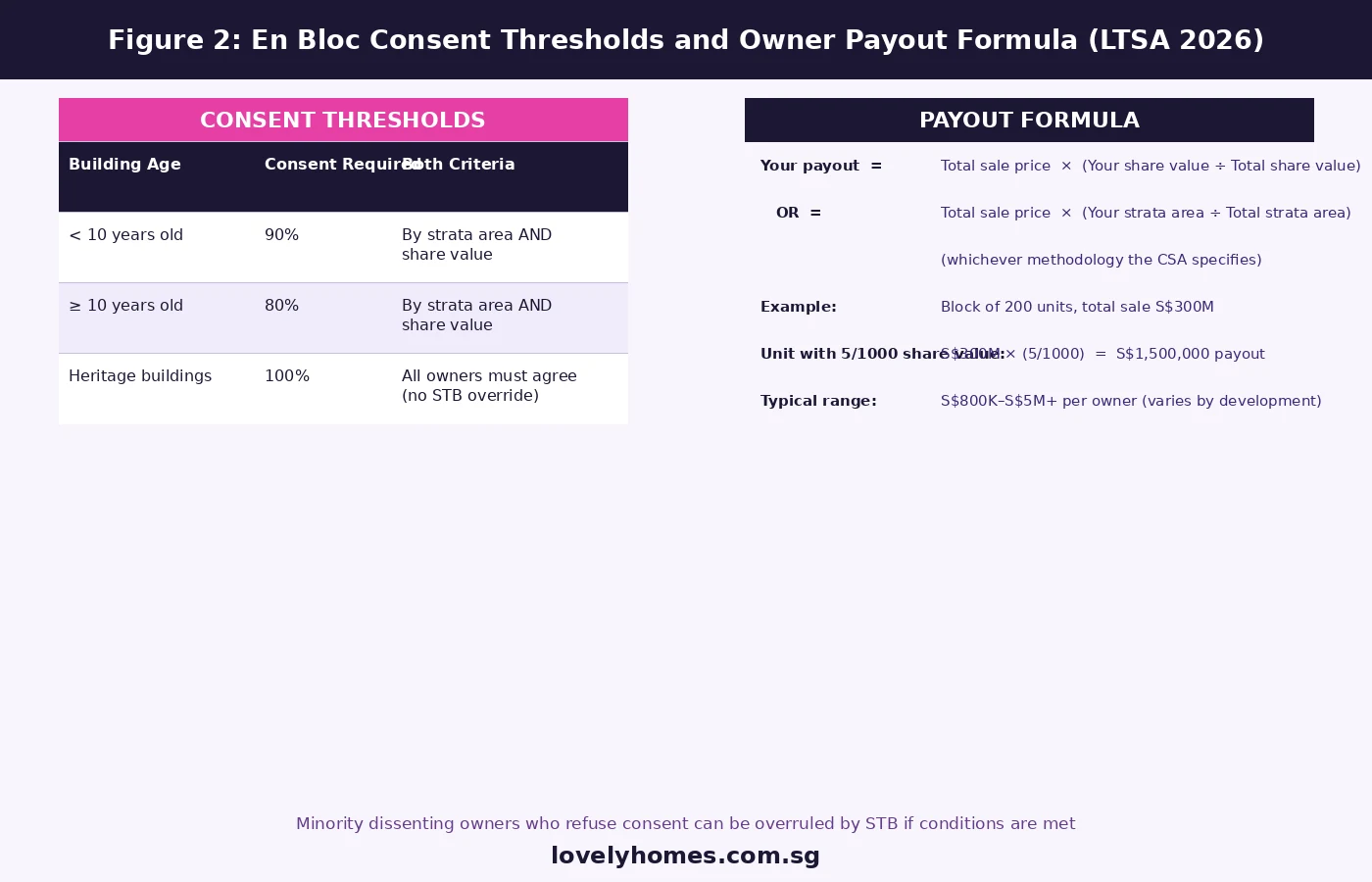
The most critical threshold is consent. Before any sale can proceed to STB, owners representing the required percentage of both share value and strata floor area must sign the Collective Sale Agreement (CSA). The thresholds depend on the age of the development:

The “age” of a development is measured from the date of issue of the latest Temporary Occupation Permit (TOP) or the date of the strata subdivision, whichever is earlier. For mixed developments (residential + commercial), the threshold applies to all strata unit types combined. A development that barely cleared 80% consent is just as legally valid as one with 95% — the STB cannot impose a higher threshold than the statute requires.
It is worth noting that the share value — a number assigned to each unit by the Land Titles (Strata) Act based on the unit’s size and level — is not the same as the strata area. A large penthouse might have a high strata area but a different share value. Developers and legal advisers pay close attention to which units’ owners have and have not signed, as a small cluster of high-share-value units can hold out against the 80% threshold even if far more than 80% of owners by head count have consented.
II. The 8-Step En Bloc Process in Singapore
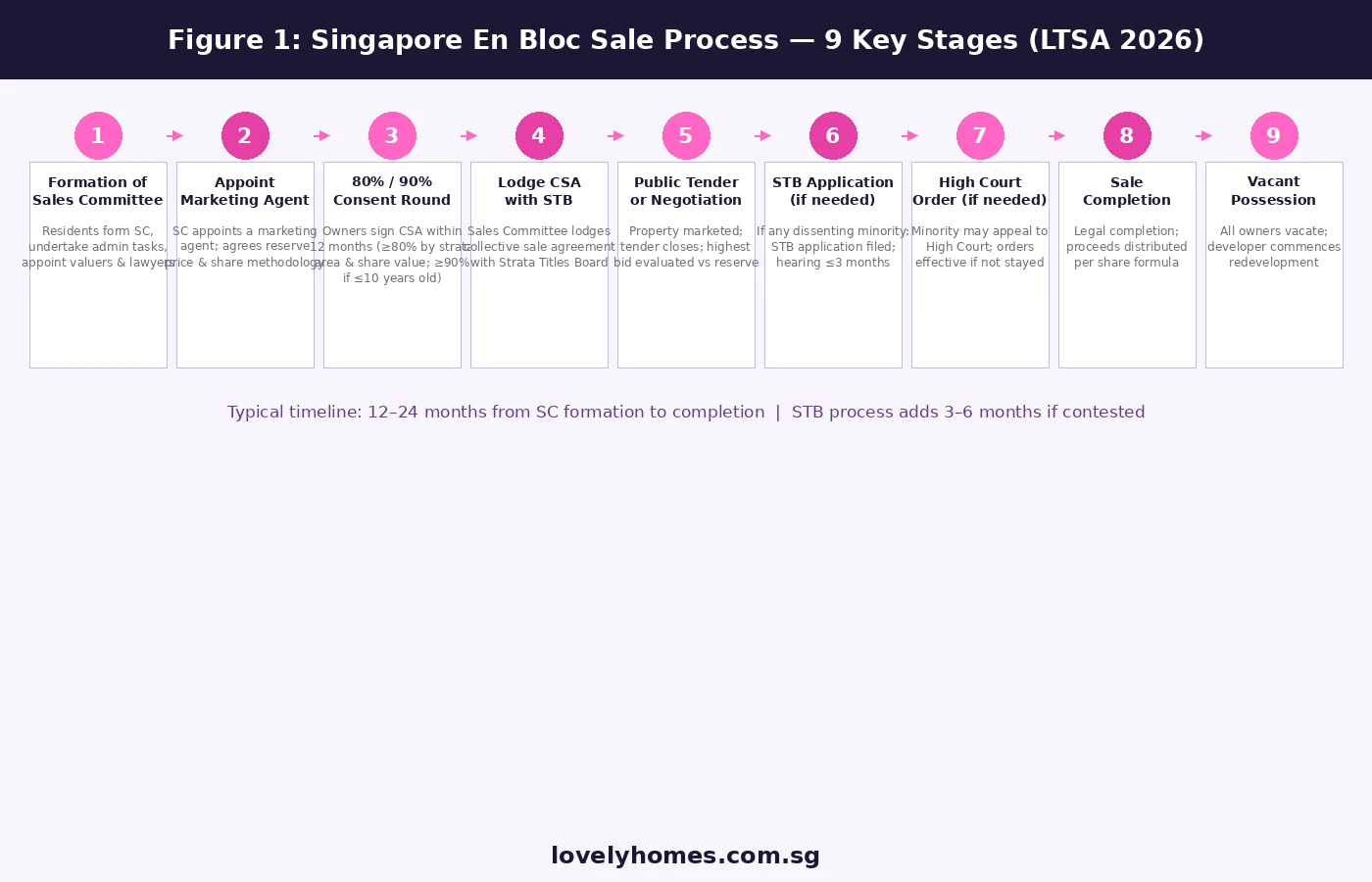
From the first EGM to the final distribution of funds, a successful en bloc sale typically follows eight distinct stages. Each stage has legal and procedural requirements under the LTSA, and the timelines can vary significantly depending on the development’s size, the level of owner consensus, and whether STB mediation is needed.

Step 1 — EGM and Sale Committee Formation: Any owner can call an Extraordinary General Meeting (EGM) to propose forming a Sale Committee. The SC is elected by majority vote among attendees. It must comprise at least 3 elected subsidiary proprietors and may not include any person who has a conflict of interest (for example, someone who stands to profit from the sale as a developer’s agent).
Step 2 — Appoint Lawyers and Marketing Agent: The SC engages a law firm specialising in collective sales and a marketing agent. The marketing agent’s role is to assess the market, recommend a reserve price, and manage the tender or expression-of-interest process. Under editorial rules, LovelyHomes does not name specific agencies — only that the SC selects via competitive pitch.
Step 3 — Draft the Collective Sale Agreement (CSA): The CSA is the binding contract between all consenting owners. It must specify the reserve price, the apportionment method for distributing proceeds, the time limit for achieving consent, the sale method (public tender, private treaty, or expression of interest), and the sale committee’s authority to negotiate. The LTSA and related regulations prescribe minimum information requirements for the CSA.
Step 4 — Achieve 80% (or 90%) Consent: Owners are given the opportunity to read the CSA, seek independent legal advice, and sign (or not sign). The SC has up to 12 months from the date the first owner signs to achieve the required threshold. If the threshold is not reached within 12 months, the collective sale attempt lapses and a new EGM must be called to start again. This is why developments like City Plaza — which took three attempts over nearly a decade — are notable.
Step 5 — STB Application: Once the consent threshold is met, the SC must apply to the STB within 12 months of achieving the required percentage. The application must include the CSA, a valuation report confirming the reserve price is not less than market value, and statutory declarations from the SC members.
Step 6 — STB Notice and Mediation: The STB serves notice on all subsidiary proprietors, including dissenting owners. A 60-day mediation period follows, during which an STB mediator attempts to resolve objections. Most objections at this stage relate to the distribution formula or alleged procedural irregularities.
Step 7 — STB Order or High Court Approval: If mediation fails or all objections are resolved, the STB proceeds to make a formal order approving the sale. If the STB cannot resolve the matter — typically because objectors raise complex legal issues — the sale must be approved by the High Court. A High Court appeal against an STB order is also possible but requires leave and is rarely granted for procedural grounds alone.
Step 8 — Completion and Distribution: The developer completes the purchase (typically 12 weeks from STB order), and the sale proceeds are distributed to all owners according to the CSA apportionment formula, less legal fees and the SC’s costs.
III. How Are En Bloc Proceeds Distributed?
The distribution formula is one of the most contested aspects of any en bloc negotiation, because different formulas can produce dramatically different payouts for large versus small units. The LTSA does not mandate a specific formula — the SC and owners must agree on one in the CSA. Three main approaches are used in practice:
- Share Value Method: Each owner receives a share of the total proceeds proportional to their unit’s share value. This tends to favour units on higher floors (which typically have higher share values under LTSA schedules).
- Strata Area Method: Each owner receives a share proportional to their unit’s strata floor area. This tends to favour physically larger units, regardless of floor level.
- Hybrid Method (most common): A weighted combination of share value and strata area — for example, 50% by share value and 50% by strata area. This is designed to be perceived as the fairest outcome by the broadest number of owners.

As the chart illustrates, the hybrid method produces a middle outcome — small units receive slightly more than under the pure share value method (if their strata area percentage is higher than their share value percentage), while large units receive slightly less. Selecting the formula is therefore a political act within the development, and the SC must manage expectations carefully to avoid the formula becoming the reason owners refuse to sign the CSA.
IV. What Minority Owners Can Do — Grounds for STB Objection
An owner who does not wish to sell their unit can refuse to sign the CSA. But once the 80% (or 90%) threshold is crossed, their refusal no longer has any legal effect on whether the sale proceeds — they will be compelled to sell at the reserve price set in the CSA. Their recourse is limited to challenging the process before the STB.
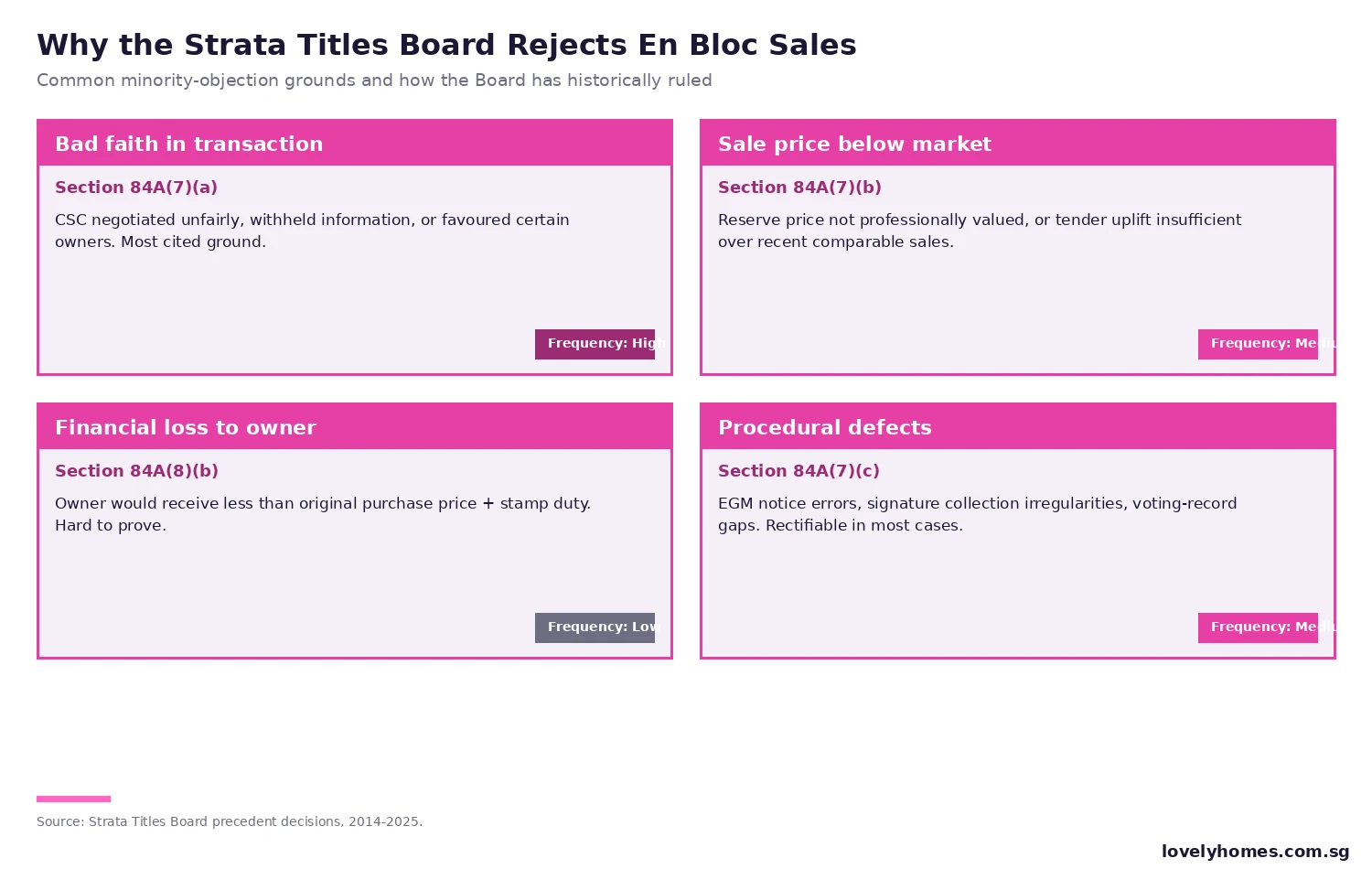
Under Section 84A(9) of the LTSA, the STB shall approve a sale unless it is satisfied that:
- The transaction is not in good faith, taking into account the sale price, the method of distribution of the sale proceeds, and the relationship between any of the purchasers and the subsidiary proprietors; or
- The sale and purchase agreement would require a minority owner to be relocated to an alternative property that is not a comparable equivalent to their current unit.
The STB has very limited discretion to refuse a sale if the statutory requirements have been met. Courts have consistently held that the collective interests of the majority — and Singapore’s urban renewal objectives — outweigh the individual rights of dissenting minority owners, provided the process was conducted lawfully. However, any procedural irregularity in the CSA or the SC’s conduct can provide grounds for challenge, which is why well-advised SCs engage experienced law firms from the outset.
V. Development Charge — What It Is and Why It Affects the Sale Price
When a developer acquires an en bloc site and proposes to redevelop it at a higher intensity (more units, taller buildings, or a change of use), the Urban Redevelopment Authority (URA) levies a Development Charge (DC). The DC represents a tax on the enhancement in land value arising from the change in approved use or plot ratio.
DC rates are published quarterly by URA and vary by use group and development charge sector. For a residential site moving from 1.4 to 2.1 plot ratio, the DC can be substantial — potentially tens of millions of dollars. Developers factor the DC into their land bid price, meaning a higher expected DC reduces the maximum price a developer can profitably pay for the site. This is why the SC’s marketing agent always models the DC when recommending a reserve price.
| Key En Bloc Fact | Details |
|---|---|
| Governing Statute | Land Titles (Strata) Act (LTSA), Chapter 158A |
| Consent Threshold (≥10 yrs) | 80% by share value AND strata area |
| Consent Threshold (<10 yrs) | 90% by share value AND strata area |
| Time to achieve consent | 12 months from first CSA signature |
| STB application deadline | 12 months from achieving consent threshold |
| STB mediation window | 60 days after all parties notified |
| Typical full cycle | 18–36 months (longer if High Court involved) |
| Capital Gains Tax on proceeds | None (Singapore has no CGT) |
| Development Charge | Paid by developer; reduces viable bid price |
| Distribution formula | Share value, strata area, or hybrid — agreed in CSA |
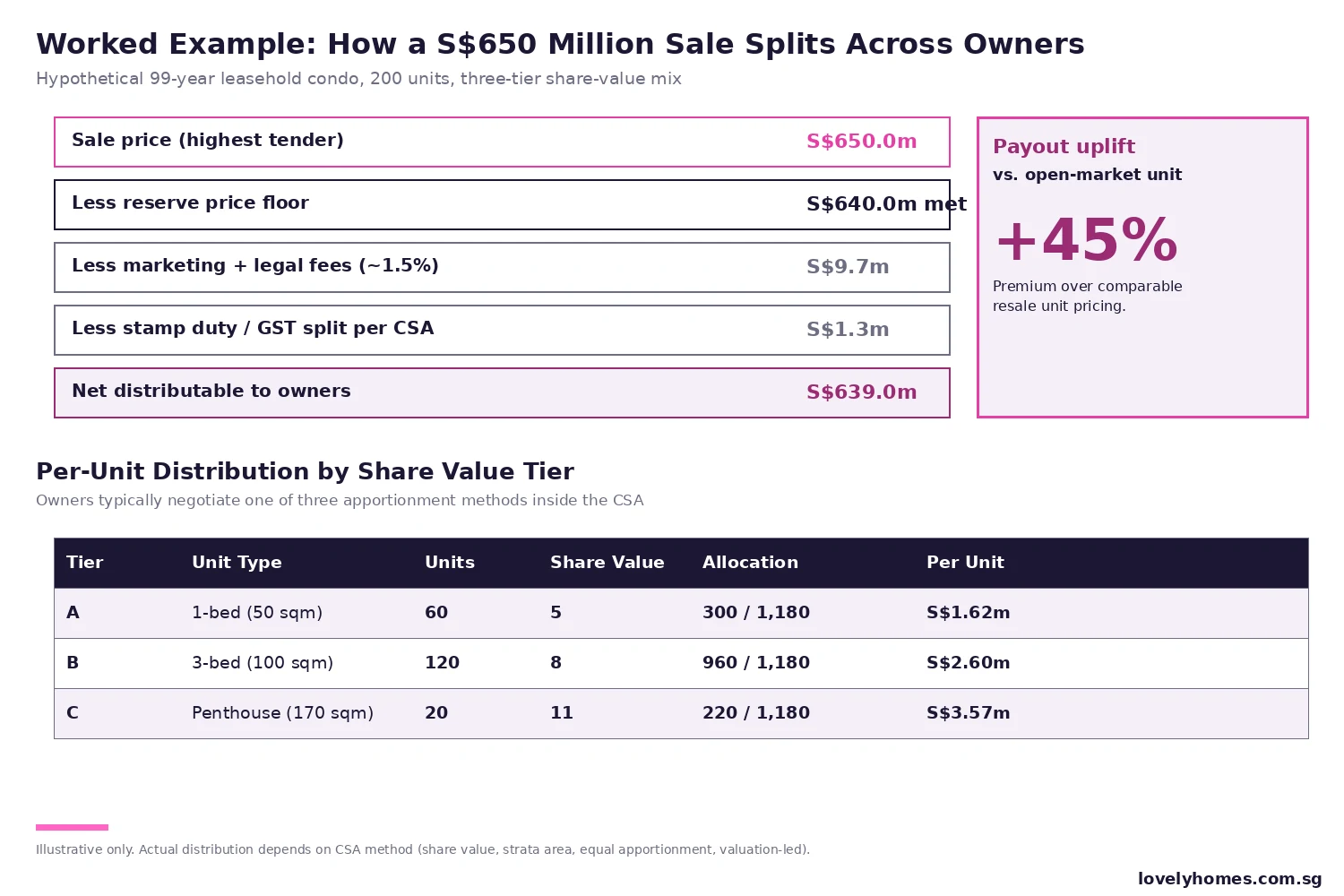
VI. Worked Example — The Numbers Behind a Typical En Bloc Sale
Consider a hypothetical 120-unit freehold condominium in District 14, built in 2008 (now 18 years old — well past the 10-year threshold). The development has a total strata area of 10,000 sqm and a total share value of 1,200. The SC has set a reserve price of S$240 million.
Mr and Mrs Lim own a 90 sqm unit on the 8th floor with a share value of 10. Their CPF Ordinary Account balance was drawn down by S$250,000 to purchase the unit in 2012, at an initial purchase price of S$850,000. The accrued interest on their CPF drawdown at 2.5% p.a. over 14 years is approximately S$104,000, making the total CPF refund obligation S$354,000 on sale.
Under the hybrid formula (50% share value, 50% strata area):
- Share value %: 10/1,200 = 0.833%
- Strata area %: 90/10,000 = 0.900%
- Hybrid average: (0.833% + 0.900%) / 2 = 0.867%
- Gross proceeds: S$240M × 0.867% = S$2,080,800
After deductions:
- Legal fees (SC’s allocated cost to each owner): approximately S$3,500
- CPF refund (principal + accrued interest): S$354,000 to CPF OA
- Remaining bank mortgage (assume S$0 — fully paid off): S$0
- Net cash received: approximately S$2,080,800 − S$3,500 − S$354,000 = S$1,723,300
If the Lims then wish to buy a replacement private property at S$1.8M (their second property, having now exited their only existing property), they would pay BSD of S$58,600 and zero ABSD — because they are SC buyers purchasing a first property after selling their only existing property. (The 28 July 2026 removal of the 15-month wait-out period for HDB resale is also relevant: if the Lims preferred to downgrade, they could now buy a non-subsidised HDB resale without waiting 15 months.)
VII. What This Means for Property Buyers and Sellers
If your current development is more than 10 years old and your management committee has received expressions of interest from developers, the en bloc process may be closer than you think. Understanding the CSA terms — especially the distribution formula and the reserve price relative to your own property’s valuation — is essential before you decide whether to sign. You are not legally required to consult a lawyer, but the LTSA expressly permits you to obtain independent legal advice at your own cost before signing the CSA.
If you are buying into a development with known en bloc potential, factor in the possibility that a successful sale could require you to exit within 12–24 months of purchase. The entry price, the potential payout, and your ability to secure replacement housing on short notice are all material considerations. En bloc potential can inflate the asking price of ageing developments in prime districts — do your own valuation analysis before paying a premium based purely on en bloc speculation.
VIII. What Might Come Next for Singapore En Bloc Sales
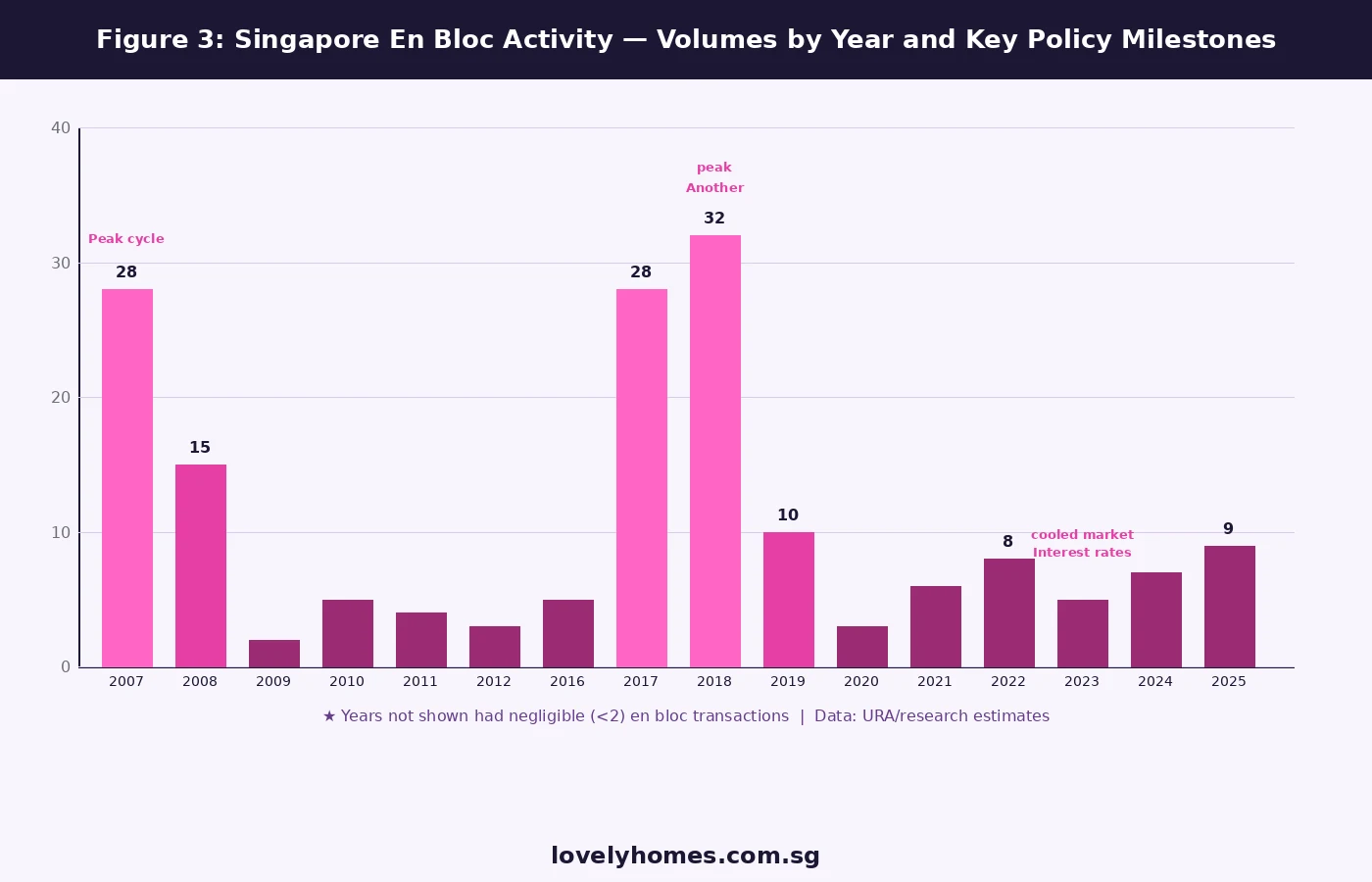
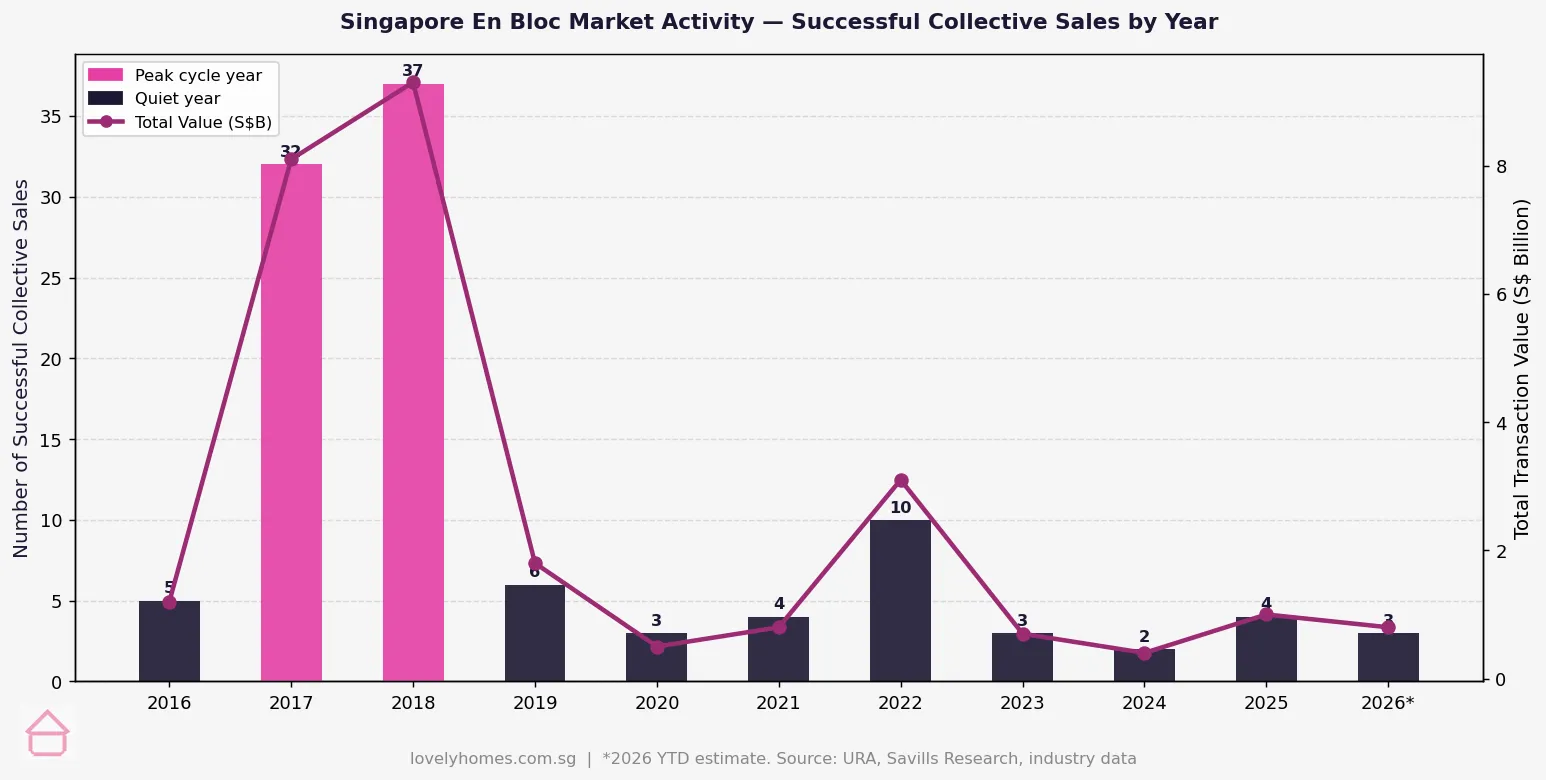
The Singapore en bloc market is cyclical. Activity tends to pick up when land-hungry developers exhaust Government Land Sales (GLS) options, when land values are rising strongly, and when the GLS Confirmed List is perceived as insufficient. URA’s 13 August 2026 release of two new GLS sites — Marina Gardens Lane and Orchard Boulevard — adds to a 2H2026 Confirmed List of 4,745 units, which is more than 50% above the 10-year average. A larger GLS pipeline gives developers more alternatives to en bloc bids and may dampen en bloc premiums over the near term.
Industry observers suggest that amendments to the LTSA to further protect minority owners or to streamline the STB process remain under periodic review by the Ministry of Law. Any changes to the consent thresholds or grounds of objection would materially alter the en bloc calculus for both owners and developers. For now, the 80%/90% framework established since 1999 remains intact.
Frequently Asked Questions: En Bloc Sales in Singapore
Can I be forced to sell my unit even if I voted against the en bloc?
Yes. Once the consent threshold (80% for developments aged 10 years or more; 90% for younger developments) has been met and the Strata Titles Board (STB) has approved the sale, all subsidiary proprietors — including those who refused to sign the Collective Sale Agreement (CSA) — are legally bound by the sale. Your only recourse is to lodge a formal objection with the STB on the limited grounds specified in the Land Titles (Strata) Act, primarily that the transaction is not in good faith or that the sale price is insufficient for you to purchase a comparable replacement property.
How long does an en bloc take from start to finish?
A straightforward en bloc where consent is achieved quickly and no STB objections are contested can be completed in as little as 18 months from the first EGM. More complex cases — particularly those involving multiple attempts at consent (as City Plaza’s three-attempt history shows) or where minority owners mount STB and then High Court challenges — can take 3–5 years or more from first EGM to final payout. The 12-month windows for achieving consent and for filing the STB application are statutory, but the STB and court processes themselves can extend considerably beyond that.
Will I pay income tax or capital gains tax on my en bloc proceeds?
For most owner-occupiers and long-term investors, no. Singapore has no capital gains tax, and en bloc proceeds received by an individual subsidiary proprietor are generally treated as capital receipts rather than income, and are therefore not subject to income tax. The exception is a developer or property trader who buys units in a development with the express intention of facilitating and profiting from an en bloc sale — in that situation, the IRAS may treat the profits as taxable income from a property trading business. If you are uncertain about your tax position, seek advice from a tax professional before the sale completes.
What is a Development Charge and who pays it?
The Development Charge (DC) is a levy payable by the developer (not the selling owners) to the Singapore Land Authority (SLA) when the proposed development exceeds the previously approved intensity or changes the use of the site. DC rates are published quarterly by URA and differ by use group and development charge sector. In practical terms, a high expected DC reduces the maximum land bid price a developer can sustain, which is why the SC’s marketing agent always models the DC when recommending the reserve price. Owners indirectly bear the DC through its effect on the bid price they receive, even though the legal obligation rests with the developer.
Can a development make more than one attempt at en bloc?
Yes. There is no statutory limit on the number of en bloc attempts a development can make. If the consent threshold is not achieved within 12 months of the first CSA signature, the attempt lapses. The Sale Committee may call a new EGM, elect a new (or reconstituted) SC, and begin the process again from the CSA stage. Developments like City Plaza (three attempts: 2012, 2018, 2021–2026) and many others in Singapore’s collective sale history have made multiple attempts before eventually succeeding — sometimes after significant shifts in the property market improved owners’ appetite for the reserve price on offer.
Is there a minimum reserve price that the Sale Committee must set?
The LTSA does not specify a minimum absolute figure. However, the CSA and the STB application must be accompanied by a valuation report from a licensed independent valuer confirming that the reserve price is not less than the market value of the property as a whole at the time of the application. In practice, most SCs set the reserve price at or above market value (often 10–30% above for prime sites) to make the collective sale financially attractive to consenting owners. Setting a reserve price that a valuer cannot certify as at least equal to market value would be grounds for STB to reject the application.
What happens to the proceeds if the sale falls through after STB approval?
If the sale falls through after the STB order — for example because the developer fails to exercise the option after the tender closes, or the developer is unable to complete — the deposit paid by the developer under the sale and purchase agreement is typically forfeited to the consenting owners (distributed according to the CSA apportionment formula). The development then continues to be owned by the subsidiary proprietors on their existing strata titles, and the SC would need to either re-launch the sale or wind up. The STB order itself does not expire if the sale is being actively pursued, but any further delay that requires a new STB application would restart the process.
Click anywhere to close