Singapore En Bloc Sale Process Guide 2026: How Collective Sales Work, Rules and What Owners Can Expect

Singapore En Bloc Sale Process Guide 2026: How Collective Sales Work, Rules and What Owners Can Expect

Quick Answer: Singapore En Bloc Sale — 8 Key Facts

  • An en bloc (collective sale) requires 80% consent by share value and strata area for developments aged 10 years or more; 90% for those under 10 years.
  • The legal framework is the Land Titles (Strata) Act (LTSA), administered by the Strata Titles Board (STB) under the Ministry of Law.
  • Owners elect a Sale Committee (SC) at an Extraordinary General Meeting (EGM) to manage the process on their behalf.
  • A Collective Sale Agreement (CSA) sets the reserve price, distribution formula and other binding terms — all consenting owners sign it.
  • STB reviews the application and mediates objections; dissenting minority owners have limited grounds for challenge once the consent threshold is met.
  • Proceeds are split by share value, strata area, or a hybrid of both — the formula is agreed in the CSA before marketing begins.
  • There is no capital gains tax on en bloc proceeds in Singapore; proceeds are treated as capital receipts for most owner-occupiers.
  • The average en bloc cycle runs 18–36 months from Sale Committee formation to final distribution of funds.

Introduction: What Is an En Bloc Sale and Why Does It Matter?

An en bloc sale — derived from the French phrase meaning “all together” — is a mechanism unique to Singapore’s strata-titled property market. It allows the entire ownership of a development (every unit, every owner) to be sold simultaneously to a single purchaser, typically a property developer. Unlike a standard private sale where one owner transacts independently, an en bloc overrides individual preference: once the statutory consent threshold is achieved and the Strata Titles Board (STB) approves the sale, all owners — including those who voted against — must sell at the agreed price.

For Singapore’s urban renewal, en bloc is a critical tool. It allows ageing, low-density developments on prime land to be redeveloped into higher-density housing, bringing new supply to the market and allowing developers to assemble large contiguous sites that would otherwise be impossible to acquire piecemeal. For the individual owner, it can represent a windfall — or an unwelcome forced exit. Understanding how the process works, what your rights are, and how the proceeds are calculated is essential for any property owner in a strata development.

This guide covers the full en bloc process under the Land Titles (Strata) Act (LTSA), the consent thresholds, the 8-step collective sale timeline, how distribution formulas work, what minority owners can do, and a worked example of how the numbers are calculated.

I. Legal Framework and Consent Thresholds

En bloc sales in Singapore are governed by the Land Titles (Strata) Act (LTSA), Chapter 158A, specifically Sections 84A to 84G. The Urban Redevelopment Authority (URA) issues development controls that dictate what a developer can build on the acquired site, and the Strata Titles Board (STB) — a quasi-judicial body under the Ministry of Law — adjudicates all en bloc applications.

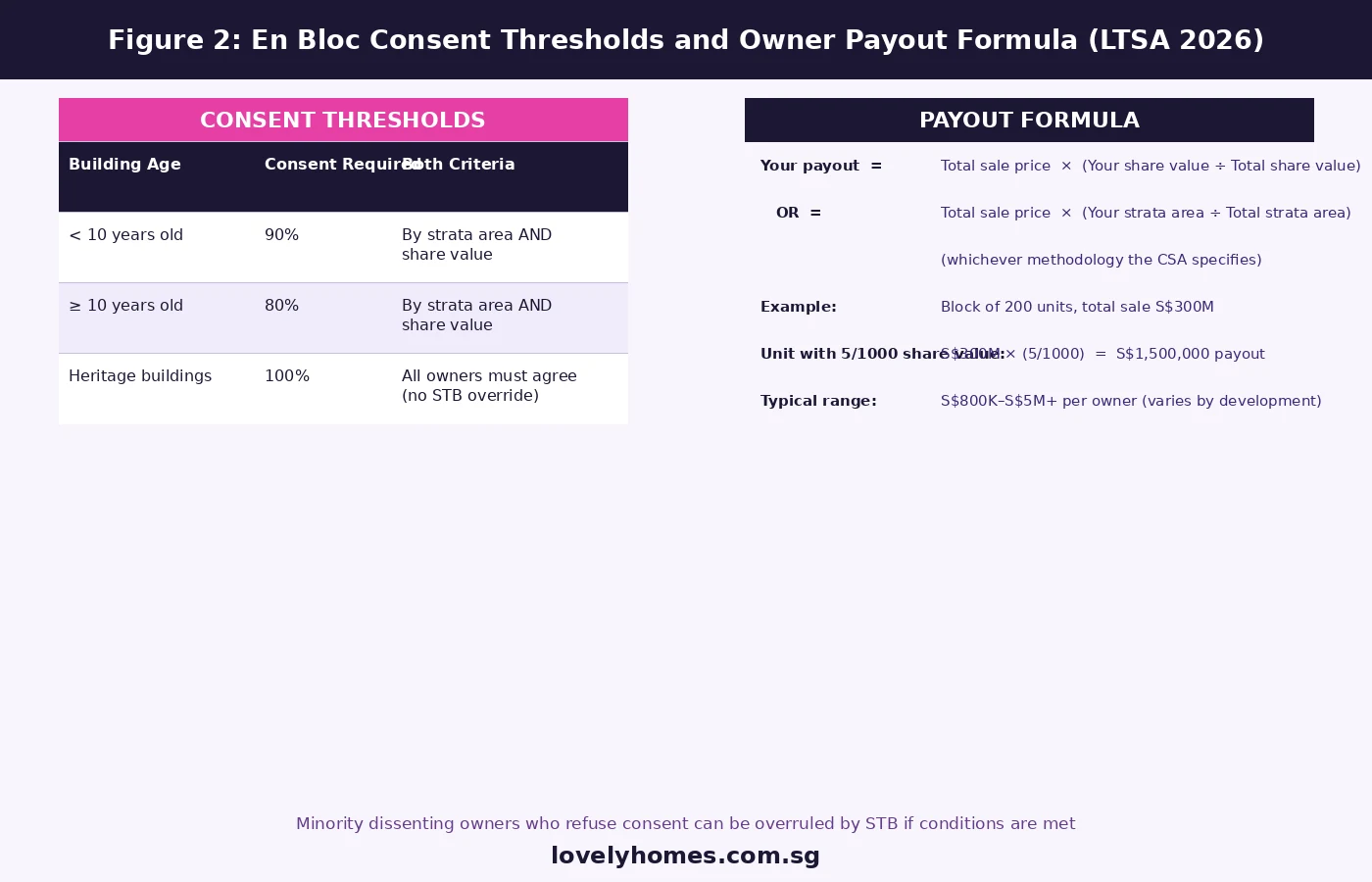
The most critical threshold is consent. Before any sale can proceed to STB, owners representing the required percentage of both share value and strata floor area must sign the Collective Sale Agreement (CSA). The thresholds depend on the age of the development:

En bloc consent threshold table Singapore 80 percent 90 percent LTSA
Figure 1: En Bloc Consent Thresholds under the Land Titles (Strata) Act — Source: Singapore Statutes Online, Ministry of Law

The “age” of a development is measured from the date of issue of the latest Temporary Occupation Permit (TOP) or the date of the strata subdivision, whichever is earlier. For mixed developments (residential + commercial), the threshold applies to all strata unit types combined. A development that barely cleared 80% consent is just as legally valid as one with 95% — the STB cannot impose a higher threshold than the statute requires.

It is worth noting that the share value — a number assigned to each unit by the Land Titles (Strata) Act based on the unit’s size and level — is not the same as the strata area. A large penthouse might have a high strata area but a different share value. Developers and legal advisers pay close attention to which units’ owners have and have not signed, as a small cluster of high-share-value units can hold out against the 80% threshold even if far more than 80% of owners by head count have consented.

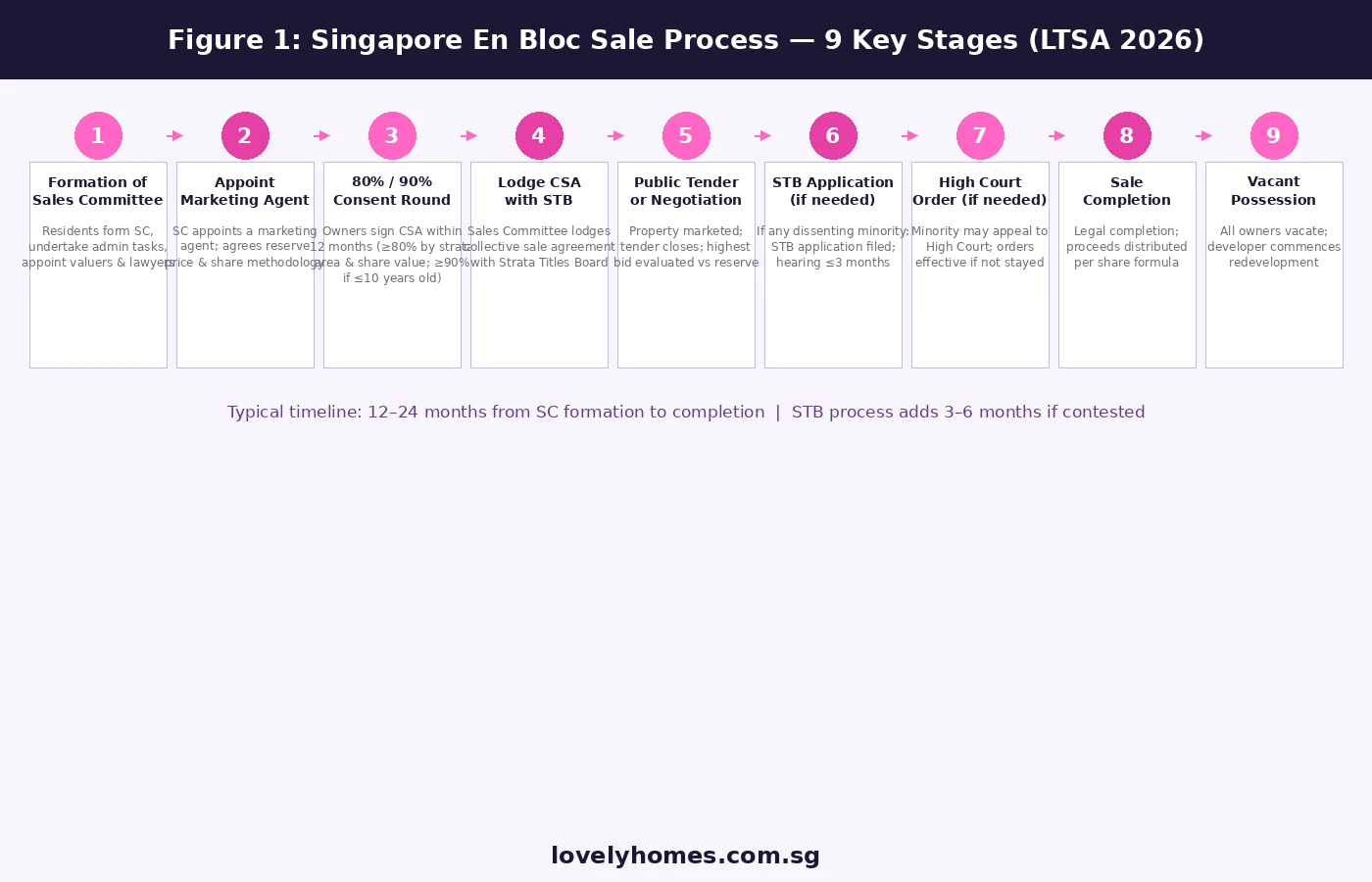
II. The 8-Step En Bloc Process in Singapore

From the first EGM to the final distribution of funds, a successful en bloc sale typically follows eight distinct stages. Each stage has legal and procedural requirements under the LTSA, and the timelines can vary significantly depending on the development’s size, the level of owner consensus, and whether STB mediation is needed.

En bloc collective sale 8-step process Singapore STB LTSA flowchart
Figure 2: The 8-Step Collective Sale Process in Singapore — from EGM to proceeds distribution. Source: LTSA, Strata Titles Board

Step 1 — EGM and Sale Committee Formation: Any owner can call an Extraordinary General Meeting (EGM) to propose forming a Sale Committee. The SC is elected by majority vote among attendees. It must comprise at least 3 elected subsidiary proprietors and may not include any person who has a conflict of interest (for example, someone who stands to profit from the sale as a developer’s agent).

Step 2 — Appoint Lawyers and Marketing Agent: The SC engages a law firm specialising in collective sales and a marketing agent. The marketing agent’s role is to assess the market, recommend a reserve price, and manage the tender or expression-of-interest process. Under editorial rules, LovelyHomes does not name specific agencies — only that the SC selects via competitive pitch.

Step 3 — Draft the Collective Sale Agreement (CSA): The CSA is the binding contract between all consenting owners. It must specify the reserve price, the apportionment method for distributing proceeds, the time limit for achieving consent, the sale method (public tender, private treaty, or expression of interest), and the sale committee’s authority to negotiate. The LTSA and related regulations prescribe minimum information requirements for the CSA.

Step 4 — Achieve 80% (or 90%) Consent: Owners are given the opportunity to read the CSA, seek independent legal advice, and sign (or not sign). The SC has up to 12 months from the date the first owner signs to achieve the required threshold. If the threshold is not reached within 12 months, the collective sale attempt lapses and a new EGM must be called to start again. This is why developments like City Plaza — which took three attempts over nearly a decade — are notable.

Step 5 — STB Application: Once the consent threshold is met, the SC must apply to the STB within 12 months of achieving the required percentage. The application must include the CSA, a valuation report confirming the reserve price is not less than market value, and statutory declarations from the SC members.

Step 6 — STB Notice and Mediation: The STB serves notice on all subsidiary proprietors, including dissenting owners. A 60-day mediation period follows, during which an STB mediator attempts to resolve objections. Most objections at this stage relate to the distribution formula or alleged procedural irregularities.

Step 7 — STB Order or High Court Approval: If mediation fails or all objections are resolved, the STB proceeds to make a formal order approving the sale. If the STB cannot resolve the matter — typically because objectors raise complex legal issues — the sale must be approved by the High Court. A High Court appeal against an STB order is also possible but requires leave and is rarely granted for procedural grounds alone.

Step 8 — Completion and Distribution: The developer completes the purchase (typically 12 weeks from STB order), and the sale proceeds are distributed to all owners according to the CSA apportionment formula, less legal fees and the SC’s costs.

III. How Are En Bloc Proceeds Distributed?

The distribution formula is one of the most contested aspects of any en bloc negotiation, because different formulas can produce dramatically different payouts for large versus small units. The LTSA does not mandate a specific formula — the SC and owners must agree on one in the CSA. Three main approaches are used in practice:

  • Share Value Method: Each owner receives a share of the total proceeds proportional to their unit’s share value. This tends to favour units on higher floors (which typically have higher share values under LTSA schedules).
  • Strata Area Method: Each owner receives a share proportional to their unit’s strata floor area. This tends to favour physically larger units, regardless of floor level.
  • Hybrid Method (most common): A weighted combination of share value and strata area — for example, 50% by share value and 50% by strata area. This is designed to be perceived as the fairest outcome by the broadest number of owners.
En bloc distribution formula share value strata area hybrid comparison Singapore
Figure 3: How Formula Choice Affects Individual Payouts — Illustrative 100-Unit Development, S$200M Total. Source: LovelyHomes analysis based on LTSA framework

As the chart illustrates, the hybrid method produces a middle outcome — small units receive slightly more than under the pure share value method (if their strata area percentage is higher than their share value percentage), while large units receive slightly less. Selecting the formula is therefore a political act within the development, and the SC must manage expectations carefully to avoid the formula becoming the reason owners refuse to sign the CSA.

IV. What Minority Owners Can Do — Grounds for STB Objection

An owner who does not wish to sell their unit can refuse to sign the CSA. But once the 80% (or 90%) threshold is crossed, their refusal no longer has any legal effect on whether the sale proceeds — they will be compelled to sell at the reserve price set in the CSA. Their recourse is limited to challenging the process before the STB.

Under Section 84A(9) of the LTSA, the STB shall approve a sale unless it is satisfied that:

  • The transaction is not in good faith, taking into account the sale price, the method of distribution of the sale proceeds, and the relationship between any of the purchasers and the subsidiary proprietors; or
  • The sale and purchase agreement would require a minority owner to be relocated to an alternative property that is not a comparable equivalent to their current unit.

The STB has very limited discretion to refuse a sale if the statutory requirements have been met. Courts have consistently held that the collective interests of the majority — and Singapore’s urban renewal objectives — outweigh the individual rights of dissenting minority owners, provided the process was conducted lawfully. However, any procedural irregularity in the CSA or the SC’s conduct can provide grounds for challenge, which is why well-advised SCs engage experienced law firms from the outset.

V. Development Charge — What It Is and Why It Affects the Sale Price

When a developer acquires an en bloc site and proposes to redevelop it at a higher intensity (more units, taller buildings, or a change of use), the Urban Redevelopment Authority (URA) levies a Development Charge (DC). The DC represents a tax on the enhancement in land value arising from the change in approved use or plot ratio.

DC rates are published quarterly by URA and vary by use group and development charge sector. For a residential site moving from 1.4 to 2.1 plot ratio, the DC can be substantial — potentially tens of millions of dollars. Developers factor the DC into their land bid price, meaning a higher expected DC reduces the maximum price a developer can profitably pay for the site. This is why the SC’s marketing agent always models the DC when recommending a reserve price.

Key En Bloc Fact Details
Governing Statute Land Titles (Strata) Act (LTSA), Chapter 158A
Consent Threshold (≥10 yrs) 80% by share value AND strata area
Consent Threshold (<10 yrs) 90% by share value AND strata area
Time to achieve consent 12 months from first CSA signature
STB application deadline 12 months from achieving consent threshold
STB mediation window 60 days after all parties notified
Typical full cycle 18–36 months (longer if High Court involved)
Capital Gains Tax on proceeds None (Singapore has no CGT)
Development Charge Paid by developer; reduces viable bid price
Distribution formula Share value, strata area, or hybrid — agreed in CSA

VI. Worked Example — The Numbers Behind a Typical En Bloc Sale

Consider a hypothetical 120-unit freehold condominium in District 14, built in 2008 (now 18 years old — well past the 10-year threshold). The development has a total strata area of 10,000 sqm and a total share value of 1,200. The SC has set a reserve price of S$240 million.

Mr and Mrs Lim own a 90 sqm unit on the 8th floor with a share value of 10. Their CPF Ordinary Account balance was drawn down by S$250,000 to purchase the unit in 2012, at an initial purchase price of S$850,000. The accrued interest on their CPF drawdown at 2.5% p.a. over 14 years is approximately S$104,000, making the total CPF refund obligation S$354,000 on sale.

Under the hybrid formula (50% share value, 50% strata area):

  • Share value %: 10/1,200 = 0.833%
  • Strata area %: 90/10,000 = 0.900%
  • Hybrid average: (0.833% + 0.900%) / 2 = 0.867%
  • Gross proceeds: S$240M × 0.867% = S$2,080,800

After deductions:

  • Legal fees (SC’s allocated cost to each owner): approximately S$3,500
  • CPF refund (principal + accrued interest): S$354,000 to CPF OA
  • Remaining bank mortgage (assume S$0 — fully paid off): S$0
  • Net cash received: approximately S$2,080,800 − S$3,500 − S$354,000 = S$1,723,300

If the Lims then wish to buy a replacement private property at S$1.8M (their second property, having now exited their only existing property), they would pay BSD of S$58,600 and zero ABSD — because they are SC buyers purchasing a first property after selling their only existing property. (The 28 July 2026 removal of the 15-month wait-out period for HDB resale is also relevant: if the Lims preferred to downgrade, they could now buy a non-subsidised HDB resale without waiting 15 months.)

VII. What This Means for Property Buyers and Sellers

If your current development is more than 10 years old and your management committee has received expressions of interest from developers, the en bloc process may be closer than you think. Understanding the CSA terms — especially the distribution formula and the reserve price relative to your own property’s valuation — is essential before you decide whether to sign. You are not legally required to consult a lawyer, but the LTSA expressly permits you to obtain independent legal advice at your own cost before signing the CSA.

If you are buying into a development with known en bloc potential, factor in the possibility that a successful sale could require you to exit within 12–24 months of purchase. The entry price, the potential payout, and your ability to secure replacement housing on short notice are all material considerations. En bloc potential can inflate the asking price of ageing developments in prime districts — do your own valuation analysis before paying a premium based purely on en bloc speculation.

VIII. What Might Come Next for Singapore En Bloc Sales

The Singapore en bloc market is cyclical. Activity tends to pick up when land-hungry developers exhaust Government Land Sales (GLS) options, when land values are rising strongly, and when the GLS Confirmed List is perceived as insufficient. URA’s 13 August 2026 release of two new GLS sites — Marina Gardens Lane and Orchard Boulevard — adds to a 2H2026 Confirmed List of 4,745 units, which is more than 50% above the 10-year average. A larger GLS pipeline gives developers more alternatives to en bloc bids and may dampen en bloc premiums over the near term.

Industry observers suggest that amendments to the LTSA to further protect minority owners or to streamline the STB process remain under periodic review by the Ministry of Law. Any changes to the consent thresholds or grounds of objection would materially alter the en bloc calculus for both owners and developers. For now, the 80%/90% framework established since 1999 remains intact.

Frequently Asked Questions: En Bloc Sales in Singapore

Can I be forced to sell my unit even if I voted against the en bloc?

Yes. Once the consent threshold (80% for developments aged 10 years or more; 90% for younger developments) has been met and the Strata Titles Board (STB) has approved the sale, all subsidiary proprietors — including those who refused to sign the Collective Sale Agreement (CSA) — are legally bound by the sale. Your only recourse is to lodge a formal objection with the STB on the limited grounds specified in the Land Titles (Strata) Act, primarily that the transaction is not in good faith or that the sale price is insufficient for you to purchase a comparable replacement property.

How long does an en bloc take from start to finish?

A straightforward en bloc where consent is achieved quickly and no STB objections are contested can be completed in as little as 18 months from the first EGM. More complex cases — particularly those involving multiple attempts at consent (as City Plaza’s three-attempt history shows) or where minority owners mount STB and then High Court challenges — can take 3–5 years or more from first EGM to final payout. The 12-month windows for achieving consent and for filing the STB application are statutory, but the STB and court processes themselves can extend considerably beyond that.

Will I pay income tax or capital gains tax on my en bloc proceeds?

For most owner-occupiers and long-term investors, no. Singapore has no capital gains tax, and en bloc proceeds received by an individual subsidiary proprietor are generally treated as capital receipts rather than income, and are therefore not subject to income tax. The exception is a developer or property trader who buys units in a development with the express intention of facilitating and profiting from an en bloc sale — in that situation, the IRAS may treat the profits as taxable income from a property trading business. If you are uncertain about your tax position, seek advice from a tax professional before the sale completes.

What is a Development Charge and who pays it?

The Development Charge (DC) is a levy payable by the developer (not the selling owners) to the Singapore Land Authority (SLA) when the proposed development exceeds the previously approved intensity or changes the use of the site. DC rates are published quarterly by URA and differ by use group and development charge sector. In practical terms, a high expected DC reduces the maximum land bid price a developer can sustain, which is why the SC’s marketing agent always models the DC when recommending the reserve price. Owners indirectly bear the DC through its effect on the bid price they receive, even though the legal obligation rests with the developer.

Can a development make more than one attempt at en bloc?

Yes. There is no statutory limit on the number of en bloc attempts a development can make. If the consent threshold is not achieved within 12 months of the first CSA signature, the attempt lapses. The Sale Committee may call a new EGM, elect a new (or reconstituted) SC, and begin the process again from the CSA stage. Developments like City Plaza (three attempts: 2012, 2018, 2021–2026) and many others in Singapore’s collective sale history have made multiple attempts before eventually succeeding — sometimes after significant shifts in the property market improved owners’ appetite for the reserve price on offer.

Is there a minimum reserve price that the Sale Committee must set?

The LTSA does not specify a minimum absolute figure. However, the CSA and the STB application must be accompanied by a valuation report from a licensed independent valuer confirming that the reserve price is not less than the market value of the property as a whole at the time of the application. In practice, most SCs set the reserve price at or above market value (often 10–30% above for prime sites) to make the collective sale financially attractive to consenting owners. Setting a reserve price that a valuer cannot certify as at least equal to market value would be grounds for STB to reject the application.

What happens to the proceeds if the sale falls through after STB approval?

If the sale falls through after the STB order — for example because the developer fails to exercise the option after the tender closes, or the developer is unable to complete — the deposit paid by the developer under the sale and purchase agreement is typically forfeited to the consenting owners (distributed according to the CSA apportionment formula). The development then continues to be owned by the subsidiary proprietors on their existing strata titles, and the SC would need to either re-launch the sale or wind up. The STB order itself does not expire if the sale is being actively pursued, but any further delay that requires a new STB application would restart the process.

Disclaimer: This article is for general information only and does not constitute legal, tax, or financial advice. En bloc processes and property legislation in Singapore can be complex and change over time. For advice specific to your situation — including whether to sign a Collective Sale Agreement, your rights as a dissenting owner, or the tax treatment of en bloc proceeds — consult a qualified Singapore lawyer, tax adviser, or licensed valuer. Official information on the Land Titles (Strata) Act is available at Singapore Statutes Online (sso.agc.gov.sg). STB procedures are documented at stratatitlesboard.gov.sg. URA Development Charge rates are published quarterly at ura.gov.sg.

×

Click anywhere to close

Singapore En Bloc Reform 2026: New Consent Thresholds for Older Developments Explained

Singapore En Bloc Reform 2026: New Consent Thresholds for Older Developments Explained

Quick Answer: Singapore En Bloc Consent Reform 2026

  • The Ministry of Law (MinLaw) tabled the Land Titles (Strata) (Amendment) Bill in Parliament on 4 August 2026.
  • The proposed Bill lowers the collective sale consent threshold from 80% to 70% for developments aged 40–59 years, and to 65% for those aged 60 years and above.
  • Consent thresholds remain unchanged at 90% for developments under 10 years old, and 80% for those aged 10–39 years.
  • Approximately 20,000 private non-landed residential units are more than 40 years old in Singapore — representing a substantial pool of potentially eligible sites.
  • The Bill has not yet been enacted. It will be debated in Parliament and voted upon before becoming law.
  • New safeguards for minority (non-consenting) owners are also proposed, including a higher requisition threshold for calling general meetings, a shorter signature-gathering window, and a longer restriction period after failed attempts.
  • Complementary policy changes announced on 28 July 2026 extend ABSD remission timelines for developers of large collective sale redevelopments, providing a more viable development economics framework for mega en bloc sites.
Note: This article is based on the Land Titles (Strata) (Amendment) Bill tabled in Parliament on 4 August 2026. The Bill has not yet been passed into law. All references to “new rules” or “proposed thresholds” reflect the Bill as tabled and are subject to Parliamentary debate and amendment.

The Proposed Changes: What MinLaw Has Tabled

Singapore’s Ministry of Law (MinLaw) tabled the Land Titles (Strata) (Amendment) Bill in Parliament on 4 August 2026, proposing the most significant overhaul of the collective sale (en bloc) framework since the regime’s inception in 1999. The centrepiece of the Bill is a tiered reduction in the consent thresholds required for older developments to proceed with a collective sale.

Under the current framework, any strata development — regardless of age — requires the agreement of owners representing at least 80% of the share value AND 80% of the strata area to proceed with a collective sale (or 90% for developments less than 10 years old). The amendment proposes a graduated approach: the older the development, the lower the threshold required to unlock a collective sale.

Singapore en bloc consent threshold reform 2026 old vs new by development age bar chart
Figure 1: Singapore en bloc consent thresholds — existing versus proposed under the Land Titles (Strata) (Amendment) Bill tabled 4 August 2026. Developments aged 40–59 years would see their threshold fall by 10 percentage points; those aged 60 and above would see a 15 percentage-point reduction. Source: Ministry of Law (MinLaw).

Why Now? The Ageing Estate Problem

Singapore’s private housing stock is ageing. Government records indicate that approximately 20,000 private non-landed residential units are more than 40 years old, compared with over 360,000 units below 40 years. The proportion of older units in the total stock has grown steadily since the 1999 collective sale regime was introduced, and MinLaw has flagged that many of these sites are not utilised to their fullest potential — particularly where new MRT lines, parks, and community facilities have since been developed in their neighbourhoods.

The practical problem is maintenance. Older developments face mounting costs to replace lifts, water pipes, electrical systems, and common-area infrastructure. Sinking fund balances built up over the decades are sometimes insufficient for major upgrades, requiring owners to make additional contributions at a time when many are retired or on fixed incomes. Where a collective sale provides a viable exit at market value, it offers a financially superior outcome for both the consenting majority and — with appropriate safeguards — the non-consenting minority.

About 40% of developments aged 40 years and above are located in prime Districts 9, 10, and 11, making them particularly attractive to developers given the scarcity of Government Land Sales (GLS) sites in those areas. The concentration of older private stock in the Core Central Region (CCR) means the potential development pipeline, if a new wave of collective sales materialises, would skew toward high-end residential and mixed-use projects in established precincts.

Development Age Existing Consent Threshold Proposed Threshold Change
Under 10 years 90% 90% No change
10–39 years 80% 80% No change
40–59 years 80% 70% −10 percentage points
60 years and above 80% 65% −15 percentage points

Source: Ministry of Law (MinLaw), Land Titles (Strata) (Amendment) Bill, tabled 4 August 2026.

Which Developments Could Benefit?

Industry data suggests there are approximately 150 private non-landed developments aged between 40 and 59 years, and fewer than 10 that are 60 years old or more. Among the most prominent older developments that have previously attempted and failed to achieve the 80% threshold — and that would now potentially fall within the new lower thresholds — are several large-scale projects in mature estates:

Braddell View (918 units, completed 1978, aged approximately 48 years) has made previous collective sale attempts that did not reach the 80% threshold. If redeveloped, the site could yield an estimated 2,600 new homes. Laguna Park (516 units, completed 1981, aged approximately 45 years) could yield around 1,700 new units. Pine Grove (660 units, completed 1984, aged approximately 42 years) has a site capable of supporting over 2,000 new homes.

Pandan Valley in District 21 is a freehold condominium development with 605 residential units across seven blocks, completed in 1978 (aged approximately 48 years). Its freehold tenure and district-21 location make it one of the more valuable potential collective sale candidates. Commercial mixed-use developments including People’s Park Complex (Chinatown, completed 1972, aged 54 years) and Far East Shopping Centre (Orchard Road, completed 1974, aged approximately 52 years) may also benefit — the Bill extends the reduced thresholds to commercial and mixed-use strata developments as well.

Complementary Policy Changes

The en-bloc threshold reform does not stand alone. The government announced two complementary housing policy changes on 28 July 2026 that collectively form a coherent urban renewal package:

Extended ABSD remission timelines for large redevelopments: Developers who acquire collective sale sites and redevelop them for residential sale currently face a five-year window to complete construction and sell all units, or face ABSD penalties. Under the revised framework, sites yielding between 700 and 1,399 units will be given up to six years; sites yielding 1,400 or more homes will receive up to seven years (with at least half their units to be sold within six years). This addresses a practical concern for mega-collective-sale sites — such as Braddell View — where the development timeline may genuinely require more than five years.

Removal of the 15-month wait-out period: Private property owners who wish to purchase a non-subsidised HDB resale flat no longer need to wait 15 months after selling their private property. This change, which took effect from 28 July 2026, effectively creates a more liquid pathway for private homeowners who receive collective sale proceeds and wish to downgrade to the HDB market — a meaningful exit for sellers in large-scale en bloc redevelopments who may not wish to re-enter the private market immediately.

Stronger Safeguards for Minority Owners

Recognising that lower consent thresholds increase the pressure on non-consenting minority owners, MinLaw has coupled the reforms with enhanced protections:

The support required to call a general meeting to form a collective sale committee is being raised from 20% of share value (or 25% of units) to 35% of either share value or units. This higher bar ensures that a well-organised small group of enthusiastic sellers cannot easily initiate a collective sale process in a development where the broader ownership base is indifferent or opposed.

Once formed, a collective sale committee will have only six months (reduced from 12 months) to obtain the signatures required to execute the collective sale agreement. The compressed timeline is intended to reduce prolonged pressure campaigns on holdout owners. The restriction period following an unsuccessful collective sale attempt will also be extended from two years to three years, meaning a failed bid cannot immediately be re-run with the same roster of owners.

For owners who ultimately do not consent but whose property is sold via the Strata Titles Board (STB), the cap on additional compensation will rise. Non-consenting owners may now receive up to 0.5% of their sale proceeds or S$2,000, whichever is higher — up from the previous 0.25% or S$2,000 cap.

Worked Example: How the New Threshold Changes the Calculus

Scenario: A 200-unit development completed in 1980 (aged approximately 46 years) has been attempting a collective sale at a reserve price of S$400 million. Under the existing 80% threshold, it needs owners representing 80% of share value AND 80% of strata area (approximately 160 units, assuming equal share values) to sign the collective sale agreement. After 18 months of engagement, it has achieved 71% — just below the 80% threshold.

Under the proposed new rule (70% for developments aged 40–59 years): The committee would need only 70% to proceed — meaning the 71% already achieved would be sufficient under the new framework. The committee could choose to terminate its existing agreement and re-execute under the new rules, subject to a seven-month transition window from the date the new law takes effect.

Key caveat: The Bill provides a transition option for committees currently gathering signatures. They may call a general meeting to decide whether to adopt the new rules. If they do, they have seven months from the commencement date of the new Act to achieve the required consent under the new framework.

What Does This Mean for Homeowners and Investors?

For owners of units in older developments, the reform is a double-edged proposition. On one hand, a successful collective sale typically delivers a premium above open-market individual sale prices — often 10%–30% above comparable valuations, depending on the development potential of the site. On the other hand, owners who wish to remain in their homes face a lower threshold of fellow owners who can outvote them.

The parallel strengthening of minority safeguards — higher requisition thresholds, shorter signature windows, extended restriction periods, and higher compensation caps — reflects MinLaw’s attempt to balance these competing interests. Whether the safeguards are sufficient will likely be debated vigorously in Parliamentary readings of the Bill.

For property investors and developers, the reform signals a more permissive environment for collective sale redevelopment, particularly in the CCR where new GLS sites are scarce. The extended ABSD remission timelines reduce the financial risk of undertaking mega-developments, potentially making large en bloc bids more economically viable.

What Might Come Next

The Land Titles (Strata) (Amendment) Bill will be debated in Parliament before being put to a vote. If passed, most provisions will apply prospectively — meaning ongoing collective sale exercises where the first signature to the collective sale agreement has not yet been obtained will transition to the new rules, while exercises where signatures are already being gathered will have an option to adopt the new framework via the seven-month transition mechanism.

Whether the reforms herald a new en bloc wave is uncertain. The last major collective sale boom (2017–2018) was characterised by 28 deals in 2017 worth a combined S$8.7 billion, followed by 38 deals totalling S$10.8 billion in the first half of 2018, before the government introduced development charge increases and cooling measures in July 2018. Market observers suggest that developer appetite, pricing expectations, and interest rates will remain the primary determinants of whether deals materialise — the threshold change is an enabler, not a trigger. This is editorial commentary and not confirmed forward-looking policy.

Frequently Asked Questions

When will the new en bloc consent thresholds take effect?

The Land Titles (Strata) (Amendment) Bill was tabled in Parliament on 4 August 2026 but has not yet been passed into law. It will be debated in Parliament and may be amended before a vote. Once enacted, MinLaw will gazette the commencement date. Collective sale exercises where the first signature to the collective sale agreement has not been obtained by the commencement date will generally fall under the new rules. For exercises already underway, a transition mechanism allows the committee to adopt the new framework within seven months of commencement, if a general meeting resolves to do so.

Does the lower threshold apply to both share value and strata area?

Singapore’s collective sale consent requirement is measured against both share value and strata floor area — both must meet the threshold. The Bill proposes to apply the lower thresholds (70% for 40–59 year developments, 65% for 60+ year developments) to both share-value and strata-area measurements simultaneously, consistent with the current framework’s dual-measurement approach.

Can a 55-year-old development use the new 65% threshold (applicable to 60+ years)?

No. The 65% threshold applies only to developments aged 60 years and above. A 55-year-old development would fall in the 40–59 year band and qualify for the 70% threshold. Age is measured from the date of the Temporary Occupation Permit (TOP) or Certificate of Statutory Completion (CSC) for the development, not the date of the strata title issuance.

What happens to collective sale committees already gathering signatures?

Collective sale committees that are currently gathering signatures when the new law takes effect will have a choice. If the first signature to the collective sale agreement has already been obtained, the existing framework continues to apply — the committee proceeds on the old 80% threshold. However, the committee may convene a general meeting to resolve to terminate the existing agreement and proceed under the new framework; if they do so, they have seven months from the commencement date to secure the consent required under the new rules.

Does a lower consent threshold mean a faster sale?

Not necessarily. Achieving the consent threshold is only the first hurdle in a collective sale. The process also involves marketing the property to developers, reviewing bids, convening a general meeting to approve the sale, and then applying to the Strata Titles Board (STB) if any minority owners object. The STB process can take months, particularly if objections are filed. The reduced threshold may make it easier to commence the process, but the overall timeline from consent to completion remains substantial — typically 18–36 months from first signature to completion of sale.

Related Articles

Disclaimer

This article is based on the Land Titles (Strata) (Amendment) Bill tabled in Parliament on 4 August 2026. The Bill has not been enacted and may be amended or rejected during Parliamentary proceedings. All information is for general educational purposes only and does not constitute legal advice. Readers who hold units in developments considering a collective sale should seek independent legal advice from a qualified Singapore solicitor. For official information on the collective sale regime, visit mlaw.gov.sg.

Singapore Stamp Duty Guide 2026: BSD, ABSD and SSD Explained

Singapore Stamp Duty Guide 2026: BSD, ABSD and SSD Explained

Quick Answer — Singapore Stamp Duty 2026

  • Singapore levies three main property stamp duties: Buyer’s Stamp Duty (BSD), Additional Buyer’s Stamp Duty (ABSD), and Seller’s Stamp Duty (SSD).
  • BSD is payable by all buyers. It follows a six-tier progressive scale ranging from 1% on the first S$180,000 to 6% on the portion above S$2.5 million (effective 15 February 2023).
  • ABSD applies on top of BSD for certain buyer profiles. Singapore Citizens (SC) pay 20% on a 2nd property and 30% on a 3rd or subsequent property. Foreigners pay 60%; entities pay 65% (effective 27 April 2023).
  • SSD is payable by sellers who dispose of a residential property within 3 years of purchase: 12% in year 1, 8% in year 2, and 4% in year 3.
  • BSD and ABSD are due within 14 days of exercising the Option to Purchase (OTP). SSD is due within 14 days of legal completion of sale.
  • ABSD cannot be paid using CPF Ordinary Account (OA) funds — it must be settled in cash. BSD, however, may be paid from CPF OA for eligible purchases.
  • Qualifying SC upgraders who sell their existing HDB flat or private property within a prescribed window may claim an ABSD remission, effectively recovering the ABSD paid on their second property.
  • All stamp duty is administered by the Inland Revenue Authority of Singapore (IRAS) via its e-Stamping portal.
  • BSD is computed on the higher of the purchase price or the market value of the property.
  • Both residential and non-residential properties are subject to BSD; ABSD and SSD apply only to residential properties unless stated otherwise.

What Is Stamp Duty? Singapore’s Property Stamp Duties Explained

Stamp duty is a tax levied on documents that evidence certain legal transactions — in the context of Singapore property, that means the instruments (Option to Purchase, Sale and Purchase Agreement, Transfer document) used to buy, sell, or lease real estate. The Inland Revenue Authority of Singapore (IRAS) administers all property stamp duties under the Stamp Duties Act (Chapter 312). Payment is made online via the e-Stamping portal at myTax.iras.gov.sg.

There are three distinct stamp duties that Singapore property buyers and sellers need to understand: Buyer’s Stamp Duty (BSD), Additional Buyer’s Stamp Duty (ABSD), and Seller’s Stamp Duty (SSD). Each has a different purpose, rate structure, and payment timeline. This guide consolidates everything in one place — from rate tables to worked examples — so you can plan your property transaction with clarity and confidence.

A note on scope: BSD and ABSD apply to the buyer at the point of purchase. SSD applies to the seller if the property is disposed of within a stipulated holding period. These duties are separate from annual Property Tax, which is an ongoing yearly levy based on the Annual Value (AV) of the property.

Buyer’s Stamp Duty (BSD) — Rates, Computation and Examples

Buyer’s Stamp Duty is payable by every purchaser of real property in Singapore — residential or non-residential — without exception. The current six-tier progressive scale took effect on 15 February 2023, when the Ministry of Finance introduced two additional top tiers as part of property market stabilisation measures.

BSD is computed on the higher of the purchase price or the market value of the property. If a buyer pays S$1.4 million for a property that IRAS values at S$1.45 million, BSD is computed on S$1.45 million.

Property Value Tranche BSD Rate Max BSD for Tranche Cumulative BSD
First S$180,000 1% S$1,800 S$1,800
Next S$180,000 2% S$3,600 S$5,400
Next S$640,000 3% S$19,200 S$24,600
Next S$500,000 4% S$20,000 S$44,600
Next S$1,000,000 5% S$50,000 S$94,600
Remainder (above S$2.5M) 6% S$94,600 + 6% on excess

As the table above makes clear, BSD is not flat — the effective rate rises with price. A buyer paying S$500,000 pays an effective BSD of 1.92%, while a buyer paying S$3 million pays an effective rate of 4.15%. The progressive structure means the rate on the last dollar spent is meaningfully higher than the average rate paid across the whole purchase price.

Singapore Buyer's Stamp Duty amounts and effective rates by property price 2026
Figure 1: BSD payable amounts and effective rates at six common Singapore property price points (2026). Amounts computed under the six-tier BSD scale effective 15 February 2023. Source: IRAS / lovelyhomes.com.sg.

BSD payment is due within 14 days of exercising the OTP (for private property) or signing the Sale and Purchase Agreement (for HDB resale). It may generally be paid using CPF Ordinary Account (OA) funds for eligible properties. Non-payment or late payment attracts a penalty of up to four times the amount unpaid under the Stamp Duties Act.

Non-residential properties (commercial, industrial) follow the same six-tier BSD scale from 15 February 2023 onwards. Prior to that date, the non-residential scale topped out at 4% — the additional tiers introduced in February 2023 apply equally to both residential and non-residential purchases.

Additional Buyer’s Stamp Duty (ABSD) — Rates by Buyer Profile

Additional Buyer’s Stamp Duty is a demand-side policy instrument that the government has used repeatedly since its introduction in December 2011 to moderate investment demand in residential property and prioritise owner-occupation. Unlike BSD, ABSD does not apply to all buyers equally — the rate depends on the residency status and property count of the purchaser. ABSD is levied on residential property only.

The current ABSD rates, which took effect on 27 April 2023 following a further round of property cooling measures, are as follows:

Buyer Profile ABSD Rate ABSD on S$1M ABSD on S$2M
Singapore Citizen — 1st property 0% Nil Nil
Singapore Citizen — 2nd property 20% S$200,000 S$400,000
Singapore Citizen — 3rd & subsequent 30% S$300,000 S$600,000
Singapore Permanent Resident — 1st property 5% S$50,000 S$100,000
Singapore Permanent Resident — 2nd property 30% S$300,000 S$600,000
Singapore Permanent Resident — 3rd & subsequent 35% S$350,000 S$700,000
Foreigner (any residential property) 60% S$600,000 S$1,200,000
Entity (company, LLP, trust) 65% S$650,000 S$1,300,000

The property count is assessed at the individual buyer level, not the household level. If a married SC couple jointly own one property each, a second joint purchase counts as the 2nd property for each spouse — a point that catches many buyers by surprise. For married couples where each spouse holds one property, decoupling or using the remission route may be worth exploring.

ABSD is computed on the same basis as BSD — the higher of purchase price or market value — and must be paid within 14 days of exercising the OTP. Critically, ABSD cannot be paid using CPF OA funds — it is a cash-only obligation. At the rates currently in force, an SC buying a S$1.5M second property owes S$300,000 in ABSD cash, before accounting for BSD and the down payment.

Singapore ABSD rates by buyer profile 2026 — Singapore Citizen SPR foreigner entity
Figure 2: ABSD rates by buyer profile, effective 27 April 2023. SC buying a first property pays no ABSD; foreign buyers pay 60%. Source: IRAS / MOF / lovelyhomes.com.sg.

Housing developers who purchase residential land for development may claim a remission on ABSD, subject to the condition that all units are sold within 5 years of acquiring the land (3 years for smaller developments). From 27 April 2023, the developer ABSD rate rose to 35% (35% upfront, with partial remission on sale completion), raising the carrying cost of unsold inventory significantly.

For a deeper dive into ABSD — including the upgrader remission mechanics and worked examples for each buyer profile — see our Singapore ABSD Complete Guide 2026.

Seller’s Stamp Duty (SSD) — Rates and Holding Period Rules

Seller’s Stamp Duty is a disincentive to short-term property flipping. Introduced in 2010 and recalibrated several times since, SSD in its current form (effective 11 March 2017) applies to sellers of residential property disposed of within 3 years of acquisition. It does not apply to HDB flats (HDB has separate rules against disposal within the Minimum Occupation Period) or to non-residential property purchases.

The holding period for SSD purposes is measured from the date the OTP is exercised (i.e., the date of the Sale and Purchase Agreement, not the date of legal completion). Key SSD rates for residential property:

Holding Period SSD Rate SSD on S$1.2M Sale SSD on S$1.8M Sale
Sold within 1 year 12% S$144,000 S$216,000
Sold in year 2 (more than 1, up to 2 years) 8% S$96,000 S$144,000
Sold in year 3 (more than 2, up to 3 years) 4% S$48,000 S$72,000
Sold after 3 years Nil

SSD is payable by the seller and is due within 14 days of the date of the instrument (i.e., the Sale and Purchase Agreement or transfer document at completion). It is computed on the higher of the sale price or the market value. Late payment attracts a penalty under the Stamp Duties Act.

There are exemptions. SSD does not apply to a transfer of residential property by way of gift between spouses or between lineal descendants (subject to IRAS approval), nor to court-ordered transfers arising from divorce proceedings. A property that is compulsorily acquired by the government is also exempt.

Singapore Seller's Stamp Duty SSD rates 2026 and BSD ABSD SSD quick reference table
Figure 3: SSD rates by holding period (residential property) and a consolidated quick reference covering BSD, ABSD, and SSD. Source: IRAS / lovelyhomes.com.sg.

ABSD Remissions — When You Can Get ABSD Back

Not all ABSD paid is lost forever. IRAS administers two principal remissions that allow qualifying buyers to recover ABSD paid on a second residential purchase.

1. SC or SC/SPR Couple Upgrader Remission. A married couple comprising at least one SC who buys a replacement private property while still owning a first residential property may claim a remission of ABSD paid on the second purchase, provided they sell the first property within 6 months of purchasing the replacement (or within 6 months of the replacement property’s Temporary Occupation Permit, for new launches under construction). The remission covers the full 20% ABSD paid — which, at today’s property prices, frequently represents several hundred thousand dollars.

2. SC Couple Remission (Both First-Time). A married couple where both are SC and neither owns any other residential property is treated as a single unit buying their first property, so ABSD is nil from the outset — no remission is needed.

For full details on how remissions are computed, which documents IRAS requires, and the deadlines that must be met to avoid losing the refund, see our Singapore Stamp Duty Remission Guide 2026.

Worked Example: Complete Stamp Duty Liability for Two Scenarios

To bring the numbers to life, consider Mr and Mrs Lim — a Singapore Citizen married couple. They currently own a 4-room HDB flat in Toa Payoh purchased in 2019. They are evaluating two scenarios for upgrading to an OCR condominium priced at S$1.5 million.

Scenario A: Sell HDB first, then buy condo (1st property). After selling their HDB flat, neither spouse owns any residential property. BSD on S$1.5M = S$44,600. ABSD = S$0 (SC, 1st property). Total stamp duty = S$44,600. BSD may be paid via CPF OA.

Scenario B: Buy condo first, claim upgrader ABSD remission, sell HDB within 6 months. At time of purchase, each spouse owns the HDB flat — so this is their 2nd residential property. BSD = S$44,600. ABSD = 20% × S$1,500,000 = S$300,000 (cash only). Total stamp duty paid upfront = S$344,600. If they sell the HDB within 6 months of purchasing the condo, IRAS will refund S$300,000 ABSD — leaving net stamp duty at S$44,600, the same as Scenario A. However, the S$300,000 must be held in cash (not CPF) for up to 6 months, which has a real financing and opportunity cost.

Scenario C: Retain HDB, buy condo (2nd property — no remission intended). Same BSD S$44,600 plus ABSD S$300,000. No remission planned. Total permanent stamp duty burden = S$344,600. The S$300,000 ABSD is sunk cost. The combined investment may still make financial sense if rental yield and capital appreciation projections justify the outlay — but it requires significantly more cash upfront and affects TDSR calculations.

This example illustrates why the sequencing and timing of property transactions matters enormously in Singapore’s stamp duty environment. The choice of whether to sell before buying, buy before selling, or hold both permanently has six-figure financial consequences.

How to Pay Stamp Duty — IRAS e-Stamping Portal

All stamp duty for Singapore property transactions is paid electronically via the IRAS e-Stamping portal (accessible at myTax.iras.gov.sg). In practice, the buyer’s law firm handles the computation and payment on the buyer’s behalf as part of the conveyancing process. The steps are straightforward: the firm uploads the instrument, computes the duty, and processes payment from the client’s funds prior to the 14-day deadline.

Buyers who transact without a law firm (rare in Singapore) must stamp the document themselves. Late stamping attracts a penalty of up to four times the unpaid duty. If IRAS determines that the declared purchase price undervalues the property, it may assess the duty on market value instead, and the difference (plus penalties) becomes payable immediately.

What Might Come Next — Stamp Duty Outlook

Property cooling measures in Singapore have historically been responsive to market conditions. ABSD has been adjusted upwards seven times since its introduction in 2011. The current rates — particularly the 60% foreigner ABSD — are the highest ever. Analysts and market observers broadly expect the government to maintain these elevated rates as long as private residential property prices continue to rise, but may calibrate them if transaction volumes fall significantly or global economic conditions shift. SSD and BSD, by contrast, have been more stable — the BSD top-tier additions in February 2023 were the first BSD change in a decade. Market participants should monitor MOF and IRAS announcements, particularly around Budget season each February, for any adjustments.

Frequently Asked Questions

Can I use CPF to pay ABSD?

No. ABSD must be paid entirely in cash. This is a firm rule — CPF Ordinary Account funds cannot be used to meet the ABSD obligation, even if you have sufficient funds in your CPF OA. BSD, by contrast, may be paid from CPF OA for qualifying residential property purchases, subject to the applicable CPF withdrawal limits and property type eligibility. The distinction matters enormously at today’s ABSD rates: a foreigner buying a S$2M property must have S$1.2M in cash earmarked for ABSD alone.

When exactly is BSD/ABSD due?

For private property, BSD and ABSD must be stamped (paid) within 14 days of the date the OTP is exercised. For HDB resale transactions, the deadline is 14 days from the date of the Sale and Purchase Agreement. If the instrument is executed outside Singapore, the 14-day clock runs from the date the document is received in Singapore. Late payment attracts penalties of up to four times the unstamped duty. Your law firm will typically ensure this deadline is met as part of the conveyancing process, but buyers should be aware of the obligation in case of any procedural delays.

Does ABSD apply to HDB flats?

HDB flats purchased directly from the HDB (BTO, resale) are subject to ABSD only when the buyer already owns other residential property. An SC buying their first property — whether HDB or private — pays no ABSD. An SC buying an HDB resale flat as a second residential property would theoretically face 20% ABSD; however, in practice, HDB’s eligibility rules generally preclude ownership of both an HDB flat and a private residential property simultaneously (because of the MOP and concurrent private property ownership restrictions). A more common scenario is an SPR purchasing an HDB resale flat as their first property — this attracts 5% ABSD. For details see our HDB Resale Eligibility Guide 2026.

How is SSD computed if I inherited the property?

If you acquired a property by inheritance rather than by purchase, the acquisition date for SSD purposes is the date of the deceased’s death, not the date of the grant of probate or transmission to you. If you sell the inherited property within 3 years of the date of death, SSD is payable at the applicable rate. This catches some beneficiaries by surprise — if the estate takes 12 months to administer, you may already be in year 2 of the SSD holding period before you have legal title. An exemption applies to transfers that are part of a compulsory acquisition by the government. Consult a solicitor before selling an inherited property within the 3-year window.

What happens if I undervalue the property on the stamp duty form?

IRAS computes stamp duty on the higher of the purchase price and the market value. If IRAS assesses the market value to be higher than the declared purchase price, it will issue a Notice of Assessment for the additional duty and impose a penalty of up to four times the underpaid amount. Purchasers who knowingly understate the purchase price to reduce stamp duty face criminal penalties under the Stamp Duties Act. In the normal course of arm’s-length transactions, this is rarely an issue — stamp duty is simply computed on the agreed price and confirmed against a bank valuation report. The rule exists to prevent artificial deflation of declared prices in related-party or distressed transactions.

Is BSD payable on commercial property?

Yes. BSD applies to all real property in Singapore — residential, commercial, and industrial. ABSD and SSD, however, apply only to residential property. So a buyer purchasing an office unit or shophouse pays BSD at the six-tier scale but owes no ABSD (regardless of how many properties they own) and faces no SSD if they sell the commercial property within 3 years. This makes commercial property relatively more attractive on a stamp-duty basis for buyers who already own residential properties and would otherwise face significant ABSD. Note: industrial SSD (separate from residential SSD) applies to industrial property disposed of within 3 years of acquisition — rates are 15% (year 1), 10% (year 2), 5% (year 3).

Related Articles

Disclaimer

This article is for general informational and educational purposes only. Stamp duty rates, rules, and eligibility criteria are subject to change by the Ministry of Finance and IRAS. The worked examples and figures in this guide are based on rates effective as at 4 August 2026. Always verify the current rates at iras.gov.sg before any transaction, and engage a qualified Singapore solicitor for legal advice specific to your circumstances. LovelyHomes is not a legal or financial adviser.

En Bloc Sale Singapore 2026: Complete Collective Sale Guide

En Bloc Sale Singapore 2026: Complete Collective Sale Guide

Quick Answer — En Bloc Sale at a Glance

  • An en bloc sale (collective sale) is the sale of an entire strata development by its subsidiary proprietors to a single buyer, usually a developer.
  • Governed by the Land Titles (Strata) Act (LTSA), administered by the Strata Titles Board (STB) and, on appeal, the High Court.
  • Minimum consent: 80% by share value and strata floor area for developments aged 10 years or older; 90% for those younger than 10 years.
  • Once 80/90% consent is reached, the Collective Sale Committee (CSC) has 10 weeks to submit the STB application.
  • Payout to each owner is apportioned by share value (and sometimes floor area), as specified in the Collective Sale Agreement (CSA).
  • En bloc proceeds are generally not subject to income tax for individual owner-occupiers; Singapore has no capital gains tax.
  • Minority owners can object at STB on grounds of bad faith, financial loss, or inability to find equivalent replacement.
  • The full en bloc process typically takes 18 months to 3 years from CSC formation to completion.
  • After receiving proceeds, owners who buy another residential property in Singapore must budget for ABSD and BSD.
  • The most recent en bloc super-cycle peaked in 2017–2018; activity has been subdued since the 2018 cooling measures.

What Is an En Bloc Sale?

An en bloc sale — from the French phrase meaning “all at once” — is the collective disposal of an entire strata-titled development (condominium, HUDC estate, or mixed-use development) by its subsidiary proprietors to a single purchaser. Unlike a standard residential sale, where you sell your individual unit, an en bloc sale transfers the entire land parcel, including every unit and common area, to the buyer in one transaction.

The rationale is straightforward: ageing developments sitting on prime land are worth far more as a redevelopment site than as a collection of individual second-hand units. Developers pay a land premium over the collective market value of the individual units, and that premium is distributed among the owners. The Urban Redevelopment Authority (URA) supports en bloc activity as part of Singapore’s urban renewal and densification strategy.

The legal framework is the Land Titles (Strata) Act (LTSA), Chapter 158 of Singapore Statutes, last substantially amended in 2007 following the en bloc controversies of the mid-2000s. Oversight sits with the Strata Titles Board (STB), a statutory tribunal under the Ministry of Law.

En bloc minimum consent threshold 80 percent 90 percent Singapore LTSA
Figure 1: En Bloc Minimum Consent Thresholds Under the Land Titles (Strata) Act — 80% for older developments, 90% for newer ones, measured by share value AND strata floor area.

The Legal Framework: Land Titles (Strata) Act

The LTSA sets out the entire architecture of a collective sale. Key provisions include:

  • Section 84A: Authorises STB to approve collective sale applications where 80% (or 90%) consent has been obtained, and to dismiss minority objections unless the grounds in the Act are satisfied.
  • Section 84C: Covers developments that are not subject to a management corporation (less common in practice).
  • Section 84D: Applies to strata landed housing developments with fewer than 10 lots.
  • Fifth Schedule: Sets out the allowable grounds of objection that minority owners may raise at the STB hearing.

The consent threshold is measured in two dimensions simultaneously. A unit owner’s “vote” in an en bloc consent is determined by their share value (as reflected in the strata title) and their strata floor area (the size of their lot). Both the 80% share-value threshold and the 80% strata-floor-area threshold must be met independently — reaching 80% on share value alone does not suffice if only 75% of floor area is represented.

Developments less than 10 years old (measured from the date of the Temporary Occupation Permit, or TOP) require a higher 90% consent threshold, reflecting the policy preference not to disrupt relatively new developments prematurely.

Once consent is obtained, the CSC must apply to STB within 10 weeks of the date on which the requisite percentage was reached. Missing this window means the consent lapses and the process must restart.

The En Bloc Process: 12 Steps from Formation to Completion

A typical collective sale moves through 12 stages, though the pace varies depending on market conditions, the complexity of the development, and whether minority owners raise objections.

Singapore en bloc sale 12-step process timeline collective sale committee STB
Figure 2: Singapore En Bloc Sale — 12 Steps from CSC Formation to Completion. The STB application at Step 9 is only required when fewer than 100% of owners have consented.

Step 1 — Form the Collective Sale Committee (CSC). At an Extraordinary General Meeting (EOGM) of the development’s Management Corporation Strata Title (MCST), subsidiary proprietors vote to constitute a CSC. The CSC may have up to 14 members under the LTSA, and members must be subsidiary proprietors. The EOGM quorum and voting rules are set by the Building Maintenance and Strata Management Act (BMSMA).

Step 2 — Appoint solicitors and a marketing agent. The CSC engages an experienced property law firm and a CEA-licensed marketing agent (also known as the Collective Sale Agent or CSA). Both are engaged under formal terms approved by the CSC.

Step 3 — Draft the Collective Sale Agreement (CSA). The CSA is the contract that each consenting owner signs. It sets out the reserve price, the method of apportioning sale proceeds among owners, the timeline for collecting signatures, and other key terms. The CSA must include an independent valuation of the property.

Step 4 — Obtain an independent valuation and set the reserve price. A SISV-accredited (Singapore Institute of Surveyors and Valuers) valuer is appointed to assess the market value of the entire development. The reserve price is typically set at or above this valuation. A realistic reserve price is critical — too high and developers will not bid; too low and owners will reject it.

Step 5 — Collect signatures (12-month window). The CSA opens for signature once the first owner signs. The 80% (or 90%) threshold must be met within 12 months of that first signature. The CSC must also hold at least one meeting for owners to review the terms and ask questions before signing.

Step 6 — Launch tender or private treaty. Once sufficient signatures are in hand (or even earlier to build momentum), the marketing agent launches the sale by public tender or private treaty. Tender is more transparent; private treaty allows more negotiation. Both are permissible under the LTSA.

Steps 7 & 8 — Evaluate bids and negotiate. The CSC, advised by its solicitors and marketing agent, evaluates received bids against the reserve price. The winning bidder is typically a developer with a clear redevelopment plan.

Step 9 — STB Application (if required). Once a sale agreement is signed with the developer, and assuming at least 80% (or 90%) but not 100% of owners have consented, the CSC applies to the STB. The STB serves notice on all owners, including non-consenting minority owners, and sets a hearing date.

Step 10 — STB Hearing. Minority owners may file objections within the period specified by the STB. The STB panel then holds a hearing. If the STB is satisfied that the transaction is in good faith (having regard to the sale price, the method of distributing proceeds, and the relationship between the CSC and the purchaser), it will issue a Sale Order.

Step 11 — Sale Order granted. The STB’s Sale Order binds all subsidiary proprietors, including those who did not consent or who objected. Objectors may appeal to the High Court within 30 days on a point of law.

Step 12 — Completion and payout. Completion typically occurs 3 to 6 months after the Sale Order. At completion, the developer pays the full sale price into a solicitors’ account. After discharging all outstanding mortgages and CPF charges, the balance is distributed to each owner per the CSA formula. Owners who have not vacated are required to do so by the completion date.

How Is the En Bloc Payout Calculated?

Your individual share of the collective sale proceeds depends on the apportionment method specified in the CSA. There are two common approaches:

  • Share value apportionment: Each owner receives a proportion equal to their share value divided by the total share value of the development. This is the simpler method and favours owners of units with higher share values (typically larger or premium units).
  • Floor area apportionment: Each owner receives a proportion equal to their strata floor area divided by the total strata floor area. This often produces a different distribution from share value, and can be fairer in developments where share values do not precisely track unit sizes.
  • Hybrid methods: Some CSAs blend both measures or add an “equalisation” component to ensure lower-floor or smaller-unit owners are not disadvantaged relative to penthouse owners.

The formula is presented in the CSA and reviewed by STB as part of the “good faith” test. Courts have intervened in cases where the distribution was grossly inequitable.

Apportionment Method Based On Typical Effect Best For
Share Value Strata title share allocation Larger units receive more Uniform or tiered developments
Strata Floor Area Size of lot in m² Directly proportional to size Mixed-use or irregular-unit projects
Hybrid / Equalisation Blend of above + equal base More equal distribution Old HUDC estates, contested sites

Worked Example: The Chen Family En Bloc Payout

Mr and Mrs Chen own a two-bedroom unit in a 98-unit condominium in the central region. The development is 15 years old (measured from TOP), so the 80% consent threshold applies. The CSC has received 85% consent and proceeded to tender.

Development details:

  • Total units: 98; Total share value: 936
  • Chen unit: 2-bed, 75 m², share value = 10 (1.07% of total)
  • Reserve price: S$190,000,000
  • Winning bid: S$198,000,000
  • CSA apportionment: by share value

Payout calculation:

  • Chen share of proceeds: 10 ÷ 936 × S$198,000,000 = S$2,115,385
  • Less outstanding bank mortgage (discharged at completion): S$180,000
  • Less CPF OA withdrawal + accrued interest refunded to CPF: S$220,000
  • Net cash received by Chen family: S$1,715,385

Tax position: The en bloc payout is not subject to income tax for the Chen family, as it is treated as a capital receipt from the disposal of their residential property. Singapore does not impose capital gains tax. Stamp duty (Seller’s Stamp Duty) is also not payable because the Chens held the unit for more than 3 years — SSD only applies to disposals within 3 years of purchase.

Subsequent purchase: The Chens use part of their net cash to purchase a new two-bedroom launch condo at S$1,600,000. Since the en bloc sale extinguishes their ownership of the old flat, this is their first residential property at the time of purchase (assuming they do not own another). Stamp duties on acquisition:

  • BSD: First S$180,000 × 1% = S$1,800; Next S$180,000 × 2% = S$3,600; Next S$640,000 × 3% = S$19,200; Remaining S$600,000 × 4% = S$24,000. Total BSD = S$48,600
  • ABSD: S$0 (SC, buying first property)

If, however, Mrs Chen had retained a separate property in her sole name and this purchase is jointly made, ABSD at 20% (SC, second property) would apply, costing an additional S$320,000. Structuring the purchase carefully around the en bloc timing is therefore critical.

Minority Owner Rights at the Strata Titles Board

Owners who did not consent to the collective sale are not without recourse. The LTSA provides an objection mechanism at the STB, but the grounds are deliberately narrow — Parliament intended that legitimate en bloc sales not be held hostage by a small minority.

Under the Fifth Schedule of the LTSA, a minority owner may object on the following grounds:

  • Financial loss: The owner can demonstrate that the sale proceeds (their apportioned payout) will not cover what they paid for the property, including stamp duties and legal fees but excluding renovation costs.
  • Bad faith: The transaction is not in good faith having regard to (i) the sale price relative to the market value; (ii) the distribution of proceeds; or (iii) the relationship between the purchaser and any CSC member.
  • Unreasonable disadvantage: In certain cases where the development is a strata landed housing estate, the STB may also consider whether the objector suffers an unreasonable disadvantage not applicable to the majority.

In practice, the STB rarely overturns a sale that meets the consent threshold and is conducted transparently. The STB’s role is supervisory rather than discretionary — if the threshold is met and no bad faith is established, the STB must grant the Sale Order. High Court appeals on points of law are permissible but uncommon.

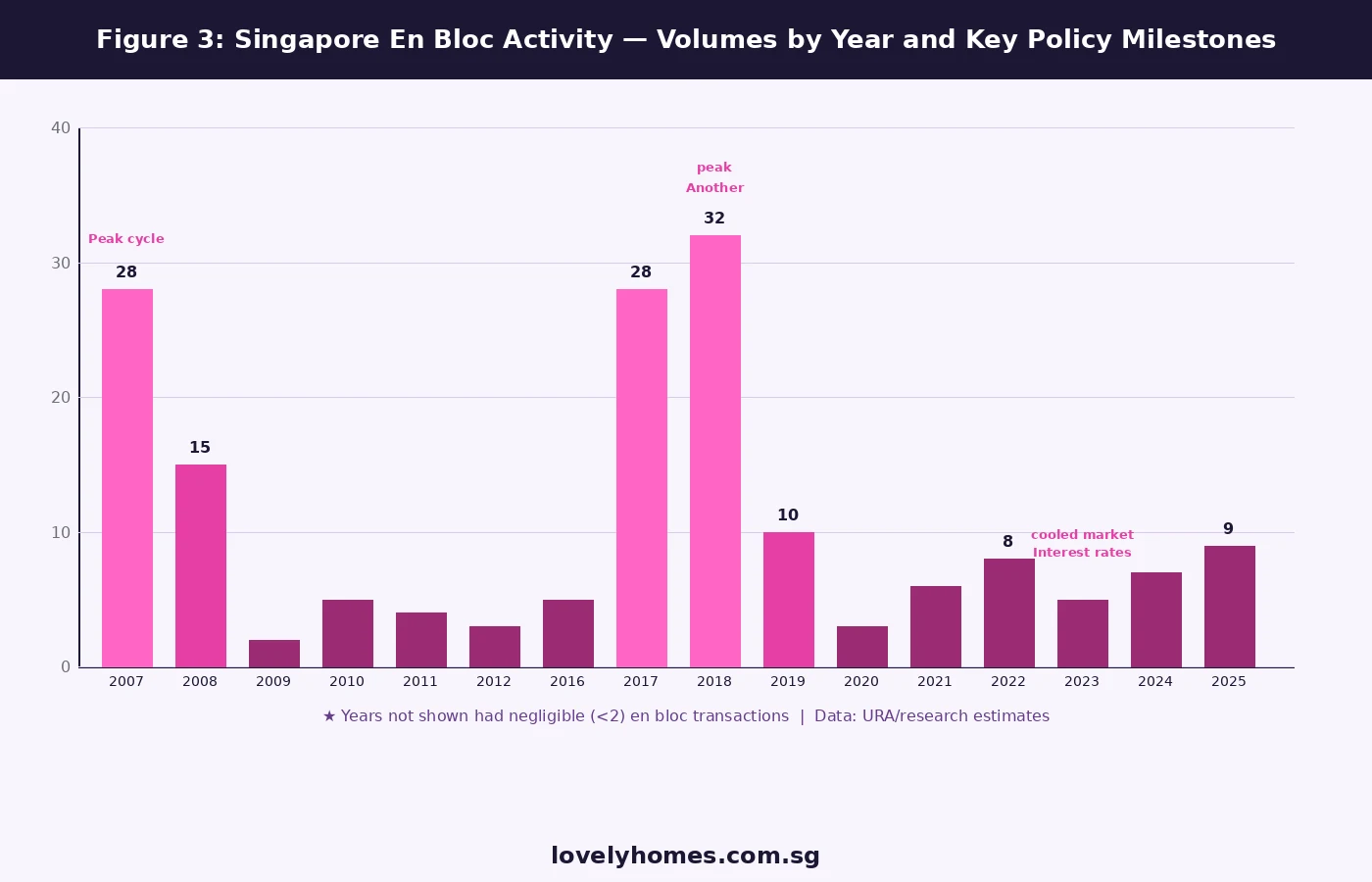
Singapore en bloc sales historical chart 2005 to 2026 collective sale statistics
Figure 3: Singapore En Bloc Sales by Year, 2005–2026 (Approximate). The 2017–2018 super-cycle was ended abruptly by July 2018 cooling measures, including ABSD hikes for developers.

What Might Come Next: En Bloc Outlook 2026–2027

The en bloc market has been subdued since the 2018 cooling measures imposed an Additional Conveyance Duty (ACD) and higher ABSD on developers who fail to sell units within their prescribed timelines. This has materially reduced developers’ appetite for large land sites, particularly those where redevelopment timelines are uncertain. The 2023 cooling measures (ABSD increases for individuals) further dampened demand for new launches, making developers cautious about bidding up land prices.

However, a number of ageing private developments — particularly those that obtained TOP in the 2005–2010 window — are approaching the point at which residents may revisit collective sale conversations. If new-launch demand firms in 2027 and developer landbanks become depleted, en bloc activity could pick up selectively in suburban and city-fringe locations.

That said, the Government has made clear that stability is a policy priority. Any return to super-cycle conditions of 2017–2018 is unlikely without a meaningful reversal of cooling measures. Owners considering initiating an en bloc should bear in mind that failed CSC attempts — where the 80% threshold is not reached within 12 months — impose a 5-year moratorium before another attempt can be made.

Summary: Key En Bloc Facts at a Glance

Aspect Details
Governing law Land Titles (Strata) Act (LTSA), Chapter 158
Administering body Strata Titles Board (STB), Ministry of Law
Consent threshold (≥ 10 yrs) 80% by share value AND strata floor area
Consent threshold (< 10 yrs) 90% by share value AND strata floor area
Signature collection window 12 months from first signature on CSA
STB application deadline 10 weeks after consent threshold is met
Grounds for minority objection Financial loss, bad faith, or unreasonable disadvantage (LTSA Fifth Schedule)
Failed attempt moratorium 5 years before next CSC formation
Tax on proceeds (individuals) No income tax; no capital gains tax in Singapore
SSD on en bloc disposal Nil if held > 3 years; normal SSD applies if < 3 years
Typical end-to-end duration 18 months to 3 years (formation to completion)

Frequently Asked Questions

Can I refuse to sell my unit in an en bloc?

Once the STB issues a Sale Order, all subsidiary proprietors — including those who did not sign the CSA and those who filed objections at the STB — are bound by the order. Refusal to vacate by the completion date can expose you to legal action by the developer. That said, you have a right to object at the STB hearing on the specific grounds in the LTSA (financial loss or bad faith), and to appeal a Sale Order to the High Court on a point of law within 30 days.

How long does the en bloc process take?

The process varies significantly depending on market conditions, the complexity of the development, and whether minority owners object. In a smooth case — enthusiastic majority, competitive tender, no STB objections — 18 to 24 months from CSC formation to completion is realistic. Where STB hearings or High Court appeals are involved, 3 years or more is common. The 12-month signature window and 10-week STB application deadline create hard boundaries within each phase.

Do I need to pay tax on my en bloc payout?

For individual owner-occupiers, en bloc sale proceeds are generally treated as capital receipts and are not subject to Singapore income tax. Singapore does not have a capital gains tax. However, if you are considered to be trading in properties (e.g., a property developer or frequent seller), IRAS may assess the gain as income. The Seller’s Stamp Duty (SSD) position depends on how long you held the unit: no SSD applies if you owned for more than 3 years from the OTP exercise date. If you held for less than 3 years, SSD of 4–12% applies. Always consult a tax adviser for your specific situation.

What happens to my outstanding mortgage at completion?

Your outstanding mortgage is discharged at completion using a portion of your en bloc payout. The sale proceeds first flow into a solicitors’ account, from which the mortgage financier is paid the outstanding loan balance. Similarly, any CPF funds withdrawn for the property (plus accrued interest at 2.5% per annum) must be refunded to your CPF Ordinary Account before the balance is paid out to you. The net cash you receive is therefore your payout minus these obligations.

Can I be part of the Collective Sale Committee?

Yes — any subsidiary proprietor (i.e., a registered owner of a unit in the development) is eligible to stand for election to the CSC at the EOGM. The CSC may have up to 14 members. CSC members owe fiduciary duties to all subsidiary proprietors, not just the consenting majority. They must avoid conflicts of interest and disclose any relationship with a potential purchaser. Serving on the CSC can be time-consuming, particularly during negotiations and the STB process.

What is the “5-year moratorium” for en bloc?

If a CSC is constituted but fails to obtain the requisite 80% or 90% consent within the 12-month signature window, the development is subject to a 5-year moratorium: a new CSC cannot be formed for 5 years from the date the previous attempt lapsed. This provision was introduced to prevent repeated disruptive en bloc campaigns in the same development. The moratorium applies to the development, not to individual units, so there is no way around it by transferring ownership.

How do I know if my development is a potential en bloc candidate?

Key indicators include: (a) the development is at least 10 years old and sits on land zoned for higher density under the URA Master Plan; (b) the redevelopment potential — i.e., the additional gross floor area the site could yield — is meaningfully larger than the existing built area; (c) the indicative land price per square foot per plot ratio (psf ppr) is attractive relative to current market benchmarks; and (d) there is broad informal sentiment among owners. Property consultants with a collective sale specialisation can provide indicative valuations to help owners assess feasibility before committing to a CSC formation process.

Related Articles

Disclaimer

This article is for general information only and does not constitute legal, tax, or financial advice. En bloc law is technical and fact-specific; the LTSA, STB practice directions, and IRAS administrative guidance evolve over time. Always verify current rules with the Ministry of Law, the Inland Revenue Authority of Singapore (IRAS), and a qualified Singapore lawyer before making any decision in connection with a collective sale. LovelyHomes is not a licensed property agent or legal practice.

En Bloc Sale Singapore 2026: Complete Guide to Collective Sales, 80% Consent and Owner Rights

En Bloc Sale Singapore 2026: Complete Guide to Collective Sales, 80% Consent and Owner Rights

En bloc sale Singapore 2026 complete guide — LTSA process, 80% consent and owner rights
Figure 0: En Bloc Sale Singapore 2026 — Complete Guide to the Collective Sale Process, Consent Thresholds and Owner Rights

Quick Answer — En Bloc Sale at a Glance

  • An en bloc sale (also called a collective sale) occurs when the majority of owners in a strata development agree to sell the entire development to a developer, who typically demolishes it and rebuilds.
  • The governing legislation is the Land Titles (Strata) Act (LTSA), administered by the Strata Titles Board (STB) under the Ministry of Law.
  • Consent threshold: 80% (by strata area and share value) for buildings aged 10 years or more; 90% for buildings aged under 10 years.
  • Owners who dissent but are in the minority can be overruled by the STB once the threshold is met, provided the sale is not prejudicial to the minority and the transaction is bona fide.
  • Typical en bloc payout: anywhere from S$800,000 to S$5M+ per unit, depending on development size, location, and land value.
  • The process typically takes 12–24 months from the formation of a Sales Committee to sale completion.
  • En bloc activity in Singapore is cyclical, spiking during low-interest-rate, high-land-demand periods (2007 and 2017–18 being recent peaks).

What Is an En Bloc Sale in Singapore?

An en bloc sale — from the French en bloc, meaning “as a whole” — is a collective sale of all the individual strata-title units in a development to a single buyer, usually a property developer. Rather than selling your individual unit separately, all (or most) owners sell their units together as one package, typically because the combined land value exceeds what individual unit sales could achieve.

In Singapore, en bloc sales are governed by Part VA of the Land Titles (Strata) Act (Cap. 158) (LTSA), which was amended in 2007 to introduce the current safeguards and procedures. The Strata Titles Board (STB), a quasi-judicial tribunal under the Ministry of Law, plays the key role of approving contested collective sales where a minority of owners object.

En bloc sales tend to occur when: the development is ageing and maintenance costs are rising; the plot ratio on the site has not been fully maximised and a developer can build more units; or land prices in the area have risen sufficiently that developers will pay a premium above individual unit values to unlock the redevelopment potential. In most cases, successful en bloc owners receive well above the prevailing open-market price for their unit — but they must also vacate and find replacement housing, which comes with its own costs and complexities.

En bloc sale process timeline Singapore 2026 — 9 stages from sales committee to completion
Figure 1: Singapore En Bloc Sale Process — 9 Key Stages under LTSA. Typical timeline: 12–24 months. Source: Ministry of Law / STB Singapore.

The En Bloc Sale Process — Stage by Stage

Stage 1: Formation of the Collective Sale Committee (CSC)

The process begins at a general meeting of the management corporation (MC) of the development, where owners vote to form a Collective Sale Committee (CSC) — commonly called the Sales Committee (SC). The CSC is elected by the owners and is responsible for managing the entire en bloc process on behalf of the consenting majority. The CSC must act in the best interests of all owners, not just those who support the sale.

Importantly, since the 2007 LTSA amendments, the formation of the CSC requires no minimum consent — any owner can propose it at an AGM or EOGM, and a simple majority vote (by share value) elects the CSC members. The 80% or 90% consent threshold comes later, when owners sign the Collective Sale Agreement (CSA).

Stage 2: Appointing Professionals

Once constituted, the CSC appoints three sets of professionals: a property valuer (to establish the reserve price and independent appraisal); a marketing agent (a licensed estate agent firm to run the public tender); and a law firm specialising in collective sales (to draft the CSA, manage STB filings, and handle the legal completion). All these appointments must be made by public tender among the professionals — the CSC cannot simply nominate a preferred firm without a competitive process.

Stage 3: Collecting Signatures — The 80%/90% Threshold

This is the pivotal stage. Owners are invited to sign the Collective Sale Agreement (CSA), which sets out the reserve price, the apportionment method, and the conditions of sale. The CSC must collect signatures from owners representing:

  • At least 80% of the total share value AND at least 80% of the total strata area — for developments aged 10 years or more.
  • At least 90% of the total share value AND at least 90% of the total strata area — for developments under 10 years old.

Both conditions must be met simultaneously. If a development has very large penthouses or commercial units with high strata areas, their owners’ signatures carry significant weight in the area test, even if their share values are proportionally lower. This dual-test structure was deliberately designed to protect both large-unit owners and those with high share values.

The signature collection exercise must be completed within 12 months from the date the first owner signs the CSA. If the threshold is not achieved within 12 months, the CSA lapses and the process must restart from scratch.

Stages 4–6: STB Lodgement, Tender and (if needed) Hearing

Once the threshold is met, the CSC lodges the CSA with the STB and simultaneously launches the public tender. If all owners (including dissenters) ultimately agree, the STB approves the sale by order on consent — a relatively quick administrative process. If there are dissenting minority owners who refuse to agree, the STB holds a hearing to determine whether the sale should be approved. The STB will approve the sale if it is satisfied that: (a) the sale is in good faith, (b) the transaction is at arm’s length, and (c) the sale is not prejudicial to the interests of the minority owners.

En bloc consent thresholds and owner payout formula Singapore 2026 — 80% and 90% rules LTSA
Figure 2: En Bloc Consent Thresholds and Payout Formula (LTSA 2026). The dual test (strata area AND share value) means large-unit owners and high-share owners both have meaningful leverage. Source: Ministry of Law / STB Singapore.

How Much Will Each Owner Receive?

The total sale price is distributed to individual owners according to a formula set out in the CSA. Two common methods are used, and the CSA must specify which applies:

  1. Share value method: Your payout = Total sale price × (Your share value ÷ Total share value of the entire development). This method tends to benefit owners of units with higher share values (typically larger or higher-floor units).
  2. Strata area method: Your payout = Total sale price × (Your strata area ÷ Total strata area). This method benefits owners of larger units by floor space.

In practice, many developments use a combination formula that blends both methods to produce a result acceptable to the majority. The valuer advises on the apportionment, and the CSC negotiates with owners to achieve sign-on. Some CSAs also incorporate a “premium” for ground-floor units or units with additional features.

Individual payouts vary enormously. In central Singapore, successful en bloc sales of small freehold developments have produced payouts of S$2M–S$5M+ per unit. In suburban or leasehold developments, payouts are typically S$800K–S$1.5M. The key driver is the land rate the developer is willing to pay for the site — which itself depends on the Gross Floor Area (GFA) the developer can build, the development charge payable to URA, and the estimated selling price of the new project.

Key Facts: What Makes a Development En Bloc Ready?

Factor What It Means Impact
Age of development Older = lower consent threshold (80% vs 90%) Easier to achieve consensus
Plot ratio Under-utilised plot = more GFA for developer Higher land price bid; higher per-unit payout
Tenure (freehold vs 99-year) Freehold land commands a premium Higher payout for freehold en bloc
Number of units Smaller number of units = fewer signatures needed Easier to reach 80% threshold
Homogeneity of unit sizes Similar units = smaller spread in payout Easier to get all owners to agree
Location and URA masterplan Upzoning potential increases developer appetite Key demand driver for developer bids
Interest rate environment Low rates reduce developers’ cost of capital En bloc cycles coincide with low rate periods

Singapore en bloc sale activity by year 2007 to 2025 — historical volumes chart
Figure 3: Singapore En Bloc Sale Activity — Estimated Transactions by Year. Activity peaked in 2007 and again in 2017–2018, both periods of low interest rates and high developer demand. Sources: URA / research estimates.

Worked Example: The Greenview Court En Bloc

Development Profile

Greenview Court is a fictional illustration. Actual en bloc outcomes will vary.

Development Greenview Court (hypothetical) — freehold, 28 units, built 2001
Location River Valley, Singapore (CCR) — URA zoning: Residential, 2.8 plot ratio
Age at time of en bloc launch 24 years → 80% consent threshold applies
Total reserve price S$168,000,000
Your unit 2BR, 850 sqft, share value 10/280 of total
Your en bloc payout S$168M × (10/280) = S$6,000,000
Estimated open market value of your unit S$4,500,000 (individual sale)
En bloc premium over individual sale S$1,500,000 (33% premium)

Costs to factor in after receipt of proceeds: CPF refund (principal + accrued interest), outstanding mortgage repayment, legal fees (~S$3,000–S$8,000), and the cost of temporary accommodation while you find a replacement home. The net windfall is generally still significant — but always model cash flows before assuming you can immediately afford a replacement at the same tenure and size.

Rights of Dissenting Minority Owners

Owners who do not wish to sell and who are in the minority have several avenues available to them. They may object to the STB on grounds set out in the LTSA, including: the transaction is not in good faith (e.g. the reserve price is too low or there are undisclosed relationships between the CSC and the buyer); they will suffer financial loss (i.e. the payout is less than their replacement cost); or the proceeds of sale are insufficient to enable them to obtain a replacement property of similar quality.

The STB will hear submissions from both the CSC and the dissenting owners. If the STB is satisfied that the sale is proper, it will issue a collective sale order that is binding on all owners, including dissenters. Dissenting owners may appeal to the High Court on points of law but not on factual grounds. In practice, High Court appeals are rare and generally unsuccessful unless there is a genuine procedural irregularity.

Once a collective sale order is issued, all owners — including dissenters — must vacate the development and hand over their units to the purchaser by the completion date. Refusal to vacate can result in court enforcement proceedings.

What an En Bloc Sale Means for Singapore Property Buyers

For buyers of older developments — particularly freehold condominiums in the Core Central Region (CCR) — en bloc potential is both an opportunity and a risk. An en bloc windfall can deliver a premium well above open-market value, making older freehold developments attractive investments for buyers who are patient and comfortable with the uncertainty. On the other hand, a successful en bloc means you are forced to sell and relocate — which may not suit occupiers who value stability, especially families with children in nearby schools.

From a market perspective, en bloc sales supply developers with land for new projects — replenishing the pipeline of new launches. The URA Q2 2026 Flash Estimates showed the CCR recovering (+2.0% QoQ), partly driven by anticipation of new launches that will replace older en bloc sites. Monitoring URA’s Master Plan and plot ratio changes helps identify which neighbourhoods are most likely candidates for the next en bloc cycle.

If you are currently in a development that is being discussed for en bloc, it is worth engaging a property lawyer early — even before the signature collection exercise begins. Understanding your rights, the valuation methodology, and the likely payout range will help you make an informed decision about whether to support or resist the collective sale. See our Singapore Property Seller Guide 2026 for broader context on your options when selling.

Frequently Asked Questions — En Bloc Sale Singapore 2026

Q1. Can I refuse to sell even if 80% of owners agree?

You can object, but once the 80% (or 90%) threshold is met and the STB issues a collective sale order, you are legally bound by it and must sell. Your remedy is to object before the STB on limited grounds (principally, financial loss or bad faith). The order, once granted, is enforceable against all owners including dissenters. The Singapore Court of Appeal has upheld this framework as constitutional.

Q2. Do I have to pay ABSD or SSD on an en bloc payout?

No. The Seller’s Stamp Duty (SSD) does not apply to en bloc sales — SSD applies only to residential property resales by individual sellers, not to collective sales under the LTSA. Similarly, the en bloc sale itself does not trigger ABSD (ABSD applies to buyers, not sellers). You may, however, trigger ABSD if you buy a replacement property and already own other residential properties at the time of that new purchase — consult our ABSD Guide 2026 for details.

Q3. What happens to my CPF after an en bloc sale?

Just as with any property sale, the CPF principal you withdrew plus the accrued interest (at 2.5% p.a.) must be refunded to your CPF Ordinary Account (OA). The refund comes from the sale proceeds before any net cash is paid to you. If the en bloc payout exceeds your outstanding loan and CPF refund obligations, you receive the balance in cash. For a detailed explanation of how CPF refunds work on property sales, see our CPF for Property Guide 2026.

Q4. How long does an en bloc sale take?

A typical en bloc sale takes 12–24 months from the formation of the Collective Sale Committee (CSC) to legal completion. The signature collection exercise alone can take 6–12 months. If the STB process is contested, add another 3–6 months for hearings. Legal completion after a sale agreement typically takes 6–9 months (including any High Court delay). Some en blocs have taken up to 3 years for complex developments with significant dissenting minorities.

Q5. Can HDB flats be sold en bloc?

Not in the conventional sense. HDB flats are public housing and cannot be collectively sold to a private developer under the LTSA — HDB retains the freehold title on all HDB land. However, HDB administers its own Selective En-bloc Redevelopment Scheme (SERS), under which HDB selects old precincts for redevelopment and offers affected residents replacement flats at a subsidised price, plus compensation. SERS is a government-initiated exercise, not owner-initiated, and the rules governing compensation and replacement flat eligibility are entirely separate from LTSA collective sales.

Q6. Is now (mid-2026) a good time for an en bloc?

En bloc activity in 2024–2026 has been below the 2017–2018 peak, primarily because elevated interest rates globally raised developers’ cost of capital and reduced their appetite for large land acquisitions. As at mid-2026, interest rates have started to ease, and developer sentiment has improved slightly — particularly in the CCR, which saw a +2.0% price increase in Q2 2026. However, this is speculative commentary, not advice. Individual development decisions depend on the specific site, its plot ratio, lease term, and the willingness of your specific neighbour cohort to agree. Any indication that the market is “ready” is a general observation, not a guarantee of a successful en bloc for any particular development.

Q7. What is the difference between an en bloc sale and a private treaty sale?

A public tender is the most common route for en bloc sales — the property is publicly advertised and developers submit sealed bids. A private treaty sale is a negotiated sale directly with a single buyer, without a public process. The LTSA allows private treaty, but it is less common as the CSC has a fiduciary duty to maximise value for all owners, and a competitive tender is the most defensible way to demonstrate that the reserve price is fair. A private treaty requires all the same STB approvals if there are dissenting owners.

Related Articles

Disclaimer: This article is for general educational purposes only. En bloc sale law in Singapore is technical and fact-specific. Individual outcomes depend on the precise terms of the Collective Sale Agreement, the development’s profile, market conditions, and the STB’s assessment. Always engage a qualified property lawyer and a licensed valuer before making any decision about a collective sale. Official guidance is available from the Ministry of Law, the Urban Redevelopment Authority (URA), and the Strata Titles Board. This article does not constitute legal or financial advice.

×

Click anywhere outside to close

Translate »