Last updated: 17 May 2026 | Authority: HDB, IRAS
Quick Answer: Can I Rent Out My HDB Flat?
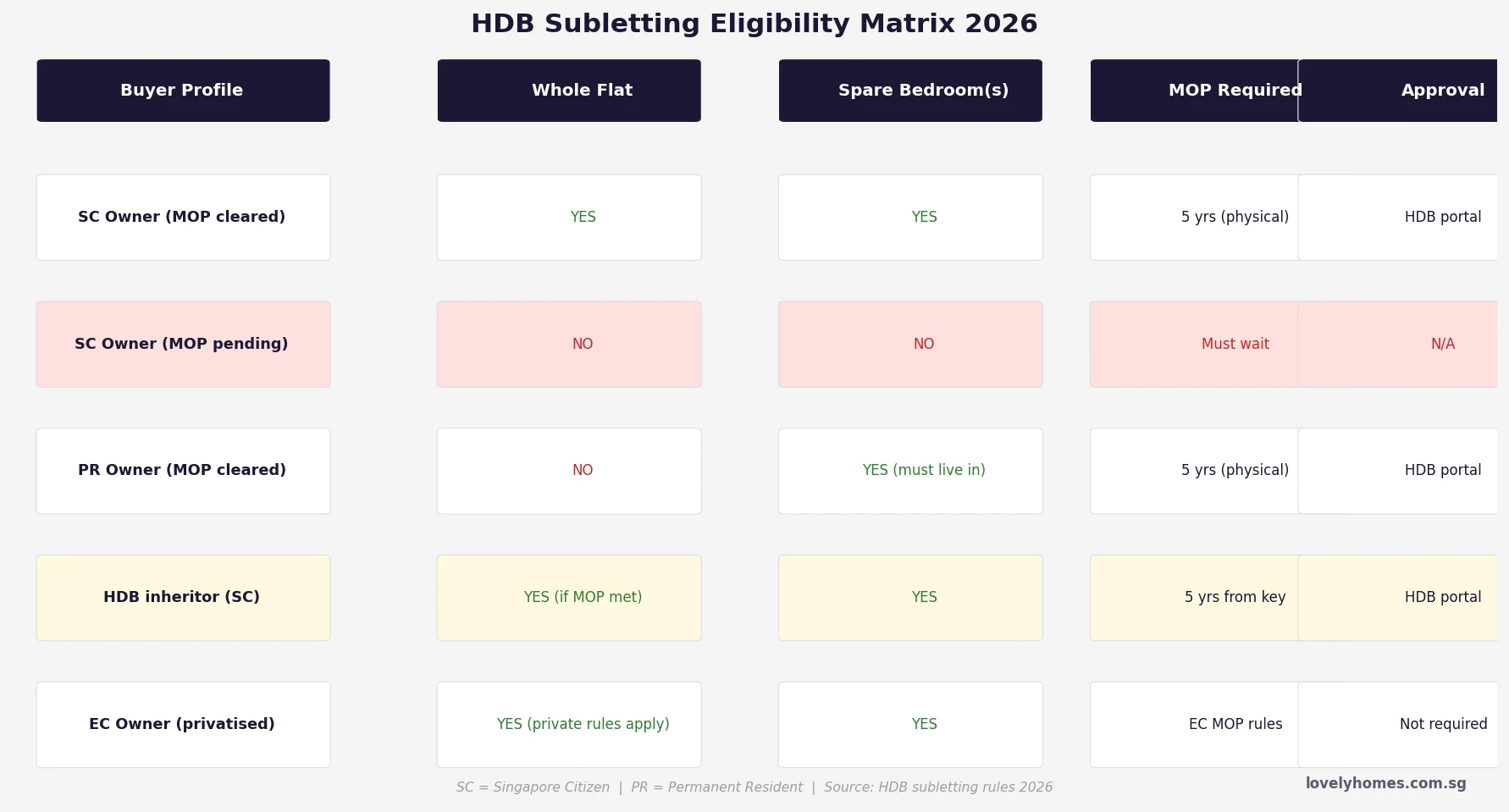
- Singapore Citizens (SC) can sublet the whole flat or individual bedrooms after meeting the 5-year Minimum Occupation Period (MOP), with HDB approval.
- Permanent Residents (PR) can only rent out spare bedrooms , not the entire flat , and must continue living in the flat.
- You must physically occupy the flat for at least 5 years from key collection before subletting; overseas postings do not pause the clock.
- Minimum rental period: 6 months per tenancy. Short-term lettings (Airbnb-style) are strictly prohibited and can result in flat acquisition.
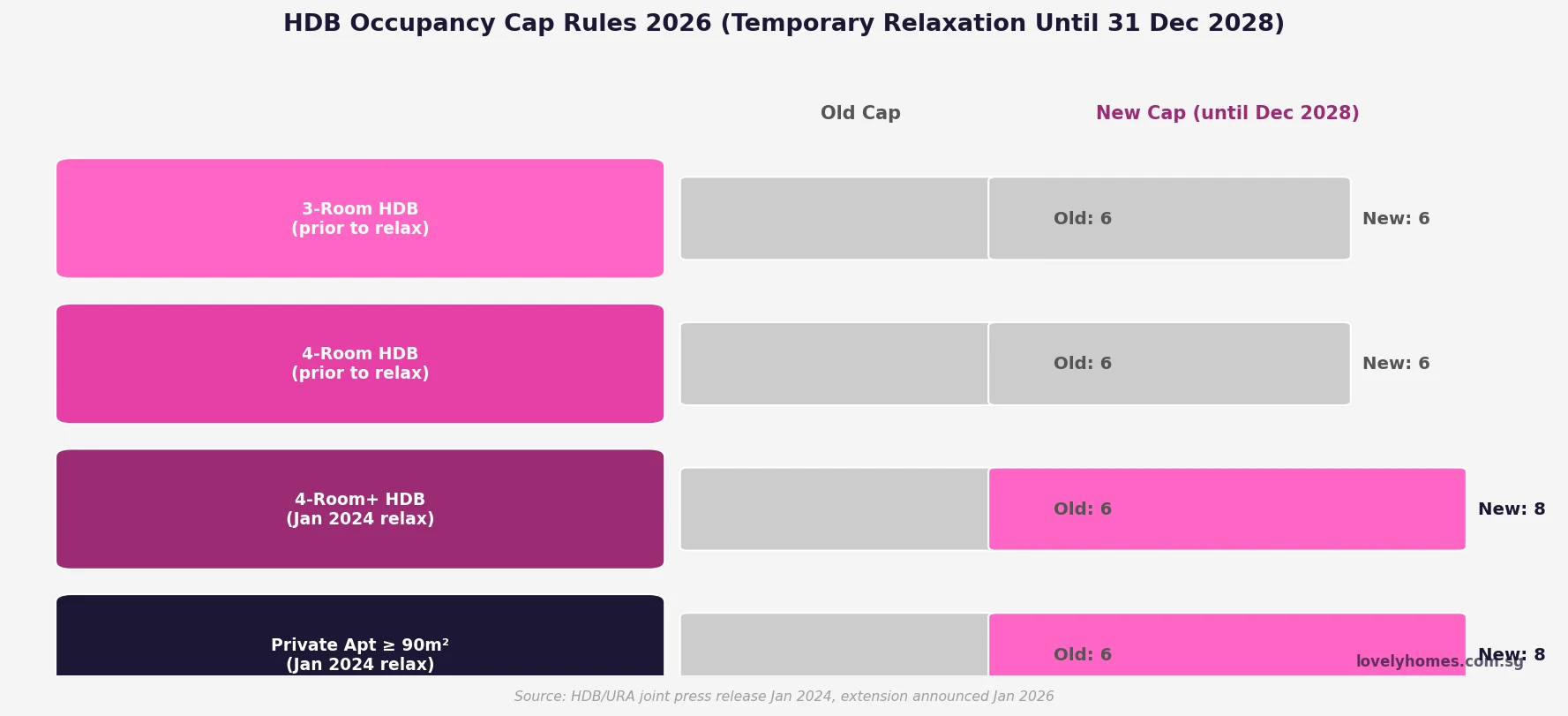
- The occupancy cap has been temporarily raised: 4-room flats and larger may now accommodate 8 unrelated persons (up from 6) until 31 December 2028, under a joint HDB/URA directive.
- All rental income must be declared to IRAS annually. You may deduct actual allowable expenses or elect the 15% deemed deduction , actual expenses typically save more.
- Penalties for subletting without HDB approval: fine up to S$5,000 for a first offence; compulsory flat acquisition for repeat or serious offences.
- Always register the tenancy with HDB within 7 days of the start of the lease.
What Is HDB Subletting?
Subletting , or renting out , your HDB flat or its spare bedrooms is permitted under the Housing and Development Act (Cap. 129) and is administered by the Housing and Development Board (HDB). It allows eligible flat owners to generate rental income while providing accommodation to tenants who cannot or prefer not to buy their own home. As at Q1 2026, approximately 58,600 HDB flats are being rented out in Singapore’s private rental market, with HDB subletting constituting an important segment of the broader rental ecosystem. HDB rental data is monitored by URA and published quarterly as part of Singapore’s official rental market statistics.
Eligibility: Who Can Sublet and What
HDB’s subletting rules distinguish sharply between Singapore Citizens and Permanent Residents, and between subletting a whole flat versus individual bedrooms.
Whole Flat Subletting , Singapore Citizens Only
Only SC flat owners may sublet the entire flat (i.e., move out and rent the property to tenants). The owner and his/her household members are not required to remain in the flat during the subletting period. Conditions:
- MOP met: 5 years of physical occupation from the date of key collection, calculated on the basis of the flat’s registration period at HDB. Importantly, if the owner relocates overseas for work, the overseas period does not count towards the MOP , the clock pauses.
- Only 3-room flats or larger may be sublet. 1-room and 2-room Flexi flats cannot be sublet as whole units.
- Owner must not own other residential property in Singapore concurrently, unless HDB grants prior approval (typically for medical or employment reasons).
- Tenants must be eligible: Singapore Citizens, PRs, and certain non-citizen pass holders (Employment Pass, S-Pass, Dependent Pass, Long-Term Visit Pass) are accepted. Tourists are not.
Bedroom Subletting , SC and PR Owners
Both SC and PR owners may sublet spare bedrooms in a 3-room or larger flat, provided the owner (and their household members) continue to reside in the flat. This is sometimes called the “stay-in landlord” model. Only spare bedrooms may be rented , the HDB does not allow the sublet of common spaces (living room, dining room, kitchen) as standalone tenancies.
The 5-Year MOP Requirement , A Critical Threshold
The Minimum Occupation Period (MOP) is the most common eligibility barrier for would-be HDB landlords. It is administered by HDB under the Housing and Development Act and applies to all HDB flat types, including flats purchased via the Build-To-Order (BTO) scheme, the Sale of Balance Flats (SBF) exercise, and the open market resale market.
The MOP clock starts from the date the flat’s keys are collected, not from the date of legal completion or the date the purchase price was paid. For BTO flats, this means the MOP begins when the owner takes physical possession of the flat after construction is completed , sometimes 3–5 years after the application. The 5-year MOP must be met in full before a subletting application can be submitted.
For HDB Plus and Prime classification flats (introduced under the new 2024 HDB flat classification framework), the MOP is extended to 10 years, and additional restrictions apply, including a clawback subsidy on resale. Owners of Plus/Prime flats must therefore wait a full 10 years from key collection before subletting.
Occupancy Cap: How Many Tenants Can I Have?
HDB has long imposed a cap on the total number of occupants in a rented flat to prevent overcrowding. Under a joint press release issued by HDB and URA on 20 December 2023, and subsequently extended in January 2026 to run until 31 December 2028, a temporary relaxation is in force:
| Flat Type | Standard Cap | Relaxed Cap (until 31 Dec 2028) | Notes |
|---|---|---|---|
| 1-Room / 2-Room Flexi | 4 | 4 (no change) | Cannot be sublet as whole unit |
| 3-Room HDB | 6 | 6 (no change) | Relaxation applies to 4-room+ only |
| 4-Room HDB and larger | 6 | 8 | Temporary relaxation; extended to Dec 2028 |
| Private apt ≥ 90 m² | 6 | 8 | URA parallel relaxation |
The relaxation was introduced to help meet demand from Singapore’s growing foreign workforce during a period of constrained housing supply. The counting of occupants includes all residents in the flat , so an owner who lives in the flat with their family of four and rents out two spare bedrooms must ensure that the combined headcount of family members plus tenants does not exceed the applicable cap.
How to Apply for HDB Subletting Approval
HDB has moved entirely to an online approval process via its My HDBPage portal at hdb.gov.sg. The process, administered by HDB’s Resale and Rental Policy Division, typically takes 7–14 working days for approval:
- Confirm MOP status , log in to My HDBPage and verify that the flat’s MOP has been met.
- Submit subletting application , provide details of the proposed tenancy: start date, number of tenants, nationality of each tenant, and proposed rental amount.
- Await HDB approval , do NOT allow tenants to move in before written approval is received. Early occupation is treated as unauthorised subletting.
- Register tenant(s) , once approved, register the tenancy on My HDBPage within 7 days of the tenancy start date.
- Renewal , subletting approvals are granted for a fixed period (maximum 3 years at a time). Renewals must be applied for before expiry; you must reconfirm tenant details and the rental amount.
Rental Income Tax: What You Must Declare to IRAS
All HDB rental income , whether from subletting the whole flat or individual rooms , must be declared to the Inland Revenue Authority of Singapore (IRAS) in your annual income tax return (Form B for self-employed; Form B1 for employees). This obligation applies regardless of the amount received; even a single room rented out at S$500/month represents S$6,000 of annual taxable income if no deductions are claimed.
Two Deduction Paths
IRAS allows flat owners to reduce their taxable rental income by choosing one of two approaches:
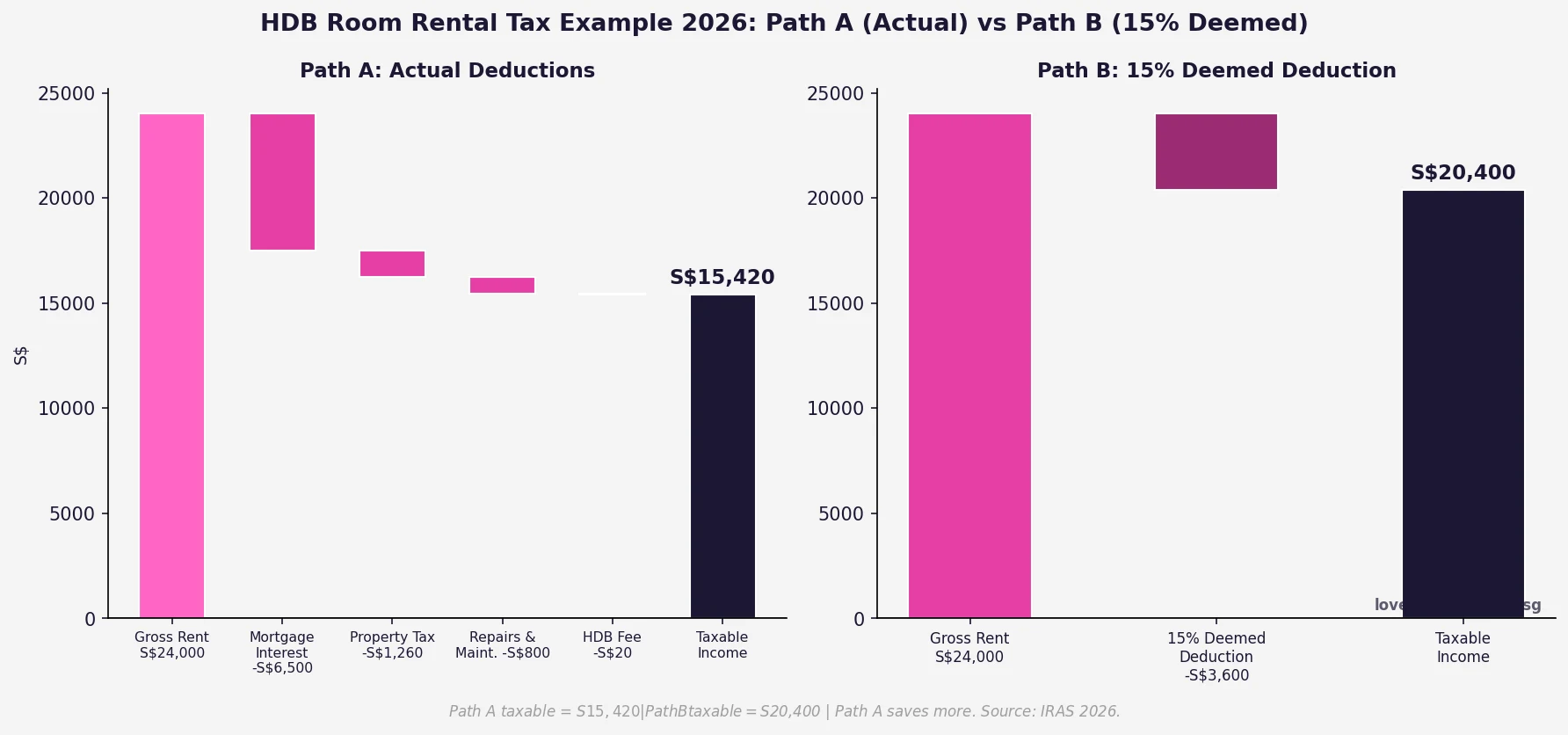
- Path A , Actual Deductions: Deduct your actual allowable expenses, which include: mortgage interest (the interest component of your bank loan instalment); property tax on the flat; costs of maintenance and repair; and the annual HDB subletting administration fee (S$20). You may not deduct principal repayment, renovation costs, furniture, or appliances.
- Path B , 15% Deemed Deduction: Simply deduct 15% of your gross rental income as a flat rate to cover all expenses. This is simpler but almost always results in a higher taxable income than Path A for landlords with a mortgage.
Worked Example: Rental Tax Calculation
Worked Example , Mdm Tan, 52, SC, renting out 2 spare bedrooms in her Tampines 5-room HDB
Gross annual rent received: S$24,000 (two rooms at S$1,000/month each).
Mdm Tan’s mortgage interest component (on her outstanding bank loan): S$6,500/yr.
Property tax (non-owner-occupier rate not applicable since she still lives in flat): S$1,260/yr.
Repair and maintenance: S$800/yr. HDB fee: S$20.
Path A (Actual): S$24,000 − S$6,500 − S$1,260 − S$800 − S$20 = S$15,420 taxable.
Path B (15% Deemed): S$24,000 × 85% = S$20,400 taxable.
Path A is S$4,980 lower in this case and should be elected. At a 7% marginal tax rate, that difference saves approximately S$348 in income tax annually.
Important: Since Mdm Tan continues to live in the flat, she retains her owner-occupier property tax rate (lower rate). She should ensure her tenancy agreement is stamped as “partially let” , not “wholly let” , so that IRAS treats the entire flat at the owner-occupier rate rather than the non-owner-occupier rate.
Penalties for Subletting Without Approval
HDB takes unauthorised subletting seriously. Under the Housing and Development Act, penalties include:
| Offence | Penalty | Notes |
|---|---|---|
| Subletting without HDB approval | Fine up to S$5,000 (first offence) | Court can order eviction of tenants |
| Repeat/serious subletting violations | Compulsory flat acquisition | HDB buys flat at below-market price |
| Short-term letting (Airbnb-style) | Fine up to S$5,000 + possible acquisition | Minimum 6-month tenancy strictly enforced |
| Failure to register tenancy within 7 days | Warning / fine | Administrative penalty; HDB portal tracks this |
What the Rental Market Means for HDB Landlords in 2026
The Singapore private rental market, which encompasses HDB subletted flats, private condos, and landed property, has seen rents ease modestly in 2026 after a record-breaking run in 2022–2023. URA’s non-landed private residential rental index showed a marginal uptick of 0.3% quarter-on-quarter in Q1 2026 , ending a seven-quarter declining streak , with the rental market stabilising as the supply wave of 55,800 pipeline units is absorbed.
For HDB room rentals specifically, demand has remained robust from Singapore’s Employment Pass and S-Pass workforce, particularly in mature estates with MRT access (Tampines, Bedok, Jurong, Bishan). A spare bedroom in a well-located 4-room HDB flat typically commands S$800–S$1,200 per month in 2026, with the upper end driven by proximity to MRT stations on the Downtown Line or Thomson-East Coast Line.
FAQ: HDB Subletting Questions Answered
Can I sublet my HDB flat if I go overseas for work?
Can I rent out my HDB flat short-term on Airbnb?
Do I need to pay tax on HDB rental income?
Can a Permanent Resident sublet their whole HDB flat?
What is the new 8-person occupancy cap and when does it expire?
How do HDB Plus and Prime flat owners sublet under the new flat classification system?
Related Articles
- Singapore Private Rental Market Q1 2026: Rents Ease as Supply Wave Arrives
- HDB Plus and Prime Flat Classification Singapore 2026: What Buyers Need to Know
- Minimum Occupation Period (MOP) Singapore 2026: HDB, EC and Private Property Rules
- Rental Yield Singapore 2026: Complete Guide to Gross, Net and Location-Adjusted Yields
- HDB Resale Flat Eligibility Singapore 2026: Who Can Buy and How to Qualify
- Capital Gains and Rental Income Tax Singapore 2026: How Property Investors Are Taxed
Supporting graphics
Original article illustrations are available below.
- Figure 1: HDB subletting eligibility matrix 2026 , who can sublet what, MOP requirement, and approval pathway. Source: HDB.
- Figure 2: HDB occupancy cap rules 2026 , temporary relaxation from 6 to 8 unrelated persons for 4-room+ flats, effective 22 January 2024 and extended to 31 December 2028. Sources: HDB, URA.
- Figure 3: HDB rental income tax 2026 , comparing Path A (actual deductions) vs Path B (15% deemed deduction) for a landlord receiving S$24,000 gross annual rent. Source: IRAS.