
Quick Answer , Punggol 2026 at a Glance
- HDB 4-Room median resale price: S$700,000 (2026); 5-Room median ~S$840,000; record transaction S$1.47M for a 5-room flat
- EC resale: Rivercove Residences ~S$1.05M–S$1.25M psf basis; Northwave EC ~S$1.0M–S$1.2M psf basis
- Private condo: Watertown and A Treasure Trove resale at ~S$1,150–S$1,500 psf
- Connectivity: North East Line (NEL) Punggol MRT; Punggol LRT East & West loops; Cross Island Line (CRL) Phase 2 planned ~2031
- Investment catalyst: Punggol Digital District , 28,000 jobs in tech, media, and design; JTC, SIT Punggol Campus
- Schools: Waterway Primary, Punggol Primary, North Spring Primary, Punggol Crest Primary, Punggol View Primary
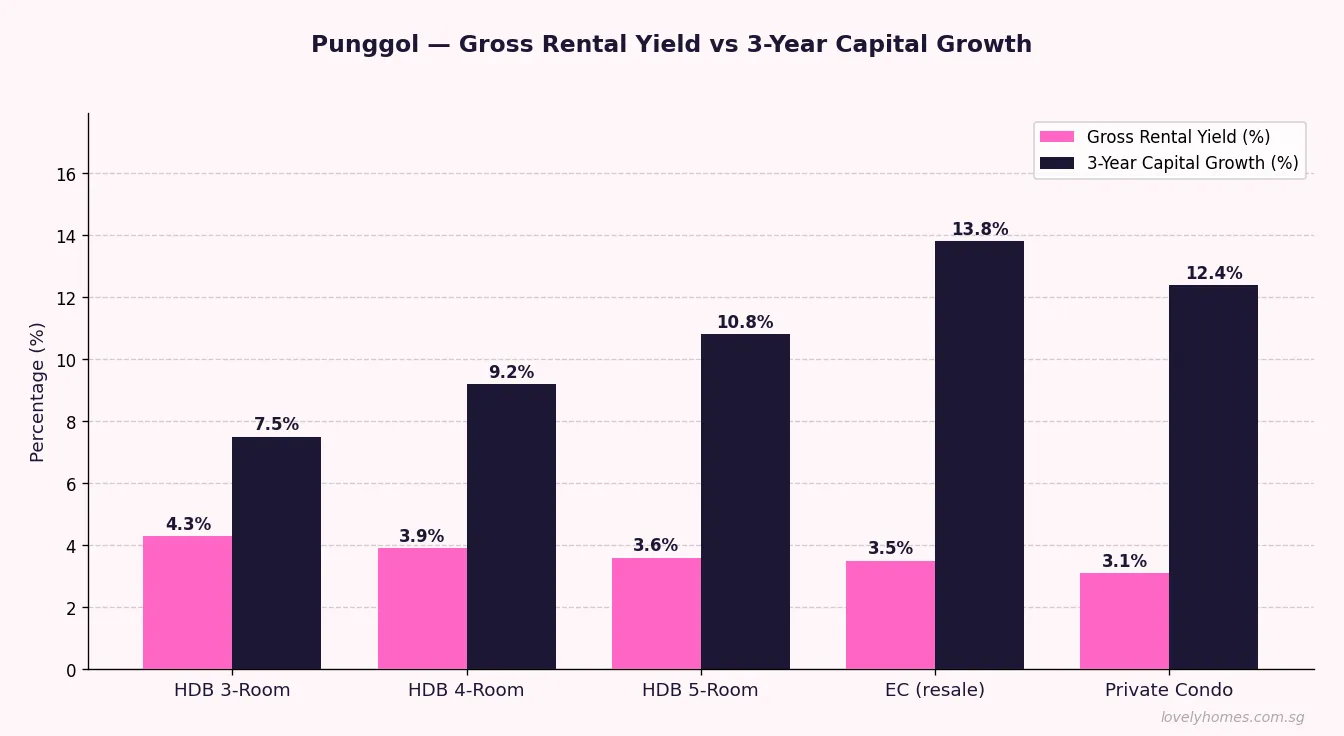
- Gross rental yields: HDB 3.6–4.3%; EC 3.5%; private condo ~3.1%; 3-year EC capital growth ~13.8%
What and Where Is Punggol?
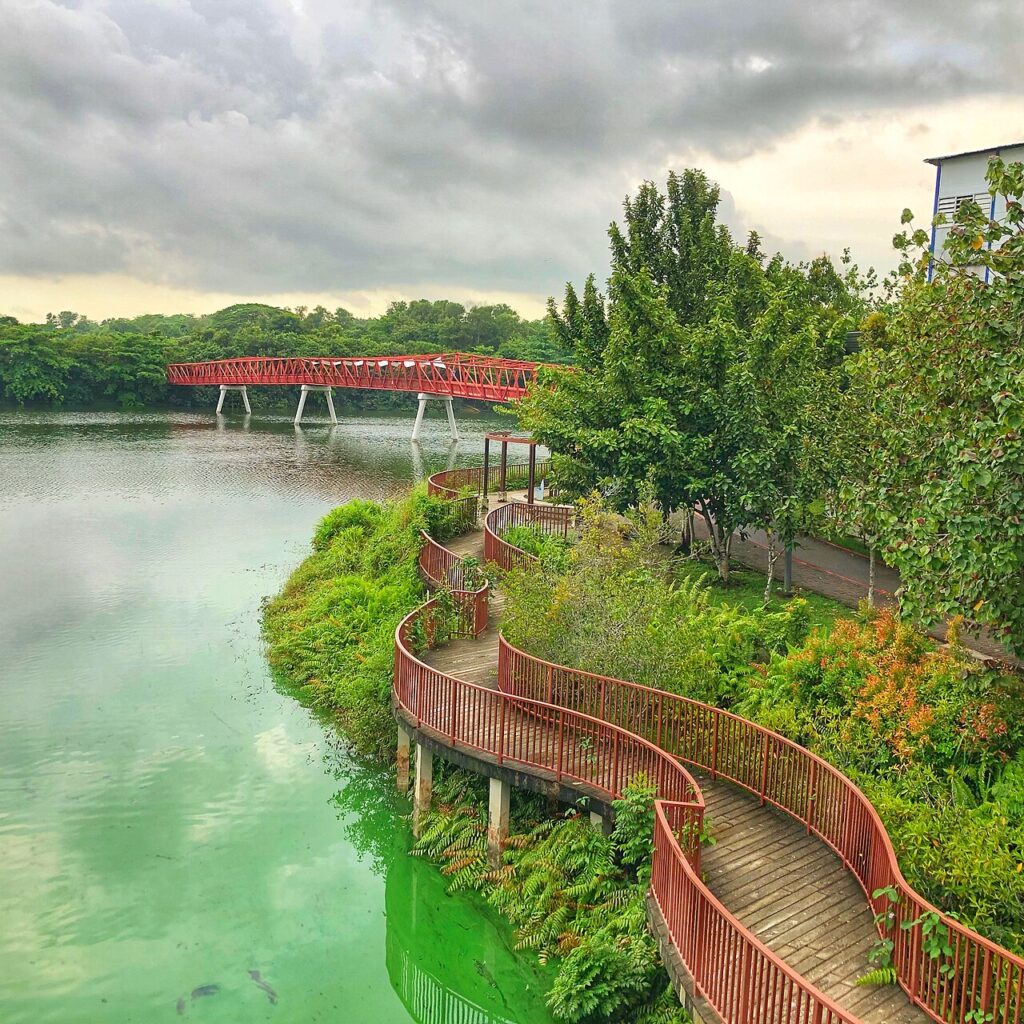
Punggol is one of Singapore’s youngest and most ambitiously planned new towns, located in the northeastern tip of the main island. Designated by the Housing & Development Board (HDB) as the centrepiece of Singapore’s “next generation” estate development under the Punggol 21 and Punggol 21-Plus master plans, the town is built around the 4.2-kilometre Punggol Waterway , an artificial freshwater channel connecting the Punggol and Serangoon rivers and serving as the spine of the town’s lifestyle and recreational offer.
Under the Urban Redevelopment Authority’s (URA) Master Plan, Punggol sits in Planning Area 22 and is divided into four planning precincts: Northshore, Punggol Field, Punggol Town Centre, and Waterway. The town is home to approximately 160,000 residents in about 52,000 HDB flats, with a population expected to grow to 300,000 as development continues through the 2030s.
What sets Punggol apart from other OCR towns is not just its waterway aesthetic but its role as Singapore’s testbed for smart and sustainable living concepts , intelligent waste management systems, sensor-driven municipal infrastructure, and energy-efficient building designs are woven into the town’s fabric. The opening of Punggol Digital District (PDD) in 2024, housing JTC Corporation’s new campus and Singapore Institute of Technology (SIT)’s Punggol Campus, has added an employment dimension to Punggol’s residential identity that most OCR towns lack.
Punggol Property Market Overview 2026
The Punggol HDB resale market has been one of the most active in Singapore’s OCR over the past three years, driven by a combination of the waterway lifestyle premium, the Punggol Digital District employment catalyst, and a steady flow of BTO flats completing their 5-year Minimum Occupation Period (MOP) and entering the resale pool.
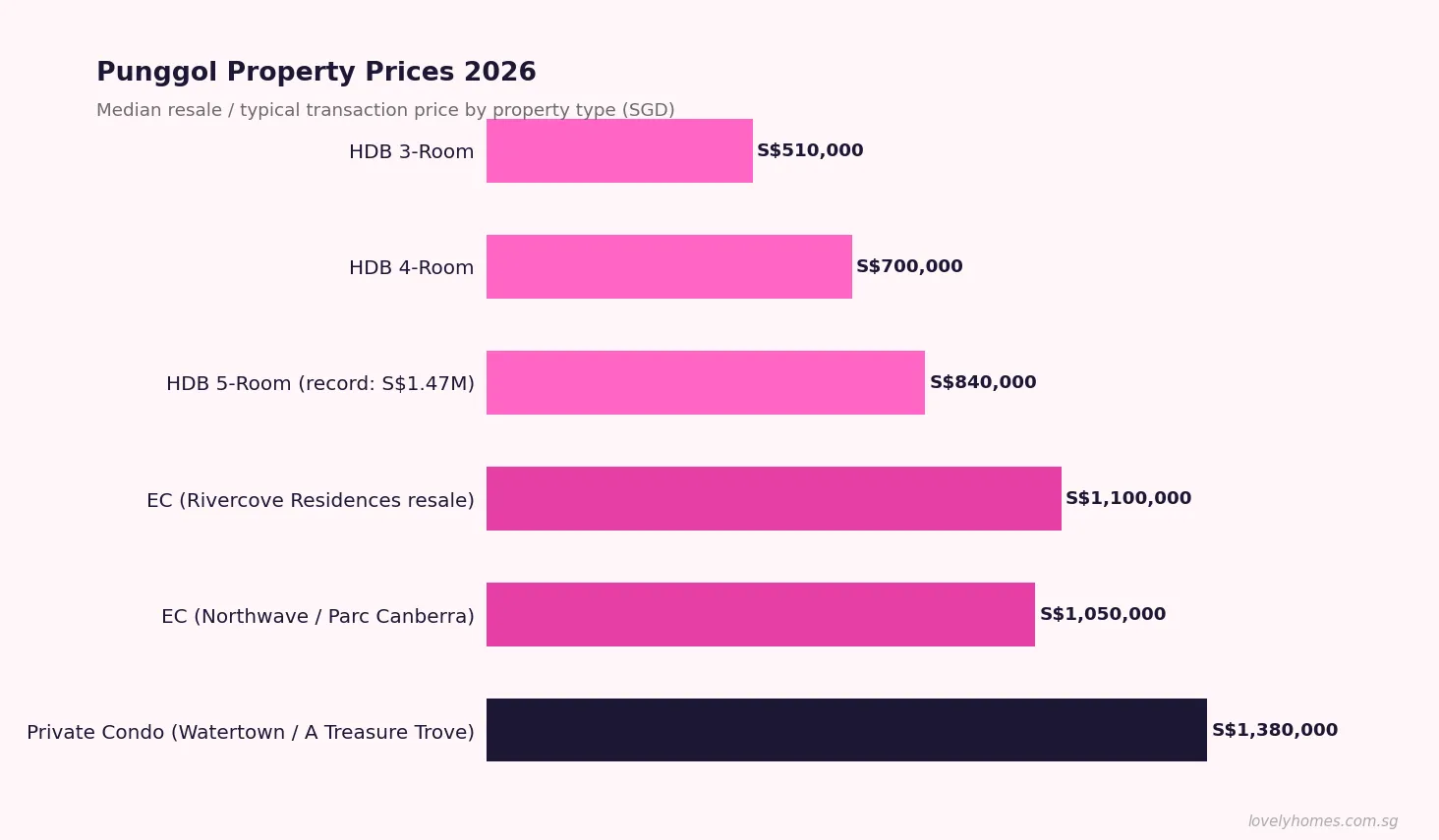
Price trajectory 2026: The median 4-Room HDB resale in Punggol reached S$700,000 in 2026, up from approximately S$540,000 in 2022 , a 3-year appreciation of roughly 30%. Five-room median prices stand at S$840,000. The most remarkable data point for 2026 is the Punggol 5-room record: a unit along Punggol Drive transacted at S$1.47 million (approximately S$929 psf) in early 2026, setting a new HDB record for 5-room flats in the town and signalling the extent of the waterway premium that buyers are willing to pay.
EC resale market: Rivercove Residences (Sengkang Avenue, adjacent to Punggol boundary) and Northwave EC (Woodlands Road) represent the main EC resale supply in the northeast corridor. Post-MOP Rivercove units transact at S$1,050–S$1,250 psf, while Northwave EC commands S$1,000–S$1,200 psf, reflecting its more mature stage of MOP completion. Parc Canberra EC (Sembawang), further from Punggol, provides pricing comparison at S$1,020–S$1,180 psf.
Private condo market: Watertown (Punggol Central, directly above Punggol MRT) commands premium pricing at S$1,250–S$1,500 psf , an integrated retail and residential development that benefits uniquely from the MRT-integrated format. A Treasure Trove (Punggol Walk) transacts at S$1,150–S$1,380 psf as a large-scale 99-year leasehold project. The private condo market in Punggol is constrained by limited supply, which supports pricing but restricts buyer choice.
Punggol Digital District , Singapore’s Largest Employment Catalyst
The Punggol Digital District (PDD) is one of the most significant employment-driven property catalysts in Singapore’s suburban history. Developed by JTC Corporation and announced under the Punggol 21-Plus master plan, the PDD is designed to house 28,000 jobs in the tech, media, creative, and design sectors across approximately 600,000 square metres of gross floor area.
The district hosts JTC Corporation’s new campus and the Singapore Institute of Technology (SIT)’s Punggol Campus, which opened progressively from 2023 to 2024, with a full student and faculty population expected by 2026. SIT’s Punggol Campus offers engineering, applied health sciences, hospitality, and information technology programmes , drawing a population of students and young professionals who rent in the surrounding Punggol HDB estates.
The PDD’s effect on Punggol’s rental market is already visible: rental demand for 2-room and 3-room HDB units within a 15-minute walk of Punggol MRT has strengthened notably since 2024, supporting gross yields of 4.3% for 3-room flats , among the strongest in the OCR for that flat type.
Getting Around , MRT, LRT and Future CRL Phase 2
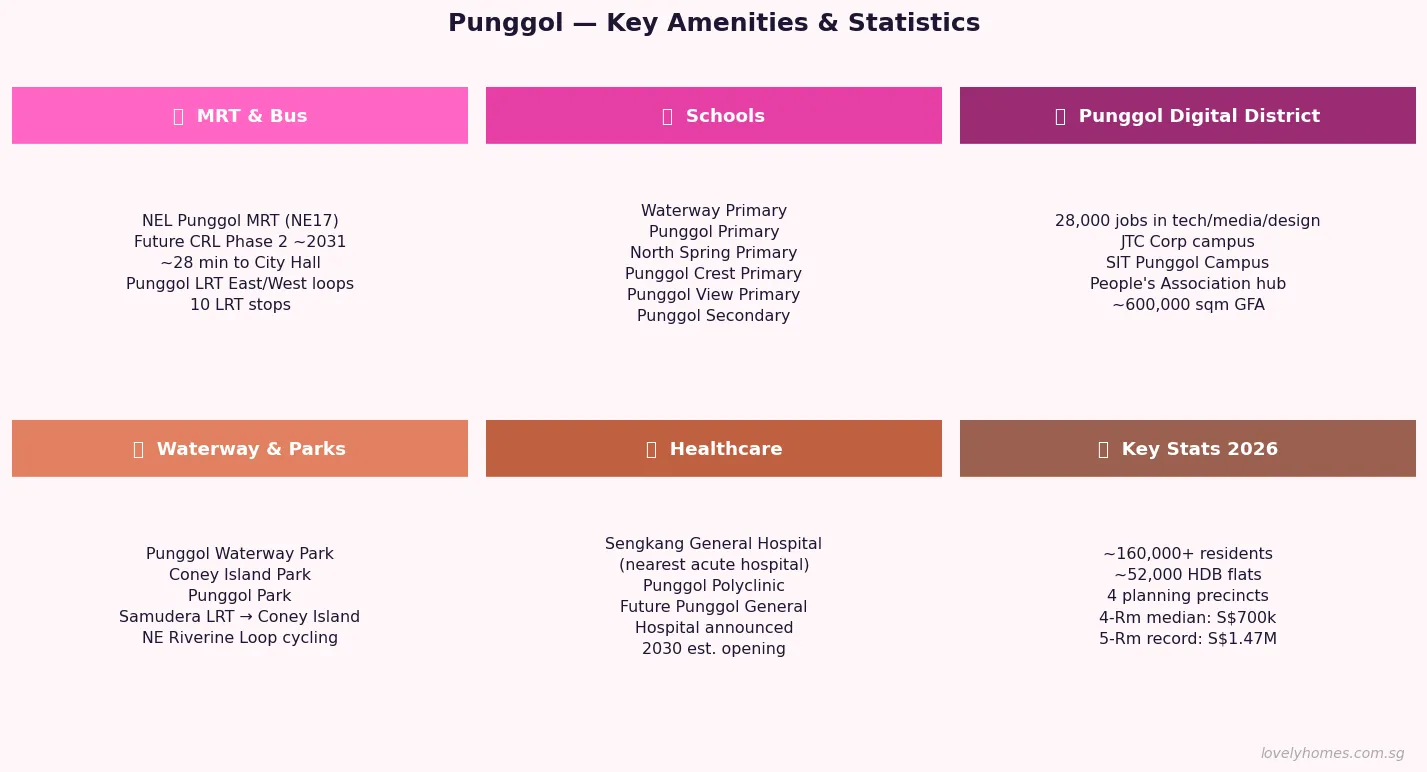
Punggol’s primary rail connection is the North East Line (NEL) Punggol MRT station (NE17), operated by SBS Transit under the Land Transport Authority’s (LTA) regulatory framework. From Punggol MRT, commuters reach Serangoon (NEL/CCL interchange) in 9 minutes, Dhoby Ghaut in 26 minutes, and HarbourFront in 33 minutes. The station is integrated with the Watertown shopping mall podium, offering a seamless retail and transit experience.
The Punggol LRT system mirrors Sengkang’s in structure, with an East Loop and West Loop running 10 stations from the Punggol MRT interchange. East Loop: Damai, Kadalur, Meridian, Coral Edge, Riviera, Layar, Tongkang, Nasi, Sam Kee. West Loop shares the Cove and Meridian stations. The LRT extends connectivity to waterway-adjacent precincts that would otherwise require a longer walk from the MRT.
The most anticipated infrastructure upgrade is Cross Island Line (CRL) Phase 2 (~2031), which will serve Punggol as a terminus station, offering direct cross-island rail access to Jurong Lake District, one-north, and the eastern end of Singapore via a single continuous line. The CRL’s Punggol connection will dramatically reduce commute times to western Singapore , a major competitive disadvantage of northeastern estates today , and is widely expected to support further HDB and private property price appreciation in Punggol from the mid-2020s.
Schools and Education in Punggol
Punggol’s school landscape reflects the town’s relatively young age , many of its primary schools were built in the 2010s to accommodate the rapid population growth from BTO completions. Families in the estate’s earlier precincts (Waterway, Punggol Town Centre) have a wider choice of established schools within the 1-kilometre priority registration radius.
Primary schools: Waterway Primary School (Punggol Waterway), Punggol Primary School (Edgedale Plains), North Spring Primary School (Sengkang, within close proximity), Punggol Crest Primary School, and Punggol View Primary School together cover the estate’s primary school catchment. Demand at these schools in Phase 2B registration rounds reflects the strong family-oriented demographic composition of Punggol.
Secondary and post-secondary: Punggol Secondary School and Greendale Secondary School serve the town. Anderson Serangoon Junior College and Serangoon Garden Secondary are accessible by LRT and bus. The most significant education catalyst is, of course, SIT’s Punggol Campus , which draws tertiary enrolment directly into the district, creating a live-work-learn environment that property investors regard as a long-term demand anchor.
Lifestyle , Waterway, Coney Island and Family Living
Punggol Waterway Park is Punggol’s signature asset , a 2.8-kilometre linear park along the Punggol Waterway offering kayaking pontoons, boardwalks, cycling paths, and F&B pavilions. The waterway connects to Punggol Point Park at the town’s northern tip, where a cluster of seafood restaurants and the Punggol Point Jetty offer a distinctly different urban-meets-nature experience from anywhere else in Singapore’s HDB landscape.
Coney Island Park, accessible via the Samudera LRT station, is a 50-hectare nature reserve and recreational island , one of Singapore’s more unexpected green assets within an HDB estate boundary. The island’s beaches, trails, and wildlife attract weekend visitors from across Singapore, reinforcing Punggol’s lifestyle brand.
Retail is centred on Waterway Point, an integrated shopping mall directly above Punggol MRT with a cinema, supermarket, and extensive F&B. Northshore Plaza I & II in the Northshore precinct provide neighbourhood-scale retail for the newer HDB clusters. The planned commercial component of Punggol Digital District will further expand the estate’s retail and F&B offering as tenancies are filled out through 2026 and beyond.
Punggol HDB Resale , Key Facts Summary
| Property Type | Typical Price Range (S$) | Median 2026 (S$) | Key Notes |
|---|---|---|---|
| HDB 3-Room | 430,000 – 600,000 | 510,000 | Strong rental demand from PDD and SIT students; good yield entry point |
| HDB 4-Room | 560,000 – 950,000 | 700,000 | Most active transaction segment; waterway units command 15–20% premium |
| HDB 5-Room | 680,000 – 1,470,000 | 840,000 | Record S$1.47M (Punggol Drive, Feb 2026); waterway-facing commands exceptional prices |
| EC (Rivercove/Northwave resale) | 900,000 – 1,400,000 | 1,100,000 | Limited supply post-MOP; strong demand from upgraders |
| Private Condo (Watertown) | 1,100,000 – 1,900,000 | 1,380,000 | MRT-integrated; premium for integrated living; thin resale market |
Worked Example , SC Couple Upgrading to Punggol 2026
Mr and Mrs Lim, Singapore Citizens, joint monthly income S$11,500. Selling their Tampines 4-room HDB (MOP cleared) for S$730,000, buying a 4-Room Punggol resale with waterway view at S$880,000 as their second property.
| Purchase price (Punggol 4-Room HDB resale) | S$880,000 |
| Buyer’s Stamp Duty (BSD, administered by IRAS) | S$22,200 |
| ABSD , SC buying 2nd property (administered by IRAS) | S$176,000 (20%) |
| Concurrent ownership note | Must sell Tampines flat within 6 months to claim ABSD remission |
| HDB Loan (80% LTV at 2.6% p.a.) | S$704,000 |
| Down payment (20%) | S$176,000 (CPF OA eligible) |
| Conveyancing and caveat fees | ~S$3,800 |
| Monthly instalment (30-year HDB loan) | S$3,196/month |
| Mortgage Servicing Ratio (MSR, cap ≤ 30%) | 27.8% ✓ |
| Total Debt Servicing Ratio (TDSR, cap ≤ 55%) | 27.8% ✓ |
BSD calculated at IRAS progressive rates: 1% on S$180k + 2% on next S$180k + 3% on balance S$520k = S$22,200. ABSD of 20% applies on the full purchase price as the Lims own an existing HDB flat. Under the SC married-couple ABSD remission, the S$176,000 ABSD may be refunded by IRAS if the Tampines flat is sold within 6 months of purchasing the Punggol flat. MSR capped at 30% of gross monthly income by MAS; TDSR at 55%.
Is Punggol a Good Property Investment in 2026?
Punggol presents one of the most compelling long-term investment narratives in Singapore’s OCR, driven by the convergence of three independent demand drivers: Punggol Digital District employment, CRL Phase 2 connectivity, and the Punggol General Hospital pipeline. Unlike many HDB estates that rely on historical infrastructure and a single MRT line, Punggol’s investment case is forward-looking , its best catalysts are still years away from full realisation.
Yield versus capital growth trade-off: Gross rental yields for Punggol HDB are slightly lower than Sengkang (3.6–4.3% versus 3.9–4.5%) because prices have risen faster than rents. For investors prioritising yield, Sengkang’s more affordable entry points and comparable rental income produce a stronger initial return. For investors prioritising capital growth, Punggol’s combination of PDD employment density, CRL connectivity, and the waterway lifestyle premium makes it the more compelling choice on a 7–10 year horizon.
HDB classification: Punggol BTO flats are classified as Standard under HDB’s 2024 framework, with the exception of units in the Northshore Straits precinct which were designated Plus classification. Buyers should check the classification of specific BTO projects before purchasing, as Plus flats carry a 10-year enhanced MOP and income ceiling at first resale , factors that may affect both exit strategy and buyer pool.
What Might Come Next for Punggol Property?
The following section reflects the editorial analysis and projections of LovelyHomes as at 19 May 2026. It is speculative in nature and should not be construed as financial or investment advice.
The three most important forward catalysts for Punggol property are well-defined but not yet fully priced in. The Cross Island Line Phase 2 (~2031) is the most transformative: a direct rail link to Jurong Lake District , Singapore’s second CBD , would reduce Punggol’s western commute time by 15–20 minutes, materially expanding the estate’s buyer and tenant catchment. Proximity to a CRL station has historically added 10–15% to residential prices in the 2–3 years before opening based on patterns observed at other MRT lines.
The Punggol General Hospital, announced by the Ministry of Health and expected to open around 2030–2032, will join Sengkang General Hospital as a major healthcare employer in the northeast, further anchoring the corridor’s population base and creating white-collar employment demand for nearby housing. Healthcare workers , a stable, income-regular demographic , are consistent tenants and buyers in proximity to their workplace.
Finally, the continued infilling of Punggol Digital District tenancies as technology companies, media firms, and government agencies take up space in the JTC campus buildings will steadily raise the daytime population and supporting retail demand in Punggol. Each additional large employer anchored in PDD adds a cohort of potential renters to the estate’s rental demand base.
Frequently Asked Questions , Punggol Property 2026
Is Punggol a good place to buy property in 2026?
Punggol is widely regarded as one of Singapore’s strongest long-term OCR investment stories, with a forward-looking infrastructure pipeline (CRL Phase 2, PDD employment, Punggol General Hospital) that justifies its current premium over comparable northeast towns. For owner-occupiers, the waterway lifestyle, newer flats, and strong school cluster make it a highly desirable family location. For investors, the capital growth case is stronger than the yield case , buyers seeking the highest immediate rental returns may find better entry in Sengkang or Woodlands, but those with a 7–10 year horizon targeting capital appreciation have strong reasons to consider Punggol.
How much does a Punggol HDB flat cost in 2026?
Punggol HDB resale prices in 2026 range from approximately S$430,000–S$600,000 for a 3-room flat to S$680,000–S$1,470,000 for a 5-room flat, with waterway-facing units commanding a 15–25% premium over non-waterway-facing units. The median 4-room resale price is S$700,000 and the median 5-room is S$840,000. The record transaction for a Punggol HDB flat stands at S$1.47 million for a 5-room unit along Punggol Drive transacted in February 2026. Buyers should verify current transaction data with the HDB Resale Portal (homes.hdb.gov.sg) and URA’s Realis system before finalising their price assessment.
What is Punggol Digital District and how does it affect property values?
Punggol Digital District (PDD) is a 50-hectare, 600,000 sqm GFA employment cluster developed by JTC Corporation, anchored by JTC’s new campus and Singapore Institute of Technology (SIT)’s Punggol Campus. At full build-out, the PDD is expected to house approximately 28,000 workers in technology, media, creative, and design industries. For property investors, the PDD functions as a direct rental-demand generator , drawing SIT students, young professionals, and tech workers who prefer to live close to their workplace. Market data from 2024–2025 already shows above-average rental demand growth for 2-room and 3-room HDB units within 15 minutes’ walk of Punggol MRT, the gateway to PDD.
What is the Cross Island Line and will it add to Punggol property values?
The Cross Island Line (CRL) is Singapore’s eighth MRT line, being built in phases. CRL Phase 2 will extend the line from its current Phase 1 terminus to include a Punggol terminus, offering direct cross-island connectivity to Jurong Lake District, one-north, and the western half of Singapore from the northeast. Phase 2 is targeted for completion around 2031. The CRL will significantly reduce Punggol’s biggest commute disadvantage , limited westward connectivity , and is widely expected by analysts to provide a measurable uplift to Punggol residential values from around 2028 onwards as the opening approaches. LTA manages MRT construction and operations under the National Land Transport Master Plan.
Are there upcoming BTO launches in Punggol in 2026?
HDB’s confirmed June 2026 BTO exercise does not include Punggol sites (it covers Ang Mo Kio, Bishan, Bukit Merah, Sembawang, and Woodlands). Punggol is likely to feature in subsequent BTO exercises in 2026 or early 2027 as development of the Northshore and Punggol Field precincts continues. Prospective BTO buyers should monitor the HDB website (hdb.gov.sg) for announcements and note that some Punggol precincts may carry Plus classification with its associated 10-year enhanced MOP , an important consideration for buyers who may need to sell within a decade of purchase.
Can a foreigner buy property in Punggol?
Foreigners cannot purchase HDB flats in Punggol under any circumstances , HDB public housing is restricted to Singapore Citizens and, in the resale market, Singapore Permanent Residents (subject to family nucleus and 3-year PR waiting period requirements). Foreigners may purchase private residential properties in Punggol , specifically, condominium units (stratum titles) , but are subject to Additional Buyer’s Stamp Duty (ABSD) of 65% on the purchase price, administered by IRAS. Foreigners may not purchase landed residential properties in Punggol without approval from the Land Dealings Approval Unit. Given the 65% ABSD rate, foreign ownership of Punggol private condos is very limited.
How does Punggol compare with Sengkang for property investment?
Punggol and Sengkang are immediate neighbours with broadly similar demographics but different investment profiles. Sengkang currently offers slightly higher rental yields (4.2–4.5% for 4-room HDB versus Punggol’s 3.6–3.9%) and a slightly lower entry price for equivalent flat types. Punggol offers a stronger capital growth narrative (3-year HDB appreciation ~9.2% versus ~8.1% for Sengkang) driven by PDD employment and CRL Phase 2 anticipation. For buyers choosing between the two in 2026, the decision often hinges on time horizon: short-to-medium term yield optimisation favours Sengkang, while longer-term capital growth targeting favours Punggol.
Related Articles
- Sengkang Neighbourhood Guide Singapore 2026 , Property Prices, Schools, MRT and Investment Outlook
- Tampines Neighbourhood Guide Singapore 2026
- Pasir Ris Neighbourhood Guide Singapore 2026
- Jurong Lake District Property Outlook 2026
- ABSD Singapore 2026 , Complete Guide to Additional Buyer’s Stamp Duty
- HDB Flat Subletting Singapore 2026 , Rules, MOP, Occupancy Cap and Rental Income Tax
- Minimum Occupation Period (MOP) Singapore 2026 , HDB, EC and Private Property Rules
- Stamp Duty Calculator Singapore 2026 , Complete BSD and ABSD Guide for Every Buyer
Disclaimer
This article is intended for general information and educational purposes only and does not constitute financial, investment, legal, or property advice. All property prices, rental yields, market data, and regulatory information are based on sources available as at 19 May 2026 and are subject to change. Buyers, sellers, and investors should verify current information directly with the Housing & Development Board (HDB) at hdb.gov.sg, the Urban Redevelopment Authority (URA) at ura.gov.sg, the Inland Revenue Authority of Singapore (IRAS) at iras.gov.sg for stamp duty matters, and the Monetary Authority of Singapore (MAS) at mas.gov.sg for loan and MSR/TDSR regulations. Always engage a licensed financial adviser, mortgage specialist, and Law Society-accredited conveyancing solicitor before making any property transaction decision.