
Long Island Singapore Preparatory Works 2026: What It Means for East Coast Property

Long Island Singapore Preparatory Works 2026: What It Means for East Coast Property

Source: URA / HDB Press Release pr26-50, 30 June 2026 — “Preparatory works for ‘Long Island’ project to commence from end-2026”

Key Takeaways: Long Island Preparatory Works 2026

  • What: Preparatory marine works for Singapore’s large-scale ‘Long Island’ coastal protection and land reclamation project, to begin end-2026 off East Coast Park
  • Phase 1: ~570 ha, west of Bedok Jetty, starts end-2026; 7km long, up to 1km wide, at least 130m from shoreline
  • Phase 2: ~155 ha, east of Bedok Jetty — deferred until after the Southeast Asian (SEA) Games 2029
  • Public impact: Beaches at East Coast Park remain open throughout; near-shore swimming continues; sea sports (especially kiteboarding) will be temporarily displaced
  • Environmental study: Water quality expected to meet marine criteria; minor impacts on coral and seagrass beds; dust and sediment managed by silt screens and EMMP
  • Property implications: East Coast (D15) property holders should view Long Island as a long-term positive catalyst — ultimately creating new land, extended waterfront, and a future reservoir adjacent to Singapore’s most liveable eastern corridor
  • Full reclamation: The preparatory works area is NOT the final Long Island profile; detailed plans will be developed through further technical studies and public engagement over the coming years

Singapore took a significant step forward on its most ambitious coastal infrastructure project on 30 June 2026, when the Urban Redevelopment Authority (URA) and the Housing & Development Board (HDB) jointly announced that preparatory marine works for the ‘Long Island’ project will begin from end-2026. For property owners and buyers along the East Coast corridor — particularly in District 15 (D15), Bedok (D16), and the Tampines/Pasir Ris eastern stretch — the announcement marks the formal start of a multigenerational transformation that will ultimately reshape Singapore’s entire southern coastline.

LovelyHomes has previously covered the Greater Southern Waterfront (GSW) — the western bookend of Singapore’s coastal transformation — in our Tanjong Pagar Neighbourhood Guide and East Coast Neighbourhood Guide. Long Island is the eastern counterpart: a critical flood protection measure that will eventually create new land and a future reservoir east of Bedok, protecting the entire East Coast from rising sea levels over the coming century.
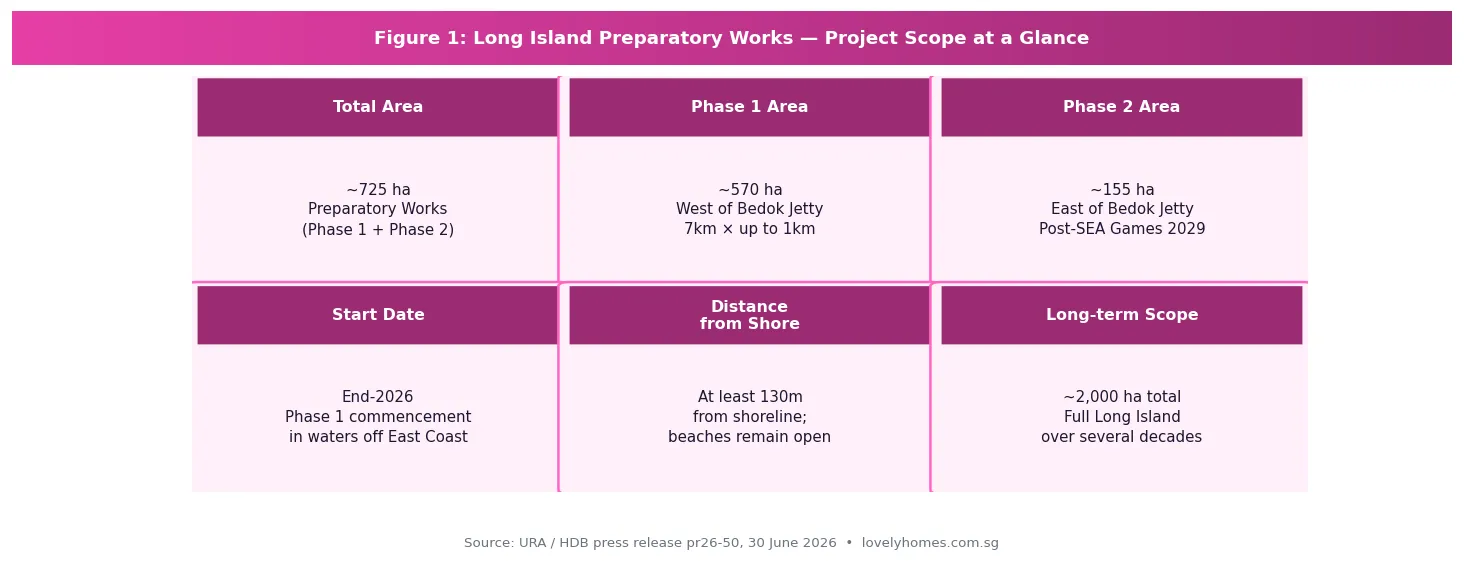
Figure 1: Long Island preparatory works project scope — Phase 1 and Phase 2 areas and timeline
Figure 1: Long Island preparatory works — project scope, Phase 1 and Phase 2 parameters, and long-term scale. Source: URA / HDB press release pr26-50, 30 June 2026.

What Are the Preparatory Works, Exactly?

Long Island is Singapore’s planned response to climate change and rising sea levels along its vulnerable East Coast. The full project — which will ultimately involve major land reclamation to create a new island and a freshwater reservoir — is a decades-long undertaking. What begins at end-2026 is the preparatory phase: essential marine construction works that lay the groundwork for eventual reclamation, but do not yet constitute reclamation itself.

The preparatory works involve three primary activities: removal of seabed obstructions (historical debris, hazards); construction of temporary sand bunds (underwater containment structures); and sand infilling within the bunded areas. These works will take place entirely offshore, at least 130 metres from the shoreline, and will be clearly demarcated by silt screens and floating barriers visible from the beach.

The works are split into two phases:

Phase Location Area Dimensions Timing
Phase 1 Waters west of Bedok Jetty ~570 ha ~7km long × up to 1km wide Commences end-2026
Phase 2 Waters east of Bedok Jetty ~155 ha TBC After SEA Games 2029 completion
Full Long Island Entire East Coast offshore zone ~2,000+ ha (indicative) TBC through technical studies Over several decades

The deferral of Phase 2 until after the 2029 SEA Games is a deliberate accommodation: the waters east of Bedok Jetty are currently used for water sports and will host major aquatic events for the SEA Games. This sequencing shows that the government is managing the project’s community impact thoughtfully — a signal that should give East Coast residents some comfort about near-term disruption.

Environmental Findings: What the Study Revealed

HDB commissioned a formal Environmental Study covering the preparatory works, consulting nature groups on scope. The study’s key findings are reassuring for the majority of East Coast users:

Water quality: No significant changes expected; water will continue to meet Singapore’s prevailing marine water quality criteria throughout the works.

Currents and waves: Slight localised changes near Bedok Jetty are expected to have minimal impact on near-shore activities. Swimming can continue along the entire East Coast stretch.

Air quality and visibility: Up to minor visual impact from sand infilling operations; intermittent sediment plumes and dust are expected, mitigated by silt screen deployment and active dust monitoring under the Environmental Monitoring and Management Plan (EMMP).

Biodiversity: Some coral and seagrass beds found near the work site may experience short-term, localised impact from sediment plumes. However, the majority of coral and seagrass — including Sisters’ Islands Marine Park — is assessed as largely unaffected. HDB has committed to EMMP monitoring throughout.

Sea sports displacement: This is the most tangible near-term impact for active East Coast users. Kiteboarding is most affected; other sea sports face minor to moderate displacement. Agencies are working with affected user groups to identify alternative sites within the sea space east of Bedok Jetty in the interim.

Key Takeaway: The environmental study concludes that preparatory works will have manageable, temporary, and localised impacts — not the large-scale ecological disruption that some stakeholders had feared. Beaches remain open. Swimming is unaffected. The most significant disruption is displacement of marine leisure activities, particularly kiteboarding, which will require temporary relocation.

What This Means for East Coast Property Buyers and Owners

For property owners in the East Coast corridor — covering D15 (Katong, Tanjong Katong, Marine Parade), D16 (Bedok, Siglap, Upper East Coast), and the eastern planning areas (Tampines, Pasir Ris, Changi) — the Long Island announcement is a long-term positive with a short-term noise caveat.

Short-term (2026–2029): Managed Disruption

The preparatory works will generate visible marine activity offshore — construction vessels, sand infilling operations, and temporary bunds. From the shoreline, this will be noticeable but distant (at least 130m offshore). Air quality impacts are expected to be minor and intermittent. Beaches remain open. The practical implication for property values is minimal in the short term: these works are a public infrastructure programme, not a lifestyle degradation, and they come with an explicit government commitment to environmental monitoring and mitigation.

Medium-term (2029–2035): Planning Uplift Begins

As the preparatory phase completes and the URA begins formal planning for Long Island’s reclamation profile, the East Coast will progressively benefit from the same planning-uplift dynamic that has historically preceded major Singapore waterfront transformations. When Marina Bay was being planned in the 1980s and 1990s, property in D1 and D2 began appreciating in anticipation of the new precinct long before a single building was complete. Long Island represents a similar, though slower, catalyst for the D15/D16 corridor.

Long-term (2035+): Transformative Uplift

When the full Long Island reclamation creates new land along the East Coast — including a future reservoir — the implications for D15 and D16 property are substantial: extended waterfront promenade access, reduced flood risk (supporting insurance and bank valuations), new residential parcels potentially creating supply (a risk to existing owners) but also major new amenity and connectivity (a positive for the precinct as a whole). The 2026 URA Q2 price data already showed D15 benefiting from TEL Stage 4 connectivity; the Long Island catalyst is additive to this structural tailwind over the 2030s and beyond.

Horizon Impact on East Coast Property Key Risk
2026–2029 (prep works) Neutral to marginally negative optics; no material price impact expected Marine activity visible from beachfront; minor sea-sport disruption
2029–2035 (early planning) Positive sentiment as Long Island masterplan solidifies; planning uplift begins Timeline may slip; full reclamation profile remains unconfirmed
2035+ (reclamation & beyond) Transformative — new waterfront, reduced flood risk, new amenity corridors New residential supply on Long Island may moderate prices on existing stock

Public Engagement and What Comes Next

The URA reiterated in the 30 June 2026 announcement that Singapore’s commitment to public engagement on Long Island planning remains firm. The government has engaged more than 14,000 people to date on Long Island’s vision. From end-2026, a new phase of public engagement will invite Singaporeans to shape key planning topics including recreational uses along the new coastline, the design of the future reservoir, and the character of new precincts that will eventually emerge.

Crucially, the URA clarified that the area used for preparatory works is not the final Long Island land profile. The reclamation profile will be determined through subsequent technical studies — covering environmental impact assessments for the actual reclamation, engineering studies, and further public engagement — expected to take several more years. Main reclamation works will only commence after these studies are complete and mitigation measures are determined.

The Environmental Study report was published for public feedback for four weeks from 30 June 2026. Members of the public may view it and submit feedback at go.gov.sg/long-island.

Frequently Asked Questions: Long Island and East Coast Property

Will the preparatory works affect East Coast Park beach access?

No. All beaches along East Coast Park will remain open throughout the preparatory works. Near-shore swimming can continue along the entire stretch of the East Coast. Exercise paths and tracks for jogging and cycling also remain fully accessible. The works are offshore (at least 130m from the shoreline) and cordoned off for public safety. Safety advisories will be posted at East Coast Park and on government agency websites.

How might Long Island affect property values in D15 and D16?

In the short term (2026–2029), the preparatory works are unlikely to have a material impact on property values in D15 (Marine Parade, Katong, Tanjong Katong) or D16 (Bedok, Upper East Coast, Siglap). The works are offshore, temporary, and environmentally monitored. In the medium to long term, Long Island is broadly a positive catalyst for the East Coast corridor — creating new waterfront, improved flood protection, and eventually new amenities. However, buyers should note that full Long Island reclamation is decades away and carries execution and timeline uncertainty. Purchase decisions should be based on the neighbourhood’s existing merits, with Long Island treated as optionality, not a near-term price driver.

What is the difference between the preparatory works and the main Long Island reclamation?

The preparatory works (beginning end-2026) involve seabed clearance, temporary bund construction, and sand infilling — foundational marine works that create the conditions for eventual reclamation without being the reclamation itself. The area used for preparatory works is not the final land profile of Long Island. The main reclamation works — which will actually create the new island — will only commence after the government completes further technical studies, determines mitigation measures, and incorporates feedback from additional public engagement rounds. This could be many years away. Think of the preparatory works as clearing and grading a site before construction, not as the construction itself.

Will Long Island create new HDB or private residential areas in the future?

Long Island’s ultimate land use profile — including any residential development — has not been finalised. The URA has noted that planning will incorporate findings from technical studies and public engagement, and that the government retains flexibility to meet evolving national needs. Historically, Singapore’s reclaimed land has been used for a mix of residential, commercial, and infrastructure purposes. It is reasonable to expect that some Long Island land will eventually be developed for housing, but the specific profile, tenure, and density remain undecided. Any residential development on Long Island is likely to be 15–25 years away.

Can I still use East Coast Park for water sports during the works?

Most water sports can continue, but with some adjustment. Near-shore swimming is unaffected. However, sea sports that require more sea space — particularly kiteboarding — will be the most significantly impacted, as the Phase 1 work area covers much of the sea space west of Bedok Jetty. Agencies are working with affected groups to identify alternative sites, including the sea space east of Bedok Jetty (until Phase 2 begins post-2029). Recreational paddling, kayaking, and water skiing in near-shore areas should be largely unaffected, though users should maintain safe distances from vessels and the cordoned work area.
Disclaimer: This article is an editorial summary of URA/HDB press release pr26-50 (30 June 2026). All project details, timelines, areas, and environmental findings cited are drawn from that official source. Property value commentary reflects editorial analysis only and does not constitute investment advice. Long Island timelines are subject to change by the Singapore Government. Readers should consult official sources — go.gov.sg/long-island, URA, HDB — and qualified property professionals before making property decisions based on this or any infrastructure announcement.

×

Click anywhere to close

Singapore ‘Long Island’ Preparatory Works to Begin End-2026: East Coast Property Outlook

Singapore ‘Long Island’ Preparatory Works to Begin End-2026: East Coast Property Outlook

Singapore’s most ambitious infrastructure undertaking in a generation took a concrete step forward on 30 June 2026, when the Urban Redevelopment Authority (URA) and the Housing & Development Board (HDB) announced that preparatory works for ‘Long Island’ — the Government’s large-scale coastal protection strategy for the East Coast — will commence from end-2026. For property owners, investors, and anyone watching the long arc of Singapore’s planning, this announcement sets a firm starting gun on a project that will reshape the East Coast’s future land supply, flood resilience, and lifestyle amenities over the next several decades.

‘Long Island’ is not simply a reclamation project — it is Singapore’s primary response to the threat of rising sea levels to its low-lying East Coast. The Government has long signalled that without proactive intervention, the East Coast’s beaches, parks, and existing development would become increasingly vulnerable as global sea levels rise. Long Island will ultimately create a new landmass off the East Coast, incorporating a reservoir, an expanded coastal park, and mixed-use development land — but that is decades away. What changes now is that the ground work begins.

Quick Answer — Long Island: What You Need to Know

  • Preparatory works (seabed clearing, sand bunds, sand infilling) begin end-2026, in the waters west of Bedok Jetty.
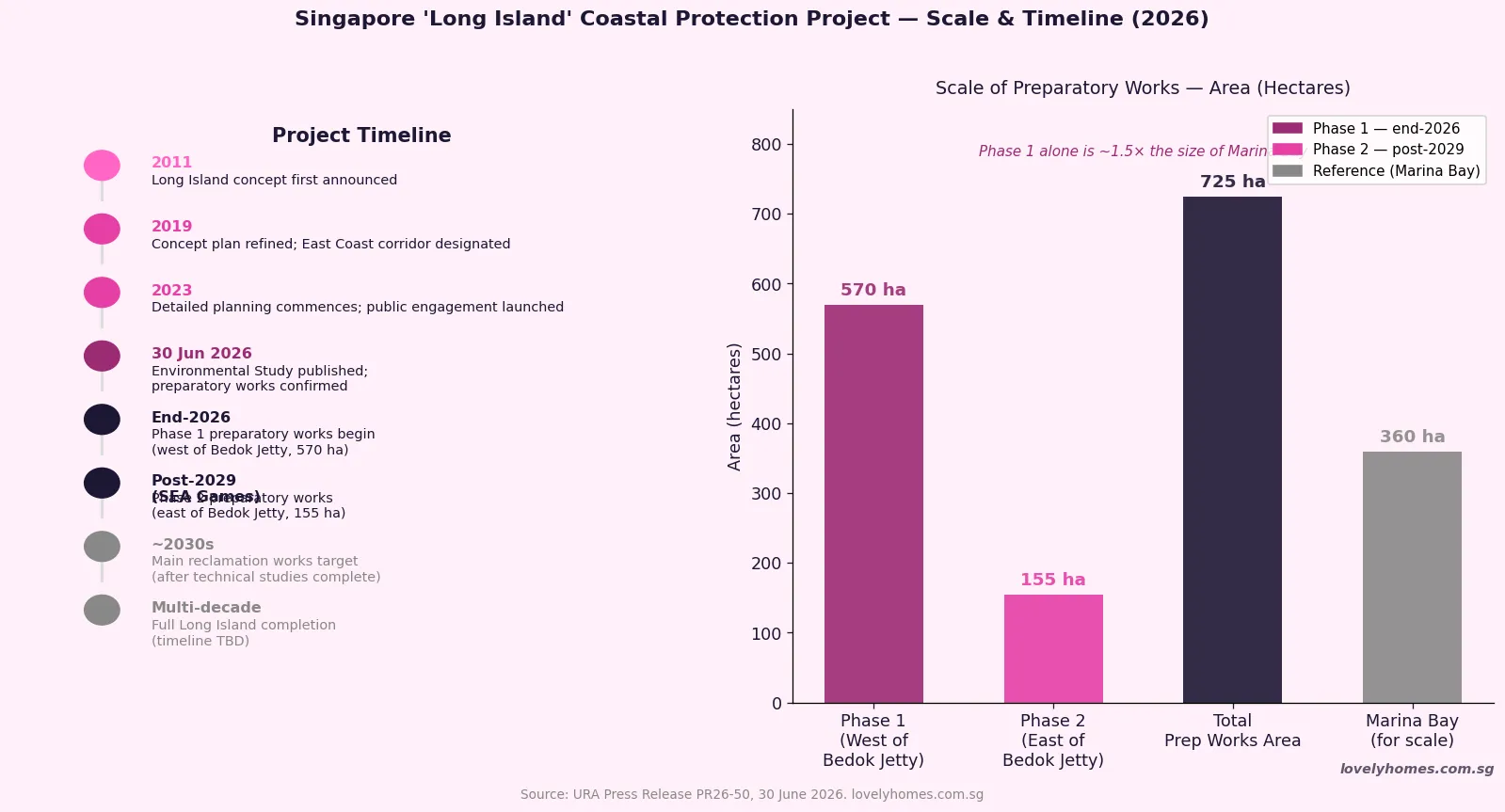
  • Phase 1 covers approximately 570 hectares — roughly 1.5 times the size of Marina Bay — spanning about 7km east-to-west and up to 1km wide.
  • Phase 2 (east of Bedok Jetty, ~155 ha) begins only after the 2029 SEA Games.
  • Beaches and parks along East Coast Park remain fully open throughout the preparatory works; near-shore swimming and jogging/cycling paths are unaffected.
  • Main reclamation works will only begin after further technical studies and public engagement — likely the early 2030s at the earliest.
  • The completed Long Island will include a new reservoir, a larger coastal park, and new urban land — potentially adding thousands of residential and commercial units in the long term.
  • An Environmental Study published alongside the announcement found no significant water quality impact and only localised, short-term biodiversity effects from the preparatory works.
  • The public has until 28 July 2026 to submit feedback on the Environmental Study report at go.gov.sg/long-island.

What Are the Preparatory Works — and Why Now?

The preparatory works announced on 30 June 2026 are a precursor to the main reclamation. They involve three primary activities: removal of seabed obstructions (existing cables, pipelines, and debris), construction of temporary sand bunds (underwater embankments to contain the work area), and sand infilling to begin building up the seabed. These are engineering prerequisites — the seabed must be cleared and stabilised before full-scale reclamation can proceed.

The timing reflects two pressures. First, the Government has identified that sea level rise poses an increasingly urgent risk to the East Coast, and delaying the preparatory works extends the timeline for protection. Second, the 2029 SEA Games — to be hosted partly at East Coast Park — limits when Phase 2 can begin. By starting Phase 1 now and phasing Phase 2 to avoid disrupting the Games, the Government has threaded the needle between urgency and community impact.

The preparatory works will take place at least 130 metres from the shoreline and will be demarcated by silt screens and floating barriers. HDB, as the appointed reclamation agent, will monitor water quality, sediment levels, noise, and dust throughout.

Singapore Long Island project timeline and preparatory works scale 570 hectares 2026
Figure 1: Long Island project timeline from concept to preparatory works commencement, and scale of the Phase 1 and Phase 2 preparatory works areas relative to Marina Bay. Source: URA Press Release PR26-50, 30 June 2026.

Environmental Impact — What the Study Found

HDB commissioned an Environmental Study specifically for the preparatory works phase. The study’s key findings provide important context for how the works will affect the surrounding environment:

On water quality: no significant changes are expected. Water quality will continue to meet prevailing marine water quality criteria throughout the works. Silt screens will contain sediment plumes.

On marine biodiversity: there is up to minor impact on some coral and seagrass beds near the works site, with potential short-term and localised effects from sediment plumes. The majority of coral and seagrass in the vicinity — including Sisters’ Islands Marine Park — are assessed to be largely unaffected. This will reassure the nature community, which had concerns about the proximity of Phase 1 to some of the East Coast’s more ecologically sensitive zones.

On sea sports: kiteboarding will be the most affected activity, with moderate displacement from the reduced sea space. Other sea sport users face minor to moderate impact. Agencies have committed to working with affected sea sport users to find alternative sites for the interim period.

The Environmental Study report is open for public feedback for four weeks from 30 June 2026. An Environmental Monitoring and Management Plan (EMMP) will be put in place to manage environmental conditions throughout the works.

What This Means for East Coast Property

Long Island will be one of the most significant drivers of East Coast property values over the coming decade — but it is a slow-burn catalyst rather than an immediate price mover. Here is the framework LovelyHomes uses to think about the property implications:

Short term (2026–2030): Neutral to slightly negative. The preparatory works bring marine vessels, sand infilling activity, and restricted sea space off the East Coast. Buyers considering East Coast properties — particularly those with sea-facing units or sea-sports lifestyle utility — should factor in construction-adjacent disruption. This is unlikely to cause price falls (East Coast fundamentals remain strong), but it may dampen the marginal premium that sea-view units command during this period.

Medium term (2030s): Watch for planning signals. When the detailed reclamation plans are released — expected after the technical studies are completed in the early 2030s — the market will get clarity on the eventual land profile, the new waterfront layout, the reservoir location, and potential residential zones. This is when the property market will begin to price in the Long Island uplift meaningfully. Marine Parade, Bedok, and Siglap properties in particular may benefit from the signal that the East Coast will gain a significant new green and waterfront amenity.

Long term (2040s and beyond): Transformative. If Long Island proceeds as currently envisaged — a new coastal park, a freshwater reservoir, and new urban land — it represents the creation of entirely new prime East Coast real estate. The precedent is Bishan, which was built on former agricultural land and is now one of Singapore’s most sought-after mature estates. Long Island’s eventual waterfront development could command premium valuations similar to the Marina Bay waterfront, which today represents some of Singapore’s highest residential and commercial values.

Long Island in Context — Singapore’s Coastal Planning History

This is not the first time Singapore has reclaimed land to address long-term needs. Marina Bay itself was reclaimed over several decades — the land that now hosts Marina Bay Sands, the financial district, and Gardens by the Bay was once open sea. Jurong Island was created by amalgamating seven smaller islands for petrochemical use. Changi Airport’s runways sit on reclaimed land. What is different about Long Island is its explicit dual purpose: it is simultaneously a climate adaptation measure (coastal protection) and a land creation exercise — and it is being planned with unusually extensive public engagement, reflecting a more consultative planning era.

The Government’s message is clear: Long Island is going ahead, and it will be built in a way that is sensitive to the environment, the existing East Coast community, and the interests of future residents. For property investors, that certainty has real value — it means the East Coast’s long-term trajectory is upward.

Summary — Long Island Key Facts

Item Detail
Lead agencies URA (planning), HDB (reclamation agent)
Purpose Coastal protection from sea level rise; new land supply
Phase 1 start End-2026, west of Bedok Jetty
Phase 1 area ~570 ha (7km long × up to 1km wide)
Phase 2 start After 2029 SEA Games, east of Bedok Jetty
Phase 2 area ~155 ha
Main reclamation start TBD — after technical studies (early 2030s est.)
Beach/park access Fully maintained throughout works
Feedback period 4 weeks from 30 June 2026 (closes ~28 July 2026)

Frequently Asked Questions

Will Long Island be built for housing? When will new homes be available?

The Government has said Long Island will include new urban land — but has not yet confirmed the mix of residential, commercial, industrial, or recreational uses. Given the project timeline, any new housing on Long Island is at least 20–30 years away. The more immediate property implication is the uplift to existing East Coast properties as the project progresses and its final scope becomes clear. The Government’s track record — Marina Bay, Bidadari — suggests Long Island’s eventual homes will be well-planned and high-quality, but buyers looking for a near-term supply injection from this project will be disappointed.

Does the Long Island announcement affect East Coast Park access?

No. URA and HDB have explicitly confirmed that beaches, jogging and cycling paths, and near-shore swimming areas along East Coast Park will remain open and accessible throughout the preparatory works. Works are at least 130 metres from the shoreline. The main restriction is on certain sea sports users — particularly kiteboarding — who will need to use alternative sea space during the Phase 1 period. East Coast Park itself, as a recreational asset, is unaffected.

Will the preparatory works affect sea views from East Coast condominiums?

In the near term, marine vessels, sand bunds, and floating barriers will be visible from East Coast properties with sea views — particularly during active infilling operations. However, these are temporary structures for the preparatory phase. The visual impact during preparatory works is expected to be significant from units with direct sea views but modest from properties further back. The more important long-term consideration is that once Long Island is reclaimed, those “sea view” units may have their sightlines altered permanently — a factor that discerning buyers of high-floor sea-facing East Coast units should factor into their purchase decision today.

How does this compare to Singapore’s previous reclamation projects?

Long Island is comparable in scale to the Tuas reclamation (which expanded Singapore’s western coast for industrial use) and the Changi East reclamation (which expanded Changi Airport). In terms of residential property impact, the closest precedent is Marina Bay — which transformed from open sea to the city’s premier commercial and residential address. Long Island’s combination of climate resilience purpose and mixed-use development potential makes it perhaps the most strategically significant reclamation in Singapore since Marina Bay, with a potentially larger impact on the East Coast residential market than any single policy change in recent memory.

Where can I read the full Environmental Study and submit feedback?

The Environmental Study report for the preparatory works is available at go.gov.sg/long-island. The public feedback period runs for four weeks from 30 June 2026, closing approximately 28 July 2026. Feedback can be submitted via the portal at that link. URA and HDB have committed to evaluating feedback thoroughly and incorporating suitable suggestions before finalising the mitigation measures for the preparatory works.

Related Articles

Disclaimer

This article is an editorial analysis produced by LovelyHomes based on URA Press Release PR26-50 (30 June 2026) and publicly available government planning documents. All timelines, area figures, and project details are drawn from official URA and HDB sources. Property market analysis represents LovelyHomes’ editorial view and does not constitute investment advice. Readers should conduct their own due diligence and consult a licensed property professional before making any purchase decision. For official information about the Long Island project, visit go.gov.sg/long-island.

Translate »