
Dual-Key Condo Units in Singapore: Who They’re Really For (2026)
The dual-key layout was a mid-2010s development marketing innovation: take a standard 3-bedroom floorplate, wall off one of the rooms into a self-contained studio with its own kitchenette and bathroom, and sell the whole thing as one strata title. Ten years on, dual-keys are a small but durable slice of the launch menu — and the rental maths often makes sense.
This guide covers the layout, the financing treatment, the rental-yield case, and the situations where a dual-key actively hurts you. If dual-key is on your shortlist alongside other condo formats, our condo downpayment guide covers the cash/CPF/LTV maths you’ll need to price it.
What a dual-key actually is
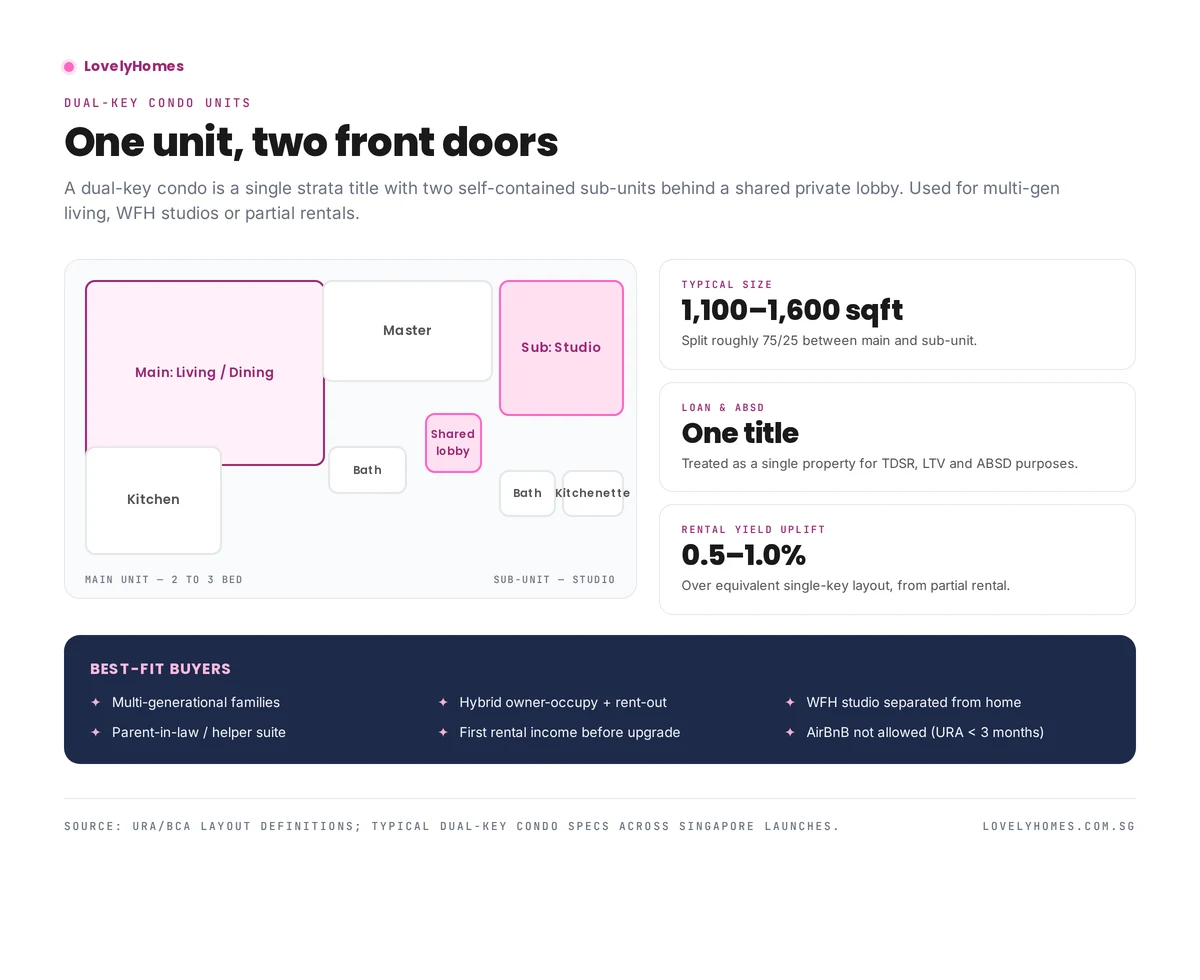
Two separate self-contained units sharing a private lift lobby. Each unit has its own:
- Front door
- Kitchen or kitchenette
- Bathroom
- Living / sleeping area
But critically, they share one strata title, one loan, one ABSD payment, one property-tax account.
Typical sizes and configurations
| Layout | Main unit | Sub-unit | Total size |
|---|---|---|---|
| 2 + 1 dual-key | 2-bed, ~700–900 sqft | Studio, ~300–400 sqft | 1,100–1,300 sqft |
| 3 + 1 dual-key | 3-bed, ~950–1,200 sqft | Studio, ~400 sqft | 1,400–1,600 sqft |
Financing, ABSD and TDSR
One property, one set of duties
The entire dual-key unit is a single purchase. BSD and ABSD are calculated on the full purchase price; LTV is capped as if it were one property; TDSR and MSR apply once. This is the defining benefit over buying two shoeboxes — which would each attract separate ABSD.
Bank valuation quirks
Valuers apply a small discount to the sub-unit versus a freestanding studio, because it cannot be sold or remortgaged separately. Expect 3–6% under the sum of two equivalent standalone units.
The rental-yield case
The typical dual-key yield uplift runs 0.5–1.0 percentage points over an equivalent single-key 3-bedder. Two drivers:
- The studio rents at studio PSF, which is always the highest PSF band.
- Partial-rental frees the owner to occupy the main unit — keeping one-time ABSD exposure.
Who dual-keys suit
- Multi-gen families: adult children, parents-in-law, or a helper with a separate bath/kitchen.
- Hybrid owner-occupy + rent-out: owner in the main unit, studio leased on 12-month terms (short-term AirBnB is prohibited under URA < 3-month rule).
- WFH professionals: completely separate workspace behind its own door.
- First-time investors: live in the main unit, let the studio produce cash flow without triggering ABSD on a second property.
When the dual-key format hurts
- Resale liquidity is thinner than a standard 3-bedder — the buyer pool is narrower (single families who want a standard 3-bed may skip dual-keys).
- The sub-unit can feel cramped without good natural light — check window/air conditioning provisions.
- PSF at launch is often above the comparable single-key because the developer prices in the yield-potential premium.
Frequently asked questions
Can I sell the two units separately later?
No. One strata title. The only way to sell separately is physical remodelling + strata subdivision, which is almost never approved.
Can I AirBnB the sub-unit?
No. URA forbids short-term rentals (< 3 months) of private residential property. 12-month leases are fine; serviced-residence-style rentals are not.
How does property tax work?
One tax account based on the unit’s Annual Value. If you owner-occupy the main and lease the sub-unit, the owner-occupier AV rates apply to the whole unit — a subtle benefit over leasing the entire unit. See our property tax guide.
Do dual-keys en bloc well?
Same as any other unit in the development — the en bloc sale is on the development, not the unit. Apportionment is usually by total share value, so dual-key owners are not disadvantaged.
This guide is for general information only and is accurate as of April 2026. Singapore property rules, taxes and cooling measures change frequently — always verify current figures with URA, IRAS, HDB or a licensed professional before committing. LovelyHomes is not a financial, legal or tax advisor.