Property Conveyancing Guide Singapore 2026: OTP, S&P Agreement, Legal Fees & Timelines
- Conveyancing is the legal transfer of property ownership from seller to buyer, handled by a Singapore-licensed lawyer on each side.
- For resale private property: the Option to Purchase (OTP) gives the buyer 14 calendar days to exercise, paying 1% + 4% option fee and BSD/ABSD.
- BSD and ABSD are due within 14 days of signing the OTP or Sale and Purchase Agreement — whichever is earlier.
- Completion (keys and balance payment) typically occurs 8–12 weeks after exercising the OTP for resale condo; 6–8 weeks for HDB resale.
- Buyer’s conveyancing legal fees for a S$1 million resale condo are approximately S$2,700–S$3,500 (including GST).
- For new launches, the developer’s lawyers handle the Sale and Purchase Agreement; you still need your own lawyer to review and for the mortgage.
- CPF OA funds can be used to pay BSD, legal fees, and the balance of the purchase price — but not the 5% mandatory cash downpayment for bank loans.
What Is Conveyancing and Why Do You Need a Lawyer?
Conveyancing is the legal process by which the title (ownership rights) of a property is formally transferred from one party to another. In Singapore, all conveyancing for residential property must be handled by a qualified Singapore-licensed lawyer (advocate and solicitor). You cannot self-convey a property transaction — the Law Society of Singapore and the Land Titles Act require a qualified professional to prepare the instruments of transfer, conduct the requisitions, and handle the lodgement with the Singapore Land Authority (SLA).
The conveyancing lawyer acts as far more than a document drafter. They carry out title searches, verify that the property is free of encumbrances, co-ordinate with CPF Board to release CPF funds, liaise with the mortgagee bank, and ensure that all stamp duties are correctly assessed and paid on time. For buyers in particular, appointing a good conveyancing lawyer early — ideally before exercising the Option to Purchase — can prevent costly mistakes around timing and documentation.
Both buyer and seller must appoint their own separate lawyers. The same law firm cannot act for both parties in the same transaction (conflict of interest rules under the Legal Profession (Professional Conduct) Rules). In HDB transactions, HDB’s legal arm processes the resale procedures and buyers/sellers interact via the HDB Flat Portal, but a buyer may still choose to appoint a private lawyer to advise.
The Option to Purchase (OTP) — Singapore’s Property Buying Trigger
For private residential property, the conveyancing process formally begins with the Option to Purchase (OTP). The OTP is a legal document granted by the seller to the buyer, giving the buyer an exclusive right to purchase the property at the agreed price within a specified period — in Singapore, typically 14 calendar days from the date the option is granted.
The OTP process works as follows. First, the seller grants the OTP upon receipt of the option fee — conventionally 1% of the agreed purchase price, paid in cash. This amount is non-refundable if the buyer chooses not to exercise. The buyer then has 14 days to decide whether to proceed. If proceeding, the buyer exercises the OTP by signing the acceptance copy and returning it to the seller’s lawyer together with:
- An additional exercise fee of 4% of the purchase price (also cash); and
- Payment of the Buyer’s Stamp Duty (BSD) and, where applicable, Additional Buyer’s Stamp Duty (ABSD) — both are due within 14 days of the OTP being granted, not 14 days from exercise.
The total 5% (1% option + 4% exercise fee) forms the initial deposit, which is typically held by the seller’s solicitors in their client account and released to the seller upon completion. The balance of the purchase price — typically 95% — is paid on the completion date.
| Step | Amount | Timing | Payment Mode |
|---|---|---|---|
| Option fee (grant OTP) | 1% of price | Day 0 | Cash/cashier’s order |
| Exercise fee (exercise OTP) | 4% of price | Within 14 calendar days | Cash/cashier’s order |
| BSD (all buyers) | Progressive, ~0.6–3%+ | Within 14 days of OTP date | Cash or CPF OA |
| ABSD (where applicable) | 5–60% flat rate | Within 14 days of OTP date | Cash only (CPF for reimbursement later) |
| Balance purchase price | ~95% of price | Completion date (8–12 weeks) | CPF OA + bank loan + cash top-up |
The Conveyancing Timeline — From OTP to Keys
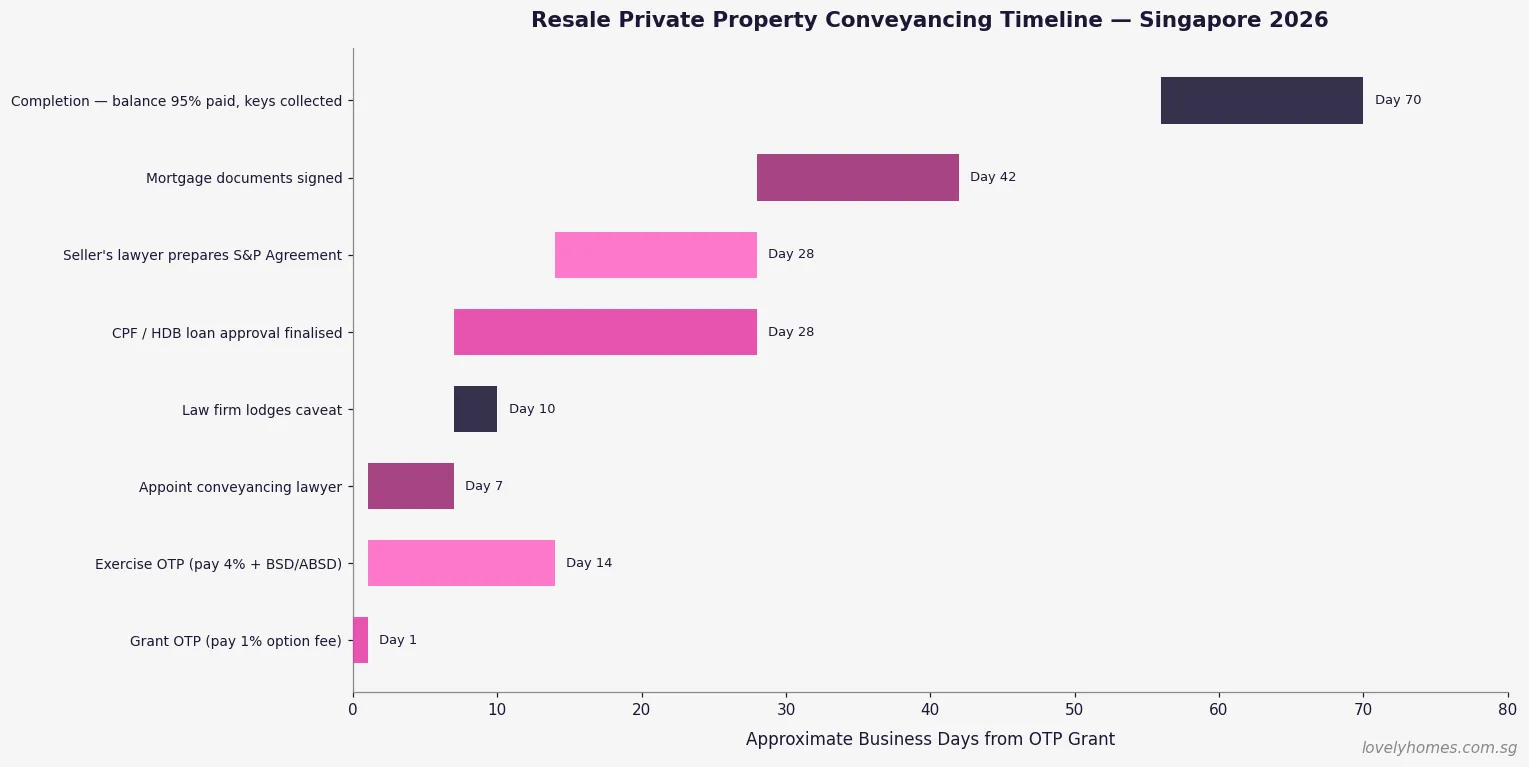
Figure 1: Approximate conveyancing timeline for a resale private residential property, Singapore 2026. Timings are indicative and may vary depending on parties and conditions. Source: Singapore Law Society / LovelyHomes analysis.
After the OTP is exercised, your conveyancing lawyer moves through a series of standard steps. The requisition phase involves sending formal enquiries to government bodies — the Land Titles Registry (SLA), URA (planning queries), HDB (where applicable), PUB, SP Group, and others — to confirm there are no adverse encumbrances, outstanding charges, or regulatory issues on the title. This typically takes two to three weeks.
Simultaneously, if you are taking a bank loan, the mortgage documentation is being prepared: the bank’s solicitors (often the same firm acting for you) will prepare the mortgage instrument, and CPF Board will be notified to set aside or release your CPF OA funds for the purchase. For new citizens or PRs using CPF for the first time for property, additional verification steps apply.
The completion appointment brings all parties together (or their lawyers in escrow). The buyer’s lawyers hand over the balance payment; the seller’s lawyers hand over the title documents and release the keys. In Singapore, completion is a smooth, paperwork-driven process — you do not physically attend a courtroom or signing ceremony (unlike some other jurisdictions). The average buyer simply receives a call from their lawyer confirming completion, and then collects the keys.
New Launch Private Property — Different Process, Same Stamp Duties
When buying a new launch directly from a developer (whether a condo or an executive condominium), the conveyancing process differs in several important respects:
- The developer uses its own solicitors to prepare the Sale and Purchase Agreement (S&P Agreement) — a standardised statutory form prescribed by the Controller of Housing under the Housing Developers (Control and Licensing) Act.
- There is no OTP for new launches; instead, you first sign an Option to Purchase issued by the developer (usually after booking a unit and paying a booking fee of typically 5%), followed by the S&P Agreement within 3 weeks.
- BSD and ABSD remain payable within 14 days of the S&P Agreement date.
- Payment follows the Progressive Payment Scheme (PPS) — instalments tied to construction milestones over the build period (typically 3–5 years to TOP).
- You should still appoint your own independent conveyancing lawyer to review the S&P Agreement and handle your CPF and mortgage documentation, even though the developer’s lawyers lead the transaction.
Conveyancing Legal Fees — What to Expect in 2026
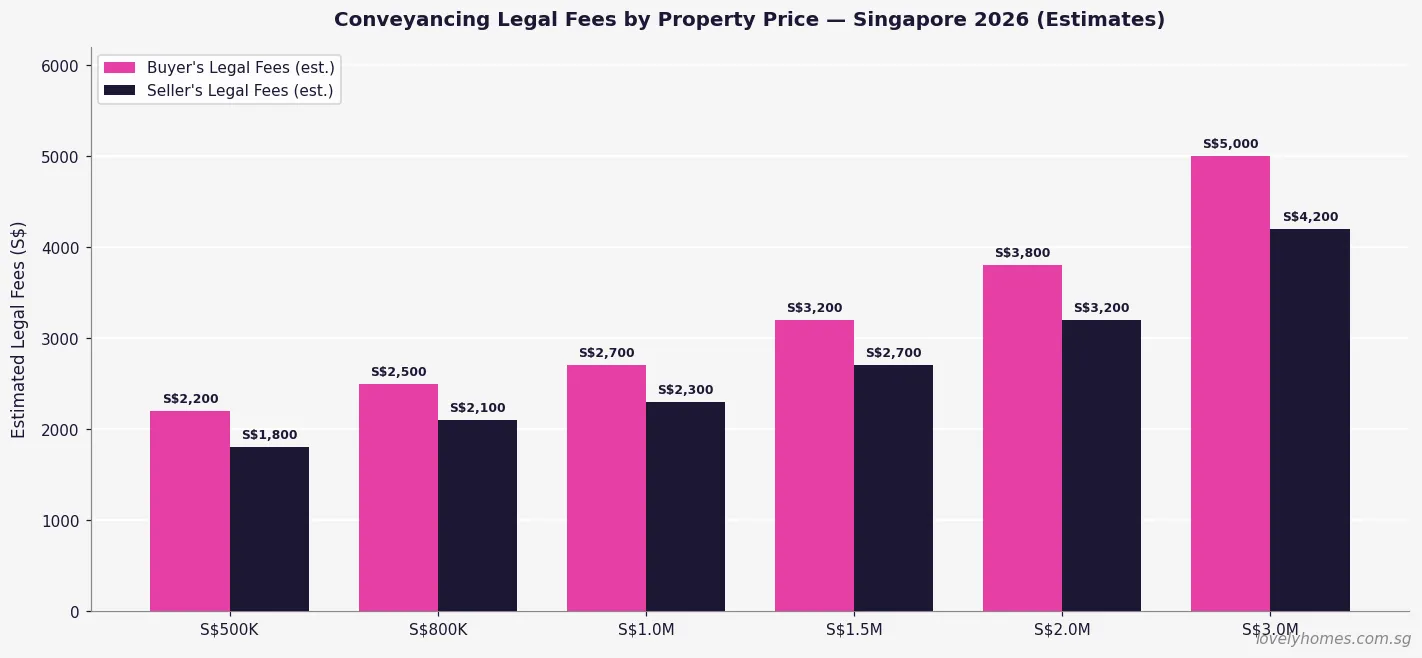
Figure 2: Estimated conveyancing legal fees for buyer and seller by property price band, Singapore 2026. All figures are indicative estimates including GST; actual fees vary by law firm and complexity.
Conveyancing legal fees in Singapore are not regulated by a fixed scale for private property transactions (unlike some Commonwealth jurisdictions). Law firms set their own fees, though market rates are broadly competitive. As a rough guide for 2026:
| Purchase Price | Buyer’s Legal Fees (est.) | Seller’s Legal Fees (est.) |
|---|---|---|
| Up to S$500,000 | S$1,800–S$2,500 | S$1,500–S$2,000 |
| S$500,001–S$1,000,000 | S$2,500–S$3,200 | S$2,000–S$2,700 |
| S$1,000,001–S$2,000,000 | S$3,000–S$4,200 | S$2,500–S$3,500 |
| S$2,000,001–S$3,000,000 | S$4,000–S$5,500 | S$3,300–S$4,500 |
| Above S$3,000,000 | S$5,000+ | S$4,000+ |
These figures include disbursements (SLA lodgement fees, title search fees, stamp certificate) but exclude the mortgage-related legal work, which is typically billed separately by the bank’s panel solicitors. Many buyers find that choosing a law firm on the bank’s mortgage panel saves money — you may qualify for a “combined” rate covering both the purchase and the mortgage documents.
For HDB resale transactions, the HDB Resale Flat Portal provides a standardised suite of forms and handles the administrative process centrally. A buyer may engage a private lawyer for S$1,000–S$2,000 for advice, but the HDB legal process itself is not separately billed to the buyer.
Worked Example — Full Buying Cost Breakdown, Resale Condo S$1.5 Million
Scenario: Singapore Citizen couple buying their second property — Resale Condo, S$1,500,000, District 15
Both buyers are Singapore Citizens. They already own their HDB flat (first property). They are purchasing the condo jointly as their second property.
- Option fee (1%, cash): S$15,000 — paid when OTP granted. Non-refundable if not exercised.
- Exercise fee (4%, cash): S$60,000 — paid within 14 days of OTP date.
- BSD (progressive): S$44,600 — due within 14 days of OTP. Can be paid via CPF OA.
- ABSD (20% for SC 2nd property): S$300,000 — due within 14 days of OTP. Must be paid in cash initially; CPF may be used for reimbursement after stamping.
- Buyer’s legal fees: approximately S$3,200–S$4,200 (including GST and disbursements).
- Valuation fee: approximately S$800–S$1,200 (required by the bank for mortgage drawdown).
- Balance 95% at completion: S$1,425,000 — funded via CPF OA balance + bank mortgage.
Total upfront cash required before completion: S$15,000 + S$60,000 + S$300,000 (ABSD) + BSD disbursement + legal fees ≈ S$382,000–S$385,000 in cash before leveraging CPF. This illustrates why ABSD planning is critical for second-property buyers — the S$300,000 ABSD alone is a major cash drain.
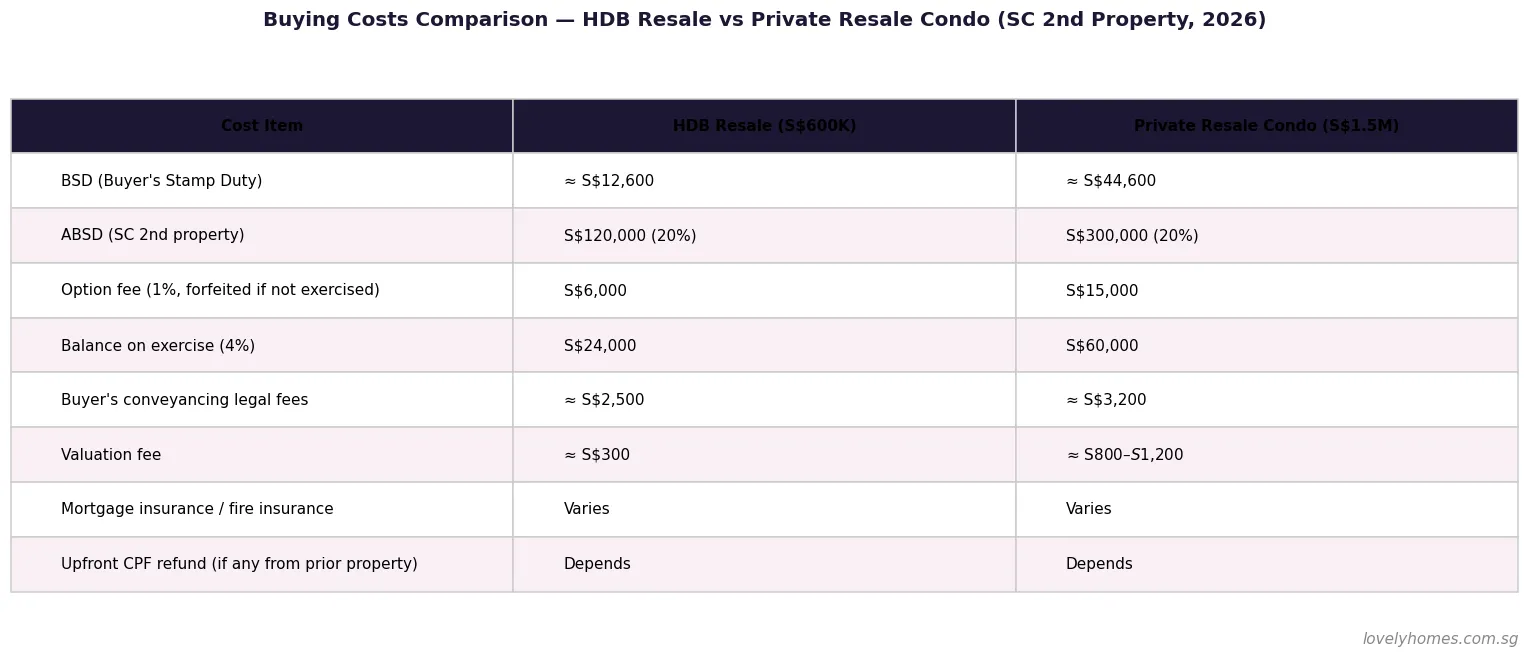
Figure 3: Full cost comparison — HDB resale (S$600K) vs private resale condo (S$1.5M) for a SC buying a second property. Source: IRAS / HDB / LovelyHomes analysis (2026).
CPF and Conveyancing — What Can and Cannot Be Paid with CPF
Understanding which costs can be funded from your CPF OA and which must be cash is essential to avoid a last-minute shortfall. As a general rule:
| Cost Item | CPF OA Usable? | Notes |
|---|---|---|
| Buyer’s Stamp Duty (BSD) | Yes | Deducted from CPF at the time of payment |
| ABSD | No (initially) | Must be paid in cash first; CPF reimbursement applies after stamping |
| 5% downpayment (bank loan) | No | Mandatory cash requirement; cannot use CPF |
| Balance above 5% (bank loan LTV) | Yes | CPF OA used for the remainder of the 25% equity requirement |
| Legal / conveyancing fees | Yes | Up to a cap set by CPF Board based on purchase price |
| Valuation fee | Generally No | Usually paid directly to the valuer in cash |
| Monthly mortgage instalments | Yes | Subject to CPF Withdrawal Limit and Valuation Limit |
Why Conveyancing Matters — Common Mistakes to Avoid
Many first-time buyers in Singapore underestimate the legal and procedural complexity of a property transaction. The most frequent pitfalls encountered in conveyancing are:
- Exercising the OTP without sufficient cash for ABSD: Buyers sometimes discover — after paying the 1% option fee — that they do not have the cash to cover ABSD on exercise. This is a costly error: forfeiting the 1% option fee and walking away. Pre-compute your full buying cost (including ABSD) before paying the option fee.
- Delaying the BSD/ABSD payment: Both duties are due within 14 days of the OTP date — not 14 days from exercise. A buyer who exercises on day 13 still has only one day to pay stamp duty. Failure to stamp on time attracts penalties of 2–4× the duty payable.
- Not checking encumbrances before exercising: A competent conveyancing lawyer will run a title search and caveat check before the exercise deadline. Buyers who rush this step can find themselves bound to a property with an undisclosed mortgage or legal charge.
- Assuming the developer’s lawyer acts for you: For new launches, the developer’s solicitors act exclusively for the developer. Your interests are protected only by your own appointed lawyer.
- Forgetting to budget for legal fees in the completion funds: On completion day, your lawyer will draw up a “completion account” showing exactly how the balance is funded (CPF, loan drawdown, cash). Buyers who have not kept the legal fees in their CPF or cash buffer occasionally face a shortfall at the last moment.
What Might Come Next — Conveyancing Reform Outlook 2026–2028
Singapore’s conveyancing framework is relatively mature and stable, but two developments bear watching. First, the Ministry of Law has been progressively digitising the conveyancing process — the Integrated Land Information Service (INLIS) already allows electronic title searches, and there are ongoing discussions around greater use of digital instruments of transfer. Second, the Law Society’s standardisation of HDB resale procedures has reduced friction significantly, and a similar standardisation framework for private property may be on the horizon. Buyers and sellers should expect a leaner, more fully digital process by the late 2020s, but the fundamental legal requirement for a qualified solicitor to handle the transfer is not expected to change.
Frequently Asked Questions
Do I need a lawyer to buy an HDB resale flat, or can HDB handle everything?
For most straightforward HDB resale transactions, the HDB Resale Flat Portal handles the administrative and procedural steps centrally — buyers and sellers submit resale applications online, and HDB’s in-house legal process manages the transfer instruments. You are not strictly required to appoint a private conveyancing lawyer. However, if your situation involves CPF complications, outstanding mortgages, an estate sale, unusual co-ownership structures, or a divorce settlement, engaging a private lawyer (typically S$1,000–S$2,000) for independent advice is well worthwhile. For private property transactions, a private lawyer is mandatory.
Can I use the same lawyer as the seller?
No. A Singapore law firm cannot act for both buyer and seller in the same property transaction. This rule exists to prevent conflicts of interest — your lawyer’s duty is to protect your interests alone, and the seller’s lawyer’s duty is the opposite. If a seller’s law firm approaches you offering to “save costs” by acting for both sides, this is in breach of the Legal Profession (Professional Conduct) Rules and should be declined.
What happens if the seller pulls out after granting the OTP?
The OTP is a binding contractual document. If the seller withdraws after granting the option and you have already exercised it, the seller is in breach of contract. You can seek specific performance (a court order requiring the seller to complete the sale) or claim damages including your costs of conveyancing, financing, and any foreseeable losses. Your conveyancing lawyer should advise you promptly if a seller attempts to back out post-exercise. The 1% option fee paid to obtain the OTP is generally retained by the buyer in such cases, but recovery of the full loss typically requires legal proceedings.
How long does conveyancing take for a new launch (BTO or developer)?
For new BTO flats, the HDB handles the conveyancing entirely in-house upon completion of the flat. The process typically takes 4–8 weeks after HDB notifies you that your flat is ready for collection (after Temporary Occupation Permit is granted and your unit passes inspection). For private new launches, the formal transfer of title occurs upon completion of the building project — conveyancing is triggered at that point, typically 3–5 years after the booking date. During the construction period, you are making progressive payments but do not yet hold the legal title to the unit.
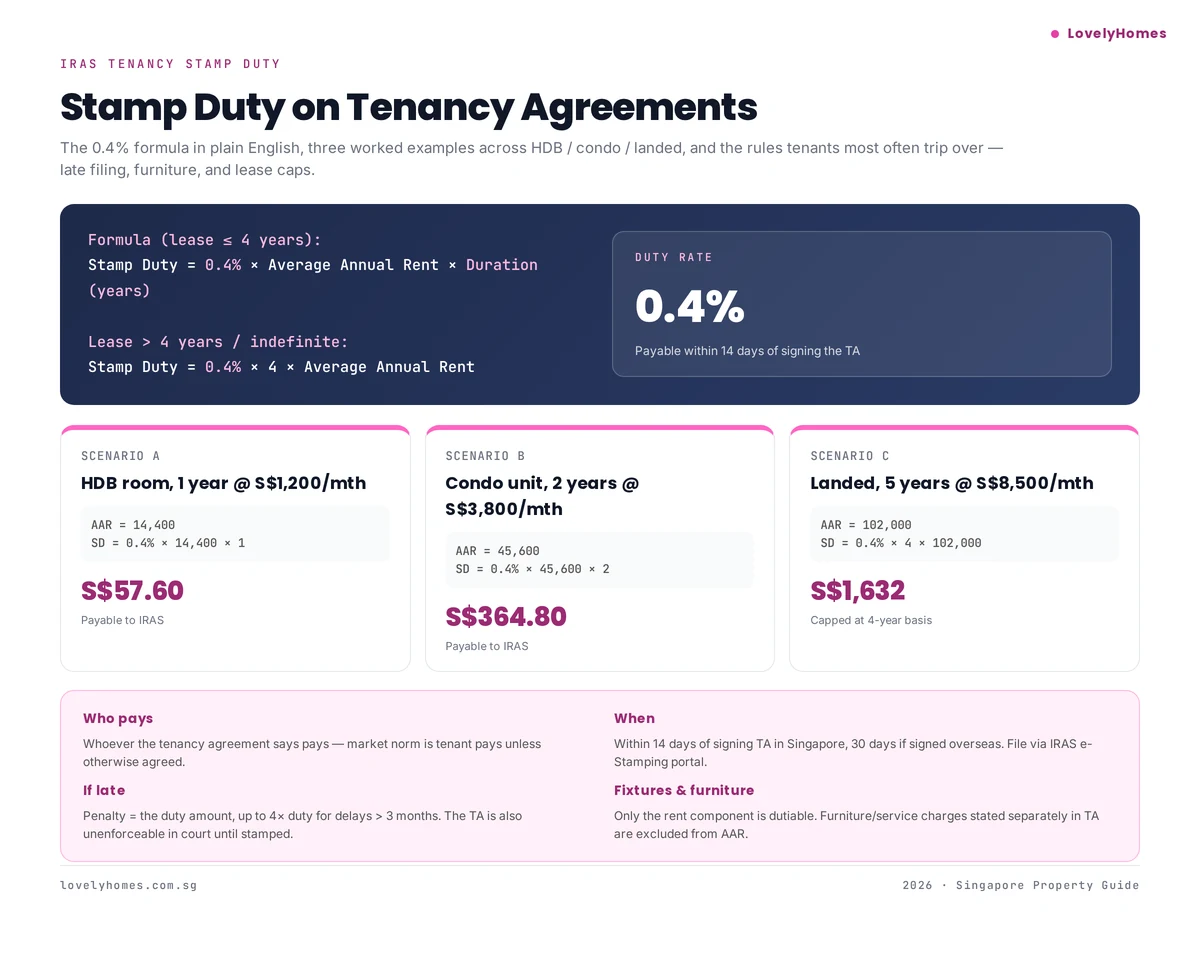
Is there stamp duty on a rental tenancy agreement in Singapore?
Yes, but it is much smaller than BSD or ABSD. Tenancy agreements in Singapore attract stamp duty under the Stamp Duties Act. The rate is S$1 per S$250 of annual rent for leases of 4 years or less, and a higher rate applies for longer tenancies. For a 2-year tenancy at S$4,000/month (S$48,000 annual rent), the stamp duty would be approximately S$192. Stamp duty on tenancy agreements is normally split between landlord and tenant by convention, unless the tenancy agreement specifies otherwise. Payment is via IRAS e-Stamping portal and must be completed within 14 days of execution.
Can foreigners engage a Singapore conveyancing lawyer and buy private property?
Yes. Foreigners may engage any Singapore-licensed advocate and solicitor to handle a private residential property conveyancing. Under the Residential Property Act, foreigners may purchase non-landed private residential properties (condos and apartments) without restriction. Landed property, including terrace houses, semi-detached, and detached houses, generally requires SLA approval for foreign buyers, with limited exceptions (e.g., Sentosa Cove). ABSD at 60% applies on any residential property purchase by a foreigner. Your conveyancing lawyer will advise on eligibility and the ABSD position at the outset of the transaction.