Singapore HDB MOP Guide 2026: Complete Minimum Occupation Period Rules Explained
💡 Quick Answer: Singapore HDB MOP 2026 — Key Facts
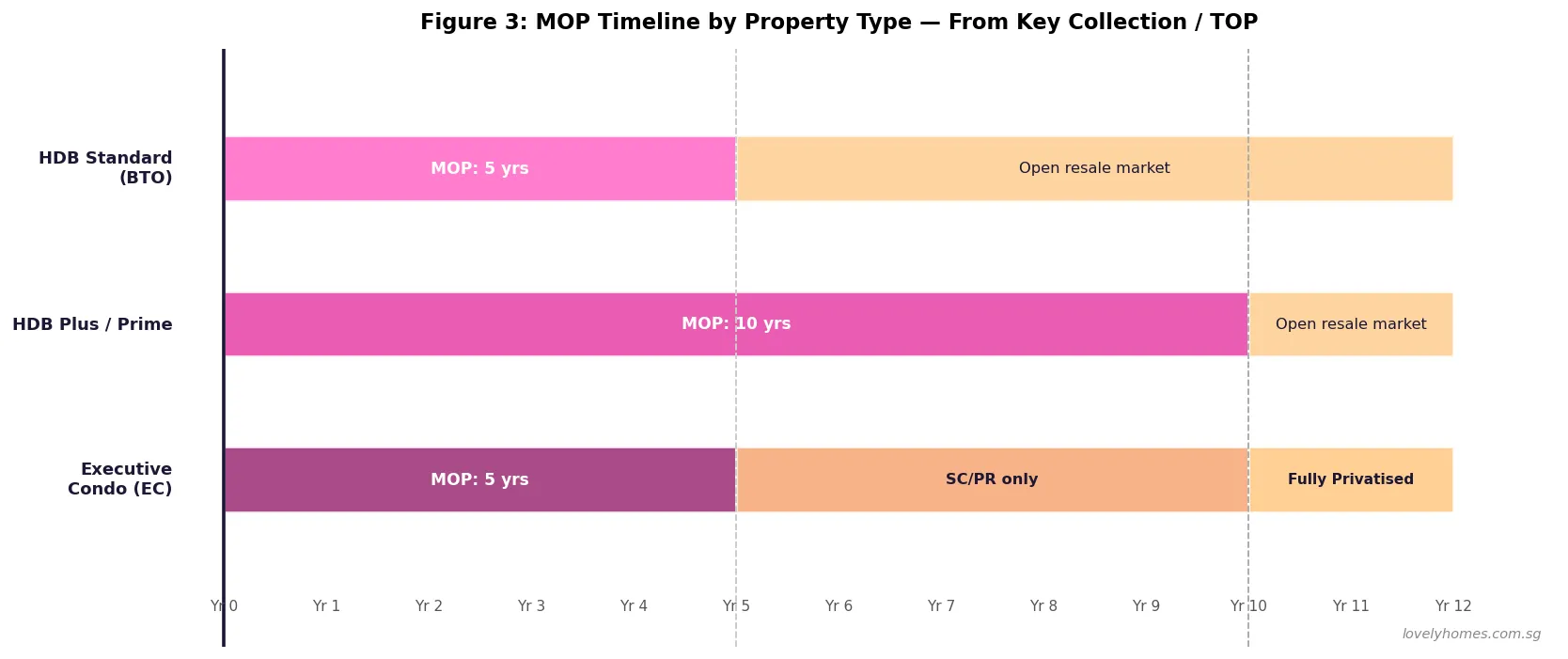
- Standard HDB BTO and resale flats carry a 5-year Minimum Occupation Period (MOP) counted from the date of key collection.
- HDB Plus and Prime classification flats (new BTO category from 2024) carry a stricter 10-year MOP, plus a subsidy clawback and no whole-flat rental after MOP.
- Executive Condominiums (ECs) have a 5-year MOP counted from TOP (Temporary Occupation Permit), after which ECs are treated as private property for resale purposes.
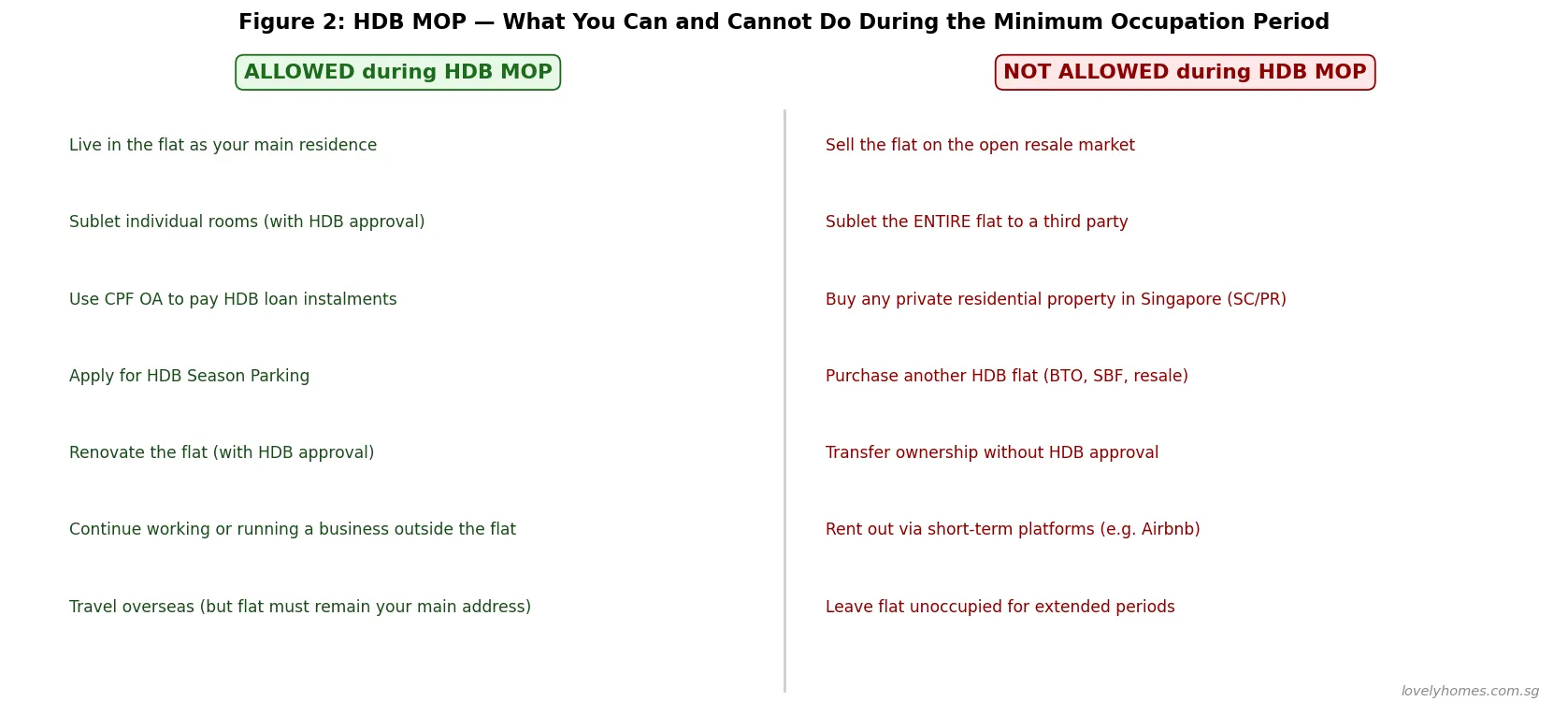
- During MOP you cannot sell the flat, sublet the entire unit, or (for subsidised buyers) purchase a private residential property.
- You can rent out individual bedrooms during MOP (with HDB written approval) and continue living in the flat.
- The MOP exists to ensure subsidised flats are used as genuine homes — not speculative assets — and to moderate the resale market.
- Buying a second property during MOP results in a 30-month wait before selling the HDB after disposing of the private property.
- From 9 May 2023, all new BTO applications are classified as Standard, Plus, or Prime — each with different MOP and post-MOP restrictions.
What Is the HDB Minimum Occupation Period (MOP)?
The Minimum Occupation Period — universally known in Singapore as the MOP — is the mandatory period during which an HDB flat owner must physically reside in the flat before being permitted to sell it on the open resale market. Administered by the Housing & Development Board (HDB), the MOP is one of the foundational pillars of Singapore’s public housing policy. It is designed to ensure that flats built with taxpayer subsidies are used as genuine long-term homes, rather than treated as short-term speculative assets.
The MOP also serves a market-stabilisation function. By requiring owners to live in their homes for a set period, HDB limits the volume of subsidised flats entering the resale market in any given year, moderating price volatility. The policy has its roots in Singapore’s earliest public housing schemes of the 1960s and has evolved considerably — most dramatically in 2024 when the Standard/Plus/Prime classification replaced the previous Mature/Non-Mature estate framework.
Understanding the MOP is essential for every HDB buyer: it determines when you can sell, when you can rent out your whole unit, and critically, when you are free to purchase a second (private) property without triggering HDB’s ownership restrictions.
MOP Duration by Property Type
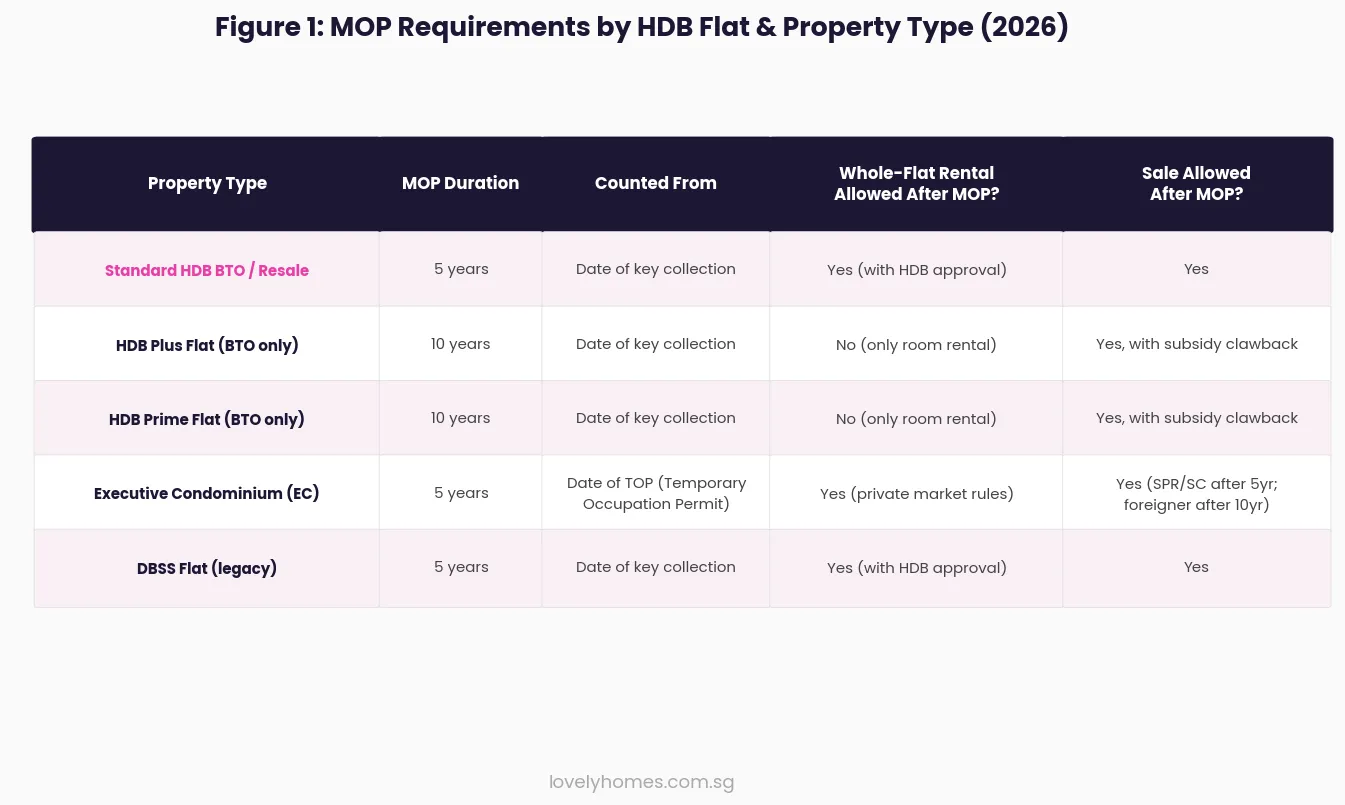
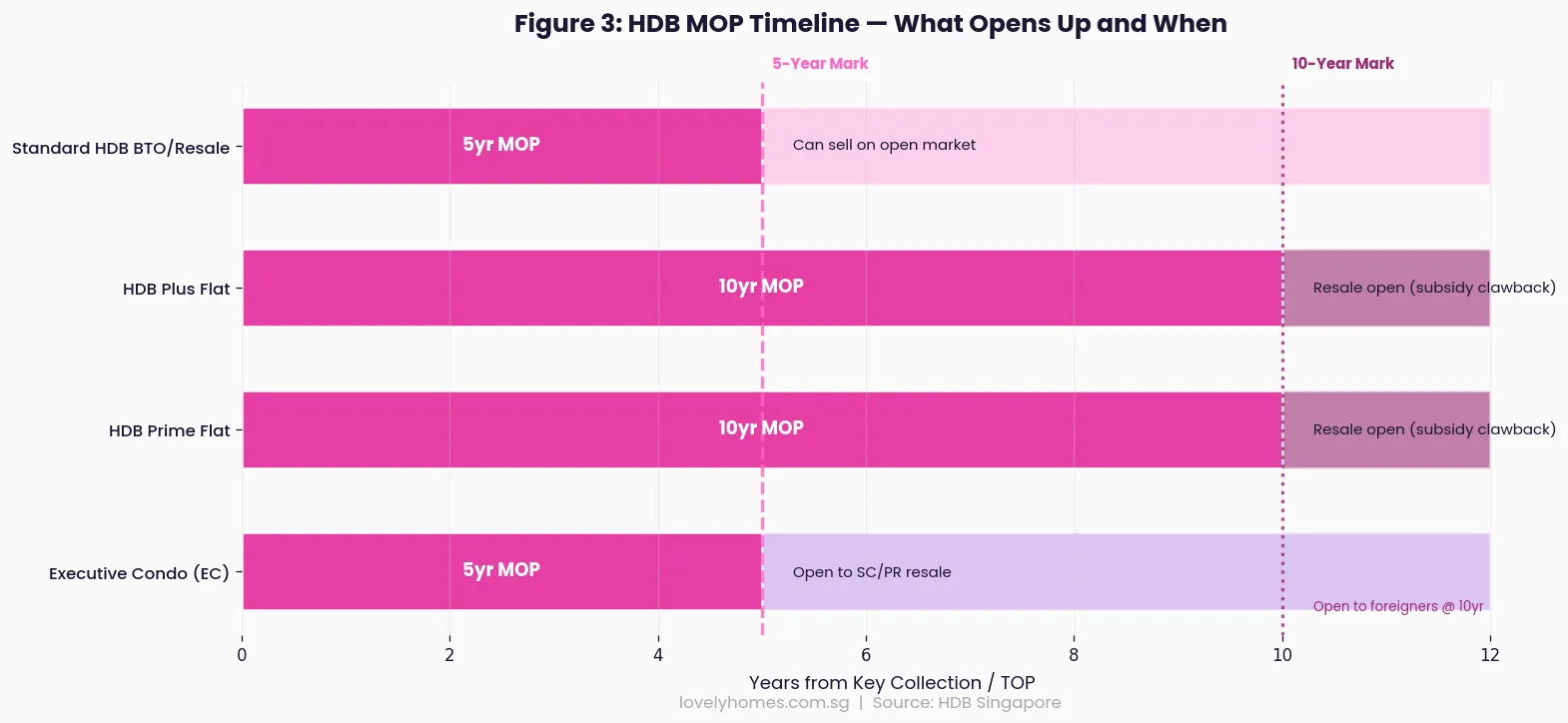
Not all HDB-related properties share the same MOP duration. Since the launch of the Standard/Plus/Prime classification on 9 May 2023 (with the first classified BTO exercises conducted under the new framework from October 2023), the MOP landscape has become more nuanced.
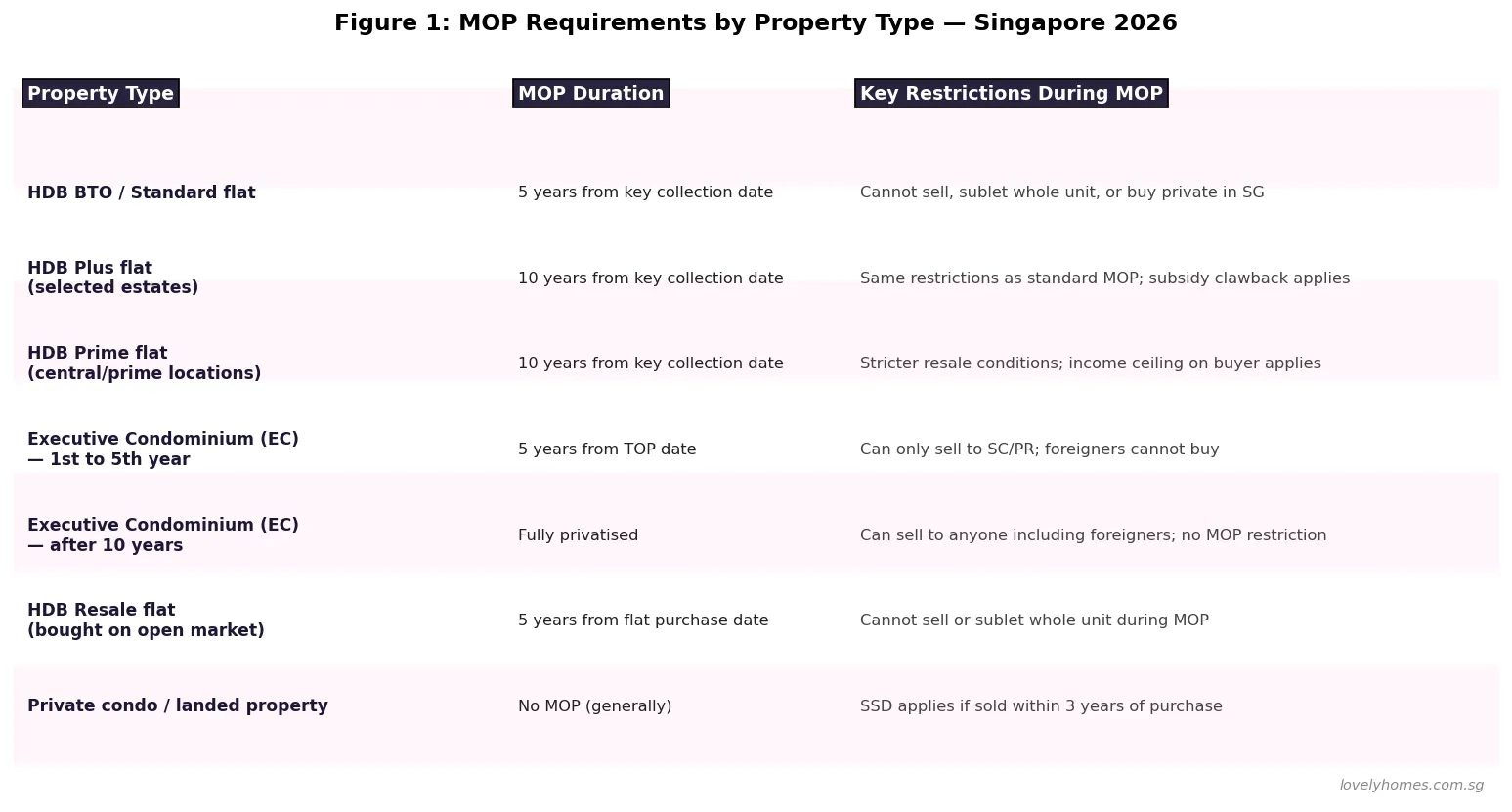
| Property Type | MOP Duration | Counted From | Whole-Unit Rental After MOP? |
|---|---|---|---|
| Standard HDB BTO or Resale Flat | 5 years | Date of key collection | Yes (HDB approval required) |
| HDB Plus Flat (BTO) | 10 years | Date of key collection | No — room rental only |
| HDB Prime Flat (BTO) | 10 years | Date of key collection | No — room rental only |
| Executive Condominium (EC) | 5 years | Date of TOP (Temporary Occupation Permit) | Yes (private market rules apply) |
| DBSS (Design, Build & Sell Scheme — legacy) | 5 years | Date of key collection | Yes (HDB approval required) |
The HDB Plus classification covers well-located flats in towns with good transport links and amenities but just below Prime estate thresholds — think Bishan, Buona Vista, or Queenstown non-central areas. The HDB Prime classification covers the most central and desirable locations such as Toa Payoh, Kallang/Whampoa, and Queenstown’s prime zones. Both carry the 10-year MOP and additional restrictions on whole-flat subletting, and come with a subsidy clawback upon resale: a percentage of the resale price (not profit) is returned to HDB to account for the higher subsidy received.
What You Can and Cannot Do During the MOP
The MOP restricts several key transactions and activities. Getting these wrong — particularly purchasing a private property during the MOP period — can result in HDB enforcement action, including compulsory acquisition of your flat at below-market value.
Key Restrictions During MOP
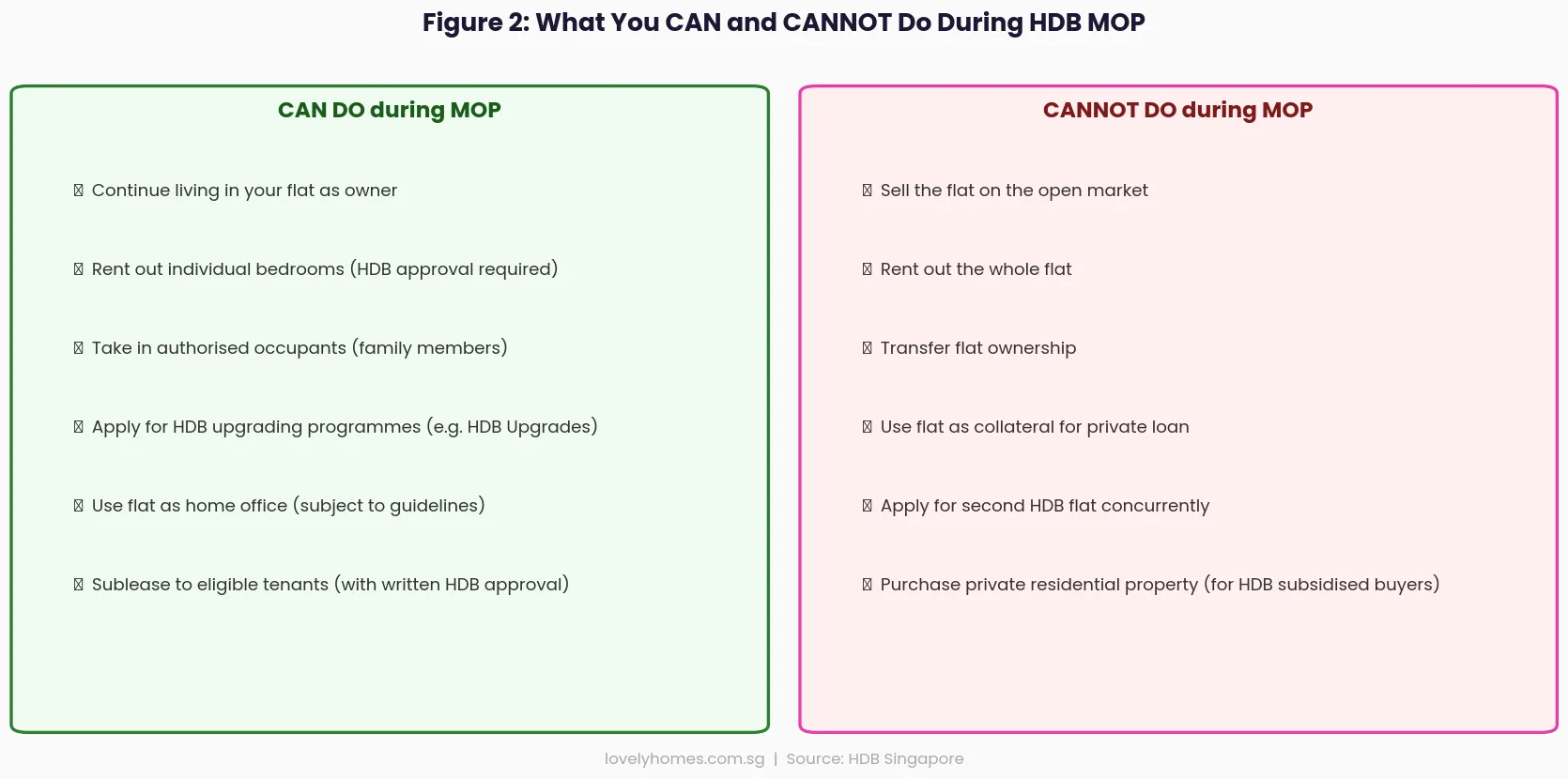
You cannot sell the flat. The resale market is closed to you until MOP is complete. This applies to open market sales, en-bloc sales, and transfers to family members (with limited exceptions for divorce, death, and court orders).
You cannot sublet the entire flat. Renting out the whole unit — including to a single tenant occupying the flat exclusively — is prohibited during MOP. However, you may rent out individual bedrooms (also called subletting of bedrooms), subject to written approval from HDB and compliance with the occupancy cap of six unrelated persons per flat.
You cannot purchase private residential property (for buyers who received a CPF housing grant or an HDB concessionary loan). If you do purchase a private property during the MOP, HDB requires you to dispose of the private property and imposes a 30-month wait before you can sell the HDB flat. This 30-month rule is a significant financial planning constraint for upgraders.
You must continue to occupy the flat. The flat must remain your principal place of residence throughout the MOP. Extended absences abroad — particularly for employment — require HDB’s prior approval. Owners who rent out their flat and relocate without approval risk having the MOP nullified and being found in breach of HDB’s conditions.
MOP for HDB Plus and Prime Flats: Stricter Rules
The introduction of the Standard/Plus/Prime classification in May 2023 was the most significant MOP reform in decades. For buyers who obtained a Plus or Prime flat — typically with a higher subsidy due to the desirable location — the MOP is doubled to 10 years. Furthermore:
- No whole-flat subletting after MOP. Even once the 10-year MOP is complete, Plus and Prime flat owners may only rent out individual bedrooms, not the entire flat. This restriction is permanent and attached to the flat.
- Subsidy clawback on resale. Upon selling a Plus or Prime flat after MOP, a percentage of the resale proceeds (calculated on the sale price, not the profit) is returned to HDB. The clawback rate is announced at the point of flat launch.
- Eligibility restrictions on resale buyers. Plus and Prime flats may only be sold to buyers who meet HDB eligibility criteria — they cannot be sold to single entities buying under the Singles scheme, for example, unless the Singles scheme conditions are met.
MOP for Special Circumstances
HDB recognises that life circumstances change, and provides specific provisions for situations that might otherwise create hardship:
Marriage during MOP. Where two HDB flat owners marry each other during the MOP, they may retain both flats only temporarily. They must dispose of one flat within six months of marriage. The flat they retain must complete its own MOP.
Divorce during MOP. A court order in divorce proceedings may direct the transfer of the matrimonial HDB flat to one party. HDB will generally approve such a transfer even during the MOP, though the transferred flat continues to be subject to the original MOP timeline.
Death of an owner during MOP. Transmission of ownership to a surviving co-owner or next-of-kin is permitted during MOP. The MOP clock does not restart upon inheritance.
Financial hardship. Owners facing genuine financial hardship — for example, inability to service the mortgage — may apply to HDB for special approval to sell the flat before MOP is complete. Such applications are assessed on a case-by-case basis and are rarely approved except in extreme circumstances.
En-bloc sale during MOP. If HDB or the government acquires your flat for redevelopment or SERS (Selective En bloc Redevelopment Scheme), the MOP requirement is waived. Eligible owners receive replacement flat offers or compensation.
Worked Example: The Rajan Family’s MOP Strategy
📍 The Rajan Family — Upgrading from BTO to Private Condo
Background: Mr and Mrs Rajan (both Singapore Citizens) collected the keys to their 4-Room Standard BTO flat in Tengah on 15 March 2022. They received an Enhanced CPF Housing Grant (EHG) of S$55,000 and took an HDB concessionary loan at 2.6% per annum. Their flat was purchased at S$380,000.
When can they sell?
MOP of 5 years from key collection = 15 March 2027 earliest.
Can they buy a condo before March 2027?
No — since they received the EHG grant and an HDB concessionary loan, purchasing a private residential property during MOP triggers HDB’s enforcement provisions. They must wait until MOP is complete before purchasing any private property.
Can they rent out bedrooms?
Yes — they can apply to HDB to sublet individual bedrooms. With a 4-room flat, they can rent out up to 2 bedrooms (HDB’s guideline: occupancy cap 6 persons total). Each 6-month subletting period requires renewed approval and must comply with tenant eligibility criteria (SC, PR, or eligible foreigners on Long-Term Visit Pass).
Financial snapshot at MOP completion (March 2027):
Estimated resale value: S$650,000 (median Tengah 4-room resale after MOP wave, estimated)
CPF OA used (principal + accrued interest): ~S$205,000
Outstanding HDB loan: ~S$178,000 (5 years repaid at S$1,234/mth)
Net cash proceeds: S$650,000 − S$205,000 − S$178,000 = ~S$267,000
No ABSD for first SC purchase. BSD on new private property of S$1.5M: S$44,600.
Effective upfront cash needed for private property: manageable given 5-year savings accumulation.
Why the MOP Matters: Strategic Implications for Upgraders
The MOP is not merely a restriction — it is a planning framework that every HDB owner should factor into their long-term property strategy. Singapore’s property upgrading ladder — the conventional pathway from BTO flat to private condominium — is entirely built around the MOP. Getting the timing right can mean the difference of tens of thousands of dollars in ABSD savings.
The critical consideration is the concurrency restriction: if you purchase a private property before your HDB flat’s MOP is complete, you must dispose of the private property within six months and wait 30 months before you can sell the HDB flat. This 30-month wait effectively extends your exposure by two and a half years. For buyers tempted to jump the gun on a desirable new launch, the financial cost is real and can be significant — particularly if the private property declines in value during the forced holding period.
For upgraders, the ideal sequence is: complete MOP → list HDB for sale → secure Option to Purchase on private property → exercise both concurrently. This sequence avoids any concurrent ownership of HDB and private property, and means no ABSD is payable on the private property purchase if the HDB sale is completed within six months.
Peer-country comparison: HDB Singapore‘s MOP is broadly analogous to the resale levy system in Hong Kong’s Home Ownership Scheme (HOS), but more flexible in that Singapore allows bedroom subletting during MOP. Australia’s equivalent — NDIS Participant Home Purchase — has a shorter 12-month occupancy requirement. Singapore’s 5-year MOP is considered globally as a well-calibrated balance between owner-occupancy intent and owner liquidity needs.
What Might Come Next: MOP Policy Outlook
The August 2024 rollout of the Standard/Plus/Prime framework introduced the 10-year MOP for Plus and Prime flats — a significant tightening. Industry observers and housing analysts note that further MOP reforms are unlikely in the near term, given that the current framework was itself a major structural change only recently implemented. However, several scenarios bear watching:
MOP for resale flats. Currently, resale HDB flats also carry a 5-year MOP from the resale purchase date. There has been policy debate about whether the MOP should be shorter for resale purchases (which are unsubsidised), but HDB has not signalled any change. A resale flat bought at market price still counts its MOP from key collection — a point often overlooked by first-time resale buyers who assume the previous owner’s MOP tenure transfers.
Private property purchase rules. The 30-month wait rule — introduced in September 2022 — was a cooling measure response to the strong public housing resale market. As market conditions evolve, HDB may revisit the 30-month wait, though any relaxation would likely signal that the resale market has moderated sufficiently.
Plus/Prime resale restrictions. The longer-term impact of Plus and Prime flat restrictions on the secondary market remains to be seen. Given the first Plus/Prime BTO exercises were conducted in late 2023, the first MOP completions for these flats will not occur until 2033–2034 at the earliest. The resale market effects are a decade away from being visible.
Frequently Asked Questions: HDB MOP Singapore 2026
Does the MOP reset if I take over an HDB flat from a family member?
It depends on the nature of the transfer. If you inherit the flat from a deceased owner, the MOP clock does not restart — you inherit the remaining MOP period. However, if you purchase a flat from a family member at arm’s length on the open resale market, your own 5-year MOP begins from the date you collect the keys. A transfer of ownership due to divorce via court order also does not restart the MOP. Any transfer that involves an element of HDB grant or concessionary loan triggers a fresh MOP assessment.
Can I buy a private property during HDB MOP without penalty?
Not if you received a CPF housing grant or an HDB concessionary loan for the flat. If you purchase a private residential property before your MOP is complete, HDB requires you to dispose of the private property within six months and imposes a 30-month wait before you can sell your HDB flat. If you purchased your HDB flat without any grant or HDB loan (i.e., a fully market-priced resale with private bank financing only), the private property restriction may not apply in the same way — but you should confirm this with HDB directly, as the rules are nuanced and case-specific.
What happens to my MOP if HDB acquires my flat through SERS or compulsory acquisition?
If HDB or a government body compulsorily acquires your flat — whether through the Selective En bloc Redevelopment Scheme (SERS), the Land Acquisition Act, or another statutory process — the MOP obligation is extinguished. You will receive either a replacement flat offer (under SERS) or statutory compensation at market value. You are not penalised for the early disposal because the initiative comes from the government, not the owner. A replacement SERS flat will carry its own fresh MOP from key collection.
How does the MOP work for an Executive Condominium (EC)?
ECs are a hybrid product — built and marketed by private developers but initially subject to HDB ownership rules. The MOP for an EC is 5 years, but it is counted from the date of the Temporary Occupation Permit (TOP) — not the key collection date or the signing of the Sale and Purchase Agreement. During the MOP, ECs may only be resold to Singapore Citizens and Permanent Residents who meet HDB eligibility criteria. After 5 years (MOP completion), the EC can be sold to any buyer including foreigners on the private market. After 10 years from TOP, the EC is fully privatised and treated identically to any private condominium for all purposes.
Can I apply for a second HDB flat while still within the MOP of my first flat?
Generally, no. HDB’s flat eligibility rules require you to dispose of your existing flat before or concurrent with purchasing a new one. You cannot hold two HDB flats simultaneously (with very limited exceptions, such as an interim period during SERS relocation). If you are still within your MOP, you cannot sell your current flat, which means you cannot apply for a new BTO flat either — unless you are eligible under specific joint-application provisions where the existing flat is earmarked for disposal. The practical implication: if you want to upgrade from your first BTO to a larger BTO or resale flat, you must complete the MOP first.
Does renting out bedrooms affect my MOP or eligibility?
Renting out individual bedrooms (subletting of bedrooms) is permitted during the MOP, subject to HDB written approval. It does not affect your MOP clock — the MOP continues to run from key collection regardless of subletting status. However, you must continue to physically occupy the flat yourself throughout the MOP period. HDB’s subletting approval requires the flat owner to be residing in the flat, and HDB conducts random inspections to verify compliance. Subletting the entire flat — even informally — while not residing there is a breach of the MOP conditions and can result in compulsory acquisition.
I bought my HDB resale flat recently. Does the previous owner’s MOP count toward mine?
No. When you purchase an HDB resale flat, your own 5-year MOP begins from the date you collect the keys, regardless of how long the previous owner held the flat. The MOP is an obligation tied to the current registered owner, not the flat itself. So if you purchased a resale flat in August 2026, your MOP will not be complete until August 2031 at the earliest — even if the previous owner had lived there for 20 years.