HDB Resale Records August 2026: Bedok South Horizon Hits S$1.45M, Pasir Ris One Breaks S$1.15M

HDB Resale Records August 2026: Bedok South Horizon Hits S$1.45M, Pasir Ris One Breaks S$1.15M

Quick Answer

  • A 5-room flat at 153B Bedok South Road (Bedok South Horizon) sold for S$1.45 million (S$1,192 psf) on 27 August 2026, the highest price ever paid for a 5-room flat in Bedok.
  • Two days earlier, on 25 August 2026, a 5-room Design, Build and Sell Scheme (DBSS) unit at 530D Pasir Ris Drive 1 (Pasir Ris One) sold for S$1.15 million (S$1,018 psf), beating the block’s prior 5-room record by S$167,000.
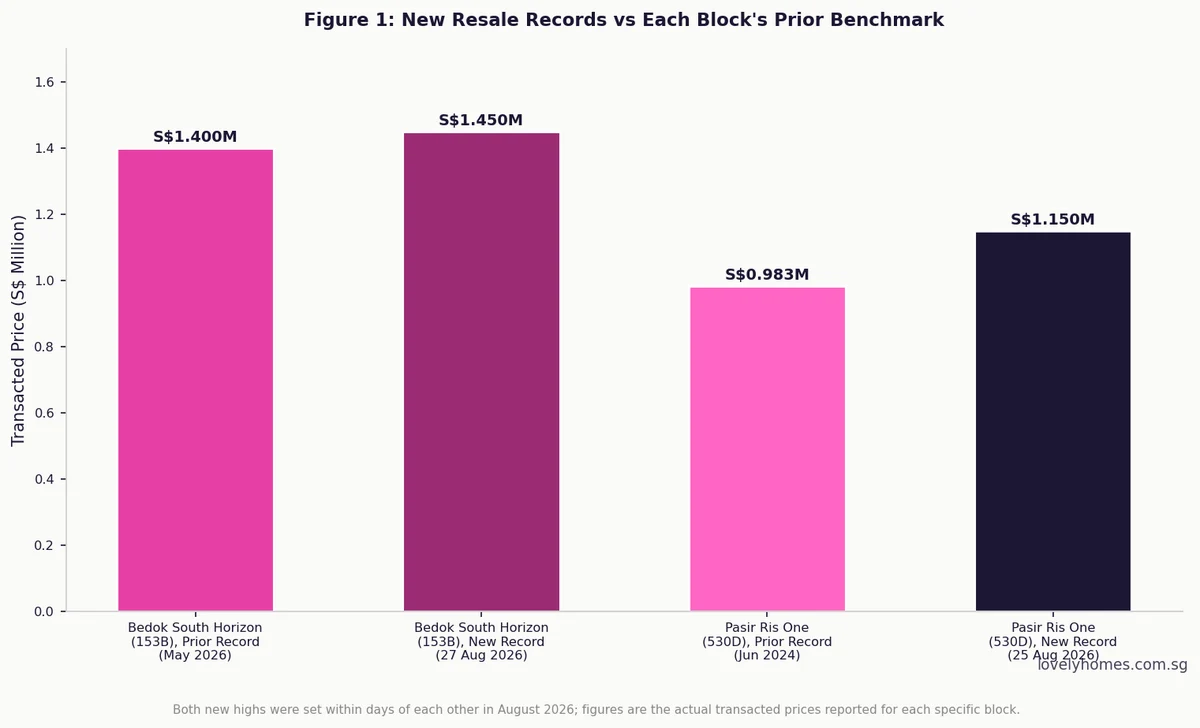
  • This is the second record that block 153B has produced in a single quarter; a unit in the same block sold for S$1.4 million in May 2026.
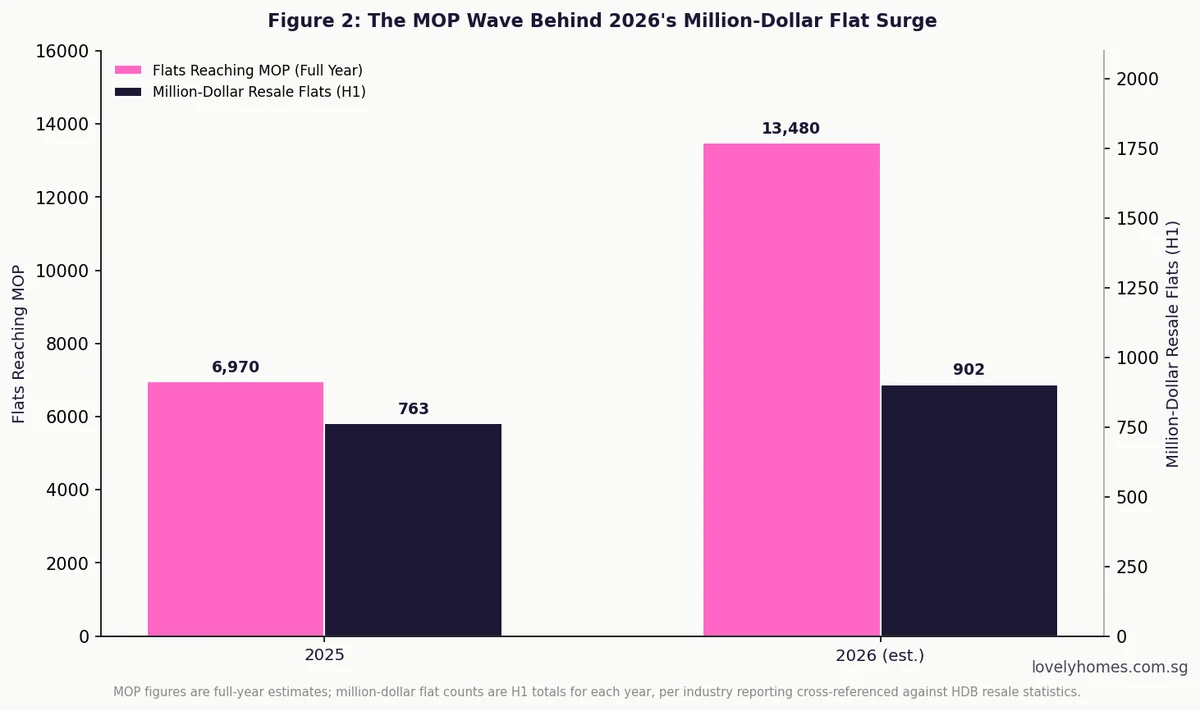
  • Both records land amid an unusually large Minimum Occupation Period (MOP) wave: an estimated 13,480 flats are expected to reach MOP in 2026, nearly double the roughly 6,970 in 2025.
  • Neither Bedok nor Pasir Ris is among the towns with the heaviest concentration of 2026 MOP completions, which are centred on Punggol, Tampines, Toa Payoh and Queenstown, making these two records more localised than estate-wide.
  • The removal of the 15-month wait-out period for private property owners buying a non-subsidised resale flat, announced 28 July 2026, reportedly saw enquiries for HDB flats above S$1 million jump 154% the following week.
  • Singapore’s most expensive HDB resale flat to date remains a 5-room unit at City Vue @ Henderson in Bukit Merah, which changed hands for S$1.728 million (S$1,421 psf) in April 2026.

Two Records, Two Estates, Days Apart

Singapore’s HDB resale market produced two fresh benchmark transactions in the space of a single week in late August 2026, in two towns that rarely feature in the usual million-dollar-flat headlines dominated by Toa Payoh, Bukit Merah and Queenstown. On 25 August, a 1,130 sqft 5-room Design, Build and Sell Scheme (DBSS) unit at 530D Pasir Ris Drive 1, part of the Pasir Ris One development, sold for S$1.15 million, working out to S$1,018 per square foot. Two days later, on 27 August, a larger 1,216 sqft 5-room flat at 153B Bedok South Road, within the Bedok South Horizon estate, sold for S$1.45 million, or S$1,192 per square foot, the highest price ever recorded for a 5-room flat in Bedok.
Bedok South Horizon and Pasir Ris One HDB resale new records versus prior benchmark
Figure 1: Both new resale records compared against each block’s prior benchmark.

153B Bedok South Road: A Second Record in a Single Quarter

What makes the Bedok South Horizon sale notable is not just the price itself, but that it is the second record-breaking sale the same block has produced within a single quarter. The previous benchmark at 153B was set only in May 2026, when a unit on a similar floor sold for S$1.4 million, itself a new high at the time. The neighbouring block, 153C Bedok South Road, has also contributed three further record-setting 5-room transactions between May and July 2026, changing hands at prices between S$1.28 million and S$1.38 million. The estate sits at the junction of Bedok South Road and Upper East Coast Road, within walking distance of the upcoming Bedok South MRT station on the Thomson-East Coast Line, which is due to open by the end of 2026, a connectivity upgrade that appears to be feeding directly into buyer willingness to pay.

Asking prices at the block have already moved to reflect the new benchmark: current listings at 153B run as high as S$1,518,888 (S$1,249 psf), with a unit at neighbouring 152C listed at S$1,438,888 (S$1,183 psf) and marketed on its unblocked views and newly-MOP status. Sellers at Bedok South Horizon appear to be treating S$1.45 million as a floor for negotiations rather than a ceiling, though whether buyers are actually willing to pay these asking prices remains to be seen in the coming weeks.

530D Pasir Ris Drive 1: A DBSS Rarity Breaks Its Own Ceiling

Pasir Ris One is one of only 13 Design, Build and Sell Scheme (DBSS) projects ever built in Singapore before the scheme was discontinued in 2011, a status that makes its flats a relatively scarce resale category in their own right. Completed in 2015 with 447 units, the development sits directly next to Pasir Ris MRT station, White Sands shopping mall and Pasir Ris Park. The new S$1.15 million transaction surpasses the block’s previous 5-room record of S$982,800, set in June 2024, by S$167,000, a jump that illustrates just how much unit-specific factors matter: a similarly sized ground-floor unit in the very same block changed hands for only S$920,000 in the same month, S$230,000 less than the record-setting unit, reflecting the premium buyers are willing to pay for a higher floor and better facing within an identical block.

Even with this new high, Pasir Ris’ overall priciest HDB resale transaction remains an executive maisonette at Block 531 Pasir Ris Drive 1, which fetched S$1.26 million (S$786 psf) in March 2026; the new 5-room record commands a higher price per square foot but still falls short of that unit’s total quantum.

Why the Records Are Landing Now: the 2026 MOP Wave

Both sales sit against the backdrop of an unusually large wave of flats reaching their Minimum Occupation Period (MOP) in 2026, estimated at around 13,480 flats, nearly double the roughly 6,970 units that reached MOP in 2025. Much of this new supply is concentrated in towns such as Punggol, Tampines, Toa Payoh and Queenstown, rather than Bedok or Pasir Ris, which suggests the Bedok and Pasir Ris records are a more localised phenomenon: relatively new, long-lease flats within these two specific estates testing how much buyers are willing to pay, rather than evidence of an estate-wide surge.

Separately, the removal of the 15-month wait-out period that previously applied to private property owners buying a non-subsidised HDB resale flat, announced on 28 July 2026, appears to have added fresh demand at the upper end of the resale market: enquiries for HDB flats priced above S$1 million reportedly jumped 154% in the week following the change. Taken together, these two records are part of a much larger surge in million-dollar HDB transactions: 902 resale flats crossed the million-dollar mark in the first half of 2026 alone, already ahead of the 763 recorded over the same period in 2025, putting 2026 on a pace that could challenge the full-year record of 1,594 million-dollar transactions set in 2025.
HDB MOP wave 2025 versus 2026 and million-dollar flat transactions
Figure 2: The MOP wave behind 2026’s million-dollar flat surge.

Summary: The Two Records at a Glance

Detail Bedok South Horizon Pasir Ris One
Address 153B Bedok South Road 530D Pasir Ris Drive 1
Sale date 27 August 2026 25 August 2026
Price S$1.45 million (S$1,192 psf) S$1.15 million (S$1,018 psf)
Flat size 1,216 sqft, 5-room 1,130 sqft, 5-room (DBSS)
Prior block record S$1.4 million (May 2026) S$982,800 (June 2024)
Margin over prior record +S$50,000 +S$167,200

Why This Matters for Buyers, Sellers and Nearby Owners

For owners in the immediate vicinity of either block, these transactions offer a genuine, if narrow, data point on what a well-located, higher-floor unit can now fetch, though it is worth being cautious about assuming the same premium applies to a lower floor, a different facing, or a different block within the same estate, given how much the Pasir Ris comparison between a top unit and a ground-floor unit in the same block illustrates that spread. For buyers, both records are a reminder that headline million-dollar transactions remain concentrated in specific, often newer or better-located blocks, rather than reflecting an estate-wide repricing, so a nearby listing at a similar asking price should still be evaluated on its own floor, facing, renovation condition and remaining lease. For the market more broadly, the fact that these two records emerged from towns outside the heaviest 2026 MOP concentration suggests demand for well-located, well-connected resale flats remains resilient even where new supply is not especially abundant.

What Might Come Next

The following is informed speculation, not confirmed policy. Given how quickly asking prices at 153B Bedok South Horizon have already moved above the new S$1.45 million benchmark, it is plausible that at least one further transaction at or above this level follows in the coming months if a buyer is found at these asking levels, though this is speculative. Similarly, at Pasir Ris One, it remains to be seen whether wider listings across the development adjust upward to reflect the new S$1.15 million benchmark, or whether this proves to be an isolated, unit-specific outcome; the current gap between recent asking prices and the new record suggests the market has not yet fully repriced as at this writing.

Frequently Asked Questions

What is a DBSS flat, and why does it matter for the Pasir Ris One sale?

Design, Build and Sell Scheme (DBSS) flats were built by private developers on HDB land under a scheme discontinued in 2011; only 13 such projects were ever built, making them a scarce resale category, which supports stronger pricing for well-located examples like Pasir Ris One.

Does this mean HDB flats in Bedok and Pasir Ris are now all worth over a million dollars?

No. Both records are specific to a single well-located, higher-floor unit within one block; a nearby flat with a different floor, facing or lease profile should not be assumed to command the same price.

What is Singapore’s highest-ever HDB resale price?

A 5-room unit at City Vue @ Henderson in Bukit Merah, which sold for S$1.728 million (S$1,421 psf) in April 2026, remains the record; neither the Bedok nor the Pasir Ris sale comes close to this figure.

What is the MOP wave, and why is it relevant here?

An estimated 13,480 HDB flats are expected to reach their Minimum Occupation Period in 2026, nearly double 2025’s figure, broadening the pool of relatively new, long-lease resale flats coming onto the market, though this wave is concentrated in different towns from Bedok and Pasir Ris.

Why did HDB resale enquiries above S$1 million jump in mid-2026?

The removal of the 15-month wait-out period for private property owners buying a non-subsidised resale flat, announced 28 July 2026, reportedly saw enquiries for HDB flats above S$1 million rise 154% in the following week.

Is the overall HDB resale market still rising as fast as these records suggest?

Not necessarily. The HDB Resale Price Index recorded its first quarterly decline since Q2 2019 in Q1 2026, even as a narrow band of premium transactions continued to set fresh records, showing the two trends can coexist.

Where can I check current HDB resale transaction prices myself?

HDB publishes resale transaction data, including price, floor level range and remaining lease, through its official resale flat prices e-service, which is the most reliable source for verifying any specific block or estate.

Disclaimer: This article is for general informational purposes only and does not constitute property investment advice. Transaction prices and market figures are drawn from publicly reported resale transactions and industry commentary current as at the time of writing and are subject to revision. Always verify current transaction data via the Housing and Development Board (HDB) resale portal before making any decision.
×

Click anywhere outside to close

Singapore HDB MOP Guide 2026: Complete Minimum Occupation Period Rules Explained

Singapore HDB MOP Guide 2026: Complete Minimum Occupation Period Rules Explained

💡 Quick Answer: Singapore HDB MOP 2026 — Key Facts

  • Standard HDB BTO and resale flats carry a 5-year Minimum Occupation Period (MOP) counted from the date of key collection.
  • HDB Plus and Prime classification flats (new BTO category from 2024) carry a stricter 10-year MOP, plus a subsidy clawback and no whole-flat rental after MOP.
  • Executive Condominiums (ECs) have a 5-year MOP counted from TOP (Temporary Occupation Permit), after which ECs are treated as private property for resale purposes.
  • During MOP you cannot sell the flat, sublet the entire unit, or (for subsidised buyers) purchase a private residential property.
  • You can rent out individual bedrooms during MOP (with HDB written approval) and continue living in the flat.
  • The MOP exists to ensure subsidised flats are used as genuine homes — not speculative assets — and to moderate the resale market.
  • Buying a second property during MOP results in a 30-month wait before selling the HDB after disposing of the private property.
  • From 9 May 2023, all new BTO applications are classified as Standard, Plus, or Prime — each with different MOP and post-MOP restrictions.

What Is the HDB Minimum Occupation Period (MOP)?

The Minimum Occupation Period — universally known in Singapore as the MOP — is the mandatory period during which an HDB flat owner must physically reside in the flat before being permitted to sell it on the open resale market. Administered by the Housing & Development Board (HDB), the MOP is one of the foundational pillars of Singapore’s public housing policy. It is designed to ensure that flats built with taxpayer subsidies are used as genuine long-term homes, rather than treated as short-term speculative assets.

The MOP also serves a market-stabilisation function. By requiring owners to live in their homes for a set period, HDB limits the volume of subsidised flats entering the resale market in any given year, moderating price volatility. The policy has its roots in Singapore’s earliest public housing schemes of the 1960s and has evolved considerably — most dramatically in 2024 when the Standard/Plus/Prime classification replaced the previous Mature/Non-Mature estate framework.

Understanding the MOP is essential for every HDB buyer: it determines when you can sell, when you can rent out your whole unit, and critically, when you are free to purchase a second (private) property without triggering HDB’s ownership restrictions.

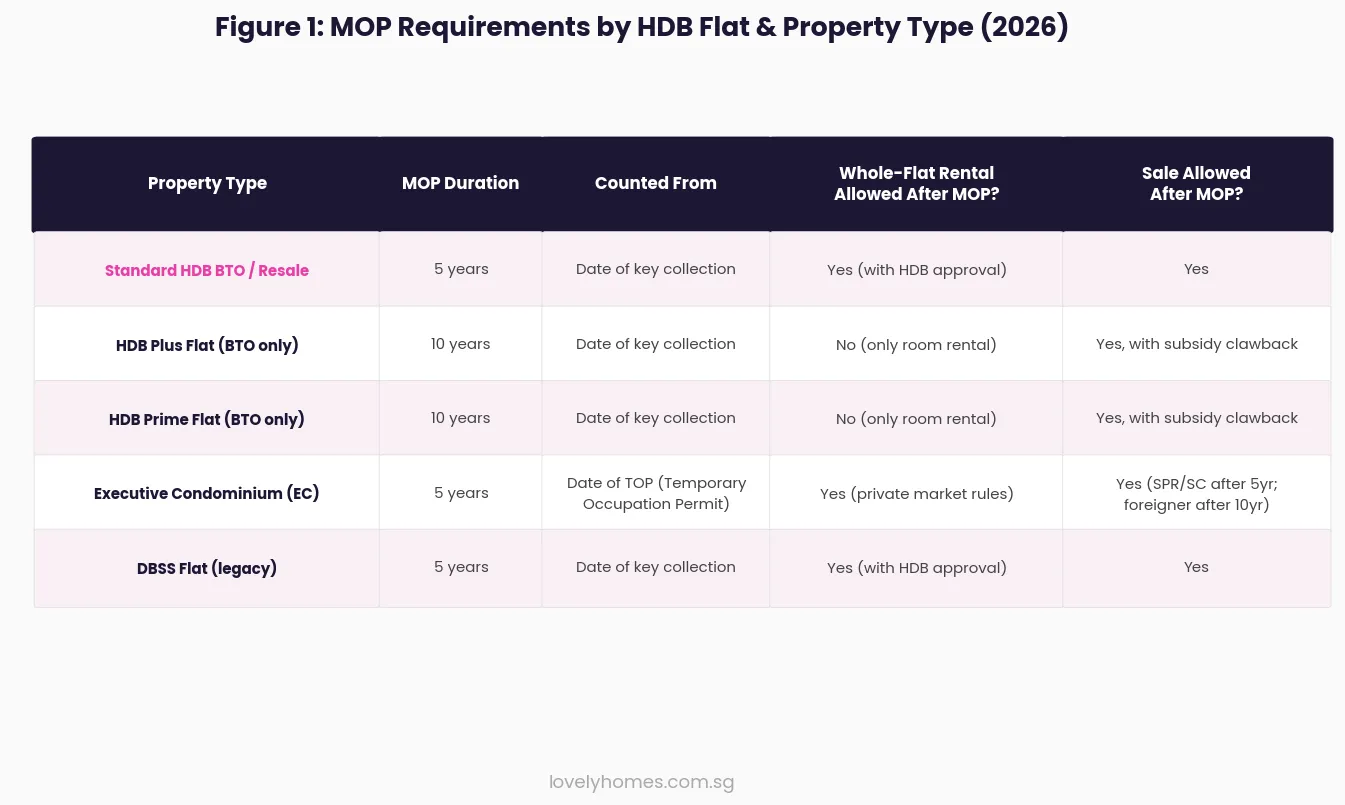
HDB MOP requirements table by flat type Singapore 2026 — Standard HDB 5 years, Plus and Prime 10 years, EC 5 years from TOP
Figure 1: MOP Requirements by HDB Flat & Property Type 2026 — Source: HDB Singapore. Click to enlarge.

MOP Duration by Property Type

Not all HDB-related properties share the same MOP duration. Since the launch of the Standard/Plus/Prime classification on 9 May 2023 (with the first classified BTO exercises conducted under the new framework from October 2023), the MOP landscape has become more nuanced.

Property Type MOP Duration Counted From Whole-Unit Rental After MOP?
Standard HDB BTO or Resale Flat 5 years Date of key collection Yes (HDB approval required)
HDB Plus Flat (BTO) 10 years Date of key collection No — room rental only
HDB Prime Flat (BTO) 10 years Date of key collection No — room rental only
Executive Condominium (EC) 5 years Date of TOP (Temporary Occupation Permit) Yes (private market rules apply)
DBSS (Design, Build & Sell Scheme — legacy) 5 years Date of key collection Yes (HDB approval required)

The HDB Plus classification covers well-located flats in towns with good transport links and amenities but just below Prime estate thresholds — think Bishan, Buona Vista, or Queenstown non-central areas. The HDB Prime classification covers the most central and desirable locations such as Toa Payoh, Kallang/Whampoa, and Queenstown’s prime zones. Both carry the 10-year MOP and additional restrictions on whole-flat subletting, and come with a subsidy clawback upon resale: a percentage of the resale price (not profit) is returned to HDB to account for the higher subsidy received.

What You Can and Cannot Do During the MOP

The MOP restricts several key transactions and activities. Getting these wrong — particularly purchasing a private property during the MOP period — can result in HDB enforcement action, including compulsory acquisition of your flat at below-market value.

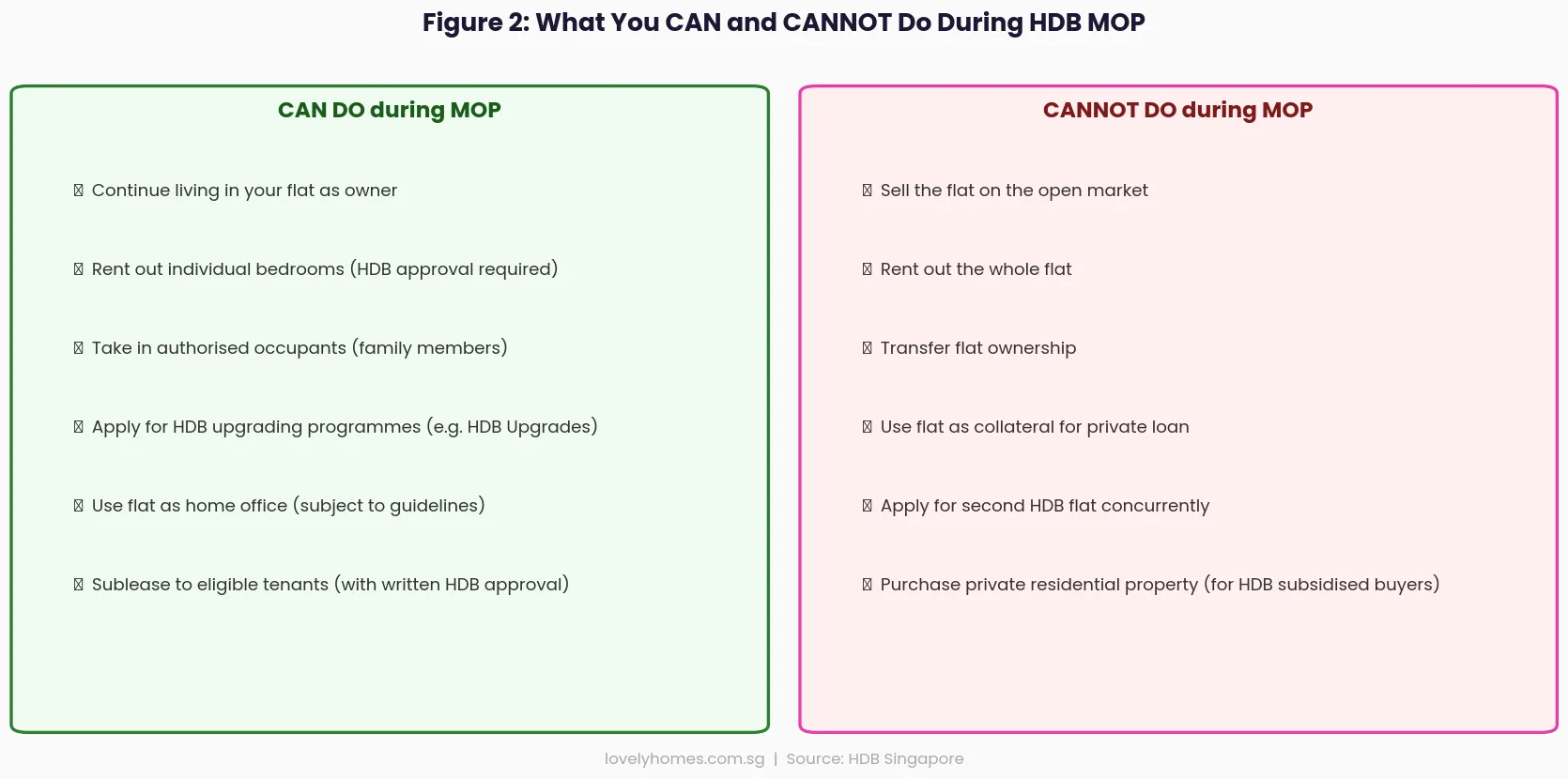
What you can and cannot do during HDB MOP Singapore 2026 — permitted activities vs prohibited activities during Minimum Occupation Period
Figure 2: Permitted vs Prohibited Activities During HDB MOP 2026 — Source: HDB Singapore. Click to enlarge.

Key Restrictions During MOP

You cannot sell the flat. The resale market is closed to you until MOP is complete. This applies to open market sales, en-bloc sales, and transfers to family members (with limited exceptions for divorce, death, and court orders).

You cannot sublet the entire flat. Renting out the whole unit — including to a single tenant occupying the flat exclusively — is prohibited during MOP. However, you may rent out individual bedrooms (also called subletting of bedrooms), subject to written approval from HDB and compliance with the occupancy cap of six unrelated persons per flat.

You cannot purchase private residential property (for buyers who received a CPF housing grant or an HDB concessionary loan). If you do purchase a private property during the MOP, HDB requires you to dispose of the private property and imposes a 30-month wait before you can sell the HDB flat. This 30-month rule is a significant financial planning constraint for upgraders.

You must continue to occupy the flat. The flat must remain your principal place of residence throughout the MOP. Extended absences abroad — particularly for employment — require HDB’s prior approval. Owners who rent out their flat and relocate without approval risk having the MOP nullified and being found in breach of HDB’s conditions.

MOP for HDB Plus and Prime Flats: Stricter Rules

The introduction of the Standard/Plus/Prime classification in May 2023 was the most significant MOP reform in decades. For buyers who obtained a Plus or Prime flat — typically with a higher subsidy due to the desirable location — the MOP is doubled to 10 years. Furthermore:

  • No whole-flat subletting after MOP. Even once the 10-year MOP is complete, Plus and Prime flat owners may only rent out individual bedrooms, not the entire flat. This restriction is permanent and attached to the flat.
  • Subsidy clawback on resale. Upon selling a Plus or Prime flat after MOP, a percentage of the resale proceeds (calculated on the sale price, not the profit) is returned to HDB. The clawback rate is announced at the point of flat launch.
  • Eligibility restrictions on resale buyers. Plus and Prime flats may only be sold to buyers who meet HDB eligibility criteria — they cannot be sold to single entities buying under the Singles scheme, for example, unless the Singles scheme conditions are met.
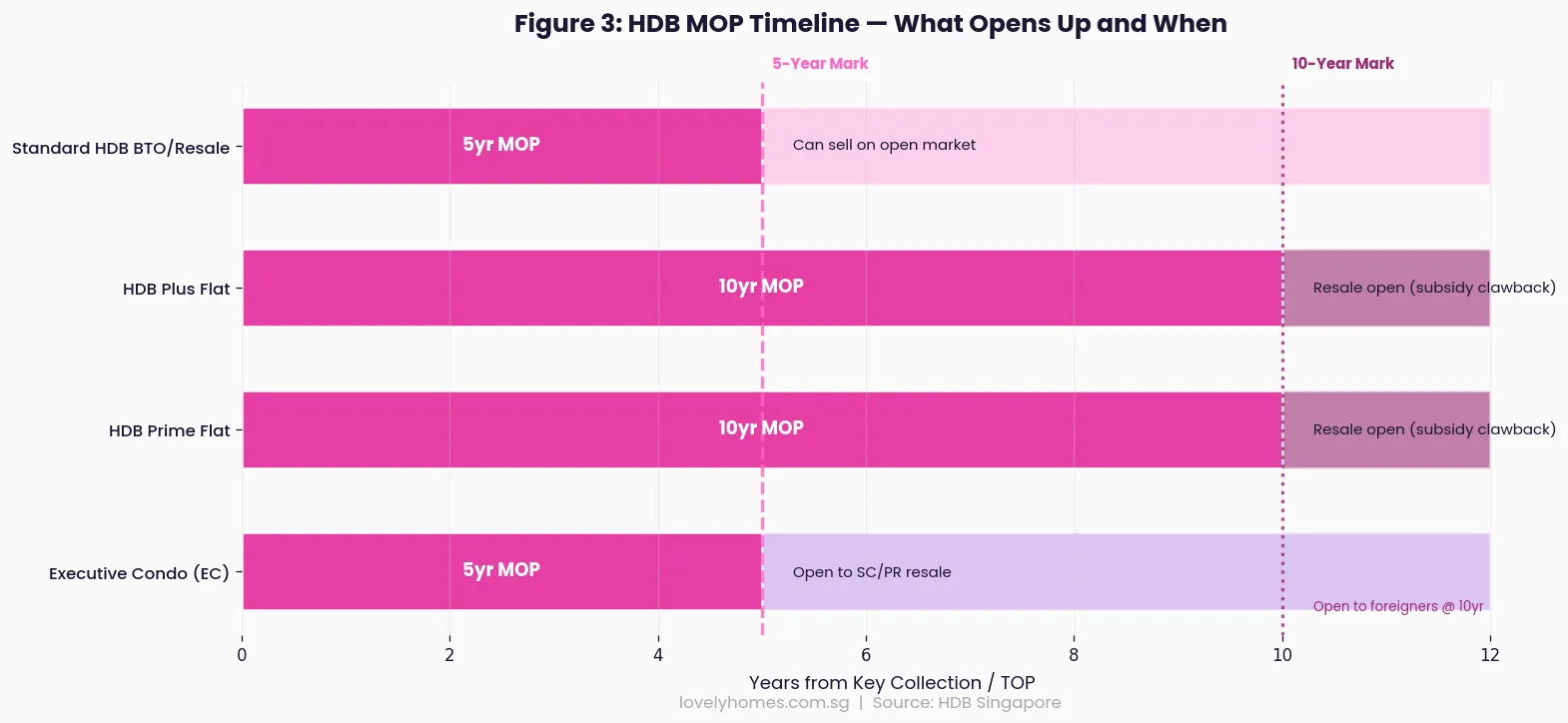
HDB MOP timeline chart showing when each HDB flat type and EC can be sold or rented — Standard 5 years, Plus/Prime 10 years, EC 5 years from TOP
Figure 3: HDB MOP Timeline — When Each Property Type Opens for Sale or Rental 2026 — Source: HDB Singapore. Click to enlarge.

MOP for Special Circumstances

HDB recognises that life circumstances change, and provides specific provisions for situations that might otherwise create hardship:

Marriage during MOP. Where two HDB flat owners marry each other during the MOP, they may retain both flats only temporarily. They must dispose of one flat within six months of marriage. The flat they retain must complete its own MOP.

Divorce during MOP. A court order in divorce proceedings may direct the transfer of the matrimonial HDB flat to one party. HDB will generally approve such a transfer even during the MOP, though the transferred flat continues to be subject to the original MOP timeline.

Death of an owner during MOP. Transmission of ownership to a surviving co-owner or next-of-kin is permitted during MOP. The MOP clock does not restart upon inheritance.

Financial hardship. Owners facing genuine financial hardship — for example, inability to service the mortgage — may apply to HDB for special approval to sell the flat before MOP is complete. Such applications are assessed on a case-by-case basis and are rarely approved except in extreme circumstances.

En-bloc sale during MOP. If HDB or the government acquires your flat for redevelopment or SERS (Selective En bloc Redevelopment Scheme), the MOP requirement is waived. Eligible owners receive replacement flat offers or compensation.

Worked Example: The Rajan Family’s MOP Strategy

📍 The Rajan Family — Upgrading from BTO to Private Condo

Background: Mr and Mrs Rajan (both Singapore Citizens) collected the keys to their 4-Room Standard BTO flat in Tengah on 15 March 2022. They received an Enhanced CPF Housing Grant (EHG) of S$55,000 and took an HDB concessionary loan at 2.6% per annum. Their flat was purchased at S$380,000.

When can they sell?
MOP of 5 years from key collection = 15 March 2027 earliest.

Can they buy a condo before March 2027?
No — since they received the EHG grant and an HDB concessionary loan, purchasing a private residential property during MOP triggers HDB’s enforcement provisions. They must wait until MOP is complete before purchasing any private property.

Can they rent out bedrooms?
Yes — they can apply to HDB to sublet individual bedrooms. With a 4-room flat, they can rent out up to 2 bedrooms (HDB’s guideline: occupancy cap 6 persons total). Each 6-month subletting period requires renewed approval and must comply with tenant eligibility criteria (SC, PR, or eligible foreigners on Long-Term Visit Pass).

Financial snapshot at MOP completion (March 2027):
Estimated resale value: S$650,000 (median Tengah 4-room resale after MOP wave, estimated)
CPF OA used (principal + accrued interest): ~S$205,000
Outstanding HDB loan: ~S$178,000 (5 years repaid at S$1,234/mth)
Net cash proceeds: S$650,000 − S$205,000 − S$178,000 = ~S$267,000
No ABSD for first SC purchase. BSD on new private property of S$1.5M: S$44,600.
Effective upfront cash needed for private property: manageable given 5-year savings accumulation.

Why the MOP Matters: Strategic Implications for Upgraders

The MOP is not merely a restriction — it is a planning framework that every HDB owner should factor into their long-term property strategy. Singapore’s property upgrading ladder — the conventional pathway from BTO flat to private condominium — is entirely built around the MOP. Getting the timing right can mean the difference of tens of thousands of dollars in ABSD savings.

The critical consideration is the concurrency restriction: if you purchase a private property before your HDB flat’s MOP is complete, you must dispose of the private property within six months and wait 30 months before you can sell the HDB flat. This 30-month wait effectively extends your exposure by two and a half years. For buyers tempted to jump the gun on a desirable new launch, the financial cost is real and can be significant — particularly if the private property declines in value during the forced holding period.

For upgraders, the ideal sequence is: complete MOP → list HDB for sale → secure Option to Purchase on private property → exercise both concurrently. This sequence avoids any concurrent ownership of HDB and private property, and means no ABSD is payable on the private property purchase if the HDB sale is completed within six months.

Peer-country comparison: HDB Singapore‘s MOP is broadly analogous to the resale levy system in Hong Kong’s Home Ownership Scheme (HOS), but more flexible in that Singapore allows bedroom subletting during MOP. Australia’s equivalent — NDIS Participant Home Purchase — has a shorter 12-month occupancy requirement. Singapore’s 5-year MOP is considered globally as a well-calibrated balance between owner-occupancy intent and owner liquidity needs.

What Might Come Next: MOP Policy Outlook

The August 2024 rollout of the Standard/Plus/Prime framework introduced the 10-year MOP for Plus and Prime flats — a significant tightening. Industry observers and housing analysts note that further MOP reforms are unlikely in the near term, given that the current framework was itself a major structural change only recently implemented. However, several scenarios bear watching:

MOP for resale flats. Currently, resale HDB flats also carry a 5-year MOP from the resale purchase date. There has been policy debate about whether the MOP should be shorter for resale purchases (which are unsubsidised), but HDB has not signalled any change. A resale flat bought at market price still counts its MOP from key collection — a point often overlooked by first-time resale buyers who assume the previous owner’s MOP tenure transfers.

Private property purchase rules. The 30-month wait rule — introduced in September 2022 — was a cooling measure response to the strong public housing resale market. As market conditions evolve, HDB may revisit the 30-month wait, though any relaxation would likely signal that the resale market has moderated sufficiently.

Plus/Prime resale restrictions. The longer-term impact of Plus and Prime flat restrictions on the secondary market remains to be seen. Given the first Plus/Prime BTO exercises were conducted in late 2023, the first MOP completions for these flats will not occur until 2033–2034 at the earliest. The resale market effects are a decade away from being visible.

Frequently Asked Questions: HDB MOP Singapore 2026

Does the MOP reset if I take over an HDB flat from a family member?

It depends on the nature of the transfer. If you inherit the flat from a deceased owner, the MOP clock does not restart — you inherit the remaining MOP period. However, if you purchase a flat from a family member at arm’s length on the open resale market, your own 5-year MOP begins from the date you collect the keys. A transfer of ownership due to divorce via court order also does not restart the MOP. Any transfer that involves an element of HDB grant or concessionary loan triggers a fresh MOP assessment.

Can I buy a private property during HDB MOP without penalty?

Not if you received a CPF housing grant or an HDB concessionary loan for the flat. If you purchase a private residential property before your MOP is complete, HDB requires you to dispose of the private property within six months and imposes a 30-month wait before you can sell your HDB flat. If you purchased your HDB flat without any grant or HDB loan (i.e., a fully market-priced resale with private bank financing only), the private property restriction may not apply in the same way — but you should confirm this with HDB directly, as the rules are nuanced and case-specific.

What happens to my MOP if HDB acquires my flat through SERS or compulsory acquisition?

If HDB or a government body compulsorily acquires your flat — whether through the Selective En bloc Redevelopment Scheme (SERS), the Land Acquisition Act, or another statutory process — the MOP obligation is extinguished. You will receive either a replacement flat offer (under SERS) or statutory compensation at market value. You are not penalised for the early disposal because the initiative comes from the government, not the owner. A replacement SERS flat will carry its own fresh MOP from key collection.

How does the MOP work for an Executive Condominium (EC)?

ECs are a hybrid product — built and marketed by private developers but initially subject to HDB ownership rules. The MOP for an EC is 5 years, but it is counted from the date of the Temporary Occupation Permit (TOP) — not the key collection date or the signing of the Sale and Purchase Agreement. During the MOP, ECs may only be resold to Singapore Citizens and Permanent Residents who meet HDB eligibility criteria. After 5 years (MOP completion), the EC can be sold to any buyer including foreigners on the private market. After 10 years from TOP, the EC is fully privatised and treated identically to any private condominium for all purposes.

Can I apply for a second HDB flat while still within the MOP of my first flat?

Generally, no. HDB’s flat eligibility rules require you to dispose of your existing flat before or concurrent with purchasing a new one. You cannot hold two HDB flats simultaneously (with very limited exceptions, such as an interim period during SERS relocation). If you are still within your MOP, you cannot sell your current flat, which means you cannot apply for a new BTO flat either — unless you are eligible under specific joint-application provisions where the existing flat is earmarked for disposal. The practical implication: if you want to upgrade from your first BTO to a larger BTO or resale flat, you must complete the MOP first.

Does renting out bedrooms affect my MOP or eligibility?

Renting out individual bedrooms (subletting of bedrooms) is permitted during the MOP, subject to HDB written approval. It does not affect your MOP clock — the MOP continues to run from key collection regardless of subletting status. However, you must continue to physically occupy the flat yourself throughout the MOP period. HDB’s subletting approval requires the flat owner to be residing in the flat, and HDB conducts random inspections to verify compliance. Subletting the entire flat — even informally — while not residing there is a breach of the MOP conditions and can result in compulsory acquisition.

I bought my HDB resale flat recently. Does the previous owner’s MOP count toward mine?

No. When you purchase an HDB resale flat, your own 5-year MOP begins from the date you collect the keys, regardless of how long the previous owner held the flat. The MOP is an obligation tied to the current registered owner, not the flat itself. So if you purchased a resale flat in August 2026, your MOP will not be complete until August 2031 at the earliest — even if the previous owner had lived there for 20 years.

Disclaimer: This article is intended for general informational purposes only and does not constitute legal, financial, or property advice. HDB rules and policies change regularly — always verify the latest requirements at HDB.gov.sg and consult a licensed property agent or HDB directly for guidance specific to your situation. Stamp duty information is subject to change; verify with IRAS. CPF usage rules should be confirmed with the CPF Board.
×

Click anywhere or press Esc to close

HDB Resale Market Q1 2026: First Price Decline in 7 Years — What It Means for Buyers and Sellers

HDB Resale Market Q1 2026: First Price Decline in 7 Years — What It Means for Buyers and Sellers

For the first time in nearly seven years, Singapore’s HDB resale prices fell — even if only fractionally. HDB’s Q1 2026 Public Housing Statistics, released in April 2026, showed the Resale Price Index (RPI) declining 0.1% quarter-on-quarter to 203.4, the first quarterly dip since Q2 2019. The data paints a nuanced picture: overall resale volumes are cooling, year-on-year price growth has slowed sharply to just 1.2%, and yet million-dollar transactions reached a record 412 in Q1 2026 — a paradox that reveals the two-speed market now operating in Singapore’s public housing segment.

Quick Answer — HDB Resale Q1 2026 at a Glance

  • HDB Resale Price Index (RPI): 203.4 — down 0.1% q-o-q (first quarterly decline since Q2 2019).
  • Year-on-year price growth: +1.2% — the slowest since Q3 2023.
  • Transaction volume: 6,179 resale transactions — down 4.5% year-on-year.
  • Million-dollar transactions: 412 in Q1 2026 — a record high.
  • MOP wave: approximately 13,480 HDB flats reached their 5-year MOP in 2026, nearly double the 2025 figure.
  • Private rental market linkage: rental softening is reducing the “upgrade and rent out HDB” incentive for some owners, contributing to reduced speculative resale demand.
  • Policy context: the Plus and Prime classification system (introduced in August 2023) is reshaping buyer segmentation as the first Plus/Prime resale eligibility windows approach.

The RPI Decline in Context: Seven Years of Unbroken Growth

From Q3 2019 onwards, the HDB Resale Price Index rose every single quarter — through the pandemic (with brief deceleration), through the post-COVID demand surge, through the April 2023 cooling measures, and through 2024 and 2025. The cumulative appreciation from Q2 2019 (RPI ~133) to Q4 2025 (RPI 203.6) was approximately 52.7% — an extraordinary run for a heavily regulated, subsidised housing segment. The Q1 2026 dip to 203.4 represents a moderation of 0.2 index points, or 0.1% — statistically a rounding event, but symbolically significant as the end of an uninterrupted run.

HDB resale price index RPI quarterly trend 2019 to 2026 first decline in 7 years Singapore
Figure 1: HDB Resale Price Index (RPI), Q2 2019 to Q1 2026. The Q1 2026 decline to 203.4 (highlighted in red) ends a 28-quarter run of uninterrupted quarterly growth. Source: HDB Public Housing Statistics Q1 2026.

HDB itself noted in its Q1 2026 release that the resale market had shown “a moderation in the rate of price increase over the past few quarters”, and that the supply of HDB flats reaching their Minimum Occupation Period (MOP) was rising sharply. The estimated 13,480 HDB flats reaching MOP in 2026 — nearly double the approximately 7,800 in 2025 — is the most consequential structural driver of the current cooling. As MOP-completed flat owners enter the market to sell and upgrade, both resale supply and demand are rising simultaneously, creating a more balanced trading environment.

The Million-Dollar Paradox: Record High Transactions, Cooling Overall

The headline number that appears contradictory is the record 412 million-dollar HDB transactions in Q1 2026. How can overall prices be falling while the number of million-dollar transactions is at an all-time high? The answer lies in market segmentation.

Million-dollar HDB transactions are concentrated in a narrow segment of premium units: large flats (5-room, maisonette, executive apartment) in high-value locations (Bukit Merah, Queenstown, Toa Payoh, Bishan, and the central belt broadly), often in high-floor, sought-after blocks with good views and remaining lease. In Q1 2026, the headline S$1.728M transaction for a Henderson Road flat set a new all-time record. These premium units are experiencing their own distinct supply constraint — there are simply very few of them coming onto the market in prime locations — and demand from upgraders and investors for these specific assets remains robust.

HDB million-dollar transactions count vs total resale volume quarterly Q1 2022 to Q1 2026 Singapore
Figure 2: Million-dollar HDB transactions (bars) vs total resale volume (line), Q1 2022 to Q1 2026. Record million-dollar count of 412 in Q1 2026 contrasts with falling total volume (6,179, down 4.5% year-on-year). Source: HDB, LovelyHomes research.

Meanwhile, in the broader resale market — the typical 4-room flat in a heartland town — the MOP wave is producing more supply than demand can fully absorb. Towns like Punggol, Sengkang, Tampines, and Woodlands are seeing increased listing volumes from the 2021 BTO cohort hitting their MOP, and buyers in these towns have more choices and more negotiating power than they did 12–18 months ago. The RPI dip is primarily a story of this broader heartland segment moderating, even as the premium central-belt segment continues to push records.

What This Means for HDB Resale Buyers and Sellers in 2026

Scenario Implication of Q1 2026 Data
Buyers — heartland towns (Punggol, Sengkang, Tampines, Woodlands) More favourable conditions: more listings, softer asking prices vs 2024–2025, more negotiating room on resale premium over valuation. This is the best entry environment in 2–3 years for buyers in these areas.
Buyers — prime belt (Bukit Merah, Queenstown, Toa Payoh, Bishan) Market still competitive for premium units. Sellers in these locations are holding firm given scarcity. Buyers should budget for cash-over-valuation (COV) at premium blocks. The RPI dip has not meaningfully softened these micro-markets.
Sellers — MOP-completing 2021 BTO cohort Act sooner rather than later: the 13,480 MOP-completions in 2026 will peak and then taper. By Q3–Q4 2026, listing competition from MOP-completers will be at its highest. Sellers who list in Q2 2026 face less competition than those who list later in the year.
Upgraders (HDB → private) The HDB-to-private upgrade path remains viable, but the ABSD 20% on a second property is unchanged. The cooling of HDB prices reduces the equity upgraders can extract from their resale. Careful timing of the sale-and-purchase sequence is critical — see our ABSD guide.
HDB landlords (subletting rooms) The private rental market softening (private rents +0.3% in Q1 2026, vs +4–6% in 2022) is reducing the “upgrade and rent out HDB” equation’s attractiveness. This has reduced one strand of speculative demand for large HDB flats.

Worked Example: Selling a Punggol 4-Room in the Current Market

The Lims purchased a BTO 4-room flat in Punggol in 2021 for S$380,000. Their MOP completes in mid-2026. They are considering selling to upgrade to a private condominium in Tampines. Based on current Q1 2026 market conditions in Punggol for a comparable unit, resale transacting prices are approximately S$550,000–S$580,000.

At a sale price of S$565,000 — a conservative estimate in the current softer market — the Lims would realise net cash proceeds after CPF OA refund (with accrued interest) and HDB loan repayment of approximately S$95,000–S$130,000 depending on their CPF usage and outstanding loan balance. This is a workable but not ample downpayment for a Tampines private condominium at S$1.2M–S$1.4M. They would need to factor in ABSD of 20% on the private condo if they buy before completing the HDB sale — a S$240,000–S$280,000 additional cost that would consume most or all of their available cash. The most prudent approach is to complete the HDB sale first, use the proceeds toward the condo downpayment, and then buy the private property as a first-time owner (0% ABSD).

What Might Come Next: HDB Resale Market Outlook for 2026–2027

The Q1 2026 dip is most likely the beginning of a gentle plateauing phase rather than a significant correction. The structural support for HDB resale prices remains robust: strong employment, sustained household formation, limited BTO supply in mature estates, and the continuing aspirational value of central-belt HDB flats. However, the MOP wave through 2026 and 2027 will keep resale supply elevated in growth towns, and the Plus/Prime classification’s subsidy-clawback rules are beginning to affect buyer eligibility calculations for units built post-August 2023.

URA’s Q1 2026 caution about “uncertain macroeconomic outlook” is a live risk variable — if global trade conditions deteriorate and employment sentiment weakens, discretionary HDB upgrade transactions are the first to soften. Conversely, if the June 2026 BTO ballot demand data shows continued oversubscription (particularly for the Bishan and Bukit Merah Prime sites), it would reinforce the view that underlying demand for well-located public housing remains structurally strong.

Related Articles

Frequently Asked Questions

Is the HDB resale market going to crash in 2026?

A 0.1% quarterly dip does not constitute a crash, and the structural conditions for a significant correction are not currently present. Singapore’s economy remains near full employment, household balance sheets are sound, and HDB resale prices are underpinned by genuine owner-occupier demand. The current softening reflects supply normalisation (MOP wave) and buyer prudence in an elevated-interest-rate environment, not a collapse in demand. A 5–10% correction over the next 12–18 months is plausible in the heartland segment if the MOP supply wave continues and macro conditions worsen, but this remains speculative.

Will the Government remove HDB cooling measures given the price decline?

Unlikely. The Government has historically been reluctant to loosen cooling measures on a 0.1% quarterly data point, preferring to see sustained trend evidence before adjusting policy. The current measures — wait-out periods, ABSD on second properties, LTV caps, TDSR/MSR constraints — are unlikely to be eased in 2026 absent a more significant downturn. It is worth noting that the April 2023 ABSD increase was applied when private prices were accelerating; a moderation in HDB prices would not typically trigger an ABSD reversal as the two markets are governed by separate policy rationales.

Why are million-dollar HDB transactions still rising if the market is cooling?

Million-dollar HDB transactions are driven by a specific micro-market: large units in premium central locations with long remaining leases, high floors, or exceptional views. This segment is structurally supply-constrained — fewer than 1% of HDB units meet these criteria — and demand from affluent Singaporean families who want to remain in public housing for cultural or financial reasons is sustained. The broader “average” market (heartland 4-room flats) is what the RPI captures, and this is where the cooling is most apparent. The two trends are not contradictory — they reflect the increasing stratification of Singapore’s public housing market.

How does the HDB RPI decline affect the CPF accrued interest I owe on my flat?

CPF accrued interest accumulates regardless of property prices — it is the notional interest (currently 2.5% per annum) that would have been earned had your CPF OA funds not been used for the property. On sale, the accrued interest must be returned to CPF before you can receive cash proceeds. A stagnating or declining property price does not reduce the accrued interest obligation; it simply means the gap between your sale proceeds and the CPF refund amount narrows. In extreme cases where a property value falls below the total CPF used (principal + accrued interest), there is a shortfall that buyers must make up from cash. This is called the CPF refund shortfall, and it is a genuine risk for buyers who purchased at peak prices with high CPF usage.

What towns are most affected by the MOP supply wave in 2026?

The 13,480 flats reaching MOP in 2026 are predominantly from the 2021 BTO launch cohort, which was particularly heavy in Punggol, Sengkang, Tengah (first wave), Tampines, Sembawang, and Woodlands. These OCR and fringe towns will see the highest relative increase in resale listing supply in 2026. Towns with fewer MOP-completers in 2026 — such as Bishan, Toa Payoh, and Queenstown, where BTO supply has been limited — are less exposed to the supply-side pressure and are likely to see more price stability or continued appreciation.


Disclaimer: This article is for general information and editorial analysis only and does not constitute financial, investment, or property advice. HDB market statistics are sourced from HDB’s Public Housing Statistics Q1 2026. Worked examples and projections are illustrative. Actual market conditions, prices, and policy parameters may differ. Consult a licensed property agent (CEA-registered) and a qualified financial adviser for personalised advice before making property decisions. LovelyHomes is not a licensed property agent and does not represent any developer, agency, or financial institution.

Translate »