Can You Own Two HDB Flats in Singapore? Eligibility, MOP and Resale Levy Rules Explained (2026)

Can You Own Two HDB Flats in Singapore? Eligibility, MOP and Resale Levy Rules Explained (2026)

Quick Answer: Can You Own Two HDB Flats?

  • No — HDB operates a strict one-flat-per-household policy. You generally cannot own two HDB flats at the same time.
  • If you’re upgrading, you’re normally given a 6-month window after collecting keys to a new flat to dispose of your existing one.
  • You must have passed your current flat’s Minimum Occupation Period (MOP) — typically 5 years — before you can sell it.
  • Buying a new subsidised flat (BTO/SBF) as a “second-timer” triggers a resale levy of S$15,000–S$50,000, depending on the flat type you previously sold.
  • Owning an HDB flat does not stop you from also owning private property — that’s a separate question governed by Additional Buyer’s Stamp Duty (ABSD), not HDB’s one-flat rule.
  • Divorce, inheritance and essential-occupier changes are assessed case-by-case by HDB and can create temporary dual-interest situations.
  • A related but separate rule — the 15-month wait-out period for private property owners buying HDB resale flats — was removed on 28 July 2026.

What Does “One Flat Per Household” Actually Mean?

The Housing & Development Board (HDB) administers Singapore’s public housing programme under the Housing and Development Act, and one of its foundational rules is that a household may only own one HDB flat at a time. This applies whether the flat was bought new (BTO, Sale of Balance Flats) or on the open resale market.

The rule exists because HDB flats are subsidised public assets, built on state land and — in the case of new flats — sold below market cost, with government grants layered on top for eligible buyers. Allowing households to accumulate multiple subsidised flats would undermine the scheme’s core purpose: ensuring every Singaporean household has access to affordable, owner-occupied housing, rather than allowing HDB flats to be treated as an investment or rental portfolio. This is fundamentally different from the private property market, where owning multiple homes is permitted but taxed progressively through Additional Buyer’s Stamp Duty (ABSD).

So when people ask “can I own two HDB flats?”, the honest, direct answer is no — not on an ongoing basis. But there is nuance in exactly how and when you can transition from one flat to another, which is what the rest of this guide covers.

Timeline for buying a second HDB flat while owning the first — MOP and 6-month disposal rule Singapore
Figure 1: The general timeline for upgrading from one HDB flat to another. Source: HDB.

The 6-Month Overlap Rule When You’re Upgrading

HDB does allow a short transitional overlap. If you already own a flat and successfully buy another one — whether a resale flat or a new flat from HDB — you are generally required to dispose of your existing flat within 6 months of collecting the keys to the new one. This is a compliance condition, not an option: HDB tracks it, and buyers who fail to sell within the window can face enforcement action, including compulsory acquisition of the surplus flat in serious cases, subject to appeal for genuine hardship.

In practice, most households list their existing flat for sale in parallel with completing the purchase of the new one, so that both transactions close close together. Some buyers choose to sell first and rent temporarily, avoiding the overlap risk altogether — though this adds moving costs and uncertainty.

The MOP Constraint: Why You Can’t “Just Buy Another Flat” Early

The Minimum Occupation Period (MOP) — typically 5 years from key collection for most flat types — is the other constraint that governs timing. You cannot sell, or rent out the whole of, an HDB flat before its MOP is up. Since disposing of your existing flat is a precondition for buying a second one, your MOP effectively sets the earliest date you can realistically “upgrade.” Attempting to buy a new flat before your existing flat has cleared MOP will simply not be approved, because you would have no way to meet the 6-month disposal condition.

This is a different (though related) concept to the MOP requirements for Executive Condominiums, which run for 5 years from TOP and carry their own resale and subletting restrictions — see our Executive Condominium Buyer Guide for that separate framework.

Resale Levy: The Cost of Being a “Second-Timer”

If you previously owned a subsidised HDB flat (bought directly from HDB — BTO, SBF, or another new-flat scheme) and dispose of it, then later buy another new subsidised flat from HDB, you are classified as a “second-timer” applicant and must pay a resale levy. This is a fixed cash amount, payable to HDB, intended to level the playing field between second-timers (who already benefited from one subsidy) and genuine first-timer households.

HDB resale levy amounts by flat type for second-timer applicants Singapore 2026
Figure 2: Indicative HDB resale levy by flat type previously sold. Confirm the current schedule with HDB, as amounts are reviewed periodically.

Important distinction: the resale levy applies only when your next flat is a new subsidised flat purchased directly from HDB. If, instead, you sell your existing HDB flat and buy another flat on the open resale market, no resale levy applies — resale flats are transacted at market price with no fresh HDB subsidy involved in that specific purchase.

What About HDB + Private Property, or Two Private Properties?

This is where a lot of confusion comes in, because the rules are entirely different depending on the property type. Owning an HDB flat does not prevent you from separately owning private property — plenty of Singaporeans do both. What changes is the tax treatment: from your second residential property onward (HDB or private, counted together), Additional Buyer’s Stamp Duty (ABSD) applies at 20% for Singapore Citizens, 30% for Singapore Permanent Residents, and 60% for most foreigners. See our ABSD Singapore 2026 Complete Guide for full rates and worked examples.

Can you own two HDB flats or an HDB flat plus private property Singapore scenarios 2026
Figure 3: Ownership scenario matrix — what’s allowed and what isn’t.

Special Situations: Divorce, Inheritance and Essential Occupiers

Real households don’t always fit neatly into the general rule, and HDB does assess a number of situations case-by-case:

  • Divorce: where a court order divides matrimonial assets, one ex-spouse may retain the existing flat while the other applies for a new one — sometimes with a temporary overlap. Each case is reviewed on its own facts.
  • Inheritance: inheriting a share of an HDB flat (for example, from a deceased parent) is not a “purchase” and does not by itself breach the one-flat rule, but it can affect your eligibility to buy a subsidised flat later. See our HDB Flat Inheritance Guide for how CPF nomination and transmission work.
  • Essential Occupier changes: removing or adding an essential occupier can, in some cases, unlock new eligibility — but this doesn’t create a right to own two flats simultaneously.

Because these situations are fact-specific, the safest step is always to check directly with HDB before committing to a purchase.

Summary: Two-Flat Ownership Questions at a Glance

Question Short Answer
Can I own two HDB flats at once? No, except a brief transition window when upgrading.
How long is the transition window? Typically 6 months from key collection of the new flat.
When can I start the process? Only after your current flat clears its MOP (usually 5 years).
Does a resale levy always apply? Only if your next flat is a new subsidised flat (BTO/SBF), not a resale flat.
Can I keep my HDB and buy private property? Yes, subject to ABSD from the 2nd residential property.

Worked Example: The Tans’ HDB-to-HDB Upgrade

Profile: Mr and Mrs Tan, Singapore Citizens, own a 4-room flat in Bukit Batok bought in 2018 (MOP cleared in 2023). Current flat is worth approximately S$550,000 on the resale market.

Step 1: In August 2026, the Tans find and sign an OTP for a 5-room resale flat in Bukit Panjang priced at S$680,000. Because they are buying another resale flat (not a new subsidised flat), no resale levy applies.

Step 2: The resale transaction completes and keys are collected around 28 November 2026 (the standard 8–12 week HDB resale completion timeline).

Step 3: The 6-month disposal clock starts on 28 November 2026. The Tans must complete the sale of their Bukit Batok flat by 28 May 2027. They list it for sale in parallel with their own purchase to avoid the deadline pressure, and it sells in February 2027 — well within the window.

Outcome: Because they timed the sale of the old flat within the 6-month window and were buying resale-to-resale, the Tans incurred no resale levy and no HDB enforcement risk. Their only additional cost versus a normal purchase was the Buyer’s Stamp Duty on the new flat (progressive rate, approximately S$16,100 on S$680,000) and standard conveyancing fees.

Why This Matters: HDB’s Non-Price Rationing Model

It’s worth understanding why HDB takes this approach instead of simply taxing multiple ownership the way private property does through ABSD. Public housing in Singapore is deliberately rationed by eligibility rules, not by price — the goal is universal, affordable owner-occupation, not investment access at a cost. Private housing, by contrast, is rationed by price (ABSD, LTV limits, TDSR) precisely because it is meant to also function as an investable asset class, open to multiple ownership for those willing to pay the tax. Comparing the two systems side by side helps explain why “just pay more” is never an option for a second HDB flat, the way it effectively is for a second condo.

What Might Come Next

The following is informed speculation, not confirmed policy. HDB has shown a willingness to adjust adjacent rules when market conditions shift — the removal of the 15-month wait-out period for private property owners buying HDB resale flats on 28 July 2026 is a recent example, following two consecutive quarters of HDB Resale Price Index softening. If resale price moderation continues through 2026 and into 2027, it is plausible that HDB could review other transitional mechanics, such as the length of the 6-month disposal window or aspects of the resale levy schedule — though there has been no signal of imminent change to the core one-flat-per-household policy itself, which remains a structural pillar of the public housing system.

Frequently Asked Questions

Can I keep my HDB flat and buy a private condo?

Yes. Owning an HDB flat does not disqualify you from buying private property. You will pay Additional Buyer’s Stamp Duty (ABSD) on the private property as your second residential property — 20% for Singapore Citizens, 30% for Singapore Permanent Residents. Your CPF usage and financing rules also differ for a second property, so it’s worth reading our ABSD and financing guides before committing.

What happens if I can’t sell my old flat within 6 months?

You should contact HDB proactively if you anticipate missing the deadline. HDB may grant a short extension in genuine circumstances (for example, a fallen-through sale), but persistent non-compliance can lead to enforcement action, including compulsory acquisition of the surplus flat. It is far safer to list your existing flat for sale well before collecting keys to the new one.

Does the resale levy apply if I buy a resale flat instead of a BTO?

No. The resale levy only applies when you buy a new subsidised flat directly from HDB (BTO, Sale of Balance Flats, or similar schemes) after having previously owned a subsidised flat. Buying another resale flat on the open market does not trigger a resale levy, because resale transactions carry no fresh HDB subsidy.

Can divorced couples each end up owning an HDB flat?

In some cases, yes — where a court order allocates the matrimonial flat to one party, the other may subsequently qualify to buy a new or resale flat under their own eligibility. HDB assesses these applications individually, taking into account the terms of the court order and each party’s eligibility scheme. It’s best to check directly with HDB once your court order is finalised.

Can I rent out my old flat while waiting to sell it?

Renting out the whole flat instead of selling it does not satisfy the disposal condition — HDB requires actual disposal (sale or transfer of ownership), not subletting, within the 6-month window. Subletting a room while you still live there is a separate matter governed by HDB’s subletting rules and is not a substitute for disposal once you own a second flat.

Can Singapore PRs go through this same upgrading process?

Singapore Permanent Residents can own an HDB resale flat (subject to the usual eligibility schemes) and are also bound by the one-flat-per-household rule and the 6-month disposal condition. PRs face a higher ABSD rate if they separately hold private property, and are not eligible to buy new subsidised flats (BTO/SBF) in the way citizens are, which changes the “second-timer” calculus considerably.

Where can I check the current official resale levy schedule?

HDB publishes the current resale levy schedule on its official website. Because amounts are periodically reviewed, always confirm the exact figure applicable to your flat type and application date directly with HDB before making financial commitments.

Disclaimer: This article is intended for general informational purposes only and does not constitute legal or financial advice. HDB eligibility rules, resale levy amounts and disposal timelines are subject to change and individual circumstances vary considerably. Always confirm your specific situation with the Housing & Development Board (HDB) directly, and consult the CPF Board for CPF-related questions, before making any purchase decision.
×

Click anywhere outside to close

Singapore HDB MOP Guide 2026: Complete Minimum Occupation Period Rules Explained

Singapore HDB MOP Guide 2026: Complete Minimum Occupation Period Rules Explained

💡 Quick Answer: Singapore HDB MOP 2026 — Key Facts

  • Standard HDB BTO and resale flats carry a 5-year Minimum Occupation Period (MOP) counted from the date of key collection.
  • HDB Plus and Prime classification flats (new BTO category from 2024) carry a stricter 10-year MOP, plus a subsidy clawback and no whole-flat rental after MOP.
  • Executive Condominiums (ECs) have a 5-year MOP counted from TOP (Temporary Occupation Permit), after which ECs are treated as private property for resale purposes.
  • During MOP you cannot sell the flat, sublet the entire unit, or (for subsidised buyers) purchase a private residential property.
  • You can rent out individual bedrooms during MOP (with HDB written approval) and continue living in the flat.
  • The MOP exists to ensure subsidised flats are used as genuine homes — not speculative assets — and to moderate the resale market.
  • Buying a second property during MOP results in a 30-month wait before selling the HDB after disposing of the private property.
  • From 9 May 2023, all new BTO applications are classified as Standard, Plus, or Prime — each with different MOP and post-MOP restrictions.

What Is the HDB Minimum Occupation Period (MOP)?

The Minimum Occupation Period — universally known in Singapore as the MOP — is the mandatory period during which an HDB flat owner must physically reside in the flat before being permitted to sell it on the open resale market. Administered by the Housing & Development Board (HDB), the MOP is one of the foundational pillars of Singapore’s public housing policy. It is designed to ensure that flats built with taxpayer subsidies are used as genuine long-term homes, rather than treated as short-term speculative assets.

The MOP also serves a market-stabilisation function. By requiring owners to live in their homes for a set period, HDB limits the volume of subsidised flats entering the resale market in any given year, moderating price volatility. The policy has its roots in Singapore’s earliest public housing schemes of the 1960s and has evolved considerably — most dramatically in 2024 when the Standard/Plus/Prime classification replaced the previous Mature/Non-Mature estate framework.

Understanding the MOP is essential for every HDB buyer: it determines when you can sell, when you can rent out your whole unit, and critically, when you are free to purchase a second (private) property without triggering HDB’s ownership restrictions.

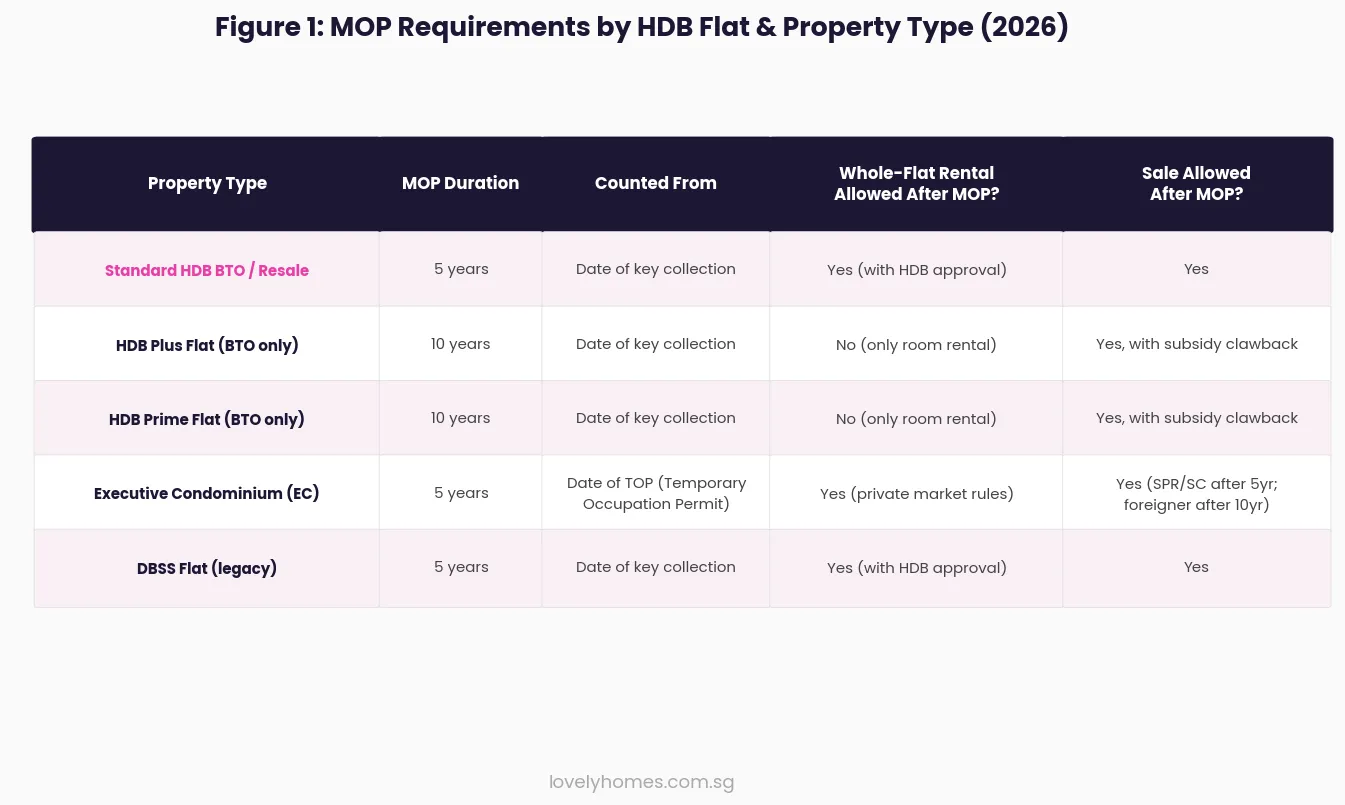
HDB MOP requirements table by flat type Singapore 2026 — Standard HDB 5 years, Plus and Prime 10 years, EC 5 years from TOP
Figure 1: MOP Requirements by HDB Flat & Property Type 2026 — Source: HDB Singapore. Click to enlarge.

MOP Duration by Property Type

Not all HDB-related properties share the same MOP duration. Since the launch of the Standard/Plus/Prime classification on 9 May 2023 (with the first classified BTO exercises conducted under the new framework from October 2023), the MOP landscape has become more nuanced.

Property Type MOP Duration Counted From Whole-Unit Rental After MOP?
Standard HDB BTO or Resale Flat 5 years Date of key collection Yes (HDB approval required)
HDB Plus Flat (BTO) 10 years Date of key collection No — room rental only
HDB Prime Flat (BTO) 10 years Date of key collection No — room rental only
Executive Condominium (EC) 5 years Date of TOP (Temporary Occupation Permit) Yes (private market rules apply)
DBSS (Design, Build & Sell Scheme — legacy) 5 years Date of key collection Yes (HDB approval required)

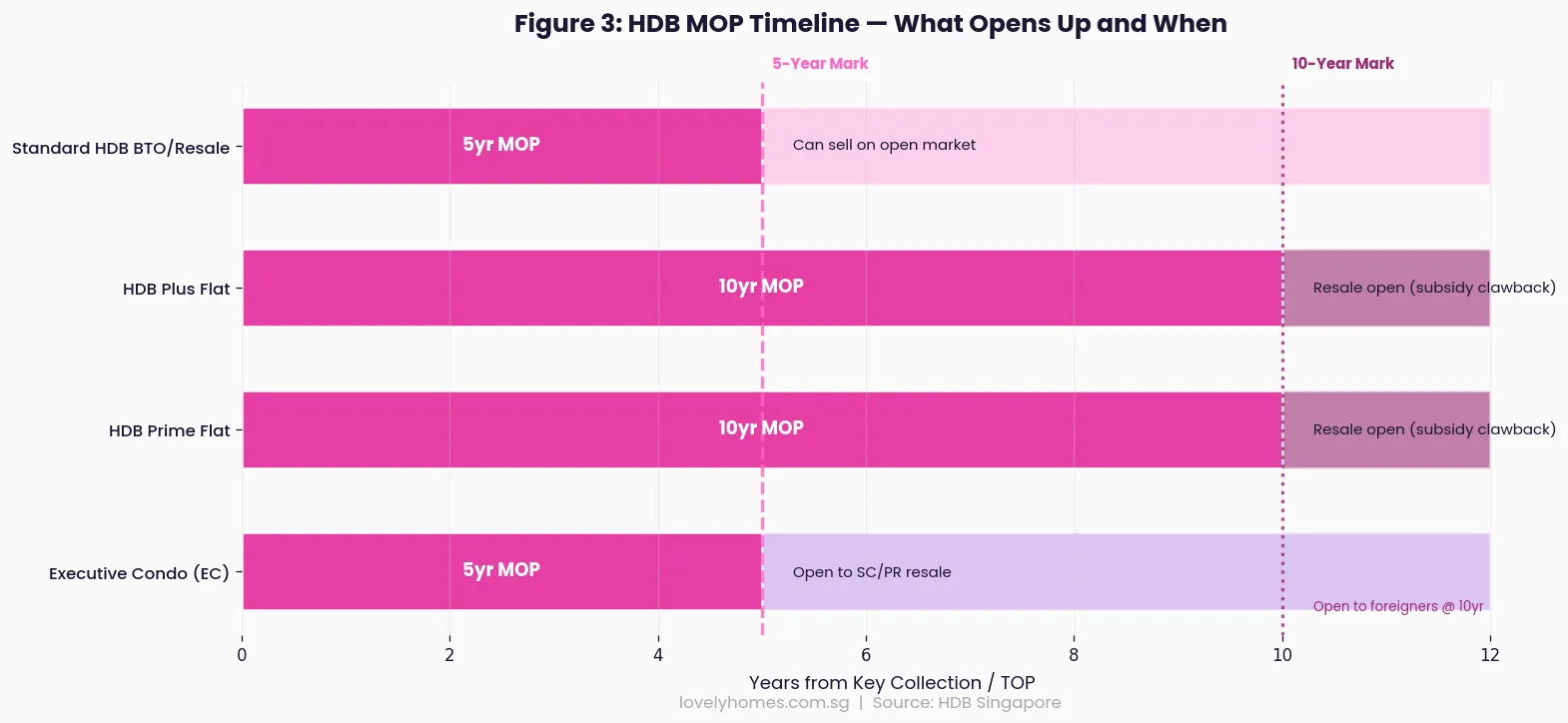
The HDB Plus classification covers well-located flats in towns with good transport links and amenities but just below Prime estate thresholds — think Bishan, Buona Vista, or Queenstown non-central areas. The HDB Prime classification covers the most central and desirable locations such as Toa Payoh, Kallang/Whampoa, and Queenstown’s prime zones. Both carry the 10-year MOP and additional restrictions on whole-flat subletting, and come with a subsidy clawback upon resale: a percentage of the resale price (not profit) is returned to HDB to account for the higher subsidy received.

What You Can and Cannot Do During the MOP

The MOP restricts several key transactions and activities. Getting these wrong — particularly purchasing a private property during the MOP period — can result in HDB enforcement action, including compulsory acquisition of your flat at below-market value.

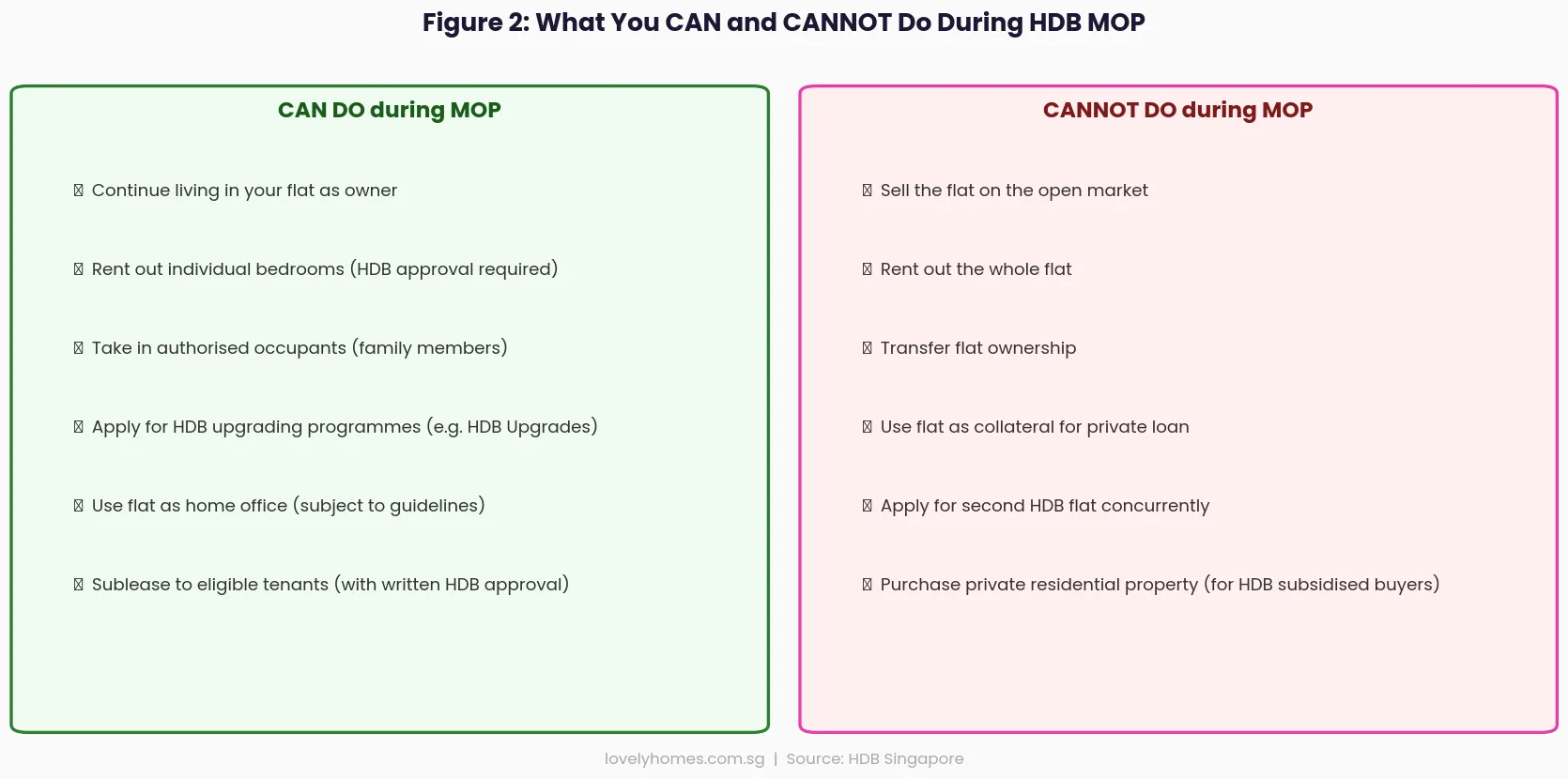
What you can and cannot do during HDB MOP Singapore 2026 — permitted activities vs prohibited activities during Minimum Occupation Period
Figure 2: Permitted vs Prohibited Activities During HDB MOP 2026 — Source: HDB Singapore. Click to enlarge.

Key Restrictions During MOP

You cannot sell the flat. The resale market is closed to you until MOP is complete. This applies to open market sales, en-bloc sales, and transfers to family members (with limited exceptions for divorce, death, and court orders).

You cannot sublet the entire flat. Renting out the whole unit — including to a single tenant occupying the flat exclusively — is prohibited during MOP. However, you may rent out individual bedrooms (also called subletting of bedrooms), subject to written approval from HDB and compliance with the occupancy cap of six unrelated persons per flat.

You cannot purchase private residential property (for buyers who received a CPF housing grant or an HDB concessionary loan). If you do purchase a private property during the MOP, HDB requires you to dispose of the private property and imposes a 30-month wait before you can sell the HDB flat. This 30-month rule is a significant financial planning constraint for upgraders.

You must continue to occupy the flat. The flat must remain your principal place of residence throughout the MOP. Extended absences abroad — particularly for employment — require HDB’s prior approval. Owners who rent out their flat and relocate without approval risk having the MOP nullified and being found in breach of HDB’s conditions.

MOP for HDB Plus and Prime Flats: Stricter Rules

The introduction of the Standard/Plus/Prime classification in May 2023 was the most significant MOP reform in decades. For buyers who obtained a Plus or Prime flat — typically with a higher subsidy due to the desirable location — the MOP is doubled to 10 years. Furthermore:

  • No whole-flat subletting after MOP. Even once the 10-year MOP is complete, Plus and Prime flat owners may only rent out individual bedrooms, not the entire flat. This restriction is permanent and attached to the flat.
  • Subsidy clawback on resale. Upon selling a Plus or Prime flat after MOP, a percentage of the resale proceeds (calculated on the sale price, not the profit) is returned to HDB. The clawback rate is announced at the point of flat launch.
  • Eligibility restrictions on resale buyers. Plus and Prime flats may only be sold to buyers who meet HDB eligibility criteria — they cannot be sold to single entities buying under the Singles scheme, for example, unless the Singles scheme conditions are met.
HDB MOP timeline chart showing when each HDB flat type and EC can be sold or rented — Standard 5 years, Plus/Prime 10 years, EC 5 years from TOP
Figure 3: HDB MOP Timeline — When Each Property Type Opens for Sale or Rental 2026 — Source: HDB Singapore. Click to enlarge.

MOP for Special Circumstances

HDB recognises that life circumstances change, and provides specific provisions for situations that might otherwise create hardship:

Marriage during MOP. Where two HDB flat owners marry each other during the MOP, they may retain both flats only temporarily. They must dispose of one flat within six months of marriage. The flat they retain must complete its own MOP.

Divorce during MOP. A court order in divorce proceedings may direct the transfer of the matrimonial HDB flat to one party. HDB will generally approve such a transfer even during the MOP, though the transferred flat continues to be subject to the original MOP timeline.

Death of an owner during MOP. Transmission of ownership to a surviving co-owner or next-of-kin is permitted during MOP. The MOP clock does not restart upon inheritance.

Financial hardship. Owners facing genuine financial hardship — for example, inability to service the mortgage — may apply to HDB for special approval to sell the flat before MOP is complete. Such applications are assessed on a case-by-case basis and are rarely approved except in extreme circumstances.

En-bloc sale during MOP. If HDB or the government acquires your flat for redevelopment or SERS (Selective En bloc Redevelopment Scheme), the MOP requirement is waived. Eligible owners receive replacement flat offers or compensation.

Worked Example: The Rajan Family’s MOP Strategy

📍 The Rajan Family — Upgrading from BTO to Private Condo

Background: Mr and Mrs Rajan (both Singapore Citizens) collected the keys to their 4-Room Standard BTO flat in Tengah on 15 March 2022. They received an Enhanced CPF Housing Grant (EHG) of S$55,000 and took an HDB concessionary loan at 2.6% per annum. Their flat was purchased at S$380,000.

When can they sell?
MOP of 5 years from key collection = 15 March 2027 earliest.

Can they buy a condo before March 2027?
No — since they received the EHG grant and an HDB concessionary loan, purchasing a private residential property during MOP triggers HDB’s enforcement provisions. They must wait until MOP is complete before purchasing any private property.

Can they rent out bedrooms?
Yes — they can apply to HDB to sublet individual bedrooms. With a 4-room flat, they can rent out up to 2 bedrooms (HDB’s guideline: occupancy cap 6 persons total). Each 6-month subletting period requires renewed approval and must comply with tenant eligibility criteria (SC, PR, or eligible foreigners on Long-Term Visit Pass).

Financial snapshot at MOP completion (March 2027):
Estimated resale value: S$650,000 (median Tengah 4-room resale after MOP wave, estimated)
CPF OA used (principal + accrued interest): ~S$205,000
Outstanding HDB loan: ~S$178,000 (5 years repaid at S$1,234/mth)
Net cash proceeds: S$650,000 − S$205,000 − S$178,000 = ~S$267,000
No ABSD for first SC purchase. BSD on new private property of S$1.5M: S$44,600.
Effective upfront cash needed for private property: manageable given 5-year savings accumulation.

Why the MOP Matters: Strategic Implications for Upgraders

The MOP is not merely a restriction — it is a planning framework that every HDB owner should factor into their long-term property strategy. Singapore’s property upgrading ladder — the conventional pathway from BTO flat to private condominium — is entirely built around the MOP. Getting the timing right can mean the difference of tens of thousands of dollars in ABSD savings.

The critical consideration is the concurrency restriction: if you purchase a private property before your HDB flat’s MOP is complete, you must dispose of the private property within six months and wait 30 months before you can sell the HDB flat. This 30-month wait effectively extends your exposure by two and a half years. For buyers tempted to jump the gun on a desirable new launch, the financial cost is real and can be significant — particularly if the private property declines in value during the forced holding period.

For upgraders, the ideal sequence is: complete MOP → list HDB for sale → secure Option to Purchase on private property → exercise both concurrently. This sequence avoids any concurrent ownership of HDB and private property, and means no ABSD is payable on the private property purchase if the HDB sale is completed within six months.

Peer-country comparison: HDB Singapore‘s MOP is broadly analogous to the resale levy system in Hong Kong’s Home Ownership Scheme (HOS), but more flexible in that Singapore allows bedroom subletting during MOP. Australia’s equivalent — NDIS Participant Home Purchase — has a shorter 12-month occupancy requirement. Singapore’s 5-year MOP is considered globally as a well-calibrated balance between owner-occupancy intent and owner liquidity needs.

What Might Come Next: MOP Policy Outlook

The August 2024 rollout of the Standard/Plus/Prime framework introduced the 10-year MOP for Plus and Prime flats — a significant tightening. Industry observers and housing analysts note that further MOP reforms are unlikely in the near term, given that the current framework was itself a major structural change only recently implemented. However, several scenarios bear watching:

MOP for resale flats. Currently, resale HDB flats also carry a 5-year MOP from the resale purchase date. There has been policy debate about whether the MOP should be shorter for resale purchases (which are unsubsidised), but HDB has not signalled any change. A resale flat bought at market price still counts its MOP from key collection — a point often overlooked by first-time resale buyers who assume the previous owner’s MOP tenure transfers.

Private property purchase rules. The 30-month wait rule — introduced in September 2022 — was a cooling measure response to the strong public housing resale market. As market conditions evolve, HDB may revisit the 30-month wait, though any relaxation would likely signal that the resale market has moderated sufficiently.

Plus/Prime resale restrictions. The longer-term impact of Plus and Prime flat restrictions on the secondary market remains to be seen. Given the first Plus/Prime BTO exercises were conducted in late 2023, the first MOP completions for these flats will not occur until 2033–2034 at the earliest. The resale market effects are a decade away from being visible.

Frequently Asked Questions: HDB MOP Singapore 2026

Does the MOP reset if I take over an HDB flat from a family member?

It depends on the nature of the transfer. If you inherit the flat from a deceased owner, the MOP clock does not restart — you inherit the remaining MOP period. However, if you purchase a flat from a family member at arm’s length on the open resale market, your own 5-year MOP begins from the date you collect the keys. A transfer of ownership due to divorce via court order also does not restart the MOP. Any transfer that involves an element of HDB grant or concessionary loan triggers a fresh MOP assessment.

Can I buy a private property during HDB MOP without penalty?

Not if you received a CPF housing grant or an HDB concessionary loan for the flat. If you purchase a private residential property before your MOP is complete, HDB requires you to dispose of the private property within six months and imposes a 30-month wait before you can sell your HDB flat. If you purchased your HDB flat without any grant or HDB loan (i.e., a fully market-priced resale with private bank financing only), the private property restriction may not apply in the same way — but you should confirm this with HDB directly, as the rules are nuanced and case-specific.

What happens to my MOP if HDB acquires my flat through SERS or compulsory acquisition?

If HDB or a government body compulsorily acquires your flat — whether through the Selective En bloc Redevelopment Scheme (SERS), the Land Acquisition Act, or another statutory process — the MOP obligation is extinguished. You will receive either a replacement flat offer (under SERS) or statutory compensation at market value. You are not penalised for the early disposal because the initiative comes from the government, not the owner. A replacement SERS flat will carry its own fresh MOP from key collection.

How does the MOP work for an Executive Condominium (EC)?

ECs are a hybrid product — built and marketed by private developers but initially subject to HDB ownership rules. The MOP for an EC is 5 years, but it is counted from the date of the Temporary Occupation Permit (TOP) — not the key collection date or the signing of the Sale and Purchase Agreement. During the MOP, ECs may only be resold to Singapore Citizens and Permanent Residents who meet HDB eligibility criteria. After 5 years (MOP completion), the EC can be sold to any buyer including foreigners on the private market. After 10 years from TOP, the EC is fully privatised and treated identically to any private condominium for all purposes.

Can I apply for a second HDB flat while still within the MOP of my first flat?

Generally, no. HDB’s flat eligibility rules require you to dispose of your existing flat before or concurrent with purchasing a new one. You cannot hold two HDB flats simultaneously (with very limited exceptions, such as an interim period during SERS relocation). If you are still within your MOP, you cannot sell your current flat, which means you cannot apply for a new BTO flat either — unless you are eligible under specific joint-application provisions where the existing flat is earmarked for disposal. The practical implication: if you want to upgrade from your first BTO to a larger BTO or resale flat, you must complete the MOP first.

Does renting out bedrooms affect my MOP or eligibility?

Renting out individual bedrooms (subletting of bedrooms) is permitted during the MOP, subject to HDB written approval. It does not affect your MOP clock — the MOP continues to run from key collection regardless of subletting status. However, you must continue to physically occupy the flat yourself throughout the MOP period. HDB’s subletting approval requires the flat owner to be residing in the flat, and HDB conducts random inspections to verify compliance. Subletting the entire flat — even informally — while not residing there is a breach of the MOP conditions and can result in compulsory acquisition.

I bought my HDB resale flat recently. Does the previous owner’s MOP count toward mine?

No. When you purchase an HDB resale flat, your own 5-year MOP begins from the date you collect the keys, regardless of how long the previous owner held the flat. The MOP is an obligation tied to the current registered owner, not the flat itself. So if you purchased a resale flat in August 2026, your MOP will not be complete until August 2031 at the earliest — even if the previous owner had lived there for 20 years.

Disclaimer: This article is intended for general informational purposes only and does not constitute legal, financial, or property advice. HDB rules and policies change regularly — always verify the latest requirements at HDB.gov.sg and consult a licensed property agent or HDB directly for guidance specific to your situation. Stamp duty information is subject to change; verify with IRAS. CPF usage rules should be confirmed with the CPF Board.
×

Click anywhere or press Esc to close

Singapore HDB Downsizing Guide 2026: How to Rightsize and Unlock Cash from Your Flat

Singapore HDB Downsizing Guide 2026: How to Rightsize and Unlock Cash from Your Flat

Quick Answer: HDB Downsizing in Singapore 2026

  • You may sell your HDB flat once the Minimum Occupation Period (MOP) is met — 5 years for Standard flats, 10 years for Plus and Prime flats.
  • Sale proceeds after repaying your HDB or bank loan and refunding CPF with accrued interest form your net cash proceeds.
  • Buying a smaller HDB resale flat as your only property incurs no ABSD for Singapore Citizens; Permanent Residents pay 5% on the first property.
  • Buying private property instead: SCs pay 0% ABSD on the first private purchase but must sell the HDB within 6 months (if still held).
  • CPF accrued interest — the HDB concessionary rate of 2.6% p.a. compounded — significantly reduces your net cash; plan ahead.
  • The Ethnic Integration Policy (EIP) and Singapore Permanent Resident (SPR) quota may limit your pool of eligible buyers in some estates.
  • Sellers bear agent commission of ~1–2% of sale price, legal and HDB admin fees of approximately S$3,000–S$5,000.
  • A retirement-minded downsize — selling a 5-room and buying a 3-room — can free S$200,000–S$400,000 in cash depending on town, storey, and loan balance.

What Does Downsizing Your HDB Mean?

HDB downsizing — also called rightsizing — refers to the deliberate decision to sell a larger HDB flat and purchase a smaller or less expensive property once you no longer need the space. It is one of Singapore’s most practical wealth-unlocking strategies for older homeowners, and the Housing and Development Board (HDB) actively encourages it through the Silver Housing Bonus and the Lease Buyback Scheme for eligible seniors.

The motivation varies: adult children have moved out, retirement is approaching, the family needs liquidity, or parents simply want to trade a 5-room flat in a mature estate for a 3-room near their children. Whatever the reason, the mechanics are the same: sell the HDB flat at market value, repay all outstanding obligations, then deploy the net proceeds toward your next home or retirement plan.

HDB resale prices hit record highs in 2025–2026, with median prices for 5-room flats in popular estates like Bishan, Queenstown, and Toa Payoh routinely exceeding S$800,000. This price environment makes downsizing financially attractive for many households that bought their flats in the 2000s at a fraction of today’s valuations.

HDB flat types market prices 2026 BTO vs resale grouped bar chart
Figure 1: HDB flat types — approximate median market prices in 2026, comparing BTO subsidised prices against resale open market values. Source: HDB, URA (indicative; actual prices vary by town, storey, and condition).

Who Can Sell and Who Can Buy Your HDB Flat?

Before you can sell, you must have fulfilled the Minimum Occupation Period (MOP). For flats classified as Standard (the majority of existing stock), MOP is five years from the date the keys were collected. For newer Plus and Prime flats launched from the August 2023 classification exercise onwards, MOP is ten years and is accompanied by an income ceiling and a subsidy clawback on resale — factors that will depress the resale market for those specific flats when they eventually transact.

Buyers of your HDB flat must meet HDB’s eligibility criteria: they must form a valid family nucleus or qualify under one of the single-buyer schemes, and they must satisfy the prevailing income ceiling (S$14,000 per month for families, or S$7,000 for singles buying a 2- or 3-room flat). This narrows your buyer pool compared to the open private market, though mature-estate flats near MRT stations tend to attract strong demand regardless.

The Ethnic Integration Policy (EIP) further constrains your buyer pool. Each block and neighbourhood has ethnic quotas for Chinese, Malay, and Indian/Other buyers. If the Chinese quota in your block is already full, you can only sell to a non-Chinese buyer — which may lengthen your marketing period or push your achieved price below valuations. Check your flat’s EIP status on the HDB website before setting a price.

Eligibility Factor Requirement Where to Check
MOP 5 years (Standard); 10 years (Plus/Prime) HDB My Flat Dashboard
Outstanding loan Must repay in full at completion HDB loan statement
CPF refund Principal drawn + 2.6% p.a. accrued interest must be refunded to CPF OA CPF website — property withdrawal history
EIP / SPR quota Check block/neighbourhood quota before listing HDB Resale Portal
Buyer eligibility Valid family nucleus; income ceiling S$14k family / S$7k single HDB Resale Portal — Check Eligibility
Flat condition Must not be under outstanding HDB infringement orders HDB My Flat Details

Understanding CPF Accrued Interest: The Silent Cost of Downsizing

Many sellers are surprised to learn that the CPF they withdraw for housing must be refunded with interest when the flat is sold. The interest rate applied is HDB’s concessionary rate of 2.6% per annum, compounded annually — the same rate used for HDB loans. This accrued interest accumulates from the date each CPF withdrawal is made, meaning a S$180,000 CPF withdrawal made ten years ago could carry roughly S$52,000 in accrued interest by the time of sale, requiring a total refund of approximately S$232,000.

The CPF refund goes back into your CPF Ordinary Account, where it earns 2.5%–3.5% interest. If you intend to use CPF again for your next purchase, the refunded amount is immediately available. If you are at or near retirement, the refund may trigger the Basic Retirement Sum (BRS) top-up rule, redirecting some OA funds into your Retirement Account.

Importantly, the CPF refund is not optional. HDB or your conveyancing lawyer will handle the refund automatically at completion. Your net cash proceeds are therefore: Sale Price − Outstanding Loan − CPF Principal − CPF Accrued Interest − Agent Commission − Legal Fees.

HDB downsizing cash proceeds waterfall 5-room resale S740k Singapore 2026
Figure 2: Illustrative cash-proceeds waterfall for a 5-room HDB resale at S$740,000 — showing loan repayment, CPF refund (principal + accrued interest), agent commission, and net cash. Actual figures depend on individual circumstances.

What Are Your Options After Selling?

Once you have your net cash proceeds, you face a strategic choice that is as much about lifestyle as it is about finances.

Buy a smaller HDB resale flat — A 3-room flat in a mature estate costs S$380,000–S$500,000 and carries no ABSD for Singapore Citizens purchasing their only property. You can finance it with an HDB loan (if you have not previously taken two HDB loans) or a bank loan, and use your CPF OA balance and cash proceeds for the purchase. This is the most common rightsizing path for older Singaporeans who wish to remain in the HDB system.

Buy OCR private condo — If your net proceeds are substantial enough, some downsizers use the freed cash as a down payment on an Outside Central Region (OCR) private condominium. A Singapore Citizen buying private property for the first time pays zero ABSD. However, if you still hold the HDB flat when exercising the private option, you are technically owning two properties and incur ABSD — you have six months from the private completion date to sell the HDB to claim an ABSD refund (subject to conditions).

Rent and invest — Some downsizers sell the HDB flat, move into a rental property, and invest the proceeds in diversified assets (unit trusts, Singapore Savings Bonds, REITs). This preserves flexibility, particularly for those uncertain about their long-term location or care needs.

Silver Housing Bonus — If you are aged 55 or above and are downsizing to a shorter-lease or 3-room (or smaller) flat, the Silver Housing Bonus provides a cash bonus of up to S$30,000 when you top up your CPF Retirement Account with at least S$60,000 from your sale proceeds. Eligible couples may each receive up to S$30,000.

Lease Buyback Scheme — For seniors aged 65 and above in a 3-room or smaller flat, the Lease Buyback Scheme allows you to sell the tail end of your flat’s lease back to HDB in exchange for cash plus CPF RA top-up, while continuing to live in the flat. This is not downsizing per se, but it serves a similar liquidity-release purpose without the disruption of moving.

Post-downsizing options Singapore HDB cash proceeds vs requirements 2026
Figure 3: Post-downsizing options compared — cash proceeds available from an illustrative 5-room sale (S$428.6k net) versus additional cash required for each pathway. Figures are illustrative; ABSD applies to second or subsequent property purchases.

Worked Example: The Tan Family’s Downsizing Journey

Scenario: Mr and Mrs Tan, both Singapore Citizens, purchased their 5-room HDB flat in Bishan in October 2016 for S$430,000 using an HDB loan. They have three adult children, all of whom have their own homes. The Tans retire in 2026 and decide to rightsize to a 3-room flat in Toa Payoh.

Their 5-room flat (selling):
• Sale price achieved: S$740,000
• Outstanding HDB loan: S$80,000
• CPF OA withdrawn over 9+ years: S$180,000 principal + S$42,000 accrued interest = S$222,000 CPF refund
• Agent commission (1%): S$7,400
• Legal and admin fees: S$4,000
Net cash proceeds: S$740,000 − S$80,000 − S$222,000 − S$7,400 − S$4,000 = S$426,600

Their 3-room flat in Toa Payoh (buying):
• Purchase price: S$450,000
• Buyer’s stamp duty (BSD): 1% × S$180k + 2% × S$180k + 3% × S$90k = S$1,800 + S$3,600 + S$2,700 = S$8,100
• ABSD: S$0 (SC buying only property)
• CPF OA available after refund: S$222,000
• CPF used for new flat: S$222,000
• Cash needed: S$450,000 + S$8,100 − S$222,000 = S$236,100
• Paid from proceeds: S$236,100
Cash remaining after new purchase: S$426,600 − S$236,100 = S$190,500

The Tans emerge with S$190,500 in cash and a fully paid (CPF-financed) 3-room flat — a meaningful retirement cushion achieved by simply rightsizing their home.

Stamp Duty: BSD and ABSD Implications When Downsizing

Selling your HDB flat itself does not attract stamp duty for the seller — Seller’s Stamp Duty (SSD) only applies if you sell within three years of purchase, and most downsizers are well past that window. When you buy your replacement property, Buyer’s Stamp Duty (BSD) and Additional Buyer’s Stamp Duty (ABSD) apply on the normal tiered schedules.

Buyer Profile ABSD on 1st Property ABSD on 2nd Property BSD (all buyers)
Singapore Citizen 0% 20% 1–6% tiered
Singapore PR 5% 30% 1–6% tiered
Foreigner 60% 60% 1–6% tiered
Entity (company/trust) 65% 65% 1–6% tiered

Key BSD tiers (effective 15 Feb 2023): 1% on first S$180,000; 2% on next S$180,000; 3% on next S$640,000; 4% on next S$500,000; 5% on next S$1,500,000; 6% on amount exceeding S$3,000,000.

The critical timing rule: if you buy a private property and still hold your HDB flat at the time of private completion, you are temporarily holding two properties. ABSD of 20% (SC) applies immediately on the private purchase. You may apply for an ABSD refund if you sell the HDB within six months of the private property’s completion date (or six months from the date the HDB OTP is exercised, if that is earlier). The refund application must be made within six months of meeting the condition.

What Does This Mean for Downsizers?

Singapore’s property market in 2026 remains one of the most expensive in Asia, but also one of the most orderly — HDB prices have appreciated substantially since the 2020s cooling measures without the volatility seen in less regulated markets. For older homeowners who bought at 2010–2015 prices, the uplift has created genuine wealth: a Queenstown 5-room flat that cost S$380,000 in 2012 regularly transacts at S$850,000–S$950,000 today.

This appreciation means downsizing is genuinely capable of releasing retirement capital rather than merely reshuffling debt. Combine the net cash with CPF Life payouts and medisave, and a rightsized household often has more financial security in retirement than they did during their working years.

The friction points — CPF accrued interest, EIP quotas, ABSD if buying private — are real but manageable with proper sequencing. The recommended order is: (1) confirm MOP is met; (2) obtain HDB resale valuation; (3) check CPF accrued interest amount; (4) model net proceeds; (5) identify replacement property; (6) apply for HDB resale Intent to Sell; (7) obtain OTP from replacement property; (8) sell HDB flat.

What Might Come Next for HDB Downsizing Policy

HDB periodically reviews schemes to support older Singaporeans in aging in place or rightsizing. The Silver Housing Bonus payout has been enhanced several times since its 2013 introduction, and further enhancements to its income ceiling and bonus quantum are plausible as Singapore’s population ages. There is active policy debate around simplifying the CPF accrued interest mechanism for elderly sellers, as the current compounding structure can significantly erode net proceeds for long-term occupants.

The Plus and Prime classification — introduced in August 2023 — will create a two-tier resale market when those flats exit MOP between 2028 and 2033. Their subsidy clawback mechanism means sellers of Plus/Prime flats will net less than sellers of equivalent Standard flats, a factor buyers and town planners will need to internalise in the coming years. This is speculative commentary and not confirmed government policy.

Frequently Asked Questions

Do I have to sell my HDB flat before buying private property?

No — you can buy private property first and sell your HDB flat within six months of private completion. However, you will pay ABSD (20% for SC, 30% for PR) on the private purchase upfront, and must apply for a refund after selling the HDB. The refund process typically takes 3–6 months. If you prefer to avoid the upfront ABSD outlay, sell the HDB first, then buy private — but you will need interim rental accommodation. Most downsizers opt for an HDB-first, private-second sequence to avoid the ABSD cash outlay.

How much CPF accrued interest will I owe on my HDB flat?

Log into the CPF website (my.cpf.gov.sg) under “My Statements → Property”. You will see the exact CPF principal withdrawn and the accrued interest to date, calculated at 2.6% p.a. compounded. The CPF Board also provides a CPF Property Withdrawal Calculator. As a rough guide: S$200,000 withdrawn 10 years ago accumulates approximately S$58,000 in accrued interest, requiring a total refund of S$258,000.

Can I use CPF to buy my smaller replacement flat after downsizing?

Yes. The CPF that is refunded to your Ordinary Account when you sell the HDB flat is immediately available for use in your next property purchase, subject to CPF OA limits (Valuation Limit and Withdrawal Limit for the new flat). If you are 55 or older, some of the refund may be directed to your Retirement Account first if it is below the Basic Retirement Sum.

Is there a minimum flat size I must buy when downsizing?

No minimum flat size is mandated by HDB for downsizing. You may buy a 2-room Flexi flat, a 3-room resale flat, or even a studio apartment in the private market. The only relevant constraint is your eligibility under HDB’s purchase schemes (you must form a valid family nucleus or qualify under single-buyer rules) and your financial assessment (MSR 30% and TDSR 55% for any loan component).

What is the Silver Housing Bonus and who qualifies?

The Silver Housing Bonus (SHB) is an HDB scheme for Singapore Citizens aged 55 and above who downsize to a shorter-lease or smaller flat (3-room or smaller, or a 2-room Flexi flat with 30-year lease or shorter). Eligible sellers receive a cash bonus of up to S$30,000 per eligible owner (maximum S$30,000 per household) when they top up their CPF Retirement Account with at least S$60,000 from their flat-sale proceeds. The SHB is not available for all downsizing scenarios — check HDB’s eligibility conditions on hdb.gov.sg.

Will EIP or SPR quotas affect my ability to sell?

Potentially, yes. If your flat’s block or neighbourhood has already met the ethnic or SPR quota, only buyers of the eligible ethnic group or citizenship status can purchase your unit. This does not prevent sale altogether but may reduce your pool of eligible buyers, lengthen the marketing timeline, or — in extreme cases — cause you to accept a lower offer. You can check your flat’s EIP and SPR quota status on the HDB Resale Portal before listing.

Are there tax implications from the sale of my HDB flat?

Capital gains from property are not taxed in Singapore. The profit you make from selling your HDB flat is entirely tax-free. Stamp duties (BSD/ABSD) apply only on the purchase of a new property, not on the sale. The exception is Seller’s Stamp Duty (SSD), which applies if you sell within three years of the date of purchase — but virtually all downsizers are well past this window. Rental income received if you sublet your flat while searching for a new home is taxable as personal income and must be declared in your IRAS tax return.

Related Articles

Disclaimer

This article is for general information and educational purposes only. It does not constitute financial, legal, or property advice. Singapore property taxes, CPF rules, HDB eligibility criteria, and stamp duty rates are subject to change. All figures, prices, and examples are illustrative and based on information available as of August 2026. Readers should verify current rates and eligibility conditions directly with HDB (hdb.gov.sg), IRAS (iras.gov.sg), the CPF Board (cpf.gov.sg), and URA (ura.gov.sg), and consult a licensed property agent, conveyancing solicitor, and/or financial adviser before making any property transaction or financial decision.

Translate »