
HDB Resale Market Q2 2026: Prices Ease but Million-Dollar Flats Hit Record 491
⚡ Quick Answer: HDB Resale Market Q2 2026
- Price trend: HDB Resale Price Index (RPI) declined in Q2 2026 — the second consecutive quarter of softening after a multi-year bull run
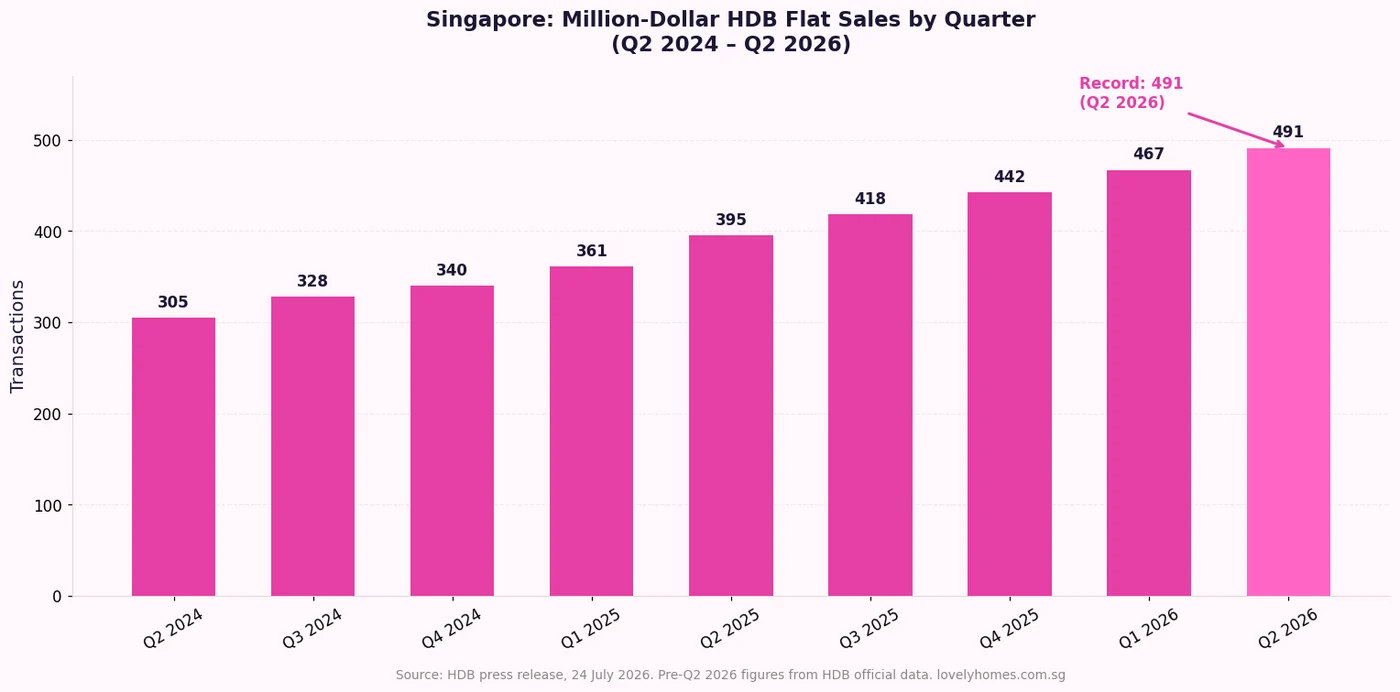
- Record million-dollar flats: 491 million-dollar HDB resale transactions in Q2 2026 — an all-time quarterly high, up from 467 in Q1 2026
- The paradox: Overall prices easing, yet the premium end of the market is more active than ever — a tale of two HDB markets
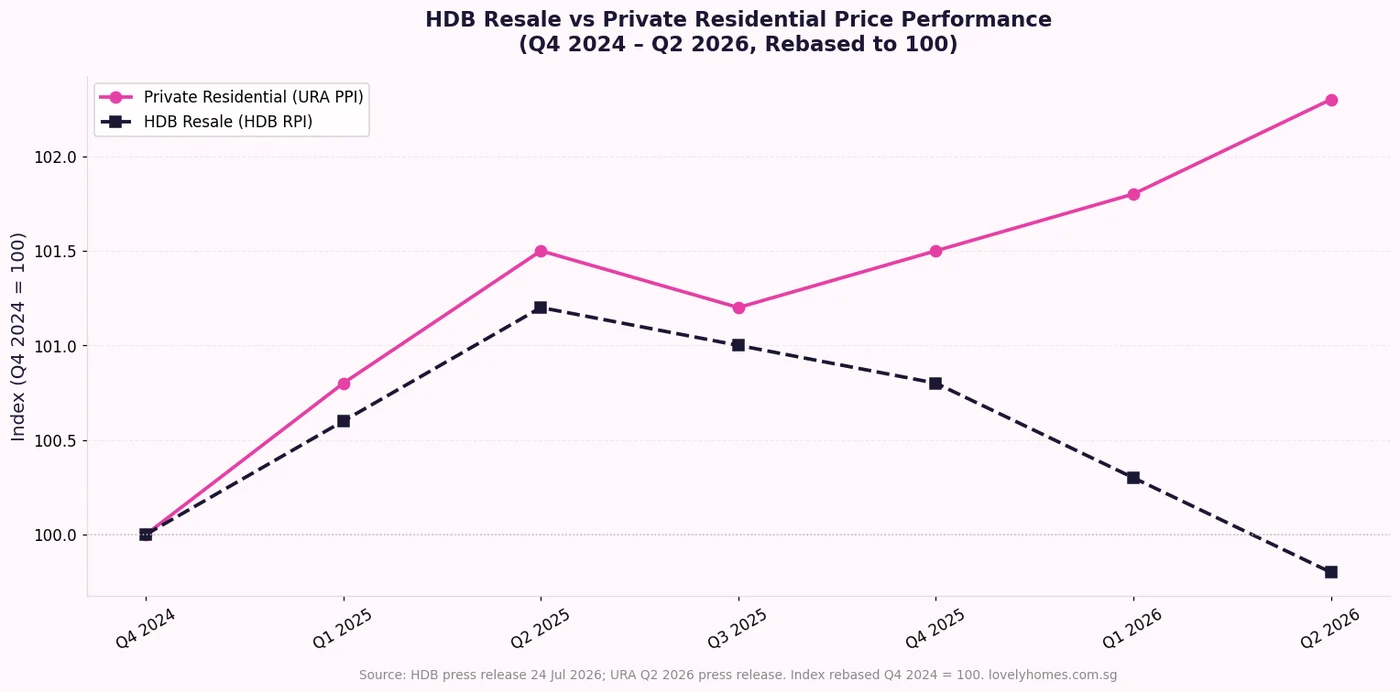
- Private vs HDB divergence: URA data shows private residential prices rose +0.5% in Q2 2026, while HDB resale drifted lower — the widest divergence in recent years
- Context: The price softening is modest — HDB resale remains significantly above pre-pandemic levels. This is a correction, not a collapse
- What buyers should know: Affordability is improving for mass-market HDB buyers; premium location and high-floor units continue to command strong premiums
- Source: HDB press release dated 24 July 2026; URA Q2 2026 flash estimates
HDB Resale Prices Ease Again — But the Premium Segment Tells a Different Story
Singapore’s Housing & Development Board released its Q2 2026 resale statistics on 24 July 2026, delivering a nuanced picture that will require careful reading. On the surface, the headline is straightforward: the HDB Resale Price Index (RPI) fell for the second consecutive quarter, extending a mild correction that began in Q1 2026. For most buyers who have been watching resale prices run continuously higher since 2020, this represents the clearest signal yet that the pandemic-era HDB bull run has entered a consolidation phase.
But the data contains a striking counterpoint. Within the same quarter that saw overall resale prices ease, 491 million-dollar HDB flats changed hands — the highest quarterly figure ever recorded by HDB. Singapore’s premium HDB segment, far from cooling, is operating at peak intensity. Understanding this apparent contradiction is the key to reading the Q2 2026 data correctly.
This report draws on HDB’s 24 July 2026 press release, URA’s Q2 2026 private residential flash estimates, and town-level resale data to give buyers and sellers a clear-eyed picture of where the HDB resale market stands at the midpoint of 2026.
The Overall Price Picture: A Modest and Orderly Correction
The HDB Resale Price Index has now posted two consecutive quarterly declines. This is the first such back-to-back softening since the 2018–2019 period, when a combination of ABSD hikes (in July 2018) and rising interest rates cooled both private and public housing markets simultaneously. The current correction has different drivers: mortgage rates have stabilised (the 3-month compounded SORA rate has eased from its 2024 peak of approximately 3.7% to around 2.9% as at June 2026), and HDB has steadily increased BTO supply, reducing urgency among first-time buyers who previously faced years-long queues.
The price softening is characterised as modest by historical standards. Resale flats across the board remain significantly above their pre-pandemic (Q4 2019) levels — the pandemic-era run-up added an estimated 30–40% to HDB resale prices between 2020 and 2023, and a two-quarter decline has unwound only a fraction of those gains. Buyers who purchased resale flats in 2020–2021 are still sitting on substantial paper gains in most towns.
| HDB Resale Trend | Q1 2026 | Q2 2026 | Direction |
|---|---|---|---|
| HDB Resale Price Index (RPI) | Declined | Declined | ↓ 2nd consecutive quarter |
| Million-Dollar Flat Transactions | 467 | 491 (record) | ↑ All-time quarterly high |
| Private Residential PPI (URA) | +0.3% | +0.5% | ↑ Outperforming HDB |
| Market character | Selective softening | Mass-market easing + premium surge | Diverging |
Source: HDB press release 24 July 2026; URA Q2 2026 flash estimates. RPI directional change only — specific index values at hdb.gov.sg.
The Million-Dollar Flat Phenomenon: 491 in a Single Quarter
The 491 million-dollar resale transactions in Q2 2026 represent a market segment that is effectively decoupled from the overall HDB resale trend. To put this in context: in the entirety of 2019 (before the pandemic acceleration), fewer than 500 million-dollar HDB flats transacted across the whole year. By Q2 2026, that is now a single-quarter figure.
The million-dollar flat segment is concentrated in a handful of locations: mature estates close to the city or with distinctive cachet. Bishan, Queenstown, Buona Vista, Toa Payoh, Clementi, and Ang Mo Kio consistently produce the bulk of these transactions. The common factors are remaining lease (typically 60+ years, some freehold-equivalent 99-year blocks built in the late 1990s now hitting 25–30 years remaining), floor level (high-floor units with city or greenery views), and proximity to primary schools with strong alumni ballot priority.
The HDB–Private Divergence: What It Signals
For the first time since 2019, Singapore’s HDB resale market and the private residential market are moving in opposite directions. URA’s Q2 2026 flash estimate showed private residential prices up +0.5% for the quarter (led by a +1.8% rise in the Core Central Region and +2.5% in the Landed segment), while HDB resale drifted lower. This divergence has meaningful implications for housing upgraders and property investors alike.
For HDB-to-private upgraders, the divergence is a double-edged sword: their HDB resale proceeds may be slightly lower than at the market’s Q3 2023 peak, while the private property they are purchasing has held its value or risen. The net affordability of the upgrade journey has therefore widened in favour of staying in HDB rather than upgrading — at least in the short term. This dynamic may itself be depressing resale volume as potential upgraders postpone the move.
For HDB resale buyers, the correction is an incremental improvement in affordability. A 4-room flat in Jurong West that might have commanded S$480,000 at the 2023 market peak may now transact at S$455,000–S$465,000 in comparable precincts, subject to block, floor, and condition. For buyers who were priced out during the 2020–2023 run-up, this is the most accommodating entry point in three years.
📊 Worked Example: Buying a 4-Room Resale HDB in 2026
Scenario: Singapore Citizen couple (first-time buyers) purchasing a 4-room HDB resale in Sengkang at S$540,000 (consistent with Q2 2026 median pricing for the area).
| Item | Amount (S$) |
|---|---|
| Purchase price | 540,000 |
| Buyer’s Stamp Duty (BSD) — 1% on first S$180K + 2% on next S$180K + 3% on balance | 10,800 |
| ABSD — Singapore Citizens, first residential property | Nil |
| HDB conveyancing & legal fees (estimate) | 1,600 |
| Minimum down payment at 5% (HDB loan) or 25% (bank loan) | 27,000 or 135,000 |
| Enhanced Housing Grant (EHG) — if household income ≤ S$9,000/month | Up to (80,000) |
| CPF Family Grant — first-timer couple buying 4-room or larger resale | Up to (50,000) |
| Estimated monthly HDB loan repayment at 2.6% p.a. over 25 years on S$513,000 loan | approx. 2,326/month |
BSD: 1% × S$180K = S$1,800 + 2% × S$180K = S$3,600 + 3% × S$180K = S$5,400; total S$10,800. Grant amounts are illustrative — verify eligibility at homes.hdb.gov.sg. Figures do not constitute financial advice.
Why This Matters: Reading the Signal Correctly
Two-quarter HDB price declines are historically brief episodes in Singapore. Policy guardrails — including the BTO supply pipeline (which increases supply but also validates long-term demand by requiring buyers to commit years in advance), the loan-to-value framework under MAS Notice 645, and the Total Debt Servicing Ratio cap — tend to prevent both runaway inflation and disorderly corrections in the public housing segment.
The million-dollar flat figure of 491 is important precisely because it shows that premium demand is structurally intact even as the mass market softens. Singapore’s affluent households continue to see mature-estate HDB flats — particularly those in education-premium catchment zones — as a combination of lifestyle asset and inflation hedge. Until either school registration rules change materially or a large volume of new premium-location HDB supply enters the market (neither of which is imminent), the premium segment is unlikely to correct sharply.
For the mass market, the correction is a healthy unwinding of excesses built during a period of constrained supply and ultra-low rates. Buyers who waited now have a modestly more favourable entry point; sellers who need to transact should price competitively and be prepared for longer marketing periods than in 2021–2023.
What Might Come Next (Speculative Outlook)
The following is editorial analysis and not investment advice. Several factors will shape the HDB resale market through the second half of 2026:
- BTO MOP completions: A cohort of flats from 2021 launches (when BTO applications surged) will complete their 5-year Minimum Occupation Period from 2026. This adds fresh resale supply, particularly in newer towns like Tengah, Punggol, and Bidadari — which could modestly increase inventory and extend the softening in those submarkets.
- Interest rate trajectory: SORA has eased in 2025–2026, reducing the cost of HDB loans (capped at 0.1% above CPF Ordinary Account rate, currently 2.6% p.a.) and bank variable-rate mortgages. Further easing would improve affordability and could reverse the price trend in H2 2026.
- Cooling measure review: The government has signalled willingness to adjust property market measures when warranted. If HDB resale prices continue declining, a targeted reduction in ABSD or HDB loan restrictions is not outside the realm of policy possibility, though the government typically moves slowly and cautiously.
Frequently Asked Questions: HDB Resale Market Q2 2026
Are HDB resale prices expected to keep falling in 2026?
Two consecutive quarterly declines do not constitute a trend on their own, and most market observers expect the Q2 2026 softening to be modest and temporary rather than the start of a sustained downturn. Singapore’s HDB resale market is supported by structural demand (permanent population growth, household formation, upgrader activity) and policy guardrails. The more likely scenario for H2 2026 is price stabilisation rather than further decline, though this depends heavily on interest rate movements and supply dynamics. Buyers and sellers should plan based on their own financial circumstances rather than trying to time the market.
What is driving record million-dollar HDB sales if overall prices are falling?
The million-dollar HDB segment is effectively a separate micro-market defined by location, lease, floor level, and school catchment rather than by general HDB supply-demand dynamics. These flats transact at prices that reflect their proximity to elite primary schools, remaining lease above 70 years, and their status as high-floor, city-view units in mature estates — attributes that are structurally scarce and for which affluent buyers pay a structural premium. The mass-market softening does not materially affect buyers who specifically want a CHIJ-, Ai Tong-, or Nanyang-catchment HDB flat with 80+ years remaining — there are simply very few of them, and multiple buyers typically compete for each one.
Should I buy or wait if HDB resale prices are falling?
This is a personal financial decision that depends on your household income, CPF savings, grant eligibility, and housing timeline. If you plan to live in the flat for 5–10 years, short-term price movements matter less than whether you can comfortably service the loan. If you are trying to time the market, note that two quarters of softening does not necessarily mean prices will fall further — previous HDB correction episodes (2014–2018) lasted longer but also offered only modest discount opportunities before prices rebounded. Consult a licensed financial adviser before committing.
Where do million-dollar HDB flat transactions typically occur?
The majority of million-dollar HDB resale transactions are concentrated in mature estates with central locations and strong school catchments. Consistently high-volume estates include Queenstown (near Henry Park Primary, Queensway Secondary), Bishan (near Ai Tong School), Toa Payoh (near CHIJ Primary), Ang Mo Kio (near Ai Tong and Anderson Primary), Clementi (near Nan Hua Primary), and Buona Vista. High-floor units in blocks with long remaining leases, unobstructed views, and MRT proximity within these estates typically clear S$1 million. Serangoon, Tampines, and Bedok have also seen increasing million-dollar transactions as buyers move slightly further from the city for comparable space.
How does the HDB Resale Price Index (RPI) differ from individual flat prices?
The HDB Resale Price Index is a composite index computed by HDB that tracks the overall price level of HDB resale transactions across all flat types and towns. It is analogous to URA’s Property Price Index for the private sector. A decline in the RPI means the weighted average transaction price across all HDB resale flats has fallen — but individual flat prices can and do diverge significantly from the index. A mature-estate 5-room flat with an exceptional view may transact well above its Q4 2025 level even as the national RPI falls. Buyers should use town-level transaction data from HDB’s resale flat prices portal at hdb.gov.sg for relevant pricing guidance rather than relying on the headline index alone.
What CPF housing grants are available for HDB resale buyers in 2026?
First-timer Singapore Citizens buying an HDB resale flat in 2026 may be eligible for the Enhanced Housing Grant (EHG, up to S$80,000 based on income), the CPF Family Grant (up to S$50,000 for 4-room or larger flats), and the Proximity Housing Grant (up to S$30,000 if buying near parents or married child). Single Singapore Citizens buying a 2-room or larger resale flat may qualify for the Single Person EHG (up to S$40,000) and the Singles Grant (up to S$25,000 for 4-room and larger). All grants are subject to income ceilings, property value caps, and other eligibility criteria — check your specific entitlement via the HDB Flat Portal at homes.hdb.gov.sg before house-hunting.
Disclaimer: This article is for general informational purposes only and does not constitute financial, legal or property investment advice. Price trend data is sourced from HDB’s press release of 24 July 2026 and URA’s Q2 2026 flash estimates. The illustrative price index chart (Figure 2) is a directional representation for editorial purposes; exact HDB Resale Price Index values are available at hdb.gov.sg. Million-dollar transaction figures (491 units in Q2 2026) are sourced from HDB’s official data. All other figures, estimates and projections are illustrative. Readers should verify all data at hdb.gov.sg, ura.gov.sg, iras.gov.sg, and cpf.gov.sg before making any property decision. Consult a licensed property agent, mortgage broker and/or qualified financial adviser for advice specific to your circumstances.