Singapore Freehold vs Leasehold Property Guide 2026: What Every Buyer Needs to Know

Singapore Freehold vs Leasehold Property Guide 2026: What Every Buyer Needs to Know


Click anywhere or press Esc to close

⚡ Quick Answer — Freehold vs Leasehold Singapore 2026

  • Freehold means you own the land in perpetuity; leasehold (typically 99 years) means the land reverts to the state when the lease expires.
  • Freehold properties command a 10–15% price premium over comparable 99-year leasehold units in most districts, based on 2026 URA caveats.
  • CPF Ordinary Account can only be used if the remaining lease covers the youngest buyer to age 95; usage is capped or barred for leases below 30 years remaining.
  • Banks do not offer mortgage loans for properties with fewer than 20 years of lease remaining; LTV ratios tighten significantly below 30 years.
  • Both freehold and 99-year leasehold properties have historically appreciated in Singapore — the difference in total return is narrower than most buyers assume.
  • For HDB resale flats (all 99-year leasehold), the same CPF and HDB loan rules apply on a pro-rated basis when remaining lease is short.
  • En-bloc (collective sale) prospects are broadly similar for both tenure types, subject to land value and developer appetite.

What Is Property Tenure in Singapore?

Property tenure determines how long you legally own — or have the right to use — the land beneath your home. In Singapore, the three common tenure types are freehold (sometimes styled as “estate in fee simple”), 999-year leasehold (functionally equivalent to freehold for most practical purposes), and 99-year leasehold, which accounts for the majority of private residential sites released by the Singapore Land Authority under the Government Land Sales (GLS) programme.

The Singapore Land Authority (SLA) administers land tenure policy. When a 99-year lease expires, the land reverts to the state. In practice, no private residential 99-year lease in Singapore has yet expired, and the government has indicated it will manage lease renewals on a case-by-case basis under the Selective En-bloc Redevelopment Scheme (SERS) or equivalent programmes — but there is no automatic right of renewal.

Understanding tenure is critical for buyers because it affects purchase price, CPF Ordinary Account (OA) usage, bank mortgage eligibility, rental yield, en-bloc potential, and long-term capital appreciation. This guide covers every dimension.
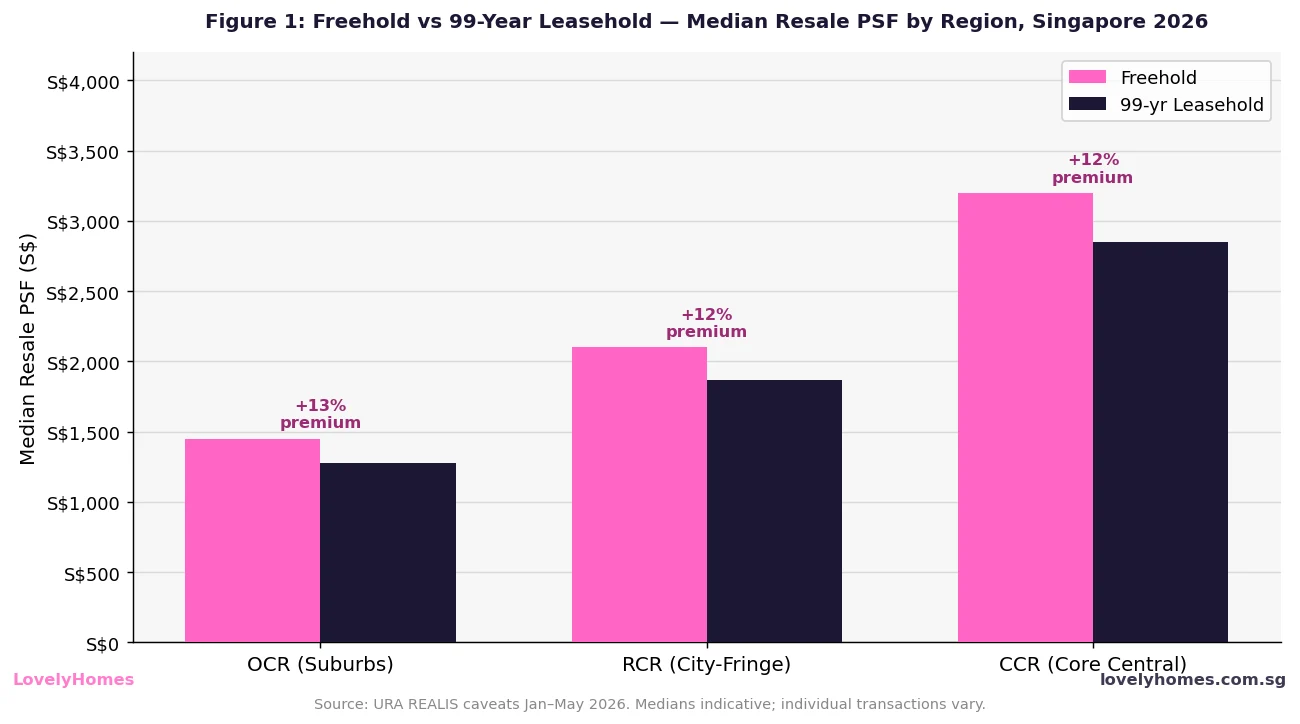
Freehold vs 99-year leasehold median resale PSF by region Singapore 2026
Figure 1: Freehold units in all three regions carry a meaningful price premium over comparable 99-year leasehold stock, ranging from ~13% in OCR to ~12% in CCR. Source: URA REALIS caveats Jan–May 2026.

The Freehold Price Premium — What the Data Actually Shows

Based on URA REALIS caveats lodged between January and May 2026, freehold condominiums in the Outside Central Region (OCR) traded at a median of approximately S$1,450 per square foot (PSF), compared to S$1,280 PSF for 99-year leasehold equivalents in the same submarket — a premium of roughly 13%. In the Rest of Central Region (RCR), the gap narrows slightly to around 12% (S$2,100 vs S$1,870 PSF). In the Core Central Region (CCR), freehold commands about S$3,200 PSF against S$2,850 PSF for 99-year leasehold — a similar 12% differential.

These aggregates mask substantial intra-district variation. A freehold apartment in a dated 1980s development in Katong may trade at a lower PSF than a brand-new 99-year leasehold launch in the same postal district, simply because age, facilities, and floor level dominate price for newer projects. The premium is most reliably observed when comparing units of similar age, size, and condition.

One important nuance: 999-year leasehold properties (common in Geylang, parts of Katong, and older estates) typically trade on par with freehold, as the difference of one lifetime is economically negligible. Buyers can treat these as functionally equivalent to freehold for all practical purposes.

Lease Decay — How Remaining Years Affect Value

The critical variable for older leasehold properties is not the original lease but the remaining lease. A 99-year leasehold condominium built in 1970 has roughly 43 years remaining as of 2026 — a materially different proposition from a 99-year leasehold condo built in 2020 with 93 years remaining.
Lease decay curve remaining lease vs value as percentage of freehold equivalent Singapore
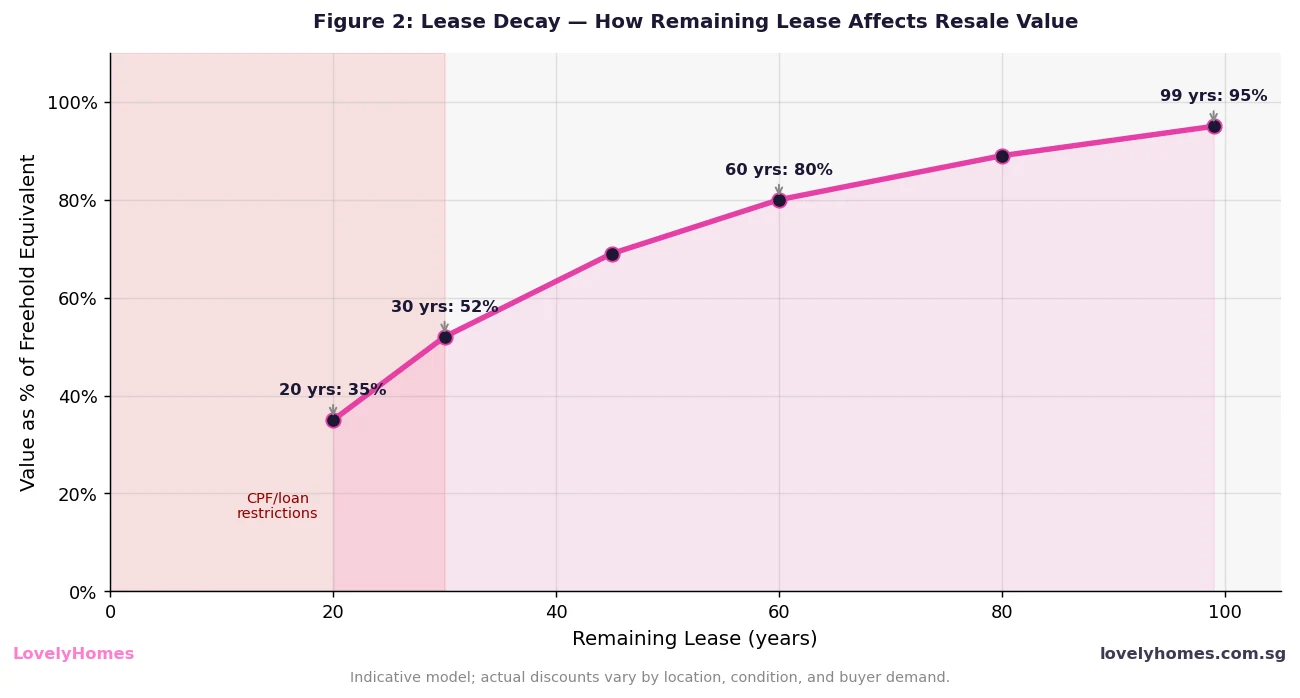
Figure 2: Property value relative to a freehold equivalent declines as remaining lease shrinks. The steepest deterioration occurs below 45 years remaining, and CPF and bank restrictions kick in below 30 years. Indicative model; actual discounts vary.

Industry practitioners and URA’s own data broadly support the following rule of thumb: a property with 60 years remaining may trade at roughly 80% of its freehold equivalent, one with 45 years at about 69%, and one with 30 years at around 52%. Below 30 years, the combination of restricted CPF usage and limited bank financing shrinks the eligible buyer pool dramatically, causing steeper discounts.

This lease-decay dynamic does not apply uniformly to all asset types. HDB resale flats, which are all 99-year leasehold, are subject to specific CPF and HDB loan pro-ration rules that differ from private condominiums — see the CPF section below.

CPF Ordinary Account — The Lease Eligibility Rule

The CPF Board imposes a key restriction: CPF OA funds can only be used to buy a property if the remaining lease at the time of purchase covers the youngest buyer to at least age 95. This is the “age-plus-remaining-lease ≥ 95” rule. For a 35-year-old buyer, this means the remaining lease must be at least 60 years (95 − 35 = 60).

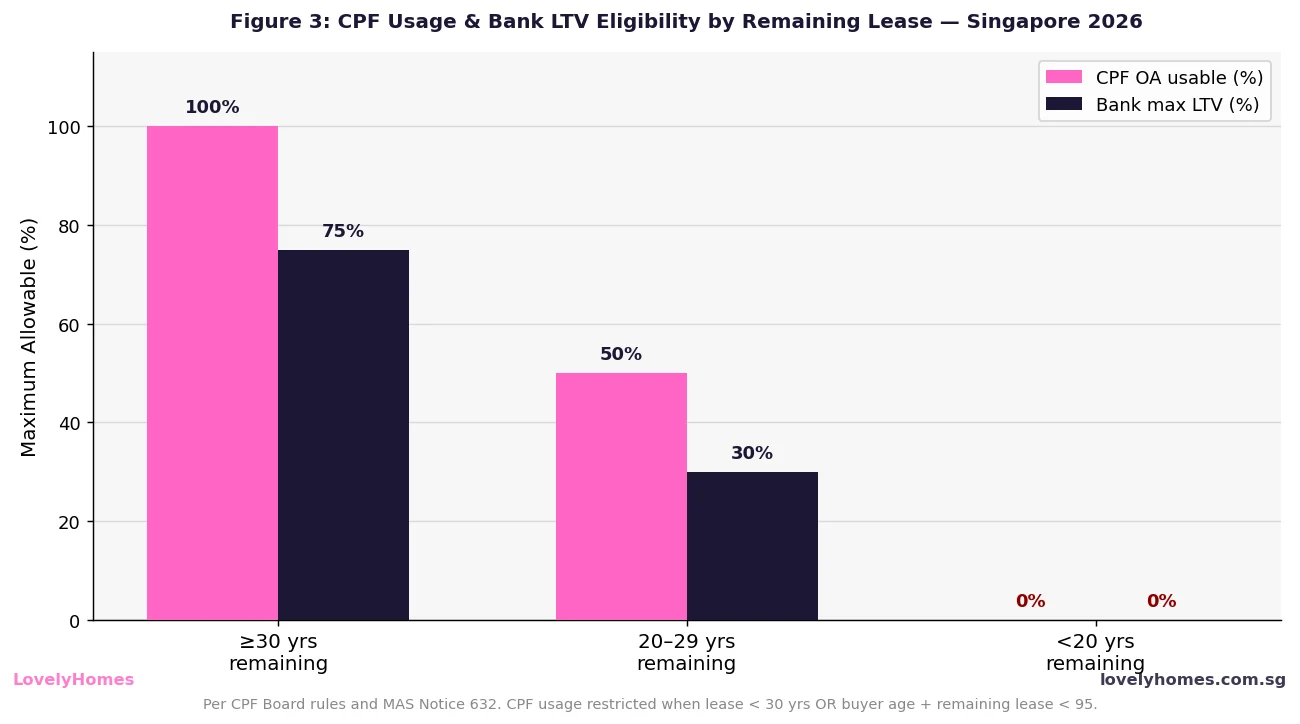
When the remaining lease is between 30 and 60 years, CPF usage is not barred outright but is pro-rated — capped at the portion of purchase price proportional to the lease that covers the buyer to age 95. For leases below 30 years, CPF usage is entirely prohibited for private properties. For HDB flats, separate pro-ration rules apply under CPF Board’s HDB withdrawal limit calculations.
CPF usage and bank LTV eligibility by remaining lease years Singapore 2026
Figure 3: CPF Ordinary Account usage and bank loan LTV eligibility decline sharply once remaining lease falls below 30 years. For properties under 20 years remaining, bank financing is generally unavailable. Source: CPF Board; MAS Notice 632.

Bank mortgage rules (governed by the Monetary Authority of Singapore under MAS Notice 632) are even more restrictive. For leasehold private properties, the maximum loan-to-value (LTV) ratio is reduced when the loan tenure plus the buyer’s age exceeds the remaining lease. In practice, for properties with fewer than 30 years remaining, banks typically offer at most a 30% LTV — and for fewer than 20 years, most banks decline entirely. This effectively forces cash-heavy transactions for short-lease properties.

Side-by-Side Comparison: Freehold vs 99-Year Leasehold

Factor Freehold / 999-yr 99-Year Leasehold (New) 99-Year Leasehold (Aging, <50 yrs left)
Purchase price premium 10–15% higher Market benchmark Discount vs new; depends on remaining lease
CPF OA usage Full (subject to Withdrawal Limit) Full (while ≥60 yrs remain for buyer aged 35) Pro-rated or prohibited
Bank LTV (MAS Notice 632) Up to 75% (first loan) Up to 75% Reduced; may be nil below 20 yrs
HDB loan eligibility N/A (private) N/A (private) N/A (private)
Rental yield Slightly lower (higher price) Similar or marginally higher Can be higher (lower acquisition cost)
Capital appreciation Historically steady; en-bloc upside Strong while new; slows as lease ages Compressed by lease decay
En-bloc potential Yes; developer pays market price Yes; lease top-up cost to developer Lower; developer must factor short residual
Inheritance / legacy Perpetual; passes to heirs Passes within lease term Limited term; heirs inherit shrinking asset
Government SERS / renewal No lease to renew; owner retains land May qualify for SERS (case-by-case) Eligible for SERS; no automatic renewal

📄 Worked Example: Mr & Mrs Ng — Choosing Between a Freehold and 99-Year Leasehold in D15

Mr and Mrs Ng (both Singapore Citizens, aged 38 and 35 respectively) are first-time private property buyers. They are deciding between two comparable 3-bedroom condominiums in District 15 (East Coast) — one freehold at S$2,100,000 and one 99-year leasehold (88 years remaining) at S$1,840,000.

Freehold option (S$2,100,000):

  • BSD: S$67,600 (1% on first S$180k, 2% on next S$180k, 3% on next S$640k, 4% on balance)
  • ABSD: S$0 (both SC, first property)
  • CPF OA available: S$350,000 (combined)
  • Bank loan (75% LTV, first property): S$1,575,000 at 3.5% p.a. over 25 years → S$7,874/mth
  • TDSR check: S$7,874 / combined income S$18,000/mth = 43.7% (PASS, ≤55%)
  • Upfront cash: S$525,000 (25% down) − S$350,000 CPF = S$175,000 cash minimum + BSD S$67,600

Leasehold option (S$1,840,000):

  • BSD: S$57,400
  • ABSD: S$0
  • CPF OA: Full S$350,000 usable (88 yrs remaining; youngest buyer aged 35 → 35 + 88 = 123 ≥ 95 ✓)
  • Bank loan (75% LTV): S$1,380,000 at 3.5% p.a. over 25 years → S$6,899/mth
  • TDSR: 38.3% PASS
  • Upfront cash: S$460,000 − S$350,000 CPF = S$110,000 cash + BSD S$57,400

The S$260,000 price difference buys the Ngs perpetual land ownership. Assuming both properties appreciate at 3% p.a. over 10 years, the freehold property grows to ~S$2.82M and the leasehold to ~S$2.47M — a gross difference of S$350,000. After deducting the extra upfront outlay, the freehold option produces a modestly better absolute return in this scenario, but the leasehold frees up S$75,000+ in cash for other investments.

Verdict for the Ngs: If they plan to hold for 20+ years or pass the property to children, freehold offers compounding legacy value. If they intend to sell within 10–15 years, the leasehold’s lower entry cost and similar near-term appreciation make it the more cash-efficient choice.

Why Tenure Matters More Than Most Buyers Think

Singapore’s land scarcity means that freehold sites represent a finite, dwindling stock. Every GLS site released under the Confirmed List is 99-year leasehold by default. The number of freehold sites available for collective sale or redevelopment shrinks every year, and prime freehold plots in Districts 9–11 change hands infrequently. This structural supply constraint underpins the persistent freehold premium.

However, context matters. Hong Kong, one of the world’s most expensive property markets, is almost entirely leasehold (government-administered long leases), yet this has not suppressed demand or prices. Japan has a strong culture of freehold residential ownership but has seen property values stagnate in some markets. Singapore’s freehold premium is a local market convention as much as a financial reality, and it has narrowed over the past decade as leasehold new launches in prime districts have demonstrated strong performance.

For HDB upgraders, the tenure question is often moot: most new launch condominiums on GLS land are 99-year leasehold, and the alternative is a freehold resale unit at a significantly higher ticket price. The financial discipline of staying within TDSR and LTV limits often makes leasehold the only viable option.

For investors, rental yield on freehold properties is modestly lower than on comparable leasehold units (due to the higher acquisition cost), but en-bloc potential — and the ability to hold indefinitely without lease clock pressure — provides a different risk-return profile.

What Might Come Next — Tenure Policy Outlook (Speculative)

This section reflects analyst opinion and publicly available policy signals — not confirmed government plans.

The Singapore government has historically been non-committal on extending leases for private properties that are not eligible for SERS. As the first cohort of 1960s and 1970s 99-year leasehold developments approaches the final third of their lease term, the policy question of what happens to owners of expiring leases will become increasingly pressing. Academic and industry voices have proposed options ranging from a voluntary lease top-up scheme (analogous to HDB SERS) to a market-based extension framework, but no formal policy has been announced.

On the supply side, the government’s commitment to a “high and steady” GLS Confirmed List supply — 9,320 units for 2026, over 50% above the 10-year average — will sustain the dominance of 99-year leasehold new launches. The ratio of freehold to leasehold private residential stock will continue to tilt toward leasehold as each GLS cycle delivers new 99-year sites. This dynamic may gradually compress the freehold premium in some markets over time, though scarcity of prime freehold land will likely keep it elevated in Districts 9–11.

Frequently Asked Questions — Freehold vs Leasehold Singapore 2026

Can I use my CPF to buy a 99-year leasehold condo?

Yes — CPF Ordinary Account funds can be used for a 99-year leasehold private condominium as long as the remaining lease at the point of purchase covers the youngest buyer to at least age 95. For a 30-year-old buyer, this means at least 65 years of lease must remain. When remaining lease falls short of this threshold, CPF usage is pro-rated or barred. The CPF Board’s website provides a calculator for your specific situation, and your solicitor will confirm CPF eligibility during conveyancing.

Is freehold always a better investment than leasehold in Singapore?

Not necessarily. While freehold carries a durable price premium and perpetual land rights, 99-year leasehold properties — especially new launches in well-located estates — have demonstrated strong capital appreciation over 10–15-year holding periods. The key variables are location, project quality, and holding period. A leasehold property in a prime district with excellent MRT connectivity can outperform a freehold unit in a secondary location. For very long holding periods (20+ years or across generations), freehold offers compounding advantages through unimpaired CPF and financing access as the asset ages.

What happens when a 99-year leasehold expires in Singapore?

When a 99-year lease expires, the land reverts to the state — specifically to the Singapore Land Authority (SLA). As at 2026, no private residential 99-year lease has yet expired in Singapore. The government has managed aging leasehold estates through the Selective En-bloc Redevelopment Scheme (SERS), under which residents are rehoused and compensated. However, SERS eligibility is selective and is not a right — it depends on redevelopment potential and public interest. Owners of non-SERS-eligible aging leasehold properties face value erosion as the lease shortens, with no guaranteed government buyback.

Does a 999-year leasehold property count as freehold?

For all practical purposes, yes. A 999-year leasehold property purchased today will not see its lease expire for nearly a millennium. CPF Board, banks, and IRAS treat 999-year leasehold broadly on par with freehold for financing, CPF usage, and stamp duty purposes. Some buyers and agents refer to 999-year leasehold as “near-freehold.” Properties in estates like parts of Katong, Geylang, and Bukit Timah may have 999-year leases dating from colonial-era grants — these typically transact at prices comparable to freehold equivalents.

Will the bank lend me less if I buy an old leasehold property?

Yes. Under MAS Notice 632, the maximum mortgage tenure a bank can offer is capped by the property’s remaining lease (specifically, the loan tenure must not cause the buyer to hold the property beyond the lease expiry). For a property with 45 years remaining and a buyer aged 40, the maximum loan tenure is capped at 45 years (but cannot exceed the standard 30-year cap). More critically, if the loan tenure would exceed the remaining lease, LTV is reduced — typically to 30% or less — making borrowing very expensive. For properties with under 20 years of lease remaining, most banks decline financing entirely.

Can I still sell a leasehold property with a short remaining lease?

Yes, you can sell, but the pool of eligible buyers shrinks considerably. Buyers cannot use CPF, cannot get standard bank mortgages, and must pay largely in cash. This compresses demand and depresses price. In practice, properties with fewer than 30 years remaining tend to trade well below their notional market value, and may take longer to find a buyer. Investors with cash liquidity sometimes target these for rental yield plays, but they must accept limited exit options.

Is the freehold premium in Singapore justified?

It is partly justified by structural supply scarcity — freehold residential land in Singapore is finite, and GLS sites are always 99-year leasehold — and partly by the CPF and bank financing advantages that persist for the full ownership period. However, research by academics (including NUS studies on Singapore residential markets) suggests the premium can be overstated relative to the actual financial difference in returns over 10–20-year holding periods. The premium also reflects behavioural and cultural preferences — particularly among older Singapore Chinese buyers who associate freehold with permanence and legacy — rather than purely rational pricing. Buyers should assess the premium in the context of their specific holding period, family plans, and financing constraints.
Disclaimer: This article is for general informational purposes only and does not constitute financial, legal, or property investment advice. Property prices, CPF rules, MAS regulations, and government policies are subject to change. CPF usage eligibility depends on individual circumstances — consult the CPF Board (cpf.gov.sg) directly. Bank loan terms and LTV ratios vary by financial institution and borrower profile — consult a licensed financial adviser or mortgage broker. Stamp duty rates and property tax information are published by IRAS (iras.gov.sg). Always verify data with URA (ura.gov.sg), SLA (sla.gov.sg), and HDB (hdb.gov.sg) before making property decisions. Past property price performance does not guarantee future results.


Freehold vs 99-Year Leasehold Singapore 2026: The Tenure Question Buyers Keep Asking

Freehold vs 99-Year Leasehold Singapore 2026: The Tenure Question Buyers Keep Asking

Freehold or 99-year leasehold? It is the single most-asked question on every Singapore condo viewing — and the most-misunderstood. The freehold premium is real but smaller than most buyers think. Lease decay is real but slower in the early years than buyers fear. Whether the freehold premium is worth paying depends almost entirely on your holding period, not your gut feeling.

This guide unpacks how Singapore property tenure actually works in 2026 — the four tenure types you will encounter, the maths behind Bala’s Curve (the lease-relativity table the Singapore Land Authority uses internally), the financing and CPF rules that bite as a lease shortens, and a worked 20-year hold comparison on a S$1.8 million condo in the same district. Where useful, we cross-link to the underlying frameworks at IRAS and CPF.

Quick Answer — Freehold vs 99-Year Leasehold at a glance

  • Freehold premium in comparable locations: typically 10–20% over 99-year leasehold
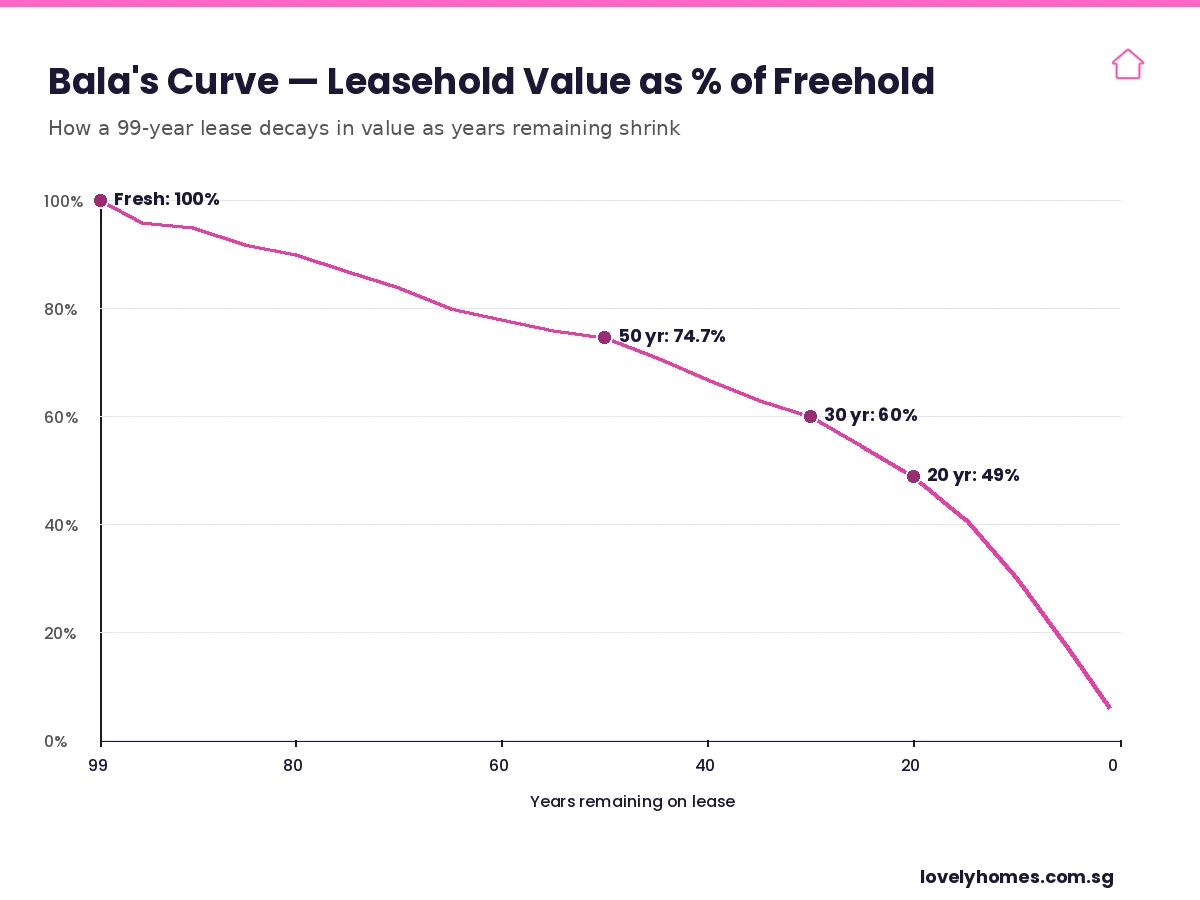
  • Bala’s Curve sets leasehold value at ~74.7% of freehold at 50 years remaining; ~60% at 30 years; ~49% at 20 years
  • CPF restrictions kick in when remaining lease is below 60 years; cannot use CPF at all if lease falls below 30 years for the next buyer
  • Bank financing tightens when remaining lease is below 40 years
  • Lease must cover the youngest applicant’s age + 95 for full CPF usage
  • Most new-launch condos and ECs are 99-year leasehold; freehold supply is fixed at ~5% of Singapore’s land area
  • For holding periods under 20 years in good locations, leasehold often outperforms freehold on a return-on-capital basis
  • For multi-generational holds (40+ years), the freehold premium pays for itself

What Are You Actually Buying? The Four Tenure Types

Singapore property comes with four main tenure types — and the difference between them is more legal than emotional. Tenure determines how long the State (or your descendants) recognises your interest in the land beneath your unit. Strata-Title in your condo gives you ownership of your apartment and a share in the land — for as long as the land tenure runs.

Singapore property tenure types — freehold 5 percent of land area, 999-year, 99-year leasehold, 60-30 year industrial
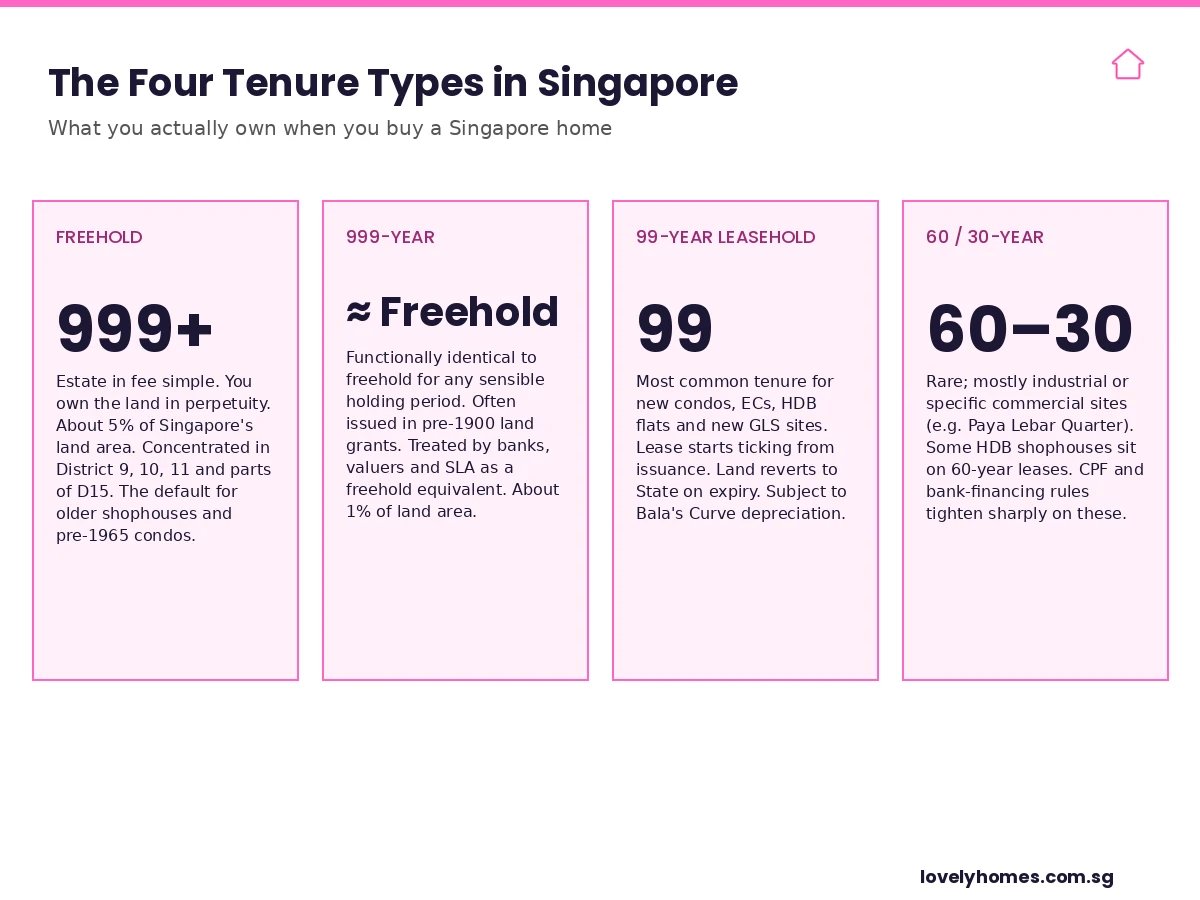
Figure 1: The four tenure types you will encounter in Singapore.

Freehold (Estate in Fee Simple)

You own the land in perpetuity, with the right to sell, lease or pass it to heirs without time limit. About 5% of Singapore’s land area is freehold — concentrated in the prime districts (D9, D10, D11) and pockets of D15. The State has not generally released new freehold land since 1965; almost all freehold supply today is from pre-1965 grants. This is why freehold supply is functionally fixed and cannot be created.

999-Year Leasehold

Issued mostly under pre-1900 colonial grants. Functionally identical to freehold for any sensible holding period — banks and valuers treat 999-year as a freehold equivalent. About 1% of Singapore’s land area sits on 999-year tenure. When you read a marketing brochure that says “freehold equivalent”, this is what is meant.

99-Year Leasehold

By far the most common tenure for new condos, Executive Condominiums, HDB flats, and almost every site released through the Government Land Sales (GLS) programme. The lease starts running on the date of issuance — which for a new launch is typically 1–2 years before TOP. Land reverts to the State at the end of the 99 years, with the building demolished or redeveloped. Subject to Bala’s Curve depreciation, which we cover next.

60-Year and 30-Year Leases

Unusual outside specific commercial or industrial sites. Some HDB shophouses sit on 60-year leases; certain industrial GLS plots are 30-year. CPF, bank-financing and resale rules are sharply restricted on these — not the tenure for a typical residential buyer.

Bala’s Curve — The Maths Behind Lease Decay

The single most important framework for understanding 99-year leasehold pricing is Bala’s Table (sometimes called Bala’s Curve, after Mr V K Balasubramaniam who developed it for the Singapore Land Authority in the 1990s). Bala’s Table sets out the value of a leasehold property as a percentage of its equivalent freehold value, indexed to the years remaining on the lease.

Bala's Curve Singapore — leasehold value as percent of freehold across 99 years remaining, non-linear depreciation
Figure 2: Bala’s Curve — non-linear lease decay across the 99-year lease. Steepest depreciation falls in the final 30 years.

Two features of the curve matter most:

  1. The depreciation is non-linear. A fresh 99-year lease is worth roughly the same as freehold — the curve sits at 100%. After 50 years remaining (i.e. ~half-life), value is still ~74.7% of freehold — a far gentler decay than the simple linear “halfway = 50%” intuition. The steep portion of the curve falls in the last 30 years, when value drops from ~60% (30 years remaining) to ~17% (5 years remaining).
  2. Bala’s Table is the floor, not the market. Real-world transactions rarely match the table exactly. Local demand, building condition, en-bloc potential, and lease topping-up rumours can push prices well above (or below) the Bala line. The table is what SLA uses to price lease top-ups and to convert tenure for tax purposes — not what the open market necessarily pays.

For a buyer, the practical implication is that the first 30–40 years of a 99-year lease behave very like freehold. A 99-year condo at TOP today is essentially “freehold for two generations”. The depreciation problem is real for buyers planning to hold past Year 60 or thinking about en-bloc redevelopment as the exit strategy.

The CPF and Financing Cliffs — When Lease Decay Starts to Bite

Bala’s Curve is the underlying valuation framework, but two regulatory cliffs determine when lease decay actually starts to hurt resale liquidity:

The CPF Usage Rules

CPF can be used in full only if the remaining lease covers the youngest buyer’s age plus 95 years. For a 35-year-old buying a property today, the remaining lease must be at least 60 years for full CPF use; otherwise CPF usage is pro-rated and capped. If the remaining lease is below 30 years, CPF cannot be used at all by your next buyer — which collapses the buyer pool to cash buyers only.

The Bank Financing Rules

Bank loan tenure cannot exceed (lease remaining minus a buffer; typically 5 years). If the remaining lease is below 40 years, banks will quote shorter loan tenures, lower LTVs, and higher rates — and some banks will decline outright. When this happens, your effective buyer pool narrows further.

Together, these two cliffs mean that the Bala’s Curve depreciation is amplified in the secondary market by liquidity contraction. A 40-year-remaining lease may be worth 67% of freehold in pure Bala terms, but the smaller buyer pool means actual transactions can clear at a steeper discount. This is why the “sweet spot” for selling a 99-year leasehold is usually before Year 50, not after.

Worked Example — 20-Year Hold, Same District, Same Specs

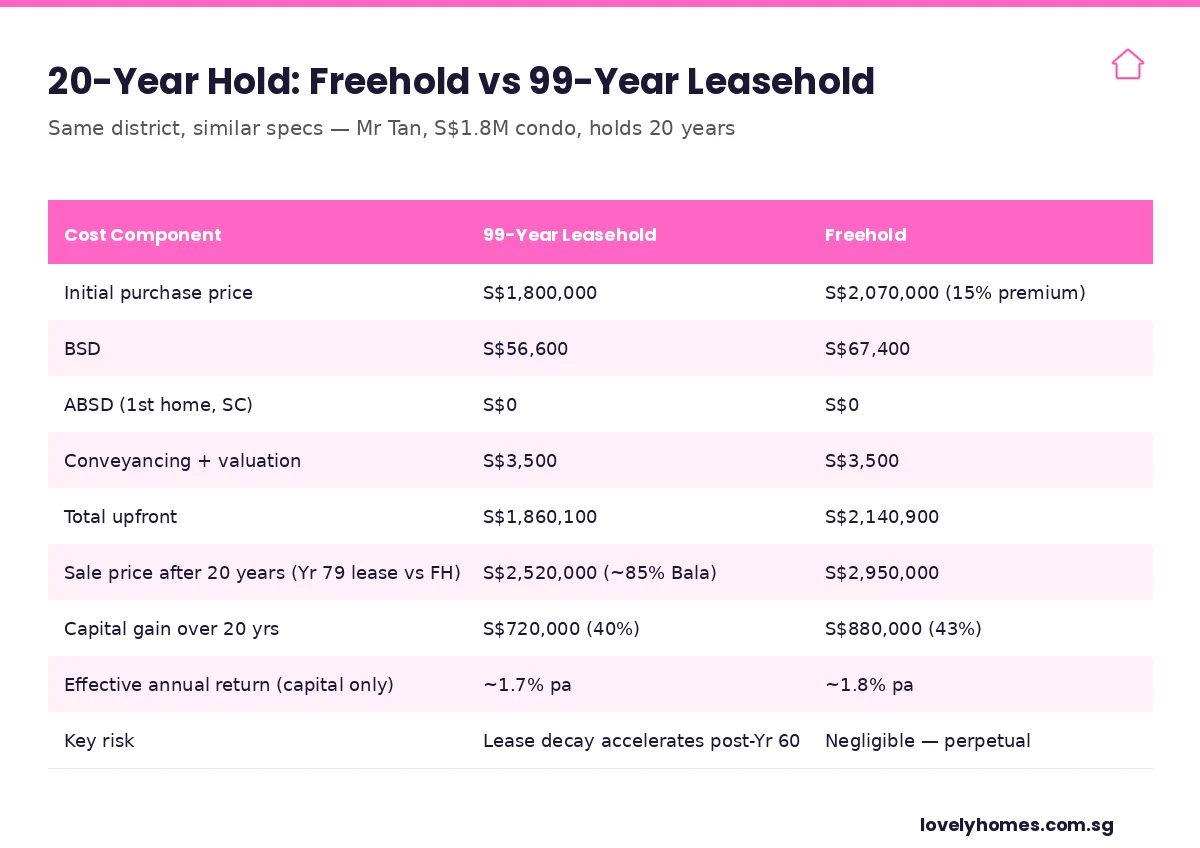
Let’s strip out emotion and compare on the maths. Mr Tan is 40, a Singapore Citizen first-time buyer. He is choosing between two condos in the same District 15 micro-market: a brand-new 99-year leasehold at S$1,800,000 and a 999-year (freehold-equivalent) unit at S$2,070,000 — a 15% freehold premium, which is roughly the historic norm. He plans to hold 20 years.

20-year hold cost stack freehold vs 99-year leasehold Singapore 2026 — S$1.8M condo identical district worked example
Figure 3: 20-year hold — freehold vs 99-year leasehold, identical-district worked example.
Cost / Outcome 99-Year Leasehold Freehold
Year 0 purchase price S$1,800,000 S$2,070,000
Year 0 BSD S$56,600 S$67,400
Year 0 ABSD (1st home, SC) S$0 S$0
Year 0 conveyancing S$3,500 S$3,500
Total upfront outlay S$1,860,100 S$2,140,900
Year 20 sale price (assume 2.0% pa district appreciation, freehold; leasehold capped at Yr 79 Bala factor ~92% of freehold) S$2,520,000 S$2,950,000
Capital gain S$720,000 (40%) S$880,000 (43%)
Effective annual return (capital only) ~1.7% pa ~1.8% pa
Return on incremental S$280,800 ~3.4% pa — the marginal freehold premium implies a ~3.4% annualised return on the extra capital tied up

The headline finding: in this worked example, the freehold buyer earns a ~3.4% annualised return on the extra S$280,800 tied up in the freehold premium — modest, and below typical bond returns. For a 20-year hold, the leasehold often comes out marginally ahead on a return-on-capital basis, especially if the freed-up capital can earn 4–5% in conservative investments.

Where the maths flips is at longer holding periods. Repeat the calculation across 40 years — with the leasehold now at Yr 59 remaining (~78% Bala) versus a still-perpetual freehold — and the freehold premium starts compounding strongly. By Year 50 of holding, the freehold has typically earned a meaningful spread.

When Freehold Wins, When Leasehold Wins

The framework most experienced Singapore buyers use is to match tenure to holding period and exit strategy:

  • Hold under 15 years: 99-year leasehold typically wins on return-on-capital. Lease decay is too gentle in this window to matter, and the freed-up capital can earn elsewhere. This is the typical short-to-medium hold investor case.
  • Hold 15–30 years: A toss-up. Outcome turns on (a) the actual freehold premium paid and (b) the district’s underlying appreciation rate. In high-growth districts, leasehold often wins; in slow-growth districts, the freehold premium does its job.
  • Hold 30+ years or multi-generational: Freehold wins. Lease decay enters its accelerating zone, and the freehold becomes a meaningfully stronger compounding asset. This is the family-legacy or trust-held case.
  • Buying for own-stay, expecting to en-bloc: Leasehold can win if the project has clear redevelopment upside (high plot ratio uplift, supportive URA zoning, agreeable owner mix). The collective sale becomes the “lease top-up” you couldn’t buy directly.
  • Buying for rental yield: Leasehold typically yields more — lower entry price for the same rent. Yield-focused investors generally prefer leasehold.

For a deeper read on holding-period maths and exit strategies, see our En-Bloc Sale Process Guide and our Seller’s Stamp Duty Singapore 2026 article, which together set out the cost of an early exit on either tenure.

What About Lease Top-Ups?

Owners and developers occasionally apply to SLA to top up a depleting lease — restoring it to a fresh 99 years for a payment based on the difference between the current and the topped-up value. The cost is calculated against Bala’s Table. In practice, lease top-ups are most often initiated as part of an en-bloc / collective sale, where the developer negotiates the top-up alongside the redevelopment approval.

An individual owner cannot reliably plan for a private top-up. The Government’s VERS (Voluntary Early Redevelopment Scheme), announced in 2018 for selected HDB precincts, is a separate framework from private leasehold top-ups and applies only to public-housing estates. There is no equivalent statutory framework for private leasehold properties — which means private leasehold owners cannot count on lease top-ups as part of their long-term plan.

What This Means for You

If you take only five things away from this guide, take these:

  1. Match tenure to holding period. Under 15 years, leasehold typically wins. Over 30 years, freehold typically wins. In between, run the maths on the actual freehold premium versus the capital-cost spread.
  2. Don’t pay more than ~15–20% premium for freehold. Above this, the maths almost never works for typical holding periods. Some new-launch freehold projects have asked for 25–30% premiums — treat those with caution.
  3. Watch the lease-remaining number when buying resale. 60 years is the CPF cliff for buyers in their late 30s. Below that, you start losing CPF eligibility for your next buyer — which compresses your exit price more than Bala’s Table would suggest.
  4. Check the lease commencement date carefully. A new-launch 99-year condo often has a lease that started 1–2 years before TOP, so a buyer at TOP only gets ~97–98 years remaining, not 99.
  5. If en-bloc is your exit strategy, leasehold can win. The collective-sale premium effectively converts the 99-year lease into a one-time cash payout that bypasses Bala’s Curve. But en-bloc success rates vary — do not assume your project will get there.

What Might Come Next

Three policy and market variables to watch in 2026–2027:

  • Bala’s Table revision. SLA last refreshed Bala’s Table several years ago. A revision — especially one that flattens the curve or pushes the steep zone closer to lease end — would mark up secondary leasehold values across the board. There is no current signal of revision in 2026.
  • Freehold premium compression. Several recent freehold launches have struggled to clear meaningful premiums over comparable leasehold launches in the same district. If this trend continues, the structural freehold premium may compress towards the 5–10% range, weakening the case for paying up.
  • VERS or analogous private-lease scheme. If the Government extends a VERS-style framework to private leaseholds (an idea floated occasionally by industry figures), the long-tail risk of holding past Year 60 reduces sharply — and the freehold premium loses some of its insurance value.

Frequently Asked Questions

Is freehold always better than leasehold?

No. Freehold is structurally lower-risk for very long holds (30+ years) and multi-generational holds. For shorter holds (under 15 years), the capital tied up in the freehold premium often earns a lower return than the same capital deployed elsewhere. The right answer depends entirely on your holding period.

What happens at the end of a 99-year lease?

The land reverts to the State. Owners typically receive no compensation unless a private collective-sale or a public scheme (e.g. VERS for HDB) intervenes earlier. In practice, almost every 99-year property in Singapore exits via en-bloc or major redevelopment well before the lease expires — full lease expiry is rare for residential land.

Can CPF be used for any leasehold property?

Only if the remaining lease covers the youngest applicant’s age plus 95. For full CPF withdrawal limits to apply, the lease must run at least to that age. Where the lease is shorter, CPF usage is pro-rated. Below 30 years remaining, CPF cannot be used at all by the next buyer.

How is Bala’s Curve different from straight-line depreciation?

Straight-line depreciation would assume the leasehold loses 1/99 of its value every year. Bala’s Curve recognises that the early years of a long lease have negligible depreciation (because the buyer pool is large and time-to-expiry is far away), while the final 20–30 years see steep depreciation (because financing and CPF rules compress the buyer pool sharply). Bala’s Table is non-linear and far more accurate for real-world pricing.

Are HDB flats freehold or leasehold?

All HDB flats are 99-year leasehold. The lease starts when the block is completed and the title issued. By the time most BTO buyers move in, the lease typically has between 96 and 99 years remaining. HDB resale flats from the 1970s and 1980s have far less remaining lease — some now under 60 years — which is why CPF eligibility for older HDB resale is increasingly tight.

Does freehold matter for rental yield?

Not really. Tenants pay for liveability, location and amenities — not for tenure. Rental yield is therefore a function of the lower entry price, which favours leasehold. Yield-focused investors typically prefer leasehold because the same rent against a lower entry price gives a higher gross yield.

Can I top up a 99-year lease privately?

An individual owner cannot reliably do so. SLA does process lease top-up applications, but they are typically in the context of an en-bloc / collective sale where the developer pays for the top-up as part of the redevelopment approval. A private owner asking SLA to extend their personal 99-year lease should not assume approval — nor should they assume the cost would be commercially reasonable.

Related Articles

Disclaimer: This guide is for general information only and does not constitute legal, tax, or financial advice. Bala’s Table and CPF / financing rules are administered by the Singapore Land Authority, the Central Provident Fund Board, and the Monetary Authority of Singapore respectively, and may be revised from time to time. Always verify the current position with the Singapore Land Authority, the CPF Board, and a licensed conveyancing lawyer before signing any Option to Purchase.

Translate »