TDSR & MSR Singapore 2026: Complete Guide to Mortgage Servicing Limits and the Stress Test Rate

TDSR & MSR Singapore 2026: Complete Guide to Mortgage Servicing Limits and the Stress Test Rate

Quick Answer: TDSR and MSR in Singapore

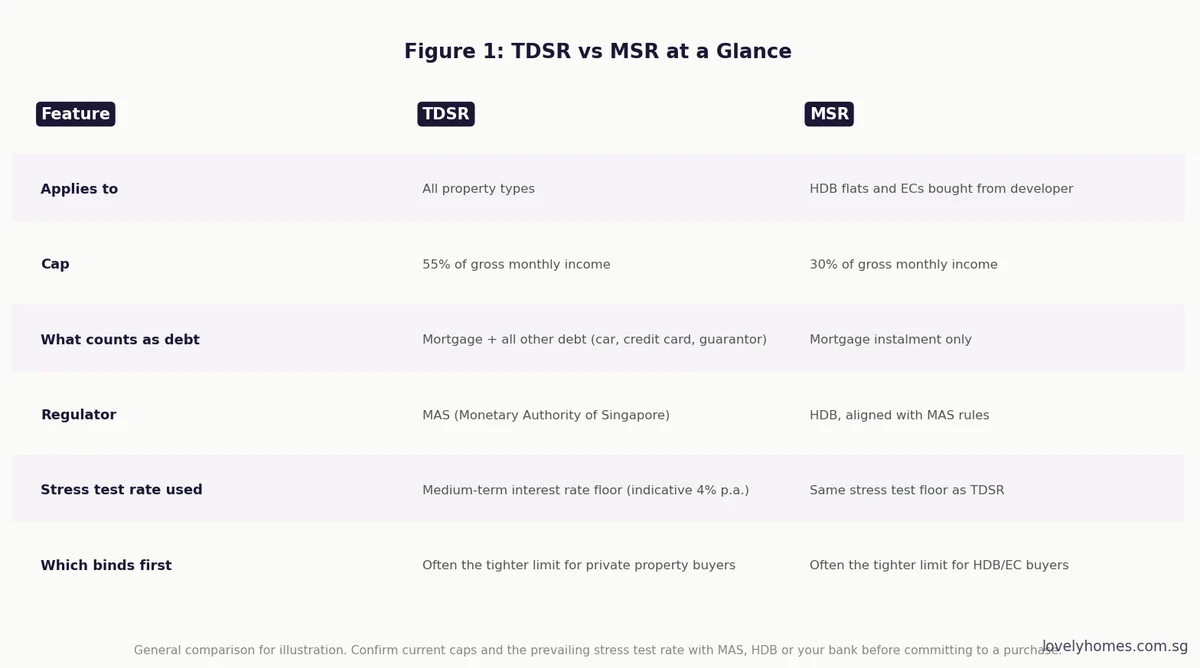
  • TDSR (Total Debt Servicing Ratio) caps all your monthly debt repayments, mortgage plus everything else, at 55% of your gross monthly income, and applies to every residential property loan in Singapore.
  • MSR (Mortgage Servicing Ratio) is a stricter, narrower limit that applies only to HDB flats and Executive Condominiums (ECs) bought directly from a developer, capping the mortgage instalment alone at 30% of gross monthly income.
  • Both ratios are administered under rules set by the Monetary Authority of Singapore (MAS); HDB applies the same underlying framework to bank loans used for HDB purchases.
  • Banks must calculate your eligibility using a stress test interest rate (an MAS-set floor, commonly cited at 4% per annum) rather than the actual rate on your loan, which is almost always lower.
  • The TDSR framework was introduced by MAS in June 2013 with a 60% ceiling, then tightened to 55% as part of the December 2021 cooling measures.
  • Variable income (commission, bonus, rental) is only counted after a haircut, commonly 30% for rental income and 30% for variable/self-employed income, before it’s added to your TDSR/MSR calculation.
  • For an HDB flat or EC, both MSR and TDSR must be satisfied simultaneously: MSR is almost always the tighter constraint for these property types.

What Are TDSR and MSR, and Why Do They Exist?

Every home loan application in Singapore is tested against one or both of two affordability ceilings set by the Monetary Authority of Singapore (MAS): the Total Debt Servicing Ratio (TDSR) and, for HDB flats and Executive Condominiums, the Mortgage Servicing Ratio (MSR). Both exist for the same underlying reason: to stop households from borrowing more than they can realistically service, and to keep systemic household leverage at a level the banking system and the wider economy can absorb if interest rates rise or incomes fall. Neither ratio is a suggestion; they are hard caps built into every bank’s and HDB’s loan approval system, and a loan application that fails either test simply cannot be approved at the requested quantum.

TDSR was introduced on 29 June 2013, in the wake of a prolonged period of low interest rates and rapid private-property price growth, as the definitive framework for assessing a borrower’s total debt burden across every loan they hold, not just the mortgage being applied for. MSR is the older, narrower sibling; it has applied to HDB flats and ECs bought from a developer for considerably longer, reflecting the public-housing policy goal of keeping mortgage burdens on subsidised or grant-supported flats conservative relative to household income.
TDSR vs MSR comparison Singapore mortgage servicing ratio 2026
Figure 1: TDSR and MSR side by side: who they apply to, the caps, and what counts as debt.

TDSR in Detail: The 55% Ceiling That Applies to Every Property Loan

TDSR looks at the whole picture of your finances, not just the loan you’re applying for. The formula is straightforward in concept: add up all your monthly debt obligations (the proposed new mortgage instalment, any existing home loan, car loan, renovation loan, personal loan, education loan, and the minimum payment due on every credit card you hold) and divide that total by your gross monthly income. The result cannot exceed 55%. If it does, the bank cannot approve the loan at that quantum; you would need to either apply for a smaller loan, pay down existing debt first, or bring in a co-borrower whose income can be added to the calculation.

Crucially, TDSR is not limited to property-related debt. A large car loan, a chunk of outstanding credit card balances, or a sizeable personal loan for a wedding can all quietly eat into your TDSR headroom well before you ever start comparing condo units, which is why mortgage brokers routinely advise clearing high-interest short-term debt in the months before a home loan application.

MSR in Detail: The Tighter 30% Rule for HDB and EC Buyers

MSR is narrower in scope but stricter in effect. It applies only to HDB flats (whether new BTO, resale, or SBF) and Executive Condominiums bought directly from a developer, and it looks only at the mortgage instalment for that specific property: not your car loan, not your credit cards, not any other debt. The cap is 30% of gross monthly income. For most HDB and EC buyers, MSR bites before TDSR does, since 30% is a materially tighter ceiling than 55%; a buyer with no other debt at all can still be constrained purely by MSR.

Both ratios must be satisfied at the same time for an HDB or EC purchase financed with a bank loan: the mortgage instalment alone must stay under 30% of income (MSR), and the mortgage instalment plus every other debt obligation must stay under 55% of income (TDSR). HDB’s own concessionary loan, used by many first-time flat buyers, applies MSR using HDB’s own assessment framework, which is administered in step with the same underlying MAS policy intent even though the concessionary loan itself sits outside the bank lending system.

The Stress Test Rate: Why Your Loan Eligibility Isn’t Based on Your Actual Interest Rate

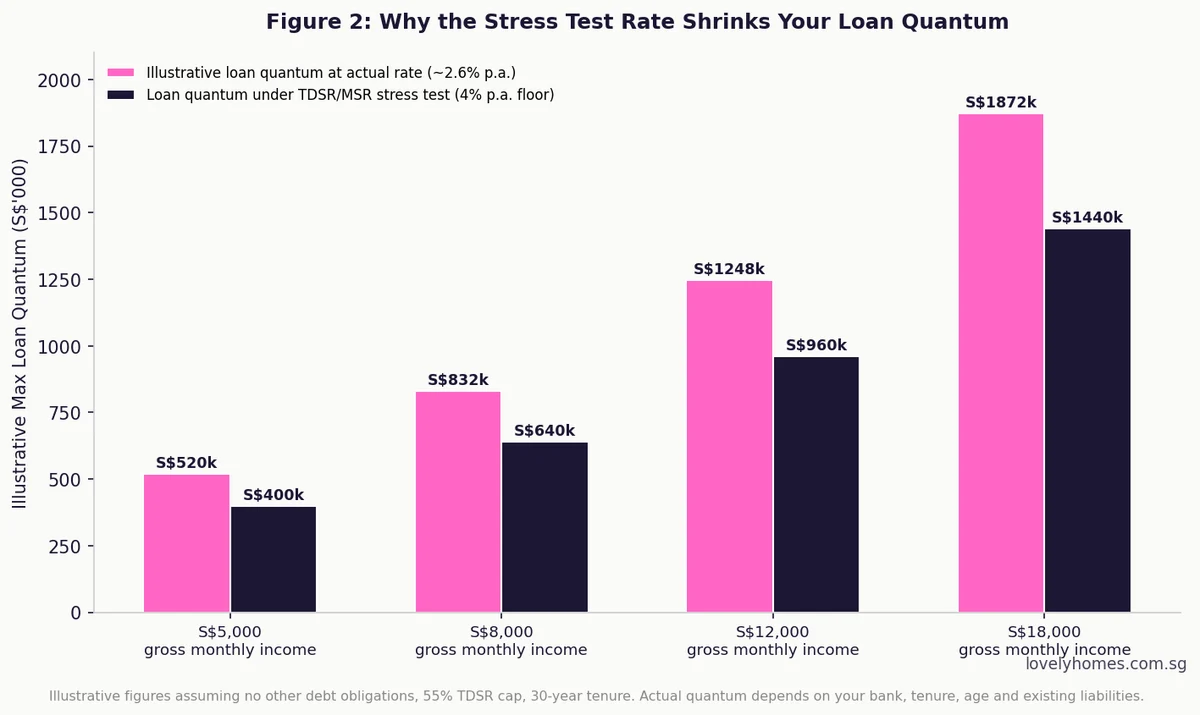
This is the detail that surprises the most first-time buyers. Banks are required by MAS to compute your TDSR and MSR using a stress test interest rate: a conservative, MAS-set floor rate, rather than the actual, usually lower, interest rate quoted on your home loan package. The stress test rate is commonly cited at a floor of 4% per annum (or the loan’s own reference rate plus a margin, whichever is higher), regardless of whether your actual mortgage package charges something closer to 2.5%–3.5%.

The logic is deliberately conservative: if interest rates were to rise materially over your loan’s 20–30 year tenure, MAS wants confidence that you could still service the mortgage at a meaningfully higher rate than today’s prevailing rate, without becoming financially distressed. The practical effect is that your maximum loan quantum is smaller than a simple calculation using your actual mortgage rate would suggest, sometimes substantially so, as illustrated below.
Stress test rate impact on maximum loan quantum TDSR MSR Singapore 2026
Figure 2: Illustrative maximum loan quantum at an actual mortgage rate versus the same household under the TDSR/MSR stress test floor.

What Counts as Income and Debt: The Details That Catch Buyers Out

Not all income is treated equally in a TDSR or MSR calculation, and this is where self-employed buyers, commission-based earners, and landlords most often find their expectations don’t match the bank’s numbers:

  • Fixed employment income (basic salary) is generally counted in full.
  • Variable income (bonuses, commissions, and income for the self-employed) is typically counted only after a haircut, commonly 30%, applied to a multi-year average rather than the most recent (and possibly best) year alone.
  • Rental income from other properties you own is likewise typically included only after a haircut, commonly around 30%, and usually requires evidence such as a signed tenancy agreement or recent rental transaction history.
  • Existing debt counted against you includes other mortgages, car loans, renovation loans, education loans, personal loans, and the minimum monthly payment on every credit card you hold, even if you pay your statement in full each month and carry no actual interest-bearing balance.
  • Guarantor obligations (if you’ve guaranteed someone else’s loan) can also be pulled into your own TDSR calculation, a detail many guarantors are unaware of until they apply for their own mortgage.

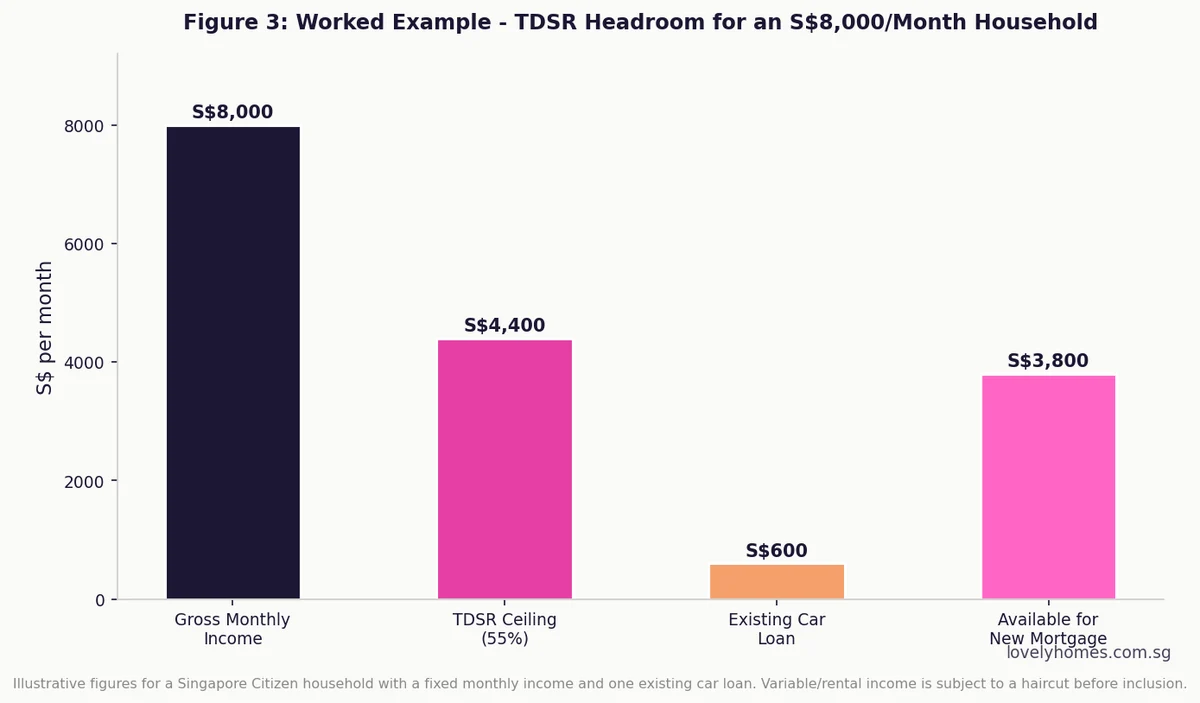
Worked Example: The Tans’ TDSR Headroom

Profile: Mr and Mrs Tan have a combined gross monthly income of S$8,000. They currently service one existing car loan with a monthly instalment of S$600, and they hold no other outstanding debt.

Step 1: TDSR Ceiling. 55% of S$8,000 = S$4,400 is the maximum total monthly debt obligation the Tans can carry across everything, mortgage included.

Step 2: Deduct Existing Debt. S$4,400 − S$600 (car loan) = S$3,800 available for a new mortgage instalment.

Step 3: Translate Into a Loan Quantum. at the MAS stress test floor of 4% per annum over a 30-year tenure, roughly S$3,800 of monthly instalment headroom supports an indicative loan quantum in the region of S$790,000–S$800,000, notably lower than a calculation using the couple’s actual, lower contracted mortgage rate would suggest.

Step 4: If Buying an HDB Resale Flat Instead. MSR would also need to be checked. At 30% of S$8,000 = S$2,400 maximum mortgage instalment, MSR would be the binding constraint rather than TDSR, since S$2,400 is lower than the S$3,800 TDSR headroom calculated above, meaning the Tans’ loan quantum for an HDB purchase would be capped by MSR, not TDSR.
Worked example TDSR headroom calculation Singapore household mortgage 2026
Figure 3: Worked example: how existing debt reduces TDSR headroom for a new mortgage.

Summary: TDSR and MSR Facts at a Glance

Question Short Answer
What is the TDSR cap? 55% of gross monthly income, all property types.
What is the MSR cap? 30% of gross monthly income, HDB flats and ECs only.
Which rate is used to test eligibility? An MAS stress test floor (commonly cited at 4% p.a.), not your actual rate.
Who regulates TDSR/MSR? The Monetary Authority of Singapore (MAS), applied by HDB for HDB loans.
Does variable income count in full? No, typically only after a haircut (commonly around 30%).
Which limit binds for HDB/EC buyers? Usually MSR (30%), since it’s tighter than TDSR (55%).

Why This Matters: Who Gets Caught Out

TDSR and MSR are most likely to bind unexpectedly for a specific set of buyers: self-employed individuals and commission-based earners, whose variable-income haircut can shrink their apparent income considerably relative to what actually lands in their bank account; guarantors, who may not realise a loan they’ve guaranteed for a family member is quietly counted against their own future borrowing capacity; upgraders who haven’t yet sold their existing home and are trying to qualify for a new mortgage while still servicing the old one; and buyers relying heavily on rental income from an investment property, which is haircut and often requires documentary proof most first-time landlords haven’t yet assembled. For all these groups, getting an informal affordability check from a mortgage broker or bank before making an offer, rather than after, avoids the disappointment of a signed Option to Purchase that a bank later can’t finance at the assumed quantum.

What Might Come Next

The following is informed speculation, not confirmed policy. The TDSR/MSR framework, and the stress test rate in particular, is periodically reviewed by MAS in response to prevailing interest rate conditions and household debt trends, as seen when the stress test floor was last adjusted upward. Should mortgage rates fall meaningfully and household borrowing appetite pick up again, some industry commentary suggests MAS could revisit the stress test floor to keep effective borrowing capacity in check without necessarily changing the headline 55%/30% caps themselves. No such change has been announced as at this writing, and the caps and stress test rate discussed in this guide should always be verified against MAS’s current published rules before making financing decisions.

Frequently Asked Questions

Do TDSR and MSR apply to me if I’m paying cash, with no bank loan?

No. TDSR and MSR are lending safeguards that apply only when you’re taking a housing loan from a bank (or, for MSR-equivalent purposes, an HDB concessionary loan). A fully cash purchase with no loan is not subject to either ratio.

Can I use my parents’ or children’s income to boost my TDSR?

Some banks allow a family member to be added as a co-borrower or guarantor, which can bring their income into the calculation, subject to the bank’s own credit assessment and MAS rules on income-weighted average age for loan tenure. This is a case-by-case discussion best had directly with your mortgage banker or broker.

Why is my maximum loan quantum lower than a simple online calculator suggested?

Most simple calculators use your actual, contracted mortgage rate. Banks are required to test your eligibility using the higher stress test rate, which produces a smaller maximum loan quantum than a calculation based on your real interest rate.

Does refinancing my existing mortgage get tested against TDSR/MSR again?

Refinancing an existing property loan without increasing the loan quantum is generally not re-tested against TDSR/MSR in the same way as a new purchase loan, though banks retain discretion and individual policies can vary; always confirm directly with your bank.

If I clear my car loan, will my loan quantum increase immediately?

Once the car loan is fully settled and no longer appears in your credit record, it should no longer count against your TDSR, freeing up that portion of your income for mortgage servicing. Processing time for the update to reflect in a bank’s assessment can vary, so it’s worth allowing a short buffer before your loan application.

Is MSR checked for HDB flats bought entirely with a bank loan, not an HDB loan?

Yes. MSR applies to HDB flats and ECs regardless of whether the financing comes from a bank loan or an HDB concessionary loan; both are subject to the 30% mortgage servicing ceiling, alongside TDSR where applicable.

Do private condo purchases get checked against MSR too?

No. MSR applies only to HDB flats and Executive Condominiums bought from a developer. Private condominium and landed property purchases are assessed against TDSR only, not MSR.

Disclaimer: This article is intended for general informational purposes only and does not constitute financial advice. TDSR and MSR caps, the applicable stress test interest rate, and income haircut percentages are set by the Monetary Authority of Singapore and are subject to change. Always confirm the current framework with the Monetary Authority of Singapore (MAS), the Housing & Development Board (HDB), or your bank/mortgage broker before making any home financing decision.
×

Click anywhere outside to close

HDB Resale Flat Buying Guide Singapore 2026

HDB Resale Flat Buying Guide Singapore 2026

⚡ Quick Answer: HDB Resale Flat Buying in 2026 — Key Points

  • Eligibility: At least one Singapore Citizen in the application; joint applicants may include Permanent Residents. Singles aged 35+ can buy resale flats. No income ceiling applies to HDB resale buyers (unlike BTO).
  • No BTO Waiting Time: HDB resale flats are available immediately — typical completion takes 8–12 weeks from Option to Purchase (OTP) to key collection.
  • Valuation Matters: HDB appoints a licensed valuer; if you pay above valuation, the difference (Cash-Over-Valuation, or COV) must be paid fully in cash.
  • Grants Available: Eligible buyers can stack CPF Housing Grants: EHG up to S$80,000, Family Grant up to S$50,000, and Proximity Housing Grant (PHG) up to S$30,000.
  • Stamp Duty: Buyer’s Stamp Duty (BSD) applies. A S$700,000 flat incurs BSD of approximately S$15,600. No Additional Buyer’s Stamp Duty (ABSD) for first-time residential property buyers who are Singapore Citizens.
  • Loan Options: HDB Concessionary Loan at 2.60% p.a. (up to 80% LTV) or a bank loan (up to 75% LTV). HDB loan requires an HDB Flat Eligibility (HFE) letter; bank loans require a Letter of Offer.
  • OTP Process: Seller grants the OTP with an option fee of S$1–S$1,000. Buyer has up to 21 calendar days to exercise the OTP by paying the full deposit (typically 5% of the agreed price, less the option fee).
  • MOP Applies to Buyer Too: After completing your resale purchase, you cannot sell the flat or purchase a private residential property for five years (the Minimum Occupation Period).
  • CPF Usage: CPF Ordinary Account (OA) can be used for the down payment, BSD, monthly repayments, and legal fees — subject to the Valuation Limit and Withdrawal Limit rules.
  • Market Context: HDB resale prices dipped 0.3% in Q2 2026 (second consecutive quarterly decline) as BTO supply expanded — potentially creating a more favourable buying environment in 2H 2026.

What Is an HDB Resale Flat, and Who Can Buy One?

An HDB resale flat is a Housing Development Board (HDB) flat that has completed its Minimum Occupation Period (MOP) of five years and is being sold by the existing owner on the open market — as opposed to a new Build-To-Order (BTO) flat purchased directly from HDB at a subsidised price.

Resale flats account for a significant portion of HDB transactions each year. They offer buyers the ability to choose their preferred floor, unit facing, and neighbourhood immediately, without the two-to-five-year BTO waiting time. Buyers of resale flats transact through the HDB Resale Portal, which is the official platform administered by HDB for all resale applications.

Who Is Eligible?

The key eligibility conditions for buying an HDB resale flat are as follows. At least one applicant must be a Singapore Citizen (SC). Joint applicants may include another SC or a Singapore Permanent Resident (SPR). Foreigners — including those on Employment Passes or Dependant’s Passes — are not eligible to purchase HDB flats regardless of tenure. An applicant must be at least 21 years old (or 35 years old if applying as a single). There is no income ceiling for HDB resale purchases (unlike BTO applications, which have income ceilings of S$7,000–S$14,000 depending on flat type).

Importantly, buyers who currently own or have an interest in private residential property (locally or overseas) are generally barred from purchasing an HDB resale flat without first disposing of the private property. Buyers also cannot own another HDB flat at the point of purchase, subject to certain exceptions.

Figure 1: 7-step HDB resale flat purchase process 2026 — from eligibility check to key collection
Figure 1: The 7-Step HDB Resale Flat Purchase Process (2026). Source: HDB.

Step 1: Check Your Eligibility and Financing

Before viewing any flat, confirm your eligibility using HDB’s HDB Flat Eligibility (HFE) letter application. The HFE letter (introduced in May 2023) consolidates in one document your eligibility to purchase, the housing grants you qualify for, and — if you are taking an HDB loan — the loan quantum and monthly repayment estimate.

If you are taking a bank loan instead of an HDB loan, you will need to obtain an in-principle approval (IPA) or Letter of Offer from a participating financial institution. Banks apply the Total Debt Servicing Ratio (TDSR) of 55% and the Mortgage Servicing Ratio (MSR) of 30% of gross monthly income when determining eligibility. The HDB loan applies the same MSR cap of 30% and uses a stress-test floor of 3.0% even though the concessionary rate is 2.60% p.a. (as at July 2026).

Step 2: Search for a Flat and Request Valuation

Buyers search for available resale flats on the HDB Flat Portal, property portals, or through a CEA-registered property agent. Once a suitable flat is identified and the seller is willing to transact, the buyer must request a HDB valuation before or concurrently with the grant of the OTP. HDB appoints a licensed valuer, and the valuation report is typically received within three to five working days. The valuation underpins the amount of CPF and HDB loan that can be used — both are capped at the lower of the purchase price or the valuation amount.

Figure 2: HDB resale buyer upfront costs and CPF housing grants by buyer profile 2026
Figure 2: HDB Resale Buyer Upfront Costs (left) and CPF Housing Grants by Buyer Profile (right). Source: HDB, IRAS 2026.

Step 3: The Option to Purchase (OTP)

When buyer and seller agree on a price, the seller grants the buyer an Option to Purchase (OTP). The option fee paid by the buyer at this stage is between S$1 and S$1,000 (set by the seller, capped at S$1,000 under HDB regulations). This gives the buyer 21 calendar days to decide whether to proceed.

Within the 21-day option period, the buyer must submit a resale application on the HDB Resale Portal (under “Intent to Sell/Buy”) to exercise the OTP. Exercising the OTP requires the buyer to pay the balance deposit — typically the remaining portion of a 5% deposit — along with completing the HDB portal application. From the date of exercise, both parties are contractually bound.

Step 4: HDB Application and Grant Disbursement

After both buyer and seller have submitted their respective portions of the resale application through the HDB Resale Portal, HDB reviews the application. This typically takes four to six weeks. HDB will issue an approval letter and a Letter of Offer for eligible grants. CPF housing grants — the Enhanced Housing Grant (EHG), Family Grant, and Proximity Housing Grant (PHG) — are disbursed directly into the buyer’s CPF Ordinary Account and credited towards the purchase.

The three main grants available to HDB resale buyers in 2026 are:

  • Enhanced Housing Grant (EHG): Up to S$80,000 for SC+SC couples with monthly household income not exceeding S$9,000. Available for both BTO and resale purchases.
  • Family Grant: Up to S$50,000 for SC+SC couples buying a 4-room or larger resale flat. SC+SPR couples may receive up to S$30,000 depending on flat size.
  • Proximity Housing Grant (PHG): Up to S$30,000 if you buy a flat within 4 km of parents’ or children’s home; S$20,000 if living with parents/children in the same flat.

Summary Table: HDB Resale vs BTO — Key Differences

Factor HDB Resale BTO
Waiting Time 8–12 weeks (completion) 3–5 years (construction)
Price Setting Market price (buyer+seller negotiate) Subsidised price set by HDB
Income Ceiling None (for purchase; grants have ceilings) S$7,000–S$14,000 (varies by flat type)
Flat Choice Immediate; choose specific unit, floor, town Balloted; limited choice of unit
CPF Grants EHG + Family Grant + PHG (up to S$160K) EHG up to S$80K
COV Risk Yes — cash if price > valuation None (priced by HDB)
MOP After Purchase 5 years from completion 5 years from key collection
Loan Options HDB loan or bank loan HDB loan or bank loan
Existing HDB Flat Owners Must sell within 6 months of completing purchase Must sell within 6 months of key collection

Figure 3: HDB resale completion timeline 2026 — typical 8 to 12 weeks from OTP to key collection
Figure 3: HDB Resale Completion Timeline — Typical 8 to 12 Weeks. Source: HDB 2026.

Step 5: Completion — Key Collection and Stamp Duties

At the HDB Hub completion appointment, the buyer pays the balance purchase price (after deducting down payment, grants, and any CPF already used), the HDB registration fee of S$80, and any outstanding legal fees. The Buyer’s Stamp Duty (BSD) — computed by the Inland Revenue Authority of Singapore (IRAS) on the higher of the purchase price or the HDB valuation — must be paid within 14 days of the OTP exercise date. BSD rates in 2026 are: 1% on the first S$180,000, 2% on the next S$180,000, 3% on the next S$640,000, and 4% on amounts above S$1 million. On a S$700,000 resale flat, BSD comes to S$15,600.

Worked Example: Mr and Mrs Tan Buy a 5-Room Resale Flat in Queenstown

💼 Worked Example: SC+SC Couple, 5-Room Queenstown Resale

Buyer Profile: Mr Tan Ah Beng (SC) and Mrs Tan Lay Tin (SC); joint monthly income S$9,200; first-time HDB purchasers

Property: 5-room HDB resale flat, Queenstown (near parents); agreed price S$830,000; HDB valuation S$810,000; COV S$20,000 (cash)

Grants Eligible: EHG S$45,000 (income S$9,200; stepped scale) + Family Grant S$40,000 (5-room) + PHG S$30,000 (within 4 km of parents) = S$115,000 total grants

Loan: HDB Concessionary Loan at 2.60% p.a.; 80% of valuation = S$648,000 (25-year term); monthly repayment ~S$2,930/mth; MSR = S$2,930 / S$9,200 = 31.8% — exceeds 30% MSR cap; reduce loan to S$625,000 (25 years) → S$2,831/mth; MSR 30.8% — still marginally above cap. Recommended: extend to 30 years → S$2,442/mth; MSR 26.5% — PASS

Upfront Cash Required:

  • COV (above valuation): S$20,000 (cash, cannot use CPF)
  • 20% down payment on valuation (S$810,000 × 20% = S$162,000) less grants (S$115,000) = S$47,000 (cash or CPF OA)
  • BSD on S$830,000: 1%×S$180K + 2%×S$180K + 3%×S$470K = S$19,500 (CPF OA)
  • Legal fees (est.): S$2,000 (CPF OA)

Total minimum cash upfront: S$67,000 (COV S$20,000 + 5% of S$810K S$40,500 rounded + HDB admin S$80 + 6 months buffer S$5,992)

HDB Loan: S$625,000 @ 2.60% p.a., 30 years → S$2,442/mth; MOP expires ~2031; PHG condition: must remain within 4 km of parents for at least 5 years

Why This Matters: The Resale Route Versus Waiting for BTO

The decision between buying a resale flat now versus balloting for a BTO flat depends on urgency, life stage, location preference, and price sensitivity. Resale flats in mature estates such as Queenstown, Bishan, or Toa Payoh often command a significant premium over BTO prices in the same estate — but they also offer immediate occupation, a predictable timeline, and the ability to choose a specific unit. Families with children in school, or those caring for ageing parents, frequently find the immediate certainty of a resale transaction worth the premium.

In Q2 2026, HDB resale prices declined 0.3% — the second consecutive quarterly dip and the first such back-to-back correction in nearly seven years. This moderation, driven partly by expanding BTO supply and a more cautious buyer sentiment, may create a more negotiable market for resale buyers in the second half of 2026.

What Might Come Next for the HDB Resale Market

HDB has committed to launching approximately 19,600 BTO flats in 2026, including the planned October sales exercise covering Bedok, Geylang, Sembawang, Tengah, Toa Payoh, and Yishun. A larger BTO supply tends to temper resale demand, particularly among first-time buyers who qualify for the highest grant amounts on BTO flats. The full Q2 2026 HDB resale statistics — including detailed town-by-town price and volume data — are expected to be released in late July 2026 and will provide a clearer picture of where prices are heading.

Policy watchers will also monitor whether CPF usage rules or the PHG eligibility criteria are adjusted as part of broader housing affordability measures. For now, eligible buyers remain able to stack multiple grants to significantly reduce their effective acquisition cost.

Frequently Asked Questions

Can a Singapore Permanent Resident buy an HDB resale flat without a Singaporean co-purchaser?

No. An SPR cannot purchase an HDB flat (resale or BTO) as a sole applicant. At least one SC must be listed as a co-purchaser. An SPR and their SC spouse can buy a resale flat jointly under the Public Scheme, and the SC applicant is treated as the primary buyer for eligibility purposes. SPR couples (without any SC) cannot buy HDB resale flats and are restricted to EC or private residential properties.

Can a single person buy an HDB resale flat?

Yes, but only if the single SC applicant is aged 35 or above. This applies under the Single Singapore Citizen Scheme. Singles aged 35+ can purchase a resale flat of any flat type (2-room to 5-room and Executive), subject to eligibility conditions such as not owning or having owned a private residential property in the previous 30 months. The EHG is available to eligible singles, with the grant quantum approximately half that available to couples at the same income level.

What happens if I pay more than the HDB valuation — do I need to pay the COV in cash?

Yes. Cash-Over-Valuation (COV) is the difference between the agreed purchase price and the HDB valuation. It must be paid entirely in cash — CPF Ordinary Account funds, HDB loan proceeds, and housing grants all cannot be used towards COV. CPF and HDB loan usage is capped at the valuation amount (not the purchase price). This means buyers should carefully consider whether the premium above valuation is justified before committing to a price above the valuation figure.

Can I use CPF to pay for stamp duty, legal fees, and the down payment on a resale flat?

Yes, with conditions. CPF Ordinary Account (OA) funds can be used towards the HDB resale purchase for: (1) the down payment (above the minimum cash requirement), (2) BSD, (3) legal fees, and (4) monthly mortgage repayments. However, CPF usage is subject to the Valuation Limit (VL) — the lower of the purchase price or valuation — and the Withdrawal Limit (WL), which equals 120% of the VL for most leasehold flats. For older flats with remaining leases below 30 years at the point the youngest buyer turns 55, CPF usage may be further restricted.

What is the Minimum Occupation Period (MOP), and how does it affect a resale buyer?

The MOP for HDB resale flats is five years from the date of completion (key collection). During the MOP, you cannot sell the flat on the resale market, rent out the whole flat (partial renting of spare bedrooms may be allowed subject to HDB approval and eligibility), or purchase another residential property (HDB or private) in Singapore. For SC buyers who already own a private property, they must sell the private property within six months of the HDB resale completion date. The MOP clock starts fresh from the date you collect the keys — not from when the original owner first moved in.

Do I need to pay ABSD on an HDB resale flat if it is my first property?

No. First-time SC buyers are exempt from ABSD on their first residential property purchase, regardless of property type. If you are a first-timer buying an HDB resale flat as your sole property, only BSD applies (not ABSD). ABSD is triggered only on a second or subsequent residential property purchase. SPR first-timers pay 5% ABSD; SPR second-timers pay 30% ABSD. Foreigners pay 60% ABSD on any residential property purchase in Singapore, and are in any case not eligible to purchase HDB flats.

What is the HDB HFE letter and how do I apply for one?

The HDB Flat Eligibility (HFE) letter is a mandatory document introduced in May 2023 that replaces the previous HDB Loan Eligibility (HLE) letter and Eligibility Check processes. It is applied for through the HDB Resale Portal using Singpass and provides a single, consolidated letter confirming: (a) your eligibility to purchase a resale HDB flat, (b) the housing grants you are eligible for and their quantum, and (c) if you are taking an HDB loan, the maximum loan amount and indicative monthly repayment. The HFE letter is valid for six months and must be obtained before you can submit a resale application on the HDB portal. It takes approximately one working day to be issued after all required information is submitted.

Disclaimer: This article is for general informational and educational purposes only. It does not constitute financial, legal, or property advice. Information on HDB eligibility, grant amounts, loan conditions, and stamp duty rates reflects publicly available data from the Housing Development Board (HDB), Inland Revenue Authority of Singapore (IRAS), and CPF Board as at July 2026. Rules and rates are subject to change. Readers should verify all information with the relevant government agencies and consult a licensed financial adviser, mortgage broker, or solicitor before making any property purchase decision. LovelyHomes.com.sg is not affiliated with HDB, IRAS, or the CPF Board.

Translate »