Queenstown Neighbourhood Guide 2026: Property Prices, MRT, Schools and the Dawson Estate Renewal

Queenstown Neighbourhood Guide 2026: Property Prices, MRT, Schools and the Dawson Estate Renewal

Quick Answer: Living and Buying in Queenstown

  • Queenstown was Singapore’s first satellite housing estate, developed from 1952 by the Singapore Improvement Trust (SIT) and later handed to HDB, and today blends some of the country’s oldest HDB blocks with newer estates and private condominiums.
  • The estate sits close to one-north (Biopolis and Fusionopolis), making it popular with tenants and buyers working in biotech, research and tech.
  • Queenstown and Redhill MRT stations (East-West Line) serve the area, with Commonwealth and Tiong Bahru stations nearby, giving strong east-west connectivity into the CBD.
  • The Dawson Estate redevelopment (SkyVille @ Dawson, SkyTerrace @ Dawson) brought some of HDB’s most architecturally distinctive public housing to the area from the mid-2010s.
  • Private condominiums such as Queens Peak and Stirling Residences sit directly above or beside Queenstown MRT, appealing to buyers who want private property with HDB-estate convenience.
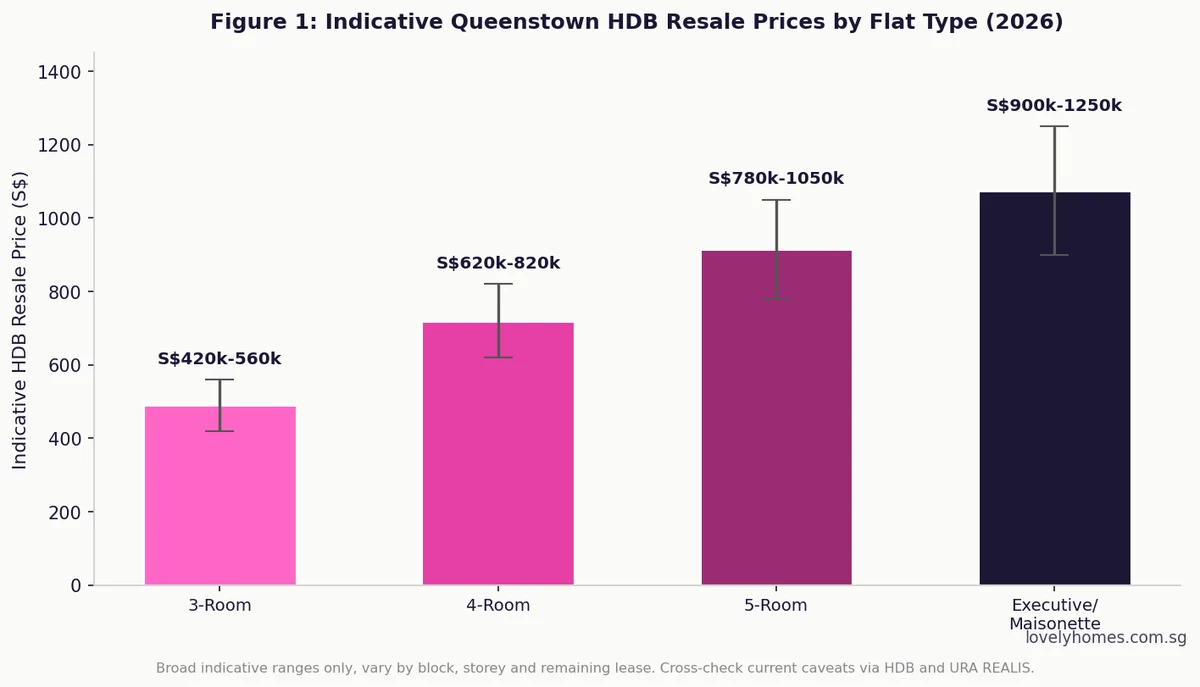
  • Indicative HDB resale prices in Queenstown range roughly from the high S$400,000s for a 3-room flat to over S$1 million for a larger, well-located 5-room or executive unit, reflecting the estate’s mature, central location.
  • As part of the Greater Southern Waterfront masterplan, areas near Queenstown’s southern fringe may see long-term redevelopment potential, though no confirmed timeline has been announced.

Queenstown at a Glance: Singapore’s First Satellite Town

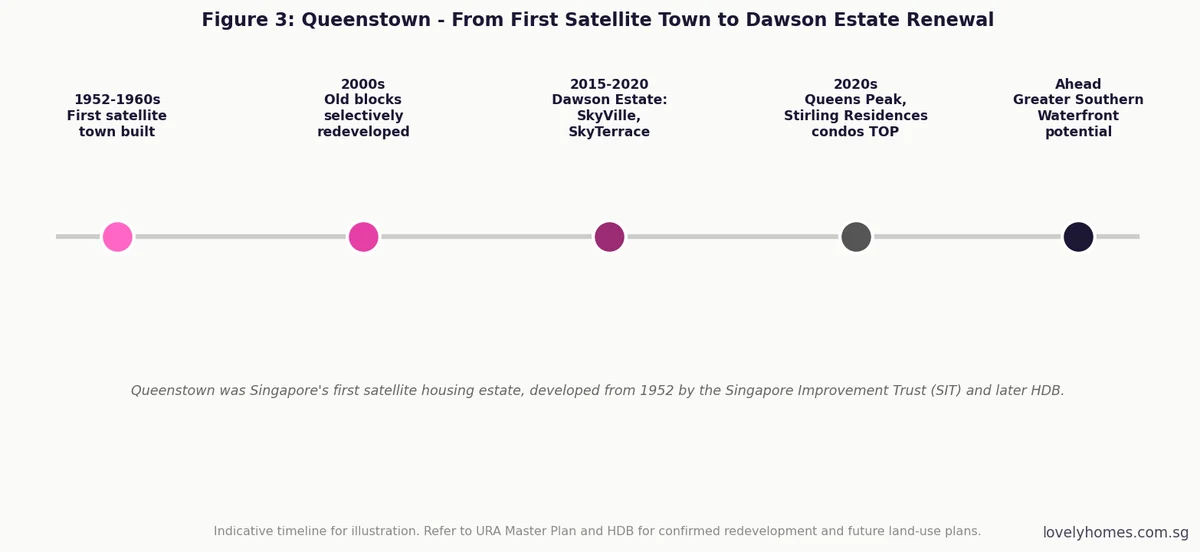
Queenstown holds a unique place in Singapore’s housing history: it was the country’s first satellite housing estate, planned and built from 1952 by the Singapore Improvement Trust (SIT), the colonial-era precursor to HDB, and named in honour of the late Queen Elizabeth II’s coronation year. Early precincts like Tanglin Halt and Mei Ling Street still carry some of the oldest public housing blocks in Singapore, and parts of the estate have been progressively renewed over the decades since, most visibly through the Selective En bloc Redevelopment Scheme (SERS) and, more recently, the striking Dawson Estate redevelopment.

Today, Queenstown is a genuinely mixed and mature estate: older walk-up and point blocks sit within a short walk of architecturally ambitious newer HDB developments and full-facility private condominiums, all wrapped around excellent transport connectivity and proximity to one of Singapore’s key research and innovation clusters. This mix of heritage character, redevelopment, and accessibility is what makes Queenstown a recurring point of interest for both HDB upgraders and private property investors.
Queenstown HDB resale prices by flat type Singapore 2026
Figure 1: Indicative Queenstown HDB resale price ranges by flat type.

MRT, Transport and Connectivity

Queenstown sits on the East-West Line (EWL), served directly by Queenstown and Redhill MRT stations, with Commonwealth station also within the broader estate boundary and Tiong Bahru station a short ride further east. This gives residents a direct, one-line run into the Central Business District and Raffles Place in well under 20 minutes, alongside easy access to Orchard Road via an interchange transfer. The Ayer Rajah Expressway (AYE) also runs along the estate’s southern edge, giving drivers fast access to the CBD, Jurong, and, via the AYE-PIE network, most of the island.

The area’s proximity to one-north (home to Biopolis, Fusionopolis and a growing cluster of biotech, media and technology firms) is a significant draw for tenants and buyers who work in that ecosystem, supporting steady rental demand for both HDB flats (where subletting rules permit) and private condominiums in the estate.

Housing Options: From Heritage HDB to Dawson Estate to Private Condos

Queenstown’s housing stock spans several distinct eras and price points:

  • Older heritage precincts (Tanglin Halt, Mei Ling Street, Commonwealth): some of Singapore’s earliest HDB blocks, several of which have gone through SERS or are earmarked for eventual redevelopment, appealing to buyers prioritising space and heritage character over newer finishes.
  • Dawson Estate: a landmark HDB redevelopment completed from the mid-2010s, featuring SkyVille @ Dawson and SkyTerrace @ Dawson, known for sky gardens, communal terraces and design-led public housing that regularly features in architecture showcases.
  • Private condominiums: including Queens Peak (directly above Queenstown MRT) and Stirling Residences, both completed in recent years and popular with both owner-occupiers and investors seeking MRT-linked convenience.
  • Executive Condominiums and older private developments scattered through the estate’s fringes, offering a further price tier between HDB resale and the newest condo launches.
Queenstown property prices compared to Tiong Bahru Toa Payoh Bishan Singapore
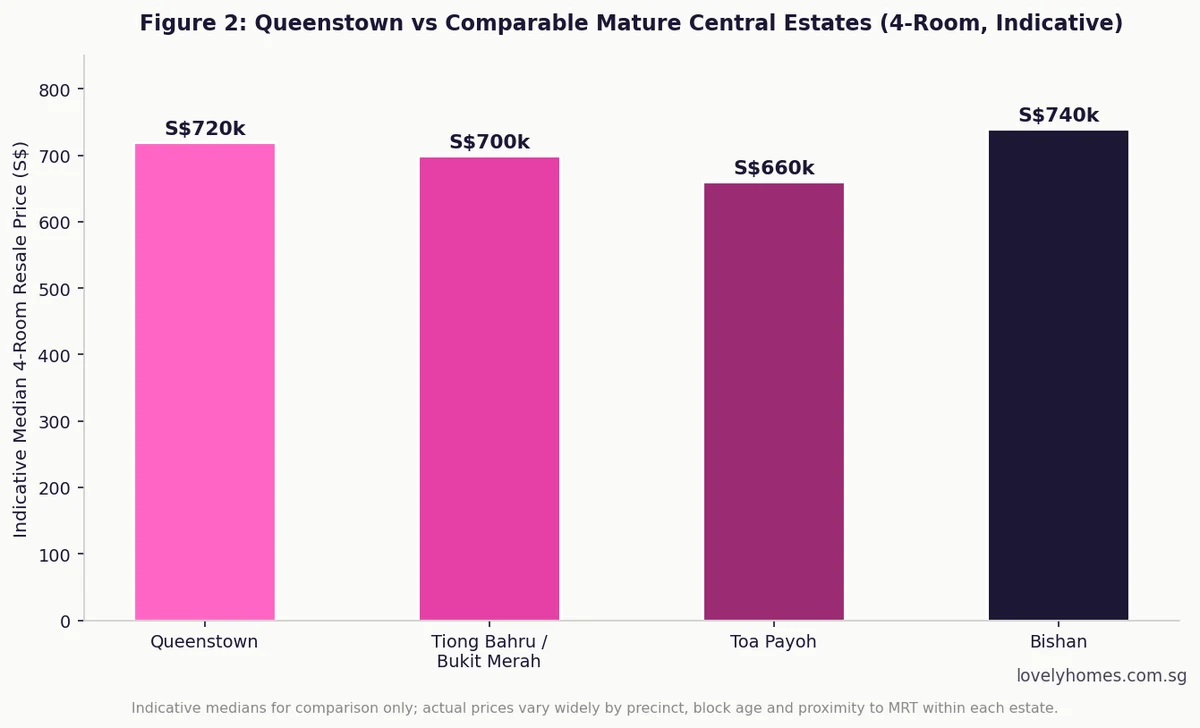
Figure 2: How Queenstown’s indicative resale prices compare with other mature central estates.

Schools, Amenities and Everyday Living

Families in Queenstown have access to established schools including Queenstown Primary School, New Town Primary School, and nearby Crescent Girls’ School and Anglo-Chinese School (Independent) in the wider vicinity, making the estate a consideration for buyers weighing school proximity under the Ministry of Education’s 1km/2km priority admission bands. Everyday amenities are anchored by Queensway Shopping Centre (long popular for sportswear and outdoor gear), IKEA Alexandra, and a wide spread of wet markets, hawker centres and neighbourhood malls typical of a mature estate. Alexandra Hospital, undergoing redevelopment as a community hospital, sits within the estate, and Queenstown Public Library, one of Singapore’s oldest branch libraries, remains a neighbourhood fixture. Recreational green space is well served by Tanglin Halt Park, Alexandra Canal Linear Park, and the wider Southern Ridges network within reach for hikers and cyclists.

Summary: Queenstown Facts at a Glance

Question Short Answer
What MRT lines serve Queenstown? East-West Line, via Queenstown and Redhill stations.
What’s the estate best known for historically? Singapore’s first satellite housing estate, built from 1952.
What are the standout newer HDB blocks? SkyVille @ Dawson and SkyTerrace @ Dawson.
Which condos sit right by the MRT? Queens Peak and Stirling Residences.
What’s nearby for work? One-north (Biopolis, Fusionopolis) is a short ride away.
Any long-term redevelopment potential? Southern fringes may be touched by the Greater Southern Waterfront masterplan, long-term.

Worked Example: Comparing a Queenstown 4-Room Resale Flat to a Nearby Condo

Profile: The Koh family is deciding between a 4-room HDB resale flat in Dawson Estate and a 2-bedroom unit at a nearby MRT-linked private condominium.

Option A: 4-Room HDB Resale (Dawson Estate). indicative price S$720,000. Buyer’s Stamp Duty (BSD) on this quantum comes to approximately S$16,500. As Singapore Citizens buying their first residential property, no Additional Buyer’s Stamp Duty (ABSD) applies. Assuming a 25-year HDB loan at the prevailing concessionary rate, the monthly instalment is comfortably within HDB’s Mortgage Servicing Ratio (MSR) cap of 30% of gross income for a typical dual-income household in this price band.

Option B: 2-Bedroom Private Condo (MRT-Linked, Queenstown). indicative price S$1,650,000. BSD comes to approximately S$52,000; again, no ABSD applies as a first property for Singapore Citizens. Monthly maintenance fees of roughly S$350–S$450 apply on top of the mortgage instalment, and the loan is tested against TDSR (55%) rather than MSR.

Takeaway: the HDB option offers substantially lower upfront stamp duty and monthly outlay, while the condo option trades a materially higher price for full condominium facilities and no MOP-style resale restrictions, illustrating the typical HDB-vs-condo trade-off that plays out across most mature, well-connected estates like Queenstown.
Queenstown redevelopment timeline Dawson Estate Greater Southern Waterfront Singapore
Figure 3: Queenstown’s evolution from Singapore’s first satellite town to the Dawson Estate renewal.

Why This Matters for Buyers and Investors

Queenstown’s combination of heritage character, strong MRT connectivity, proximity to a major employment cluster in one-north, and a genuine mix of older and newer housing stock makes it a useful case study in how mature, centrally located estates command a premium over newer, more peripheral towns, while still trading at a discount to the most exclusive central districts. For owner-occupiers, the choice between an older heritage block, a newer Dawson Estate flat, and an MRT-linked condo comes down to budget, space priorities and appetite for facilities. For investors, the one-north tenant pool and enduring appeal of an East-West Line address near the city are the estate’s most durable long-term demand drivers, though as with any mature estate, individual block age, remaining lease and precise walking distance to the MRT materially affect both price and rental achievability.

Renting in Queenstown: Tenant Demand and What Landlords Should Know

Queenstown’s rental market is shaped heavily by its proximity to one-north, drawing a steady pool of tenants working in biotech, pharmaceutical research, media and technology roles at Biopolis and Fusionopolis who value a short commute over a car-dependent one. This tenant profile tends to favour smaller, well-maintained units close to the MRT, whether HDB flats (where subletting rules permit, typically after the Minimum Occupation Period for whole-flat subletting) or private condominium units such as those at Queens Peak and Stirling Residences.

Landlords considering Queenstown should weigh the estate’s mixed housing stock carefully: newer precincts like Dawson Estate and the MRT-linked condos generally command a rental premium over older heritage blocks, reflecting both condition and proximity, but older units can still let reasonably well given the estate’s overall connectivity and amenity base. As with any estate, prospective landlords should benchmark asking rents against recently transacted caveats rather than listing prices, and factor in realistic vacancy periods between tenancies, particularly for larger units that appeal to a narrower pool of sharers or families.

For HDB flat owners, it’s worth remembering that subletting rules differ for whole-flat versus room-only arrangements, and that non-citizen tenant quotas can apply at the block and neighbourhood level; landlords should check current conditions directly with HDB before advertising a unit for rent, rather than relying on rules that may have applied in a previous tenancy cycle.

What Might Come Next

The following is informed speculation, not confirmed policy. Queenstown’s southern and western fringes lie within the broad footprint of URA’s long-term Greater Southern Waterfront vision, which could, over a multi-decade horizon, bring further transformation to the wider area as port and industrial land is progressively repurposed. No confirmed redevelopment plans or timelines specific to Queenstown’s existing residential precincts have been announced as at this writing, and prospective buyers should treat any such long-range masterplan potential as a multi-decade consideration rather than a near-term price driver.

Frequently Asked Questions

Is Queenstown considered a mature HDB estate?

Yes. As Singapore’s first satellite town, Queenstown is one of the country’s most mature HDB estates, with a mix of decades-old blocks, redeveloped precincts like Dawson Estate, and nearby private housing.

What’s the remaining lease like on Queenstown’s older flats?

This varies significantly by block, since some precincts date back to the 1950s-1970s while others (like Dawson Estate) are far newer. Always check a specific block’s lease commencement date via HDB’s records before making an offer, as remaining lease affects both financing (CPF usage, loan tenure) and resale value.

Are there new BTO launches in Queenstown?

As a fully built-out mature estate, new BTO supply in Queenstown is limited compared with newer towns, and typically arises only from selective redevelopment or infill sites when available. Check HDB’s BTO launch calendar for the latest confirmed sites.

How far is Queenstown from Orchard Road and the CBD?

Via the East-West Line with an interchange, Orchard Road is typically reachable within about 15-20 minutes, and the CBD/Raffles Place area within a similar timeframe, making Queenstown a genuinely central, well-connected estate.

Is Queenstown a good fit for renting to one-north workers?

Many landlords in the estate do target this tenant pool given the short commute to Biopolis and Fusionopolis, though actual rental demand and achievable rents should be checked against current listings and transacted rental caveats rather than assumed.

What’s the difference between Dawson Estate and the rest of Queenstown?

Dawson Estate refers specifically to the HDB precinct redeveloped from the mid-2010s around Dawson Road, featuring design-led blocks like SkyVille and SkyTerrace. It’s a newer, distinct precinct within the broader Queenstown planning area, which also includes much older sections like Tanglin Halt and Commonwealth.

Do the private condos in Queenstown have a minimum occupation period like HDB flats?

No. Private condominiums such as Queens Peak and Stirling Residences do not carry an HDB-style Minimum Occupation Period. Ordinary private property rules on stamp duties, financing and (where applicable) ABSD apply instead.

Disclaimer: This article is intended for general informational purposes only and does not constitute financial or investment advice. Prices, redevelopment plans and amenities referenced are indicative and subject to change. Always verify current transacted prices via HDB and URA REALIS, and confirm any masterplan or redevelopment details via the Urban Redevelopment Authority (URA) before making a purchase decision.
×

Click anywhere outside to close

HDB Million-Dollar Flats Singapore 2026: Where, Why, and Whether One Is Worth Buying

HDB Million-Dollar Flats Singapore 2026: Where, Why, and Whether One Is Worth Buying

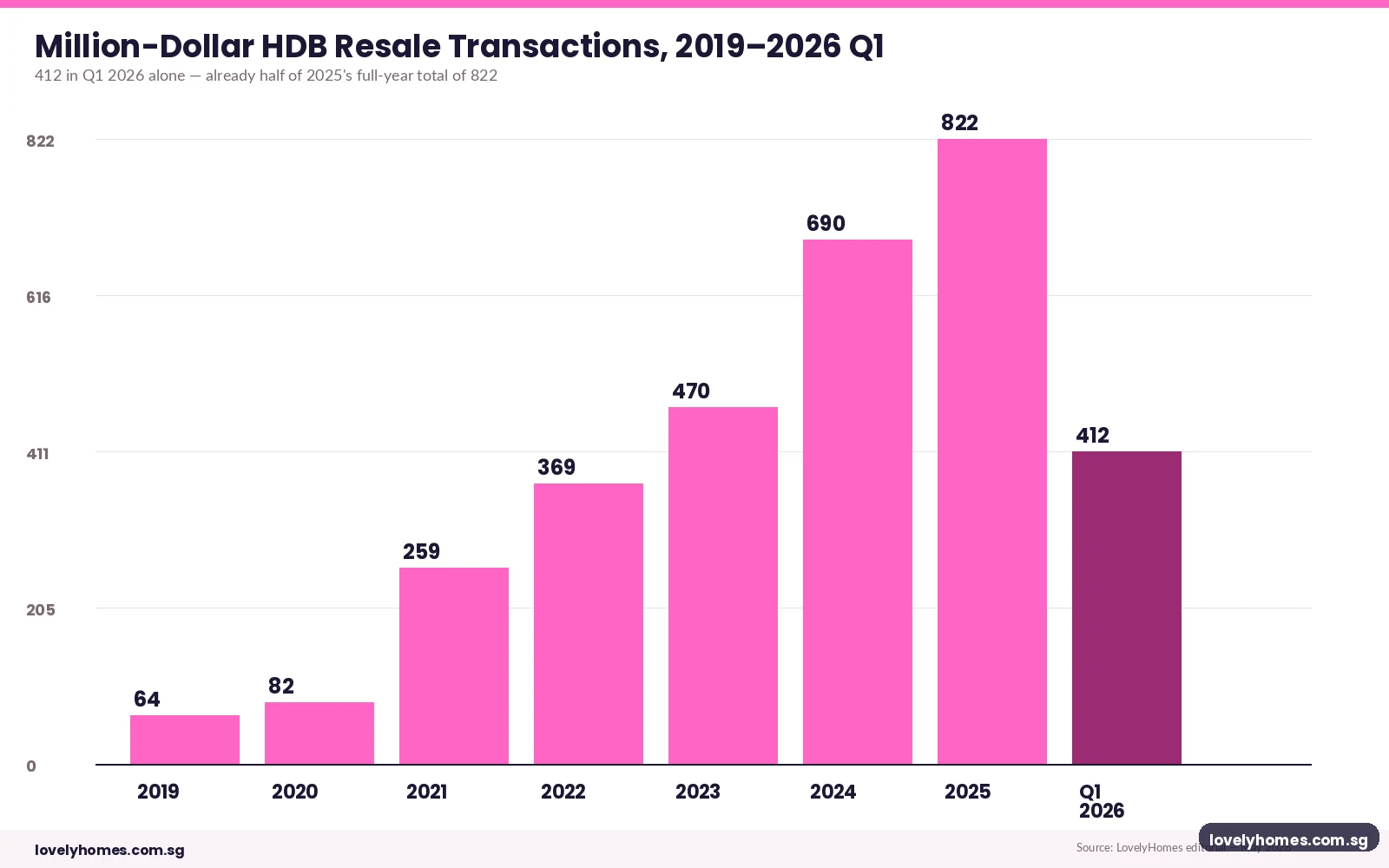
Million-dollar HDB flats are no longer the freak occurrence they once were. In the first quarter of 2026, 412 HDB resale transactions crossed the S$1,000,000 line — a single-quarter record, and already roughly half of the 822 logged across the whole of 2025. Bukit Merah, Toa Payoh, Queenstown, Bishan, and Kallang/Whampoa do most of the heavy lifting, but flats in Tampines, Sengkang and even outer-ring towns are now occasionally clearing the bar.

If you own one of these flats, you are sitting on a paper windfall that the rest of the market can only watch. If you are thinking about buying one, the question is harder: are you paying for a real long-run asset, or for a short-lived premium that will reset the moment supply normalises? This guide walks through the data, the geography, the buyer profile, and the upgrade math — with worked numbers in Singapore dollars.

For the full quarterly market context, see our companion piece on the HDB resale price decline in Q1 2026, the earlier flash-estimate analysis, and the URA private-market Q1 final figures.

Quick Answer — Million-Dollar HDB at a glance

  • 412 transactions crossed S$1,000,000 in Q1 2026 alone — a record quarter.
  • 2025 full-year total: 822, up from 690 in 2024 and 470 in 2023.
  • Top five towns: Bukit Merah, Toa Payoh, Queenstown, Kallang/Whampoa, Bishan — all mature, rail-served estates.
  • Typical winning unit: 4-room or 5-room flat, high floor, walking distance to MRT, with most lease years remaining.
  • Highest single sale on record: S$1.7 million at Dawson Road (5-room, Q1 2026).
  • For owners, the headline is paper wealth; the cash you walk away with after CPF refund + accrued interest is much smaller.
  • For buyers, factor MOP (5 years), the LTV cap on subsequent property, and the limited resale liquidity above S$1.2 million.

How Common Are Million-Dollar HDB Flats Now?

Think of it as a slow build, then a sharp acceleration. Pre-pandemic Singapore saw fewer than a hundred million-dollar HDB transactions a year, almost all of them at Pinnacle@Duxton or other iconic central blocks. From 2021 onwards, two things changed: the COVID-era price surge in resale lifted everything by about 30%, and a steady drip of well-located DBSS / SBF estates hit their MOP and entered the resale market. The result is the curve in Figure 1.

Million-dollar HDB resale transactions per year, 2019 to Q1 2026, rising from 64 in 2019 to 822 in 2025 and 412 in Q1 2026 alone
Figure 1 — Million-dollar HDB resale transactions per year, 2019 to Q1 2026.

The Q1 2026 number deserves its own line. At 412 it is roughly half a normal full-year total compressed into 12 weeks. It is also doing this while the broader HDB Resale Price Index fell 0.1% quarter-on-quarter for the first time since the second quarter of 2019. Two things are going on at once: the average flat is finally cooling after 25 consecutive quarters of growth, while the top end keeps climbing because demand for irreplaceable mature-estate stock has not budged.

Where Million-Dollar HDB Flats Cluster

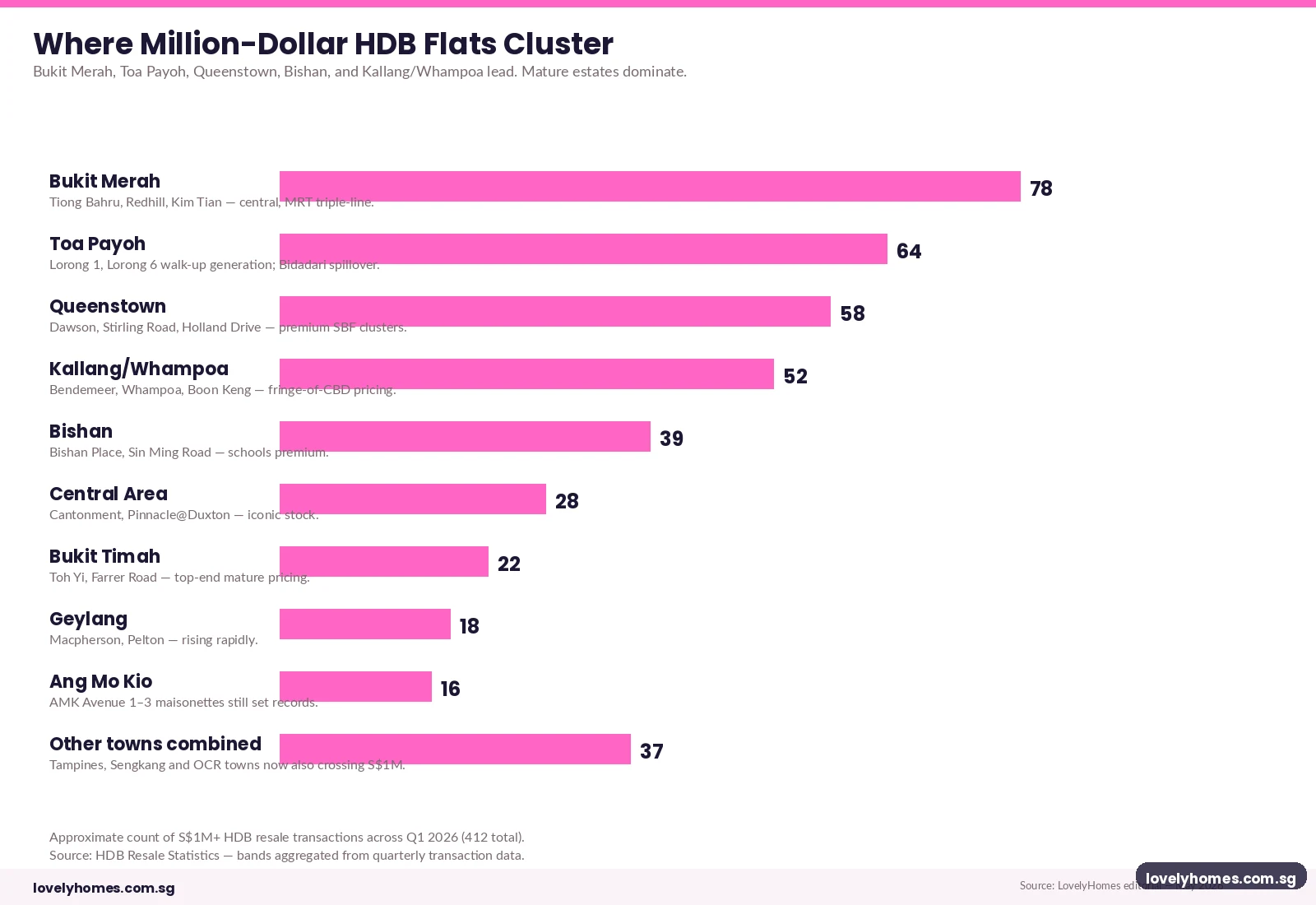
Geography is the single biggest determinant of whether a flat will sell above the million-dollar mark. The flats that clear the bar share three traits almost without exception: a mature estate within ten kilometres of the central business district, direct rail connectivity (preferably to two or three lines), and most of the 99-year lease still intact. Figure 2 maps the leading towns for Q1 2026.

Bukit Merah, Toa Payoh, Queenstown, Kallang Whampoa, Bishan lead million-dollar HDB transactions in Singapore Q1 2026
Figure 2 — Towns leading million-dollar HDB transactions in Q1 2026.

Bukit Merah alone accounts for nearly one in five million-dollar transactions, anchored by Tiong Bahru, Redhill, and the Kim Tian / Bukit Ho Swee corridor. The pattern repeats: high-floor 4 and 5-room flats from the early 2010s build cycle, ten minutes by walking link to two MRT lines, with views over the city. Toa Payoh and Queenstown sit just behind — the Dawson and Stirling Road clusters in particular have produced multiple S$1.4–1.7 million sales over the past 18 months.

The pattern starts to break down further out. Tampines, Sengkang and Punggol flats now occasionally cross S$1 million, but they tend to be flagship corner units, executive maisonettes from the 1990s, or DBSS sales like the Pinnacle-style towers. They do not yet form a stable resale pool above the bar in the way that the central towns do. For broader town-level pricing context, see our HDB resale flat buying guide.

Why Million-Dollar HDB Pricing Holds Up

Three structural forces keep the top end of the HDB resale market firm even as the overall index turns:

  1. Supply is genuinely scarce. Most million-dollar flats are 4 or 5-room units in mature estates with high floors and short walks to MRT. HDB does not build new flats with those characteristics any more — central-area BTO supply has shifted to smaller 3 and 4-room units in tower blocks at higher densities.
  2. Demand is mostly cash-rich upgraders and second-time buyers. First-time buyers cannot compete here. The market for million-dollar flats is dominated by households trading down from a private property to a centrally-located HDB, or by Singapore Citizens cycling out of an executive condo and buying back into HDB before applying for a Build-To-Order replacement.
  3. Private-condo prices have set the ceiling. When a freehold city-fringe condo trades at S$2,400 per square foot, a 1,200 sq ft 5-room HDB at S$1,400,000 is still S$1,166 per sq ft — less than half. Buyers see relative value, not absolute expense.

That last point matters for the path ahead. As long as the gap between mature-estate HDB and city-fringe condos remains north of 50%, the top end of HDB pricing has a floor. The risk is a meaningful condo correction or a sustained leasehold-decay narrative shift — either of which would pull the ceiling lower.

Summary Table — Profile of Q1 2026 Million-Dollar Sales

Metric Q1 2026 2025 Full Year 2024 Full Year
Million-dollar transactions 412 822 690
Share of total HDB resale ~5.4% ~3.1% ~2.3%
Highest sale S$1.70m (Dawson, 5-room) S$1.65m (Dawson, 5-room) S$1.58m (Pinnacle, 5-room)
Most common flat type 5-room 5-room Executive / 5-room
Top town Bukit Merah Bukit Merah Queenstown

Indicative figures cross-referenced from HDB’s quarterly resale statistics and SRX/EdgeProp reporting; minor variances arise from cut-off dates.

Worked Example — What S$1.2 Million Actually Looks Like in Cash

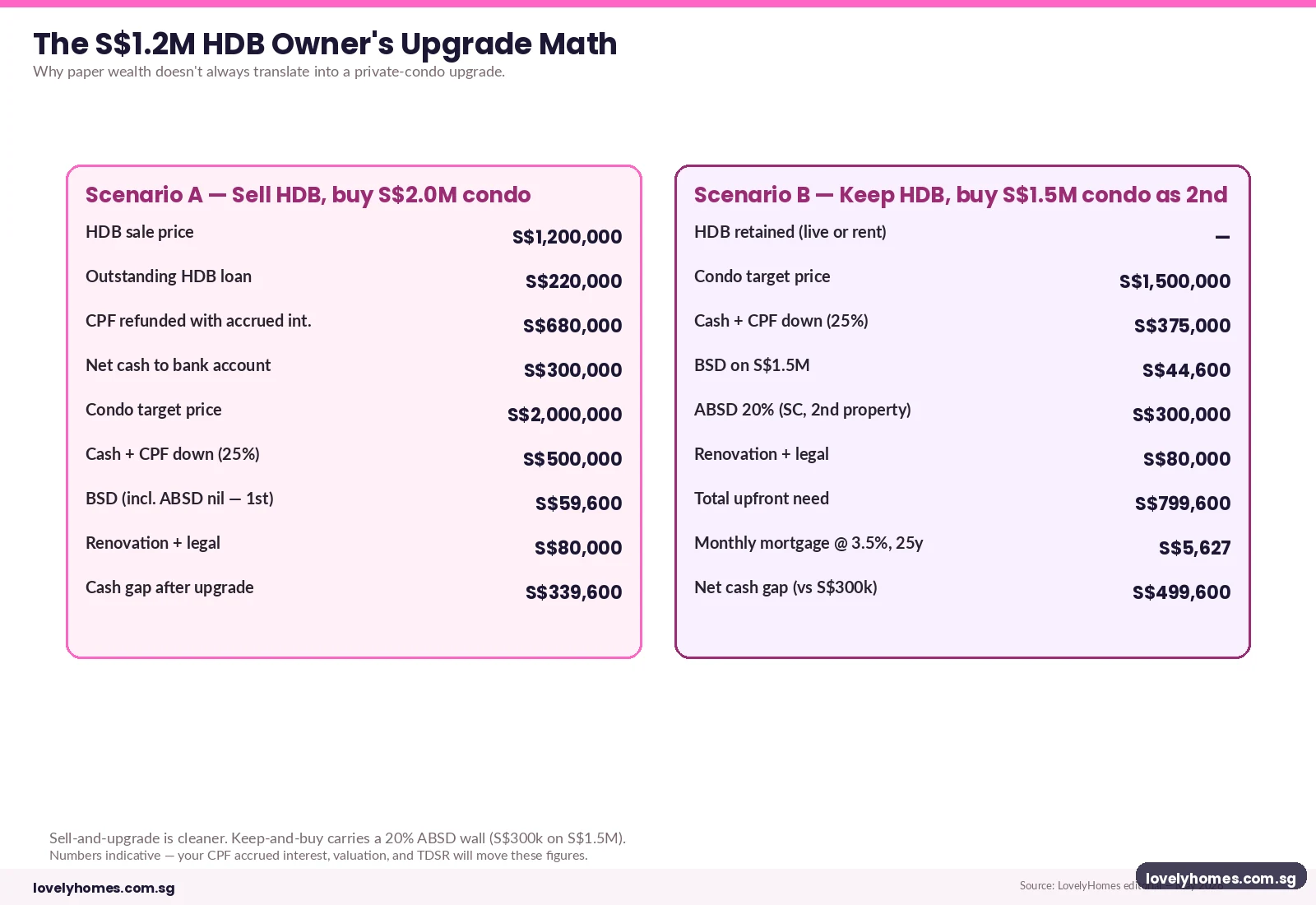
Let’s anchor on a realistic scenario. A Singapore Citizen couple, both 42, own a 5-room flat in Bukit Merah bought new from HDB in 2010 for S$520,000. Their outstanding HDB Concessionary Loan balance is S$220,000. They have used a combined S$420,000 of CPF Ordinary Account funds across the holding period, and CPF accrued interest has compounded to S$260,000. They list the flat and accept an offer at S$1,200,000.

HDB upgrader scenarios — sell flat to buy condo vs keep flat to buy second condo, with ABSD wall comparison
Figure 3 — The S$1.2 million HDB owner’s upgrade math.

What hits the bank account? Sale price S$1,200,000, less HDB loan repayment S$220,000, less CPF refund S$420,000 + S$260,000 accrued interest = S$680,000 returned to CPF (not cash), less legal and agent costs of around S$30,000. Net cash to the seller: S$270,000. Net CPF balance: S$680,000 (which can be redeployed for a next property purchase). The headline million-dollar print is real, but it travels in two channels — cash and CPF — and most of it is not cash.

Now layer on the upgrade decision. Scenario A — sell HDB and buy a S$2.0M condo: the couple uses S$500,000 down payment (cash + CPF mix), pays Buyer’s Stamp Duty of about S$59,600, no ABSD (it is a first private property after disposing of the HDB), and a S$1.5M loan at around S$7,520 per month over 25 years at 3.5%. Scenario B — keep the HDB, buy a S$1.5M condo as a second property: they need S$375,000 down, pay BSD of S$44,600, and an additional 20% ABSD on the S$1.5M = S$300,000. The ABSD wall changes the maths fundamentally; total upfront need is S$799,600. For most upgraders, scenario A wins for cash flow; scenario B wins only if the rental yield on the retained HDB is meaningfully positive after MSR and HDB sub-letting rules are factored in.

For the full mechanics on the second-property tax, see our ABSD complete guide.

Why This Matters for Buyers, Sellers, and Upgraders

If you are a seller sitting on a likely million-dollar flat: the asset is real, but realise that less than 30% of it lands as cash if you have used CPF heavily across the holding period. Run the cash-out arithmetic before listing — especially if you intend to fund a private upgrade. The CPF for Property Purchase guide walks through the refund and accrued-interest mechanics in detail.

If you are a buyer considering a million-dollar HDB: be honest about exit liquidity. Above S$1.2M the resale buyer pool is thin and dominated by HDB-eligible, MOP-cleared upgraders trading sideways; foreign demand and PR demand are zero by regulation. Hold periods of less than seven to eight years can leave you exposed to a price reset if the index turns and the cash-rich upgrader cohort sits out a cycle.

If you are an upgrader: the S$1M HDB and the S$2M condo are not the same dollar. The HDB is mostly CPF; the condo down payment must be cash + CPF in regulated proportion, and the ABSD wall sits between you and a second property. For the full upgrade decision tree, see our HDB-to-condo upgrade guide.

How Singapore Compares

Comparing public-housing premium pricing across cities is messy — few jurisdictions have a system as institutionalised as HDB. The Hong Kong public estate market trades at very different scarcity premiums. Sydney’s former public-housing stock at Waterloo and Glebe has occasional A$1m+ trades, but those are usually privatised dwellings in markets with no income-cap rules. The closest comparable framework is South Korea’s LH-built apartments at high floors in Seoul, where the cap-relaxation cycles drive episodic premium pricing. Against those benchmarks, HDB’s top-end resale market is unusually deep, unusually well-policed for ownership, and unusually liquid.

What Might Come Next

Forward-looking commentary — clearly speculative. Three scenarios bear watching over the rest of 2026 and into 2027:

  • Continued top-end strength even as the index falls. The most plausible scenario. Mature-estate scarcity is structural; the top end carries on as the broader resale market cools through fresh BTO supply (around 13,000 flats expected in 2026, roughly double 2025).
  • Targeted cooling. If the Government feels the optics of S$1.7M HDB sales are inconsistent with public-housing affordability messaging, a targeted measure — expanded Prime / Plus restrictions on high-priced resale, or a longer MOP — is possible. None has been signalled, but the policy lever is real.
  • Material condo correction pulling the HDB ceiling down. The least likely in the near term but the most disruptive: a 10–15% private-condo correction would compress the relative-value gap and remove the implicit ceiling on million-dollar HDB pricing.

None of these scenarios changes the basic logic for owners or considered buyers. Million-dollar HDB pricing is geographic, structural, and slow-moving. Trying to time it is a poor use of attention; understanding what you actually own (or are buying) is the better use.

Frequently Asked Questions

What is the highest price ever paid for an HDB resale flat?

As at Q1 2026, the published record sits at S$1.70 million for a 5-room SBF flat at Dawson Road in Queenstown. Prior records included a S$1.65 million Dawson sale in 2025 and a S$1.58 million Pinnacle@Duxton sale in 2024. HDB and SRX publish resale transaction records monthly; record-breakers are usually high-floor 5-room or executive flats in central, MRT-served estates.

Why are million-dollar HDB flats clustering in Bukit Merah and Queenstown?

Three reasons: most of the high-floor 4 and 5-room SBF flats from the 2010–2014 build cycle are now MOP-cleared and entering the resale market; the central location supports very high relative-value pricing against private condos; and the rail connectivity (Tiong Bahru / Redhill / Queenstown / Commonwealth on the East-West Line) means buyers are paying for both location and convenience. Toa Payoh and Bishan show similar patterns on the North-South Line corridor.

Can foreigners or PRs buy million-dollar HDB resale flats?

Foreigners cannot buy any HDB resale flat. Permanent Residents can, but only as part of a family nucleus where the eligibility scheme is met (PR Quota for the block applies, and the standard SPR holding rules), and never as a sole household. The buyer pool above S$1 million is therefore entirely Singapore Citizen + PR family nuclei — this is one of the structural reasons the market behaves differently from private resale.

Should I buy a million-dollar HDB or a similarly-priced city-fringe condo?

The honest answer depends on horizon and household composition. The HDB delivers more living space, better proximity to schools and transport in the affected estates, and lower maintenance fees, but it locks you into the public-housing rule set (MOP, ethnic quota, no rental until MOP, restrictions on second-property ownership). The condo trades floor space for asset class flexibility — you can rent it, sell it without MOP, and own it alongside other properties (subject to ABSD). Many buyers find the HDB the better lifestyle choice and the condo the better balance-sheet choice; very few buyers should pretend the two are equivalent.

How much cash will I actually walk away with from a S$1.2 million HDB sale?

Less than the headline. From a typical S$1.2M sale you must repay the outstanding HDB or bank loan, then refund used CPF principal plus accrued interest at 2.5% per annum into your CPF account, then pay legal and agent fees. In a representative scenario with S$220k loan outstanding, S$420k of OA used over 14 years, S$260k accrued interest and S$30k transaction costs, the seller receives roughly S$270k as cash to the bank account and S$680k restored to CPF. The CPF portion can fund a next purchase but is not free cash. See our CPF for Property Purchase guide for the mechanics.

Will the price falls in Q1 2026 reach the million-dollar segment?

The Q1 2026 HDB Resale Price Index fell 0.1% — the first quarterly decline since Q2 2019 — while million-dollar transactions hit a record. The two facts coexist because the broader index is moved by the volume centre of the market (3 and 4-room flats in non-mature towns), while the million-dollar segment depends on the supply of mature-estate, rail-served, larger flats. The mechanisms that have lifted the top end (scarcity, relative value vs condos) are not the mechanisms cooling the broader index (fresh BTO supply, transactional fatigue). The two segments can diverge for an extended period.

What should I do if I bought my flat for S$400,000 and it’s now worth S$1.2 million?

First, separate the unrealised gain from your decision: the windfall does not change whether your home suits your household. Second, if you intend to monetise, run the cash-out + CPF refund maths before listing — many sellers find their actual cash-in-hand is far less than expected. Third, if you intend to upgrade to a private property, model both the “sell + upgrade” path and the “keep + buy second” path with full ABSD; the answer is rarely obvious. Fourth, engage a conveyancing solicitor and (where relevant) a CPF-aware financial planner before signing any OTP. The numbers are too large for shortcuts.

Related Articles

Disclaimer

This article is general information about HDB resale pricing in Singapore as at May 2026 and does not constitute financial, tax, or legal advice. Transaction figures are aggregated from HDB’s published resale statistics, with cross-reference from URA, MAS, IRAS and CPF Board guidance where applicable. Individual transaction values, CPF balances, and accrued interest computations vary materially by household; for a transaction of this size always engage a licensed Singapore conveyancing solicitor, a CPF-aware financial adviser, and (if upgrading) a chartered tax practitioner before signing any Option to Purchase or Sale & Purchase agreement.

Translate »