
Correction, 11 September 2026: corrected HDB ownership and ABSD remission conditions, separated cash from CPF refunds, and added a checked moving-budget example.
If you need your flat's sale proceeds or CPF refund to fund the next home, selling first is usually the more manageable starting point. Buying first can preserve a place to live while you prepare the next home, but only if you can fund the overlap, obtain the required loan and meet the tax conditions without relying on an optimistic sale date.
Start with three separate checks: whether HDB permits the purchase, what the bank will lend, and what IRAS will charge. Passing one does not settle the others. This guide concerns an HDB owner moving to a private condominium for their own stay. A new executive condominium bought from a developer has a different eligibility and purchase process.
Confirm what applies to your flat and household
Check your actual Minimum Occupation Period (MOP) status with HDB before committing. The period is not always five years, and time spent not occupying the flat can affect the calculation. Restrictions also cover spouses and occupiers, not only the person whose name appears on the next purchase.
HDB's private-property ownership guidance distinguishes households. After MOP, a household with at least one Singapore Citizen flat owner can retain its HDB flat when private residential property is acquired. Where all flat owners are permanent residents, HDB requires prior notification and sale of the flat within six months of acquiring completed or uncompleted local private residential property. Confirm how the rule applies to the actual owners and occupiers.
Do not confuse that HDB requirement with an IRAS deadline for obtaining an ABSD refund. They serve different purposes. Nor should a proposed transfer of ownership between spouses be treated as a routine way around either set of rules. Resolve any ownership change with HDB and your conveyancing lawyer before building a budget around it.
Choose the sequence by the risk you can afford
| Decision | Sell first | Buy first |
|---|---|---|
| Money for the next home | Sale price becomes known earlier; completion and CPF availability still matter | Existing savings and approved finance must cover payments before sale funds arrive |
| Housing | May involve temporary accommodation and two moves | May reduce disruption, but possession and renovation dates can still leave a gap |
| Main exposure | Rent, moving costs and the next home's price changing while you search | Tax, overlapping debt, a delayed sale and pressure to accept a lower offer |
| Before committing | Check a realistic replacement budget and where the household will stay | Check the peak funding need and a viable plan if the sale or refund is delayed |
Selling first does not necessarily mean waiting for every dollar to arrive before looking at condos. It means choosing commitments in an order your solicitor and lender have checked. A signed sale, legal completion, mortgage redemption, release of cash and usable CPF are different milestones.
For ABSD, IRAS gives an example of a Singapore Citizen who has contracted to sell their only property before accepting the option for the replacement: the replacement does not attract second-property ABSD. Obtain advice on the relevant documents and dates for your own transaction. A listing or an interested viewer is not a contracted sale. See IRAS's ABSD guidance.
Treat a possible ABSD refund as a conditional later receipt
A Singapore Citizen's second residential purchase currently attracts 20% ABSD, calculated on the higher of price and market value. Joint buyers' profiles can change the applicable rate; 20% is not a universal upgrader rate. At a S$1.6 million taxable value, that single rate represents S$320,000. BSD remains a separate charge.
Under IRAS's married-couple remission rules, the replacement must be bought jointly in the couple's names only, with at least one Singapore Citizen. Each spouse must own no more than one residential property at purchase. ABSD must be paid; the couple must remain married, retain the replacement's ownership and acquire no further residential property before the first home is sold.
The first property (or both, if separately owned) must be sold within six months after purchase for a completed replacement, or after the earlier TOP/CSC issue date if bought uncompleted. The refund-application deadline is six months after sale of the first property. IRAS defines purchase and sale by the relevant accepted option or agreement, rather than invariably by key collection. Eligible transactions can receive an automatic refund under the declared-intention process. Have your solicitor confirm the exact deadlines, declarations and refund route. Do not assume an extension.
Buying alone is not the married-couple concession. Separate relief may apply to qualifying single Singapore Citizen seniors; obtain advice on that scheme if relevant. For planning, keep a potential refund outside the money available to pay your next immediate bill.
Calculate cash proceeds before choosing a condo budget
Your flat's selling price is not the amount that lands in your bank account. Obtain a current loan-redemption figure, each owner's CPF refund amount and an itemised sale-cost estimate. Use CPF's actual records rather than applying a rough interest percentage to a guessed lump sum.
CPF explains the refund of savings used for housing and accrued interest. That money returns to your CPF accounts; it is not a payment to the buyer or automatically spendable cash. CPF's current refund-use guidance also distinguishes members below 55 from those aged 55 and above, whose refunds first address retirement-account requirements. Confirm the amount available for another home and when it can be used.
Here is an invented household, not a reader case or a price estimate. Both owners are below 55. They sell their only jointly owned HDB flat for S$800,000. The combined required CPF refund is assumed to be S$320,000, the outstanding loan S$200,000, and all sale costs S$20,000.
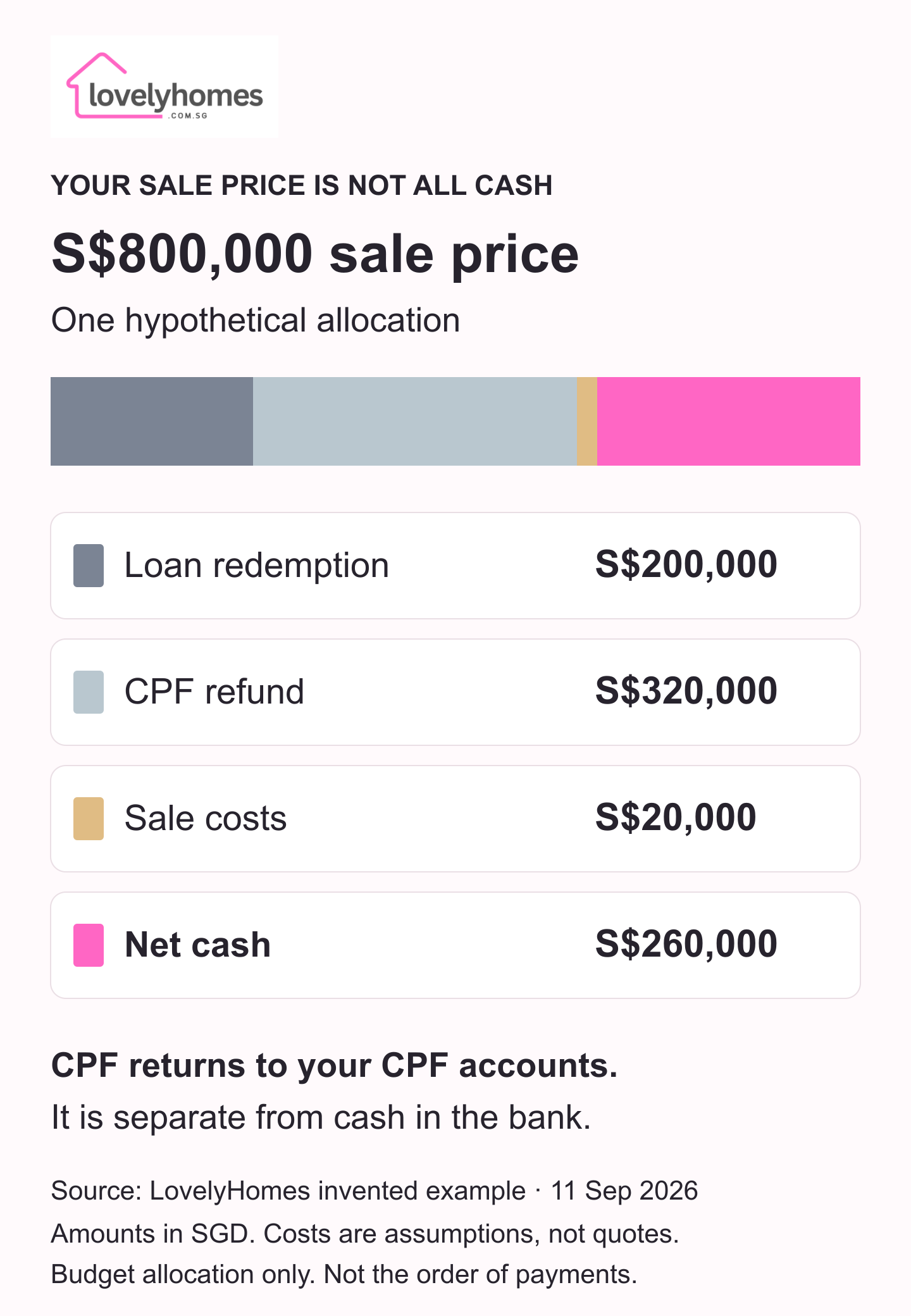
| Allocation of the hypothetical sale price | Amount |
|---|---|
| Loan redemption | S$200,000 |
| CPF refund | S$320,000 |
| Sale costs, including assumed fees | S$20,000 |
| Net cash from sale | S$260,000 |
| Total | S$800,000 |
The graphic shows a budget allocation, not the legal order of payments. The CPF amount is an assumed dashboard figure, not an accrued-interest calculation. Costs are invented allowances, not quotations. Any option money already received is part of the sale price and must not be added again.
Test the replacement with a protected reserve
Suppose the same household already has S$100,000 cash and S$80,000 usable CPF. After completion and the assumed refund, they have S$360,000 cash and S$400,000 CPF. They protect S$50,000 cash for emergencies, leaving S$310,000 cash to allocate to the move. That reserve is their chosen assumption, not a recommended amount for every family.
They consider a S$1.6 million resale condo. Assume price equals valuation, both buyers are Singapore Citizens, the sale has been sequenced so no ABSD applies, and a lender has approved a S$1.2 million loan. Assume CPF rules permit the S$320,000 contribution below. None of these is guaranteed by selling the flat.
| Planned payment or allowance | Cash | CPF |
|---|---|---|
| S$400,000 contribution towards purchase price | S$80,000 | S$320,000 |
| Buyer's Stamp Duty | S$49,600 | S$0 |
| Purchase legal costs, moving and other fees | S$20,000 | S$0 |
| Renovation and furnishings | S$60,000 | S$0 |
| Temporary accommodation | S$24,000 | S$0 |
| Total allocated | S$233,600 | S$320,000 |
The IRAS residential BSD bands produce S$49,600: S$1,800 + S$3,600 + S$19,200 + S$20,000 + S$5,000. The example funds duty entirely in cash to avoid assuming immediate CPF reimbursement.
After those allocations, S$76,400 of the available cash and S$80,000 CPF remain, alongside the separately protected S$50,000 cash reserve. That is a funding illustration, not a verdict that this household can afford the mortgage. They still need an ongoing budget for instalments, maintenance, tax, insurance and daily life.
Reduce the sale price by S$50,000 while holding the assumed loan, CPF refund and costs constant. Net sale cash becomes S$210,000 and the extra cash margin falls to S$26,400. A lower sale price plus higher works costs could quickly absorb that margin.
Buying before the sale is very different. The household initially has only S$100,000 cash and S$80,000 CPF, before any sale proceeds or refunds arrive. Even before stamp duty and other costs, that cannot cover the assumed S$400,000 purchase contribution. Keeping the S$50,000 reserve leaves a S$270,000 funding gap towards that contribution alone. A S$320,000 ABSD payment would add another substantial requirement if applicable. A hoped-for refund does not solve the earlier shortfall.
Obtain a loan assessment for both sequences
Property count for ABSD and outstanding housing loans for financing are different tests. MoneySense's bank-loan guidance explains that loan limits depend on existing housing loans, tenure and age. Its table provides different limits where a housing loan remains outstanding. Ask the lender whether a contracted sale and the documents you have satisfy its requirements for your proposed financing.
Do not carry the example's 75% loan assumption into a buy-first plan. Request written assessments for each sequence, including the money and evidence required before disbursement. Ask about existing-loan redemption, interest and fees on any bridging facility, repayment dates and what happens if sale completion slips. A bridging loan needs approval and a credible repayment source; it does not make an unaffordable purchase affordable.
Test the monthly budget against an income interruption and higher repayments. If one salary disappears during the overlap, identify which savings pay both the housing commitments and ordinary bills. Keep the emergency reserve distinct from money already promised to contractors or needed for tax.
Make the moving plan work for the people living there
Before agreeing dates, price a realistic housing gap. Include rental deposits, storage, removals and a possible second move. Check tenancy conditions rather than assuming a short stay is available at a monthly rent advertised for a longer lease. If relying on an extension of stay in the sold flat, confirm eligibility, agreement and approval; it is not yours to assume.
For the next home, check actual possession, renovation access and a realistic move-in date. For an uncompleted condo, separate the developer's projected completion from a date on which your household can comfortably occupy the unit. School runs, caregiving, pets, accessibility and working from home may make a nominally cheaper transition impractical.
An investor considering keeping the HDB flat needs a different budget: retained debt, applicable ABSD, rental permissions, vacancy, repairs and cash reserves. Do not use the sell-first example's proceeds while simultaneously assuming the flat remains available to rent out.
Take a dated payment schedule to your conveyancing lawyer and lender. For every payment, list the amount, deadline, funding source and earliest confirmed availability date. Add the lowest sale price you can accept and the alternative if the preferred condo sells first. Staying put, choosing a less expensive completed home or delaying the move are valid outcomes when the numbers do not leave room for ordinary life.
For the next-home shortlist, our MacPherson and Farrer Park guides provide practical neighbourhood questions. Apply them to your own daily routine before paying more to change tenure or property type.
Editorial method: official-source desk research checked on 11 September 2026. The household and all non-tax amounts are hypothetical. No site visit, customer case, loan offer or personal tax assessment is claimed. Transaction-specific eligibility, financing, CPF use and deadlines require confirmation before commitment.