

Singapore Renovation Cost Guide 2026: HDB, Condo & Landed Budgets Explained
📌 Quick Answer: Singapore Renovation Costs at a Glance (2026)
- HDB 3-room reno: S$18,000–S$40,000 (basic to premium)
- HDB 4-room reno: S$25,000–S$55,000 — the most common renovation bracket
- HDB 5-room / EA: S$32,000–S$90,000 depending on scope and finishes
- Condo 2-bedroom: S$30,000–S$65,000; 3-bedroom S$45,000–S$100,000
- Landed (inter-terrace): S$80,000–S$180,000 for a mid-range full reno
- Cost driver: Carpentry (built-ins) typically accounts for 25–30% of total budget
- HDB rules: All renovation works in HDB flats require an HDB-approved renovation contractor and specific permits for hacking, plumbing, and electrical works
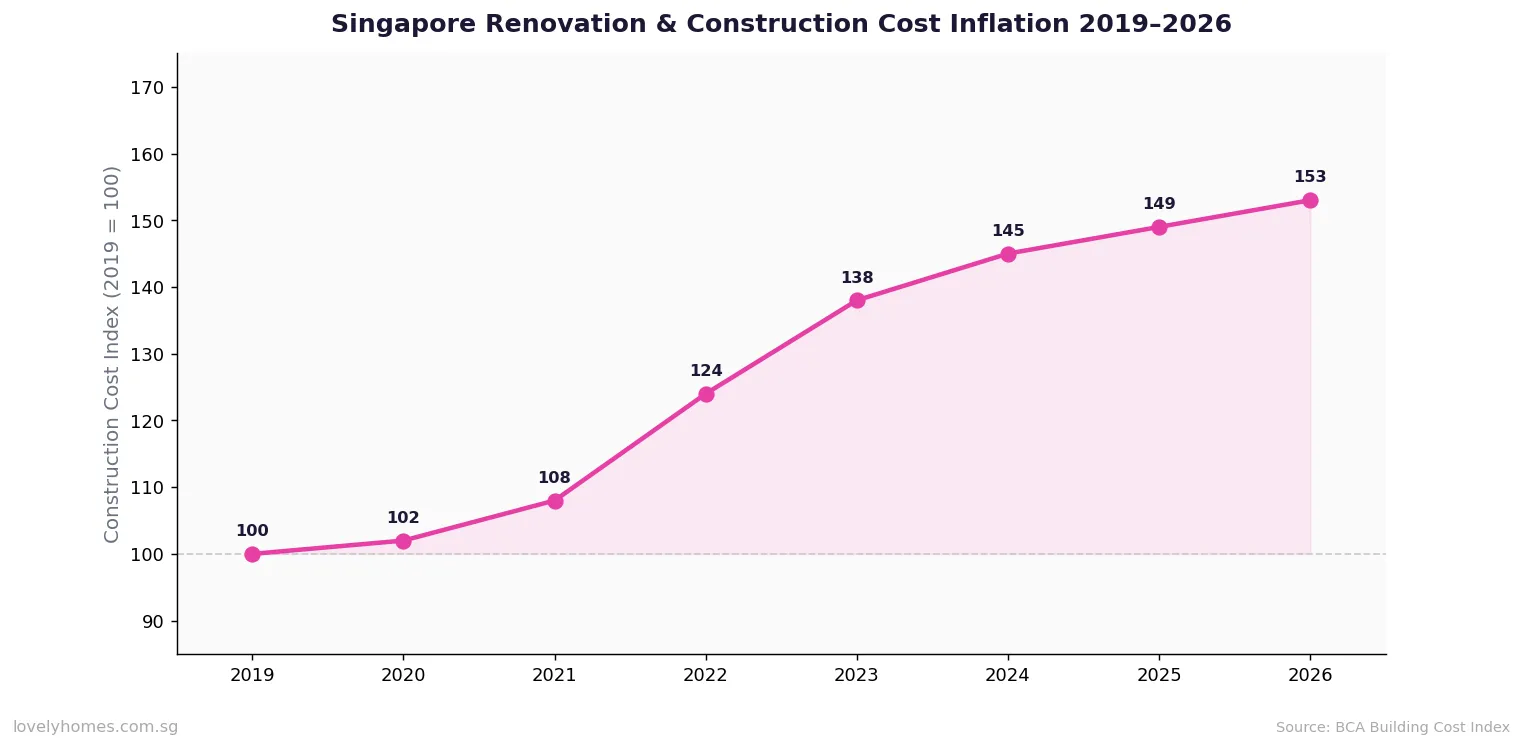
- Cost inflation: The BCA Building Cost Index rose ~53% between 2019 and 2026, driven by labour shortages, import costs, and COVID disruptions
Introduction: Understanding Renovation Costs in Singapore
Renovating a home in Singapore is one of the largest discretionary expenditures most households will make after purchasing property. Whether you have just collected the keys to a new HDB Build-To-Order (BTO) flat, bought a resale unit requiring a full makeover, or acquired a condo for rental fit-out, understanding the realistic cost envelope — and what drives it — is essential before signing any contractor agreement.
This guide draws on Building and Construction Authority (BCA) cost data, HDB renovation guidelines, and industry contractor surveys to give you a transparent, up-to-date picture of what renovations cost in Singapore in 2026. We cover all property types, break down costs by trade, flag the HDB-specific rules you must follow, and provide a worked example of a realistic S$60,000 HDB 4-room renovation.
Renovation costs in Singapore have risen sharply since 2019 — the BCA Building Cost Index climbed approximately 53% between 2019 and 2026, driven by a combination of labour shortages (post-COVID, especially for skilled trades), higher import costs for materials (tiles, sanitary ware, timber), and supply chain disruptions. Buyers who last renovated in 2018–2020 will find that comparable works cost materially more today.
Renovation Cost Ranges by Property Type
The first step in any renovation budget exercise is benchmarking your total envelope against the market range for your property type. These figures represent the realistic range for Singapore renovation contractors in 2026 — the lower end assumes basic joinery, standard fittings, and minimal hacking; the upper end assumes premium materials, extensive carpentry, and full kitchen/bathroom overhauls.

A few caveats: these figures assume a straightforward renovation with no major structural changes. Knocking down walls (even non-structural ones in HDB flats) requires permits and increases costs. Additions and Alterations (A&A) works on landed properties are governed by URA and BCA regulations and can add significantly to the base scope. Condo renovations also require approval from the Management Corporation Strata Title (MCST) for any works affecting common property or structural elements.
HDB-Specific Renovation Rules
Renovating an HDB flat is more tightly regulated than renovating private property. The HDB Renovation Guidelines, administered under the Housing & Development Board Act, mandate that all homeowners:
- Engage only HDB-registered renovation contractors — a list is maintained on the HDB portal. Using an unregistered contractor voids your renovation permit and may result in enforcement action.
- Apply for a Renovation Permit (RP) through the HDB portal before works commence. Most structural, plumbing, electrical, and hacking works require a prior permit.
- Adhere to permitted renovation hours: weekdays 9 am–5 pm, Saturdays 9 am–1 pm; no renovation noise on Sundays and Public Holidays.
- Complete all works within the one-month renovation period (extendable by application for complex projects).
Common HDB-prohibited works include: removal of structural walls or floor beams, installation of structural roof modifications, and certain types of wet area extensions beyond the bathroom footprint. Always confirm with HDB before including any such works in your renovation scope.
HDB Renovation Costs by Room
| Room / Area | Typical Cost Range (S$) | Key Work Items |
|---|---|---|
| Living/Dining | S$8,000–S$20,000 | Feature wall, flooring, false ceiling, lighting, TV console |
| Master Bedroom | S$5,000–S$12,000 | Wardrobe, bedhead, flooring, lighting |
| Common Bedrooms (×2) | S$3,000–S$7,000 each | Wardrobe, flooring, study desk |
| Kitchen (HDB) | S$5,000–S$15,000 | Cabinet replacement, countertop, backsplash, appliances excl. |
| Bathrooms (×2) | S$4,000–S$10,000 each | Tiles, sanitary ware, shower screen, waterproofing |
| Electrical & Lighting | S$3,000–S$8,000 | Rewiring, additional DB points, smart switches |
| Painting (whole flat) | S$2,000–S$5,000 | Full repaint, feature wall |
Renovation Cost Breakdown by Trade
Understanding how renovation budgets are distributed across trades helps you identify where to focus your cost-saving efforts and where to protect quality. The single largest cost centre in most Singapore renovations is carpentry and built-in joinery, which typically represents 25–30% of the total budget. This covers wardrobes, kitchen cabinets, TV consoles, book shelves, and any custom millwork. Premium solid-wood or veneer finishes can push carpentry costs materially higher than the base rate.
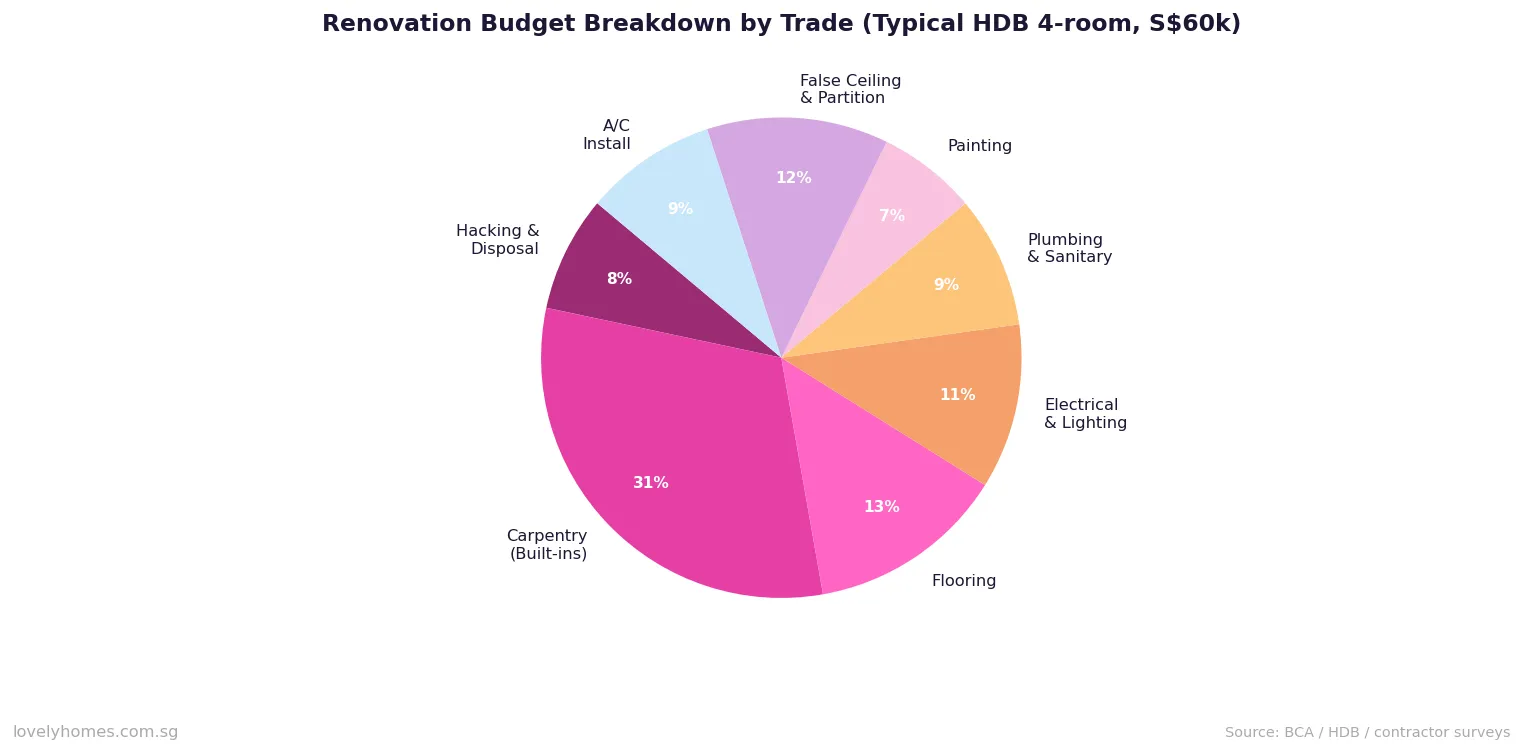
The second-largest bucket is typically flooring (ceramic/porcelain tiles or vinyl plank), which accounts for around 12% of the budget. Electrical and plumbing works together form another ~18%, and are subject to HDB permit requirements for all HDB flat owners. Painting — often perceived as expensive — is actually among the most cost-efficient trades: a full repaint of an HDB 4-room flat typically costs S$2,000–S$5,000 and has a disproportionate visual impact relative to its cost.
Renovation Cost Inflation: The 2019–2026 Story
Singapore’s renovation industry has absorbed significant cost pressures since 2019. Labour costs for skilled tradespeople — carpenters, tilers, plumbers, and electricians — rose sharply as COVID-19 border restrictions in 2020–2021 reduced the availability of foreign construction workers. Material costs (particularly timber, tiles, and sanitary fittings) rose with global shipping costs and supply chain disruptions in 2021–2022. Although freight costs normalised from 2023 onward, labour costs have remained elevated as the construction sector competes for workers with major public infrastructure projects (MRT, public housing, Changi Airport Terminal 5).
Condo and Landed Renovation: Key Differences
Private condo renovations follow BCA regulations under the Building Control Act, but are also subject to each development’s MCST by-laws. Common restrictions include no wet works above the 2nd storey without waterproofing certification, no penetration of ceiling slabs, and defined renovation hours (which may be stricter than the HDB schedule). Always obtain a copy of the MCST by-laws before finalising your renovation scope.
Landed property renovations involving Additions and Alterations (A&A) of more than a specified GFA threshold require a Qualified Person (QP) — an architect or engineer — to submit plans to BCA and URA. For conservation shophouses or bungalows in gazetted conservation areas, URA’s Conservation Guidelines impose additional requirements on façade changes, window types, and internal modifications. Budget an additional S$15,000–S$40,000 for QP fees and regulatory compliance on complex landed A&A projects.
How to Choose a Renovation Contractor
Singapore has no single licensing body for interior designers or renovation contractors (other than the HDB registration requirement for HDB flat works and the BCA licensing system for general construction contractors above certain project values). Homeowners should:
- Obtain at least three quotations from different contractors, specifying the same scope in writing.
- Verify the contractor’s HDB registration (if applicable) and any relevant BCA licensing at hdb.gov.sg and bca.gov.sg.
- Request a detailed Bill of Quantities (BQ) — a line-item breakdown by trade and material. Reject any contractor who provides only a lump-sum quote without itemisation.
- Include a defects liability period of at least 12 months in the contract, with a retention sum of 5–10% held until defects are rectified.
- Pay progressively: typically 10% on signing, 30% on commencement, 30% on milestone completion, and the balance (including retention) on final handover.
Summary: Singapore Renovation Costs at a Glance (2026)
| Property Type | Basic Reno (S$) | Mid-Range (S$) | Premium (S$) |
|---|---|---|---|
| HDB 3-room | 18,000–25,000 | 25,000–32,000 | 32,000–40,000+ |
| HDB 4-room | 25,000–35,000 | 35,000–45,000 | 45,000–55,000+ |
| HDB 5-room / EA | 32,000–45,000 | 45,000–60,000 | 60,000–90,000+ |
| Condo 1-bed | 22,000–30,000 | 30,000–38,000 | 38,000–45,000+ |
| Condo 2-bed | 30,000–45,000 | 45,000–55,000 | 55,000–65,000+ |
| Condo 3-bed | 45,000–65,000 | 65,000–85,000 | 85,000–100,000+ |
| Landed (Inter) | 80,000–110,000 | 110,000–140,000 | 140,000–180,000+ |
Worked Example: A Realistic S$60,000 HDB 4-Room Renovation
📊 Case Study: The Lim Family — New BTO 4-room at Kallang Horizon (98 sqm)
Budget: S$60,000
Timeline: 6 weeks from commencement
Property: New BTO 4-room HDB flat — bare unit, no flooring, no built-ins
| Trade / Work Item | Scope | Cost (S$) |
|---|---|---|
| Hacking & disposal | Bathroom walls, kitchen walls (existing tiles), debris removal | 4,200 |
| Carpentry (built-ins) | Master wardrobe (2.4m, 4-door), 2× common room wardrobes, TV console, kitchen cabinets (upper & lower), shoe cabinet | 16,800 |
| Flooring | 600×600 porcelain tiles throughout (except bathrooms), L&D and installation | 7,200 |
| Electrical & lighting | Rewiring, 8 fan/light points, track lighting, 4 additional DB points | 6,000 |
| Plumbing & sanitary | 2× bathroom refit (WC, basin, mixer, accessories), kitchen sink & mixer | 4,800 |
| Painting | Full flat repaint, 1× feature wall | 3,600 |
| False ceiling & partition | Living/dining plaster false ceiling with cove lighting, bedroom partition | 6,600 |
| Air-conditioning | 4-trunking system (Daikin multi-split, 5 FCUs) — supply & installation | 7,200 |
| Miscellaneous & contingency | Grouting, sealants, touch-ups, 5% contingency | 3,600 |
| Total | 60,000 |
HDB Renovation Permit required for: hacking, electrical works, plumbing. Permit application submitted online via HDB portal before commencement. Contractor is HDB-registered. Renovation hours: Mon–Fri 9am–5pm, Sat 9am–1pm.
What This Means for Homeowners in 2026
The renovation cost picture in 2026 is one of structurally higher but stable prices. The dramatic 2021–2022 spike in material and labour costs has plateaued, but there is no expectation of a meaningful reversal — labour costs are sticky, and major public infrastructure projects (T5, Cross Island Line Phase 2, Jurong Lake District) will continue to compete for skilled workers with the residential renovation sector.
The practical implication is that homeowners should budget conservatively, obtain multiple quotations, and resist the temptation to compress scope at the expense of structural works (waterproofing, electrical distribution boards, plumbing) — these are the items where deferred spending creates expensive future problems. A well-specified renovation with clear defects liability terms and a staged payment schedule remains the best risk-management approach available to homeowners.
What Might Come Next: Renovation Costs in 2027 and Beyond
Several policy and structural trends will shape renovation costs over the next 1–2 years. The Singapore government’s push to increase the use of Integrated Digital Delivery (IDD) and Design for Manufacture and Assembly (DfMA) in the construction sector — led by BCA — may eventually improve productivity and moderate labour cost growth in renovation. However, the near-term impact on residential renovation (which relies on small-scale, bespoke trades) is likely to be minimal. More consequential in the near term will be the wind-down of the Temporary Housing Unit levy rebate scheme, and any changes to foreign worker levy rates for the construction sector.
❓ Frequently Asked Questions: Singapore Renovation Costs 2026
Do I need a permit to renovate my HDB flat?
Yes. All renovation works in HDB flats — including hacking, plumbing, electrical changes, and structural modifications — require a Renovation Permit (RP) from HDB before works commence. Your HDB-registered contractor is responsible for applying for the RP on your behalf through the HDB portal. Works carried out without a valid RP are an offence under the Housing & Development Act and may result in a restoration order requiring you to reinstate the unit at your own cost.
Can I renovate a condo unit without MCST approval?
Minor works (painting, replacing fixtures, installing non-structural furniture) generally do not require MCST approval. However, any works affecting the common property — drilling into structural walls, modifying utility risers, replacing windows, or any wet works above ground-floor units — typically require prior written approval from the MCST. Review your development’s by-laws carefully before commencing work, and obtain written MCST approval for any ambiguous scope items. Your contractor should also observe the development’s stipulated renovation hours, which may be stricter than the HDB schedule.
What is the cheapest way to renovate an HDB flat in Singapore?
The three most effective cost-saving strategies are: (1) Minimise hacking — hacking and disposal is disruptive, expensive, and can trigger unforeseen defects in adjacent surfaces; retiling over existing tiles (if structurally sound) can save S$3,000–S$6,000. (2) Rationalise carpentry — limit built-ins to rooms that genuinely need them; freestanding furniture is more cost-effective than custom carpentry for secondary bedrooms. (3) Obtain at least three detailed BQ quotations and negotiate on the basis of comparable line items — price competition between contractors is substantial in Singapore’s current renovation market.
How long does a typical HDB renovation take?
A standard HDB 4-room renovation takes 4–8 weeks from commencement, depending on scope and contractor scheduling. The HDB-permitted renovation period is one month, extendable by application. Complex scopes (full wet works, extensive electrical rewiring, major carpentry) typically require 6–8 weeks and should be confirmed with your contractor before signing. Factor in a buffer: contractor delays, material lead times (especially for imported tiles or custom joinery), and defect rectification commonly add 1–2 weeks to the projected timeline.
Is renovation loan interest deductible for tax purposes?
For owner-occupied residential properties in Singapore, renovation costs and renovation loan interest are not deductible against personal income tax. However, if you are renovating a property that you rent out, renovation costs that constitute deductible repairs and maintenance (restoring existing fixtures to working condition, not upgrading or adding new fixtures) may be deductible against rental income under Section 14 of the Income Tax Act, administered by IRAS. Capital expenditure — adding new fixtures or improving the property beyond its original condition — is not deductible. Consult a tax professional or refer to the IRAS website for the current guidance on rental property deductions.
Does CPF Ordinary Account funds cover renovation costs?
No. CPF Ordinary Account (OA) savings cannot be used for renovation expenses. CPF OA funds may only be used for approved property purchases, HDB home loans, mortgage instalment payments, property-related insurance premiums, and stamp duty. Renovation must be funded from cash savings or a renovation loan. Most major Singapore banks offer unsecured renovation loans at rates between 3.88% and 6.0% effective p.a. for tenures of 1–5 years — these are typically lower-cost than personal loans but must not exceed 6× the borrower’s monthly income or S$30,000, whichever is lower, under MAS guidelines for licensed financial institutions.
Click anywhere outside to close